Tag Archives: film reviews

We’re Gonna Need a Montage

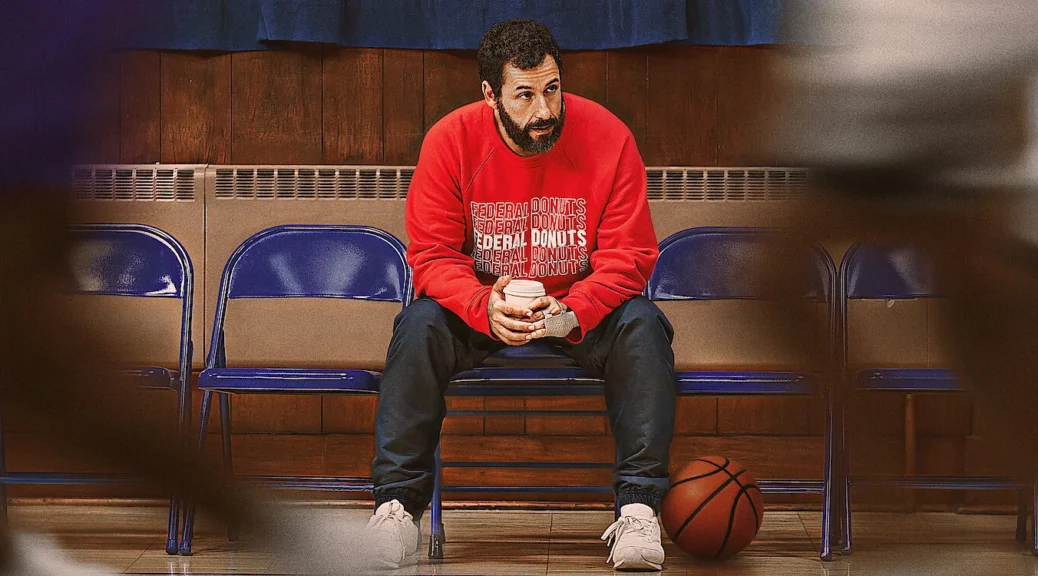
Hustle

by George Wolf

Adam Sandler’s passion for basketball is fairly well known, so the fact that Hustle is a love letter to the NBA shouldn’t be a huge surprise. And, this being a sports movie, you can expect some familiar benchmarks the film wisely doesn’t shy away from.

But this film about the heart and commitment that’s required in the Association boasts plenty of both from nearly everyone involved, landing Netflix an enjoyable winner.

Sandler plays Stanley Sugerman, a road-weary scout for the Philadelphia 76ers whose devotion to team owner Rex Merrick (Robert Duvall) is finally rewarded with a job on the bench as Assistant Coach.

But with clear shades of the Buss family drama in L.A., Rex’s son Vince (Ben Foster) wrestles control of the team from his sister (Heidi Gardner), and Stan is back living out of a suitcase while he scours the globe for a susperstar.

Writers Will Fetters and Taylor Materne set some nice stakes early, as Vince dangles a return to coaching in front of Stan. The quicker he finds the team a game-changing phenom, the sooner he can be home closer to his wife (Queen Latifah) and daughter (Jordan Hull).

On a gritty playground in Spain, Stan thinks he’s found his unicorn in the 6’9” Bo Cruz (NBA vet Juancho Hernangomez). The talk of big money lures Bo to Philly, but the path to a payday hits some roadblocks, and Bo’s longing for this mom and daughter back home creates some effective character-driven parallels with Stan.

Sandler and Hernangomez share a sweet, funny chemistry, and a constant stream of past and present NBA stars adds plenty of authenticity. Even better is director Jeremiah Zagar’s (We the Animals) skill in framing on-court action with speed, sweat and a tense, in-the-moment feel that gives the standard sports themes some needed vitality.

Hustle is a story of father figures, redemption, perseverance, and leaving your mark. No one’s claiming to re-invent anything here, and the winking nod to an iconic Rocky moment cements a self-awareness that only adds to the film’s charm.

It’s also another example of Sandler’s versatility, and the good that comes from surrounding himself with unique voices. When Sandler cares, he shines.

And he clearly cares about basketball.

Rites of Passage

Tahara

by George Wolf

If you saw Rachel Sennot’s breakout performance in last year’s wonderful Shiva Baby, the setup of Tahara is going to look pretty familiar. But in their feature debut, writer Jess Zeidman and director Olivia Peace find a vibrant, refreshing lens for their own look at one funeral’s anxious aftermath.

Sennot is terrific again as the self-centered Hannah, who joins her more reserved best friend Carrie (Madeline Grey DeFreece, also excellent) at the service for their Hebrew school classmate Samantha. Samantha killed herself at the age of 18, and after the funeral the girls will join other classmates at a grief session to talk about their feelings.

They will also gossip, navigate cliques, and bitch about having to be there while they try to catch the eye of Tristan (Daniel Taveras).

At least Hannah will be flirting with Tristan. Because Carrie is hiding some true feelings for her bestie, a conflict that Peace and Zeidman surround with some touching and effective parallels.

Peace frames most of the film in a square, 1:1 aspect ratio, but goes wide at important moments, most of which are animated. It’s a clear nod to the times when Carrie, a young Jewish queer woman of color, sees herself – and the world – in new ways.

Though the animation sequences and lack of score can give the film an experimental feel, a juxtaposition with the Jewish ritual meant to cleanse the body before burial (Tahara) ultimately grounds it as a deeply personal journey.

The students tell their teacher (and by extension, those not familiar with Jewish traditions) that the ritual’s goal is to “erase social status,” which feeds perfectly into the teenage power struggles (and one suicide) we see through the eyes of a type of character not often represented.

At times funny, uncomfortable, and heartbreaking, Tahara is an ambitious and ultimately moving film, from a pair of voices we should look forward to hearing again.

Not All Men

Watcher

by George Wolf

If you’re a fan at all of genre films, chances are good Watcher will look plenty familiar. But in her feature debut, writer/director Chloe Okuno wields that familiarity with a cunning that leaves you feeling unnerved in urgent and important ways.

Maika Monroe is sensational as Julia, an actress who has left New York behind to follow husband Francis (Karl Glusman) and begin a new life in Bucharest. With a mother who was Romanian and a fluent grasp on the language, Francis instantly feels at home.

Julia does not, and her feelings of vulnerability are compounded by her trouble communicating, the news reports of a serial killer, her husband’s late nights at the office…and the man in the window across the street (the effortlessly creepy Burn Gorman) who is constantly watching her.

And as soon as Julia makes accusations, the games begin.

Is the watcher really a threat? Is he stalking Julia, or is she the one who’s following him?

None of these beats are new, and as events escalate, others are pretty clearly telegraphed. But it’s the way Okuno (who helmed the impressive “Storm Drain” segment from V/H/S /94) slowly twists the gaslighting knife that makes the film’s hair-raising chills resonate.

She finds a perfect conduit in Monroe, who emits an effectively fragile resolve. The absence of subtitles helps us relate to Julia immediately, and Monroe never squanders that sympathy, grounding the film at even the most questionably formulaic moments.

Even as Julia pleads to be believed, the mounting indignities create a subtle yet unmistakable nod to a culture that expects women to ignore their better judgment for the sake of being polite.

And from the friendly bystander who jokes about the creeper’s “crush” to Francis’s weak-willed humoring, Okuno envelopes Julia in male gazes that carry threats of varying degrees, all building to a bloody and damn satisfying crescendo.

Mission Accomplished

Top Gun: Maverick

by Hope Madden and George Wolf

Sentimental, button-pushing and formulaic, as predictable as it is visceral, Top Gun: Maverick stays laser-focused on its objective.

Attract crowd. Thrill crowd. Please crowd.

Expect bullseyes on all three fronts, as star Tom Cruise and director Joseph Kosinski take a couple cues from the Star Wars franchise in reconnecting with friends and re-packaging feelings.

After all these years in the Navy, Pete Mitchell’s “Maverick” tendencies have kept him from advancing past the rank of Captain. And when Pete blatantly shows up Admiral Cain (Ed Harris), he’s in danger of being grounded until Admiral “Iceman” (Val Kilmer) rescues him with orders to return to Top Gun and whip some new flyboys and girls into shape for a secret mission.

One of those young guns is “Rooster” (Miles Teller), son of “Goose,” who resents Maverick for more than just coming home alive when his father did not.

Against the wishes of Admiral “Cyclone” (Jon Hamm), it is Maverick who will train the 12 Top Gun pilots, and then pick 6 to take out a newly discovered uranium plant that poses a clear and present threat to the U.S.

Who’s doing the threatening? We never know. Does it matter?

Not in Maverick‘s world.

The screenplay-by-commitee doesn’t stretch anybody’s imagination or talent, with early hotshot dialog so phony it feels like a spoof. But nobody came for banter. We came for nostalgia, flight action, and – god help us – Tom Cruise.

He delivers, in his inimitable movie star way. He cries on cue, runs like his hair’s on fire, and burns charisma. What more do you want?

Romance? Here’s old flame Penny (Jennifer Connelly), who now runs that famous San Diego beachfront bar and just happens to be a single mother who might be looking for someone as ridiculously good-looking as she is. As both characters and actors, they click.

Cruise’s chemistry with a mainly underused Teller – who really looks like a chip off the old Goose – finally gets to show itself late in the film, exposing both tenderness and humor in its wake.

And once we’re in the air, get in front of the biggest screen you can and hang on. Kosinski’s airborne action sequences are often downright breathtaking, every moment in the danger zone moving us closer to that Goose/Rooster/Maverick moment that has no business working as well as it does.

It’s emotional manipulation, but not nearly as garish an act as Val Kilmer’s thankless role. Still, Cruise and Kosinski know it’s nostalgia that flies this plane, and Iceman is part of the plan that starts right from that original Kenny Loggins tune heard in the opening minutes.

From manufactured rivalries to shirtless team building to the entrance of a surprise Top Gun instructor from last night at the bar, Maverick sells us back what we first bought back in 1986.

And dammit, it feels even better this time.

Patty All the Time

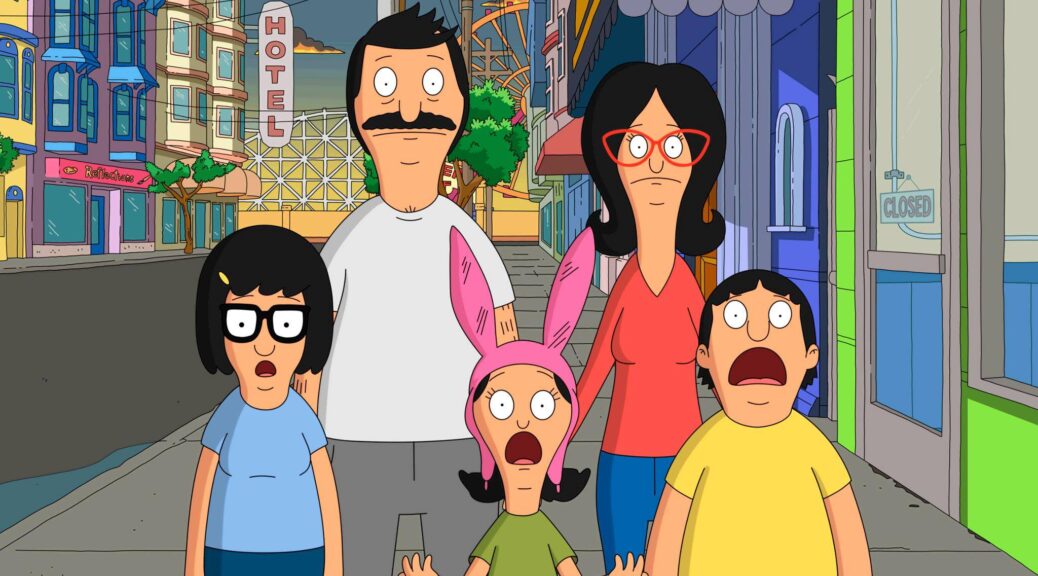
The Bob’s Burgers Movie

by George Wolf

Some fifteen years ago (!), at a critics screening for the movie version of Strangers With Candy, I laughed early and often. I was a fan of the TV show and its particular brand of humor, and I thought the film was hilarious. And then I realized something.

I was the only one laughing.

At the recent critics screening for The Bob’s Burgers Movie, a similar thing happened. Only one person was laughing.

It wasn’t me.

Series creator Loren Bouchard brings his baby to the big screen as co-writer and co-director, and he promptly puts the Belcher burger joint in jeopardy.

The family has just seven days to make a loan payment to the bank, and business isn’t exactly booming. And that was before a big sinkhole formed directly outside the front entrance! Meanwhile, the Belcher kids stumble onto a mystery involving the obnoxiously rich Calvin and Felix Fischoeder (voiced by Kevin Kline and Zach Galifianakis) that could reveal a way out of the whole mess.

Bouchard and his regular cast of voice actors (including H. Jon Benjamin, Kristen Schaal, Dan Mintz, Eugene Mirman and John Roberts) have been at this for over a decade, and their move to the multiplex shows no signs of re-inventing a formula that has clearly worked for years.

It just doesn’t work for me.

The songs are spirited, the animation well-crafted, and the dialogue often rapid fire. But it leans on a style of humor that’s often obvious and repetitive, in a cartoon world where nearly every single business has to have a corny name like “It’s Your Funeral Home,” “Sprain Sprain Go Away” and “Weight Weight Don’t Tell Me.”

But to its credit, The Bob’s Burgers Movie is here to super serve the regulars. There may be too much fatty in the patty to attract many new converts, but if you’ve already memorized the specials, belly up for a deluxe portion.

Bloody Water Everywhere

A Taste of Whale

by George Wolf

Filmmaker Vincent Kelner knows you don’t want to see what he has for you.

But while his documentary A Taste of Whale doesn’t shy away from blood in the water, his ultimate goal lies beyond the killing grounds.

In his feature debut, Kelner takes us to Europe’s Faroe Islands, where every year some 700 pilot whales die in a traditional slaughter known to locals as the “Grind” (pronounced like “grinned”). Though the Faroes is a constituent country of Denmark, the people live under their own constitution, just one of the reasons many natives believe it’s a privilege to call the Faroes home.

And Kelner lets many Faroese defend the Grind with conviction, pointing to mischaracterizations and misunderstandings, while labeling visiting activists as “tourists.”

But there are some on the island that are willing to admit their hunting methods have strayed far beyond the traditional, and that maybe some of the protesters have a point.

Kelner does an admirable job tackling the issue from opposing sides, even drawing a subtle parallel between pragmatic approaches to behavioral change and recent pandemic mandates here at home.

But Kelner’s understated hand begins to apply more pressure once someone comments on the disconnect between not wanting to see things die, but still wanting to eat things that are dead.

If you turn away in horror at Kelner’s graphic footage from the Grind – and later, from slaughterhouses – A Taste of Whale stresses that this bloodshed will always exist “wherever you have meat for food.”

It is a bit of rope-a-dope from Kelner, but he wants you to be horrified. And when you are, he’s waiting to challenge your convictions with a lifestyle change that’s framed as the only logical choice.

Think It Through

Emergency

by George Wolf

Take two longtime friends on the verge of going their separate ways, and throw in one night of epic partying before they graduate. There will be hijinks, conflict, feelings expressed, and resolution.

We know this formula, right?

Not so fast. Expanding their Emergency short from 2018, director Carey Williams and writer K.D. Dávila run those familiar tropes through a tense, in-the-moment lens that upends convention while still delivering a consistent layer of laughter.

Sean (RJ Cyler from Power Rangers and The Harder They Fall) and Kunle (Donald Elise Watkins, Black Box and The Underground Railroad) have two months until they graduate Buchanan college. Their plan is to make history by becoming the first Black men to complete Buchanan’s Legendary Party Tour. They’ve managed to score all seven necessary invites, but a complication arises.

There’s a passed-out underage white girl in their living room.

Kunle’s instinct is to call 911, but Sean quickly reminds him that Black folks have been shot for far less than what it might appear is going on.

And so the two friends decide to deal with the situation themselves, adding their pal Carlos (Sebastian Chacon) to the plan while the unconscious girl’s sister (Sabrina Carpenter) and two of her friends stay in pursuit via phone tracking.

Williams does a masterful job juggling tones. Early on, the terrific performances from Cyler and Watkins get us invested in the friendship before Williams increases the pressure. He’s able to blend some terrifying dread into the ridiculous nature of the situation with a quiet confidence that deepens the real-world stakes.

Dávila, fresh off writing the Oscar-nominated short Please Hold, again mines law enforcement anxieties with deft precision. Her transition to a feature-length screenplay is seamless, sharpening the narrative with clever, organic plot turns and the characters with authentically grounded humor.

From clueless white allies to the distance between “Black excellence” and “thug,” Emergency covers plenty of socially conscious ground. And though a beat or two may seem less than subtle, the film never panders.

So we get the two friends ready to explore the future, searching for their place in the world. But this wild night of partying holds more sobering lessons than we’re used to seeing.

For these young men, it’s about how quickly their perception of the world can change forever, and the unrelenting weight of navigating how the world sees them.

Upstairs, Downstairs

Downton Abbey: A New Era

by Hope Madden

The Crawleys exit the roaring 20s a bit cash-strapped (can’t fix the roof but can holiday en masse, butlers in tow). Fans of the long-running series, now unleashing its second feature film, can rest easy. Heads held high, the family is ready to face a new decade with new leadership and the same old posh spirit.

Elegant escapism of the breeziest order, Downton Abbey: A New Era follows the idle rich through the travails of trying to remain both idle and rich. Now about that attic.

It seems a film producer hopes to shoot a movie in Downton. Lord Grantham (Hugh Bonneville) wants no part of it, but Lady Mary (Michelle Dockery) is running the show now. She hates to seem common, but the fee will fix those leaks.

Of course, the servants are thrilled to have real-life movie stars in the building. All except Mr. Carson (Jim Carter), who can’t bear to see the family stoop so low. Why, the Queen of England sat right at that table!

Meanwhile, Lady Grantham (Maggie Smith, scene-stealing, as is her way) is surprised to have inherited a French villa from a man she knew many wistful years ago. Mysterious? Or is it scandalous?!

So, off half the family goes to investigate, leaving Lady Mary and the servants to contend with the handsome director (Hugh Dancy), charming actor (Dominic West) and dour actress (Laura Haddock).

The old gang has fun stretching their familiar characters a bit for the big screen, although director Simon Curtis (My Week with Marilyn) has a tough time staging the interior conversations as anything more than expensive TV set pieces.

Still, the expansive grounds are gorgeous and Nice is gorgeous, and it can be restful to spend a full two hours where the stakes are no higher than whether or not the world will remember granny as a tramp.

Downton Abbey is a really well-dressed, well-acted, well-produced, uptight soap opera. Droll dialog, stunning locales and exquisite costuming elevate each scene to something more than a guilty pleasure, but the film’s sites never veer from its target audience.

If You Noé You Know

Lux Æterna

by George Wolf

For anyone who’s still wary of the Gaspar Noé sensory assault in full feature length form, Lux Æterna offers a slight variation.

Oh, he’s still beating us about the face and neck with psychedelic imaging, pulsating rhythms and immersive colors, he’s just keeping it to under an hour this time. And, even bringing along a dare-I-say lighthearted touch to this meta mashup of cinema and witchcraft.

Most everyone here is playing themselves, starting right at the top with Béatrice Dalle and Charlotte Gainsbourg talking shop. They swap stories, laugh heartily at their “shit films” and eventually get down to the business of making “God’s Work,” a post-modern tale of witches.

Dalle is directing, Gainsbourg is starring, and once on set, the laughter gives way to a cascade of madness and hysterics, rendered even more disorienting by Noé’s consistent use of split screen formatics. Not only is following both sides often challenging, but anyone sensitive to flashing lights might well be overwhelmed.

The “God’s Work” producer is hatching a plan to get Dalle fired from the project. Gainsbourg is juggling trouble at home and unsolicited pitches from an aspiring director (Karl Glusman from Noé’s Love), while her female co-stars (including Abbey Lee and Clara Deshayes) face a string of indignities.

Noé intersperses it all with clips and quotes from films and filmmakers he admires, and when a lighting miscue becomes a flashpoint for total chaos on the production, Noé’s embrace of the breakdown is clear.

This is where his art thrives, and Lux Æterna finds Noé nearly winking at his own reputation. Longtime aficionados may feel a bit slighted, but any neophytes will get a healthy appetizer to help decide if you’re up for bigger portions.

Evil Strange

Doctor Strange in the Multiverse of Madness

by Brandon Thomas

Welcome back, Sam Raimi. 

The madcap director of the Evil Dead series, Darkman and the Tobey Maguire Spider-Man films, makes a triumphant return to the big screen with Doctor Strange in the Multiverse of Madness. 

Dr. Stephen Strange (Benedict Cumberbatch) has battled other sorcerers, alien threats and even villains from alternate realities. All of them pale in comparison to the dark entity chasing young America Chavez (Xochil Gomez) across dimensions. As Strange fights to protect the young girl, he finds that the line between good and evil can easily be blurred – and sometimes even compromised by the best of intentions. 

The jump in quality between the first Doctor Strange film and Multiverse of Madness is more of a leap than a step. The first film sets it up well enough, but like many of the Marvel origin stories, it takes a while to get to the good stuff. Raimi’s film has no such issues. Cumberbatch is more comfortable in the role now, having appeared in two Avengers films and Spider-Man: No Way Home. Despite having a packed to the gills story, there’s still a lot of meaty character work for Cumberbatch to latch onto. 

Speaking of the story, yes this is another Marvel film with lots of tie-in to movies that came before and movies that will come after. Like the more successful Marvel Cinematic Universe endeavors, Multiverse of Madness delicately threads the needle and never feels too chaotic or unfocused. Raimi fought that battle and lost once before with Spider-Man 3.

There are plenty of surprises in the film. The marketing team behind the trailers should be commended for spoiling next to nothing – not even the main villain. Surprises are a big selling point for these MCU movies, and Multiverse has plenty of them up its sleeve.

Multiverse of Madness is Raimi firing on all cylinders. The movie absolutely crackles with the filmmaker’s energy and signature style. I nearly jumped out of my seat in delight when a couple shots of doors slamming in dutch angles appeared on screen. Few directors attack action sequences with the inventiveness and fun that Raimi does. You can feel the director’s personal flourishes coming through in those scenes instead of pre-visualized dreck from VFX artists in Vancouver.  

The film also leans into horror. Like his skill with action, horror carnage is a specialty of Raimi’s. Witches, demons and undead sorcerers pop up, and Raimi delights in tossing them at Cumberbatch’s Strange. I doubt the director tortured Cumberbatch like his friend Bruce Campbell in the Evil Dead films but it is fun to speculate. 

By embracing the character’s more horror-centric roots, and letting director Sam Raimi cut loose, Doctor Strange and the Multiverse of Madness offers up one of the most exciting – and different – films in the MCU so far.