I roll my eyes as much as the next guy at these obligatory two-part blockbuster finales, but as Mockingjay Part 2 brings The Hunger Games saga to a close, it might be time to reconsider.
A combo with Part 1 for an overlong single film was certainly possible, but the odyssey of Katniss Everdeen wouldn’t feel quite as complete. What began as entertaining “young adult” fare has evolved into a franchise that’s unafraid to take on some very mature themes.
Director Francis Lawrence, who has helmed the films since Catching Fire (still the standout in the series), is back, and we pick up with Katniss still recovering from her attack by a brainwashed Peeta (Josh Hutcherson).
Rebel leaders Coin (Julianne Moore) and Plutarch (Phillip Seymour Hoffman) want to use Katniss’s status as the Mockingjay for mostly symbolic effect…but c’mon, our girl ain’t gonna sit still for all show and no go!
Katniss wants the head of President Snow (Donald Sutherland), so she and Gale (Liam Hemsworth) sneak off with a battle unit and head for the Capitol. A de-programmed Peeta joins as well, but can he be trusted? Can anyone?
Per usual, J. Lawrence is in complete command of her character, never allowing a misstep along Katniss’s journey from scrappy upstart to badass warrior. She has made the transition seem effortless and completely authentic, confirming again that Lawrence remains one of the most talented actors in film.
The “love triangle” with Gale and Peeta remains muted among the film’s heady matters, which seems all the more appropriate when the few scenes addressing it land with an unfamiliar thud. Sure, Katniss makes the obvious choice, but she’s got more pressing matters.
From the start, F. Lawrence establishes Mockingjay 2 as a film that embraces the bleak. The mood is boldly dark, and Lawrence makes sure it has time to sink in before unleashing the fireworks. But once the group decides to avoid Snow’s traps by heading underground, well, hang on to your butts.
It’s entertaining, tense, even downright scary, but it also wants to matter. This is a war film, and it doesn’t back down from the moral ambiguities and social atrocities that come with the territory. As the aftermath of recent events in Paris continues to play out, there is a conscience here that will feel especially timely.
And, sadly, the end of The Hunger Games also marks Hoffman’s final film appearance. Though the scenes most affected by his untimely death are fairly evident, his exit, like that of this franchise, is handled with the grace and poignancy of a truly fond farewell.
The film drops you into a world you would be hard-pressed to even imagine and finds a story that is both bright and beautiful despite itself. It’s the story of a young woman, held captive inside a shed, and her 5-year-old son, who’s never been outside of “room.”
Never lurid for even a moment, both restrained and urgently raw, the film benefits most from the potentially catastrophic choice to tell the story from the child’s perspective. And here is the miracle of Room: without ever becoming precious or maudlin or syrupy, with nary a single false note or hint of contrivance, the boy’s point of view fills the story with love and wonder. It gives the proceedings a resilience, and lacking that, a film on this subject so authentically told could become almost too much to bear.
Director Lenny Abrahamson (Frank) creates yet another meticulously crafted, lived-in world – a world that should look like nothing we have ever seen or could ever imagine, and yet manages to resonate with beautifully universal touches. He is absolutely blessed with two magnificent leads and one wonderful supporting turn.
The undeniably talented Brie Larson gives a career-defining performance as Ma. On her face she wears the weariness, desperation, and surprising flashes of joy that believably create a character few of us could even imagine. She conjures emotions so tumultuous as to be nearly impossible to create, but does it with rawness that feels almost too real.
Veteran Joan Allen is the normalizing presence, and her characteristically nuanced turn gives the film its needed second act emotional anchor.
Surrounded as he is by exceptional talent, it is young Jacob Tremblay who ensures that the film won’t soon be forgotten. Where did Abrahamson find such a natural performer? Because an awful lot rests on those wee shoulders, and it’s the sincerity in this performance that keeps you utterly, breathlessly riveted every minute, and also bathes an otherwise grim tale in beauty and hope.
Visual showman Corin Hardy has a bit of trickery up his sleeve. His directorial debut The Hallow, for all its superficiality and its recycled horror tropes, offers a tightly wound bit of terror in the ancient Irish wood.
Adam (Joseph Mawle) and Clare (Bojana Novakovic) move, infant Finn in tow, from London to the isolated woods of Ireland so Adam can study a tract of forest the government hopes to sell off to privatization. But the woods don’t take kindly to the encroachment and the interlopers will pay for trespassing.
What’s in the woods and why is it so angry?
“An occupied people forced into hiding by fire and iron,” explains a friendly Irish policemen to the Brit couple helping to sell off Erin’s ancient forests.
Openly influenced by Evil Dead, The Shining, The Thing, and Straw Dogs, among others, the film rarely feels stale for all its rehash. Hardy borrows and spit-shines, but the final amalgamation takes on such a faery tale quality that it generally works. (Except for that Necronomicon-esque book – that’s just a rip off.)
Hardy has a real knack for visual storytelling. His inky forests are both suffocating and isolating with a darkness that seeps into every space in Adam and Clare’s lives. He’s created an atmosphere of malevolence, but the film does not rely on atmosphere alone.
Though all the cliché elements are there – a young couple relocates to an isolated wood to be warned off by angry locals with tales of boogeymen – the curve balls Hardy throws will keep you unnerved and guessing.
A lot of the scares require very little visual effect – one early bit where Adam is knocked into the trunk of his car while something claws and bangs at the door toward his screaming infant is particularly nerve wracking. Still, Hardy’s joy and real gift is in the creature feature half of the film.
The magical folk of the Hallow – “faeries, banshees, and baby stealers” – have a look that is unique, appropriately woodsy, and immensely creepy. And just when you think the film’s reached its peak with this back woods monster mash, Hardy takes a sharp turn with a deeply felt emotional plot twist.
The political allegory doesn’t really pan out; Clare, though well performed, is entirely one-dimensional; the mythology of the sludge, while cool, doesn’t clearly fit with the monsters; and why in the hell do the rest of the natives stay?!
That’s a lot to ponder, but Hardy – magician that he is – will keep you so interested with relentless pacing and horror wonder that you won’t even notice.
!Dios mio! There are so many exceptional Spanish language horror films, it was hard to choose just 5 – so we didn’t! Whether it’s a Mexican director working in Spain, a Cuban zombiepocalypse, or ghosts, zombies, mad doctors or madder clowns, we have you covered with our fuzzy math salute to el cine de los muertos.
6. Juan of the Dead (2011)
By 2011, finding a zombie film with something new to say was pretty difficult, but writer/director/Cuban Alejandro Bruges managed to do just that with his bloody political satire Juan of the Dead.
First, what a kick ass title. Honestly, that’s a lot to live up to, begging the comparison of Dawn’s scathing social commentary and Shaun’s ingenious wit. Juan more than survives this comparison.
Breathtakingly and unapologetically Cuban, the film shadows Juan and his pals as they reconfigure their longtime survival instincts to make the most of Cuba’s zombie infestation. It’s a whole new approach to the zombiepocalypse and it’s entirely entertaining.
https://www.youtube.com/watch?v=CZrKJvX7mjg
5. The Devil’s Backbone (2001)
Guillermo del Toro’s The Devil’s Backbone unravels a spectral mystery during Spain’s civil war. The son of a fallen comrade finds himself in an isolated orphanage that has its own troubles to deal with, now that the war is coming to a close and the facility’s staff sympathized with the wrong side. That leaves few resources to help him with a bully, a sadistic handyman, or the ghost of a little boy he keeps seeing.
Backbone is a slow burn as interested in atmosphere and character development as it is in the tragedy of a generation of war orphans. This is ripe ground for a haunted tale, and del Toro’s achievement is both contextually beautiful – war, ghost stories, religion and communism being equally incomprehensible to a pack of lonely boys – and elegantly filmed.
Touching, political, brutal, savvy, and deeply spooky, Backbone separated del Toro from the pack of horror filmmakers and predicted his potential as a director of substance.
4. The Skin I Live In (2011)
In 2011, the great Pedro Almodovar created something like a cross between Eyes Without a Face and Lucky McGee’s The Woman, with all the breathtaking visual imagery and homosexual overtones you can expect from an Almodovar project.
The film begs for the least amount of summarization because every slow reveal is placed so perfectly within the film, and to share it in advance is to rob you of the joy of watching. Antonio Banderas gives a lovely, restrained performance as Dr. Robert Ledgard, and Elena Anaya and Marisa Paredes are spectacular.
Not a frame is wasted, not a single visual is placed unconsciously. Dripping with symbolism, the film takes a pulpy and ridiculous story line and twists it into something marvelous to behold. Don’t dismiss this as a medical horror film. Pay attention – not just to catch the clues as the story unfolds, but more importantly, to catch the bigger picture Almodovar is creating.
3. [Rec] (2007)
Found footage horror at its best, [Rec] shares one cameraman’s film of the night he and a reporter tagged along with a local fire department. Bad, bad things will happen.
The squad gets a call from an urban apartment building where one elderly tenant keeps screaming. No sooner do the paramedics and news crew realize they’ve stepped into a dangerous situation than the building is sealed off and power is cut. Suddenly we’re trapped in the dark inside a building with about fifteen people, some of them ill, some of them bleeding, some of them biting.
The found footage approach never feels tired – at first, he’s documenting his story, then he’s using the only clear view in the darkened building. The point of view allows [Rec] a lean, mean funhouse experience.
2. The Last Circus (2010)
Who’s in the mood for something weird?
Unhinged Spanish filmmaker Alex de la Iglesia offers The Last Circus, a breathtakingly bizarre look at a Big Top love triangle set in Franco’s Spain.
Describing the story in much detail would risk giving away too many of the astonishing images. A boy loses his performer father to conscription in Spain’s civil war, and decades later, with Franco’s reign’s end in sight, he follows in pop’s clown-sized footsteps and joins the circus. There he falls for another clown’s woman, and stuff gets nutty.
Iglesia’s direction slides from sublime, black and white surrealist history to something else entirely. Acts 2 and 3 evolve into something gloriously grotesque – a sideshow that mixes political metaphor with carnival nightmare.
The Last Circus boasts more than brilliantly wrong-minded direction and stunningly macabre imagery – though of these things it certainly boasts. Within that bloody and perverse chaos are some of the more touching performances to be found onscreen.
https://www.youtube.com/watch?v=oM2corZvDTI
1. The Orphanage (2007)
Sometimes a throwback is the most refreshing kind of film. Spain’s The Orphanage offers just that fresh breath with a haunted house tale that manages to be familiar and surprising and, most importantly, spooky.
Laura (Belén Rueda) and her husband reopen the orphanage where she grew up, with the goal of running a house for children with special needs – children like her adopted son, Simón, who is HIV positive. But Simón’s new imaginary friends worry Laura, and when he disappears it looks like she may be imagining things herself.
One of the film’s great successes is its ability to take seriously both the logical, real world story line, and the supernatural one. Rueda carries the film with a restrained urgency – hysterical only when necessary, focused at all times, and absolutely committed to this character, who may or may not be seeing ghosts.
A good ghost story is hard to find. Apparently you have to look in Spain.
A bruised, muscular romanticism – a nostalgia for a hipper, more rebellious and gorgeous reality – informs Jake Hoffman’s Asthma.
The beautifully damaged Gus (Benedict Samuel) can’t claim a place in the generic uniformity of the modern world. He longs for the grittier and richer reality he believes came and went before his time. So he steals a Rolls, picks up the girl he admires, and attempts the kind of tragically restless road trip you might find in a Godard film.
All of which would feel precious were it not for erratic but solid performances, and a revelation that unveils Gus as the poseur we knew he was. Surprisingly, Hoffman and Samuel are able to mine that late-film revelation to connect the lead with the ordinary Joe in the audience, and still make his troubles resonate because of the genuine pain in the performance.
For all the film’s showy quirks – Nick Nolte, for instance, is the voice of Gus’s Guardian Angel/Wolfman – Hoffman’s abrupt manner with both camera and soundtrack keep things from feeling frivolous or pretentious.
The slew of peculiar folk Gus meets along his journey nearly chokes any hint of authenticity from Asthma, although the great (and appropriate) Iggy Pop is like a needed and timely punch in the gut to a film just about to topple over with its own quirkiness.
For a hyper-masculine road-type-picture, Asthma boasts a surprisingly nuanced female lead. Yes, Krysten Ritter’s Ruby looks like the typical off-beat beauty, and her character is certainly the right combination of naughty and nice to fit the bill, but Ritter never lets the character off too easy. She makes poor decisions, kicks herself for them, hardens, and moves on – all with a grace that feels of this time and of another.
There’s an addiction theme that threatens to hold the film together, give it purpose and drive, but often feels like the least authentic piece of the movie. Without it, though, Asthma too often comes off as a nostalgic riff on another era’s nostalgic riffs.
Hoffman’s a confident first time filmmaker with a product that is great to look if purposeless – kind of like Gus.
Not exactly a novel concept, but one you can expect to find at the multiplex this time of year, so if nothing else, Love the Coopers is punctual.
As Christmas approaches, longtime married couple Charlotte and Sam Cooper (Diane Keaton and John Goodman) have decided to split, but Sam has promised to keep quiet about it until the family has enjoyed one last “perfect” Holiday together.
But as they ready their Pittsburgh home for guests, things are far from perfect.
Their son Hank (Ed Helms) is divorced and now, suddenly jobless. Resentful daughter Eleanor (Olivia Wilde) is bringing home a fake boyfriend (Jake Lacey) just to shut her parents up. Grandpa (Alan Arkin) is upset because his favorite waitress at the diner (Amanda Seyfreid) is moving away. Aunt Fishy (June Squibb) is having memory lapses, while Charlotte’s sister Emma (Marisa Tomei) just got arrested and is trying to psycho-analyze Officer Williams (Anthony Mackie) from the back of a police car.
The big disadvantage with this formula is that as the cast of characters grows, so does the necessity of quality writing to make any of them impactful. Steven Rogers provides a script that’s pleasant enough, but it can’t resonate any more than a random sampling of Hallmark cards.
Love the Coopers wants us to slow down, live each moment, and take the time to appreciate life.
It is a sweet sentiment, truly, but told in an obvious and often contrived manner, right down to the obligatory foul-mouthed little kid (Blake Baumgartner) and reaction-shot dog. Well worn themes can still be vital, but that usually results from less telling and more showing, an approach which doesn’t seem to interest director Jessie Nelson (I Am Sam).
Instead, she invites you over for a likable cast serving up harmlessly disposable Holiday fare.
Love the Coopers? Not really, but The Coopers Are Okay I Guess didn’t seem quite wonderful enough for this time of year.
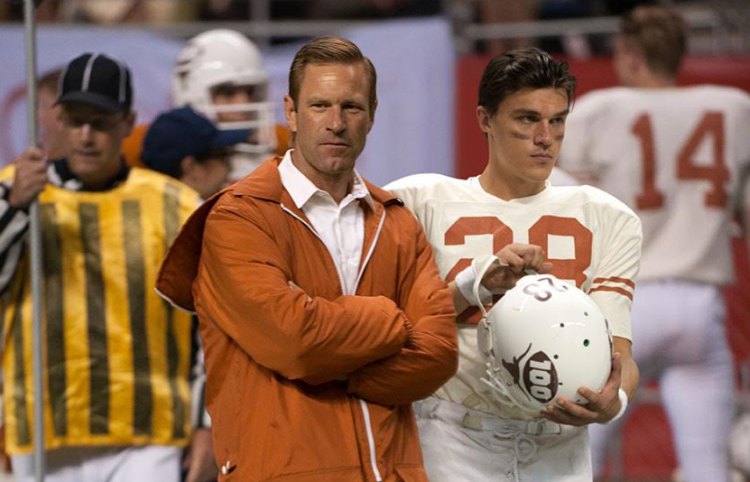
My All American is the story of an underdog college football player who became an inspiration. It was written and directed by the same guy who wrote Hoosiers, which begs the question: did the guy who wrote Hoosiers get hit in the head or something?
Angelo Pizzo also penned the script for Rudy, so this true life story finds him in a familiar neighborhood.
In the 1960s, Freddie Steinmark was an undersized Colorado high school standout who found himself passed over by most college football programs due to his stature. Legendary coach Darrell Royal gave Steinmark a chance with a full scholarship to the University of Texas, and Steinmark worked his way to team leader before chronic pain led to a cancer diagnosis.
Sports movies often come pre-loaded with inherent cliches, but Hoosiers and, to a slightly lesser extent, Rudy, overcame them by avoiding sweeping generalities to embrace smaller moments with finely drawn characters. My All American takes the opposite approach.
You’d be tempted to pin the anomaly on this being Rizzo’s first try at directing, if the script itself wasn’t equally culpable.
There’s no depth at all here, just one-note characters, swelling music and soaring shots of football stadiums.
Finn Wittrock (Unbroken, American Horror Story) is passable as Steinmark, but he’s saddled with a role that is more saint than flesh and blood. We learn in the introduction that Steinmark was never named an All American at Texas, yet the film paints him as perhaps the greatest player to ever suit up. Rizzo gives Wittrock no edges to make Steinmark’s influence resonate, and the multiple times other players tell Freddie “I wouldn’t be here if it wasn’t for you,” carry zero weight.
As Coach Royal, Aaron Eckhart proves adept at walking into a room, putting his hands on his hips, and exclaiming, “Men…”
Subtlety takes a beating on the field as well. As Coach Royal debuts the innovative triple option (aka “wishbone”) offense in 1968, his starting quarterback struggles with the unusual formation. Royal makes a QB change and the offense instantly takes off, prompting the game announcer to explain, “I guess they just needed the right quarterback to make the triple option work!”
That’s right, Jim, and that water they have on the sideline sure looks wet.
No doubt Steinmark’s is a story worth telling, but My All American needs more from Jimmy Chitwood’s playbook.
Bare has the elements to be a great film. It’s a story of a woman, Sarah. Feeling restless and lost in small town Nevada, she is taken under the wing of a drifter, Pepper, who opens her up to new experiences and new feelings. Sarah is a relatable, empathetic character. While the story isn’t entirely original, interpretations of old tales can be great if the right pieces are in place. Unfortunately, the elements simply don’t come together in a satisfying way in Bare.
The crux of the film is the relationship between Sarah (Dianna Argon), our restless protagonist, and Pepper (Paz de la Huerta), the wanderer who stumbles into Sarah’s hum drum life. The major problem is that Pepper is not an appealing character. It’s hard to understand what Sarah finds interesting about her when she first meets Pepper crashed out on a couch in her father’s antique store. When Sarah tells Pepper she can continue to stay, the audience is left wondering why Sarah would want to be around this woman who can barely string together a coherent sentence. While writer/director Natalie Leite might be trying to create a realistic character with Pepper, she fails to find the appeal the character would have for Sarah.
Dianna Argon brings her best game to Bare, but she is restricted by a script that doesn’t develop a realistic relationship between Pepper and Sarah. The characters do drugs together, visit Reno together, and Pepper introduces Sarah to the strip club where she works, but they never share a truly meaningful conversation on screen. There are mentions of conversations the characters have shared, but without seeing them, the relationship never develops beyond two acquaintances who do drugs together.
Paz de la Huerta’s interpretation of Pepper is interesting, but not in a good or compelling way. At times, it seems Pepper is mentally handicapped, perhaps a side effect of all the drugs she’s taken. Anyone sober would not want to spend that much time with Pepper, no matter how dissatisfied one is with their life.
There is some beauty in the film. The cinematography is at times lovely, even within the confines of a strip club, with all the gritty seediness still intact. The desert shots convey the vast emptiness of the landscape and plays nicely on the emptiness within Sarah.
It is unfortunate that the film doesn’t have much to offer between a few great shots and one great actor.
New Zealand teenage outcast Brodie (Milo Cawthorne) knows he and his friends are losers, so of course they start a band to get loud and be cool! But when their rocking involves playing an ancient piece of music known as the Black Hymn, they unwittingly summon an evil entity and the body count starts rising.
New Zealand actually has a strong history of blood-soaked horror comedies – beginning with the early, goretastic work of Oscar winner Peter Jackson – and Deathgasm is among the most accessible and most fun of the lot.
In his feature debut, writer/director Jason Lei Howden, a veteran of Jackson’s special effects team, borrows heavily from Shaun of the Dead-style pacing and camerawork while managing to poke some blood-spattered fun at the “devil music” stereotypes often thrown at heavy metal.
You’ll find plenty of laughs, some rom-com elements, and winning performances from both Cawthorne and Kimberley Crossman as Medina, the school beauty who can also swing a pretty mean ax.
You’ll also find an awful lot of clever kills, including the very non-traditional usage of a closet full of sex toys.
Clever and surprisingly self-aware, Deathgasm is fine excuse to feed your inner metalhead.
Few true events lend themselves more perfectly to film than the 2010 Chilean mine collapse. There is more drama, peril, resilience, and joy in the facts of this incident than anything that could believably be created in a piece of fiction.
Director Patricia Riggen tackles the story of the miners trapped about half a mile below ground. With food enough for three days, all 33 men survived an impossible 69 days. The story that mesmerized the world is not just of the unbelievable perseverance of the miners themselves, but also of the tenacity of an international team of engineers who worked against both overwhelming odds and an urgent timeclock to save them.
There is no end to the cinematic possibilities available in this deeply moving, thrilling story, which is why it’s so unfortunate that Riggen layers on so much artificial melodrama.
Antonio Banderas and Lou Diamond Phillips anchor a cast saddled with one-dimensional characters, each allowed a particular flaw to overcome or an inspiring trait to benefit the group. Riggen undermines the miners’ struggles by inexplicably skirting a claustrophobic feel, allowing no one the chance to truly panic or lose hope without Saint Mario (Banderas as inspirational leader Mario Sepulveda) swooping in with a word of wisdom to put everyone back on the right track.
Events above ground are treated with even less integrity, as engineers undergo lengthy, obvious epiphanies, and families offer little more than tearfully unwavering support. Riggen’s script, adapted by a team of writers from Hector Tobar’s book “Deep Down Dark,” leeches the human drama and complexity from all the events surrounding the collapse, replacing it with by-the-numbers disaster flick clichés and easy answers.
Most of the actors struggle with accents (I’m looking at you, Gabriel Byrne), and the back and forth use of Spanish and English only further exacerbates the film’s lack of authenticity.
And yet, when that first miner is lifted from his would-be tomb, it is impossible not to be moved. Because this really happened. Thirty three humans spent more than two months 2300 feet below ground, all the while understanding that their chance for survival was infinitesimal. Their ordeal is incomprehensible, and the fight against hopelessness and financial complacency to free them is genuinely inspiring.
The miners received no compensation from the company that stranded them, and this is the best Hollywood can do?