Category Archives: New In Theaters

Reviews of what’s out now

Oh, Can’t You See, You Belong to Me?

Comet

By Christie Robb

The extent to which you will enjoy Comet will probably depend on whether you are the type of person who thinks the Police’s “Every Breath You Take” is a good song to play at a wedding or not.

Romantic or stalkery?

Comet has a similar feel.

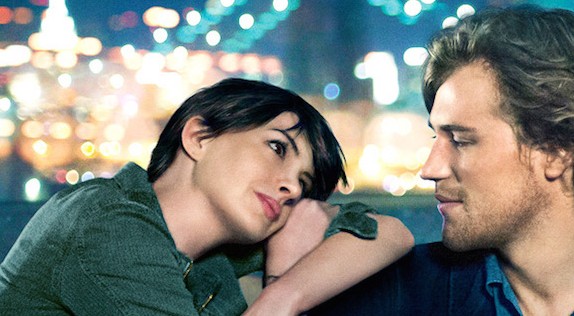
Neurotic Dell (Justin Long, who you might remember as the Mac guy from the commercials),relentlessly pursues Kimberly (Emmy Rossum) over a six year period during which he physically runs her down, declares his probable love for her on their first date, waylays her on a train, and shows up on her doorstep before her wedding.

Long and Rossum deliver stellar performances managing to effortlessly handle repartee of nearly Gilmore Girls proportions. Their chemistry is undeniable. However, it may be my inner cynic talking, but I found myself wanting to shake Kimberly by her slender little shoulders and point out all the red flags she seems unable to see.

Comet is a far more intellectual movie romance than is typical. It takes place in a parallel universe, which allows writer/director Sam Esmail to include some beautiful and trippy imagery. He also presents the story out of sequence, skipping around in the timeline of Dell and Kimberly’s relationship from a meeting during a meteor shower, to a snowy day in Paris, to a heart-to-heart on an LA rooftop at dusk (or is it sunrise?). Comet leaves the interpretation of what actually happens to the couple up to your careful scrutiny and interpretation.

Maybe not the movie to see on a first date, it nevertheless provides excellent fodder for discussion and perhaps a follow up movie marathon featuring 500 Days of Summer and Eternal Sunshine of the Spotless Mind.

Verdict-3-0-Stars

One Bad Book

The Babadook

by  Hope Madden

You’re exhausted – just bone-deep tired – and for the umpteenth night in a row your son refuses to sleep. He’s terrified, inconsolable. You check under the bed, you check in the closet, you read a book together – no luck. You let him choose the next book to read, and he hands you a pop-up you don’t recognize: The Babadook. Pretty soon, your son isn’t the only one afraid of what’s in the shadows.

It’s a simple premise, and writer/director Jennifer Kent spins her tale with straightforward efficiency. There is no need for cheap theatrics, camera tricks or convoluted backstories, because Kent is drilling down into something deeply, frighteningly human.

Like a fairy tale or nursery rhyme, simplicity and a child’s logic can be all you need for terror.

Kent’s film is expertly written and beautifully acted, boasting unnerving performances from not only a stellar lead in Essie Davis, but also the alarmingly spot-on young Noah Wiseman. Davis’s lovely, loving Amelia is so recognizably wearied by her only child’s erratic, sometimes violent behavior that you cannot help but pity her, and sometimes fear for her, and other times fear her.

Likewise, Wiseman delivers as a tender, confused, dear little boy you sometimes just want to throttle. Their naturalistic performances genuinely showcase the baggage that can exist between a parent and a child.

Radek Ladczuk’s vivid cinematography gives scenes a properly macabre sense, the exaggerated colors, sizes, angles and shadows evoking the living terror of a child’s imagination.

Much of what catapults The Babadook beyond similar “presence in my house” flicks is the allegorical nature of the story. There’s an almost subversive relevance to the familial tensions because of their naked honesty, and the fight with the shadowy monster as well as the film’s unusual resolution heighten tensions.

The film’s subtext sits so close to the surface that it threatens to burst through. Though that does at times weaken the fantasy, it gives the film a terrifying urgency. In the subtext there is a primal horror, a taboo rarely visited in film and certainly never examined with such sympathy. Indeed, the compassion in the film may be the element that makes it so very unsettling.

Eerily familiar yet peculiar and unique, The Babadook immediately ranks among the freshest and more memorable films the genre has to offer. It also marks a filmmaker to keep an eye on.

Verdict-4-0-Stars

Doc Week Reviews: “Happy Valley” & “Art and Craft”

by George Wolf


Happy Valley

A documentary filled with sordid details of Penn State University’s sexual abuse scandal is, thankfully, not something that Happy Valley is interested in becoming. Instead, writer/director Amir Bar-Lev (My Kid Could Paint That) wisely keeps his focus on the aftermath, and the shockwaves the trial set off in the community.

It is a striking portrait of a community dealing with the realization that they had a monster in their midst, and struggling to balance a devotion to Penn State football with the crimes that were committed within that very program.

Of course, by extension the film becomes a comment on the religion of football in all of America, and how, as one man puts it, “we all want to believe we live in a better world than we do, and it’s pretty easy when there’s a big, shiny, loud spectacle.”

Though Bar-Lev gives the Paterno family a bit too much airtime to hammer home their mantra “Joe did the right thing,” he delivers several even-handed and downright devastating sequences on the dark side of hero worship.


Verdict-3-5-Stars


Art and Craft

“He knew right where to hit us…our soft spot: art and money.”

Art and Craft is the fascinating documentary on Mark Landis, one of the most notorious art forgers in U.S. History. Over the course of three decades, Landis successfully duped countless museums, bowing to a strange compulsion he seems powerless to control.

The directing team of Sam Cullman, Jennifer Grausman and Mark Becker are able to balance a compelling character study with an art world mystery, crafting a film that does not require an Art History degree to enjoy.

Landis is a fragile soul, and the film treats him as such. Never judgmental, it seems to echo the sentiments of those in the art community who are shown tracking him down. They badly want Landis to stop his forgeries, but can’t bring themselves to treat him impolitely.

At times funny, shocking, and intensely curious, Art and Craft is also a heartbreaking look inside a lonely life, and the lengths to which one might go to find a sense of belonging.

It’s even better when viewed as a companion piece to Big Eyes, Tim Burton’s upcoming look at a very different kind of art forgery.


Verdict-4-0-Stars


https://www.youtube.com/watch?v=gb9A5qu_GNA

Sarcrapagus

The Pyramid

by Hope Madden

The Pyramid could not have better timing. Had the film been released just a few weeks later it would missed its opportunity to rank among the very worst films of 2014.

To be fair, a really good creature feature is incredibly difficult to make, so you can hardly blame first time director Gregory Levasseur for not even trying. Instead he’s crafted a The Descent knock off that can’t rise above the caliber of a late night, made for cable TV movie.

His Egyptian horror sees a father and daughter archeologist team and the documentarians who want to film their discovery – a mysterious pyramid sitting hundreds of feet below the desert sands.

The bickering parent and child are played by American Horror Story’s Denis O’Hare and bad actress Ashley Hinshaw, respectively (but not respectably). That Hinshaw plays an archeologist seems less ludicrous only if you remember that Denise Richards played nuclear physicist Dr. Christmas Jones in The World is Not Enough. But at least that was back when the Bond films embraced their campy awfulness. The Pyramid is just awful.

O’Hare serves an unseemly purpose in his American Horror Story roles, but he’s not a strong enough actor to elevate this dreck. Hinshaw’s worse, and Christa Nicola is community theater bad as the documentarian risking life and cameraman for that elusive Emmy.

The only castmate to acquit himself with any level of respectability is former Inbetweener James Buckley, who still struggles mightily with this script.

An aside: When you’re writing a screenplay and you’ve trapped all your characters with unnamed beasties in a labyrinthine catacomb hundreds of feet below the earth’s surface, you may want to limit your use of the lines “we have to get out of here” and “we need to find a way out of here” to fewer than 200 instances apiece. It sort of goes without saying.

Oh, yes, and the beasties – if you squint and pretend they are ill-conceived but earnest odes to Ray Harryhausen and not simply weak, uninspired, fake looking props … Basically, it’s just too much work to have to pretend they don’t suck. Like the movie itself. It’s best just to accept it.

Verdict-1-0-Star

Not So Happy Trails

The Homesman

by Hope Madden

In front of the camera, Tommy Lee Jones is a world-wearied, direct and laconic actor, but there’s a cowboy poetry about him. He’s no different behind the camera, as his second feature proves. The Homesman brims with the lonesome, brutal beauty of the frontier, but thanks to Jones’s capable storytelling, it offers more than that.

Jones plays George Briggs – if that is the real name of the claim jumping low life who finds himself at the end of a rope and the mercy of the upright Mary Bee Cuddy (Hilary Swank). A prosperous but “uncommonly single” lady on the frontier, Ms. Cuddy has volunteered her services for a particular journey and will oblige Mr. Briggs to accompany her or remain in his predicament.

What unfolds is a wagon wheel Western of sorts, replete with stunning images of the prairie, beautifully framed by the director. Swank – who can be counted upon to create a vivid if one-dimensional character – can’t help but bring to mind the Mattie Ross role from True Grit. It appears Jones (and Swank) are intentional with this, as Hailee Steinfeld (of the Coen remake) has a late supporting role.

It suggests that Jones is retelling our sentimental Western favorites with a lonelier, harsher but hauntingly beautiful tone.

The journey meets expectations and then subverts them, filling the screen with surprises – some fun, some bitter, all a bit melancholy. And yet there’s a black but entertaining humor in many scenes. The swings in tone, on the whole, are capably handled by a director who mined somewhat similar styles in his underseen 2005 first feature as director, The Three Burials of Melquiades Estrada.

Peppered with fascinating if jarringly brief cameos, Jones’s film keeps your attention as it journeys slowly East, making a statement about the hard realities of frontier life as well as the more universal ache to be loved.

The territories of the American West have filled our imaginations for more than two hundred years and it can be tough to find a new approach. Jones succeeds in using that same dusty path across the frontier we find so familiar, and even populating the trip with characters we almost remember, yet somehow he tells a truly new and memorable tale.

Verdict-4-0-Stars

The Lady is a Vamp

A Girl Walks Home Alone at Night

by Hope Madden

Earlier this year Jim Jarmusch released his vampire film, Only Lovers Left Alive – a brilliant and woefully underseen flick. Had he not released that film, A Girl Walks Home Alone at Night would certainly be the most Jarmusch-y vampire movie ever made.

In fact, writer/director Ana Lily Amirpour has made the world’s first Iranian vampire movie, and though she borrows liberally and lovingly from a wide array of inspirations, the film she’s crafted is undeniably, peculiarly her own.

Amirpour is blessed with a cinematographer in Lyle Vincent capable of translating her theme of loneliness in a dead end town, as well as the cultural influences and Eighties pop references, into a seamless, hypnotic, mesmerizingly lovely vision. The film is simply, hauntingly gorgeous.

Set in Bad Town, a city depleted of life – tidy yet nearly vacant – Girl haunts the shadowy, lonesome fringes of civilization. The image is highly stylized, with a hip quirkiness and stationary camera framings that noticeably mine Jarmusch’s early work. Indeed, Amirpour seems an avid fan of American indies of the Eighties and Nineties, as well as the films of endlessly imitated French New Wave filmmakers and Sergio Leone – so that’s a mish mash. But Amirpour effortlessly balances the homages and inspirations, the cultural nuances alive in Girl giving every scene a uniqueness that makes the whole effort surprising.

Amirpour develops a deliberate pace that makes the film feel longer, slower than is probably necessary. The time is spent with singular individuals – a prostitute (a world-wearied and magnificent Mozhan Marno), a drug addicted father (Marshall Manesh), a street urchin (Milad Eghbali), a pimp (Dominic Rains), and a rich girl (Rome Shadanloo). Two people weave in among these players – the handsome Arash (Arash Marandi), and a lonesome vampire (Sheila Vand).

Though these are character types more than characters outright, Amirpour and her actors don’t abandon them. Each has breath and dimensionality, their fate a question that piques sympathy.

Vand’s Girl is the constant question mark, and that – along with the eerie, sometimes playful beauty of Vincent’s camerawork – is what makes the film unshakably memorable. I promise the image of a vampire on a skateboard will stay with you.

Verdict-4-0-Stars

He Blinded Her with Science

The Theory of Everything

by Hope Madden

If there is one thing that The Theory of Everything should convince you to do, it is this: Get to know Eddie Redmayne.

He is a magnificent, chameleonic actor who has found a way to bring humanity to roles as varied as that of a matricidal son, a suicidal homosexual teen, a socially awkward hick, a deeply conflicted witch hunter, and a love-struck baritone in post-revolution France. And now he will finally be known – and likely Oscar nominated – for his subtle, authentic and moving portrait of Stephen Hawking.

Redmayne is the reason to see this film. It’s a remarkable performance at the heart of a decent but not exceptional film.

Based on Jane Hawking’s second memoir, the film begins as a young doctoral student falls for a medeival poetry major and, despite the death sentence of a medical diagnosis, marries. While Anthony McCarten’s adaptation retains the struggles and failings in the marriage, director James Marsh can’t find the passion or urgency the story needs.

The problem is certainly not his cast. Alongside Redmayne, Felicity Jones offers a tender, thoughtful performance, and the supporting players turn in solid work as well. But their relationships, passions and drama are all kept too tidy and too subdued.

Marsh, whose previous films – documentaries, in particular – have proven to be honest, impish and fascinating – can’t seem to find his footing. Where his approach in previous work has always felt fresh, here he makes safe choices at every turn. Aside from an odd, fish-eye close up here and there, nothing about his telling of this extraordinary life ever feels daring.

The science itself is minimized to the point of near nonexistence, making the only examined aspects of the Hawkings’ story that of her love and his physical disability. And even that feels slight.

It’s a gorgeous film to watch, with lush but muted colors, manicured lawns and relentlessly clean sidewalks, hallways and college students. Marsh’s framing is always truly lovely. And Jones and Redmayne exhibit a deep connection that allows their characters’ struggles to feel poignantly real.

There is much to applaud in The Theory of Everything, but there should have been more.

Verdict-3-5-Stars

Like Your Crazy Uncle Frank

Horrible Bosses 2

by George Wolf

After trying to kill your boss and getting away with it, the sensible career choice is clearly self employment. That’s the plan for the three bumbling schemers in Horrible Bosses 2, a film with scattershot hilarity that can’t quite match the success of the original.

Nick, Kurt and Dale (Jason Bateman, Jason Sudeikis and Charlie Day, respectively) have a great new plan for business success and surprise, it’s legal! Their new “shower buddy” invention looks promising, so all the guys need now is a big investor, and their days of working for someone else will be history.

Things look good when business tycoon Bert Hansen (Christoph Waltz) puts in a big order, but when he pulls out and leaves the boys high and dry, their criminal minds take over. After an inspired brainstorming session, they decide to kidnap Hansen’s obnoxious son Rex (Chris Pine) and hold him ransom for a payback payday.

Hard to believe, but the plan goes quickly sideways, and to stay ahead of the law and out of the morgue, the boys turn to some old friends: Nick’s former boss (Kevin Spacey), Dale’s sexual harasser (Jennifer Aniston) and the trusted criminal adviser “MF” Jones (Jamie Foxx).

Most of the original writing team is back for the sequel, but their script is lighter on laughs and heavier on convention, relying on the cast to just squeeze out laughs whenever they can. With this cast, that’s a safer bet than most. Bateman, Sudeikis and Day are flat out funny, and their wonderful chemistry is anchored by flawless timing that is just a kick to watch.

The supporting trio of Foxx, Aniston and Spacey is nearly as good, and Pine blends in nicely with the stable of returning castmates. Only Waltz seems out of place, his usual greatness wasted in a very limited role.

You know that crazy uncle you still invite over for Thanksgiving because, even though he can be offensive and tedious, he’s still funny and likeable?

That’s Horrible Bosses 2.

Pass the peas (and stay for the credits).


Verdict-3-0-Stars


File This One to Squee

Penguins of Madagascar

By Christie Robb

This movie may well provide the cure for seasonal affective disorder. What’s not to love? Adorable animated baby penguins? Check. John Malkovich playing a demented doctor octopus? Check. Nonstop action? Check. Ridiculous puns? Check. Werner Herzog and Benedict Cumberbatch? Check.

Penguins of Madagascar was an almost perfect hour and a half of zany fun.

(I say almost perfect only because Cumberbatch was drawn as a wolf and not, more appropriately, as an otter.)

The film follows the adventures of the four beloved penguins from the Madagascar franchise. Trapped inside a vending machine full of Cheezy Dibbles, they are kidnapped by Malkovich’s Dave the Octopus—a formerly adored aquatic attraction bumped from zoo to zoo in favor of the lovable antics of Antarctica’s flightless waddlers.

Rejection has taken its toll. Dave, now bent on revenge, has concocted a serum that will mutate the squee little penguins into monsters.

Joined by a secret interspecies task force, the North Wind (led by Cumberbatch’s Agent Classified); Skipper, Kowalski, Rico, and Private take on Dave and his army of octopi henchmen and attempt to preserve cuteness as we know it.

If you are looking for a way to entertain the kiddos for 90 minutes this holiday weekend while avoiding a turkey-induced coma yourself, this is a fantastic option.

Verdict-4-0-Stars

Rebel Rebel

The  Hunger Games: Mockingjay – Part 1

by Hope Madden

What makes the Hunger Games franchise so much stronger than the rest of the adolescent lit series out there? Perhaps more than anything – more than a compelling hero’s quest, more than the peril and drama, more than director Francis Lawrence’s eye for action and sense of pacing – it’s that each new film expands the profound talent in this pool of actors.

The great Julianne Moore joins ranks that include 2-time Oscar nominee Woody Harrelson, consummate bad guy Donald Sutherland, genius character actors Jeffrey Wright, Jena Malone, Elizabeth Banks and Stanley Tucci, and the greatest actor of his generation, Philip Seymour Hoffman. And who can forget the lead – a performer with an Oscar and two additional nominations under her belt at the ripe old age of 24? Let’s be honest, these humans could elevate any script that fell into their collective grasp. They could make a decent film out of Fifty Shades of Grey, for God’s sake.

Lucky for us, instead they collaborate on the third of four episodes in the program, The Hunger Games: Mockingjay – Part 1.

Reluctant hero Katniss, having destroyed the games and been rescued by rebel forces, agrees to be the face of the rebellion in return for the rescue of her beloved friend Peeta (Josh Hutcherson).

Gone is the Battle Royale nightmare and excitement of the games themselves, replaced with the broiling drama of a budding revolution. Gone, too, are the writers that mined Suzanne Collins’s novel Catching Fire for its underlying political maneuverings. They are replaced by Collins herself, who adapts her novel, as well as Peter Craig (The Town) and Danny Strong (The Butler). Their treatment lacks much of the excitement of earlier installments, spending more time with the brooding, dramatic Katniss than with the arrow-wielding badass.

They don’t write down to their audience, though, touching upon the helplessness and compromise of political manipulations, finding similarities between the behavior of the rebellion and that of the dread Capitol.

Credit Lawrence (the director) for keeping a quick pace though saddled with more exposition and fewer action sequences, more heavy drama and less bloodshed. But honestly, the magic of the film is in Stanley Tucci’s disingenuous TV interviews, in Moore’s subtle evolution, in Hoffman’s every bemused chuckle, and in Jennifer Lawrence’s ability to transform into a skulking, unlikeable, single minded teen who happens to carry a revolution on her shoulders.

Verdict-3-5-Stars