Category Archives: New In Theaters

Reviews of what’s out now

Single White Follower

Ingrid Goes West

by George Wolf

Oh, look, some Hollywood elitists want to wag a finger in our general direction and lament how our obsession with social media connections keep us from making real ones. Can’t wait.

Hold on, Ingrid Goes West is smarter than your average wag, and the feature debut from director/co-writer Matt Spicer sports a welcome swagger that holds the film’s satirical bite just when you think it’s going soft.

Aubrey Plaza is Ingrid Thorburn, a shall-we-say “high strung” young woman in Pennsylvania who earns some mental health evaluation after an unsavory incident at a friend’s wedding. Ingrid’s spirits are lifted when she comments on a post by Instagram star Taylor Sloane (Elizabeth Olsen), and Taylor actually responds.

Uh-oh.

Newly motivated, Ingrid is off to California, where she finds a way to insert herself into Taylor’s perfect life, maybe make a boyfriend out of her Batman-obsessed landlord Dan (Straight Outta Compton‘s O’Shea Jackson, Jr.) and definitely live out her social media fantasies.

Though Spicer freely uses contrivance to set up and maintain his narrative, the comedy is deliciously dark and the characters keep us invested even when they’re far from likable. Plaza (earning another producing credit) easily makes Ingrid an appealing mix of sympathetic and psychotic, while Olsen crafts the perfect embodiment of insufferably attractive hipster.

The metaphors aren’t always subtle, but Ingrid Goes West finds a delicate balance in its travels, one that understands the allure of a volatile facade.

Verdict-3-5-Stars


Tart

Lemon

by Hope Madden

Lemon announces itself immediately.

As a documentary on the horrors of war plays on a TV, the camera pans a drab living room, finding a man asleep upright on a sofa. He wakes to realize he’s wet himself.

He is Isaac. Isaac is a lemon.

The documentary Isaac had slept and peed through provides the context for a story in which one man can so obliviously wallow in self-inflicted misery.

In quick succession, Isaac will dismiss what his (randomly blind) girlfriend Ramona (Judy Greer) has to say before publically humiliating a female student (Gillian Jacobs). Both are too focused on themselves.

Why aren’t they focused on him?

Co-writer Brett Gelman plays Isaac, a send-up of sorts of the self-pitying hero of so many indies.

Director/co-writer Janicza Bravo borrows and rebrands independent film stylizing – from Wes Anderson to Jared Hess to Todd Solondz – to deliver a wry satire of the quirky worlds they create. Her framing, color palette, set design and timing offer spot-on re-renderings of the atmospheres created in a generation of arthouse movies that follow the unraveling lives of misunderstood, entitled outcasts.

Bravo peppers the film with a handful of perfectly discordant scenes: Isaac running up a road with a stroke-impaired old woman in a wheelchair; Isaac awkwardly threatening and then kissing Michael Cera; Isaac and his profoundly dysfunctional family participating merrily in a rendition of the song A Million Matzoh Balls.

Individually, these scenes are amazing. Truly. But they don’t string together to form a cohesive image or a compelling narrative.

Gelman’s intentionally weird and flat performance engages, in a trainwreck sort of way that suits the effort. You believe him. And many – most – of the performances around him are clever, individual and memorable. Their interactions and the story, slight as it is, strain the imagination, though.

Nia Long’s Cleo, for instance, seems included solely to allow for a new series of awkward moments. Long’s performance rings true, from her friendly introduction through her polite if wearied response to Isaac’s racist flirtation.

Her actions, however, defy logic in a way that exposes a narrative weakness you’re less likely to find in the films of Anderson, Hess or Solondz.

Todd Solondz knows what to do with an unlikeable protagonist. You won’t enjoy it, but he will not pull any punches and you will have closure. This is the problem with subverting the work of superior filmmakers – your film invariably suffers by comparison.

Which is not to say that Lemon has nothing to offer. It offers a pantload of intriguing character work and suggests the vision of a worthy director. The script just needed another draft.

Verdict-3-0-Stars

Brother’s Keeper

Good Time

by Hope Madden

Regardless of the film’s title, Connie Nikas (Robert Pattinson) does not appear to be having a Good Time.

Connie is trying to keep the system away from his mentally impaired brother Nick (Benny Safdie, who also co-writes and co-directs). He uses what means he has, none of which are legal.

After a botched bank robbery sees the brothers separated and Nick incarcerated, Connie engages in ever riskier behavior in a desperate attempt to save his brother.

Safdie, alongside his real brother and filmmaking partner Josh, once again explores an urban underbelly. The two have proven with films like their 2014 festival favorite Heaven Knows What that they can tell a deeply human story set on the fringe of society.

Good Time is a bit more high energy than Heaven Knows What, but once again the Safdies create a world that’s simultaneously alien and authentic. It’s hard to believe people live like this, and yet every moment of Connie’s increasingly erratic evening rings true. Nuts, but true.

Pattinson delivers his strongest performance yet. His glittering vampire days long behind him, he’s shown versatility in recent projects including Cosmopolis, The Rover and Maps to the Stars. Here he balances a seedy survival instinct with heart-wrenching loyalty and tenderness.

Everything Connie touches, he poisons. In Pattinson’s hands, he’s righteous enough to believe in his own cause, even when it means convincing himself that he’s protecting someone – his brother, a teenage girl, another lowlife looking for a score – who’d be better off without him.

Benny Safdie impresses in front of the camera as well as behind. His understated performance shows no sign of artificiality, and his skill as a filmmaker has never shined more brightly.

His gift for pacing that matches the hustle – the constant shifting, shuffling and scheming needed for survival – keeps Good Time both exhilarating and exhausting.

The film showcases the kind of desperation that fueled many a New York indie of the Seventies, Midnight Cowboy among them. The urgency of a quick con that could lead to freedom but will undoubtedly end in tragedy seems the only kind of choice Connie ever makes.

It’s a grim film full of bruised people, but it never loses hope entirely.

Verdict-4-0-Stars

Timing is Everything

Bushwick

by Hope Madden

Who was not delighted and surprised by David Bautista’s runaway comedic performance in 2014’s Guardians of the Galaxy?

And truth be told, his turn in the sequel was funnier still. Dave Bautista is comic gold!

Drama, on the other hand, is still just a tad outside his grasp.

Bautista stars with Brittany Snow (Pitch Perfect) in Bushwick, a real-time(ish) survival adventure.

Lucy (Snow) brings a new beau home to her Brooklyn neighborhood Bushwick to meet the fam. Weirdly, there is not a soul in their subway station – aside from that screaming man who’s on fire. That’s extreme, even for New York.

Bombs, snipers and general mayhem greet the two as they try to leave the underground and head to Lucy’s grandma’s place. What is happening?

Directors Cary Murnion and Jonathan Milott want to take a minute before laying it all out for you. It’s not a bad narrative decision – having the audience share in Lucy’s confusion. The directors make a handful of worthy choices, the most provocative and obvious of which is the sleight of hand used to make the film look and feel like one long take.

Beyond the visual trickery employed to minimize the noticeability of cuts, most scenes are delivered as if caught in one take. Actors stumble over lines, for instance, in much the same way humans might when conversing.

There’s even a chance it could have even worked to generate urgency and underscore the raw, wild ride of the adventure if the writing weren’t so bad and the actors had talent.

Snow could not be more irritating or less believable and Bautista, God help us, is asked to deliver an earnest, emotionally devastated monolog.

He’s awful, but he’s not alone. Everyone is. In fact, the most common comment in my notes from the film: This is so bad.

The one reason the film may stick out this weekend is its utterly amazing timing.

Bushwick has been invaded by a well-armed, organized militia of entitled racists.

Shut the F up.

The film won’t satisfy your blood lust, your peaceful dreams or your hope for a decent movie. But damn, its timing is eerie.

Verdict-2-0-Stars

A Tale of Two Catherines

The Midwife

by Matt Weiner

There is a scene early on in The Midwife that consists almost entirely of a conversation between Beatrice (Catherine Deneuve) and her doctor, in which Beatrice says barely a word and yet the camera doesn’t move from her face the entire time.

Director and writer Martin Provost allows moments like these to unfold again and again throughout the film, relying on superb performances and an unsentimental treatment of the material to present an arresting and spare meditation on love and the passage of time.

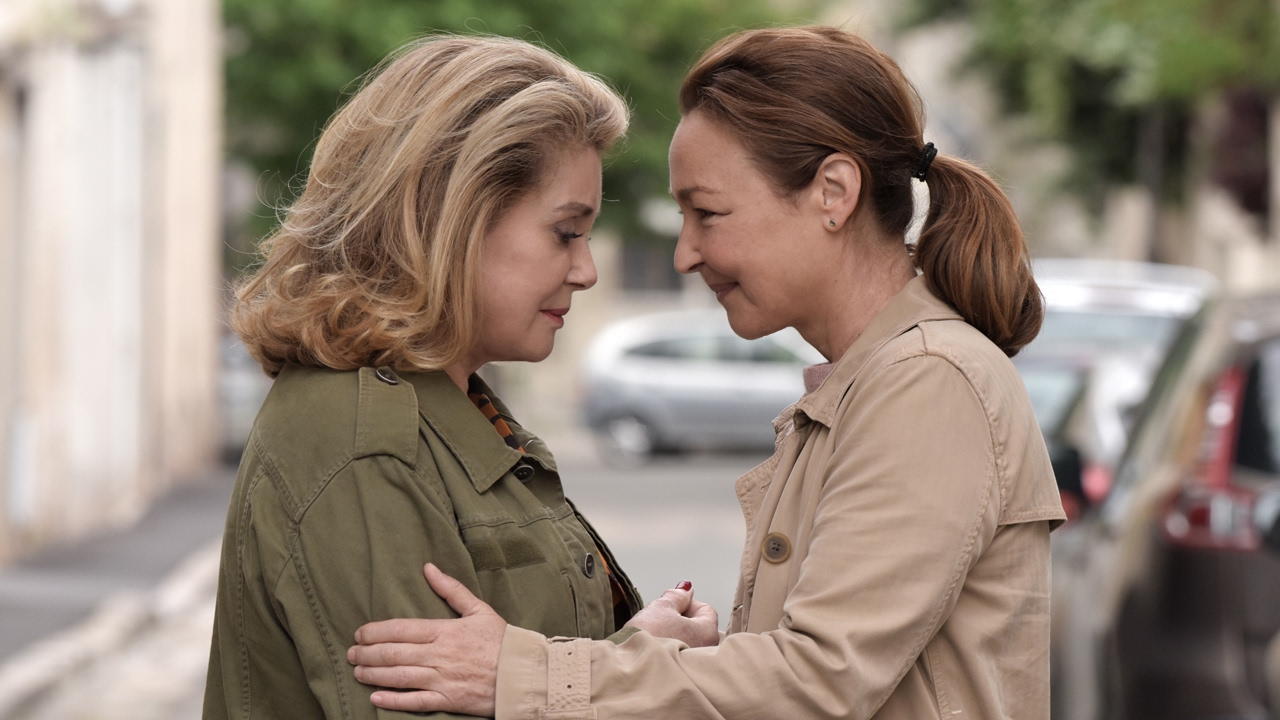
Claire (Catherine Frot) is an uptight midwife in Paris whose grim adherence to routine seems on the verge of upheaval, both professionally and personally. This coincides with the free-spirited Beatrice, the mistress of Claire’s dead father, reappearing out of nowhere.

It’s a familiar setup: Claire and Beatrice are natural foils, and they both have some unexorcised emotions to work out over the man they both loved, in their own ways. But that relationship between Claire and Beatrice is the main attraction, and the two actresses work off one another in a way that keeps things poignant, never melodramatic.

Deneuve, in particular, is equal parts devastating and disarming as Beatrice. It’s fitting that at this point in her career, she’s now deconstructing the haughty mystery that she become indelibly associated with over the last 50 years.

What happens when life finally strips away all the defensive layers and artifice that a woman like Beatrice has worked so hard to maintain? What remains when you’re all alone save a body that’s slowly betraying you?

The film doesn’t answer all these questions. And, beguilingly, neither does Deneuve. As circumstances force Beatrice to part with all her glamorous trappings, she holds onto her defiance. And some of her reticence.

In The Midwife, it’s not death that the characters are afraid of—it’s all the indignity that time heaps on us in between being born and dying. Babies “spring out from nothing,” Claire observes. Controlling as she is, Claire can only do so much for those she has brought into the world.

What anyone chooses to make of their time afterward, the film suggests, is all part of the mystery, joy and frustration of being alive.

Verdict-4-0-Stars

Language of the Unheard

Whose Streets?

by George Wolf

Moving like a living, breathing monument to revolution, Whose Streets? captures a flashpoint in history with gripping vibrancy, as it bursts with an outrage both righteous and palpable.

Activists Sabaah Folayan and Damon Davis share directing duties on their film debut, bringing precise, insightful storytelling instincts to the birth of the Black Lives Matter movement. Together, they provide a new and sharp focus to the events surrounding the 2014 killing of 18-year-old Michael Brown by Ferguson, Missouri police officer Darren Wilson.

But what’s even more striking in this debut is how little these new directors care if they’re following anyone’s filmmaking 101 checklist. This is an extremely raw, incendiary story with a fitting perspective to match. To Folayan and Davis, buoyed by a stellar assist from film editor Christopher McNabb, these events demand nothing less, and they are correct.

Inevitable finger-pointing about a one-sided perspective is dealt swift, preemptive justice. As we’re quickly reminded of how the mainstream media framed their reporting on the Ferguson riots, urgent new footage bearing a citizen journalist zeal drives home the filmmakers’ point.

What most people have been shown has been “one sided for a reason.” This is the other side, and the unforgettable sights begin to mount.

A Ferguson resident displays the various military-grade ammo casings strewn about the local streets. An African-American police officer tries to remain stoic when her priorities are questioned. A white officer wears a “support Darren Wilson” bracelet while on duty in Ferguson.

As deeply as it cuts on a blunt, visceral level, Whose Streets? also benefits from a powerfully subtle context. It takes the pulse of communities that have railed against unequal policing for decades, only to find even more frustration when added video evidence failed to result in social justice.

To Dr.Martin Luther King, Jr., riots were “the language of the unheard.” Whose Streets? lays bare the rise of a movement powered by the voiceless going quietly no longer.

Verdict-4-5-Stars


Hiroshima Story

In This Corner of the World

by Matt Weiner

The animated film In This Corner of the World contrasts one of the single most destructive acts of war—the United States dropping the atomic bomb on Hiroshima—alongside a decade of daily life for the inhabitants of Hiroshima and the neighboring port city of Kure.

Suzu (Rena Nounen) is a free-spirited young girl with a talent for art that gets reflected in the film’s beautifully drawn seascapes and pre-war countryside. Suzu’s recollections, emotions and eventual tragedies are inextricably tied to the fantastical watercolors that make up the animated film’s palette.

The effect is beautiful—and unsettling. Writer-director Sunao Katabuchi centers a war movie around non-combatants. Loved ones die and faceless air raids bombard Kure. But Katabuchi grounds the Japan’s participation in World War II around Suzu’s family and other townspeople, blending uneventful tedium, Suzu’s vibrant drawings and matter-of-fact catastrophe to convey a routinization of horror that’s far more emotionally devastating than most war movies.

So when Suzu moves from Hiroshima to live with her new husband Shusaku (Yoshimasa Hosoya) and his family, it’s disarmingly easy to keep the effects of war on the periphery—as Suzu herself does. The film allows the escalating seriousness to insert itself into Suzu’s colorful idylls more and more as the date of the fateful bombing nears. But even then, these moments are deftly handled as impressionistic memories from a quiet domestic life: a rationing here, a death there—just more brushstrokes, some thicker than others.

When Suzu’s way of life is permanently shattered, she seems to be one of the last to realize that the life she thought she’d be growing into died long ago at the start of the war. It’s fitting that deeply personal violence is the emotional climax for Suzu. The bombing of Hiroshima and all its horrors are an almost perverse falling action, but Katabuchi’s focus on Suzu keeps things poignant and utterly free of sentimentality.

At times, the film’s languorous advance feels a little too at odds with everything going on outside their corner of the world. When coupled with the loose plot, some stretches veer closer to deadweight than emotional weight. But the editing mostly works, with the war on domestic bliss feeling as meaningful as any battle.

This is war under the influence of Ozu—a quiet but singularly focused attention to the ordinary in extraordinary times.

Verdict-3-5-Stars


Vanishing America

Wind River

by Hope Madden

In many beautiful and horrific ways, the scripts of Taylor Sheridan (Sicario, Hell or High Water) felt like a reemergence of Cormac McCarthy.

His lean and often quite mean stories have been blessed with two of the more capable visionaries of modern film (David Mackenzie and Denis Villeneuve) – filmmakers whose camerawork, pacing and sense of urgency hauntingly animated the damaged Americana Sheridan’s stories announced.

With his latest, Wind River, Sheridan takes the helm, borrowing inspiration from both directors.

Another tale of violence, bureaucratic vagueries and the vanishing of American heritage, Wind River certainly feels like a Taylor Sheridan film.

Jeremy Renner plays Cory Lambert, sharp shooter for Wyoming’s department of fish and wildlife. He protects livestock from predators – like the three wolves surrounding a flock of sheep in the scene that immediately follows that of a young girl bleeding and dying alone in a frozen wasteland.

Behind the camera, Sheridan is a bit less subtle with symbolism than he might want to be. In fact, though Wind River spins a compelling murder mystery, it’s far more of a blunt instrument than the filmmaker’s last two – admittedly magnificent – efforts as writer.

Perhaps Sicario and Hell or High Water represent too high a bar for a director with only one feature, the 2011 horror flick Vile, under his belt.

Performances are wonderful. Renner’s stoic cowboy unveils genuine tenderness, Gil Birmingham’s brief screen time is a blistering blessing of tumultuous emotion, and Elizabeth Olsen breathes life into a surprisingly one-note role.

Sheridan doesn’t have quite the touch of Villeneuve or Mackenzie, and without it, his material feels a touch too preachy, a whisper too self-righteous, and most troublingly, too white.

Set on a Native American reservation, Lambert is enlisted to help Olsen’s fledgling FBI agent Jane Banner and an understaffed tribal police department solve the crime behind the girl’s death.

And though Renner brings his grieving hunter to the screen with an aching, restrained performance, it’s hard to understand why the character needed to be white. That piece of casting gives the film a “white savior” tenor that only exacerbates that nagging feeling of misplaced self-righteousness.

Wind River is a fine, if flawed, police procedural. Unfortunately, that makes it a bit of a disappointment coming from Sheridan.

Verdict-3-0-Stars

https://www.youtube.com/watch?v=zN9PDOoLAfg

Hillbilly Heist

Logan Lucky

by George Wolf

You’re not long into director Steven Soderbergh’s latest before you expect to see Brad Pitt standing around eating something.

Why?

Because Logan Lucky is essentially Soderbergh’s Ocean’s 11 with hillbillies, which had to intrigue Soderbergh when he first read the script from Rebecca Blunt. If that is her real name.

No, seriously, Blunt is rumored to be a pseudonym for the actual writer, who should just ‘fess up and take credit for this hoot of a heist homage.

Jimmy Logan (Channing Tatum) gets laid off from his job fixing sinkholes underneath Charlotte Motor Speedway, so he puts together a 10-point plan for his next career move. Two of those points are labeled “shit happens.”

The rest is simple.

Jimmy, his one-armed brother Clyde (Adam Driver) and their sister Mellie (Riley Keough), will bust redneck robber Joe Bang (Daniel Craig) out of jail to help them rob the speedway during the biggest NASCAR race of the year, and then have Joe back in the slam before anyone is the wiser.

Soderbergh structures everything to parallel his Ocean‘s films so closely that when he finally addresses that elephant outright, the only surprise is how often the rubes draw a better hand than the Vegas pretty boys.

Logan serves up indelible characters, fun suspense, finely tuned plotting and solid humor, including a hilarious bit with a prison warden (Dwight Yoakam) explaining to some rioting inmates why the next Games of Thrones novel isn’t available yet.

As Bang, Craig is a flat out riot, doing fine justice to the best character name since Chest Rockwell, and standing out in an ensemble (also including Katie Holmes, Seth MacFarlane, Katherine Waterston, Hilary Swank and Sebastian Stan) that shines from top to toe.

Assembled as precisely as a letter-perfect grift, Logan Lucky has smarts, charm and some downright weirdness. It’s a late August blast with more than enough fun to beat our summertime blues.

Verdict-4-0-Stars


Going the Distance

The Farthest

by Rachel Willis

Forty years ago, the first of two vessels was launched into space to begin the unmanned Voyager mission. To commemorate NASA’s monumental achievement, Emer Reynolds explores the operation from its beginnings in 1972 to present day in the documentary, The Farthest.

A lot of effort goes into the creation and execution of a space odyssey, and Reynolds brings the story to life through interviews with NASA scientists and engineers. There’s a lot of ground to cover, from the meeting with Nixon to approve the budget, to the technology on board the Voyager vessels, to the inclusion of the famous Golden Record, and Reynolds seeks to examine all of it during the documentary’s two-hour run time.

Because there are forty years of history to explore, oftentimes The Farthest feels like an overview. Rather than focusing on one aspect of Voyager, be it the rudimentary technology aboard the vessels or the first images of the planets farthest from the sun, the film instead follows the Voyager timeline.

By doing this, there is a lot of information glossed over, but Reynolds still manages to inject a touching poignancy into the documentary. The men and women who worked on Voyager are full of passion and wonder, and they convey this to the audience.

Arguably the most interesting aspect of the film, the most interesting aspect of Voyager, is the inclusion of the Golden Record.

As Voyager 1 and 2 were designed to go beyond our solar system into interstellar space, a decision was made to include a record of life on Earth. The records (one in each space craft) include images of Earth, music, and mathematical equations in an attempt to encapsulate what it means to be an earthling. The Farthest spends more time with the Record than any other aspect of Voyager, but in light of how far Voyager 1 and 2 have traveled, and how far they may still go, the idea that the Golden Record may end up in the possession of alien life is a wondrous prospect.

As Voyager 1 and 2 continue their journies, The Farthest celebrates the men and women who built them and sent them into the farthest corners of our galaxy and beyond.

Verdict-4-0-Stars