Category Archives: New In Theaters

Reviews of what’s out now

She’s a Brainiac, Brainiac…

The Female Brain

by Rachel Willis

It seems strange that in 2018, romantic comedies continue to follow the same tired clichés. While some have mined new territory, The Female Brain isn’t taking any risks.

Focusing on four couples, the film explores the ups and downs of relationships through the studies of neurologist Julia (Whitney Cummings, who also co-writes and directs). Looking at how brain chemistry affects the way men and women behave, why they make certain romantic choices, and why they continue to make the same mistakes, Julia seeks to find answers to her own relationship traumas.

The film’s biggest issue is its lack of cohesion. The couples never share screen time, save one moment in which Steven (Deon Cole) and Adam (James Marsden) discuss how their significant others have changed or are trying to change them. And while it seems the couples are part of Julia’s study based on a few voice-overs, that fact is never quite clear. The movie would have been much stronger if it had kept a tighter focus on Julia’s story or found a better way to connect the couples and their foibles to her study.

There is some humor to be found, primarily from Cole and Cecily Strong. SNL veteran Strong shines, and plays well off of NBA veteran Blake Griffin, who does occasionally hold his own against his much funnier on-screen spouse. Unfortunately, most of the comedy falls flat, as the script relies too much on overused stereotypes: Women are either trying to change men or are too emotionally closed off to accept love.

Cummings is a capable actress. As Julia, she is sympathetic while managing to mine the humor from her role. However, as a director, she never manages to find her footing. The film’s pacing is off, resulting in a movie that feels much longer than its actual runtime. Cummings’s script (co-written with Louann Brizendine and Neal Brennan) suffers from banal dialogue. Any potential moments of originality are undermined by reliance on formulaic ideas of romance.

Hiding behind the guise of being scientifically sound in examining the difference between male and female brains, we’re sadly left with a film that reiterates the same stereotypes and problems of many romantic comedies.

Scissor Sister

Samson

by George Wolf

From parable to porno, it’s not the type of story you’re telling, it’s how that story is told.

Samson isn’t a disappointing effort merely because it’s a “faith based” film, but because it is lazy in almost every aspect, seemingly confident that its target audience doesn’t demand anything more.

It is 1170 BC, and we meet the Hebrew Samson (Taylor James) as a mischievous scamp, comically running from Philistine guards, winking at the village lovelies (they’re the ones sporting full runway-ready makeovers) and mulling his destiny as “God’s hand of vengeance.”

King Balek (Billy Zane) orders his son, Prince Rallah (Twilight‘s Jackson Rathbone), to keep Samson and his legendary strength in check. Rallah, with help from the cunning Delilah (Caitlin Leahy), hatches a plan that will bring Samson down and snuff out any Hebrew rebellion before it has the chance to start.

Directors Bruce Macdonald and Gabriel Sabloff (both vets of the faith-based genre) and their team of writers craft a drama full of ridiculous set pieces, weak production values (“check out these sweet fake beards I found in the Target Halloween aisle!”), soap opera dramatics and a complete lack of subtlety. Performances run the gamut, from amateurish (James) and stiff (Leahy) to scenery devouring (Rathbone) and waiting on you to turn that table into Bud Light (Zane, dilly dilly).

There’s a story here, full of wonder, cruelty, betrayal, intrigue and redemption. Samson leaves so much unexplored, just wanting the credit for telling it.


It’s Mainly Liverpudlians

Film Stars Don’t Die in Liverpool

by Hope Madden

Jamie Bell is a versatile, talented actor too often relegated to minor roles.

Annette Bening has always been a powerful performer.

Director Paul McGuigan—Victor Frankenstein, Lucky Number Slevin, Wicker Park—is, unfortunately, just not that good.

So, there you have it. In their collaboration, Film Stars Don’t Die in Liverpool, Bening and Bell generate honest chemistry while imbuing their characters with relatable flaws and beauty. McGuigan surrounds them with flashy staging conceits and the single ugliest wallpaper the world has ever known.

It’s 1979 in Liverpool, and struggling young actor Peter Turner (Bell) makes the acquaintance of his quirky new neighbor, former silver screen siren Gloria Graham (Bening).

A one-time Oscar winner fallen on hard times, pretty, flirty and nearly 30-years his senior, Gloria is a mystery to Turner and, in turn, to us. Here is where the two leads rise above their script to develop something touching and lovely, something that mines the earth between starstruck and true love. It’s wonderful to behold.

Bening adopts a baby voice as she oscillates between headstrong and insecure, but she seems to fully understand this figure who, in her time, was a daily scandal. Bening moves from seductress to damaged old woman and back again with fluidity and without excuses.

Here’s how McGuigan wrecks it.

1) We get it. It’s the Seventies. Does every surface—including co-star Stephen Graham’s head—have to be covered in garish, patterned shag? The costume and set design are beyond distracting. They will actually make you dizzy.

2) Bening cannot help but pique your interest in Gloria Graham’s life, and several courtship scenes expose something unique and quite worth an entire film. Unfortunately, the movie itself is a maudlin exercise in watching the decay of a once-vibrant woman, punctuated by flashes of that vibrancy.

3) He picks at themes of humanizing that which we objectify, even using fun visual nods to the seductive artifice of movies to slide between time spans, but he can’t truly abandon blandly by-the-numbers storytelling.

Which is a shame because, between the two stellar leads and a handful of amazing supporting turns (Vanessa Redgrave and Frances Barber leave marks) there was really something here.

Say It Loud

Black Panther

by Hope Madden and George Wolf

Ryan Coogler’s stunning first feature, 2013’s Fruitvale Station, proved his instincts as a storyteller. It also made apparent the force of nature that is Michael B. Jordan. That the two could go on just two years later to craft the fresh and vibrant Creed from the tired Rocky franchise showed that the blockbuster was as much in their mastery as the indie drama.

But a Marvel superhero action flagship? That’s Big. Big budgets. Big canvas. And with Black Panther, big expectations. Are Coogler and Jordan up to the challenge?

Hell yes.

Just when you’ve gotten comfortable with the satisfying superhero origin story at work, director/co-writer Coogler, co-star Jordan and the stellar ensemble start thinking much bigger. And now, we need to re-think what these films are capable of.

The action—whether air battles, hand-to-hand or via car chase—is breathtaking.

Wielding a palette of colors and visuals unseen to this point inside the MCU—this set design is glorious, situating a SciFi tech metropolis easily within a world that still embraces ancient tradition, an isolated world that evolved in its own course rather than being led by the evolution of the world outside. Wakanda looks unlike anything we’ve seen in the Marvel Universe or any other.

Not a minute of the film is wasted. Coogler manages to pack each with enough backstory, breathless action, emotional heft and political weight to fill three films.

The cast shines from the top down, but there are some stand-outs.

Chadwick Boseman, all gravitas and elegance, offers the picture perfect king—one who’s respectful of tradition yet still ready to open his eyes to the plight of his brothers outside his hidden nation of Wakanda.

Side note: is there anyone more effortlessly badass than Danai Gurira? Trick question, there is no question—the answer is no. And though she has remarkable range (if you haven’t seen her 2013 indie Mother of George, give yourself that gift today), her General Okoye is here for the beat down.

Lupita Nyong’o is also characteristically excellent in the role of the conscience-driven liberal. In a scene where she expects Gurira’s general to commit what amounts to treason, Coogler expertly reinforces an amazingly well-crafted theme mirrored in other pairings: the friction between surviving by force or by conscience.

This theme is most clearly outlined by the conflict between Boseman’s King T’Challa and his new nemesis, Jordan’s Killmonger.

Michael B. Jordan, people.

Coogler hands this actor all of the most difficult lines. Why? Because it is material a lesser actor would choke on, and Jordan delivers like a perfectly placed gut punch. He sets the screen on fire, and though every single performance in this film is excellent, Jordan exposes the artifice. His castmates are in a Marvel superhero movie. Jordan is not. Instead, he is this rage-filled, broken, vengeful man and he is here to burn this world to the ground.

His scenes with Boseman provide a cunning twist on the battle between a struggling hero and his evil twin. Usually a tired staple of sequeldom, BP adds an undercurrent of Shakespearean drama to the inevitable showdown of two characters who could easily represent the dueling inner conflict of one.

Coogler works with many of these basic themes found in nearly any comic book film—daddy issues, becoming who you are, serving others—but he weaves them into an astonishing look at identity, radicalization, systemic oppression, uprising and countless other urgent yet tragically timeless topics. The writing is layered and meaningful, the execution visionary.

Blistering social commentary, brilliant escapist fantasy, eye-popping visual wonder—Black Panther has it all.

Your move, every other superhero.


Ironic Title

Happy End

by Hope Madden

Happy End is as perceptive as it is dispassionate—and this, as every choice filmmaker Michael Haneke makes—is intentional.

Channeling themes from across his career, pulling most noticeably from both his 1992 horror Benny’s Video and his 2012 masterpiece Amour, Haneke slowly, deliberately unveils a tale of distance.

His subjects are the well-off Laurent family: a doddering patriarch (Amour’s brilliant Jean-Louis Trintignant), the daughter who runs the company (Isabelle Huppert), her surgeon brother (Mathieu Kassovitz), her disappointing son (Franz Rogowski), and the surgeon’s 13-year-old daughter, Eve (Fantine Harduin).

Eve has come to live with the family because of her mother’s suicide.

In the film’s opening moments, we watch as an emotionally unattached and unnamed character documents a mother’s every banal moment with critical commentary before poisoning a pet hamster.

It’s a maneuver that announces Haneke’s point: whether by way of technology, psychosis or money, the Laurents lack any depth of emotion, intimacy or personal connection. Or is it humanity they lack?

The filmmaker braids together the stories and points of view of several main participants, keeping his focus at arm’s length until we’ve become apprehensive about every move. Why is Georges (Trintignant) wandering the median in a wheelchair and talking to strangers? What struggles could cause Pierre (Rogowski) to behave—and dance—like that?

Why would anyone leave a baby alone with Eve?

Patient viewers will recognize Haneke’s deliberate and chilly storytelling, but Happy End really requires your patience. Still, don’t let your eye wander because too many frames contain a startling image, and this filmmaker won’t insist that you notice.

Eventually the distance becomes somewhat problematic because it feels as if Haneke is pulling punches he was happy to land in previous films.

As is always the case, though, you’re repaid for your efforts. Whether it’s the understated brilliance of the performances (Trintignant and Harduin are particularly memorable), the chilling clash of human emotion with whatever has taken its place within the Laurent family, or the diabolical final image, Happy End leaves you stunned.

The Oscar Nominated Short Films: Documentary

by Rachel Willis

This year’s batch of Oscar nominated documentary short films offers a look at wide-ranging subjects. From an artist’s struggles with mental illness, to the problem of elder care, to the effects of the opioid epidemic in Huntington, West Virginia, these documentaries will evoke a gauntlet of emotions.


Edith + Eddie – USA  Dir: Laura Checkoway

“It was love at first sight.”

So says Eddie, who at 95 married 96-year-old Edith. The two are very obviously in love, but because of a dispute between Edith’s daughters over her care, the couple’s relationship is put into question. Through this clash, we’re given a look at the effects of elder guardianship. It’s a depressing glimpse at the reality many elderly face as their own wants are often circumvented by the wants of others or by their own medical needs.


Heaven is a Traffic Jam on the 405 – USA  Dir: Frank Stiefel

For artist Mindy Alper, life has been extraordinarily hard. Early in the film, she lists the myriad drugs she takes daily, including Zyprexa, an antipsychotic, one she says she’d  be vegetative without. As Alper speaks about her experiences with mental illness, her art plays on screen, a visual representation of her story. Stiefel conveys deep sympathy for Alper and magnificently blends her drawings and sculptures into his narrative. It’s a lovely, touching film that celebrates Alper’s accomplishments in life and art.


Knife Skills – USA  Dir: Thomas Lennon

Edwins Restaurant in Cleveland, Ohio is unique. Its owner, Brandon, is at the center of Knife Skills because he’s done something that many would never think to do: hire eighty former prisoners to work in his restaurant. Most of them have no restaurant experience, but Brandon’s restaurant also functions as a school. In the six weeks leading up to opening night, the film follows the students as they earn all they can about how to work in a French restaurant. It’s an ambitious idea, but Knife Skills only scratches the surface. Rather than focusing on Brandon and his goal, the film follows several of the students and teachers, leaving the viewer with a shallow impression of the subject.


Heroin(e) – USA  Dir: Elaine McMillion Sheldon

Deputy Chief Jan Radar, Judge Patricia Keller, and Necia Freeman are the heart of Heroin(e). While Radar’s rush to save drug overdose victims in Huntington, WV is the film’s primary focus, we also spend time with Judge Keller in her courtroom, and with Freeman as she drives around the city at night handing out food to the needy. Each woman has a goal in mind: to end the epic of overdoses in her city. Huntington is the overdose capital of America, and Sheldon gives a face to that haunting fact. There is a slight glimmer of hope in the film, even though, for now, the reality in Huntington is bleak.

Also included in the program is Traffic Stop – USA  Dir: Kate Davis.

(rating for full program)

The Oscar Nominated Short Films: Animated

by George Wolf

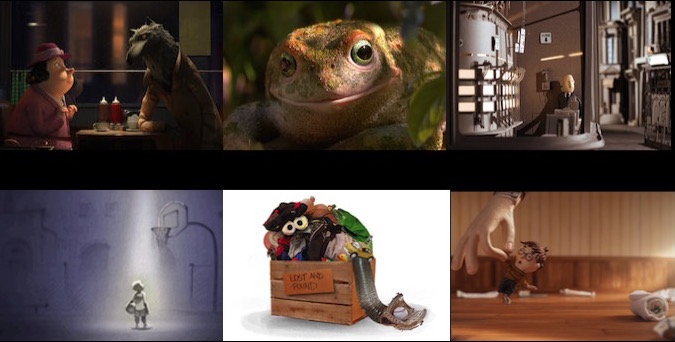
Pixar – the veritable Meryl Streep of this category – is here again, and deservedly the favorite to win more hardware. But some impressive frogs may spring an upset, while fractured fairy tales, a sports icon and emotional baggage round out a captivating program.


Dear Basketball – USA  Dir: Glen Keane Wr: Kobe Bryant

From a distance, Bryant’s love letter to his sport may appear self-serving, but when brought to life through graceful, impressionistic chalk animation and a John Williams score, it becomes more. Vanity project? That’s fair, but it’s also a sincere farewell from a complicated legend.

https://www.youtube.com/watch?v=vA3Pqne28PE


Negative Space – France  Dirs: Max Porter and Ru Kuwahata

With Sam’s dad often leaving on business trips, father and son form a bond forged in a perfectly packed suitcase. The stop motion animation is arresting and well-played, setting fertile ground for the bittersweet emotions the film explores.


Lou – USA  Wr./Dir:Dave Mullins 

Look at you Pixar, charming us again with your gentle humor and effective poignancy. A cousin to the Toy Story universe, Lou finds a playground bully meeting his match, in a good way. It’s surprisingly touching, and, no surprise, the frontrunner of the group.

https://www.youtube.com/watch?v=0iYsBnj2BUk


Revolting Rhymes – UK  Wrs./Dirs: Jakob Schuh and Jan Lachauer

Based on the much-loved rhymes written by Roald Dahl and illustrated by Quentin Blake, Revolting Rhymes counters its somewhat bland animation with a talented voice cast (including Dominic West and Rob Brydon) to give famous fairy tales some new, sinister edges. Part one of a British TV double dip, it wanders off in spots but rallies at the finish.


Garden Party – France  Dirs: Victor Caire, Florian Babikian, Vincent Bayoux, Theophile Dufresne, Lucas Navarro and Gabriel Grapperon

In a deserted, well-appointed mansion, some amphibians explore their surroundings and follow their primal instincts to unexpected results. Practically bursting with wondrous CGI photorealism, this ambitious film – a graduation project from a French animation school – offers delight in every frame.


Also included in the program are these additional animated shorts:

Lost Property Office  – Australia  Wr./Dir: Daniel Agdag
Coin Operated  – USA  Wr./Dir: Nicholas Arioli
Achoo  – Japan

(rating for entire program)

You Can’t Punish in Here. This is the Red Room of Pain!

Fifty Shades Freed

by Matt Weiner

Boiling down the Fifty Shades movies into a capsule summary has always felt a bit like playing Mad Libs with a head injury, and Fifty Shades Freed gleefully continues the trend.

Anastasia Steele and Christian Grey (Dakota Johnson and Jamie Dornan, each blinking out Morse code to their agents throughout the franchise) are now married. Christian’s dominant side causes fresh problems for Ana at work, but not as much as her ex-boss (Eric Johnson) returning to stalk the entire Grey family for reasons both mysterious and incredibly obvious.

Having watched the entire series, it’s hard not to feel like additional complaining is punching down, so here are some nice things about Fifty Shades Freed:

• This is the first film in the franchise that earns intentional laughs, an incredible improvement all on its own.
• All the shots, while filmed so perfunctorily that you forget what you’ve just seen nearly in real-time, are in focus.
• There is what amounts to a five-minute Audi commercial, which is helpful if you are considering buying or leasing a new Audi.
• According to the credits, Marcia Gay Harden and Danny Elfman received paychecks from this, and although you can hardly feel their presence on screen or in the score, I cherish them both and I hope they buy nice houses from this because they deserve it.

But the other major improvement in the franchise can’t be separated from the movie’s biggest flaw. The good news: with Ana and Christian having settled into betrothed BDSM bliss, the film (written by Niall Leonard and directed by James Foley) devotes less time to their tepid romance and more time allowing the characters to simply be themselves as they get caught up in a sordid thriller.

Here’s the bad news. Allowing these characters to be themselves suffers from one crucial flaw: every single character in the series is boring to an extent that’s almost an achievement in its own right.

And just like in the first two films, the sexual chemistry between Ana and Christian never clicks on screen. Although since Freed revolves more around the couple’s marital gamesmanship than their “erotic” courtship, the tension occasionally works this time. And even produces some real laughs.

While the movie wraps things up neatly for Ana and Christian—albeit in a comically abrupt way I guess is a clever callback to the bizarre pacing of the previous films—it doesn’t answer the question of exactly who this movie is for.

There’s plenty of nudity, but it’s clinically divorced from any recognizable human emotion. Such short shrift is given to character development that I can’t imagine fans of the lengthy books have been satisfied. There’s a mystery plot, sort of, but nothing you couldn’t get from a made-for-TV movie and save the cash.

But if you’ve made it this far through the series, Fifty Shades Freed is the most competent of the bunch. And at least this one can be watched with a clear conscience knowing that the actors are as freed from contractual obligations as their characters are rid of emotional baggage.


No Shoes, No Pants, No Problem

Peter Rabbit

by Christie Robb

Once upon a time there were four little rabbits, some gatecrashing, a tense dude named McGregor, and a pervasive lack of pants. But Will Gluck’s Peter Rabbit is a bit of a departure from Beatrix Potter’s twee kids’ books.

And you might think, ugh, not another attempt to lengthen and embellish a piece of classic literature beyond all reason (looking at you, Peter Jackson). But hold on. This (cotton) tale takes place somewhat after the events in Ms. Potter’s books. Both Peter’s (James Corden) parents are dead and there’s a new McGregor in town, Domhnall Gleeson (perhaps most familiarly known now as the strident General Hux from the Star Wars saga).

Gleeson’s McGregor is an acutely type A city slicker who longs to immediately sell his recently inherited country estate in order to reinvest the profits in a business venture back in London. Until he meets the animal lover/bunny portraitist Bea (Rose Byrne) who lives in the Pinterest-worthy cottage next door.

This gets Peter’s invisible knickers in a twist for two reasons: 1) restricted access to the tantalizing McGregor garden, and 2) a rival for the affections of Bea who, in the absence of his own rodent parents, has become personage he invests with a significant amount of maternal affection.

The conflicts escalate in cartoon violence that’s kinda Home Alone by way of the Odd Couple. And, as you might expect, it is an absolute delight to see Gleeson rant in nearly Shakespearean cadences about the antics of an anthropomorphized rabbit.

(To be honest, I’d probably pay the price of a movie ticket to see Gleeson take exception to piece of burnt toast.)

Like Gleeson, the supporting cast is also a delight. Margot Robbie, Elizabeth Debicki, and Daisy Ridley stand out as Peter’s siblings Flopsy, Mopsy, and the devil-may-care Cotton-tail.

If you want to get all highbrow about it, the entire movie can be read as a metaphor for a kid’s struggle to accept a new romance in the life of a primary caregiver. And if you want to be honest, it bears as much resemblance to its source material as my 4-year-old’s picture of me does to the Mona Lisa.

But there’s enough beautiful animation, fun 90s and early 00s songs, and Easter-egg jokes for parents in case the kids decide they really like this movie and you have to watch it 400 times.

The Oscar Nominated Short Films: Live Action

by George Wolf

Remember when you asked your English teacher how long your term paper had to be and they answered “As long as it needs to be”?

This year’s group of live action short nominees does. The five stellar films will quicken your pulse, break your heart, educate and bring a welcome giggle, all offering satisfying cinematic visions in smaller packages.


DeKalb Elementary – USA Wr./Dir: Reed Van Dyk

A troubled young man (Bo Mitchell) enters an elementary school office, heavily armed and ready to kill, and a terrified administrator (Tarra Riggs) becomes mediator between the gunman and the police. Awash in breath-holding tension, the film boasts two terrific lead performances and a filmmaker with fine instincts for effective restraint.


The Silent Child – UK Dir: Chris Overton Wr: Rachel Shenton

Libby (Maisie Sly) is a four year-old deaf child who bonds with the social worker (Rachel Shenton) teaching her sign language. Shenton, who also wrote the film, is an advocate for deaf awareness and her passion shines through in this heart-touching and informative short.


My Nephew Emmett – USA Wr./Dir: Kevin Wilson, Jr.

In 1955, Mississippi preacher Mose Wright (L.B. Williams) tries to protect his 14-year-old nephew, Emmett Till (Joshua Wright) from two racist killers out for blood. Based on a true story, Kevin Wilson Jr.’s film is mournful and built from a simmering dread, but ultimately lifted by a spirit that that will not be broken.


The Eleven O’Clock – Australia Dir: Derin Seale Wr: Josh Lawson

While a temp secretary (Alyssa McClelland) minds the appointment book, a delusional patient (maybe Damon Herriman) of a psychiatrist (maybe writer Josh Lawson) believes he is actually the psychiatrist. As each attempts to treat the other, the session gets out of control. Seemingly inspired by Monty Python’s famous “Argument Room” sketch, it’s cleverly cheeky and sometimes hilarious.


Watu Wote/All of Us – Germany Dir: Katja Benrath Wr: Julia Drache

Based on the 2014 attack by Al-Shabaab militants on a Nairobi-bound bus near the Kenya-Somali border, Watu Wote is grounded in a familiar narrative theme, but buoyed by director Katja Benrath’s gracefully subtle hand. It’s a somber yet inspiring salute to courage, love and mercy.


Rating for full program: