Category Archives: New In Theaters

Reviews of what’s out now

Orchestral Maneuvers

Woman at War

by Rachel Willis

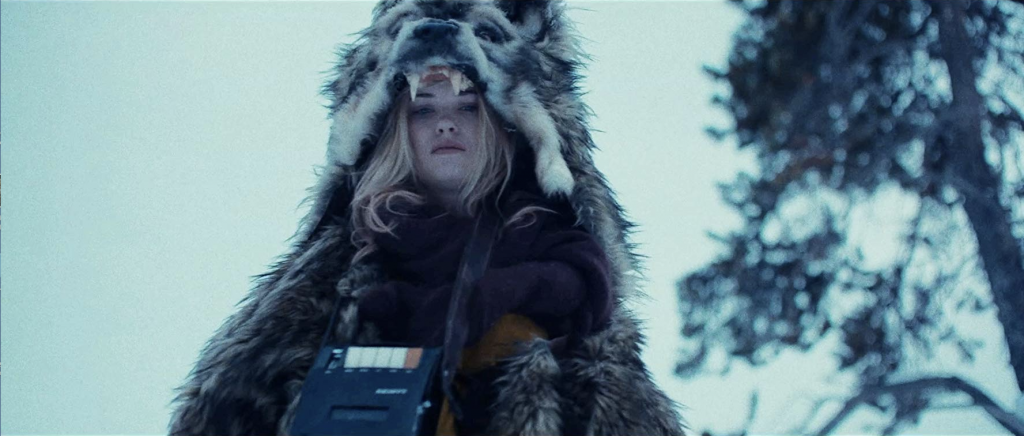
One of the best things about Woman at War is the hero, Halla (a superb Halldóra Geirharðsdóttir). Not often do we see a heroic middle-aged woman, but that’s exactly what we get in director Benedikt Erlingsson’s odd, charming, thrilling comedic fairy tale about a female warrior fighting against the devastating environmental effects of a local aluminum plant.

Like any superhero, by day Halla is a model citizen protecting her secret identity as the “Mountain Woman.” A choir director who rides her bicycle to work, she lives a seemingly routine life. But her inner turmoil compels her to fight the environmental destruction she sees happening in the name of greed.

A wrench is thrown into Halla’s life when she learns that her dreams of adopting a child are finally coming to fruition. A little girl in Ukraine needs a home, and Halla wants a chance at motherhood as much as she wants to fulfill her mission.

Emphasizing the film’s heroic theme, musicians play the score onscreen. In terms of stage theater, it’s reminiscent of a choir that typically opens a play by setting the scene. Then by popping up throughout the acts, they keep the audience apprised of things happening “off stage.” Erlingsson uses these musicians to similar, if not exact, effect, and it’s a unique way to demonstrate Halla’s internal conflict.

To underscore the motif of the importance of environmental preservation, we’re treated to many scenes of Iceland’s vast natural beauty. Halla uses the environment to her advantage, finding out of the way locations to sabotage power lines (skillfully using a bow and arrow), effectively cutting power to the plant. She hides from authorities in natural fissures in the ground, and earns her media-branded nickname by being of the earth that she seeks to save.

Interesting questions are raised in connection with Halla’s mission. When does activism become extremism? What actions will we accept as the effects of climate change become more and more drastic? What will we do to protect our home?

Because Woman at War is interested in these questions, and it’s time we make a serious attempt to answer them.

Slow Down, You Move Too Fast

The Hummingbird Project

by Christie Robb

Director Kim Nguyen’s contributes a meditation into the nature of success in the modern world.

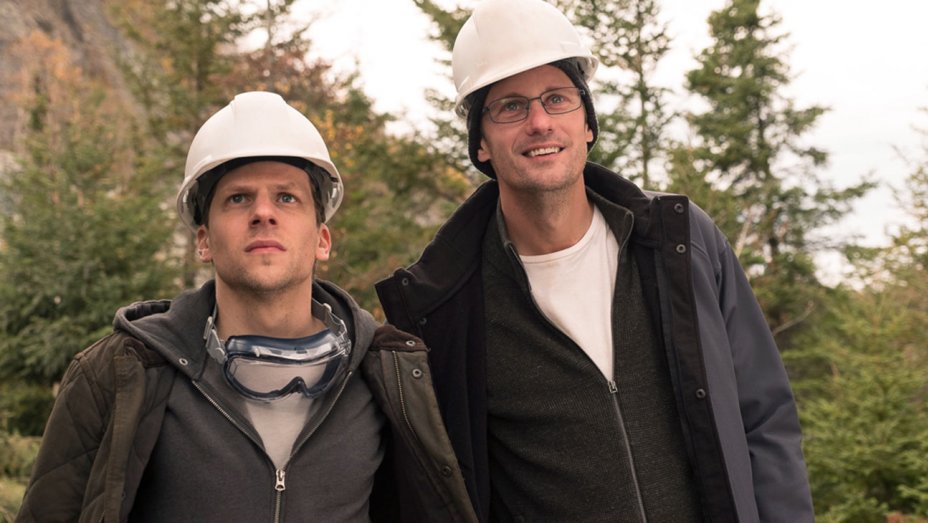
Wall Street traders and cousins Vincent and Anton Zaleski (Jesse Eisenberg and Alexander Skarsgard) resign from their jobs as high-frequency traders and embark on a quest to build a ramrod-straight fiber-optic cable joining the servers of the Kansas and New York stock exchanges. The objective: to make stock trades a millisecond faster than their competitors and make millions in the time it takes for a hummingbird to flap its wings.

Obstacles block their path—mountains, swamps, health issues, reluctant property owners, and a vengeful ex-boss played by Salma Hayek.

The technobabble in the film feels like it is based-on-a-true story. But, it isn’t. Eisenberg plays Vincent as a monomaniac. He’s almost as focused on his line as Ahab is consumed by destroying Moby-Dick. Skarsgard disappears into the role of Anton, contorting his height into an excruciating stoop and delivering a genius-on-the-spectrum performance that is nuanced, funny, sad, and kind of inspiring.

The Hummingbird Project is often beautifully shot, with frequent use of slow motion footage. However, it struggles in focus. It could easily have been tweaked into several different movies. One can imagine editing it into a comedy like Office Space. It could have been Hitchcockian corporate thriller by expanding Hayek’s role. Or it could have shone more of a spotlight on the relationship between characters to flesh out what seems to be the movie’s purpose: questioning whether racing for wealth is really a better use of time than downshifting to spend time with the people around you.

As it is, the movie tries to be too many things and ends up being an ok entry rather than a good one.


Dancing Queen

Gloria Bell

by Hope Madden

Six years ago, Chilean filmmaker Sebastian Lelio released a vibrant and unapologetic look at aging and living with his magnificent Gloria. He re-images that gem with Gloria Bell, his second English language film, placing the incomparable Julianne Moore at the center of a different kind of coming of age story.

Moore is Gloria, a single fiftysomething who’s starting to feel her mortality. The film itself is a character study of the type Lelio does best. His films nearly always focus unflinchingly on the struggles of a woman trying to live freely and authentically.

As with his Oscar-winning A Fantastic Woman, his underappreciated Disobedience, and the original Gloria, Lelio’s observational and unobtrusive direction trusts the lead to carry the weight of the film. Moore characteristically rises to the occasion.

In Moore’s hands Gloria is perhaps a tad more reserved, a little more tentative than the firebrand depicted by Paulina Garcia in the original, but she’s no less wonderful. As Gloria struggles between the freedom and the loneliness of independence, and as she comes to terms with her own mortality, Moore’s tenderness and vulnerability will melt you and her sudden bursts of ferocity will delight.

John Turturro offers impeccable support as Gloria’s love interest. The performance is slippery and unsettlingly believable. He’s joined by strong ensemble work from Michael Cera, Brad Garrett, Alanna Ubach and Holland Taylor, each of whom delivers the spark of authenticity despite limited screen time.

But make no mistake, Gloria Bell is Moore’s film.

Is this just another in a string of brilliant performances, one more piece of evidence to support Moore’s position among the strongest actors of her generation? No.

Gloria Bell is a beautiful film, one that fearlessly affirms the potency of an individual woman, one that recognizes the merit of her story.


And Them

Us

by Hope Madden and George Wolf

Jordan Peele loves horror movies. How cool is that?

It’s evident from the strangely terrifying opening moments of Us, when a little girl watches what is probably MTV from her suburban couch, the screen flanked by stacks of VHS tapes including C.H.U.D., and you’re pulled in to an eventful birthday celebration for this quiet, wide-eyed and watchful little girl (Madison Curry).

From a Santa Cruz carnival to a hall of mirrors to a wall of rabbits in cages—setting each to its own insidious sound, whether the whistle of Itsy Bitsy Spider or Gregorian chanting— Peele draws on moods and images from horror’s collective unconscious and blends them into something hypnotic and almost primal.

Then he drops you 30 years later into the Wilson family truckster as they head off for summer vacation. The little girl from the amusement park, Adelaide (Lupita Nyong’o – beyond spectacular) is now a protective mom.

And that protective nature will be put to a very bloody test.

A family that looks just like hers – doppelgängers for husband Gabe (Wnston Duke), daughter Zora (Shahadi Wright Joseph), son Jason (Evan Alex) and Adelaide herself – invade the Wilson’s vacation home, forcing them to fight for their lives while they wonder what the F is going on.

Even as Peele lulls us with familiar surroundings and visual quotes from The Lost Boys,  Jaws, then Funny Games, then The Strangers and Night of the Living Dead and beyond, Us is far more than a riff on some old favorites. A masterful storyteller, Peele weaves together these moments of inspiration not simply to homage greatness but to illustrate a larger, deeper nightmare. It’s as if Alice’s Adventures in Wonderland turned into a plague on humanity.

Loosely based on an old episode of Twilight Zone (which, not surprisingly, Peele is rebooting), Us is a tale full of tension and fright, told with precision and a moral center not as easily identifiable as Get Out‘s brilliant takedown of “post racial America.”

Do these evil twins represent the darkest parts of ourselves that we fight to keep hidden? The fragile nature of identity? “One nation” bitterly divided?

You could make a case for these and more, but when Peele unveils his coup de grace moment (which would make Rod Serling proud), it ultimately feels like an open-ended invitation to revisit and discuss, much like he undoubtedly did for so many genre classics.

While it’s fun to be scared stiff, scared smart is even better, a fact Jordan Peele has clearly known for years.

Guess who he’s reminding now?

Shotgun Safari

Dragged Across Concrete

by George Wolf

Songwriter Jim Steinman, best known for baroque and dramatically verbose musical epics often belted out by Meat Loaf, has said in interviews that he would love to write 3-minute pop toe tappers, he just doesn’t know how.

Filmmaker S. Craig Zahler can probably relate. Dragged Across Concrete is his third feature as writer/director, and he’s still clearly invested in the long game. Like Bone Tomahawk and Brawl in Cell Block 99, Zahler’s latest is full of strangely indelible characters and memorable dialogue, a film anchored in creeping dramatic dread that finally explodes with wonderfully staged brutality.

Brett (Mel Gibson) and Anthony (Vince Vaughn), street-smart cops in a fictional urban jungle called Bulwark, get popped when a bystander captures one overly zealous interrogation on video. A suspension without pay is something they’re forced to accept, but it isn’t long before Brett has a plan to make up for the lapse in funds with a little “proper compensation” on the side.

But of course, they’re not the only ones looking for a score.

Henry (a terrific Tory Kittles) is fresh out of the joint and needs money for his family. His old friend Biscuit (Michael Jai White) hooks them both up as drivers for a lethal bank robber (Thomas Kretschmann), and the long fuse to a standoff is lit.

This is Zahler’s slowest burn yet, but he keeps you invested with a firm commitment to character, no matter the screen time. From a new mother with near-crippling separation anxiety (Jennifer Carpenter) to a loquacious bank manager (Fred Melamed) and a shadowy favor-granter (Udo Kier), nothing in the film’s 159 minutes feels superfluous.

In fact, quite the opposite.

As Zahler contrasts the cops with the robbers, the sharply-defined supporters orbiting the core conflict only add to its gravity, despite a few moments than seem a bit too eager for Tarantino approval.

Gibson is fantastic, drawing Brett as the real bulwark here, defending what he feels is his with a savage, unapologetic tenacity. Vaughn, re-teaming with Zahler after a standout turn in Cell Block 99, again shows how good he can be when pushed beyond his default setting of “Vince Vaughn.”

Finally, the steady march of battered souls, desperate measures and eclectic soundtrack choices comes to a bloody, pulpy head, staged with precision and matter-of-fact collateral damage.

Zahler’s command of his playbook is hard to ignore. Though the glory of Concrete‘s payoff never quite rises to the breathtaking heights he’s hit before, his confident pace and detailed observations make for completely absorbing storytelling.

And two out of three ain’t bad.


Women Interrupted

3 Faces

by Rachel Willis

After receiving a distressing video from a young, aspiring actress, Behnaz Jafari’s life is thrown into turmoil. Playing herself in director Jafar Panahi’s largely fictionalized narrative about cultural differences, honor, and the dreams of a young girl, Jafari abandons the set of her current project to travel to a remote village in northwestern Iran. Haunted by this plea for help, she feels compelled to seek out the young woman.

Panahi, also playing himself, accompanies Jafari on her search. Though the director is, in fact, in the midst of a 20-year filmmaking ban imposed on him by the Iranian government, he once again manages to make a thought-provoking films examining life in his country. Here he looks at the struggles of three actresses at different points in their careers: a pre-Revolution actress named Sharzad, current star Jafari, and the young actress in need, Marziyeh Rezaei.

Rezaei’s won an opportunity to study acting, which her parents have accepted as a condition of accepting an engagement. Learning that her parents have no intention of upholding their end of the bargain, Rezaei’s desperation compels her to reach out to Jafari, whom she believes can help convince her parents to let her go.

While searching for Rezaei, Jafari and Panahi find themselves engaging with a number of villagers. Most of the exchanges are comical. The residents are at times star-struck, sometimes suspicious, and often dismissive of the “entertainers.” The conversations revolve around an excellent stud bull, the magical properties of foreskin, and the pretension of people from the city, among other things. These interactions reveal a lot about the people in Rezaei’s village, and the kind of challenges she faces.

For the majority of the film, Panahi’s camera focuses on Jafari. Even during scenes where the story seems to follow another character, our focus remains on Jafari. When Panahi does shift focus, it can’t help but draw your attention. Again, during what appear to be meaty scenes – as when Jafari speaks with Rezaei’s parents—we are not privy to the action. Instead, this time, we remain with Panahi as he wanders away from Rezaei’s house and watches Sharzad from afar as she paints. It’s only through a car alarm in the background that we understand the possibility that not everything is well back at the house.

Minimalist in style and tone, Panahi’s film still mines the deepest wells of human emotion.

Starry Eyes

Starfish

by Rachel Willis

Still reeling from the loss of her friend, Grace, Aubrey (Virginia Gardner) finds herself facing the end of the world in director A.T. White’s film, Starfish.

After breaking into Grace’s apartment in an attempt to connect to her friend, Aubrey hears a walkie-talkie spring to life. The static coming from the device implies someone might be listening, and Aubrey is momentarily compelled to speak to whoever is on the other end. This is our first hint that not all was well in Grace’s life, with more hints coming before the film takes a deep dive into its world-ending scenario.

There’s a mystery involved that’s best not spoiled, and it isn’t always clear what’s real and what’s imagined, but it works well to us engaged, and haunting images feed the increasing unease.

As a metaphor for grief, Starfish is a curious, interesting take. Aubrey moves through the stages of grief while, outside the apartment, the world is falling apart. She spends time in an apathetic cycle, her only companions a box turtle and a couple of jellyfish (who eat desiccated starfish, apparently). Aubrey’s anger manifests in violent ways, and she’s utterly alone with her sorrow.

Gardner does an excellent job conveying the gauntlet of emotions roiling inside her character. Her performance is easily the film’s strongest element.

There are also a number of exciting and tense scares, and the effectively oppressive score amplifies the more terrifying elements. However, where the score is effective at producing tension, the soundtrack doesn’t always fit the mood. Some of the song choices are out of place. While many of them are meant to represent Aubrey and Grace’s friendship, they disrupt the film’s intensity.

The film takes risks. Some of them work, and some of them don’t, but it’s always intriguing to watch something different, something that challenges us to think outside the box on what a movie can be.

Resist

Captive State

by Hope Madden

Imagine, if you will, that someone bullied their way to a takeover of the government. Imagine that they exploited the poor for labor while gutting Earth’s natural resources for their own gain, leaving a husk of a planet behind.

Imagine that they enacted blunt order with no thought to human rights, as they built walls, separated families and cordoned off neighborhoods to keep the poor a safe distance from the wealthy.

Let’s say they also passed themselves off as some almost holy enterprise that rewarded compliance and adoration.

Right, not such a stretch.

Oh, it’s aliens? That would actually be a lot easier to accept.

Filmmaker Rupert Wyatt returns to the theme of his greatest success, Rise of the Planet of the Apes, with his latest SciFi adventure, Captive State.

Wyatt drops us into the heart of Chicago some ten or so years after an alien invasion. Earth has long since accepted the aliens as their new legislature, and terrestrial natives are now either blindly following command with the hope of reward, or they are not.

Gabriel Drummond (Ashton Sanders, Moonlight) can’t quite make up his mind. His brother Rafe (Jonathan Majors) is the symbol of the revolution, but Gabriel just wants to get out of Dodge and try for a new life.

Lawman William Mulligan (John Goodman, wonderful as always) won’t let him. What emerges is an intricate and often clever thriller about submission and resistance.

Though Wyatt’s allegory is clear, it doesn’t drown the story itself. Even the most thinly drawn character has purpose and dimension, the ensemble talent assembled here delivering memorable but understated turns.

Vera Farmiga offers a particularly poignant performance, though her screen time can’t reach past 2 minutes. Likewise, James Ransone, Alan Ruck and Lawrence Grimm balance desperation, courage and hope in brief episodes that help Wyatt create the bleak but almost optimistic tone.

The look is a bit murky, the 1984-style occupations a tad convenient and the lack of one single point of view character limits audience investment in character, and therefore, in the outcome. But the aliens look pretty cool, John Goodman offers a twisty, melancholy performance that’s worth seeing, and there’s rarely a bad time to be reminded of the power of resistance.

The Fault in Our Script

Five Feet Apart

by George Wolf

Haley Lu Richardson is a very talented young actress. Director Justin Baldoni seems to have very good intentions. Neither can save Five Feet Apart from crawling through the heap of Young Adult angst as the unholy love child of Nicholas Sparks and Lars von Trier.

Richardson is Stella, an optimistic cystic fibrosis patient who vlogs about her experiences with an encouraging smile. Hospitalized for a new drug trial, she meets fellow “CF’er” Will, a dreamboat with an attitude and a darker prognosis.

Fears of  bacteria bring strict orders for Stella and Will to always remain at least six feet apart. But when love blooms…..

Stories of young forbidden love have been sprouting since the Capulets and Montagues, but the biggest surprise in Five Feet Apart is that it didn’t start as a YA novel. Screenwriters Mikki Daughtry and Tobias Iaconis wear the hats, here, working through as many formulaic and manipulative opportunities as possible.

Though many health care issues are conveniently skirted, some honest moments about the struggles of CF patients find a mark, thanks mainly to some warm chemistry between Richardson (Columbus, The Edge of Seventeen, Split) and Sprouse (Big Daddy, TV’s Riverdale). But as the overly orchestrated suffering continues to mount, the entire CF storyline starts smelling of the easiest path to teenage tears.

Baldoni, whose My Last Days web series benefits a variety of charities, may have his heart in the right place. And there is certainly talent in this cast, which Richardson leans on to deliver the line “Thank you for saying something real!” without a trace of irony.

But the boxes for plaintive music, closing narration, and the gay best friend are all checked. Plus, the life lessons that are dictated to us because that’s easier than building a story that resonates strongly enough to let us realize things on our own. So much YA drama is anchored by this cheap enlightenment, and there is plenty here to wallow in.

So depending on your side of that fence, the bar may have been raised. Or lowered.

But Haley Lu, though.

Bewilder Land

Wonder Park

by Hope Madden

Credit any film that can tap into the audience’s sense of wonder.

Wonder Park is that movie. I wonder why the film was called Wonder Park when the amusement park at the center of the film—and of little June’s imagination—is actually called Wonderland.

I wonder who directed the film, because there’s no one listed on imdb or the film’s own credits.

I wonder if there was no director at all, and that’s why the first act runs for 35 minutes, dumping us headlong into a second act full of characters we don’t feel connected to, regardless of the fact that they are the talking animals we’ve been trained to love and want to purchase.

(Fun fact: Wonder Park may or may not have been directed by David Feiss, who reportedly took over after Dylan Brown was fired over sexual misconduct allegations but is uncredited here. Makes you wonder.)

I also wonder how that bear ended up at the top of the roller coaster hill, because there is literally no explanation for it at all and yet it leads to a climactic scene. I wonder if the filmmaker – whoever that might have been – knows that there is no payoff, no matter the visual wonder, if there is no set up. The bear can’t just be at the top of the roller coaster hill. If he can magically wake up there without having to get up there, then he can magically wake up at the bottom, so where’s the fun in that?

There’s not a lot of fun in this movie. There is a lot of talent: Jennifer Garner, Mila Kunis, John Oliver, Ken Jeong, Kenan Thompson, Matthew Broderick. And the animation looks good. There is also an admirably nerdy underpinning that encourages kids—girls, in particular—to appreciate the excitingly destructive qualities of math and science.

As is often the case with powerful and memorable animated films – Up, Bambi, DumboWonder Park is also about grief. It’s grief and fear that cause mischievous little genius June (Sofia Malie and Brianna Denski, depending on the age of the character) to lose her spark.

With the help of science, math, girl power and imagination, she can face her grief and fear and come out the other side.

Wait, is that how it works?

No. Math and science can help with a lot of things, but grief is grief and it just needs to be accepted. This trickery to overcome it is a cheat, as is the film’s ending, not to mention that roller coaster bear moment.

Good lord, I wonder how this got made.