Countless movies over the years have pondered what it might feel
like to be immortal. Writer Jon Dabach, in four separate tales with one thread
in common, wonders what it would be like not to be able to die.
His film Immortal strings together these stories,
each one directed by a different person (Tom Colley, Danny Isaacs, Rob
Margolies and Dabach himself), each one depicting one person’s relationship
with deathlessness.
The composite contains a horror short, two thrillers and one
anguished romance.
Chelsea, starring the great Dylan Baker, offers a
somewhat overwritten first act. Baker is beloved old high school English
teacher Mr. Shagis, Chelsea (Lindsay Mushet) is the school’s star athlete, and
today’s lesson is symbolism.
Baker’s as nuanced and fascinating as always in a short that
starts things off with a solid smack.
Of the balance, Mary and Ted is most effective. Assisted
suicide advocates film a video of the longtime married couple played lovingly
by Robin Bartlett and Tony Todd. We, along with the crew, get to know them—their
love, their suffering—and then the crew leaves them to their task.
I feel like I want to send Dabach a thank you note for this
one, just to see Tony Todd this tender. The sub-baritone voiced horror icon (Candyman,
Night of the Living Dead) delicately wields emotion and heartbreak here
in a way we’ve certainly never seen from this actor. Bartlett offers an
outstanding counterpoint, the believable resignation in her delivery weighing down
every line.
A hit and run victim exacts precise revenge in Warren, which takes a particularly solitary view: So you just found out you can’t die. What do you do now? The absolute ordinariness, the down-to-earthiness of this one’s delivery—as well as the charmingly odd investigator—give it real appeal.
Even the one that feels most predictable takes a wildly
unpredictable turn—one the filmmakers do not shy away from capturing on film.
In each, there’s an element of discovery that punctuates the story. Dabach and
his team of directors capture a wide range of emotions and attitudes, but leave
the audience wondering just enough.
Immortal is essentially an anthology of short films, and in fact, the pieces do not intersect, nor do they clarify much. Instead, they offer four slices of life—well, slices of not death—and an intriguing look at what death means to us.
Well, it’s got enough of its Irish up that hearing “Whiskey in the Jar” play on a barroom jukebox feels like being part of an inside joke. And that’s about the only funny business in a film that fuses multiple inspirations into one searingly intimate rumination on a life defined by violence.
Douglas “Arm” Armstrong (Cosmo Jarvis) was once a promising Irish boxing champion, but left the gloves behind for the reliable income and familiar treatment offered by the Devers crime family. As their chief enforcer, Arm is feared, which often hampers his relationship with his ex Ursula (Naimh Algar) and their autistic son Jack.
The delicate co-existence of Arm’s two worlds is a constant struggle, but when family patriarch Paudi Devers (Ned Dennehy) finally orders Arm to kill, it becomes clear there is room for only one set of loyalties.
Director Nick Rowland and screenwriter Joseph Murtagh adapt Colin Barrett’s short story “Calm With Horses” with a tightly-wound sense of tension and brutality that propels a fascinating curiosity about the lasting effects of violence on the ones dishing it out.
While recalling films from the classic (On the Watefront) to the underseen (The Drop), Rowland’s feature debut carves out its own rural identity thanks to an instinct for detail (watching two Irish gangsters debate the wisdom of fleeing to Mexico is perfection) and a marvelous cast.
Jarvis makes Arm an endlessly sympathetic brute, providing a needed depth to Arm’s slow awakening about who is and isn’t worth his trust. Much of that trust is given to Paudi’s heir apparent Dympna, an unrepentant manipulator brought to menacing life by Barry Keoghan (The Killing of a Sacred Deer, Dunkirk), who again shows why you don’t want to miss any film with him in it.
But it’s Arm’s time with Ursula and Jack (Kiljan Moroney) that reminds him of the kind of man he wants to be, one that knows the difference “between loyalty and servitude.”
These moral complexities of a man questioning his sense of the world are what gives The Shadow of Violence its voice, one that speaks most eloquently in the spaces between the bloodshed.
Even as we’re still reeling from the shocking death of Chadwick Boseman this past weekend, Robin’s Wish takes us back to August of 2014, when Robin Williams’s suicide sent similar shockwaves.
In the years since, Robin’s death has often appeared as a testament to the danger of chronic depression. But with this film, director/co-writer Tylor Norwood’s main goal is allowing Robin’s widow to correct the record.
Depression may have touched Robin’s life, but that’s not what ended it.
Susan Schneider Williams explains that an autopsy revealed that Robin suffered from diffuse Lewy body dementia, a buildup of proteins in the brain. Always fatal, the degenerative disease can cause anxiety, self-doubt, delusions, an intense lack of sleep, and drastic paranoia.
As sad as the ending is, Norwood and Schneider Williams make sure we see the genius of Robin’s talent and the “bigness of love” in his soul. The joy he took in bringing smiles to others is touching, as is the Robin and Susan love story that began when one of them (guess) wore camouflage pants to the Apple store.
The film’s overview of Williams’s career is satisfactory but, for the most part, a rehashing of information. The really glaring hole here is the absence of any Williams family member beyond Susan. The reason for this is unclear, but outside voices would certainly have broadened the context.
But Robin’s Wish is indeed worthwhile for a more complete understanding of a legend. The final days of Williams’s life are re-defined with tenderness, clarity and purpose, framing a once-in-a-lifetime talent in an entirely new and tragic light.
What were we looking for? Reboots/remakes that are superior to the original. There are more than you think. In the podcast, we run through eight horror reboots that are superior to the original, kick around another handful that are Even Stevens, and argue about several that could maybe go either way (depending on which one of us you’re talking to). So, you know, have a listen.
5. Dawn of the Dead
Zack Snyder would go on to success with vastly overrated movies, but his one truly fine piece of filmmaking updated Romero’s Dead sequel with the high octane horror. The result may be less cerebral and political than Romero’s original, but it is a thrill ride through hell and it is not to be missed.
The flick begins strong with one of the best “things seem fine but then they don’t” openings in film. And finally! A strong female lead (Sarah Polley). Polley’s beleaguered nurse Ana leads us through the aftermath of the dawn of the dead, fleeing her rabid husband and neighbors and winding up with a rag tag team of survivors hunkered down inside a mall.
In Romero’s version, themes of capitalism, greed, and mindless consumerism run through the narrative. Snyder, though affectionate to the source material, focuses more on survival, humanity, and thrills. (He also has a wickedly clever soundtrack.) It’s more visceral and more fun. His feature is gripping, breathlessly paced, well developed and genuinely terrifying.
4. Suspiria
Luca Guadagnino continues to be a master film craftsman. Much as he draped Call Me by Your Name in waves of dreamy romance, here he establishes a consistent mood of nightmarish goth. Macabre visions dart in and out like a video that will kill you in 7 days while sudden, extreme zooms, precise sound design and a vivid score from Thom Yorke help cement the homage to another era.
But even when this new Suspiria—a “cover version” of Dario Argento’s 1977 giallo classic—is tipping its hat, Guadagnino leaves no doubt he is making his own confident statement. The color scheme is intentionally muted, and you’ll find no men in this dance troupe, serving immediate notice that superficialities are not the endgame here.
3. The Ring/Ringu
Gore Verbinski’s film The Ring – thanks in large part to the creepy clever premise created by Koji Suzuki, who wrote the novel Ringu – is superior to its source material principally due to the imagination and edge of the fledgling director. Verbinski’s film is visually arresting, quietly atmospheric, and creepy as hell.
From cherubic image of plump cheeked innocence to a mess of ghastly flesh and disjointed bones climbing out of the well and into your life, the character of Samara is brilliantly created.
Hideo Nakata’s original was saddled with an unlikeable ex-husband and a screechy supernatural/psychic storyline that didn’t travel well. Screenwriter Ehren Kruger did a nice job of re-focusing the mystery.
Sure, it amounts to an immediately dated musing on technology. (VHS? They went out with the powdered wig!) But still, there’s that last moment when wee Aidan (a weirdly perfect David Dorfman) asks his mom, “What about the people we show it to? What happens to them?”
At this point we realize he means us, the audience.
We watched the tape! We’re screwed!
2. The Thing/The Thing From Another World
The 1951 original The Thing From Another World is a scifi classic, and every inch of it screams 1950s. The good guys are good, the monsters are monsters. Everything has its place. It’s reassuring.
John Carpenter’s remake upends all that with a thoroughly spectacular tale of icy isolation, contamination, and mutation.
A beard-tastic cast portrays a team of scientists on expedition in the Arctic who take in a dog. The dog is not a dog, though. Not really. And soon, in an isolated wasteland with barely enough interior room to hold all the facial hair, folks are getting jumpy because there’s no knowing who’s not really himself anymore.
This is an amped up body snatcher movie benefitting from some of Carpenter’s most cinema-fluent and crafty direction: wide shots when we need to see the vastness of the unruly wilds; tight shots to remind us of the close quarters with parasitic death inside.
The story remains taut beginning to end, and there’s rarely any telling just who is and who is not infected by the last reel. You’re as baffled and confined as the scientists.
1. The Fly
As endearing and fascinating as we find Kurt Neumann’s 1958 Vincent Price vehicle, it just doesn’t quite have the same impact once you’ve seen Jeff Goldblum peel off his fingernails.
Not because it’s gross—and it is gross AF—but because he’s fascinated by the process itself. It’s the scientist in him.
David Cronenberg knows how to properly make a mad scientist film, especially if that madness wreaks corporeal havoc. But it’s not just Cronenberg’s disturbed genius for images and ideas that makes The Fly fly; it’s the performance he draws from Goldblum.
Goldblum is an absolute gift to this film, so endearing in his pre-Brundlefly nerdiness. He’s the picture’s heartbeat, and it’s more than the fact that we like his character so much. The actor also performs heroically under all those prosthetics.
Comparing America and much of the world’s shift toward fascist totalitarian ideals to the rise of dictators in the 1930s may at first seem over the top. Indeed, much of Dan Partland’s new documentary #Unfit may seem heavy handed – until you remember where we are as a nation.
We elected a textbook narcissist whose strategy for gaining followers centers around a self-obsessed “me first” ethos. He vows to bring back the “the good old days” and encourages an inherently nationalistic philosophy. Enter Donald Trump.
Really, it’s hardly shocking when this film reveals that a guy like Trump had affection for the rousing public speaking stylings of Adolf Hitler. Trump has not changed since his billionaire playboy days, his goal is still clear: “win” by any means necessary. Sadly enough, if that’s your only real goal, taking pointers from charismatic fascists continues to be a useful strategy.
Naturally, #Unfit is not saying Trump is Hitler, but that his fits of totalitarian megalomania have the potential to be similarly dangerous.
Until it really sinks in, it may also seem like a cheap shot for this film to compare Trump and his followers’ behavior to that of apes in the wild.
Trump’s mission to be the biggest and the best by any means necessary is as old as animal life on this planet. A leader who pounds his chest the loudest, who rallies followers around self-serving goals and shared hatred for outsiders, unfortunately remains a rather attractive choice in the eyes of many American voters.
Scenes of white nationalist pride and news footage of men screaming “go cook my burrito” to Mexican folks at Trump rallies are juxtaposed with scenes depicting animal “us vs them” mentality. The irony here is of course that the conservatives, who make up the bulk of Trump’s following, who often seem to have the most reservations around ideas of evolution and the link between humanity with the animal kingdom, seem to be themselves clearly emulating primal group dynamics.
Partland’s film is not always eloquent, and at times it stumbles into obvious biases toward the Democratic party. Flashes of former President Obama are shown as folks talk of “better times.” This documentary really shines when it keeps its eye on the bottom line, that Trump is not simply a threat to left wing politics but to American democracy as a whole.
A not-at-all funny thing happened to the movie calendar this year. And now, instead of kicking off the summer blockbuster season with a bang, the stakes for Tenet are a wee bit higher: rescue movie theaters.
As you may have heard, writer/director Christopher Nolan has been adamant that this film be experienced in theaters. He’s not wrong.
Tenet is a sensory battering experience, one not to be paused or downsized. The ideas are big, the visuals are full of wide-eyed wonders, and the persistent mind-bending immediately invites second helpings (maybe more).
An agent known only as The Protagonist (John David Washington) is introduced to technology that has the power to invert time. Time travel? Sorry, that’s Bill & Ted kid stuff. We’re talking the ability to move forward in a space where everything else is moving backward.
Nolan is returning to a familiar playground that manipulates time and reality. From Leonard looping through a constant present tense in Memento to Cobb forever bumping into his own past in his attempts to shift the future in Inception, back to The Prestige, forward to Interstellar and again to the braided timelines of Dunkirk, Nolan is a filmmaker who orchestrates universes by playing with time and consequence.
In Tenet, the future is talking to the past, and the fate of the world hangs in the balance. To put things right, our Protagonist and a mysterious partner named Neil (Robert Pattinson) must gain the trust of a high-end art dealer (Elizabeth Debicki) on the way to taking down her Russian arms dealer husband (Kenneth Branagh) who’s thinking bigger than Thanos.
A dialog heavy first half benefits primarily from the oily charm and sly humor of Pattinson’s character, whose arc is made more fun and more interesting by the way the film loops its realities. As elegant as always, Debicki exists to give the film a truly human character, which is to say, one whose behavior is too often (and too conveniently) impetuous.
The film’s biggest drawbacks are some cliched dialogue and its tendency to present itself as a SciFi James Bond movie with well-dressed characters popping up in gorgeous locales to impressively (and too conveniently) offer well-timed information. (Washington does impress as a potential Bond, though.)
The two and a half hour running time is not a concern, because once we hit the midpoint, Nolan (with a big assist from cinematographer Hoyte van Hoytema and stunt coordinator George Cottle) decide we ain’t seen nothin’ yet. Past and present collide in some of the most interesting, tense and downright fun action sequences Nolan’s ever put together—and fan or not, that’s a feat to acknowledge.
That’s merely a summary that doesn’t require a physics degree, but as Nolan’s own screenplay admits, “Don’t try to understand it.” We’re back to big screens, baby, let’s make it count!
Let’s be honest. Logan’s
dead, JLaw’s past her contract obligations, Dark
Phoenix bombed and the X-Men are in need of some new blood and maybe a
new direction.
The franchise does make a big of a zig with its latest
offshoot. The New Mutants is essentially a YA horror film. Co-writer/director
Josh Boone’s premise may be comic book, but his execution is angst and PG-13 scares.
Dani Moonstar (Blu Hunt) wakes up to find herself in a locked-down, mainly vacant, definitely old and unmistakably spooky asylum of some sort. Here Dani will learn to control her power—whatever that might be—with the help of the sole custodian of Dani and four other special youngsters, Dr. Reyes (Alice Braga).
Focusing exclusively on adolescence allows the film to
deliver, undiluted, the main concepts of the franchise: embrace your differences,
forgive yourself, accept others for what they are, master your own potential
and stick it to the man. Fine ideas, every one of them, and certainly common
themes in YA.
As our plucky hero, Hunt struggles to find anything close to
authenticity in her dreamy dialog, but the balance of the cast is strong.
The always remarkable Anya Taylor-Joy relishes the wicked
girl role while Game of Thrones’s Maisie Williams (battling Taylor-Joy
for largest eyes in a human face) is a deeply empathetic, awkward girl with a
crush.
That the crush is not on one of the two boys in
lockdown—played by Charlie Heaton and Henry Zaga—is a refreshing change of pace
charmingly underscored by the teens’ apparent fixation with the TV show Buffy
the Vampire Slayer.
Boone, whose 2014 effort The
Fault In Our Stars defines angst porn, knows YA. His combination of these
two genres is a bit of a misfire, though, particularly when the final, big,
giant scare is revealed. Yikes—and I don’t mean that in a good way.
New Mutants is a film trying too hard to cash in on proven youth market formulas, but the concoction fizzles. It doesn’t really work as an angsty romance, misses the mark as a horror movie and never for a minute feels like a superhero flick.
You know why Death (William Sadler) was really kicked out of Wyld Stallyns?
Well, I’d tell you, but that would take the number of laughs waiting for you in Bill & Ted latest romp down to two…maybe three.
It’s been almost 30 years since their Excellent Adventure gave way to the Bogus Journey, but Bill (Alex Winter) and Ted (Keanu Reeves) are still best buds. Now living in the suburbs, each has the wife that they brought back from Medieval England (Erinn Hayes, Jayma Mays), plus a daughter (Samara Weaving, Brigette Lundy-Paine) that is the younger version of their most excellent dad.
Though they still rock out, Ted is ready to hang up his guitar until the future comes calling.
It’s Kelly (Kristen Schaal), daughter of their old pal Rufus (George Carlin, thanks to a well-placed hologram), with news from the Great Ones. The boys have exactly 77 minutes to play their song that united the world, or reality will collapse.
Whoa.
While it’s nice to know Bill & Ted will finally achieve musical greatness, the world needs that song right now. So why not go into the future, steal it from themselves, then come back and get quantum physical?
Director Dean Parisot, who helped make Galaxy Quest an underrated cult classic, teams with original franchise writers Chris Matheson and Ed Solomon for a time-traveling ode to living in harmony. This time, the historical figures we meet are mainly musical (Mozart, Satchmo, Grohl), but while the journey is long on sweetness and good-natured stupidity, it just isn’t very funny.
After all these years, Reeves and Winter make an endearing pair of overgrown adolescents, and they do seem genuinely joyful about stepping back into that magical phone booth.
The joy that you get from Face the Music will likely match up perfectly with the amount of nostalgia you have for this franchise. The film’s present isn’t bad, either. Because theaters are opening again, and God knows we’re all longing for a simpler time right now.
For almost 90 minutes, Bill & Ted make sure we get one.
The Personal History of David Copperfield reunites
the writing/directing team of Simon Blackwell and Armando Iannucci, whose Death
of Stalin, In the Loop and the series Veep represent high
water marks in political satire.
How are they with whimsy?
Not too bad. While the material is a far different style of
cynical minefield for the filmmakers, Dickens offers a couple of opportunities
Iannucci and Blackwell can appreciate: a big cast and wordplay.
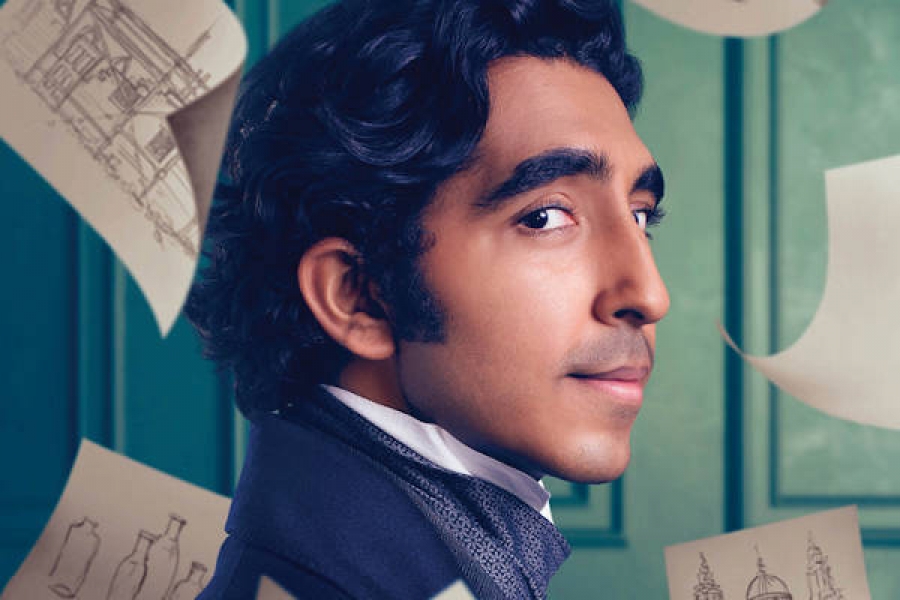
Dev Patel is a perfectly amiable, easy to root for David
Trottwood Daisy Dodi Murdstone Davidson Copperfield. (Ranveer Jaiswal is the
even easier to root for, ludicrously adorable youngster version.) As we see
their tale spun and re-spun, it is, of course, the characters that come and go
that make the biggest impression.
Who? Tilda Swinton (with the year’s best onscreen entrance), Hugh Laurie, Ben Whishaw, Gwendoline Christie, Benedict Wong and Peter Capaldi, among many others. The multiracial cast emphasizes the fanciful fiction, the desire of a writer to create a story better than their own reality. Here, each actor takes character to caricature, but the brashness suits Iannucci’s busy, bursting, briskly paced narrative.
Iannucci hopscotches about the story and timeline in an episodic manner that fits the source material. What results is a charmingly animated rumination on those characters in life who shape our stories, experiences and maybe our character.
We can all get behind an underdog story, although like most of Dickens’s work, David Copperfield isn’t one. It’s the would-be tragedy of a person of good breeding who falls into a life that’s beneath him only to have his proper station returned to him via a happy ending.
Not to poo-poo Dickens, but it’s in the cheery resolution
that the material seems a misfit for the raging if delightful cynicism of the
filmmakers. When Uriah Heap accuses, “You and yours have always hated me and
mine,” the boisterous nature of Iannucci’s film feels ill at ease because of
the line’s pointed honesty. Let’s just right these cosmic wrongs and give the
money back to the people who had it in the first place, shall we?
Still, this David Copperfield has its own lunatic charm to burn. Gone are the laugh out loud moments as well as the bitter aftertaste of Iannucci’s best work, but in their place is a lovely time.