All posts by maddwolf

Creeping Dread

Acute Misfortune

by Brandon Thomas

Movies have always been a grand showcase for the tortured artist. The pain and darkness they use to create have made for some incredible films over the years. What we don’t normally see is how this darkness seeps its way into the lives of the people the artist is closest to. Acute Misfortune offers a bleak look at how the lines between friendship, work and art begin to blur by way of cruelty. 

Young journalist Erik Jensen (Toby Wallace) is sent by the Sydney Morning Herald to interview acclaimed artist Adam Cullen (Daniel Henshall). Despite Cullen’s intimidating presence, Jensen goes on to write a successful piece. Cullen then offers Jensen the job of being his biographer, which leads to the young journalist staying at the artist’s remote mountain home. As time marches on, Jensen finds himself becoming the target of Cullen’s toxic physical and psychological abuse. 

There are many biopics I’ve loved over the years; but the truth of the matter is that most of them are fairly similar, and sometimes rather bland. The same cannot be said of Acute Misfortune. More often than not, this film feels more akin to a simmering thriller. Not being well versed in the true story the movie is based on, I half expected this to turn into a cliche slasher movie.

The film draws its greatest strength from the tension created. The uncertainty around not only the narrative but Cullen’s actions keeps the audience on the edge of its seat. Director Thomas M. Wright films some scenes in backward motion – a cheap, yet effective, trick that pulls us further into the psychological degradation of our principal leads. It’s a visual gag that adds to the feeling of discomfort surrounding Jensen and Cullen’s relationship.

Wright approaches the material very matter-of-factly, neither overly stylish nor pompous in its manner. With its distinct tone, and by shooting in the 1.33:1 aspect ratio, Acute Misfortune recalls the infamous Henry: Portrait of a Serial Killer. Nowhere near as brutal – nor even really the same genre – but the ever creeping sense of unease was still just as palpable. 

With its distinct style and adherence to tone, Acute Misfortune is a powerhouse of tension and dread. 


Origami Original

Attack of the Demons

by Cat McAlpine

Quick! Where were you in 1994? Were you listening to your Walkman and attending local shows? Maybe you were trying to catch classic films at your movie theatre. Or, could you have been haunting the arcade machine at the local diner? No matter where you were, you probably weren’t protecting your small town from a wave of horrific, mutating demons.

Natalie (Katie Maguire), Jeff (Andreas Petersen) and Kevin (Thomas Petersen) suddenly find themselves tasked with just that in Attack of the Demons.

The visual style of Attack of the Demons is undoubtably its greatest strength. Editor, cinematographer and director Eric Power defines his unique style with his second paper cut animated film. While comparisons to South Park are easy to make, what Powers does is way beyond that, with much more layered and complicated vignettes. The details are what really help Attack of the Demons pop, from arcade games to shadows.

Where low-budget indie horror often struggles, Power excels, thanks to his stylistic choices. Monsters and their grotesque transformations don’t look cheesy because they are done so consistently and well within the film’s aesthetic.

With low-budget often comes new talent, and Power’s vision is hampered by weak voice acting and recording quality from a host of new names. But it’s easy to let the cast’s uneasy delivery become a part of Attack of the Demons’ hand-done charm.

There are other weaknesses. Written by Andreas Peterson, the film struggles a bit with pacing, in both story and style. The script itself is a bit cheesy, with weak dialogue and a bevy of characters. If anything, though, this little piece of horror is simply subject to the same shortcomings as other bigger-budgeted films in the genre.

Overall, Attack of the Demons is fun and unlike anything I’ve quite seen. With grunge bands, arcade games, local diners, and a town carnival, it stands on its own while being an homage to all the nostalgia of horror.

If you’re not ready to let spooky season go, Attack of the Demons has a new look for familiar story beats and is sure to scratch your itch.

Family Feud

Let Him Go

by George Wolf

It feels like Kevin Costner and Diane Lane have made ten movies together, doesn’t it? They haven’t, but their low key and lived-in chemistry keeps you constantly invested in Let Him Go, a slow burning and effective revenge thriller aimed squarely at the older demos.

Costner and Lane are George and Margaret Blackledge, a retired Sheriff and his wife loving their status as grandparents to little Jimmy Blackledge in late 1950s Montana. The simple life turns tragic when their son James (Ryan Bruce) dies in an accident, and complicated when their daughter-in-law Lorna (Kayli Carter) marries the brooding Donnie Weboy (Will Brittain).

Donnie’s an abusive husband and stepfather, and without warning, takes Lorna and Jimmy back to his family in North Dakota.

George and Margaret decide to track them all down, finding out pretty quickly the Weboy clan don’t appreciate attention from strangers.

The flashpoint to this Western Gothic blood feud is matriarch Blanche Weboy, brought to scenery devouring life by the glorious Lesley Manville. Dragging on her cigarettes and demanding obedience, Blanche is quick to show the Blackledges how far she’ll go to keep Lorna and their grandson under her thumb.

Writer/director Thomas Bezucha builds the tension well, then uses Manville’s entrance as the natural catalyst for amped intensity. Adapting Larry Watson’s novel, Bezucha carves out the road to vengeance and redemption like a less nuanced Cormac McCarthy. This isn’t poetry, but that doesn’t mean it’s not primal and satisfying.

Costner’s in his comfort zone as a weathered country lawman, more invested and touching than he’s been in years. Lane grounds Margaret with a wounded but determined heart, stepping easily into the soul of the film.

After a tender kiss, a sixty-something husband telling a fifty-something wife, “Don’t start anything you can’t finish” could seem like a cheesy ad for Viagra. It doesn’t here, and that’s a testament to the authentic bonds of time, grief and love formed by Costner and Lane.

Even at nearly two hours, the secondary character development does feel slight, and some thematic possibilities of the Blackledge’s friendship with a young and wayward Native American (Booboo Stewart) are never quite fulfilled.

But Let Him Go is here for the adults at the ranch, with a solid American genre yarn full of few surprises, but plenty of bang for your buckaroo.

Involuntary Tributes

Triggered

by Rachel Willis

If you’re looking for a not-so-scary, violent, sort-of funny horror film this post-Halloween, Triggered might be for you.

Director Alastair Orr’s (Indigenous) latest effort starts with a violent opening, but quickly shifts focus to nine twentysomethings camping in a remote location in the woods. We learn this is a reunion of friends who were involved in a horrible event back in high school.

After a night of partying, the nine wake to find themselves hooked up to bombs, each with a countdown timer. As the friends learn the rules of the “game,” we suddenly find our characters locked in a Hunger Games-type situation. (There’s even a character named Kato.)

It’s hard to root for people fighting for their lives when none of them are very likable. It’s also nearly impossible to give the characters more than superficial identifiers (the smart one, the quiet one, the bad boy, etc.) when there are so many involved. However, the filmmakers do a good job of introducing them slowly over the opening scenes so we can better keep track of who’s who.

If you don’t remember their names, it doesn’t really matter. They’re pawns in a game, not people to care about. It’s a wise move, limiting the time spent getting to know the characters. It thrusts us more quickly into the “kill or be killed” situation, which is a lot more fun.

Some of the film’s jokes land, but most don’t, and it’s hard to build tension when so much of dialogue is a forced attempt at humor. There are a couple of lines that elicit a few good laughs, though. (“That’s the herpes talking!”) If you can ignore some of the weaker moments, you’ll be happier for it.   

A few of the actors really get into their roles, bringing some entertainment value, but others play their parts without enthusiasm, clarifying an imbalance of talent among the nine.

There are few surprises in a movie without much imagination, so don’t expect too much of the revelations as they come – you’ll likely predict most of what’s going to happen before it happens.

However, it’s easy to have fun with this movie – as long as you check your expectations at the door.

Game Off

True to the Game 2

by Darren Tilby

Full disclosure: I never had the pleasure of seeing the first True to the Game movie, and so my thoughts here are based entirely on Jamal Hill’s sequel True to the Game 2 and what little I managed to garner from it about the first movie.

Picking up a year after the murder of her husband – Quadir – by rival gang leader Jerrell (Andra Fuller), Gena (Erica Peeples) is determined to leave her life in Philly behind her, moving to New York City and reinventing herself as a journalist. But the past has a way of catching up, and soon the drug gangs she thought she had escaped are closing in.

At its heart, this is a story of black lives being torn apart by gang violence, and as such, you might expect it to be a profound or maybe even empowering experience. Regretfully, the only thing remotely profound or empowering here is that not absolutely everyone in the film is an utterly detestable stereotype—although most are.

Much of the film relies on broad stereotypes and genre clichés, as it grinds from one scene to the next, and from one two-dimensional character to another. And there are a lot of characters here, in fact too many. Each with their own branching story going on, many of them not particularly well written, and most with arcs never satisfactorily resolved. While there are many perfectly capable performances, I just can’t accept them as believable people.

Quite apart from that, the pacing is off, the soundtrack feels like an afterthought and the plot is quite dull. It’s not bad, but nor is it exciting; there is nothing here that we haven’t seen before, and seen done better. The camera work, however, is really rather splendid. Framing is solid, and how the camera drifts and floats throughout and from scene to scene is skillfully done and pleasing.

True to the Game 2 didn’t work for me, on any level whatsoever. I disliked many of the characters, I was disinterested in the story, and I was bored by the predictability of its cliché-ridden writing. Fans of the first film (True to the Game), and perhaps fervid fans of the crime genre itself, may get something out of this, or at least more than I did. But suffice to say, I won’t be climbing the walls in anticipation for a sequel.

Ship of Ghouls

Blood Vessel

by Darren Tilby

I was excited to see Blood Vessel for two reasons: firstly, it’s a creature feature, which I love. And secondly, I love the deserted/ghost ship setting. Now I’ll be the first to admit I had high expectations for this film, and perhaps they were too high. Because by the end, I was left feeling a little deflated.

Now I want to be absolutely clear when I say Blood Vessel is NOT a bad film. Not by any stretch of the imagination. My main issue with the film comes from the pacing. We follow a group of seven survivors of a German U-Boat attack. Three Americans: Malone (Robert Taylor), Jackson (Christopher Kirby) and Bigelow (Mark Diaco). Two Brits: Nurse, Jane Prescott (Alyssa Sutherland) and codebreaker, Faraday (John Lloyd Fillingham). Also Australian, Sinclair (Nathan Philips) and Russian, Teplov (Alex Cooke). A diverse selection of allied forces.

We join this mixed bag of characters adrift at sea and with dwindling supplies. On the verge of losing all hope, a Nazi minesweeper hoves into view—a visually stunning sequence. Deciding that capture, or possibly even murder by the Nazi’s is better than starving to death the group clamber aboard. But once aboard, the ship seems deserted. Apart from a mysterious young girl (Ruby Isobel Hall) who – in a sequence mimicking Newt’s discovery in Aliens – is found hiding deep in the ship’s interior.

Blood Vessel gets off to a strong start and wastes no time getting the survivors onto the doomed vessel. Director/co-writer Justin Dix employs visuals here, and in fact, throughout the film, that are incredibly compelling and atmospheric. The eerie red hue of the sky and crashing waves of the ocean as the Nazi ship pierces the seemingly unnatural pelagic fog is quite a sight to behold. The movie’s excellent visual quality is maintained in its production design and particularly with its creature effects. And while the creatures themselves are, without a doubt, grotesque and frightening looking, they are never fully utilised.

Which brings me to the issue of pacing; for me, the film’s biggest problem. Which really is a shame because, actually, it starts off so well. But after a long time of exploring the ship and discovering the desiccated and burnt corpses of the ship’s crew (which is fun), we still haven’t learned anything new. And by the time the creatures are released, the events in the story restrict them doing anything that feels worth our wait.

What this does mean, however, is that we get to spend more time with these characters, which isn’t a terrible thing. The quality of the performances throughout the film’s cast is solid, with Alex Cooke’s Teplov really standing out for me. The problem here is the unoriginality of the characters themselves. None really express as anything other than genre typical stereotypes, which isn’t a massive problem for a film like this; character backstories and development aren’t terribly important. But it would have been nice to have seen something a little different.

All things considered, and in spite of a few issues, Blood Vessel is an entertaining enough horror romp. A well-directed, situational horror film with gorgeous cinematography from Sky Davies and John Sanderson’s superb special effects is what awaits anyone daring enough to hop aboard.

Sheep Go to Heaven, Goats Go to Hell

The Dark and the Wicked

by Hope Madden

I’ve been a Bryan Bertino fan since The Strangers because of course I have. How could I not be? That loyalty paid off in 2016 with the moving allegorical horror The Monster, and it rewards viewers again this weekend with the supernatural terror of The Dark and the Wicked.

A twisty old Southern Gothic that relies on practical effects and imagination, the film arrives somewhere in deeply rural America with Louise (a terrific Marin Ireland). She’s about a day behind her brother Michael (Michael Abbott Jr., The Death of Dick Long), back at home because of Dad’s deteriorating health.

Mom (Lynn Andrews) does not want them here.

Bertino is not a filmmaker to let his audience off the hook—if you’ve seen The Strangers, you know that. Like that effort, TD&TW is a slow burn with nerves fraying inside the isolated farmhouse as noises, shadows, and menacing figures lurk outside.

Bertino and cinematographer Tom Schraeder work the darkness in and around the goat farm to create a lingering, roaming dread. There are clumsier moments that feel like pre-ordained audience scares, and they really stand out in a film that otherwise just seeps into your subconscious. But where Bertino, who also writes, scores extra points is in crafting believable characters.

Too often in horror you find wildly dramatic behavior in the face of the supernatural. One character adamantly denies and defies what is clearly happening while another desperately tries to communicate with “it.” No one would do either, but this is the best way to serve the needed action to come in lesser films.

Here, Bertino, Ireland and Abbott give us real characters honestly grappling with something extraordinary.

The don’t want to be here. They don’t want to leave. So, they just do what they can, like the rugged folks they are.

“Well, if I’m here, I’m gonna work.”

Like Natalie James’s Relic from earlier this year, TD&TW has the long, slow, debilitating experience of parental illness on its mind. Like that film, this movie has a deeply aching center that makes the horror in the house as tragic as it is scary, and more horrifyingly, somehow inevitable.

Waiting On a Friend

Come Play

by George Wolf

In a vacuum, Come Play is a fairly smart and mildly jump-scary slice of PG-13 horror for your Halloween weekend. It even finds an unexpected and satisfying way out of the monstrous concept that it fosters.

But the feature debut for writer/director Jacob Chase has trouble escaping the shadow of two other films. One is Larry, Chase’s own short from 2017, and the other is the modern horror classic that clearly inspired him.

Larry is the star of Misunderstood Monsters, a story app that Oliver, a non-verbal autistic boy (Azhy Robertson from Marriage Story), has stumbled onto. Larry says he just wants a friend, but he’s too scary, and Oliver resists.

But Larry just won’t be denied. And it isn’t long before Oliver’s estranged parents (Gillian Jacobs and John Gallagher, Jr.) have to admit they really are being terrorized by an entity let in through the screens on their many devices.

A monster from a troubled child’s story manifests itself in a home unsettled by emotional turmoil. Though the metaphors in Come Play are geared more toward multiplex than art house, the blueprint is plenty familiar.

Chase does prove himself to be an able technician, exhibiting some nifty camerawork and a fine sense of visual creepiness. But the road to his effective finale drags from a lack of solid scares and the feeling of filler that can plague a short film stepping up in class.

There are some valid ideas at work here. They’re not terribly urgent or original, but Come Play isn’t pretending they are. It’s a film with little interest in overthinking, for horror fans not interested in films that do.

Witchy Women

The Craft: Legacy

by Hope Madden

Does The Craft: Legacy miss the Goth Goddess vibe that only Nancy Downs (Fairuza Balk) can bring to a teen horror about high school witchcraft?

Of course it does. All movies do. I can name very few films that would not benefit from at least a touch of Nancy Downs’s magic, although this one does seem to ache for it. Still, writer/director Zoe Lister-Jones does an admirable job of updating the angst, limiting the cattiness, and creating a coven worthy of the best weirdos.

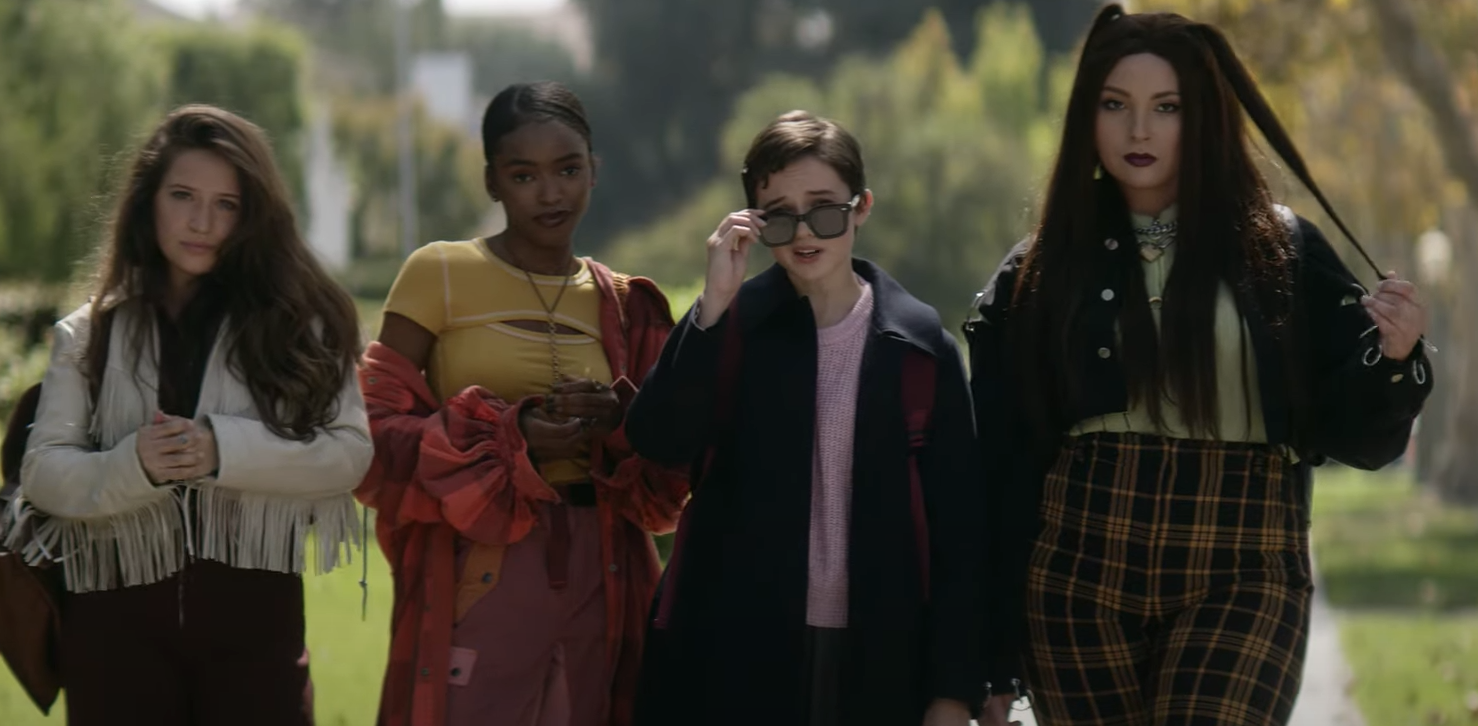
The sequel of the 1996 cult classic drops into modern day suburbia with adorable little outcast Lily (Cailee Spaeny) and her mom (Michelle Monaghan). Mom is moving in with beau Adam (David Duchovny) and his three teenage sons, so Lily is trying to be supportive.

And then, it’s the first day of high school in a brand new school, which is, itself, the worst day of anyone’s life, right? No. This really becomes the worst day—THE WORST—until Lily is rescued by three new friends.

They like her even before they realize that she’s the witch they’ve been waiting for to fill out their coven. Yay!

Lister-Jones creates an atmosphere far more fun and accepting than the one you’ll find in the ’96 original. Written and directed by men (Peter Filardi and Andrew Fleming), The Craft created a sisterhood only to have it destroy itself from within.

In the sequel, girls are told that their difference makes them powerful and only villains seek to control a girl’s power for her.

The result is a lot of fun, although it’s also a film that loses track of its purpose pretty quickly. The stakes never feel especially high, and most of the real drama and peril aren’t introduced until halfway through the film, giving them a tacked on quality. It’s as if Lister-Jones really loved hanging out with these kids and then realized at the last minute she was going to have to give them something to do.

So it’s uneven. Characters are fun and performances are strong. Nicholas Galitzine is especially delightful in what amounts to a dual role. He’s equally convincing in each. Lovie Simone, Zoey Luna and Gideon Adlon round out the coven, and they are as adorable as Lily.

They just really need more to do.