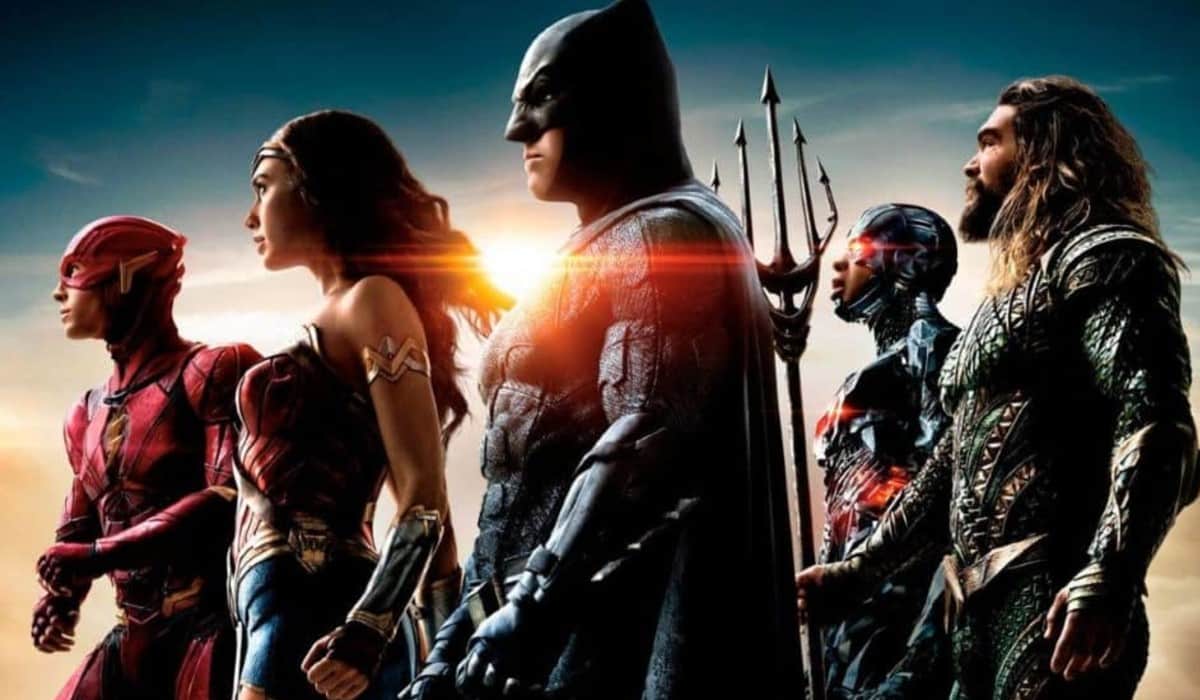
No matter what you thought of Justice League 1.0, the mere arrival of this “Snyder Cut” is fascinating on multiple levels.
It’s more than the Everest of fan service. There just isn’t any way Snyder’s DCEU epic – this version of it anyway – would exist without the Snyder/Whedon mashup mess of 2017.
It’s four freaking hours, people! You think Snyder’s gonna get that (and the extra millions for reshoots) without the whole hashtag campaign? But while the extended time and money giveth, they also taketh away, meaning that first JL debacle can take some ironic credit for all that’s better – and worse – about round two.
But it is indeed better.
More than anything, it’s a singular vision. The first was nothing if not a super-sized compromise, but this is Snyder unbound, no compromises. The 4:3 format is enriched with greatly improved CGI, specifically the “armor of scales” appearance of Steppenwolf (voiced by Ciaran Hinds), the underwater depths of Atlantis and the complete absence of Superman’s (Henry Cavill, again a perfect Clark Kent) distractingly altered upper lip.
The character development – as you would hope with this run time – is much more satisfying, especially with the two justice leaguers we know the least: Flash (Ezra Miller) and Cyborg (Ray Fisher).
And while truly important moments (Superman’s death and rebirth, for example) get the extra time they need to resonate, Snyder can still linger too long (those mini music videos, ugh) when he could be moving on.
Ben Affleck reminds you he’s a fine grizzled Batman, Gal Gadot’s Wonder Woman gets more badass moments and fewer leering camera angels, and at its core, the basic plot remains the same. Steppenwolf is seeking to unite the three “mother boxes” that will conquer another world for his master Darkseid (voiced by Ray Porter). But with the nurturing of return characters and the welcome appearance of new ones (like Darkseid), the chaptered storytelling feels more natural and complete.
Yes it is dark and brooding, and this League may hold the mother lode of daddy issues, but it never becomes tedious. And while you can’t quite call it fun, it is super, and heroic, and sometimes thrilling.
The stinger (actually an epilogue)? It’s a humdinger (nothing rhymes with epilogue), one that will more than satisfy the die hards while setting a major hook for more justice, darkly served.
The Tangle introduces us to a future world controlled by AI where people spend their time jacked into an Eden-esque reality. Information is widely available just by thinking it or asking aloud, and acts of violence are impossible to commit.
When a government agent turns up dead in a locked safe room, her fellow agents (writer/director Christopher Soren Kelly and Jessica Graham) must find out how and why the first murder in years was committed right under their noses.
We now live in a cinematic world where science fiction is more than just large-scale films. Star Trek, The Matrix, 2001 – all of these films have left a lasting impact on the genre. However, small, en vogue movies like Primer and Coherence have wowed audiences with their big ideas despite having budgets that would have only covered catering on Interstellar. The Tangle strives to be one of the latter films with its budget-friendly thinking and world building.
The sci-fi of The Tangle isn’t overtly flashy, nor is it original. Driverless cars roam the streets, and avatars are a common use for those plugged into the Tangle itself. It’s nothing we haven’t seen before. The minimalism works to the film’s advantage as the audience is given more time to focus on theme and character. Sure, it’s fun to “ooh” and “aah” at spectacle, but this isn’t the kind of story Soren Kelly is telling.
The Tangle comes alive as it leans into its more noir-ish elements. Despite the sci-fi window dressing, the film is a mystery through and through.
The classic noir trappings are apparent in nearly every scene. A sizable chunk of the movie takes place in a dimly lit room as the agents interrogate a suspect. The costume design has nods to the noir classics of the 1940s and 50s, and the dialogue is snappy and cool. You could almost imagine a trenchcoat-clad Robert Mitchum delivering a few of these monologues.
In a film this exposition-heavy, it’s important to have a cast that’s up to the challenge. While the leads in The Tangle aren’t household names, they more than hold their own with this tricky, tech-laden script. The cast might be the film’s secret weapon, bringing a sincerity that makes the movie work. There’s not an ounce of camp in any of their performances and that’s exactly what this material is asking for.
While not a groundbreaking entry into the sci-fi genre, The Tangle manages to impress with clever execution, a committed cast, and a fun noir twist.
Your regular Joe Schmo can do anything. He can save the
world. He can even learn to love ballet.
Greville Wynne (Benedict Cumberbatch) was a garden variety salesman in England in 1960, right about the time a highly decorated Soviet leader and member of Khruschev’s inner circle found a clever way to announce to the right people in the West that he wanted to share intel.
Think of The Courier as England’s version of Bridge
of Spies, sort of. There’s even some cast in common.
Essentially it is a solidly made if tight-lipped political thriller
about an unlikely duo racing against time to save humanity.
A bit like The Imitation Game. (Again, cast in
common.)
Director Dominic Cooke has had remarkable success directing
the British stage. His first foray into features, 2017’s On
Chesil Beach, suffered from a choice to keep the protagonists at arm’s
length. The same problem hampers the effectiveness of The Courier.
Merab Ninidze does what he can to come closer. As Oleg
Penkovsky, or Alex, as his friend Greville calls him, Ninidze finds
opportunities for the character to surrender to his own warm nature. He gives the
Russian “traitor” a tenderness and heart that brightens even the greyest scenes.
Cumberbatch is characteristically solid, his demeanor just the right mixture of vanity, insecurity and good-natured humility to make him the perfect salesman. Likewise, Jessie Buckley (Oscar-worthy in last year’s I’m Thinking of Ending Things) and Rachel Brosnahan (I’m Your Woman) provide spot-on support as Greville’s wife and CIA contact, respectively.
The true story itself is tragic, astonishing and in need of public airing. We should know that these men existed and what we owe them. But regardless of a slew of sharp performances, Cooke plays it too safe, leaving us with little to remember.
There is nothing wrong with The Courier. It’s well made and informative. Which is to say, it’s kind of a waste of a great cast and an even better story.
After nearly three years of lawsuits, allegations, finger-pointing and false starts, City of Lies lands in theaters as an engrossing attempt to untangle a web of conspiracy.
Based on LAbyrinth, Randall Sullivan’s non-fiction best-seller about the investigations into the murders of Tupac Shakur and Christopher Wallace (aka Biggie Smalls/Notorious B.I.G), the film leans on stellar performances and solid construction to advance its very clear agenda.
Johnny Depp stars as Russell Poole, the LAPD detective who collaborated on the book, with Forest Whitaker as journalist “Jack” Jackson, a fictional character modeled after Sullivan.
It was Poole’s belief that members of the LAPD conspired with Death Row Records mogul “Suge” Knight to murder both iconic rappers. Poole’s case is not a simple one, but director Brad Furman and first-time screenwriter Christian Contreras are able to deconstruct it and then reassemble the parts with a satisfying amount of thriller intrigue.
Employing shifting timelines and a touch of voiceover narration from Depp, Furman (The Lincoln Lawyer, The Infiltrator) and Contreras find numerous avenues to inform us organically. As the case does come to resemble “a riddle inside an enigma,” our own sense of discovery is consistently nurtured, which naturally increases our investment in what Poole is selling.
Depp and Whitaker make their characters’ gradually increased trust authentic and well-earned, though some of the film’s period detail (especially in the wig and makeup dept.) isn’t exactly on point.
More curious is Furman’s late game decision – just when similarities to JFK are impossible to ignore – to roll out some grainy, slo motion footage that feels wildly misplaced.
And, much like Oliver Stone’s playbook in 1991, there is little interest in leaving equal time for rebutting Poole’s conclusions. Armed with strong accusations that hardly seem like a stretch anymore, this is a film with a complicated story it wants you to hear – and hopefully believe.
But believe it or don’t, City of Lies tells that story in a compelling fashion that doesn’t waste your time.
Does anybody remember those old Shrink to fit only you
501 jeans ads? They are creepier now.
Absurdism meets consumerism in co-writer/director Elza
Kephart’s bloody comedy, Slaxx.
Brightly lit and colorful CCC clothing store—offering high priced garments that are sustainably sourced without sweatshops, GMOs, or any other unsightly thing—is on shutdown to prep for the 8am onslaught as their new line of jeans finally hits the market.
It’s not just any jeans. This denim adjusts to your body and
makes you look even more glorious than you already do. And these jeans fit every
single figure, from 5 pounds underweight to 5 pounds overweight. It’s a dream
come true.
Also, they kill you. Their zipper might bite your hand off,
the legs might slip around your neck like a noose, or the waist might just
slice you in two.
Kephart is not the first filmmaker to animate bloodthirsty clothing. Peter Strickland’s 2018 treasure In Fabric followed a red dress wantonly slaughtering its wearers, while Yong-gyun Kim gave us murderous shoes in 2005’s The Red Shoes. And who can forget Martin Walz’s 1996 glory Killer Condom? (Well, no, they’re not clothes, but you do wear them.)
CCCis the type of trendy clothier that uses terms like ecosystem to define different sections of the store. Kephart’s message is that this kind of establishment is as dedicated to capitalism as any other form, and therefore it enslaves those working at the store, those working for the store before product makes it to their shelves, and even those who show up in hordes to purchase those wares.
Where Romero mainly pointed fingers at the hordes mindlessly drawn to stores like CCC, Kephart sees the villains as those perpetuating clean corporate hypocrisy. Still, it’s their customers and workers she murders—by the pantload.
Profoundly typical in its structure, Slaxx still has
fun with its kills and characters. Romane Denis is likeably earnest as the teen
on her first night at work, while Brett Donahue’s broad stroke sycophant boss
fits into the general tone of the film.
Sehar Bhojani steals every scene as the cynical Shruti, but the jeans are the real stars here. Kephart finds endlessly entertaining ways to sic them on unsuspecting wearers.
Kephart can’t overcome tonal confusion once she and co-scribe Patricia Gomez uncover the source of the jeans’ power. The filmmakers are unable to balance the serious nature of this curse with the brightly colored bloodbath of the previous 80 minutes.
We have certain expectations when it comes to documentaries. Maybe we expect to be informed, enlightened, sometimes moved, and when we’re really lucky, taken on a journey that both surprises and delights us. That’s the case with Selina Miles’s Martha: A Picture Story.
In Martha, Miles has crafted amulti-layered film that paints a vivid portrait of photographer Martha “Marty” Cooper as an artist who is, above all else, true to herself. We also see Cooper as a pioneer from 1963 when at the age of 20 she joined the Peace Corps to be able to “take pictures in foreign places,” followed by her solo motorcycle ride from Thailand to England, her role as the first female intern at National Geographic, and her position as the first female staff photographer at the New York Post in the 1970s.
The heart of the film is Cooper’s personal history of her work in photographing the graffiti scene in New York City of the 70s and 80s, which took it from a national phenomenon to a global phenomenon. Miles goes further in shining a light on the origins of hip-hop culture, the casitas and community gardens that sprouted in vacant lots of a city trying to rebuild itself, and Sowebo, Southwest Baltimore as an impoverished neighborhood on the cusp of gentrification. Cooper photographed it all and we learn that her work is virtually the only meaningful documentation of some cultures.
As Steve Zeitlin, Founder of
City Lore at the New York Center for Urban Folk Culture puts it in the film,
“She’s photographing these corners of life which are often forgotten about.
Having that record of how people lived is important. That’s the only way that
we have of transcending time. And the only thing we’ll have to go back to is
the record that Marty left.”
In the early 80s, Cooper teamed up with photographer Henry Chalfant. Both were attracted to the vibrant graffiti scene and as Cooper puts it, “He was very interested in the art and I was interested in the culture.” Their combined efforts in capturing the art form gave rise to the book, Subway Art, released in 1984 by a German publisher. While the book was a financial loss in its time, it inspired generations of new artists over the following decades and changed visual culture all over the world. Many street artists refer to it as their Bible.
Miles’s filmmaking style parallels and complements Cooper’s story: it’s kinetic and holds our interest. Tight and artful editing keeps the story moving. The music score supports and elevates Miles’s telling of the story of Cooper’s work and her global impact on generations of people and artists worldwide. The contemporary footage, much of which was shot by Miles herself, grounds the film and shows Cooper at the age of 75, still shooting pictures on the street, meeting fans, and even accompanying German graffiti artists on illegal, clandestine hits, racing along with them as they tag subway tunnels and train yards.
Together, Miles and Cooper explore themes such as accepting when something has run its course, the sidelining of marginalized cultures, and the ongoing battle over what is valued as art. At one point, Cooper tells us, “I’m not comfortable with the idea that I’m a legend or icon.”
What about Groundhog Day, but with unrelenting psychological dread? That’s the premise of Johannes Nyholm’s horror fable Koko-di, Koko-da, and it’s a testament to writer/director Nyholm that the film’s excruciating time loop manages to go from torturous to therapeutic.
After a family vacation takes a shocking turn, Tobias (Leif Edlund) and Elin (Ylva Gallon) lose themselves in their own private grief, their marriage one submerged argument away from total annihilation. What better time for a camping trip in the foreboding Swedish forests to get that old magic back?
Their unresolved trauma starts to literally stalk the couple
in the shape of three carnivalesque figures, with each nightmare encounter ending
the same way: some gruesome death, and then Tobias wakes up to repeat the loop
all over again.
The horror of Koko-di Koko-da rarely gets gory.
Tobias and Elin continually suffer extreme violence and torture, but it’s all
(thankfully) implied. Instead, what’s so unnerving about the film is the
inescapable dream logic that suffuses their fateful loop: no matter how hard
Tobias tries or how fast he runs, it’s only a matter of time before the first
strains of the fateful nursery rhyme on which the title is based start up, and
the couple’s shared torture begins anew.
The film’s main down side is that we aren’t allowed to see
or know much beyond the confines of this inexorable—and unrelenting—loop. And
once the metaphor is clear, there’s little else to do besides feel like an
eavesdropper in a long overdue couples therapy session. (An unconventional one,
sure, with more murder and animal attacks than the APA likely recommends, but
who knows what they get up to in Sweden.)
Still, it’s impossible not to feel for the grieving pair.
Anyone deserves some kind of catharsis after enduring such tragedy, and both
Edlund and Gallon manage to make it feel earned, even with their thinly
detailed characters.
Koko-di Koko-da is not a pleasant film to watch, but it is often a beautiful one. And it lays bare the truth that there’s no escaping misery in life—that the only way to break the cycle is to confront it, pain and all.
It was a weird year for movies. When the world shut down, so did
production, so far fewer movies were being shot because when they did keep
filming, Robert Pattinson got Covid, and nobody wants that.
When movie theaters shut down, movies went directly to streaming, so
Oscar made the unprecedented (and correct) decision to include films without
theatrical releases in their body of contenders. That turned out to be a good
idea since no one went to the theaters even when they opened back up.
They also widened the window of eligibility, which means that 14
months’ worth of movies were in the running. What does that mean for 2021? Will
the 2021 eligibility calendar be just 10 months long? Will we forever push the
eligibility deadline back to March to keep it at 12? That choice will have a
bigger impact on what comes out when than you think. What it means for 2020 is
that small films that you hoped would get notice—First Cow
and Shirley, for example—still got swamped in the larger pool, and
recency bias potentially helped voters forget about films that came out early
in 2020. Let’s be honest, early 2020 feels like 1976 by this point.
It was just so long ago.
On the whole, though, we don’t have too many complaints about the
Academy’s 2020 Oscar choices. Independent films just kicked all manner of ass
this year.
Best Film
The Father
Judas and the Black Messiah
Mank
Minari
Nomadland
Promising Young Woman
Sound of Metal
The Trial of the Chicago 7
Thoughts:
Again, the Academy can potentially include 10 candidates. A film
has to reach a low-end threshold of votes to be included, which is why those
last couple of slots are usually left vacant. If we could fill them, Soul and First
Cow would certainly have made this list.
Lead Actress
Viola Davis, Ma Rainey’s Black Bottom
Andra Day, The United States Versus Billie Holiday
Vanessa Kirby, Pieces of a Woman
Frances McDormand, Nomadland
Carey Mulligan, Promising Young Woman
Thoughts:
Killer lineup. It’s painful to see another year go by without
acknowledging the sublime Elizabeth Moss, but honestly, this group is hard to
complain about.
Lead Actor
Riz Ahmed, Sound of Metal
Chadwick Boseman, Ma Rainey’s Black Bottom
Anthony Hopkins, The Father
Gary Oldman, Mank
Steven Yeun, Minari
Thoughts:
These five performances are undoubtedly award worthy. But where is
Delroy Lindo for Spike Lee’s almost completely overlooked Da Five
Bloods? We probably would give him the Hopkins or Yeun spot, but we would
definitely have made room for him.
Supporting Actress
Maria Bakalova, Borat Subsequent Movie Film
Glenn Close, Hillbilly Elegy
Olivia Colman, The Father
Amanda Seyfried, Mank,
Youn Yun-jung, Minari
Thoughts:
How great is it to see Youn Yun-jung on this list?! Close is the sentimental favorite because she has inexplicably never won an Oscar regardless of her 8 nominations and mind blowing talent, but please God please don’t let her win for the abomination that was Hillbilly Elegy.
Supporting Actor
Daniel Kaluuya, Judas and the Black Messiah
Sacha Baron Cohen, The Trial of the Chicago 7
Leslie Odom Junior, One Night in Miami
Paul Raci, Sound of Metal
LaKeith Stanfield, Judas and the Black Messiah
Thoughts:
It’s impossible not to note that there are three Black actors on
this list—a historic moment and one worth celebrating. Most people assumed
Chadwick Boseman would be on this list for his role in Da 5 Bloods.
We’re wondering, though: if LaKeith Stanfield is a supporting actor, who was
the lead in Judas and the Black Messiah?
We’d also loved to have seen Michael Stuhlbarg squeezed in here
for his brilliant turn in Shirley, but to be totally honest, we
loved all these performances and have no serious complaints. Just questions.
If Kaluuya doesn’t win, the Academy is wrong.
Director
Thomas Vinterberg, Another Round
David Fincher, Mank
Lee Isaac Chung, Minari
Chloe Zhao, Nomadland
Emerald Fennell, Promising Young Woman
Thoughts:
Regina King (One Night in Miami) and Aaron Sorkin (The
Trial of the Chicago 7) are notable absences, and Vinterberg is the
obvious surprise here. We’d have loved to see Kelly Reichardt get some love
for First Cow, but that’s asking too much, we know.
Adapted Screenplay
Borat Subsequent Movie Film
The Father
Nomadland
One Night in Miami
The White Tiger
Thoughts:
The White Tiger is a pleasant surprise. When you think of Borat
Subsequent Movie Film, you don’t think of writing. You think of one guy
riffing, and you’re so surprised that he isn’t murdered in front of you that
you ignore the incredible amount of planning and, yes, writing that must go
into it. Good for the writing pool of the Academy for seeing past that potential
murder to take note.
Original Screenplay
Judas and the Black Messiah
Minari
Promising Young Woman
Sound of Metal
The Trial of the Chicago 7
Thoughts:
Not a ton of surprises here. We’d love to see Soul in
this bunch, but we don’t know where we’d put it. 2020 was a bad year all
around, but it was a great year for original films.
Documentary
Collective
Crip Camp
The Mole Agent
Octopus Teacher
Time
Thoughts:
Year after year, documentary feature gets to be a tighter and
tighter race. In recent years there are more documentaries worthy of true
consideration than there are features. We’d loved to have seen Boys
State and/or Capital in the 21st Century on
this list, but this is a smart group and its content and style run a big gamut.
Smart money is probably on Collective because it’s also
nominated for International Picture, but we’d give it to Time all
day.
Animated
Onward
Over the Moon
A Shaun the Sheep Movie: Farmageddon
Soul
Wolfwalkers
Thoughts:
It was an incredibly weak year in big screen animation,
although Wolfwalkers was an incredible film that you should
find and watch immediately. And Soul was quite possibly the
best movie to come out in 2020, so at least it will get its due here.
Catch the 93rd annual Academy Awards Sunday, April
25th on ABC.
The beautifully clear, almost neon blue water of Freeport, Bahamas provides an idyllic backdrop for the broadly-brushed and easily digested drama of Dolphin Island, an acceptable adventure for the 10 and-under set.
Since her parents died in a diving accident nine years ago, 14 year-old Annabelle (Tyler Jade Nixon) has lived with her fisherman grandfather Jonah (Peter Woodward). Annabelle loves to help Jonah on the boat, stroll through the docks saying hello to everyone by name, a la Mr. Rogers, and swim with her dolphin bestie, Mitzy.
Trouble comes in the form of Robert Carbunkle, Esq. (Bob Bledsoe), an unscrupulous lawyer representing Annabelle’s maternal grandparents – a rich New York couple who think Annabelle would be better off with them.
As Carbunkle starts manufacturing dirt about Annabelle’s living situation, she and Jonah will need help from a social worker (Dionne Lea), her handsome son (Aaron Burrows), and one incredible dolphin (Mitzy) to save the day and keep Annabelle at home on the island she loves.
Director/co-writer Mike Disa – a veteran of kids’ tv and video – steers the nicely diverse cast through a surface level drama that’s sanitized for family protection. In this world, even a 14-year-old is too young to understand serious illness and someone is always ready to explain things we can clearly see happening for ourselves.
But who doesn’t love dolphins and Caribbean locales?
If your young ones do, Dolphin Island will entertain them for 90 minutes while you daydream about visiting Mitzy’s home in person.
Our son Donovan joins us this episode, so obviously the best idea is to look into horror movie families that make ours look downright wholesome. Check out the boy’s band, NEW PLAGUE RADIO!
6. The Woman (2011)
Forget Pollyanna McIntosh for one minute (if that’s even possible). One of many reasons that Lucky McKee’s powerhouse of horror is so memorable is that McIntosh’s feral cannibal (who must smell awful) is not the scariest person on screen.
There’s something not quite right about Chris Cleese (an unsettlingly cherubic Sean Bridgers), and his family’s uber-wholesomeness is clearly suspect. This becomes evident once Chris hunts down a wild woman, chains her, and invites the family to help him “civilize” her.
It doesn’t go that well for anybody, really, in a film rethinks family.
Well, patriarchy, anyway.
https://www.youtube.com/watch?v=GL50yBcw5wA&t=27s
5. The Texas Chainsaw Massacre (1974)
Poor, unlikeable Franklin Hardesty, his pretty sister Sally, and a few other friends head out to Grampa Hardesty’s final resting place after hearing the news of some Texas cemeteries being grave-robbed. They just want to make sure Grampy’s still resting in peace – an adventure which eventually leads to most of them making a second trip to a cemetery.
But that’s not the family we’re after. The clan that will come to be known as the Sawyers begin humbly enough in Toby Hooper’s original nightmare: a cook, a hitchhiker, a handyman of sorts, and of course, Grandpa.
There are so many moments to recall. Maybe it’s the slamming metal door, or the hanging meat hook, or the now iconic image of the hysterical and blood-soaked Sally Hardesty hugging the back of a pick up truck bed as the vehicle speeds away from Leatherface.
Or maybe it’s dinner, when Hooper really gives us some family context. He uses extreme close up on Sally’s eyeball as she takes in the bickering family lunacy of a dinner table quite unlike any we’d seen before.
4. The Lodge (2019)
It’s Christmas, and regardless of a profound, almost insurmountable family tragedy, one irredeemably oblivious father (Richard Armitage) decides his kids (Jaeden Martell and Lia McHugh) should get to know the woman (Riley Keough) he left their mother for. A week in an isolated mountain cabin during a blizzard should do it.
Dad stays just long enough to make things really uncomfortable, then heads back to town for a few days to work. Surely everybody will be caroling and toasting marshmallows by the time he returns.
What is wrong with this guy?! And it’s not just him. Turns out his kids are pretty seriously messed up as well. But fear not (or fear a lot) because Grace has some profound family dysfunction to fall back on, and pretty soon it’s just a guess as to who’s going to out-dysfunction the other.
3. We Are What We Are (2010)
In a quiet opening sequence, a man dies in a mall. It happens that this is a family patriarch and his passing leaves the desperately poor family in shambles. While their particular quandary veers spectacularly from expectations, there is something primal and authentic about it.
It’s as if a simple relic from a hunter-gatherer population evolved separately but within the larger urban population, and now this little tribe is left without a leader. An internal power struggle begins to determine the member most suited to take over as the head of the household, and therefore, there is some conflict and competition – however reluctant – over who will handle the principal task of the patriarch: that of putting meat on the table.
Jorge Michel Grau’s We Are What We Are is among the finest family dramas or social commentaries of 2010. Blend into that drama some deep perversity, spooky ambiguities and mysteries, deftly handled acting, and a lot of freaky shit and you have hardly the goriest film ever made about cannibals, but perhaps the most relevant.
2. Raw (2016)
Justine (Garance Marillier, impressive) is off to join her older sister (Ella Rumpf) at veterinary school – the very same school where their parents met. Justine may be a bit sheltered, a bit prudish to settle in immediately, but surely with her sister’s help, she’ll be fine.
Writer/director Julia Ducournau has her cagey way with the same themes that populate any coming-of-age story – pressure to conform, peer pressure generally, societal order and sexual hysteria. Here all take on a sly, macabre humor that’s both refreshing and unsettling.
Because what we learn is not just that Justine’s sister will not be a good mentor, or that there is definitely something wrong with Justine. By the blackly hilarious final moments on the screen, we see the big family portrait.
1.Hereditary (2016)
What else?!
With just a handful of mannerisms, one melodic clucking noise, and a few seemingly throwaway lines, Aster and his magnificent cast quickly establish what will become nuanced, layered human characters, all of them scarred and battered by family.
Art and life imitate each other to macabre degrees while family members strain to behave in the manner that feels human, seems connected, or might be normal. What is said and what stays hidden, what’s festering in the attic and in the unspoken tensions within the family, it’s all part of a horrific atmosphere meticulously crafted to unnerve you.
Aster takes advantage of a remarkably committed cast to explore family dysfunction of the most insidious type. Whether his supernatural twisting and turning amount to metaphor or fact hardly matters with performances this unnerving and visual storytelling this hypnotic.