This week’s new releases in the screening room: Predator: Badlands, Christy, Die My Love, Train Dreams, Lost & Found in Cleveland, Nuremberg, and Down to the Felt.
This week’s new releases in the screening room: Predator: Badlands, Christy, Die My Love, Train Dreams, Lost & Found in Cleveland, Nuremberg, and Down to the Felt.
by George Wolf
No matter what you think of Sydney Sweeney the celebrity glamour girl, you’ve got to give her props for not resting on her sexy laurels. I’m not saying her turn in the bikini-friendly Anyone But You didn’t show fine comic timing, but in five of her last seven films, Sweeney has chosen roles that downplayed her curves and provided the chance to challenge herself as an actress.
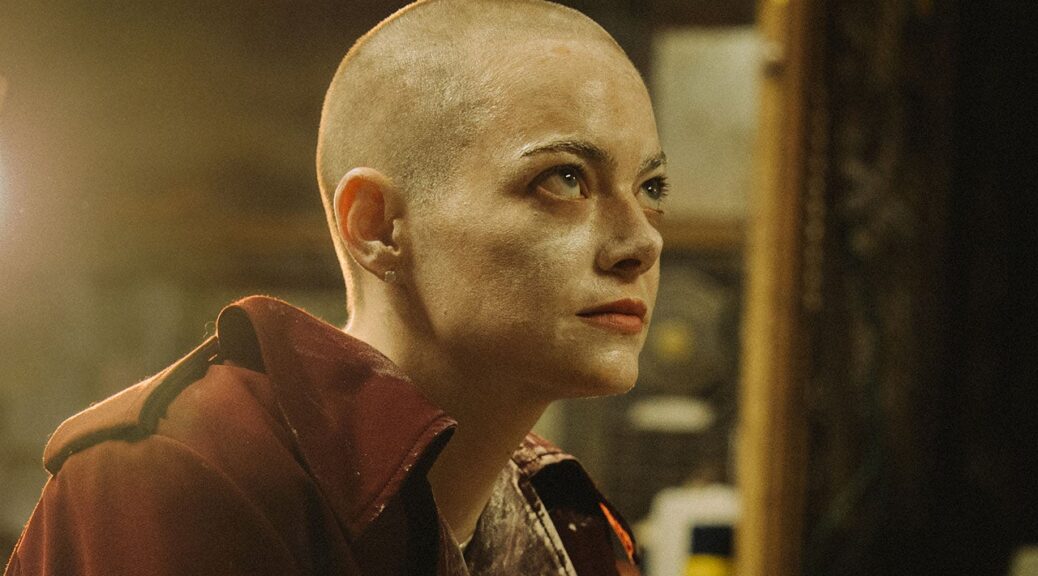
Okay, so Echo Valley, Eden, American, Immaculate and Reality didn’t make the box office buzz, but Christy continues Sweeney’s ambitious trend. And right on the cusp of awards season, she doesn’t waste the opportunity to impress, leading a stellar ensemble in giving some well-deserved flowers to a trailblazer in women’s sports.
In 1989, Christy Salters was a bored girl from West Virginian who played a very physical brand of basketball and bristled when her mother (Merritt Weaver) obsessed over the whispers about Christy’s relationship with girlfriend Rosie (Jess Gabor). After winning $300 in a local Toughman contest, Christy is introduced to boxing trainer/future husband Jim Martin (Ben Foster), who guides her, exploits her and violently abuses her on Christy’s path toward becoming Don King’s “Coal Miner’s Daughter,” the first woman to headline a PPV undercard.
Boxing films may carry the most inherent cliches of all sports stories and director/co-writer David Michôd can only steer Christy around them about half the time. As Christy’s fame and fortune grew, the level of abuse she suffered only intensified, to a level that will surprise many. And when Michôd (Animal Kingdom, The Rover) finds small moments to accentuate with a dramatic camera angle or well-timed edit, the performances from Sweeney and Martin find resonant depth.
We’re used to exemplary work from Foster, and here he makes Jim Martin a slippery, violent gas-lighter with just enough relatable edges to avoid caricature. Sweeney responds with committed grit, and Christy’s battles both in and out of the ring elicit sympathy, respect and admiration.
Even so, the biggest challenge to telling a story so personal is the temptation of throwing too many formulaic haymakers. When Christy can do that, it becomes a film worthy of Martin’s fight.
Winner by split decision.

New in the screening room this week: Bugonia, Stitch Head, Ballad of a Small Player, It Was Just an Accident, Anniversary, and Indera.
by George Wolf
Driving home one night with his wife and daughter, a man strikes and kills a stray dog that runs into the road. It is simply an accident, an innocent mishap.
But accidents and innocence are seldom part of Iranian filmmaker Jafar Panahi’s intricate parables, and 2025 Palme d’Or winner It Was Just an Accident quickly becomes the latest searing indictment of injustice and corruption in his homeland.
After hitting the dog, Eghbal (Ebrahim Azizi) takes his car in for service. At the shop, Vahid (Vahid Mobasseri) instantly thinks he recognizes Eghbal as the intelligence officer who brutalized Vahid and his fellow political prisoners years before.
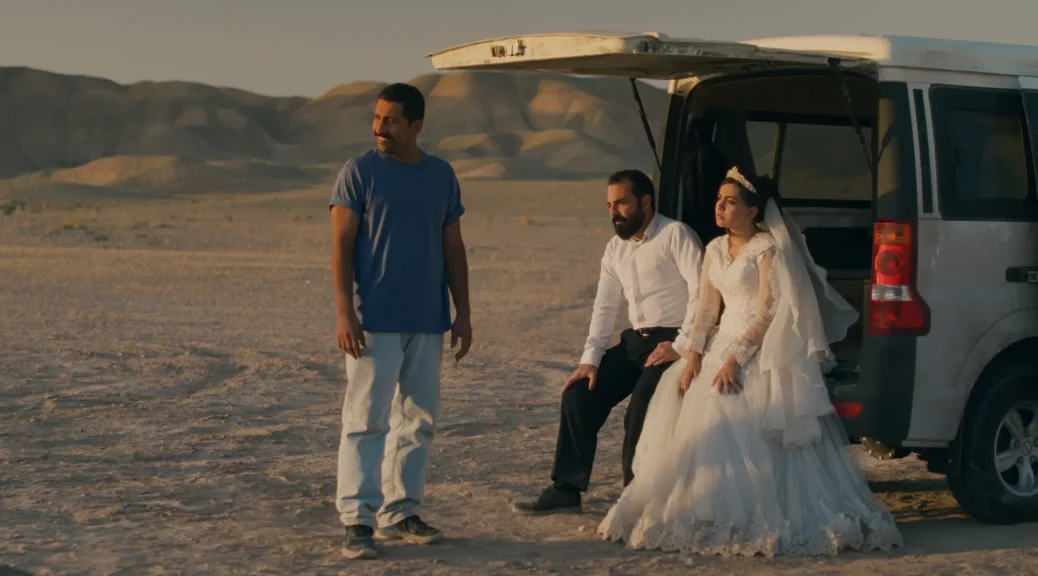
Vahid kidnaps Eghbal and is on the verge of killing him, when doubt creeps into his mind. Loading the unconscious Eghbal in the back of his van, Vahid heads out to find his fellow ex-inmates and some help in an airtight identification. The compatriots (including a bride, a groom, and a wedding photographer) react with a mixture and rage and uncertainty, and their travel over the course of one day allows Panahi to organically detail the abuse they once suffered and the casual corruption they still navigate daily.
This is the first film for Panahi (No Bears, Taxi, Closed Curtain) since Iran lifted his decade-long filmmaking and travel ban, and while he’s no longer filming himself in secret, Panahi’s storytelling still bursts with intimacy and courage.
The first rate ensemble makes the anger palpable, and Panahi masterfully weaves it into the mystery surrounding Eghbal’s guilt to create a thriller of simmering tension, comic sidebars and complex moralities.
If Eghbal is indeed their tormentor, is vengeance justified? And even if it is, would mercy actually bring them more peace?
True to form, Panahi closes with a shot that seems to close one chapter and open another, and the fade to black may require a few minutes to decompress.
But that’s the kind of effect Panahi’s films can have. It Was Just an Accident is more proof that he is one of the true modern-day masters, with a clear and distinctive voice that demands attention.

by George Wolf
Many fans of Lawrence Osborne’s 2014 book Ballad of a Small Player won’t be surprised to learn how long the film adaptation was stuck in development. The tale presents a tricky narrative tone, mixing metaphor, dark comedy and psychological mind games for a ride of desperate obsession.
Director Edward Berger and star Colin Farrell are all in for the Netflix version, but they leave the final table a little short of the jackpot.
Farrell is Lord Doyle, on the run in the Chinese region of Macau. Doyle needs to settle a $350,000 casino tab in three days or he’ll be arrested. But there are plenty of other glitzy casinos to visit, and Doyle works whatever angle he can to get credit at the baccarat tables, always promising that big score that never comes.
He seems to meet a kindred spirit in Dao Ming (Fala Chen), a casino manager who takes pity on Doyle’s lonesome loser nature. It is the Festival of the Hungry Ghosts in Macau, and Dao Ming may have some surprising burnt offerings in mind.
While the two begin to form a fragile bond, private investigator Cynthia Blithe (Tilda Swinton) is on Doyle’s tail, and may finally force him to confront the secret life he has been hiding.
Farrell brings sympathy to Doyle’s downward spiral in writer Rowan Joffe’s adaptation, making it easier to accept a third act that surprises no one. Swinton carves her usual glory out of limited screen time, and Chen gives Dao Ming the mysterious grace of possible salvation. Kudos as well to Deanie Ip as Grandma, an ultra-rich gambler who has no trouble sizing Doyle up in hilarious fashion.
Berger (All Quiet on the Western Front, Conclave) brings his own air of desperation, filling each frame with a forced showiness that wears out its welcome pretty quickly. There’s no doubt many set pieces are bursting with color and beauty, but the attempts to blur the real and surreal are so forced it begins to detract from the pleasure of watching these actors claw closer to that final reveal.
Ballad of a Small Player has no problem reminding you that the source is probably a great read. Watching it unfold – in select theaters, or on Netflix – is just too frustrating to rise above pretty good.
Hope and George cover this week’s new releases: Springsteen: Deliver Me From Nowhere, Frankenstein, Blue Moon, Shelby Oaks, The Hand That Rocks the Cradle, Stiller & Meara: Nothing Is Lost, and Last Stop: Rockafort St..
by George Wolf
My sister-in-law Ellen still tells the story of when she bought Bruce Springsteen’s new album Nebraska in 1982. She was a college student, and was ready to rock out in her dorm room with the guy who was coming off the top ten singalong smash “Hungry Heart.”
What she got was a collection of stark, acoustic songs about murder, desperation and dead dogs. Not much to dance to.
Why would a rock star on the verge of global superstardom make such an unexpected move?
Writer/director Scott Cooper explores that question with Springsteen: Deliver Me From Nowhere, a heartfelt and emotional story of a man caught between the echoes of his past and the promise of his future.
Jeremy Allan White is sensational as Bruce. The look is right, and White’s playing and singing often get eerily close to the real thing. But even more than that, White captures the tortured soul of a rising phenom seemingly terrified of the success he knew was suddenly within his grasp.
Adapting Warren Zanes’s 2023 book, Cooper revisits some themes from his Oscar-winning Crazy Heart and makes the film a collection of small moments that capture a pivotal snapshot in the life of a living legend.
And none of it pushes too hard. Glimpses of a Flannery O’Connor book, the movies Badlands and Night of the Hunter, and the Suicide song “Frankie Teardrop” quietly tell us much about Bruce’s inspirations for the album. Black and white flashbacks to Bruce’s childhood with a troubled father (Stephen Graham) and a protective mother (Gaby Hoffmann) take a similarly understated approach, effectively layered as the lingering memories they were.
Bruce’s relationship with fictional girlfriend Faye (Odessa Young) begins as an awkward choice amid all this attention to detail, but the device ultimately gives us some insight into his fear of any happiness he felt was undeserved.
Lighter moments do come, almost always with the reactions to Bruce’s new direction. Manager Jon Landau (yet another terrific supporting turn from Jeremy Strong) gently tries to steer him toward the songs that would become Born in the U.S.A., while a record exec (David Krumholtz) throws up his hands in exasperation. And through it all, everyone (including Marc Maron as longtime engineer Chuck Plotkin) keeps wondering where the case is for Bruce’s cassette of homemade demos.
Bruce fans know well that those demos became the album, one now regarded as a seminal statement of untold influence. Those longtime followers will appreciate Cooper’s respectful approach that doesn’t feel the need to explain who people like Jon Landau are and where they fit in.
Because even for people who haven’t listened since 1982, Deliver Me From Nowhere presents a richly satisfying story of inspiration, artistic passion, and finding an inner peace that has long eluded you.
And yes, there’s a bit of “Born to Run” in here, too.
by George Wolf
Even at its most fun, 1992’s The Hand That Rocks the Cradle was a bit of a guilty pleasure. Hulu’s new update strips away the overdone pulp for a more focused, and more primally scary tale.
Caitlin (Mary Elizabeth Winstead) is an L.A. lawyer who diligently screens her children’s food for sugars and aims to get a new stop sign for her neighborhood. Working at a tenants rights group, Caitlin helps Polly (Maika Monroe) with a landlord problem, and when the two cross paths again at a local market, fate seems to have dealt a good hand.
Polly has experience as a nanny, and she comes with a glowing recommendation from her last employer. She looks like the perfect choice to help Caitlin and her husband Miguel (Raúl Castillo) with young Emma (Mileiah Vega) and baby Josie (Nora and Lola Contreras).
Caitlin chooses poorly.
Screenwriter Micah Bloomberg (Sanctuary) updates the original story with some important twists, and director Michelle Garza Cervera sets a pace that lets the gaslighting, secrets and lies simmer nicely before boiling over.
Cervera crafted an impressive maternal nightmare three years ago with her feature debut, Husera: The Bone Woman. Here, she trades the religious imagery for symbols of upwardly mobile success, while still toying with anyone eager to check boxes of good mother/bad mother.
Winstead and Monroe are both terrific, bringing their characters into a dance of identity with menacing dread. There is more to Caitlin than her liberal guilt, and as Polly twists the knife with increasing sociopathy, Cervera’s instincts for a modern horror thriller are again solid.
Is any remake truly “necessary?” Debatable. But even back in ’92, the original film seemed like one that wouldn’t age particularly well. The questionable decisions remain, and one or two story beats are foreshadowed too heavily, but by the time all secrets are revealed, this Cradle rocks with some newly relevant bloodletting.
by Hope Madden and George Wolf
Luca Guadagnino likes a provocative tale of challenging relationships, opportunists and lovers. With lush visuals. And sometimes peaches. His fruit free triangle of sorts, After the Hunt, considers and reconsiders a “he said/she said” in the ever-fluctuating moral landscape of higher education.
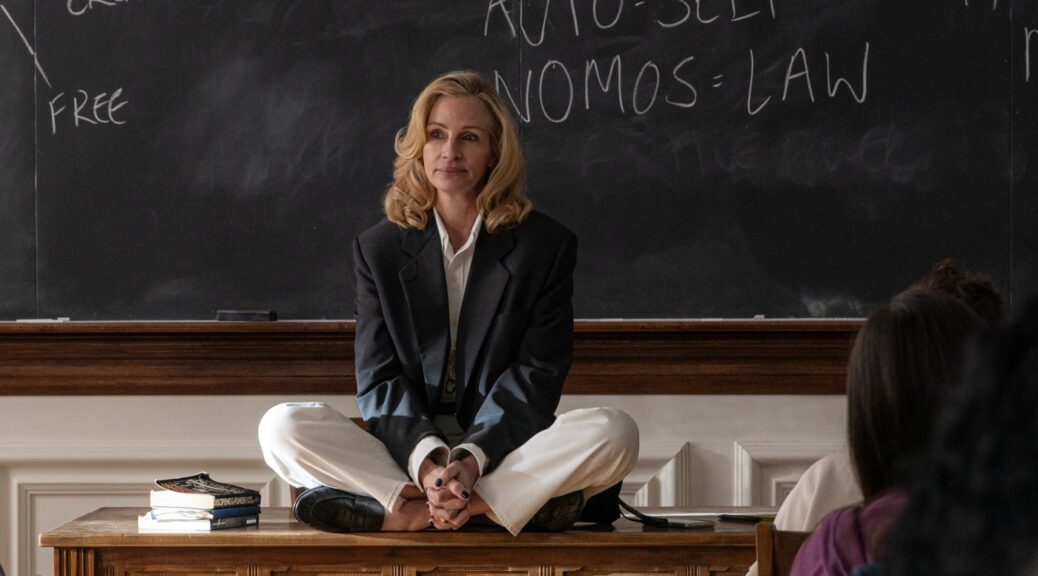
Julia Roberts is Yale philosophy professor Alma Imhoff. She and her husband, Frederik (Michael Stuhlbarg), are awaiting word on Alma’s tenure, alongside her very close colleague, Hank (Andrew Garfield). But when star student Maggie (Ayo Edebiri) makes an accusation, Alma faces a conundrum. She should believe Maggie, but does she? She should come to her aid, but will that be a risk to her tenure?
That barely scratches the surface of all the pathos and conniving, manipulation and secrecy, and above all, opportunism afoot in this fascinating but cumbersome thriller.
First time screenwriter Nora Garrett bites off more than she can chew, but her commitment to looking at every angle is both laudable and often fascinating. It’s rarely satisfying, but the densely textured characters provide rich opportunities for this talented cast.
Sure, these are caricatures of academia – like those dinner party people on South Park who like to smell their own farts – but Guadagnino, Garrett and cast are so entrenched in the melodrama you can’t help but be sucked in.
Roberts is an effective mix of conflict and entitlement, and Garfield is especially good as a man so sure of his superiority that an accusation against him seems like an affront to human evolution itself. Stuhlbarg finds his usual ways to make a supporting role memorable, especially when Frederik takes offense to Maggie’s suggestion that he may be a wee bit out of touch.
And ironically, that’s as issue that dogs the film. It wants to lead and provoke, but the worthy issues it raises are so malleable that much of verbal sparring already feels a half step behind the conversation. An epilogue that shrugs at the whole affair only neuters the search for clarity.
Like Ari Aster’s Eddington, After the Hunt is bound to offend people because of its absolute refusal to take sides or tidy up motivations. Like Aster’s film, Guadagnino’s latest is far more interested in philosophy and the muddy concept of morality in the context of success—particularly when everyone involved is damaged in one way or another.
We are horror movie superfans. Maybe you are too. So today, let’s celebrate our own. Would we eat the object of our affection just to keep them close? No – think of the cholesterol! But we can get behind some of these behaviors, we’re not going to lie.
5. The Fan (1982)
The first thing Eckhart Schmidt’s film has in its favor is that the audience is meant to empathize with the fan, Simone (Désirée Nosbusch). Generally, we see the fanatical from the celebrity’s point of view, but this makes more sense because every member of the audience is more likely to have lost their shit over a teen idol than they’ve been worshipped themselves.
And yet, Simone clearly has a screw loose. Schmidt’s approach to her obsession as seen through the eyes of worried parents, apologetic postmen and other adults is confused and compassionate. Teenage girls – who can understand them? The tone is ideal to set up the explosive heartbreak you know is coming, as well as a third act you couldn’t possibly see coming.
4. Perfect Blue (1997)
This psychosexual thriller might feel garden variety if it had been made into a live action film. A young woman trades in her innocent image to take on more suggestive roles as an actress, only to find her fans turning on her in violent ways. Or is it an internal conflict over the way men and the media need to sexualize her that’s fragmenting her own mind?
In director Satoshi Kon’s anime vision, those familiar thriller tropes take on an unseemly dreamy quality. The animation style suggests more about the way mass media consumes a sexualized idea of innocence than any live action film could muster, and the hallucinatory quality achieved in the film would never have played this well in any other style.
3. Play Misty for Me (1971)
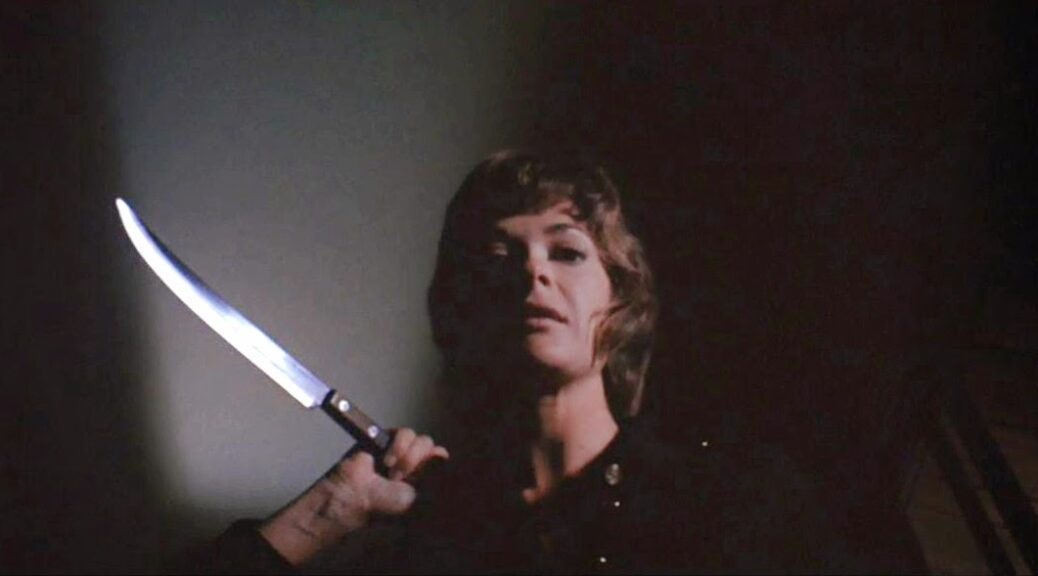
Clint Eastwood made his directorial debut with this cautionary tale. Free-wheeling bachelor and jazz radio DJ Dave Garver (Eastwood) picks up a fan (Julie Walter) in a local bar, but it turns out she’s an obsessive and dangerous nut job.
You can see this film all over later psycho girlfriend flicks, most notably Fatal Attraction, but it was groundbreaking at the time. To watch hard edged action hero Eastwood – in more of a quiet storm mode – visibly frightened by this woman was also a turning point. We’re told the shag haircut sported by Donna Mills also became quite the rage after the film debuted in ’71.
Eastwood capitalizes on something that all the rest of the films on this list pick up – that voice on the radio is actually a person who’s somewhat trapped. You can hear him, but you can’t necessarily help him. He’s both public and isolated. Eastwood’s slow boil direction and Walter’s eerie instability infuse the soft jazz sound with an undercurrent of danger that generates unease in every frame.
2. Chain Reactions (2024)
Not everyone believes Tobe Hooper’s The Texas Chain Saw Massacre is a masterpiece of American filmmaking. I find those people suspicious. Luckily, those are not the people filmmaker Alexandre O. Philippe (Memory: The Origins of Alien, 78/52) talks to for his latest documentary, Chain Reactions.
Philippe’s approach is that of a fan and an investigator. When Patton Oswalt compares Hooper scenes to those from silent horror classics, Philippe split screens the images for our consideration. When Karyn Kusama digs into the importance of the color red, Chain Reactions shows us. We feel the macabre comedy, the verité horror, the beauty and the grotesque.
What you can’t escape is the film’s influence and its craft. The set design should be studied. Hooper’s use of color, his preoccupation with the sun and the moon, the way he juxtaposes images of genuine beauty with the grimmest sights imaginable. Chain Reactions is an absolute treasure of a film for fans of The Texas Chain Saw Massacre.
1.Misery (1990)
Kathy Bates had been knocking around Hollywood for decades, but no one really knew who she was until she landed Misery. Her sadistic nurturer Annie Wilkes – rabid romance novel fan, part-time nurse, full-time wacko – ranks among the most memorable crazy ladies of modern cinema.
James Caan plays novelist Paul Sheldon, who kills off popular character Misery Chastain, then celebrates with a road trip that goes awry when he crashes his car, only to be saved by his brawniest and most fervent fan, Annie. Well, she’s more a fan of Misery Chastain’s than she is Paul Sheldon’s, and once she realizes what he’s done, she refuses to allow him out of her house until she brings Misery back to literary life.
Caan seethes, and you know there’s an ass-kicking somewhere deep in his mangled body just waiting to get out. But it’s Bates we remember. She nails the bumpkin who oscillates between humble fan, terrifying master, and put-upon martyr. Indeed, both physically and emotionally, she so thoroughly animates this nutjob that she secured an Oscar.