Tag Archives: Screen Wolf

To Have and Have Not

The Forgiven

by George Wolf

When we first meet the idly rich people that populate the opening minutes of The Forgiven, they seem laughably idle and cartoonishly rich, more fitting for a satirical comedy than a searing sociopolitical thriller.

But it isn’t long before you appreciate the purposeful precision in writer/director John Michael McDonagh’s adaptation of Lawrence Osborne’s bestseller. The excess is this wretched for a reason, as the contrast between privilege and honor takes on a classic, Hemingway-esque flavor.

Flamboyant couple Richard (Matt Smith) and Dally (Caleb Landry Jones) are hosting an annual weekend bacchanal at their lavish retreat in the middle of the Moroccan desert. As numerous Westerners are attended by a staff of native Moroccans, unhappily marrieds Jo and David Henniger (Jessica Chastain and Ralph Fiennes) are making the long drive to the party.

The couple argues about which turnoff is correct, David takes his eyes off the road and strikes a Moroccan teen named Driss (Omar Ghazaoui) – killing him. Richard helps to smooth things over with the local police captain (Ben Affan), but word spreads to the villagers, and soon Driss’s father (Ismael Kanater) is demanding that David follow custom and make the long journey to the boy’s burial.

David agrees, setting up McDonagh’s fascinating examination of worlds colliding.

Jo instantly indulges the attention of Tom, a playboy financial analyst (Christopher Abbot), which gives the servants yet another affirmation of their guests godless natures. The wealth of the expats guarantees a life free of consequence, but David is learning that the Moroccans offer no such promises.

McDonagh (Calvary, The Guard) is such an insighftul writer, and he’s able to turn shallow first impressions into complexities as skillfully as he brings authentic depth to what easily could have been the magic brown people.

As a director, McDonagh’s touch here can feel sluggish in spots, but this first-rate ensemble (also including Abbey Lee, Mourad Zaoui and an excellent Saïd Taghmaoui) always keeps things compelling. At the top, Chastain and Fiennes slowly craft competing moral compasses, and The Forgiven lands as an intelligent reconsideration of a seemingly timeless lesson.

They Don’t Like Me, They Really Don’t Like Me

Official Competition

by George Wolf

Who’s more full of it: The cinema snob who dismisses whatever’s popular, or the escapist fan wary of any whiff of highbrow? Awards shows, or those who protest them too much? Film festival agenda twisters, or film festival attention whores?

Official Competition is here to nominate them all. Co-directors Mariano Cohn and Gastón Duprat (both also co-write with Andrés Duprat) come armed with plenty of knives, and their mischievous and wonderfully witty satire has them out for pretty much everyone involved in movie making.

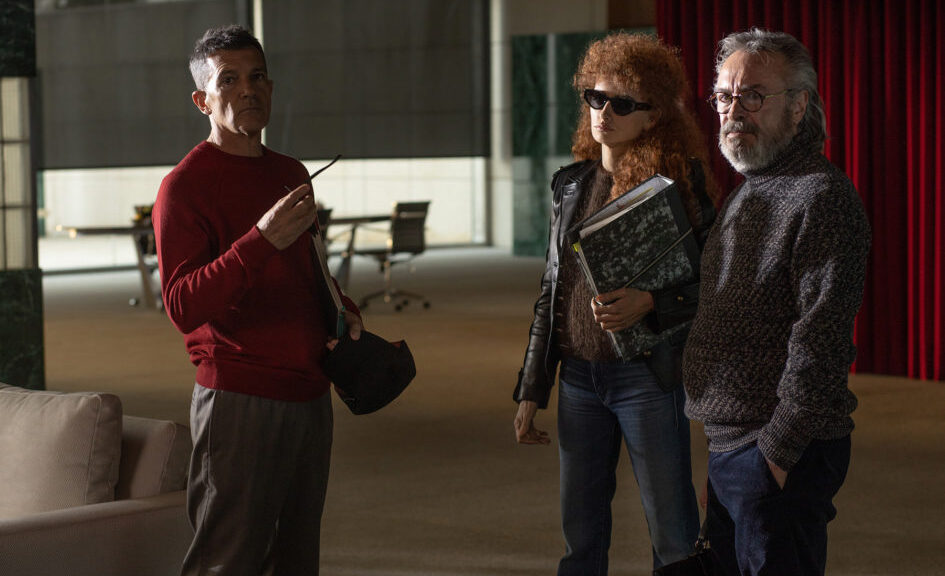
When an 80 year-old millionaire (José Luis Gómez) decides his legacy should involve producing the film version of a Nobel prize-winning novel, critic’s darling Lola Cuevas (Penélope Cruz) gets the call to direct. But Lola insists on adapting “La Rivalidad” with a unique vision, one that starts with casting polar opposites in the lead roles.

Félix Rivero (Antonio Banderas) is the worldwide box office star, while Iván Torres (Oscar Martinez) is the legendary thespian. They will play warring brothers, while their own philosophical clashes grow more volatile – and more dryly hilarious – by the day.

And don’t bother looking to Lola for cool-headed problem-solving. She’d rather provoke the tension with a variety of creative exercises – such as wrapping her two stars in restraints and threatening to destroy their most prized awards right in front of their panic-stricken faces.

Subtle it ain’t, but funny it is.

And even when a joke or two lingers a beat past its expiration, this sublime trio of actors makes nearly every frenzied interaction a joy to behold.

Is Lola a motivational genius or a complete fraud? Does Félix have the chops to go toe-to-toe with the prestigious Iván? And does Iván secretly admire Félix’s success? Cruz, Banderas and Martinez are clearly having as much fun acting it out as we are trying to sort it out.

And like much of the best satire, Official Competition is talking about one thing, but saying something else. Its barbs aimed at the movie business may be silly, acerbic and insightful, but none can hide the respect this film has for the entirely mad nature of the creative process.

Call it a love letter, with a completely entertaining ‘smidge of hate.

Fright Club: Frightful Forests

We’re thrilled to welcome filmmaker George Popov back to Fright Club. His Sideworld docuseries explores different supernatural whatnot the world over, beginning with the Haunted Forests of England. So, we thought we’d comb through our favorite haunted forests together. Here’s what we came up with!

5. The Hallow (2015)

Visual showman Corin Hardy has a bit of trickery up his sleeve. His directorial debut The Hallow, for all its superficiality and its recycled horror tropes, offers a tightly wound bit of terror in the ancient Irish wood.

Adam (Joseph Mawle) and Clare Hitchens (Bojana Novakovic) move, infant Finn in tow, from London to the isolated woods of Ireland so Adam can study a tract of forest the government hopes to sell off to privatization. But the woods don’t take kindly to the encroachment and the interloper Hitchens will pay dearly.

Hardy has a real knack for visual storytelling. His inky forests are both suffocating and isolating, with a darkness that seeps into every space. He’s created an atmosphere of malevolence, but the film does not rely on atmosphere alone.

Though all the cliché elements are there – a young couple relocates to an isolated wood to be warned off by angry locals with tales of boogeymen – the curve balls Hardy throws will keep you unnerved and guessing.

4. Without Name (2016)

Haunting and hallucinatory, this Irish gem develops a menacing presence you cannot shake. Director Lorcan Finnegan (Vivarium) leads surveyor Eric (AlanMcKenna) into the Irish woods with no real hope of finding his way back.

Like The Hallow, this film braids ecological horror with the supernatural, all of it rooted in Irish folklore. The’s an understanding that not everything was pushed out once Catholicism took over, the two sides just kept their distance. But now that it’s big companies making the decisions, a lack of reverence in the presence of the past is more than one man can survive.

3. Antichrist (2009)

A meditation on grief and sexual politics, it’s not until Antichrist moves into its second act that you know the kind of film Lars von Trier has actually made. It’s a cabin in the woods horror show, and one of the very best.

Grief becomes something supernatural, a hellish nightmare perfectly suited to the type of woods Shakespeare wrote of. The forest is a lurking, magical place where danger and enchantment frolic.

In this case, they frolic perhaps too close to the tool shed.

2. The Blair Witch Project (1999)

Blair Witch may not date especially well, but it scared the hell out of a lot of people back in the day. This is the kind of forest adventure that I assume happens all the time: you go in, but no matter how you try to get out – follow a stream, use a map, follow the stars – you just keep crossing the same goddamn log.

One of several truly genius ideas behind Blair Witch is that filmmakers Daniel Myrick and Eduardo Sanchez made the audience believe that the film they were watching was nothing more than the unearthed footage left behind by three disappeared young people. Between that and the wise use of online marketing (then in its infancy) buoyed this minimalistic, naturalistic home movie about three bickering buddies who venture into the Maryland woods to document the urban legend of The Blair Witch. Twig dolls, late night noises, jumpy cameras, unknown actors and not much else blended into an honestly frightening flick that played upon primal fears.

1. The Witch (2015)

Ideas of gender inequality, sexual awakening, slavish devotion to dogma, and isolationism roil beneath the surface of the film, yet the tale itself is deceptively simple. One family, fresh off the boat from England in 1630 and expelled from their puritanical village, sets up house and farm in a clearing near a wood.

Every opportunity writer/director Roger Eggers has to make an obvious choice he discards, though not a single move feels inauthentic. Rather, every detail – whether lurid or mundane – feels peculiarly at home here. Even the most supernatural elements in the film feel appallingly true because of the reality of this world, much of which is owed to journals and documents of the time, from which Eggers pulled complete sections of dialog.

You are trapped as they are trapped in this inescapable mess, where man’s overanxious attempt to purge himself absolutely of his capacity for sin only opens him up to the true evil lurking, as it always is, in the woods.

Tears in His Eyes, I Guess

The Phantom of the Open

by George Wolf

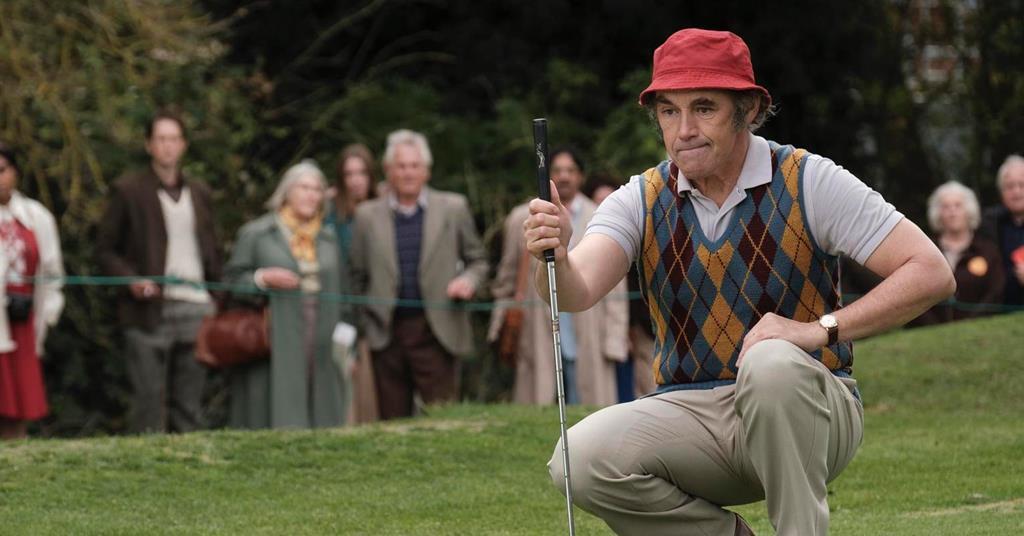
Olympic ski jumping found its unlikely warrior in Eddie the Eagle. Championship golf has a similar everyman hero in Maurice Flitcroft, and while Maurice still needs a catchy nickname, his tale finally gets the big screen treatment with The Phantom of the Open.

Maurice actually made his name years before Eddie, when he qualified for the British Open back in 1976.

And?

Up until that time, Maurice was a crane operator at a British shipyard who had never played even one full round of golf.

Cinderella story, meet Cinderella boy.

Well, not exactly, as Maurice shoots the worst round in Open history and quickly runs afoul of the course director (Rhys Ifans).

But a legend is born, and right from the film’s storybook-styled opening, director Craig Roberts (Eternal Beauty) and writer Simon Farnaby (Paddington 2) adapt Scott Murray’s book on Maurice’s often hilarious exploits with a whimsical, endlessly optimistic treatment. It fits like a pair of plaid pants at the 19th hole.

And what perfect casting. Oscar-winner Mark Rylance effortlessly brings Maurice to lovable life as a gentle, indefatigable dreamer. He’s also a soft-spoken family man, devoted to his wife (an equally perfect Sally Hawkins), the older stepson who’s embarrassed by him (Jake Davies) and his twin sons obsessed with disco (Christian and Jonah Lees).

His wife supports him, so why shouldn’t Maurice take a stab at the Open? Why can’t his friend at the shipyard open that pub he’s always wanted? And who says his boys can’t be disco dance champions? The world is your oyster, go find that pearl!

The film may not always share Maurice’s grand ambitions, but it has plenty of good humor and nearly overflows with crowd-pleasing charm. An unassuming ode to staying committed to what – and who – you love, The Phantom of the Open plays to the gallery with an awkward, sweater-vested panache that makes one history-making slouch seem pretty tremendous.

Screening Room: Lightyear, Spiderhead, Cha Cha Real Smooth, Mad God & More

The Pleasure Principle

Good Luck to You, Leo Grande

by George Wolf

If we’re boiling down film narratives to heroes and quests, it won’t take long to define Good Luck to You, Leo Grande.

Nancy is our hero, and sex is her quest.

And she would like good sex, thank you, although she can’t quite bring herself to expect the elusive release that she spent decades faking for her husband’s benefit.

But now Nancy (Emma Thompson) is an aging widow, fidgeting nervously in a hotel room and second-guessing her decision to hire handsome young escort Leo Grande (Daryl McCormack) for a tryst.

Thompson is, of course, glorious. And as much fun as it always is to see her command those in-charge characters spitting ruthlessly droll asides, Nancy reminds you how equally adept Thompson is with self-effacing humor, vulnerability and longing.

Writer Katy Brand’s script is filled with delightful wordplay, subtle wit and insightful details, one of the most resonant being Nancy’s history as a religious education teacher. We see her as a woman not only desperate to learn things she was never taught (and she has a list!), but also now regretting some of the lessons she passed down to young girls in her classrooms.

To Nancy, Leo represents more than just lust. He is the power of youth, and all the possibilities of a different generation that have long felt shameful to many from her generation.

McCormack is terrific, worthy of extra kudos for not shrinking from the prospect of simply being the “other half” of a two-hander led by a rarified talent. Leo has some issues of his own beneath his suave demeanor, and McCormack reveals them with subtlety and heart.

But back to our hero.

Nancy’s journey is, of course, an intimate one, and director Sophie Hyde doubles down on the intimacy, rarely leaving the privacy of the hotel room. Regardless, the film is never claustrophobic and always cinematic, framing even the most sexual moments with a refreshing honesty that the characters (and these two impeccable performances) deserve.

And you know what? We deserve it, too. Good Luck to You, Leo Grande is a simply wonderful look at embracing who you are and what you want. It’s funny and empowering, warm and touching, even heartbreaking at times.

Let’s hope it finds the audience it deserves.

We’re Gonna Need a Montage

Hustle

by George Wolf

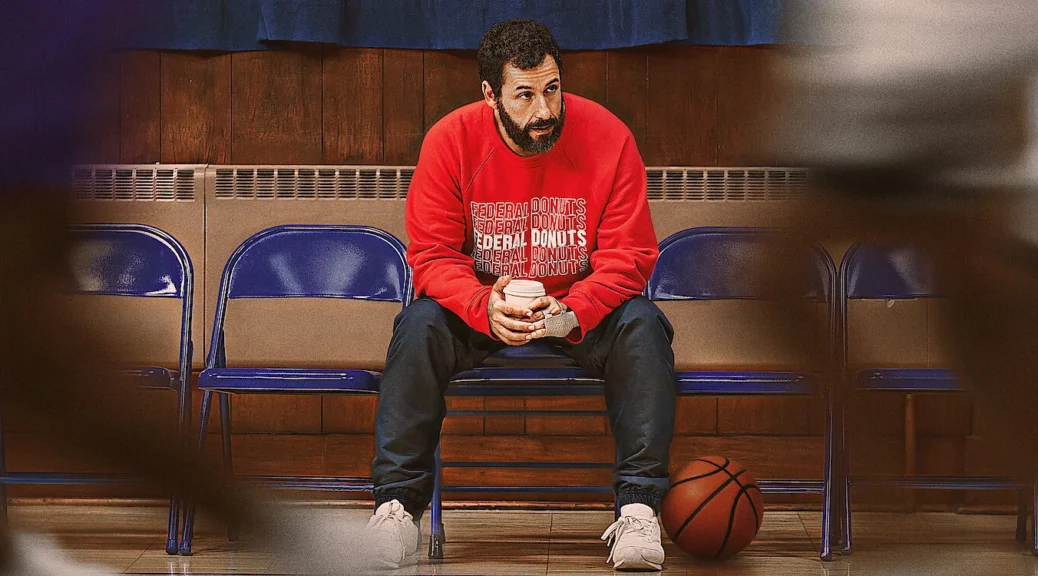
Adam Sandler’s passion for basketball is fairly well known, so the fact that Hustle is a love letter to the NBA shouldn’t be a huge surprise. And, this being a sports movie, you can expect some familiar benchmarks the film wisely doesn’t shy away from.

But this film about the heart and commitment that’s required in the Association boasts plenty of both from nearly everyone involved, landing Netflix an enjoyable winner.

Sandler plays Stanley Sugerman, a road-weary scout for the Philadelphia 76ers whose devotion to team owner Rex Merrick (Robert Duvall) is finally rewarded with a job on the bench as Assistant Coach.

But with clear shades of the Buss family drama in L.A., Rex’s son Vince (Ben Foster) wrestles control of the team from his sister (Heidi Gardner), and Stan is back living out of a suitcase while he scours the globe for a susperstar.

Writers Will Fetters and Taylor Materne set some nice stakes early, as Vince dangles a return to coaching in front of Stan. The quicker he finds the team a game-changing phenom, the sooner he can be home closer to his wife (Queen Latifah) and daughter (Jordan Hull).

On a gritty playground in Spain, Stan thinks he’s found his unicorn in the 6’9” Bo Cruz (NBA vet Juancho Hernangomez). The talk of big money lures Bo to Philly, but the path to a payday hits some roadblocks, and Bo’s longing for this mom and daughter back home creates some effective character-driven parallels with Stan.

Sandler and Hernangomez share a sweet, funny chemistry, and a constant stream of past and present NBA stars adds plenty of authenticity. Even better is director Jeremiah Zagar’s (We the Animals) skill in framing on-court action with speed, sweat and a tense, in-the-moment feel that gives the standard sports themes some needed vitality.

Hustle is a story of father figures, redemption, perseverance, and leaving your mark. No one’s claiming to re-invent anything here, and the winking nod to an iconic Rocky moment cements a self-awareness that only adds to the film’s charm.

It’s also another example of Sandler’s versatility, and the good that comes from surrounding himself with unique voices. When Sandler cares, he shines.

And he clearly cares about basketball.

Rites of Passage

Tahara

by George Wolf

If you saw Rachel Sennot’s breakout performance in last year’s wonderful Shiva Baby, the setup of Tahara is going to look pretty familiar. But in their feature debut, writer Jess Zeidman and director Olivia Peace find a vibrant, refreshing lens for their own look at one funeral’s anxious aftermath.

Sennot is terrific again as the self-centered Hannah, who joins her more reserved best friend Carrie (Madeline Grey DeFreece, also excellent) at the service for their Hebrew school classmate Samantha. Samantha killed herself at the age of 18, and after the funeral the girls will join other classmates at a grief session to talk about their feelings.

They will also gossip, navigate cliques, and bitch about having to be there while they try to catch the eye of Tristan (Daniel Taveras).

At least Hannah will be flirting with Tristan. Because Carrie is hiding some true feelings for her bestie, a conflict that Peace and Zeidman surround with some touching and effective parallels.

Peace frames most of the film in a square, 1:1 aspect ratio, but goes wide at important moments, most of which are animated. It’s a clear nod to the times when Carrie, a young Jewish queer woman of color, sees herself – and the world – in new ways.

Though the animation sequences and lack of score can give the film an experimental feel, a juxtaposition with the Jewish ritual meant to cleanse the body before burial (Tahara) ultimately grounds it as a deeply personal journey.

The students tell their teacher (and by extension, those not familiar with Jewish traditions) that the ritual’s goal is to “erase social status,” which feeds perfectly into the teenage power struggles (and one suicide) we see through the eyes of a type of character not often represented.

At times funny, uncomfortable, and heartbreaking, Tahara is an ambitious and ultimately moving film, from a pair of voices we should look forward to hearing again.