Tag Archives: Rachel Willis

Involuntary Tributes

Triggered

by Rachel Willis

If you’re looking for a not-so-scary, violent, sort-of funny horror film this post-Halloween, Triggered might be for you.

Director Alastair Orr’s (Indigenous) latest effort starts with a violent opening, but quickly shifts focus to nine twentysomethings camping in a remote location in the woods. We learn this is a reunion of friends who were involved in a horrible event back in high school.

After a night of partying, the nine wake to find themselves hooked up to bombs, each with a countdown timer. As the friends learn the rules of the “game,” we suddenly find our characters locked in a Hunger Games-type situation. (There’s even a character named Kato.)

It’s hard to root for people fighting for their lives when none of them are very likable. It’s also nearly impossible to give the characters more than superficial identifiers (the smart one, the quiet one, the bad boy, etc.) when there are so many involved. However, the filmmakers do a good job of introducing them slowly over the opening scenes so we can better keep track of who’s who.

If you don’t remember their names, it doesn’t really matter. They’re pawns in a game, not people to care about. It’s a wise move, limiting the time spent getting to know the characters. It thrusts us more quickly into the “kill or be killed” situation, which is a lot more fun.

Some of the film’s jokes land, but most don’t, and it’s hard to build tension when so much of dialogue is a forced attempt at humor. There are a couple of lines that elicit a few good laughs, though. (“That’s the herpes talking!”) If you can ignore some of the weaker moments, you’ll be happier for it.   

A few of the actors really get into their roles, bringing some entertainment value, but others play their parts without enthusiasm, clarifying an imbalance of talent among the nine.

There are few surprises in a movie without much imagination, so don’t expect too much of the revelations as they come – you’ll likely predict most of what’s going to happen before it happens.

However, it’s easy to have fun with this movie – as long as you check your expectations at the door.

Freedom Is Slavery

The Antenna

by Rachel Willis

The installation of a state-sponsored satellite dish on the roof of an apartment building is the inciting event for ominous, Orwellian horror in writer/director Orçun Behram’s first feature, The Antenna.

A commentary on the political situation in modern day Turkey, Behram’s debut film is focused on oppression. Though oppression takes many forms (the oppression of youth, the patriarchy, the status quo), the movie is most interested in the state’s suppression of speech and expression.

From the moment the satellite is fitted onto the roof of the building, sinister events occur. A black ooze, which emanates from the antenna, leaks through the walls, something Mehmet (Ihsan Önal), the building’s evening landlord, discovers when he’s called to a tenant’s bathroom to address the seeping goo.

The ooze creeps through the building, infiltrating more and more apartments as the night progresses toward the launch of the new state-run programming.

The kick-off event for the state’s broadcasting system is the “Midnight Broadcast.” Building superintendent, Mr. Cihan, has been advertising it to all the residents to ensure maximum audience participation. The Leader (who bears a certain resemblance to Recep Erdoğan) hosts the broadcast, and while the Leader’s delivery seems benevolent, the underlying message is a sinister reminder that dissent will not be tolerated.

Helping to tie the film’s many many pieces together is Mehmet. As odd and menacing events happen in the hours leading up to the Midnight Broadcast, he becomes increasingly invested in the fates of the residents in his building. Mehmet experiences a few disturbing visual and auditory assaults, all of which propel him to action.

The black ooze is a not-so-subtle metaphor for the insidious nature of state propaganda. But when you want to deliver a warning to your audience, knocking them over the head with the message is sometimes worth doing.

There is a lot working for Behram’s film. As we watch the events unfold, dialogue between characters is replaced by broadcasts from a threatening voice that emanates from every radio and TV. The tense score puts you on edge, and the climax is almost unbearably stressful as the auditory assaults reach their peak.

This is a reminder of what’s at stake when you take your freedom for granted in a world that seeks to rob you of it at every turn.  

Raise A Voice

Resisterhood

by Rachel Willis

It’s been a hell of a year.

Not only will 2020 live in infamy as the year we grappled with a worldwide pandemic, it is also the year Trump faces a reckoning in the United States. Will he be voted out of office? Or will he secure a second term?

As unlikely as a second term might sound to some, director Cheryl Jacobs Crim doesn’t want her audience (likely those opposed to Trump and his agenda) to become complacent. With her film, Resisterhood, she reminds us why people, particularly women, are fighting the Trump agenda.

On Day 1 of Trump’s presidency, as many as 500,000 women, and men, descended on the nation’s capital for the Women’s March – a gathering that let the new president know he was on watch.

And as the days of Trump’s presidency progressed, he was indeed being watched. As every devastating and harmful decision was passed down, protestors lined the streets around the country to declare this was not their America. From the People’s Climate March on Day 100 to the United We Dream protest on Day 231, Crim documents it all.

Crim captures the feelings surrounding these moments by interviewing women and men who are part of the resistance. From psychologist Jean Graber, who is following in the footsteps of her grandmother – suffragette Edith Hooker – to Egyptian immigrant, Mimi Hassanein, who ran for office in her community, to Illinois Representative Luis Gutiérrez, Crim intersperses these interviews with scenes of protests, primarily in the nation’s capital.

The movie runs pell-mell through the actions and reactions of Trump’s presidency. At times, when reminded of everything Trump has realized as president, it’s hard not to feel dejected. However, many of the women Crim interviews are still hopeful. More and more women, minorities and young people are participating in the democratic process – either in the streets, at the ballot box, or as political candidates. 

But there is a reminder that complacency is the enemy. It would be easy, worryingly easy, to topple our democracy, and while Resisterhood is steeped in the culture surrounding our current political climate, it has a timeless message. 

If you want to effect change, you must participate. If you need a reminder that your vote, your voice matters, start with Resisterhood.  

https://www.youtube.com/watch?v=RcPWit7cjEY

Gone Catfishin’

Summerland

by Rachel Willis

It’s hard to sympathize with a catfish – someone who pretends to be someone else online to develop a misleading relationship.

Yet, in the film, Summerland, directed by Lankyboy (the nickname for directing duo Kurtis David Harder and Noah Kentis), we’re asked to do just that.

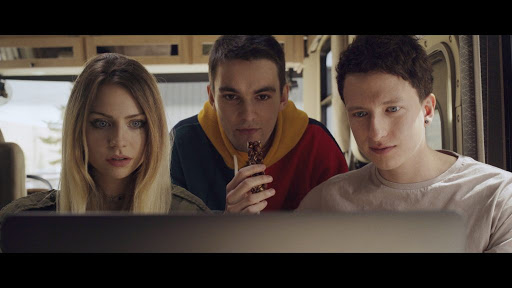
Bray (Chris Ball), who is pretending to be Victoria online, has made a connection with Shawn (Dylan Playfair) via a Christian dating site. Bray/Victoria has plans to meet Shawn at the music festival, Summerland.

Along for the road trip to Summerland is Oliver, Bray’s best friend, and Oliver’s girlfriend, Stacey. The problem? Bray has been using Stacey’s pictures to construct Victoria online. Once the trio gets to Summerland, will Bray be able to find Shawn before he finds Stacey?

Miraculously, as the film progresses, we do begin to sympathize with Bray. As a gay teenager, he is not accepted by his parents and struggles with his identity. He wants to meet someone, to have a relationship, and be himself. Despite the fact he has lied about his identity, he’s managed to be as open with Shawn as he has with anyone.

However, the film doesn’t let Bray off the hook entirely. We’re repeatedly reminded that he’s constructed a relationship around a lie. We must ask ourselves if some lies are forgivable when the liar struggles with what it means to be himself.

Most of the film is centered around the road trip to Summerland. Bray is anxious to get there so he can finally meet Shawn in person. Oliver wants to enjoy the journey. Stacey is rebelling against a stepdad she doesn’t like.

Lankyboy wants their movie to be quirky, but it’s a conventional road trip/relationship movie with some weird extras thrown in. Those weird moments are forced, don’t contribute much, and end up making a short movie feel intolerably long.

There are also far too many montages for such a short film.

The actors aren’t terrible in their roles. They’re not the worst trio to spend time with on a road trip movie, and the film does have one or two funny moments. But too much of the movie is focused on what it wants to be rather than effectively embracing what it is.

Unfortunately, what is ends up being is an unmemorable experience.

Looking for a Miracle

Fatima

by Rachel Willis

Director Marco Pontecorvo (Pa-ra-da) seeks to bring the “Miracle of the Sun” (also known as the “Miracle of Fatima”) to life with his newest film, Fatima.

In 1917, in the midst of World War I, ten-year-old Lucia (Stephanie Gil) has a vision of the Virgin Mary. Along with her two young cousins, Lucia is asked by the Virgin to return to the same spot every month to pray for peace. When word of this vision spreads, people from all over flock to the small village of Fatima, Portugal to receive the message each month from the Virgin.

Perhaps unsurprisingly, there is a lot of conflict in a film about a miracle. Young Lucia faces skepticism from those around her. The local mayor (Goran Visnjic) is man of science and fears the influence of a young girl on the religious population. The area priest doubts her. Even Lucia’s mother (Lúcia Moniz), a humble believer, thinks her daughter is lying. Why would the Virgin Mary bestow this message on Lucia?

It’s a question posed to the adult Lucia (Sonia Braga), a nun, when a professor (Harvey Keitel) visits her at her convent to ask about the events of 1917. A nonbeliever, Professor Nichols listens to the story as Sister Lucia relives it. The audience is privy to the conversations between Professor Nichols and Sister Lucia, as well as the Sister’s reminiscence on the past.

The film is primarily concerned with the events of 1917. The few moments between Sister Lucia and Professor Nichols are shallow question-and-answer sessions in which neither convinces the other of their position.

This is a movie for believers, to reward their devotion with a “faithful” portrayal of the events in Fatima. There is some neat imagery during some of Lucia’s visions, but most of the moments are unbelievably cheesy.

Pontecorvo’s effort is a messy, one-dimensional film. Characters, particularly the nonbelievers, are stereotypes portrayed in the simplest terms. Lucia’s family members pop in and out of the film at convenient moments to voice concern or disbelief. It’s unclear how many sisters Lucia has. If their names are given in the film, it doesn’t really matter since they don’t really matter.

Though Lucia’s cousins are also witness to the Virgin, they’re not interrogated the same way as Lucia who, for some unexplained reason, is the instigator.

Strong acting, particularly from Lúcia Moniz, keeps the movie watchable, but it’s not enough to save it from poor writing.

I don’t doubt this latest retelling of the “Miracle of Fatima” will be held in high regard by many, even though, at best, it’s a mediocre movie.

Mission Control

Desert One

by Rachel Willis

It has been nearly 41 years since 52 American diplomats and citizens were taken hostage in Tehran, Iran. Coming on the heals of the Iranian revolution, in which the Ayatollah Khomeini took power from the U.S.-backed Shah, the hostage crisis was perhaps the single biggest catastrophe of the Carter presidency.

Five months after the hostages were taken prisoner, in April of 1980, President Carter authorized a rescue mission, the subject of director Barbara Kopple’s (Harlan County, USA) latest documentary, Desert One.

Drawing on previously unreleased audio recordings, extensive interviews with those involved in the operation, and archival footage, Kopple’s film is one of the most compelling you’ll see this year.

Viewers may not be aware of the details of the Iranian Hostage Crisis, so a brief but informative overview of the situation in Iran paints a vivid picture. What led to the crisis is laid-out in clear detail. Interviews with many of the diplomats who were later held hostage help the audience understand the mood in D.C. as Khomeini came to power. Interviews with Iranian citizens further develop the picture of their attitude toward U.S. policy.

The most remarkable aspect of Desert One is the sheer number of interviews conducted for the film. Kopple interviews hostages and hostage takers, Delta Force members, as well as former president, Jimmy Carter, and his vice president, Walter Mondale.

Though the film is heavily skewed toward the American perspective, there is an attempt at balance by allowing some of the Iranians involved to share their perspective on the situation. However, as with most of history, memories of the incident vary wildly – prisoners describe being tortured; translator Hossein Sheikholeslam describes friendly relationships with the hostages. Hostage taker Faizeh Moslehi says the hostages were treated with respect, yet revels in the memory of seeing Americans defeated in brutal ways.

Animations serve to emphasize the words of the interviews and as reenactments for events not recorded. However, the most effective aspects are the pictures and archival footage – at times, almost too gruesome to bear. It emphasizes the sheer tragedy of the situation, as well as the mounting pressure on the U.S. to resolve it.

Removed from the situation by nearly half a century, it is still a critical moment in American history and not one to be forgotten. Kopple ensures it will remain fresh in our minds a little longer with her riveting piece of filmmaking.   

License to Kill

Spree

by Rachel Willis

I am about as unplugged as one can be in this hyper-connected world. I have zero social media profiles and visit around five websites regularly (this one included). Considering my lack of presence online, I may as well not exist.

At least, according to Kurt Kunkle (Joe Keery, Stranger Things).

Kurt is the wannabe viral sensation at the center of director Eugene Kotlyarenko’s latest film, Spree. Deciding to live stream his evening as a driver for the ride-share company, Spree, Kurt – star of @KurtsWorld96 – has a lesson to share and knows this is his ticket to fame in the digital world.

Kotlyarenko, co-writing with Gene McHugh, wants to deliver a comedic observation of the effects of the digital world on the real one. It’s not a bad idea. It’s too bad the movie isn’t funny nor especially profound.

There are multiple cameras on Kurt throughout the movie – phone camera, dash cam, window cam, security cam, body cam – at times, the cinematography piles on the footage, using split screens to show us multiple views. A running commentary is sometimes seen at the bottom of one or two of the screens. This lets us know that everyone in cyberspace viewing Kurt’s night – which involves several crimes – thinks it’s staged. Occasionally, someone chimes in wondering if it’s real, but for the most part, they can’t discern fact from fiction.

It’s exhausting. Aside from one, blink-and-you’ll-miss-it shot that I couldn’t account for, every scene is delivered through a handheld or portable device. Watching the movie, it’s hard to imagine anyone consumes anything this way. If this is the way of the world, our attention spans will surely dwindle closer and closer to that of a goldfish (if they haven’t already).

The movie’s only plus is Sasheer Zamata (The Last O.G., Saturday Night Live). Her character, Jessie Adams, runs across Kurt early in his night and is everything he wants to be. Zameer delivers the right amount of comedy in a few spots that, had the movie matched her efforts, might have helped its appeal.

While the attempt at commentary on the larger culture does not go unnoticed, as one of Kurt’s followers says to him of his attempts to go viral, it’s “boring and awkward.”

Same goes for Spree.

Odd Couple

Summerland

by Rachel Willis

Irascible Alice Lamb (Gemma Arterton, The Girl with All the Gifts) doesn’t care what anyone thinks of her. Called a witch by local children, pranked by schoolboys, and barely tolerated by the adults in her community, she’s resigned to her routine and to living her life alone.

Writer/director Jessica Swale, with her first feature film, Summerland, examines what it means to be a woman in a world where women had very few choices in life.   

In the early-1940’s, the British countryside of Kent is seemingly removed from the harsher realities of World War II. The residents are asked to do their part for the “war effort,” but none of this affects Alice. At least, not until a trainload of children arrive from London. Fleeing the frequent bombing raids on the city, the children have been separated from their parents and sent to live with strangers.

Conscripted to care for Frank (Lucas Bond), Alice is perturbed by this development in her life. She wants nothing to do with the boy, but with no other options, she’s forced to take him.

Though the film has a warm, light-hearted tone, there are moments that remind the audience about the harsh realities of the time. Frank is on his own with a stranger who treats him with undisguised annoyance. Through flashbacks, we learn that Alice’s past still haunts her. As Frank becomes a part of her life, we come to understand why she is angry with the world.

But it’s past trauma that allows the characters to bond, and Swale conveys this with tenderness. Though Alice doesn’t have the foggiest idea how to care for a child, she finds a companion who accepts her and treats her with kindness even when she doesn’t deserve it.

Swale explores a few themes, but she’s primarily concerned with Alice’s experiences, leaving little room for anything else. Alice is the only character with depth. The ancillary characters round out the main story, but none of them truly live and breathe. We barely scratch the surface of this complex world.

While the theme of Swale’s choosing is worthwhile, the lack of attention to the other details is distracting. Rather than serving as a thematic bookend to Alice, Frank ends up as a crutch for her growth.

The result is a middling film about love and friendship that still has enough appeal to thaw the coldest hearts.

Legacy

John Lewis: Good Trouble

by Rachel Willis

With a man as active as John Lewis, finding a focal point from which to craft a story could prove challenging. Should a documentarian focus on his early years as a civil and voting rights activist? His first years as a politician? His contemporary battle to overturn voter suppression laws?

Director Dawn Porter decides to highlight a little bit of everything in John Lewis: Good Trouble. The result is a fascinating, if messy, portrait of one of America’s greatest fighters for equality and justice.

Porter’s efforts have previously featured John Lewis as an interviewee (the magnificent docu-series Bobby Kennedy for President), but this time, she mines the wealth of material surrounding the man himself.

Congressman Lewis is a more than worthy subject. His early years on the front lines of the fight for racial equality alongside Dr. Martin Luther King, Jr. to his current stumps along the campaign trail offer endless archival footage, colleagues and siblings to interview, and opportunities to follow the Congressman during his day-to-day life on the Hill. 

Some of the most noteworthy parts of the documentary showcase conversations with those who have been inspired by Lewis. Representative James Clyburn says Lewis is “the most courageous person [he] has ever met.” Representative Ilhan Omar quotes John Lewis saying she took to heart his message to “love your country like you love yourself.”

The bulk of the film addresses Mr. Lewis’s continuing struggle to ensure voting is accessible to everyone. In the 50’s and 60’s, it involved (among other things) walking door to door in black neighborhoods to encourage the residents to vote. Today, he wages the war in Congress, trying to strengthen the Voting Rights Act after it was gutted by the Supreme Court in 2013. On the campaign trail, he encourages those who are most affected by restrictive voting laws to turn out in waves.

Some moments drag, as Porter tries to cram as much information about Lewis as she can into her 96-minute documentary. Certain stories seem added as an afterthought that would perhaps have been better left on the cutting room floor.

Mr. Lewis says he is deeply concerned about the future of democracy in America, but that he still believes “we shall overcome.” Anyone who needs inspiration or hope in these chaotic times can always look to John Lewis for guidance.

Phenomenal Woman

Miss Juneteenth

by Rachel Willis

When Turquoise (Nicole Beharie of TV’s Sleepy Hollow) enters her teenage daughter, Kai (newcomer Alexis Chikaeze), in the Miss Juneteenth pageant, she is optimistic Kai will win. Turquoise herself was a Miss Juneteenth winner fifteen years previously.

For those unfamiliar with the Juneteenth holiday, writer/director Channing Godfrey Peoples weaves an explanation and short history into the film at relevant moments. You’ll quickly understand the importance of this holiday, not only in the film’s setting of Ft. Worth, Texas, but in the greater black community.

If you are anticipating a film about the ins and outs of pageants, you won’t find it. Yes, there is some focus on the pageant, but mostly, this is a film about mothers and daughters.

Turquoise is the focus. Beharie and Peoples create a lot of empathy for a black, single mother trying to make it work.

There are numerous layers to Turquoise’s life. She’s separated from her husband, Kai’s father Ronnie (Kendrick Sampson), although he’s still around. It’s clear Turquoise loves Ronnie, but he’s disappointed her in the past.

The film’s strength is the way it lets this story unfold organically. As the plot takes us forward, we learn more about the connections between characters—small, intimate moments conveying vast amounts of information.

And the film’s main relationship, the one between Turquoise and Kai, is one of the most tender mother-daughter relationships you’ll find. Beharie and Chikaeze have a winning chemistry that completely roots the audiences in Turquoise and Kai’s relationship.

Of course the characters butt heads, but the conflict is secondary to the loving bond the two women share. Turquoise maintains a hard line with her daughter because she wants Kai to do better in life than she did. Though Kai at times resents this, she seems to understand her mother’s intentions. When Kai finds ways to push back against her authoritarian mother, you are never in doubt of Kai’s love for Turquoise, she simply wants to be her own woman.

The film also delivers a realistic view of poverty. Whenever Turquoise gains financial ground, something happens to pull the rug out from under her, leaving her with questions like whether to pay her late electric bill or the registration fee for the Miss Juneteenth pageant. Turquoise will always invest in her daughter’s future.

Turquoise has a supportive community around her, a cast of characters who round out the story nicely, and when life tries to knock her down, she will get back up with the help of those around her.

As we approach the 155th anniversary of Juneteenth, this is a film worth seeing.

https://www.youtube.com/watch?v=DUKVFJAUb3Q