Tag Archives: movie reviews

Welcome

Jungle

by Hope Madden

It is hard to go wrong with a story as viscerally affecting as that of Yossi Ghinsberg, an Israeli who took a year off from his life to seek adventure. He found it in the Jungle.

Beautifully portrayed by Daniel Radcliffe, Yossi heads to Bolivia where he befriends Swiss schoolteacher Marcus (Joel Jackson) and American photographer Kevin (Alex Russell).

Director Greg McLean (Wolf Creek) invests a good chunk of Jungle in letting us get to know this amiable, romantic trio—searching souls that seek some kind of connection with nature, humanity and life.

They find something that may be too good to be true when Yossi meets the mysterious jungle guide Karl (a wonderful Thomas Kretschmann). Together the foursome head into uncharted territories in search of lost tribes, rivers full of gold and other wonders not found on the typical tourist to-do list.

You know what they say about things that sound too good to be true.

Frustrations run high, mercy runs low, faith in leadership wanes, and eventually, an accident separates Ghinsberg from the group. He is on his own to survive the jungle, starvation, delirium, and one nasty, squirmy head wound.

Adapting Ghinsberg’s autobiography, screenwriter Justin Monjo sticks to highlights, which gives the film an artificiality it never fully shakes. McLean’s camera embraces both the overpowering beauty of the extreme environment as well as its shadowy, jagged, sometimes toothy menace. He just needs to learn when to leave it alone.

Speaking of alone, Radcliffe spends about 1/3 of the film on his own. For anyone still wondering whether Harry Potter can act, this film should set aside all doubt. Radcliffe is a natural fit for deeply decent characters, and his expressive face helps him communicate an enormous amount of unspoken content.

He’s great, as is the story and the balance of the cast. It’s just the writer and director who let us down from time to time.

Jungle is at its worse when McLean shows how little faith he has in his material and his audience, leaning on emotional manipulation and an almost oppressively leading score to ensure we are getting his point.

There are other questionable decisions, like the dream sequences, which offer little to the film besides the opportunity to objectify the few—all lovely, all nameless—women who grace the screen.

Jungle is, if nothing else, a powerful testament to Daniel Radcliffe’s potency as an actor. It’s also an unbelievable story, and Radcliffe’s performance ensures your keen interest regardless of McLean’s antics.

We Are Marshall

Marshall

by Hope Madden

Thurgood Marshall is among the most fascinating figures in contemporary American history. Too bad his biopic isn’t about him.

Marshall, director Reginald Hudlin’s glimpse at the first black Supreme Court justice’s earlier career as a tireless NAACP lawyer, offers an image of the man by way of one of his court cases.

It’s an interesting case, though probably not the best Marshall case to choose as a focus. It does, however, allow the unearthing of many complex and unfortunately still relevant issues of racism and injustice.

Like a hardboiled detective story turned historical courtroom drama, the film follows the 1941 case of Connecticut Versus Joseph Spell in which a white New England socialite (Kate Hudson) accused her African American chauffeur (Sterling K. Brown) of rape and attempted murder.

In the role of Thurgood Marshall is go-to biopic actor Chadwick Boseman. As you might expect given his string of impressive performances, Boseman has brooding, wise-beyond-his-years charisma to spare.

Josh Gad plays Marshall’s unlikely partner-in-justice Sam Friedman, a Connecticut tax attorney who wants nothing to do with this case. He and Boseman share a sometimes comical odd couple chemistry that often works in the film’s favor but just as often does not.

This speaks to one of Marshall’s two major weaknesses: Hudlin can’t find a tone. Too stylized to be a straight biopic, comical enough to feel tone deaf once the seriousness of the subject matter settles in, Marshall rarely finds its footing.

More problematic, though, is the court case itself.

Don’t get me wrong, this case is rife with cinematic elements and historical significance. The problem is that father and son writers Jacob and Michael Koskoff chose a case in which Thurgood Marshall was voiceless.

The presiding judge, capably played by the always welcome James Cromwell, forbade the out-of-state attorney to speak in court. An amazing piece of racially motivated injustice right there, making it another fascinating detail. It also means that we don’t get to see Thurgood Marshall command this court case.

It’s Gad’s Friedman who handles the courtroom drama—which he does quite well—but it leaves us with only some outside the courtroom mentoring and challenges from Marshall, and not enough else.

It may not totally sink a film built on solid performances and engaging material, but it’s enough to keep Marshall from making the kind of lasting impression it should have.

And Many More…

Happy Death Day

by Hope Madden

It’s funny how long it took people to rip off the Groundhog Day conceit—20 years, basically. No one really revisited the “day on repeat” idea (Source Code came close, but it wasn’t a full day) until Tom Cruise’s surprisingly high-quality 2014 flick Edge of Tomorrow.

It took twenty years to redo it once, and yet I’ve seen at least 9 of these this year. OK, I’ve seen two (Happy Death Day, Before I Fall) and am aware of two others (Naked, Premature). Still, that’s a lot. It’s like sitting through the same events over and over and over and over again with no idea why it’s happening or how to make it stop.

Happy Death Day does what it can to make up for its lacking originality with a tight pace and compelling lead performance.

Tree (Jessica Rothe) wakes up on her birthday in some rando’s dorm room with no memory of the night before, a raging hangover and an attitude. She’s murdered that night by a knife-wielding marauder in a plastic baby mask, only to wake up back in that same dorm room under that same They Live poster.

Repeat ad nauseam.

It doesn’t take too many déjà vu mornings before Tree decides there is a mystery to solve here and just like that, we’re off in Phil Connors territory: reliving the same day again and again gives you the chance to become a better person, right?

If, like Tree, you are unaware of Groundhog Day, Phil Connors is the Bill Murray character doomed to relive February 2 until he…well, if you haven’t seen it I don’t want to ruin it for you. But the fact that Happy Death Day addresses the groundhog in the room is part of its self-aware, played-for-comedy charm.

Rothe boasts strong comic timing and a gift for physical comedy, a skill that transitions nicely to the demands of being repeatedly victimized by a slasher.

Director Christopher Landon (Scout’s Guide to the Zombie Apocalypse) wisely mines Scott Lobdell’s screenplay for laughs. Given the repetitive, bloodless nature of the kills, trying to generate scares would have been a tough go.

The mystery absolutely does not hold up, red herrings are silly and fairly pointless, and whatever charm the filmmakers infuse into this recycled premise wears off just a tad before the credits roll. Still, there are funny bits and clever moments peppered throughout what is easily this year’s best Groundhog Day ripoff.

The Screening Room: Back to the Future

Click HERE to join The Screening Room Podcast, where we hash out our thoughts on Blade Runner 2049, The Mountain Between Us, and what’s new in home entertainment – The Survivalist, A Ghost Story, Pirates of the Caribbean: Dead Men Tell No Tales, and Goon 2.

Skin Trade

Blade Runner 2049

by Hope Madden

Who’s ready to go back to the future?

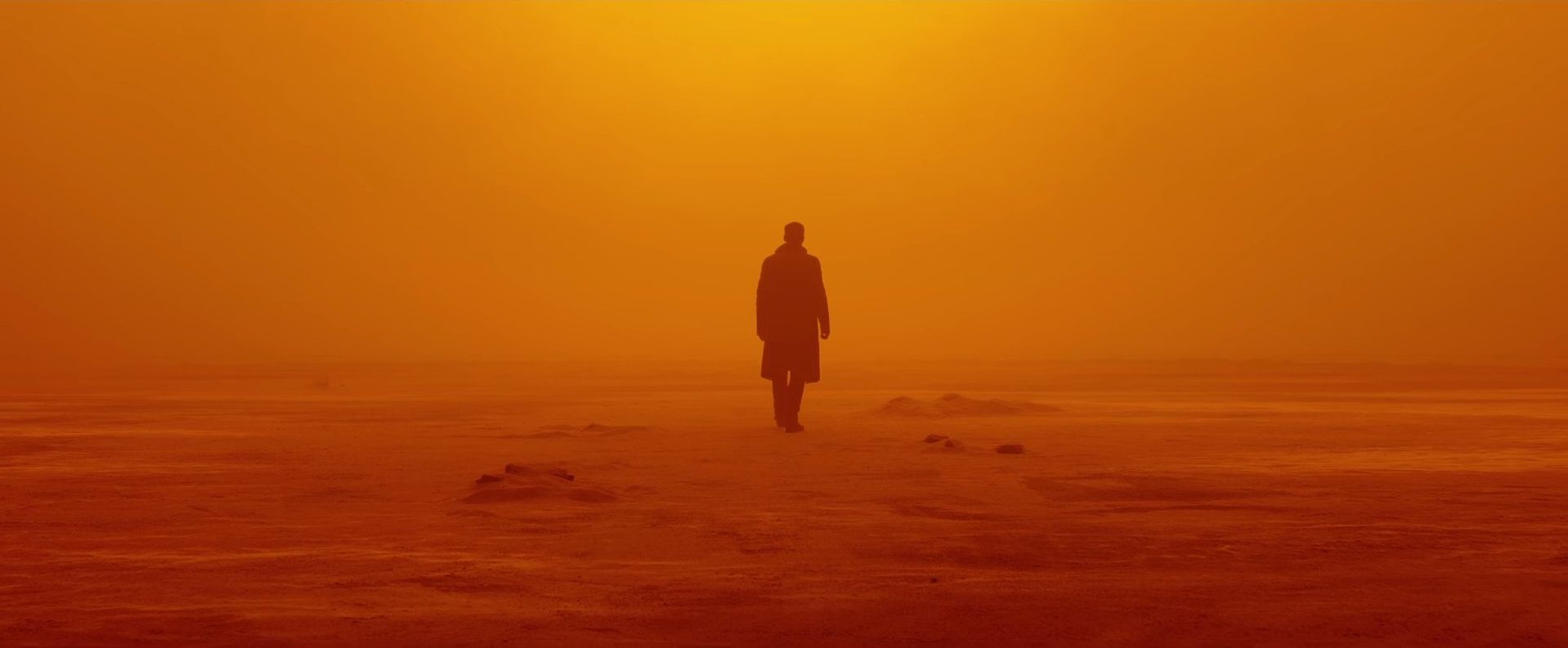
No gigawatts necessary. With Blade Runner 2049, director Denis Villeneuve returns us to the hulking, rain-streaked metropolis of another generation’s LA. We ride with K (Ryan Gosling), a blade runner charged, as always, with tracking down rogue replicants and retiring them.

Things get more complicated this time around.

Gosling’s the perfect choice to play dutiful sad sack LAPD blade runner K. Few actors can be simultaneously expressionless and expressive, but Gosling’s blank slate face and long distance stare seem to say something mournful, defeated and rebellious without giving anything away.

It’s no spoiler to mention that Harrison Ford returns. He’s a welcome presence, and not simply for nostalgia. The film toys with the “is he or isn’t he?” debate that has raged for 35 years, and gives the veteran ample opportunity to contribute.

God complexes, sentience and existence, clones – Ridley Scott saw his own longtime preoccupations playing out in Philip K. Dick’s prose and now, with returning screenwriter Hampton Fancher and new teammate Michael Green (Logan), Villeneuve gets his chance.

Their take is engrossing, satisfying and impressive, though the group stumbles over a few of their ideas—particularly those that consider the female in this particular universe.

As enamored of the original as we are, Villeneuve weaves intoxicating threads and callbacks throughout—most welcome is Hans Zimmer’s periodic moaning and sighing echoes of Vangelis’s original score.

In fact, the echoes from the Ridley Scott (now executive producing) ‘82 classic almost threaten to overrun the film. There are plenty of differences, though.

Villeneuve carves out a much larger corner of author Phillip K. Dick’s universe—not quite taking us off-world, but far beyond the teeming streets, towering buildings and oppressive rain of Scott’s retro-futuristic noir. The expansive story fills the screen with breathtaking frames and immediately iconic imagery, thanks in large part to acclaimed cinematographer Roger Deakins, at the top of his game.

Few if any have delivered the kind of crumbling, dilapidating futurescape Ridley Scott gave us with his original. But between the stunning visual experience and meticulous sound design, Blade Runner 2049 offers an immersive experience perfectly suited to its fantasy.

Picking at ideas of love among the soulless, of souls among the manmade, of unicorns versus sheep, Villeneuve channels Dick by way of Scott as well as a bit of James Cameron and more than a little Spike Jonze. There’s even a splash of Dickens in there.

Sounds like a hot mess, but damn if it doesn’t work.

I Don’t Want to Go Out – Week of September 30

Two of the best and most criminally underseen films of the summer are now available for your home viewing pleasure. Watch them! And also, there are a couple we think you might want to skip.

For the full review, click the film title below.

A Ghost Story

Survivalist

(DVD/BR)

Pirates of the Caribbean: Dead Men Tell No Tales


https://www.youtube.com/watch?v=1xo3af_6_Jk

Goon: Last of the Enforcers

(DVD/BR)

Do Not Stop in Willits

Welcome to Willits

by Alex Edeburn

In their debut feature, Trevor and Tim Ryan welcome us to the backwoods of Northern California where the weed, meth and aliens are bountiful and the yokels are creepy. The town of Willits—known as the Gateway to the Redwoods—attracts a young group of hikers looking to enjoy a weekend in the woods, who only get lost and spend the night near a cabin shared by a pair of strung-out conspiracy theorists.

Brock (Bill Sage) and Peggy (Sabina Gadeki) believe aliens are after the powerful batch of crystal meth the two have been cooking and smoking. “Emerald Ice,” as the locals call it, brings on intense hallucinations, exposing the user to the nefarious creatures visiting Earth, and in some cases, inhabiting human bodies.

Brock has no other option than to stand his ground and fend off the aliens he can only see through meth-tinted glasses. This proves problematic for our unsuspecting hikers when they eventually find themselves in Brock’s crosshairs.

The comedy of the film mainly relies on lazy stoner-humor courtesy of Possum, played by Rory Culkin. A Willits local who tags along with the hikers, Possum also provides the explanation for the UFO sightings and other spooky happenings around the town. Except his “explanation” is more of a half-assed paraphrasing of an Ancient Aliens episode.

The central question of the film: Does “Emerald Ice” actually expose the hidden truth about aliens, or are these visions part of a drug-induced psychosis? The narrative attempts to answer this by setting characters on a collision course with butchery. It’s a nice idea that just doesn’t work out since scenes with lost hikers or a homicidal Brock are too short for us to feel invested.

Given the cavalcade of circumstances, the premise seems promising for a science-fiction/horror romp. But the lack of tension and careless writing cripple a film that could have been frightening and fun.

If you’re looking for something with scares and laughs, try watching conspiracy theories on YouTube before watching this movie.

https://www.youtube.com/watch?v=BvhOiwnh5zA

Separation Anxiety

Super Dark Times

by Hope Madden

Super Dark Times opens ominously enough: a broken schoolroom window, a trail of blood running through empty classrooms and into a cafeteria. Though the outcome is not what you may expect, it sets an eerie stage for the 90s-set coming of age thriller.

Zach (Owen Campbell) and Josh (Charlie Tahan) are best friends, not yet driving, not yet dating, not yet determined if they are permanently dorks or just “awkward stage” dorks. They both like Allison (Elizabeth Cappuccino), both tolerate Daryl (Max Talisman).

Thanks in large part to a weirdly believable cast, writing that dances past clichés and confident direction, Super Dark Times creates the kind of charming but clumsy authenticity rarely seen in a coming-of-age indie.

Eighties high school flicks, mainly of the John Hughes variety, focused on right- versus wrong-side-of-the-tracks, popularity and the pressures parents can put on us. That is to say, they focused in most ways on the same worries that had plagued adolescent-focused films since the Fifties.

Contemporary films dealing with high schoolers require the ubiquitous presence of social media. But there is a particular darkness that entered the global consciousness about adolescents in the 90s, and Super Dark Times tries to tap that, using it to color the tone of its nostalgia and cusp-of-adulthood energy.

Kevin Phillips, making his feature debut, leans on his experience as a cinematographer to ensure the film looks as appealing and authentically nostalgic-90s-coming-of-age as possible. Writers Ben Collins and Luke Piotrowski are unafraid to drop contextual clues without burdening characters with too much backstory, just to go on to upend expectations now and again to keep you on your toes.

Super Dark Times develops a thriller atmosphere fueled by the paranoid, confused logic of an adolescent. It’s all a fascinating and realistic journey—until it isn’t.

At a certain point in Super Dark Times, the film settles. It becomes something it didn’t have to become—like the teen who’s cool to hang onto that Subway job when he really needs to ditch town and make something of himself.

It’s an enormous credit to Philips and his young cast that this unnecessary cop-out doesn’t ruin the film. Together they have drawn so much investment in these characters and their futures that you can’t help but stay tuned and attentive.

But they could have done more.