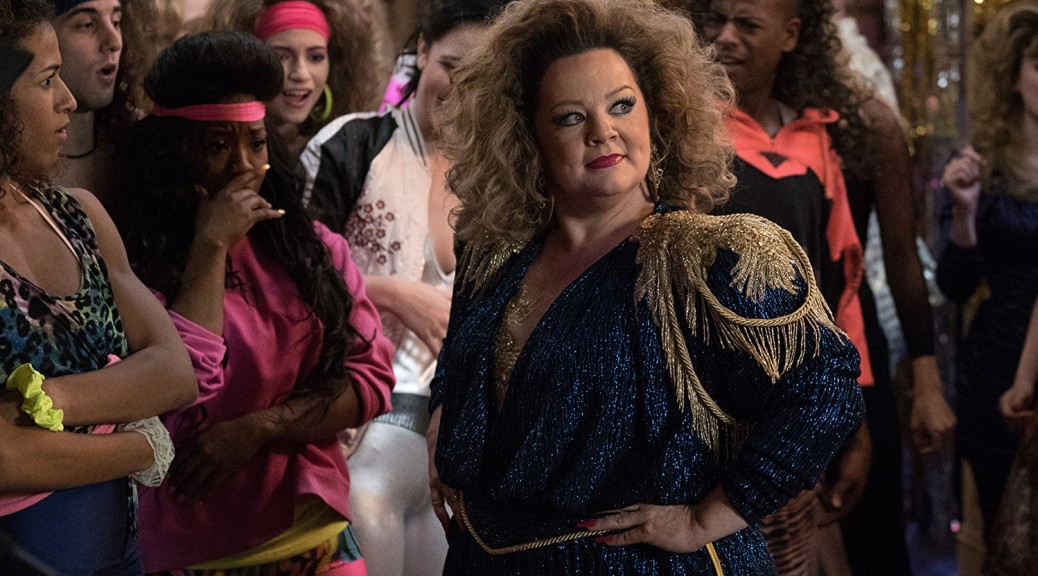
Recorded live at the Columbus Podcast Fest, this week’s Screening Room takes a look at Melissa McCarthy’s latest, Life of the Party, as well as Breaking In, Terminal, Revenge and the latest in home entertainment.
Listen to the full podcast HERE.
Recorded live at the Columbus Podcast Fest, this week’s Screening Room takes a look at Melissa McCarthy’s latest, Life of the Party, as well as Breaking In, Terminal, Revenge and the latest in home entertainment.
Listen to the full podcast HERE.
by Hope Madden
The rape-revenge film is a tough one to pull off. Even in the cases where the victim rips bloody vengeance through the bodies of her betrayers, the films are too often titillating. Almost exclusively written and directed by men for a primarily male audience, the comeuppance angle can be so bent by the male gaze that the film feels more like an additional violation.
Well, friends, writer/director Coralie Fargeat changes all that with Revenge, a breathless, visually fascinating, bloody-as-hell vengeance flick that repays the viewer for her endurance. (His, too.)
Jen (Matilda Lutz—Rings) travels with her wealthy, married boyfriend to a remote desert getaway. She’s very young, bubble-gum sweet and trusting, a sexy charmer who wants far too much to be liked and noticed.
Her lover, Richard (Kevin Janssens) is happy to oblige with that attention. Unfortunately, so are his two sketchy hunting buddies (Vincent Colombe, Guillaume Bouchede), who show up a day early, interrupting the romance and creating an unseemly tension at the house.
Fargeat’s grasp of male entitlement and the elements of a rape culture are as sharp as her instincts for visual storytelling. Wildly off-kilter close-ups sandwich gorgeous vistas to create a dreamlike frame for the utterly brutal mess of a film unfolding.
The filmmaker articulates the gender power struggle throughout the film as sights and sounds reflect and repeat—the echo of the image of a trail of blood from Act 1, for example, wordlessly emphasizes the shifting power.
Symbol-heavy but never pretentious or preachy, the film follows a traditional path—she is betrayed, she is underestimated, she repays her assailants for their toxic masculinity. But between Fargeat’s wild aesthetic, four very solid performances, and thoughtful yet visceral storytelling, the film feels break-neck, terrifying and entirely satisfying.

by Rachel Willis
To give away too much of the plot of Lu Over the Wall would be to steal the joy of experiencing this unique, quirky film. Director Masaaki Yuasa has crafted a sweet fantasy that explores the moving friendship between a boy and a mermaid.
The first half of the film offers an unpredictable journey that follows Kai as he gets to know the buoyant Lu. Along for the ride are Kai’s friends, Yuho and Kunio.
Before Lu, Kai is sullen and morose, having recently moved from Tokyo to a small fishing village with his dad following his parents’ divorce. Yuho and Kunio try their best to engage Kai, even talking him into joining their band. But it isn’t until Lu appears, drawn by Kai’s music, that he begins to open up to the world around him.
Though the first half of the film is unusual, and, at times, downright weird, the second half falls into a more predictable pattern. However, the shift into a more traditional story doesn’t detract from the film. And though the second section is more certain, the quirks and oddities of the story are maintained through the animation. Lu and Kai, along with Yuho and Kunio, face challenges as old prejudices and new curiosities are aroused by the arrival of Lu.
At times, the animation is reminiscent of Hayao Miyazaki’s work, but it also occasionally has the slapstick style of Tex Avery’s old Bugs Bunny cartoons. The blending of styles, along with the film’s own specific elements, merge together to serve the unconventional story well. From the monstrous creatures to the everyday people to the village’s shops and streets, the visuals are the most memorable part of the film.
Music also plays an important role, but the soundtrack is a little stale when paired with the rich animation. Too often, the score and soundtrack fade forgettably into the background when the movie would be better served by sound that enhanced the animation onscreen.
Though often strange and unusual, Lu Over the Wall is a touching tale.

by Hope Madden
Breaking In—the latest in a line of Liam Neeson movies—sees a desperate parent doing whatever it takes to save their tender offspring.
This time around Gabrielle Union plays Liam Neeson. Well, she plays Shaun, a woman who’s brought her two children with her to her recently-deceased father’s wooded property to get the place ready to sell. Problem is, somebody’s already there.
Shaun suddenly finds herself in the situation of trying to save her children from the men who’ve come to rob her late father’s safe.
The film was penned by Ryan Engle, who’s written two of Neeson’s own Liam Neeson movies (Non-Stop, The Commuter). The man likes a formula.
Union convinces as the family’s level-headed, savvy matriarch.
She’s locked out of her dead father’s tech-dense fortress while her kids are locked in with baddies. The clock is ticking until the cut phone cable brings the cops. Shaun’s indeterminate experiences at her shady father’s secluded property have apparently better prepared her for this event than the villains would have expected.
There could be something here.
Though little more than a mishmash of domestic thriller clichés, still, with a bit of style and a little creativity, it could make for a tense and brisk 90 minutes.
If only the bad guys moved quickly, as if they were working against a timer. Show a little urgency, fellas.
Or if all that tech—the cameras, the motion-sensor lights, the door locks—worked consistently rather than conveniently.
Or if director James McTeigue (V for Vendetta) brought any style to the project. Any at all.
Home invasion movies can become pressure cookers of tension and diabolical possibility. Too bad McTeigue has no idea how to exploit any of the tenser elements Engle gives him, nor does he have the skill to draw your attention away from any of the gaping holes littered throughout this plot.
Union’s fighting against more than seedy criminals.

by Matt Weiner
One of these days we’ll finally get a Melissa McCarthy movie that deserves her talents and doesn’t just desperately depend on them. Even though Life of the Party is written by McCarthy along with husband and frequent collaborator Ben Falcone… well, the wait isn’t over quite yet.
McCarthy stars as Deanna Miles, a woman whose life is upended by a sudden divorce with her husband Dan (Matt Walsh). Realizing that she spent her adult life meekly going along with other people’s wishes, Deanna decides to finish her abandoned senior year of college. It’s a positive message, as far as mid-life crises go.
This brings her into embarrassingly close contact with her daughter Maddie (Molly Gordon), who is also finishing her senior year at school, as well as Maddie’s sorority sisters. (All standard “not actually that weird” movie misfits, except for Gillian Jacobs, who injects some actual off-kilter menace as Helen.)
The idea of a former student getting into classes immediately (apparently without the need to re-take additional core requirements), and paying to live on campus despite living 20 minutes away raises some logistical questions. But McCarthy’s comedic gifts have saved staler setups. She turns Deanna into a woman to root for, not pity, as she completes her degree, relives her youth and gets over her spineless ex-husband.
Not that the film’s cringe comedy with a heart comes without a cost: the gentle nudges toward empowerment and inclusivity make for a welcoming message. But the steady laughs are all a bit defanged, especially for a setup about a woman whose husband has just divorced her after decades of building a life together (and who apparently still controls their finances in a way that makes her life materially difficult).
Given how much the story invests in the contrived college setup, the real missed opportunity feels like the uninhibited adult comedy nipping at the outer edges of what ended up on screen. Maya Rudolph is wickedly good as Christine, the best friend living vicariously through Deanna. And Walsh can tease out more notes than should be possible when given the room to work his sad sack variations.
It doesn’t really seem like the film is trying to connect with a younger audience anyway. The film is more homage to the triumphant ‘80s teen movies that McCarthy and Falcone would have eaten up as teens, with a “Save Deanna” finale and all.
This is a good thing when it comes to the sexual politics. (Have you re-watched Revenge of the Nerds lately?) But the predictable setup makes Life of the Party diverting yet wholly forgettable.
It’s a passing grade, but just barely.
by Hope Madden
Femme fatales. Hitmen. Disjointed timelines. Neon.
Sin City was interesting in 2005.
Vaughn Stein’s debut as a feature film writer/director, after many years assisting, borrows heavily from the Tarantino explosion of the Nineties and early 2000s. He drops us into a metropolitan underworld where danger intersects with madness and borrowed style tries desperately to draw attention away from lack of substance.
He does have Margot Robbie, though, so that’s a start. Robbie plays the aforementioned femme fatale in a hulking underbelly of a soundstage meant to look like a cross between a wee-hours train terminal, an insane asylum and Wonderland—all with that vacant, neon emptiness of a neo-noir.
Robbie’s Annie is a hitman masquerading as a waitress in the terminals all-night diner. There’s a hidden mastermind, a mysterious cripple, a couple of contract killers and a teacher who needs a little nudge before he’s ready to off himself.
Vaughn immediately brings Sin City to mind with his splashy comic book noirisms. It’s hard for that to feel fresh at this stage in filmdom, and his tired hodge-podging of hyper-dramatic tropes doesn’t breathe any new life into the story.
In fact, the story is the problem. It’s an awful lot of nothing, truth be told, with nary a surprise and loads of letdowns.
There is a bit in the diner that’s worth a watch. An excellent Simon Pegg waits for a train and chit chats with a borderline insane waitress (Robbie). Their chemistry is odd and welcome, and Pegg’s delivery is particularly impeccable. In these scenes, Vaughn’s writing suddenly feels engaging and unpredictable.
The core story about two killers Annie is playing against each other peters out blandly, and though the answer to any other surprise has long ago been telegraphed in, still we sit through an intolerable backstory.
Robbie does what she can, though she leans a bit too heavily on her Harley Quinn character to sell Annie’s mental state. She’s mad as a hatter, you see. We know that because she told us so in an opening voiceover narration.
The film isn’t awful, but it isn’t good. Mainly, there is just nothing new to see here.

Wow, some very different films available for home entertainment this week. On one hand, artist Ai Weiwei’s utterly breathtaking documentary on displacement and refugees. On the other, the last and worst of the Fifty Shades films. Our guess is that either one or the other may interest you, not likely both.
Guess which one we like better. Click the link to read the full review.


This week we take a breather from superheroes to look into the lives of some frazzled women. Join us as we chat about Tully and Overboard, as well as The Endless and Foxtrot, plus all that’s fit to consume in home entertainment.
Listen to the full podcast HERE.
by Hope Madden
More than 30 years ago, Garry Marshall directed one of those Eighties films: good-heartedly hateful and contrived in that colorfully rom-com way, Overboard.
It is the ridiculous story of comeuppance wherein a small-town carpenter (Kurt Russell), cheated out of payment by a scantily clad, uppity billionaire (Goldie Hawn), concocts a plan to get the money he is due when she washes ashore with amnesia.
Flash forward several decades and director Rob Greenberg makes his feature debut after a lifetime of sitcoms, revisiting Leslie Dixon’s 1987 screenplay.
His update sees Kate (Anna Faris) as a single mom just trying to pass that damn nursing exam so she can quit her two jobs (pizza delivery, carpet cleaner) and offer a better life for her three daughters.
She’s sent to sop up the champagne spillage on a yacht, meets spoiled heir Leonardo (Eugenio Derbez), argues and ends up in far worse financial trouble than she’d been in a day before.
Now she’ll never get that nurse’s license!
When the billionaire washes up back in Elk Cove, Kate’s pizza place boss (Eva Longoria) figures the least he owes Kate is some some day labor (so she doesn’t have to replace that job he lost for her), and enough chores to give Kate the time to study.
Only until the exam—then we’ll tell him.
The premise is no fresher or more believable this time around, though they do update in a couple of interesting ways. Leonardo is a Mexican heir; the day laborers only speak Spanish and most of the pizza crew is bilingual Mexican American, so about fifty percent of the film is subtitled.
This is an interesting choice, since the point of both versions of Overboard is to point out the hideous gap in work ethic and morality you can find between the rich and poor. Choosing not to “Roseanne” that image of the American working poor was a solid decision. Not that it can help this movie.
This is simply not a premise that has the strength to stand the test of time. The original was a success on the charm and natural (and obviously abiding) charisma of its stars. Why was it successful? Goldie Hawn was a comic genius, Kurt Russell was gorgeous, and it was the Eighties. That is it.
The remake has none of those things going for it. Greenberg, updating Dixon’s script with Bob Fisher (Wedding Crashers), can’t write his way out of the contrivance. Though Faris is certainly a talent, she lacks the charisma to carry a film.
Perhaps most damaging is the utter absence of chemistry between the leads, making every inch toward romance feel unnatural and, honestly, almost creepy.
by Hope Madden
There is something very clever about the way Justin Benson and Aaron Moorehead’s movies sneak up on you. Always creepy, still they defy genre expectations even as they play with them.
Camp Arcadia offers the rustic backdrop for their latest, The Endless. A clever bit of SciFi misdirection, the film follows two brothers as they return to the cult they’d escaped a decade earlier.
Just to visit.
Do you ever have those dreams where you find yourself back in your hometown and no matter how hard you try, you can’t leave? No? You must not be from Tiffin, Ohio.
Benson and Moorehead capture that particular panicked feeling, each slow-moving moment generating a louder and louder echo in your head, yelling: Why are you still here? Go already!
The other thing the directing pair creates with uneasy authenticity is that spotty forgiving and unforgiving bond between siblings.
The directors themselves play those siblings. Though Moorehead and Benson have had cameos in their previous films Spring and Resolution, as well as a handful of other horror flicks, The Endless, penned by Benson, is the first film they anchor.
Their acting chops are mainly solid, although perhaps not lead-worthy. Moorehead’s innocence and whining sometimes feel forced. Meanwhile, Benson’s character’s motivation is at times suspect, and he’s unconvincing as a sheltered, shell-shocked, co-dependent.
Though the lead performances sometimes undermine the agile storytelling, the turns the directors draw from their ensemble are strong across the board. Welcome familiar faces in a third-act surprise prove the filmmakers’ nimble skill with a fantasy storyline that could easily collapse on itself but never does.
It is this story and the pair’s storytelling skill that continues to impress. Their looping timelines provide fertile ground for clever turns that fans of the filmmakers will find delightful, but the uninitiated will appreciate as well.
https://www.youtube.com/watch?v=eRg7lwDsGpw



