Tag Archives: movie reviews

Big Fish

Blueblack

by Rachel Willis

An encounter with a wild blue grouper sends 8-year-old Abby on a lifelong mission to understand, and save, the ocean ecosystem in writer/director Robert Connolly’s feature, Blueback.

We follow Abby through three stages of her life. The first – and shortest – at age 8 is precociously played by Ariel Donoghue. Teenage Abby, played by Isla Fogg, is who we spend the most time with as she reconciles her love of the ocean with her mom, Dora’s (Radha Mitchell), overt activism. A contemporary framing story follows the adult Abby (Mia Wasikowska) as a marine biologist who returns home after Dora (the older version portrayed by Elizabeth Alexander) suffers a stroke.

On paper, this seems like a lot to contend with, but Connolly handles each stage well, ping-ponging primarily from adult Abby and teenage Abby with a skillful touch. There’s never any confusion as to where we are in time, as both Fogg and Wasikowska cement us with the character (as do Mitchell and Alexander with Dora). Both depictions are so strong as to convince us that we’re watching the same woman across time.

The movie’s biggest problem is overstuffing the scenes of teenage Abby’s life, leaving too little time for both the framing story, and the fish that gives the film its name. Though Eric Bana is a fine actor, his character Macka feels extraneous. There are other characters with whom our time is better spent.

Because we spend so little time with the grouper, there’s never the sense that we’re connecting with an animal in the way other films showcase the human-animal bond. It’s possible it’s simply hard to make a girl and her fish land the same way as a boy and his dog, though I imagine those who saw My Octopus Teacher might beg to differ.

Despite the film’s tendency to take on a little too much regarding its worldbuilding, it’s still an effective exploration of family and community, and how we relate to the natural world. There are those who seek to exploit it for everything it’s worth, while others wish to preserve it for future generations.

There’s a sense that for each piece of the world we lose, more than we can ever imagine is lost along with it. Abby and Dora hope to preserve that which connects us to something bigger than ourselves. The theme is always one worth repeating, and Blueback adds a unique perspective to the mix.

Ritchie Stew

Operation Fortune: Ruse de Guerre

by Hope Madden

Guy Ritchie’s latest, Operation Fortune: Ruse de Guerre, is neither the crisscrossing schemery of 2019’s The Gentlemen, nor the dour action plodder of 2021’s Wrath of Man. Although it has elements of both.

Like the former, the film delivers an incredibly talky tale of flippant action shenanigans undertaken by varying teams at cross purposes and boasts a delightful turn from Hugh Grant. Like the latter, it’s not very good and stars Jason Statham.

Statham plays Orson Fortune, a cantankerous special agent whose skillset is the only thing standing between some unknown item recently stolen and, you know, whatever it might do to the world.

That is the fun part. Fancy lad Nathan Jasmine (Cary Elwes) pieces together the team tasked with finding and returning the missing “handle” although no one knows what it is, so determining that bit will be useful as well. Figuring out who took it, why they took it and what they mean to do with it, then stopping them from doing it, whatever it is, represents the balance of the job.

Who’s to help Mr. Fortune? Bugzy Malone (rapper and regular Ritchie contributor) and Aubrey Plaza (the only truly new flavor in Ritchie’s crockpot of leftover ideas).

Plaza contributes that uncomfortable comedy she does so well, although it sometimes feels like she’s actually performing in a different film that has somehow broken into Ritchie’s movie. Still, she’s at least a lively and amusing distraction, although I can’t say she has real chemistry with anyone onscreen besides Grant.

Grant’s a hoot no matter whose scenes he is stealing, and Josh Hartnett surprises in a comedic role that would be more fun if it didn’t feel borrowed directly from (the entirely superior) The Unbearable Weight of Massive Talent.

There are a few laugh-out-loud moments, and some scenes that push the film toward parody, although Ritchie and crew cannot land on a tone. Everything feels more like a brainstorming session than a finished film. Nobody gels, nothing hangs together. The action is just this side of exciting, the humor lands about 40% of the time, and one scene pulls directly from Team America: World Police.

Mainly Operation Fortune: Ruse de Guerre just made me wish I was watching Team America.

Three Men and a Baby

The Donor Party

by Tori Hanes

Ah, the days of early aughts romcoms. Do you remember turning off your brain for 90 full minutes while the cinematic equivalent of white noise lulled you? Could it be considered brave for a film released in 2023 to pivot on its heels back to this genre of gooey nothingness? If so, The Donor Party by director Thom Harp deserves a Purple Heart.

Following wanna-be mother Jaclyn (Malin Ackerman) through her misguided – and frankly, morally challenged – quest for self-insemination, The Donor Party does little to endear itself to audiences through its clunky plot. The hook- one night, three unknowing sperm “donors”, and a woman watching her biological clock click closer to midnight- is one better left in the aughts.

The story bobs and weaves awkwardly, causing fatigue for both the audience and, seemingly, the performers. The cutesy setup of quirkily tricking men into fatherhood immediately stings and continues to rest like a hot iron branding the forearm.

The film finds its footing through the natural chemistry and charisma that the performers practically beg you to acknowledge. Having pulled a crew of stealthily loaded comedic talent, Harp allows for long moments of play from his actors. In these beats of palpable improv, the humor, depth, and charm of The Donor Party shimmers.

Rob Corddry, Bria Henderson, Erinn Hayes, and Dan Adhoot bring a warmth and passion so rarely seen in mid-to-low-budget romcoms that it’s occasionally staggering. A particular scene with Erinn Hayes (who plays up-tight, accidentally drugged host Molly) lamenting to Jacyln about her march toward stagnation while high off her rocker in a pool strikes as one of the more sincere moments in the recent memory of movies.

It’s fun. The story gets caught up in itself at the expense of any sort of meaning, the plot feels icky at times, but Harp couldn’t have picked a more affable crew. If you’ve long missed the washing glow of aughts-based goof, The Donor Party is for you.

Under Pressure

Free Skate

by Christie Robb

That being a professional athlete is not all fun and games probably doesn’t come as a surprise these days. Just look at all the flack Simone Biles took for withdrawing from competition at the Tokyo Olympics, or the years of sexual abuse perpetrated by the U.S. Gymnastics team’s doctor against team members.

Director Roope Olenius’s (Bunny the Killer Thing) Free Skate focuses on the athletes of elite figure skating. It follows an immensely talented young unnamed female skater (Veera W. Vilo, also the film’s writer) as she flees an abusive situation in Russia and attempts to rebuild her life and career in her native Finland.

Olenius and Vilo have elected to tell the story in non-linear fashion, bouncing between the skater’s time in Russia and her new life. There is a bit of a failure in the visual storytelling here, making it tricky to differentiate between the two timelines. There is also the occasional flashback to the skater as a child and her relationship with her mom, but superficial physical similarities between the skater and her mother make these scenes difficult to parse as well. Now, the film does use Russian, Finnish, and English and I’m guessing that folks more familiar with Russian and Finnish would have a much easier time orienting themselves in the story’s timeline. (So, really, I’m just criticizing my own inability to differentiate Russian and Finnish.)

Vilo, who was an elite gymnast, plays the skater with a polished exterior veneer barely covering a fractured center. It’s difficult to assess her overall acting ability as she plays the skater as emotionally disassociated. But Vilo definitely has the physical ability to portray this level of athlete without Olenius having to cut away to a body double very often—super impressive as figure skaters bend in impossible ways while basically balancing on knives.

Slow to begin, the movie increases in tension until it starts to resemble a horror movie toward the final act as almost everyone in the skater’s life demands more and more from her—wanting more cheerful facial expressions, wanting her to lose weight on a frame already too skinny to menstruate, wanting her to share stories about her past, wanting her to let rich men fuck her for sponsorship.

The last act, perhaps, veers a bit too hard toward melodrama, but overall Free Skate is a solid film exploring the unhealthy power dynamics and overwhelming pressures in elite sport.

Fright Club: Skeletons in the Closet, Oscar Nominees, 2023

It’s our favorite time of year! This is when we take the Way Back Machine (or this year, the Not-So-Way-Back Machine) to unearth 2023 Oscar nominees’ bad horror movie past.

Some nominees have made exceptional horror films. We’re looking at you, Brendan Gleeson (28 Days Later), Bill Nighy (Shaun of the Dead), Austin Butler (The Dead Don’t Die), Andrea Riseborough (Possessor, Mandy), and let’s not forget the queen, Jamie Lee Curtis (Halloween, duh).

Of course, JLC has also made enough bad horror for her own entire Skeletons podcast. But today, we’re focused on other people. Why? Because these guys made some bad, bad choices.

5) Knock Knock (2015), Ana de Armas

In 2015, Eli Roth remade Peter S. Traynor’s 1977 cult horror Death Game for the uber generation. Ana de Armas and Roth’s then-wife Lorenza Izzo play two wayward strangers, drenched and looking for a party but their uber driver dropped them off at the wrong place. Won’t Keanu Reeves let them in for just a minute to use his laptop and figure things out? Their phones got all wet!

And he does. Where Trynor’s film was a belated entry into the “what’s with these damn hippie kids” horror, Roth only barely taps into the paranoia and tension around generational differences in the social media era. Instead, he digs into midlife crisis and male weakness as Keanu’s devoted dad Evan caves to the pair’s mocking seduction.

You don’t believe it for a minute. De Armas is fine (in her first English language film), but Roth doesn’t find anything to say and the slight premise feels stretched well beyond its breaking point.

4) The Grudge (2020), Andrea Riseborough

Oh, Andrea Riseborough! Oh, Nicolas Pesce!

One of the most reliable character actors of her generation teams up with Eyes of My Mother filmmaker to revisit the haunted world of Takashi Shimizu’s Ju-On: The Grudge. The result is spectacularly unspectacular.

Riseborough is a detective in what amounts to an anthology film, each short a quick look at a haunting. Pesce, who co-wrote the screenplay, revisits a lot of Shimizu’s threads but breathes no new life into anything. Transitions from one short to the next are choppy, the imagery is never compelling, shocking or fun, and worst of all, that creepy sound design that made all the previous installments memorable is absent.

None of the talented cast members – Riseborough, Demian Bishir, Lin Shaye, Betty Gilpin, John Cho or Jacki Weaver (who seems to be acting in an entirely different film) – elevates the listless material.

3) The Intruders (2015), Austin Butler

It’s an iCarly reunion! Miranda Cosgrove and her sometime co-star Austin Butler co-star in this “your new house is probably haunted or something” thriller.

Cosgrove is Rose, and she has stopped taking her meds, so her dad (Donal Logue) doesn’t believe her wild stories about the house being haunted. And maybe it isn’t. Maybe it’s that creepy yet dreamy handyman (Butler).

What it is not is good. Plot holes could swallow you whole, contrivance and convenience are the primary narrative devices, but Butler’s as cute as can be and his little smirk fits both the character and the film itself.

2) I, Frankenstein (2014), Bill Nighy

Good lord, who greenlit this mess? Aaron Eckhart is Frankenstein’s monster, unintentionally drawn into the ongoing war between demons and gargoyles because no one cares. On planet earth. Nothing could be less interesting.

Oh, wait. The CGI is less interesting. Everything looks like the pre-play opening to a 1990s video game. And the gargoyle queen gives the monster a name: Adam. Why? Because co-writer/director Stuart Beattie thinks so little of viewers that he assumes no one will realize Adam is his name. It’s in the book. He thinks we are illiterate morons.

He’s hoping so, anyway, because even the great Bill Nighy cannot do anything to help this turd.

1) Critters 4 (1992), Angela Bassett

So, what’s worse than I, Frankenstein? Worse, sure, but also far more charming, Critters 4 sends those Gremlin/Ghoulie ripoff fur balls to space with Angela Bassett, Brad Dourif and a terrible script.

Cheaply made and far too slight on carnage, the film still benefits from Bassett’s undeniable badassedness. Her lines are garbage, and yet you believe her. (Same with Dourif.) And it’s the kind of stupid that can, if you’re in the right frame of mind, almost be fun. What Bassett is doing in it is too puzzling to consider, but she got her Ripley moment and that’s all that counts.

Hell of a Drug

Cocaine Bear

by Hope Madden

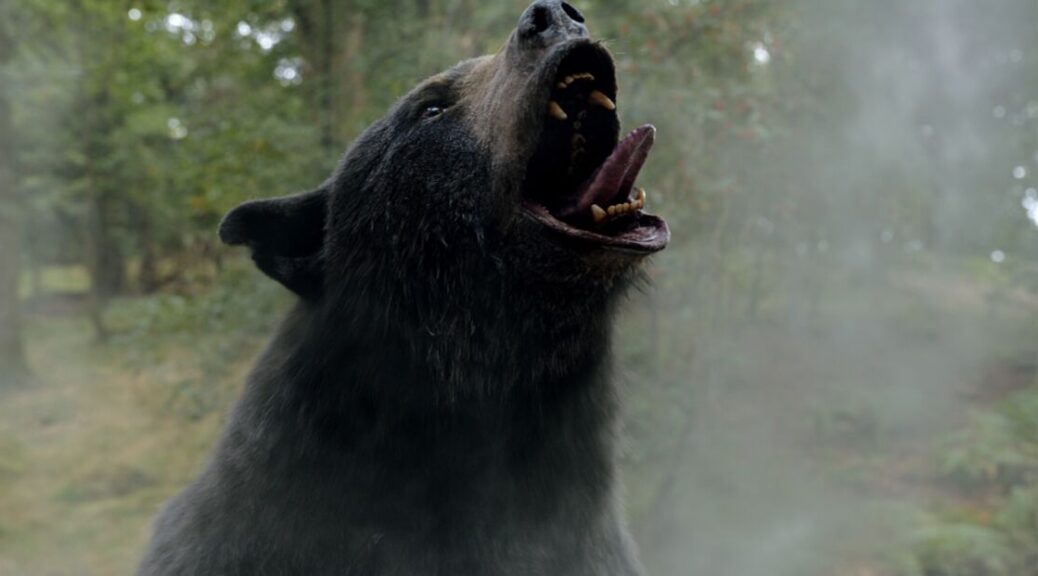
As misbehaving bears go, Elizabeth Banks’s Cocaine Bear puts Winnie the Pooh to shame. The laughs are intentional, for one thing, but the outright carnage outstrips anything I’ve seen in a genre film this year. And it’s not even a horror movie!

The year is 1985, from what I can piece together from an inspired soundtrack of pop hits spilling out of speakers, and one Jefferson Starship fan is about to make a jump from his plane with an awful lot of coke. Things don’t go well, and next thing you know, drug kingpin Syd (Ray Liotta in his final screen performance) is sending his reluctant son (Alden Ehrenreich) and best guy (O’Shea Jackson Jr.) to Blood Mountain to retrieve $14 million in missing blow.

As you may have guessed from the title, a bear found it first.

It’s barely (bear-ly?) accurate to say that Jimmy Warden’s screenplay is based on true events. In fact, a smallish black bear overdosed on drugs dropped into a Tennessee wilderness, only to be stuffed and displayed in a mall. That’s just sad no matter how you look at it. So, Warden says to himself, what if the bear was like three times bigger? All hell might break loose.

We meet an assortment of folks trying to stay out of the bear’s way, as well as those trying to track down the cocaine. One mom (Keri Russell) is looking for her errant daughter (Brooklynn Prince) and her buddy, Henry (Christian Convery, scene larcenist).

The great Margo Martindale as Ranger Liz is hysterically deadpan opposite three skate punks (Aaron Holliday, J.B. Moore and Leo Hanna, all superb). And even with as little time as we get to spend with the paramedics (Scott Seiss and Kahyun Kim of the badass blue eyeshadow), you’ll miss them.

That’s really Banks’s trick. The film offers little more than a loose assortment of national park visitors/bear meat, but the filmmaker and her comedically able cast invest enough in each character that you like them. You root for them, despite the fact that most of them are bad people. And bound to die.

For a very dark comedy, Cocaine Bear is light entertainment. It’s hard to imagine expecting anything more.

Not every animal lover is going to appreciate the comedy in this film, FYI. An enormous black bear is high out of her mind for 90 minutes and, in that deranged state, does some funny things but mostly tears humans to pieces to the delight of the crowd. If this doesn’t sound entertaining to you, maybe don’t see Cocaine Bear.

You Say You Want a Revolution?

The Jesus Revolution

by Matt Weiner

In 1966, TIME Magazine captured the tumultuous era with a bleak cover question: “Is God Dead?”

One answer to that question was in the form of a countercultural movement that arose in the following years. The “Jesus Revolution” is less incongruous than it first sounds, placed among the backdrop of Vietnam, sex, drugs and rock & roll and a general spiritual ennui. The long-haired, sandal-wearing “love the stranger” Jesus spoke not just to some of the more soul-searching hippies but a wider generation trying to find its own voice.

At least that’s the message that Jesus Revolution wants to focus on. The film, written and directed by Christian film powerhouse Jon Erwin, falls more on the mainstream spectrum like Heaven Is for Real than the pricklier polemics like God’s Not Dead.

But for all its gloss, Jesus Revolution is a confounding movie. The production itself is a savvy, just saccharine enough dramatization of Pastor Chuck Smith (Kelsey Grammer) and the countercultural rise of the “Jesus freaks” in the late 60s and early 70s.

It’s a feel-good story, and the shiny treatment it gets here seems like a perfect match. But it’s also a story and a movement that deserves a more critical look than it gets here from the true believers.

Smith is a pivotal figure whose Calvary Chapel movement has influenced evangelical Christianity and the modern megachurch. Jesus Revolution wisely centers on an avuncular, befuddled version, with Grammer perfectly cast to deliver profundities like “It’s not something to be explained, it’s something to be experienced” in his soothing baritone.

It’s not until Smith meets the radical Lonnie Frisbee (Jonathan Roumie) that he comes to see that the Jesus of the Bible has a lot more in common with the growing hippie movement, and his unlikely partnership with Frisbee is part of a momentous time in evangelical history.

What the film omits from this “all are welcome” version of Smith, however, are any edges that might clash with a wider audience. Most notably, the pastor’s strident views against homosexuality. And while the script hints at Lonnie Frisbee’s split with Calvary and Smith, this is chalked up to doctrinal differences with no mention of Frisbee’s semi-open homosexuality.

At what point does the reality of a biography subject veer so far from the adaptation’s message that it becomes disingenuous? This friction-free adaptation goes well beyond that line. Which is curious, given that director Jon Erwin also wrote and directed the exceptional documentary The Jesus Music in 2021.

It’s a low bar to clear, but that sweeping look at contemporary Christian music from the era of Smith and Frisbee to artists today takes a more frank look at internecine debates and controversies, both within the movement and alongside secular culture at large. As someone whose personal history with religion starts and stops with the Old Testament, I feel confident recommending The Jesus Music as the better choice—both as film and agitprop—for those not already in the movement.

Where does that leave Jesus Revolution? To say it’s a Hallmark movie with better production values undersells how watchable the movie is. But if the film succeeds in standing on its own, with a goal of preaching beyond the choir, it also deserves to be judged that way. And that means bringing in the messy earthly politics that the script assiduously avoids. The likely reality is that church viewings will get an extremely competent adaptation of a historical era that continues to shape the country.

Secular audiences get a decent airplane movie that’s worth it for Kelsey Grammer completists. It’s win-win—unless you’re gay, in which case you might be incurring divine wrath, if you ask Pastor Smith. Better not to dwell on that part of Smith’s theology for a mainstream movie, though, and instead rely on the Old Testament and split the baby.

Lock, Stock, and a Barrel of Laughs

Three Day Millionaire

by Daniel Baldwin

What would you do if, after being handed a big paycheck, you found out that it might be your last? That your bosses had conspired to do away with your job? If you’re a character in the latest film from Jack Spring (Destination Dewsbury), you’d find yourself in a British heist comedy!

Three Day Millionaire follows a gaggle of “Trawler-men” from the port town of Grimsby, England as they come ashore to have themselves a good time with their latest hefty batch of wages, only to find themselves in a bit of a pickle. Their world is about to move on without them, leaving them with only hope and desperate measures. It’s a tale as old as time: the smalltown little guy versus the unflinching, uncaring machine that is corporate “progress” and greed.

Director/producer Spring takes this premise and fashions a dark comedy around it, imbuing the all-too-familiar plight of the working man with all the British crime comedy tropes that we have come to love throughout the decades. As well as a few that maybe should have been allowed to die off. The resulting concoction presents itself as a smaller, more regional riff on the works of Guy Ritchie, Danny Boyle, and Edgar Wright.

The good news is that this is filled with a lot of personality, which can go a very long way in films of this type. The bad news is that sometimes it goes a bit too far into pastiche, particularly when it comes to the freeze-framed “character bio” introductions.

Three Day Millionaire never truly finds an identity purely its own, instead leaning on the aforementioned auteurs to get its tale across. Its Ritchie-ness is thick, but also shallower than Guy. Its party-hard Boyle-isms are never as biting as Danny’s. It’s Wright-ings never fully measure up to the wittiness of Edgar. Despite all of this, as well as some pacing issues, it still manages to be a laugh-filled good time.

If you’re in the mood for a quainter British black comedy caper picture, it’ll get the job done. Not every film needs to rewrite the rule book, as sometimes you just want something that will deliver what’s on the box. Jack Spring’s Three Day Millionaire does just that.

https://www.youtube.com/watch?v=hu-7IrMxDFQ

Sick Thinking

Nocebo

by Hope Madden

There’s a lot to recommend in Lorcan Finnegan’s new film, Nocebo. It depicts the horror of corporate and personal greed, which is not only currently popular but horrifyingly timeless.

It boasts four admirable performances. Eva Green is Christine. Christine designs clothing for children, and right as she’s launching a new line, she gets some kind of terrible news. Simultaneously, she runs afoul of something seriously foul and finds herself, some months later, debilitated by a mysterious illness.

Her husband Felix (Mark Strong, always welcome) and daughter Bobs (Billie Gadsdon, terrific) are surprised to come home and find Diana (Chai Fonacier) has been hired as live-in help. Honestly, Christine is surprised, too, but she just can’t trust her memory anymore.

It’s a solid setup. Fonacier and Finnegan, whose Without Name (2016) offered excellent and underseen “into the woods” horror, keep you guessing as to Diana’s motives. Fonacier grounds her character, finding a balance between a number of rote horror options, which invites constant curiosity.

Still, without giving away any major plot points, it’s the character of Diana that makes the film so problematic. Writer Garret Shanley, who collaborated with Finnegan on both Without Name and the 2019 sci-fi horror Vivarium, leans into stereotypes and dated tropes to tell his tale.

That’s unfortunate because it’s a big problem for the film.

Finnegan does what he can by investing in both Christine and Diana’s points of view, which also keeps viewers off balance in terms of the likely outcome of the story. Strong injects the proceedings with a genuinely sympathetic perspective in a role that rarely benefits from such a thing. And Gadsdon is more than just adorable, although adorable she is.

But Nocebo doesn’t pack the punch it intends to, the point-of-view sleight of hand limiting the impact. It’s not the body horror promised by the catalyst, either. Instead, it’s a muddled if well-performed tale that leans heavily on an idea that needs to die.