Screening Room: Barbie, Oppenheimer, Amanda, The League, Sharksploitation
by Hope Madden
Like some sort of bourgeoise, European Napoleon Dynamite, the diabolically deadpan Amanda (Benedetta Porcaroli) is a weird, mesmerizing mess (the character, not the film). Writer/director Carolina Cavalli’s feature debut delivers on the weird and mesmerizing, but the vision is intentional and its delivery confident.
The titular character, a 25-year-old with no friends or job who rails against nonexistent oppressors while sponging off her parents, is as off-putting as any narcissist would be. At the same time, thanks to Cavalli’s witty script and Porcaroli’s surprising wealth of vulnerability, you can’t help but root for Amanda.
Her only friend is the family’s middle-aged maid who doesn’t mind so much, but she’d rather spend time with her own kids than get dragged to another rave. Afraid she’s a loser, will always be a loser, Amanda decides to become besties with Rebecca (Galatéa Bellugi), the daughter of a family friend. This is not something Rebecca will accept voluntarily.
Cavalli’s fills dining rooms, bedrooms, gravel paths and cinemas with a dark whimsy that’s hard to pull off. Her film borders on the absurd but never fully crosses over – kind of a Yorgos Lanthimos (particularly Dogtooth), but with more heart and less devastating cynicism.
Amanda is the embodiment of a generation of lonely people unable to form human connection, but her charm is her sincere desire to find that one person who connects with her – regardless of her profound selfishness, interest in nothing, and desire to do nothing except save up enough supermarket store points to win an electric fan.
Cavalli populates Amanda’s world with a few equally odd characters. Rebecca’s self-imposed isolation becomes a fascinating counterpoint to Amanda’s involuntary version. Giovanna Mezzogiorno, playing Rebecca’s mother, offers a liltingly bizarre turn.
Margherita Missoni is a delight playing Amanda’s pharmacist sister, a woman so weary of Amanda’s irresponsible divadom that she appears to melt.
It’s a perversely lovely, lonely world. Cavalli lenses an environment simultaneously elegant and bucolic, a kind of fairy tale where nobody’s feeling very optimistic of a happy ending but are unready to embrace reality quite yet. It leaves a little room for hope.

by Hope Madden
The world today is split. On the one hand there is a rabid sect donning their finest sparkles in anticipation of Margot Robbie’s Barbie. On the other hand, there are those who cannot believe people are this unreasonably geeked over a movie about Barbie.
And then there are the Greta Gerwig fans, who perhaps have a complicated but mostly contemptuous relationship with the doll but will nonetheless stride through the pink boas and tiara glare to soak up whatever glorious wonder the filmmaker has to give us.
That was me, that last one. I’ve come to witness Gerwig’s hat trick.
Barbie, which director Gerwig co-wrote with Noah Baumbach (that slouch), delivers smart, biting, riotous comedy with more whimsy than anything this politically savvy has any right to wield.
It’s a role Robbie was clearly born to play. Barbie’s endless run of perfect days actually ends, and she has to seek the advice of Weird Barbie (Kate McKinnon, perfection). You’ve seen the ads – she has to go to the real world to solve her problem. But there’s one hiccup. (That’s not true, there are plenty of them, but it all starts with this first one.) Ken stows away in the back of the Barbie Dream Car.
Ryan Gosling, the man behind the tan, plays Existential Crisis Ken and it’s possible he’s never been better. That’s a big statement because he was nearly perfect in Drive. Also, The Nice Guys. Also, Half Nelson. Plus, Blue Valentine.
He’s good. This is my point. But his Ken delivers all the self-effacing humor of The Nice Guys with sincere pathos and a vacuous tenderness it’s hard to describe.
And my god, that dance number!
Simu Liu, Michael Cera, Issa Rae and Alexandra Shipp also get to carve out some funny screentime, but the whole cast shines. Barbie does not work without a tightrope of a tone, and everyone walks it with their heels off the ground.
Gerwig’s lack of cynicism may be the thing that shines brightest in all three of her films. Lady Bird was the most open and forgiving coming of age film I’ve ever seen, and also probably the best. Who on earth thought we needed another Little Women until Gerwig mined it for the gorgeous feminism that always drove it?
Barbie is a brilliantly executed, incredibly fun, brightly colored, completely logical feminist statement that should be remembered come awards season.

Sure, the Losers Club leaps to mind. But the truth is that horror films are littered with lovable losers – often their corpses. Why? It’s easy to root for an underdog, and nothing packs an emotional wallop like watching that bumbling, vulnerable sweetheart meet a grim end.
We love them all: Sean & Ed, Viago & Vladislav, Melvin Juno and 100 Bloody Acres‘s Reg & Angus Sampson. But these are our favorites.
In 2008, Sweden’s Let the Right One In emerged as an original, stylish thriller – and the best vampire flicks in years. A spooky coming-of-age tale populated by outcasts in the bleakest, coldest imaginable environment, the film breaks hearts and bleeds victims in equal measure.
Kare Hedebrant‘s Oskar with a blond Prince Valiant cut needs a friend. He finds one in the odd new girl (an outstanding Lina Leandersson) in his shabby apartment complex. She, as it turns out, needs him even more.
This is a coming-of-age film full of life lessons and adult choices, told with a tremendous atmosphere of melancholy, tainted innocence, and isolation. Plus the best swimming pool carnage scene ever.
The unsettling scene is so uniquely handled, not just for horrifying effect (which it certainly achieves), but to reinforce the two main characters, their bond, and their roles. It’s beautiful, like the strangely lovely film itself.
Rated R for “an abundance of outrageous gore,” Dead Alive is everything the early Peter Jackson did well. It’s a bright, silly, outrageously gory bloodbath.
Lionel Cosgrove (Timothy Balme) secretly loves shopkeeper Paquita Maria Sanchez (Diana Penalver), but she has eyes for someone less milquetoast. Until, that is, she’s convinced by psychic forces that Lionel is her destiny. Unfortunately, Lionel’s milquetoast-iness comes by way of decades of oppression via his overbearing sadist of a mother, who does not take well to her son’s new outside-the-home interests. Mum follows the lovebirds to a date at the zoo, where she’s bitten (pretty hilariously) by a Sumatran rat-monkey (do not mistake this dangerous creature for a rabid Muppet or misshapen lump of clay).
Braindead is so gloriously over-the-top that nearly anything can be forgiven it. Jackson includes truly memorable images, takes zombies in fresh directions, and crafts characters you can root for. But more than anything, he knows where to point his hoseful of gore, and he has a keen imagination when it comes to just how much damage a lawnmower can do.
Takashi Miike is an extremely prolific director. He makes a lot of musical films, a lot of kids’ movies, a lot of horror movies, and then this – a mashup of all of those things. Like Sound of Music with a tremendous body count.
The Katakuris just want to run a rustic mountain inn. They’re not murderers. They’re lovely – well, they’re losers, but they’re not bad people. Buying this piece of property did nothing to correct their luck, either because, my God, their guests do die.
You might call this a dark comedy if it weren’t so very brightly lit. It’s absurd, farcical, gruesome but sweet. There’s a lot of singing, some animation, a volcano, a bit of mystery, more singing, one death by sumo smothering, and love. It sounds weird, truly, but when it comes to weird, Miike is just getting started.
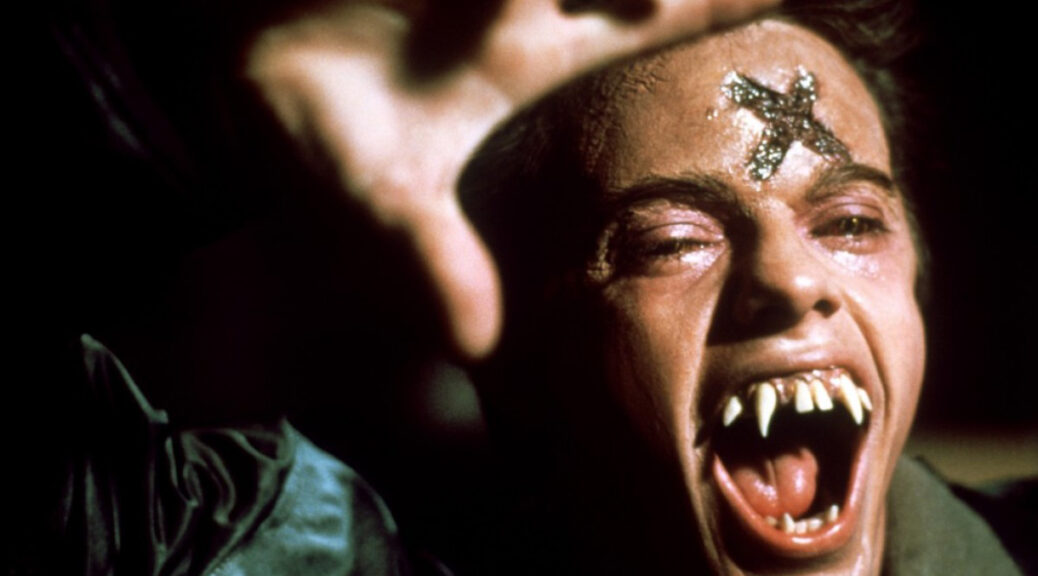
Fright Night takes that Eighties, Goonies-style adventure (kids on an adult-free quest of life and death) and uses the conceit to create something tense and scary, and a bit giddy as well. The feature debut as both writer and director for Tom Holland, the film has some sly fun with the vampire legend.
Roddy McDowall got much deserved love at the time for his turn as a washed-up actor from horror’s nostalgic past, and Chris Sarandon put his rich baritone to campy, sinister use.
Still, everyone’s favorite character was Evil Ed, the manic, pitiful loser turned bloodsucking minion. Credit Stephen Geoffreys for an electric and, at least in one scene, heartbreaking performance.
Horror cinema’s most common and terrifying villain may not be the vampire or even the zombie, but the hillbilly. The generous, giddy Tucker and Dale vs. Evil lampoons that dread with good-natured humor and a couple of rubes you can root for.
In the tradition of Shaun of the Dead, T&DVE lovingly sends up a familiar subgenre with insightful, self-referential humor, upending expectations by taking the point of view of the presumably villainous hicks. And it happens to be hilarious.
Two backwoods best buds (an endearing Tyler Labine and Alan Tudyk) head to their mountain cabin for a weekend of fishing. En route, they meet some college kids on their own camping adventure. A comedy of errors, misunderstandings and subsequent, escalating violence follows as the kids misinterpret every move Tucker and Dale make.
T&DVE offers enough spirit and charm to overcome most weaknesses. Inspired performances and sharp writing make it certainly the most fun participant in the You Got a Purty Mouth class of film.
by Hope Madden
Back in 2017, Shin’ichirô Ueda made a truly clever zombie comedy with no zombies or horror in it. It was a film within a film that delightfully hacked away at the undignified and thrilling process of moviemaking.
Between 2017 and 2023, two things have happened worth noting. 1) French filmmaker Michel Hazanavicius has remade Ueda’s movie. 2) I made an independent film. The first point will be the focus, but the second is worth bringing up because Hazanavicius’s Final Cut is an entirely different experience for me now. It made my stomach hurt. Not in a bad way – I mean, that’s never pleasant, but Hazanavicius mines Ueda’s material to create the same compelling, queasying anxiety that likely all filmmakers know.
How charmingly insane is it that the writer/director behind the 2011 surprise Oscar winner The Artist has remade Ueda’s shoestring zombie insanity One Cut of the Dead? He seems such an odd match, with his very fluid, very French comic sensibilities. And his Oscar. But maybe this story compelled him because it’s every filmmaker’s living nightmare.
The screenplay, which he adapted, is almost exactly the same except for a handful of jokes that explain how very Japanese the content is. (The zombies, for instance, are the undead result of Japanese military experiments. “Japanese? Here?” asks one actress. “Improbable, but not impossible,” answers her co-star.)
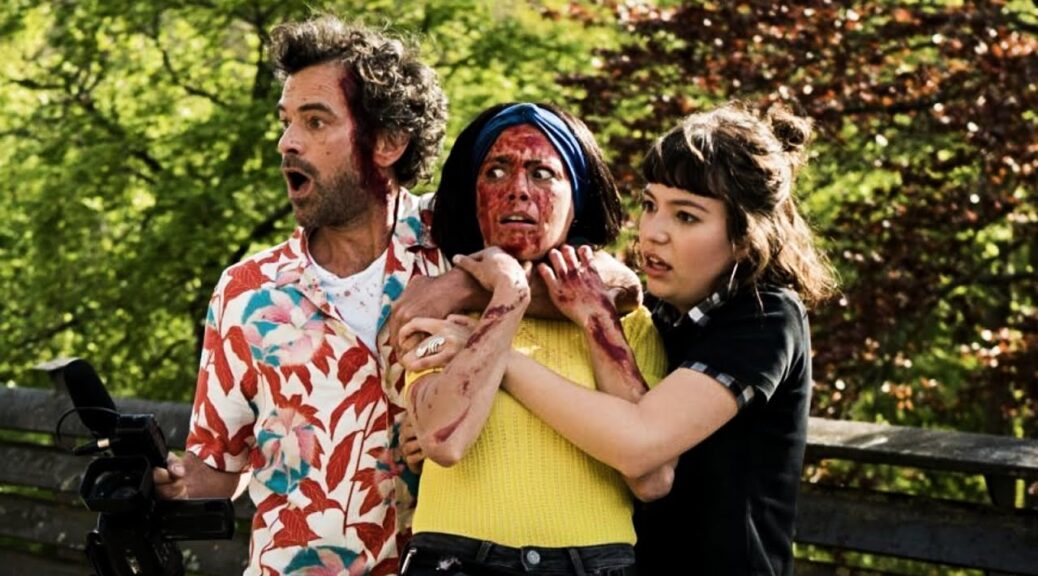
Like Ueda’s original, Final Cut is split basically into two movies. In the first, the cast and crew of a low-budget zombie flick find their set under attack from real zombies. The zealot auteur (Romain Duris) films on, gleeful at the authenticity his movie has finally achieved.
It’s a clever way to deconstruct filmmaking, but it’s only the beginning. And even though Final Cut is a remake, the likelihood that you missed the original requires that I forego additional plot details. I’d hate to spoil the silly ingenuity to come.
Duris is wonderful in a lead performance that requires a lot. Finnegan Oldfield brings wonderful layers to his pretentious young actor character and the whole ensemble seems to have a blast.
Final Cut is missing the manic, raw authenticity of Ueda’s original, though. It feels too well constructed, its jokes too perfectly timed and placed. And yet it is otherwise so similar to One Cut of the Dead that it’s tough not to wonder over the point of remaking it.
If you have not seen One Cut of the Dead, this is a fun film but you should do yourself the favor of finding the original. If you have seen it, Final Cut a good time. If you’re a filmmaker, bring the Pepto.

by Hope Madden
How do Christopher McQuarrie and Tom Cruise outdo Mission Impossible: Fallout? Because even the most impressive of the previous MI films couldn’t hold a candle to that one. I mean, the public restroom fisticuffs alone!
Mission Impossible: Dead Reckoning Part I has big shoes to fill and bridges to blow up and buildings to scale and masks to wear and trains to stop and whatnot. Does it succeed?
Of course, it does.
Ethan Hunt (Cruise) accepts a mission from his sketchy government contact (Henry Czerny). But Ethan and his team will do what they do best: go rogue. Because this key is too powerful for any one man, any one nation.
We know Ethan will do the right thing because he’s a beautiful soul. Come on, have you not been paying attention? But this villain – sentient AI “the Entity” – constantly calculates odds and probabilities. It knows Ethan’s weakness and will use it against him.
It’s a clever script by Bruce Geller, Erik Jendresen and McQuarrie. By weaponizing AI and falling back on the old rubber mask disguises, MI: DR1 mines contemporary anxiety with old school solutions.
But McQuarrie et al know what’s made the best of these films stand out. It’s not the plot – although there’s nothing at all wrong with this plot. It’s not really the villains (that’s Bond’s territory). The MI franchise lives and dies on two things: Ethan Hunt’s humanity and Tom Cruise’s willingness to risk his own life for thrilling stunts.
Expect both – aplenty! – in Episode 7.
Incredibly fun and impressive car chases follow some nifty rooftop running before turning to a magnificent series of train-related set pieces. Plus, of course, that motorcycle/mountain thing they tease in the trailer. Lunacy!
The core team – Cruise plus Simon Pegg, Ving Rhames and Rebecca Ferguson – continue to share entertaining camaraderie. Franchise newcomers Esai Morales, Hayley Atwell and Pom Klementeiff bring varying degrees and styles of badassedness. But, let’s be honest, all eyes are on Cruise.
He sells it. There is something old timey about a runaway train, and yet, in Cruise and McQuarrie’s hands, it’s never looked more fun or more thrilling. It’s a long film – just a hair under 3 hours – and it tells only half the story. Part 2 is due out in 2024. Still, Cruise and company manage to exceed expectations yet again.
by Hope Madden
Back in 2023, Chris Kentis crafted one of the most nerve-wracking explorations in tension ever filmed. Open Water dropped you in the middle of the ocean with a married couple and, eventually, as day turns to night and their scuba boat never comes back for them, a lot of sharks.
Few survival tales have stripped away so much and still left you so frazzled. Andres Beltran follows the minimalist tourism of doom path with his Colombian hiking misadventure, Quicksand.
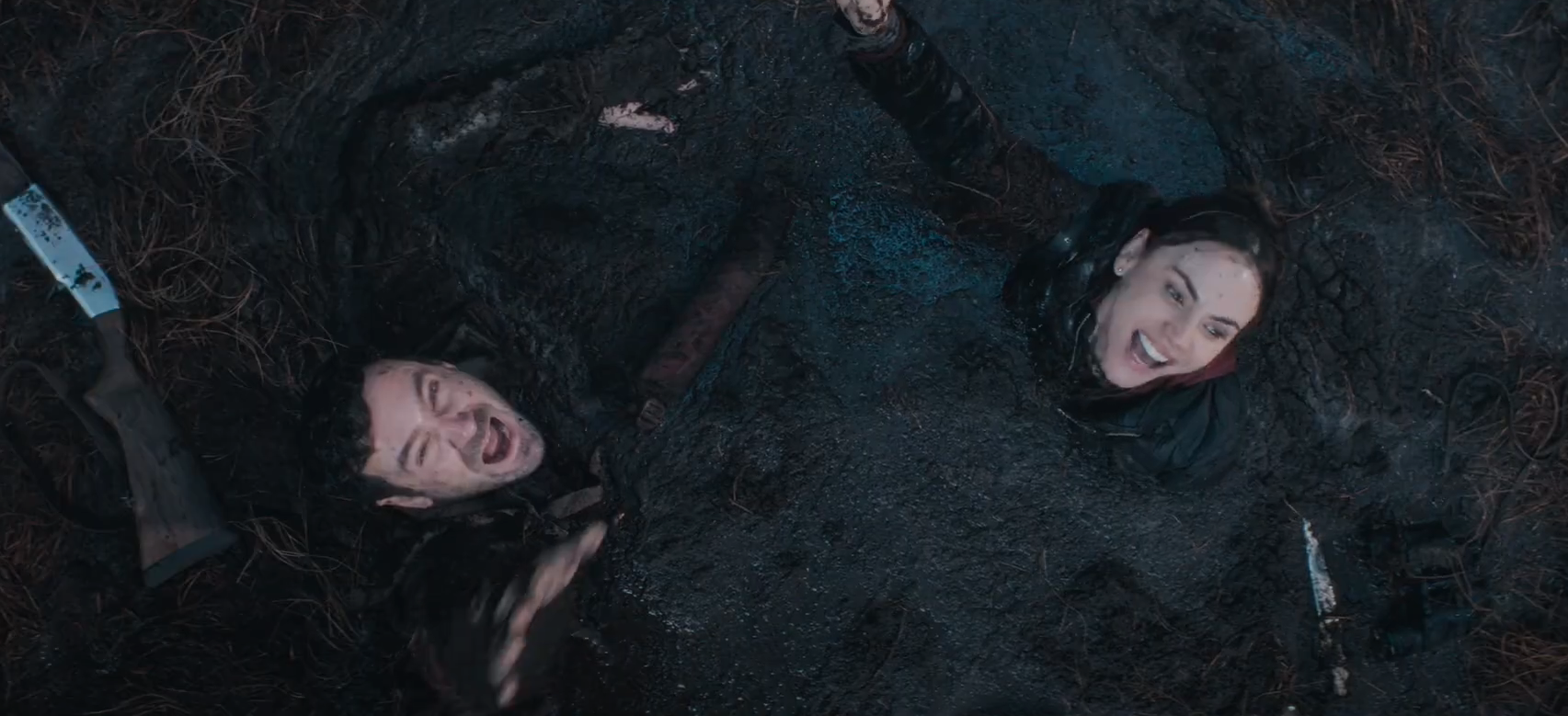
Although Sofia (Carolina Gaitan) and Nick (Allan Hawco) are separated and heading toward divorce, they accept friend Marcos’s invitation to speak at his medical convention. During some down time, they go for a hike, run into trouble, and flee for their lives in the wrong direction – into a part of the rainforest known for quicksand.
Here is where we spend most of the film: stuck chest deep in Colombian mud with an unhappy married couple. No one will realize they’re missing for at least a day, and even then, they’re miles away from where anyone might look for them.
The quicksand isn’t their only problem, naturally. Trapped as they are, they’re vulnerable to predators – fire ants, snakes – but they’ll still have time to hash out their own issues.
A film this limited, done well, can keep you in the moment, your head on a swivel, your mind working along with the characters’ to find a solution. Adam Green’s 2010 skiing horror Frozen succeeded, as, to a degree, did the 2010 Ryan Reynolds date with claustrophobia, Buried.
Given the extremely limited cast, action and locations, a film like this lives and dies on performances since there’s almost nothing else to look at. Hawco delivers layered, vulnerable work that surprises.
Gaitan is less convincing, partly because the performance is superficial and partly because Sofia’s internal journey feels inauthentic and manipulative.
Beltran’s direction, though competent, lacks inspiration. He never manages to mine tension, and his actors rarely feel truly stuck. Uncomfortable, sure. Dirty and wet, definitely. Trapped and panicked, nope.
The fact that the film’s blandly obvious, wildly outdated message is all we get from our efforts doesn’t do Quicksand any favors, either.

by Hope Madden
Wasting an exceptional if oddly miscast ensemble, Thaddeus O’Sullivan’s The Miracle Club has something important on its mind. It just can’t quite articulate it.
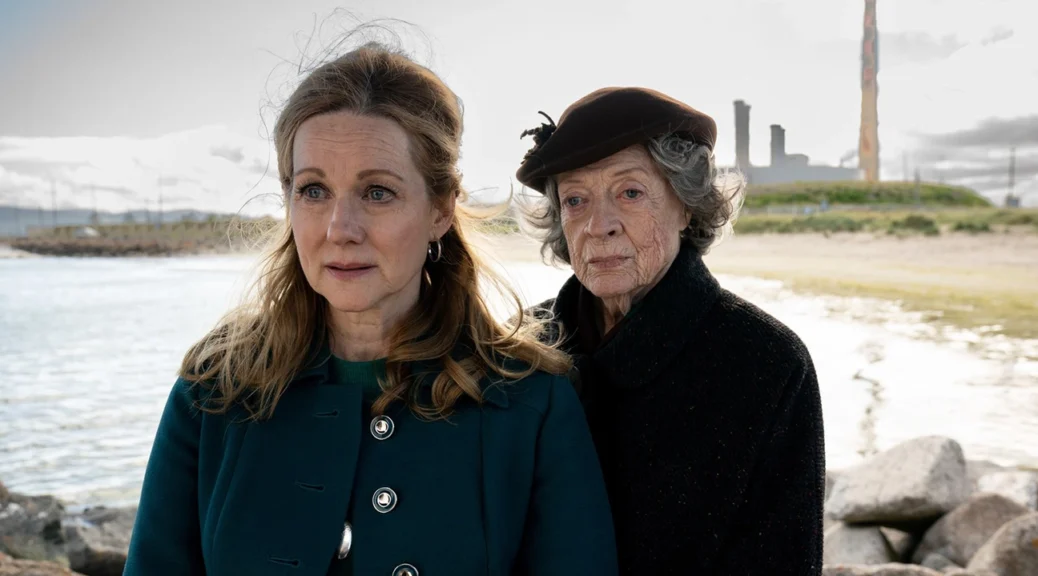
Two Americans and a Brit lead the cast as scrappy Irish folk. Chrissie (Laura Linney) is the prodigal daughter returned for her mother’s funeral. Eileen (Kathy Bates) is her childhood friend who cannot believe Chrissie had the gall to return after what she did. The deceased’s best friend Lily (Maggie Smith) is disappointed the girl didn’t come sooner to comfort her mother during her time of need.
Chrissie’s timing is actually amazing. The whole parish is taking part in a talent show in honor of her mother. The winners get a trip to Lourdes to ask for a miracle. One contrivance follows another and next thing you know, Chrissie, Eileen and Lily are all en route to the holy city in France, begrudgingly together.
The Miracle Club is frustratingly evasive when it comes to Chrissie’s backstory. We get a sense but no real clarity, but it seemed to have been something quite dire. And yet, all is forgiven without much a do.
What O’Sullivan – working from a script by Joshua D. Maurer, Timothy Prager and Jimmy Smallhorne – tries to bring to the surface is an image of systemic oppression relieved only when women support each other.
There is one moment – a climactic confession – where the film’s themes resonate, thanks mostly to Linney’s quietly desperate performance. Dolly (Agnes O’Casey) is hoping that, with the help of the Blessed Virgin, her son will finally speak. But she has a secret, and she believes she’s to blame for whatever ails little Daniel (Eric D. Smith, adorable).
In this moment, O’Sullivan’s film seems to find its miracle, as four women recognize the burden their faith and the patriarchy have put on them. But we must rely on the weighty stares from one talented actor to the next because the film has no intention of pinpointing its deeper concerns.
Worse still, O’Sullivan’s film is so entirely forgiving of both the church and the patriarchy that these themes feel as artificial as the leads’ accents.
O’Sullivan’s tone is forever uplifting, sometimes comically so, but the underlying peril these women have faced and forced is anything but light. He and his writers (men, all) honor these put-upon women who manage. God bless them for managing. God forbid they revolt.