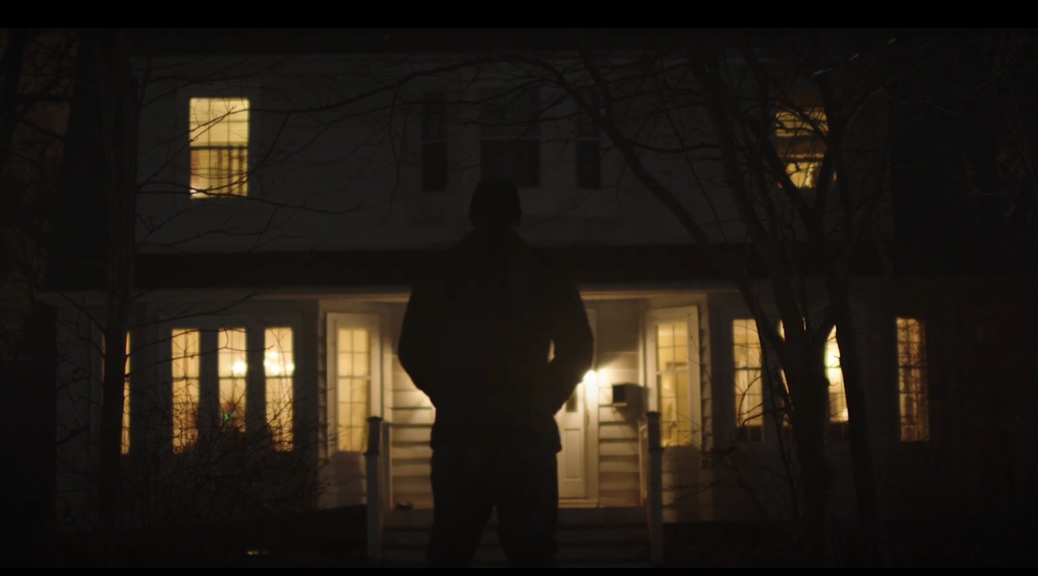
Filmmaker Kyle Hausmann-Stokes impresses with his feature debut, My Dead Friend Zoe. Based on his 2022 short Merit x Zoe, the film follows Army veteran Merit (Sonequa Martin-Green, Star Trek: Discovery) as she tries to overcome some post-Afghanistan trauma.
Merit’s best friend Zoe (Natalie Morales)—who is, as you might surmise from the title, dead—isn’t making recovery easy. A constant companion (at therapy, on dates, etc.), Zoe— as well as Merit’s noticeable interactions with the invisible friend—is a big part of Merit’s problem.
But therapy will have to hang on because Merit’s hero, Vietnam Veteran grandpa (Ed Harris), has early onset Alzheimer’s and Merit (with Zoe in tow) needs to get to the family lake house and figure things out.
While the title and premise may sound a tad flippant, My Dead Friend Zoe turns out to be a rewarding and earnest drama. Morales delivers a boldly funny and equally vulnerable turn, and love interest Alex (Utkarsh Ambudkar) injects the film with charming, self-deprecating humor. But the levity tends to enrich the film’s truly human quality rather than distract from its underlying tensions.
Hausman-Stokes’s patient direction and unsentimental script, co-written with Cherish Chen and A.J. Bermudez, slowly uncover Merit’s trauma, which gives the unfolding family drama the attention and respect it needs.
Martin-Green’s stoic performance is offset by well-timed flashbacks to the friendship during active duty. So often in other films, this structure feels cliché and formulaic, as the look back teases a dark episode that the frivolity is meant to contrast with. Instead, Hausman-Stokes and his remarkable cast clarify the joyous bond the two women shared, deepening the sense of loss that is now drowning Merit.
We’ve seen plenty of solid dramas depicting struggles facing veterans, Megan Leavey, Thank You for Your Service, American Sniper, and the masterpiece Leave No Trace among them. The commonality My Best Friend Zoe shares with these films is the profound need for the veteran services currently on the DOGE chopping block. While My Dead Friend Zoe’s delightful and moving buddy picture vibe carves a different direction than the others took, the message is even more urgent.
Lean, mean and affecting, Mickey Keating’s take on the home invasion film wastes no time. In a wordless—though not soundless—opening, the filmmaker introduces an unhinged presence.
Cut to Ana (Vero Maynez). She’s sleepy, it’s late, the bus is empty except for the driver hustling her off, his voice constant, annoyed, and on repeat: Come on. Get off the bus. Last stop. You gotta go.
It’s 4:30 am. The bus was late, the station is deserted, and Carmilla—Ana’s cousin—is not answering.
Immediately Keating sets our eyes and ears against us. His soundtrack frequently blares death metal, a tactic that emphasizes a chaotic, menacing mood the film never shakes. Using primarily handheld cameras from the unnerving opening throughout the entire film, the filmmaker maintains an anarchic energy, a sense of the characters’ frenzy and the endless possibility of violence.
Keating strings together a handful of believably tumultuous moments early in the film—particularly a couple of run-ins with a horn-blaring cabbie—to work the nerves and leave you feeling as raw and vulnerable as Ana. Rather than dip and settle, Invader delivers relentlessly on that early sense of harried terror.
Scenes possess an improvisational quality that coincides with the rawness of the overall effort. Keating is spare with exposition—if you can’t figure out what’s going on without having it explained to you, you are clearly not paying attention. The verité style accomplishes what it’s mean to, lending Invader an authenticity that amplifies the horror.
Maynez carries that authenticity. Ana never feels written, she feels alive. Her confusion, anger, fear—all of it runs together in a way that reflects what the audience is experiencing in each moment. Her limited screentime with Colin Huerta introduces enough tenderness to give the sense of terror real depth.
Joe Swanberg, with limited screentime and even more limited dialog, crafts a terrifying image of havoc. His presence is perversely menacing, an explosion of rage and horror.
Invader delivers a spare, nasty, memorable piece of horror in just over an hour. It will stick with you a while longer.
Why is it that so many kids’ toys are creepy? Not that you should call The Monkey a toy. You should not, ever. Because this windup organ grinder monkey, with its red eyes and horrifyingly realistic teeth, is more of a furry, murder happy nightmare.
The film itself is a match made in horror heaven. Osgood Perkins (Longlegs, Gretel & Hansel, The Blackcoat’s Daughter) adapts and directs the short story by Stephen King about sibling rivalry and the unpredictability of death.
The delightfully low-key Christian Convery (Cocaine Bear) carries the first half of the film as young Hal and Bill, twins who discover their dad’s old closet full of knickknacks and collectibles, one of which will indiscriminately kill a lot of people. They boys eventually believe they’ve eliminated the beast, but decades later, the adult brothers (played with deadpan precision and one impressive mullet by Theo James) must contend with bloody monkey business once more.
Perkins surrounds his deliberately low energy leads with bizarre, colorful characters—even more colorful when they catch fire, explode, are disemboweled, etcetera. The film is laced with wonderful bursts of Final Destination-like bloodletting, as the Monkey’s executions are carried out via Rube Goldberg chain reactions that quickly become fun to anticipate.
Yes, fun. And funny.
There is a different tone at work here for Perkins. It’s one that is somehow both bone dry and silly, creating a dark humor that wallows delightfully in the pulpy carnage. His usual aesthetic of dreamy Gothic beauty is replaced by a more grimy, Earth tone palette that seems purposefully at odds with the stated time stamps.
And yet, underneath all of it you’ll find a meaningful layer that speaks to absentee fathers and generational trauma. There are disjointed moments, but only a few, thanks mainly to grounded reminders about the monkey’s shoulder-shrugging mantra: “everybody dies.”
Indeed. And if sometimes they need a little help, well, you can always wind up Furious George and take your chances.
Filmmaker Jon Gunn makes inspirational movies. Some of them are overly faith based (The Case for Christ, Do You Believe?). Others are of the less overt, true story style (Ordinary Angels). The Unbreakable Boy is of the second variety.
Zachary Levi is Scott, a dad out of his depth with a young son who is on the spectrum and suffers from brittle bone disease. The ebullient Austin (Jacob Laval) is not bothered by his condition or anything else. But middle school approaches, and as Austin transitions to adolescence, other fractures within the family begin to make themselves known.
Based on a true story, the film demands that you recognize that while Austin would be exhausting, he is also an absolute joy. Laval is adorable. His indominable spirit fuels the film and when Gunn’s focus changes to another family member, Laval’s presence is missed.
What the film gets right is the heartbreaking difficulty of parenting, rarely giving into unidimensional characterizations and allowing for weakness and weariness as well as joy.
Levi’s a natural charmer and Meghann Fahy impresses, carving an honest character of the underwritten loving wife role. Likewise, young Gavin Warren makes the most of his limited screentime.
Levi is considerably less convincing when it comes to the more emotionally difficult scenes. This weakness is paired with a weird imaginary friend situation. Though Drew Powell (the friend) brings welcome levity and opportunity for insight—and, per post-film snapshots of the real family, this was an actual part of their lives—he’s used as a narrative convenience and feels like unnecessary nonsense.
Gunn’s script, co-written with Scott LeRette and Susy Flory, lacks focus and it’s never clear whose story we’re trying to tie up. Needless, often cloying voiceovers from multiple characters compound the problem, without completely sinking the film.
The Unbreakable Boy is more evenhanded than most of Gunn’s movies, although subtle it’s not. It’s tidy and predictable and suffers under the weight of sentimentality. But it’s undeniably sweet, and if an inspirational film appeals to you, you could do worse than to let Jacob Laval charm you for 90 minutes.
Aaah, the old “video nasties” — movies banned from view to protect us from the untold damage they would do, their ruinous images. The idea that watching something could be our end is a fantastic source for horror. Horror filmmakers have taken that idea and run wild with it. Watching could make you mad. Making one could make you mad. Hell, just listening could do irreversible damage!
Thanks to Greg Hansberry of The Empty Coffin podcast for filling in for George this week! Today we celebrate the nasty videos that have propelled some of our favorite flicks.
6. Red Rooms (2024)
True crime culture. Serial killer groupies. The Dark Web. Does all of it seem too grim, too of-the-moment, too cliché to make for a deeply affecting thriller these days? Au contraire, mon frère. Québécois Pascal Plante makes nimble use of these elements to craft a nailbiter of a serial killer thriller with his latest effort, Red Rooms.
Plante expertly braids vulnerability and psychopathy, flesh and glass, humanity and the cyber universe for a weirdly compelling peek at how easily one could slide from one world to the other.
His real magic trick—one that remarkably few filmmakers have pulled off—is generating edge-of-your-seat anxiety primarily with keyboard clicks, computer screens and wait times. But the tension Plante builds—thanks to Juliette Gariépy’s precise acting—is excruciating. They keep you disoriented, fascinated, a little repulsed and utterly breathless.
5. Berberian Sound Studio (2012)
Madman Peter Strickland (In Fabric) made an entire film about sound, and it gets so much right. Not just about sound—about the era, the equipment, giallo sensibilities and moviemaking.
Strickland, working with a sound department of 34, creates a psychological experience through sound almost exclusively. The amazing Toby Jones plays Gilderoy, flown in specifically to helm the sound in a horror movie.
“This isn’t a horror movie. This is a Santini movie!”
Gilderoy’s arc is profound, and sound is our only window into what is changing him. We don’t see what he sees, only his reaction to it and the sound of it that makes his psychological breakdown believable.
4. The Ring (2002)
Gore Verbinski’s film achieves one of those rare feats, ranking among the scarce Hollywood remakes that surpasses the foreign-born original, Japan’s unique paranormal nightmare Ringu. Verbinski’s film is visually arresting, quietly atmospheric and creepy as hell.
This is basically the story of bad mom/worse journalist Rachel (Naomi Watts) investigating the urban legend of a videotape that kills viewers exactly seven days after viewing.
The tape itself is the key. Had it held images less surreal, less Buñuel, the whole film would have collapsed. But the tape was freaky. And so were the blue-green grimaces on the dead! And that horse thing on the ferry!
And Samara.
From cherubic image of plump-cheeked innocence to a mess of ghastly flesh and disjointed bones climbing out of the well and into your life, the character is brilliantly created.
3. Censor (2021)
Writer/director Prano Bailey-Bond crafts such a stylish, unsettling film with her ode to Britain’s “Video Nasty” era and the theme that censoring something ugly can somehow make it disappear.
Naimh Algar astonishes as Enid, a film censor whose childhood trauma and guilt resurface when a producer (Michael Smiley) invites her to watch a movie. A mystery—and Enid’s fragile sanity—unravel as Bailey-Bond develops a murky, fantastical and wildly horrific atmosphere that leaves you guessing and disturbed.
2. Videodrome (1983)
Videodrome was the last true horror and truly Canadian film in David Conenberg’s arsenal, and it shows an evolution in his preoccupations with body horror, media, and technology as well as his progress as a filmmaker.
James Woods plays sleazy TV programmer Max Renn, who pirates a program he believes is being taped in Malaysia – a snuff show, where people are slowly tortured to death in front of viewers’ eyes. But it turns out to be more than he’d bargained for. Corporate greed, zealot conspiracy, medical manipulation all come together in this hallucinatory insanity that could only make sense with Cronenberg at the wheel.
Deborah Harry co-stars, and Woods shoulders his abundant screen time quite well. What? James Woods plays a sleaze ball? Get out! Still, he does a great job with it. But the real star is Cronenberg, who explores his own personal obsessions, dragging us willingly down the rabbit hole with him. Long live the new flesh!
1. Peeping Tom (1960)
Director Michael Powell’s film broke a lot of ground and nearly ended his film career. People tend to react badly to horror movies that unnerve them, which is really odd given that this is the entire point of the genre. Peeping Tom pissed everybody off, maybe because—like Michael Haneke’s films Funny Games—Peeping Tom implicates you in the horror.
Mark (Karlheinz Bohm) had a difficult childhood, developing a bit of a voyeuristic hobby to help him cope. He starts off with prostitutes, filming them, capturing their terror as he kills them. He’s a voyeur, but who can throw stones? Didn’t every one of us who’s ever watched this film— or any other horror movie, for that matter—sign up to do exactly what Mark was doing?
Bohm’s great success is in making Mark unsettlingly sympathetic. Powell’s is in using the audience’s instincts against us. Bohm makes us feel bad for the villain, Powell makes us relate to the villain. No wonder people were pissed.
Set in the “every fabric is patterned” Seventies, Little Bites drops us into one really horrifying relationship.
Widowed mom Mindy (Krsy Fox) has sent her 10-year-old, Alice (Elizabeth Phoenix Caro), to stay with Grandma (Bonnie Aarons, The Nun franchise)—an overbearing, hypercritical shrew. That’s not the problematic relationship, though. Mindy sent Alice away because of the demon living in her basement, the one who rings a dinner bell a few times a day, then takes a couple of bites out of Mindy.
The mythology is interesting if undeveloped, but whatever the reason Agyar (Jon Sklaroff, excellent) came to live off of Mindy’s flesh, it’s a solid and troubling concept. Sklaroff’s weary superiority and dark wit create a fascinatingly nightmarish villain.
It’s a metaphor concerning the life draining sacrifice motherhood can be—something Babadook explored so beautifully and startlingly. It’s a provocative idea executed poorly.
Writer/director Spider One (Rob Zombie’s youngest brother) strings together some memorably disturbing ideas made weirder and better with some (not all) of his dialog. And a slew of veteran actors (Aarons, Barbara Crampton, Heather Langenkamp) strengthens the effort. Chaz Bono (who Executive Produces with his mother) delivers a sweetly bruised performance.
Fox is the weak link. She lacks chemistry with the rest of the cast and struggles mightily with the filmmaker’s more overwrought sections of dialog (any conversation between Mindy and her mother, for example).
At least as problematic is the stiff direction. There’s precious little variety in shot selection, at an hour and 45 minutes, the film is in desperate need of a good trim. Every scene goes on for an awkward length, far longer than the actors are able to maintain any sense of naturalism. Tightening scenes would certainly have made carrying the film an easier task for Fox.
There’s something here, something unseemly and a little tragic. If the filmmaker could have trimmed the fat, Little Bites might have been a pretty tasty horror.
There were three reasons to be optimistic about Old Guy, the latest from director Simon West. West used to make big budget, memorably bad actioners (Con Air), then middle budget middling actioners (The Mechanic, The Expendables 2), and now low budget actioners that have to find a way to capture attention. Hence, the three reasons for optimism.
Number one, two-time Oscar winner and all around magnetic onscreen mischief maker Christoph Waltz plays the lead. He’s Danny Dolinski, an aging hitman with a penchant for drink, drugs and threesomes (and hideously patterned short sleeve button downs).
Dolinski’s recovering from hand surgery—his trigger hand—which is slowing him down. Thus, he’s been tasked with training a new man, Wihlborg (Cooper Hoffman). Reason number 2. The actor’s handful of onscreen performances—particularly, his remarkable lead turn in Paul Thomas Anderson’s 2021 Licorice Pizza—mark him as an actor I’m anxious to see in anything.
And reason 3, Lucy Liu, whose recent work finds edges and scars that give characters intriguing dimension. She’s particularly wonderful onscreen right now in Steven Soderbergh’s inverted ghost story Presence.
What’s most fun about the casting is that all three talents are playing entirely against type. And though not one of them is entirely convincing as their own particular fringe-of-society misfit, each is deeply charming.
West’s direction is frantic enough to do service to both the action and comedy Old Guy is trying to convey. Greg Johnson’s script is not helping. The dialog is not especially funny and worse still, the plot itself falls entirely apart under the lest scrutiny. But the veteran popcorn-and-car-chase director injects a bit of tension and giddy humor with image juxtaposition and punchy editing.
And there’s just a silliness in the cast that’s engaging. Liu’s character is an absolute afterthought, but the performance compels interest nonetheless. Hoffman’s been handed less a character than a handful of tics in dark nail polish, but he gives the guy a heartbeat and you find yourself rooting for him.
And Waltz, so charmingly miscast, characteristically finds insignificant moments to turn into cinematic highlights. You’ll forget Old Guy the minute those catchy looking credits stop rolling, but sometimes a brain needs to turn off and wallow in three solid performers having fun and making the most of a bad situation.
Look out! There’s a bloated menace wreaking havoc at the White House, throwing temper tantrums, creating enemies of allies, and ruining everything he touches.
But wait, could there be some nefarious, nerdy, unelected mastermind behind the villainy destroying the United States of America?
Art imitates life in Marvel’s latest big screen attempt, Captain America: Brave New World. Anthony Mackie picks up the shield as Cap. We’ve known Mackie could act since his 2009 breakout, The Hurt Locker, but can he carry a franchise film?
As a rule, franchise films are helped by the addition of Harrison Ford. He loses the mustache and picks up the mantle carried by Sam Elliott and William Hurt, playing Thaddeus Ross, newly elected President of the USA.
The President has done some pretty horrible things, though, and should really be in prison. Instead, he’s in the White House. Pair that with a mysterious villain trying to orchestrate a war, and the end of the world could be in sight.
But the movie has bigger problems, starting with its script. Writers Rob Edwards, Malcolm Spellman and Dalan Musson stuff the film with repetitive dialog and endless exposition. Not sure what just happened or what’s about to happen? No need to fret, somebody’s about to explain it again.
Director Julius Onah (Luce, The Cloverfield Paradox) strings together a few impressive action sequences, but the momentum always gets derailed by needless explanation and – especially in the third act – some bland CGI visuals. Even the cameos and end credits scene are less than inspiring.
From the beginning, the Captain America character felt like the moral compass of the MCU. The best films in the franchise have found ways to balance the super-heroics with timely questions about power and responsibility. Brave New World creates the opportunity but never allows Cap to follow through. Instead, complexities are neutered in favor of easily digestible answers and the next weakly earned plot point.
That’s what makes the film so disappointing. A deserving new hero and a solid cast are given a narrative treatment usually suited to streaming audiences who are looking at their phones or getting up to feed the dog.
Above all, this new world seems satisfied with playing it safe. And that’s not brave at all.
So what has Paddington bear been up to in the eight years since the classic Paddington 2?
Well, he’s got a new director (Dougal Wilson in his feature debut), a new Mrs. Brown (Emily Mortimer steps in for Sally Hawkins), and a brand new British passport (with an unusual photo)! And that legal ID comes in mighty handy when Paddington (perfectly voiced again by Ben Whishaw) gets a mysterious letter from Peru.
Aunt Lucy is missing!
So what’s there to do except pack up the Browns, Paddington, and Paddington’s brand new deluxe umbrella and head out to solve the mystery. After meeting with the Reverend Mother (Olivia Colman, always a plus) and collecting clues at the Home for Retired Bears, the gang hires dashing Captain Hunter Cabot (Antonio Banderas) and his daughter Gina (Carla Tous) to take them up river and straight into a jungle adventure.
Because while Paddington and family may be searching for Aunt Lucy, certain other parties are searching for El Dorado, the mythical lost city of gold!
The bar set by Paddington 2, an honest to God masterpiece, is very high. Dougal and team had their work cut out for them, and the Browns’ Peru visit is never quite as intricate, clever or transcendent as the last installment. But Colman’s comedic genius, lushly crafted scenery, meticulous CGI, and the cast and filmmakers’ commitment to the earnest charm characteristic of the franchise guarantee a delightful cinematic experience for every member of the family.
Dougal keeps the pace and perils lively, while the new screenwriting team (Mark Burton, Jon Foster and James Lamont) delivers sweet family fun that weaves in some warm furry feelies before the credits roll and a surprise guest appears.