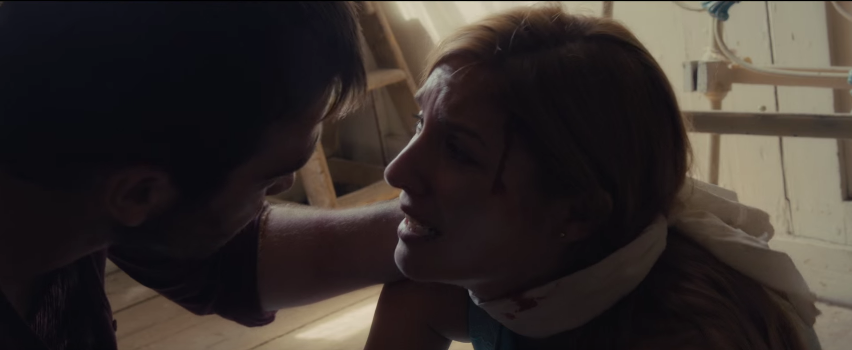
“Hell is not a place you see. You carry Hell with you at all times.”
Cheery stuff, that! If you’ve ever wondered what hell might look like, first time feature director Can Evrenol has some ideas to share. They are vivid. You’ll swear they even have an odor.
Evrenol’s Baskin is a loose, dreamily structured descent into that netherworld in the company of a 5-man Turkish police unit. (Baskin is Turkish for “police raid.”) The serpentine sequencing of events evokes a dream logic that gives the film an inescapable atmosphere of dread, creepily underscored by its urgent synth score.
We are trapped along with this group of somewhat detestable, somewhat sympathetic men as they respond to a call for backup in an “off the map” nearby area. What they find is deeply disturbing.
Unless you really like frogs. If so, then – hooray! Frogs!
The rest of it, though? Horrifying.
Evrenol’s imagery is morbidly amazing. Much of it only glimpsed, most of it left unarticulated, but all of it becomes that much more disturbing for its lack of clarity.
The cast is uniformly solid with the exception of Mehmet Cerrahoglu, who may leave you speechless. The director has taken to calling him the new Michael Berryman – a name genre fans will recall as the haunting, hulking, hairless menace in Wes Craven’s The Hills Have Eyes and their nightmares.
Cerrahoglu’s remarkable presence authenticates the hellscape of these characters’ descent. Evrenol’s imaginative set design and wise lighting choices envelope Cerrahoglu, his writhing followers, and his victims in a bloody horror like little else in cinema.
There are moments when Baskin feels like a classier, more stylishly made Nightbreed, but there’s no camp factor here. Just a surreal exploration of the corruptibility of the human soul, and its final destination.
Baskin may infuriate viewers looking for a tidy package, and it may underwhelm gorehounds intrigued by reports of audience walk outs. Be that as it may, the film represents a vital new voice in the genre (Evrenol), not to mention a potentially iconic new face in horror and bad dreams (Cerrahoglu).
We’re on a music kick. Last week we looked at the best rock star horror movies, so it seemed only natural to move on to the best horror musicals this week. At our house, this particular sub-genre might serves as a kind of bridge between the two of us, since Hope generally hates musicals while George appreciates them. And though it is true that Hope can find some love in her heart for a musical with a side of bloodletting, it turns out that George only likes actually good musicals. Which is to say, they disagree a bit on this list.
Dude, 1974 must have been nuts. Brian De Palma’s first and only musical is a Phantom of the Opera/Faust/The Picture of Dorian Gray mash up (with some Frankenstein, The Cabinet of Dr. Caligari, and more than a little Rocky Horror thrown in for good measure). That’s a heady mix, and while the film was nominated for an Oscar for its music, it isn’t exactly the classic you might expect.
A campy skewering of the soulless music industry, Phantom sees tiny Seventies staple Paul Williams as the Satan-esque Swan, a music executive with a contract for you to sign. Poor Winslow (William Finley) is just as wide-eyed about his music as all those would-be starlets are about their chances for fame and fortune in this evil world of pop super stardom.
Like many horror musicals, the film works best as a comedy, but Finley’s garish visage once he makes his transformation from idealistic musician to mutilated Phantom is pretty horrifically effective. The film as a whole is a hot Seventies mess, but that’s kind of the joy of it, really.
4. House (Hausu) (1977)
If Takashi Miike’s Happiness of the Katakuris were to marry Pee-wee’s Playhouse, this would be their offspring.
A spoof of sorts, Hausu tells the story of six uniform-clad high school girls named Gorgeous, Fantasy, Sweet, Melody, Kung Fu, and Mac. The nomenclature alone should clue you in on the film’s lunacy. The giggling sextet spend spring break at an aunt’s spooky house – or, in fact, a cheaply made set of an aunt’s spooky house. Not a single thing that follows makes sense, nor is it really meant to.
Expect puppets, random musical sequences, remarkably bad backdrops, slapstick humor, and an amazingly sunny disposition given the sheer volume of human dismemberment. The trippy nonsense wears a bit thin eventually. Luckily director Nobuhiko Obayashi’s film clocks in at under 90 minutes, so the screen goes dark before the novelty wears off.
3. Sweeney Todd: The Demon Barber of Fleet Street (2007)
Here’s a bizarre idea for a musical: The barber upstairs kills his clients and the baker downstairs uses the bodies in her meat pies. Odd for a Broadway musical, yes, but for a Tim Burton film? That sounds a little more natural.
Burton’s Sweeney Todd: The Demon Barber of Fleet Street is a full-on musical – Burton’s first – and every inch a stage play reproduction. For many films, this would be a criticism, but Burton’s knack for dark artificiality serves the project beautifully, and he achieves the perfect Dickensian Goth tone. His production is very stagy and theatrical, but never veers from his distinct, ghoulish visual flair.
As in most of Burton’s best efforts, Sweeney Todd stars Johnny Depp in the title role. Depp is unmistakably fantastic – consumed, morose, twisted with vengeance – and he’s in fine voice, to boot.
The supporting cast boasts a liltingly nefarious performance by Alan Rickman. As the judge whose sent an innocent Todd off in shackles, raped his wife, then took custody of his daughter, whom he leeringly admires, Rickman is wonderful as always. His duet with Depp on “Pretty Women” is the film’s real musical gem.
With Burton’s help, Depp found another dark, bizarre anti-hero to showcase his considerable talent. With Depp’s help, Burton gorgeously, grotesquely realized another macabre fantasy.
2. The Happiness of the Katakuris (2001)
Takashi Miike is an extremely prolific director. He makes a lot of musical films, a lot of kids’ movies, a lot of horror movies, and then this – a mashup of all of those things. Like Sound of Music with a tremendous body count.
The Katakuris just want to run a rustic mountain inn. They’re not murderers. They’re lovely – well, they’re losers, but they’re not bad people. Buying this piece of property did nothing to correct their luck, either because, my God, their guests do die.
You might call this a dark comedy if it weren’t so very brightly lit. It’s absurd, farcical, gruesome but sweet. There’s a lot of singing, some animation, a volcano, a bit of mystery, more singing, one death by sumo smothering, and love. It sounds weird, truly, but when it comes to weird, Miike is just getting started.
https://www.youtube.com/watch?v=XDfMXwRapNc
1. The Rocky Horror Picture Show (1975)
Surely you expected no other atop this list because, honestly, nothing else comes close. The most iconic of all horror musicals, The Rocky Horror Picture Show boasts the best soundtrack, the best performances, the best mad scientist, and quite possibly the most fun there is to be had (legally) at the movies.
I’m afraid you’ve touched on a rather tender subject there.
Tim Curry is utter perfection as Frank-N-Furter (A Scientist). The entire balance of the cast is also amazing, but no matter how many times you watch Curry step out of that elevator, abuse his servants, or seduce his houseguests, it never gets old.
Creator Richard O’Brien’s raucous, once controversial film about a sweet transvestite, a slut, an asshole, and a couple of domestics who sing, time warp, throw rice, animate monsters, swap partners, and finally put on a show is still as much fun as it ever was.
Once a subversive take on the classic musicals and sci-fi films of the 30s and 40s, Rocky Horror is now a high-camp icon of its own.
The rock star/horror movie crossover seems a natural extension of the darkness and cool of each, and it has happened countless times. Some of the crossovers are almost too obvious – Ozzy Osbourne in Trick or Treat or Grace Jones as an aggressive stripper/vampire in Vamp. John Mellencamp, Iggy Pop, Cherie Curie, Jon Bon Jovi, and, of course, Meat Loaf – these rockers and others have lined up to dance with the dead.
But here are the best rock star performances in horror.
Let us just get this out of the way now – we don’t care for this film. Yes, John Carpenter is a master of horror, but this film felt stale in ’87 and it has not aged well.
However, perhaps the greatest stroke of genius Carpenter had when filming was to cast Alice Cooper as the leader of the demon-possessed band of shopping cart people.
As scientists and theologians hole up inside an abandoned church in a very bad neighborhood, they begin to notice the attention of the silent, menacing homeless man outside. And every time they look, he has more friends. It is possibly the only genuinely chilling image in the film, and much of the success is due to Cooper’s effortlessly menacing presence.
Alice Cooper’s stage persona makes him a perfect fit in horror – perhaps moreso than any other rock star. Indeed, he’s gone on to play Freddy Krueger’s father, a vampire, and all manner of supernatural lowlife in film. But for his most unsettling turn, all he needed was a disheveled appearance and his own natural presence.
5. Tom Waits: Bram Stoker’s Dracula (1992)
Francis Ford Coppola took his shot at Dracula in ’92. How’d he do?
Cons: Keanu Reeves cannot act. Winona Ryder can act – we’ve seen her act – but she shows no aptitude for it here, and lord she should not do accents. Anthony Hopkins has always enjoyed the taste of scenery, but his performance here is just ham-fisted camp.
Pros: Tom Waits as Renfield – nice! Creepy yet sympathetic, with that haggard voice, Waits brings a wizened mania to the character that’s more than refreshing. Likewise, Gary Oldman, who can chomp scenery with the best chewers in the biz, munches here with great panache. He delivers a perversely fascinating performance. His queer old man Dracula, in particular – asynchronous shadow and all – offers a lot of creepy fun.
Still, there’s no looking past Ryder, whose performance is high school drama bad.
4. Henry Rollins: He Never Died (2015)
With a funny shuffle step and a blank stare, Henry Rollins announces Jack, anti-hero of the noir/horror mash up He Never Died, as an odd sort.
Jack, you see, has kind of always been here. The “here” in question at the moment is a dodgy one bedroom, walking distance from the diner where he eats and the church where he plays bingo. An exciting existence, no doubt, but this mindlessness is disturbed by a series of events: an unexpected visit, a needed ally with an unfortunate bookie run-in, and a possible love connection with a waitress.
From the word go, He Never Died teems with deadpan humor and unexpected irony. Casting Rollins in the lead, for instance, suggests something the film actively avoids: energy. The star never seethes, and even his rare hollers are muted, less full of anger than primal necessity.
Rollins’s performance is strong, offering Jack as a solitary figure who clings to all things mind numbing as a way to pass the time without complication or human interaction. As a survival mechanism, he’s all but forgotten how to behave around humanity, a species he regards without needless sentimentality.
3. Sting: Brimstone & Treacle (1982)
Easily the best acting of Sting’s career, his con man Martin turns out to be a far more malevolent presence in the Bates household than poor Norma (Joan Plowright – wonderful as always) and Tom (Denholm Elliott) could imagine.
Martin feigns a fainting spell on the street long enough to lift Tom’s wallet. When he returns it – cash light – to the address on the license, he quickly eyeballs the surroundings and claims to be the fiancé of their bedridden daughter Pattie (Suzanna Hamilton).
The film mines layer after layer of repression – societal, sexual, religious and other – as it plays on your constantly expanding sense of dread. Sting is wonderful. His playfully evil performance and the way he eyes the audience/camera gives him the air of something far more unwholesome than your run of the mill conman. Maybe even something supernatural.
2. Debbie Harry: Videodrome (1983)
As bizarre as anything he ever made – even Cosmopolis – Videodrome shows an evolution in David Cronenberg’s preoccupations with body horror, media, and technology as well as his progress as a filmmaker.
James Woods plays sleazy TV programmer Max Renn, who pirates a program he believes is being taped in Malaysia – a snuff show, where people are slowly tortured to death in front of viewers’ eyes.
Punk goddess Deborah Harry co-stars as a seductress intrigued by the slimy Renn. Harry is, as always, effortlessly sultry – a quality that works queasyingly well in this Cronenberg head trip.
But the real star is Cronenberg, who explores his own personal obsessions, dragging us willingly down the rabbit hole with him. Corporate greed, zealot conspiracy, medical manipulation all come together in this hallucinatory insanity that could only make sense with the Canadian auteur at the wheel.
Long live the new flesh!
1. Bowie: The Hunger (1983)
Tony Scott’s seductive vampire love story has a little bit of everything: slaughter, girl-on-girl action, ’80s synth/goth tunage, David Bowie. What more can you ask?
Actually the film’s kind of a sultry, dreamily erotic mess. Oh, the gauzy, filmy curtains. It looks great, but the internal logic of the vampirism as a disease doesn’t work very well. Lots of meaningless parallels with some experiment apes don’t help.
Catharine Deneuve is the old world vampire Miriam, David Bowie is her lover. But he suddenly begins aging, and she needs to find a replacement. Enter Susan Sarandon as a medical specialist in unusual blood diseases and a fine actress who’s not above smooching other girls.
There are three reasons people still watch it: Bowie, Catherine Deneuve’s seduction of Susan Sarandon (classy!), and the great dark-wave Bauhaus number Bela Lugosi’s Dead. Together it’s a Goth Trifecta! And Goths do love them some vampires.
Writer/director Abner Pastoll takes his cues from existing genre efforts, but the tale he weaves with Road Games is more than fresh and intriguing enough to stand on its own.
The film opens with unnervingly effective sound editing, as we witness the disposal of a body, pulled from a car trunk on its way in pieces to the overgrown countryside. Cut to Jack (Andrew Simpson) standing roadside, his thumb proudly announcing his purpose. He stands directly in front of a roadway sign warning in French: Danger! Do not pick up hitchhikers.
We’ll soon realize that Jack doesn’t speak French.
Pastoll continually uses this type of clever shorthand to utilize language barriers and heighten Jack’s helplessness – a state Jack himself is blissfully unaware of.
Unsurprisingly, Jack’s having no luck on the road, but soon he comes to the aid of a young woman – a fellow traveler – whose ride has become belligerent. Veronique (Josephine de la Baum) and Jack make the most of the time they have to kill on the sun dappled countryside until a kindly if odd man offers both a ride to his home for the night, with the promise of a lift to the ferry in the morning. Weird things get weirder in a film with an equal volume of red herrings and road kill.
Pastoll develops atmospheric dread reminiscent of that 1970 doomed road trip through the French countryside, And Soon the Darkness. In both films, there’s plenty you don’t know, language barriers heighten tensions, and pastoral isolation amplifies the danger.
But Pastoll inverses the narrative. And Soon the Darkness asked you to participate in the unraveling of a mystery. In Road Games, you can’t quite figure out what the mystery is.
The film has its share of problems. It too often feels contrived, it relies a bit heavily on stock genre images for shock value, and its slow pace sometimes feels leaden rather than languid. But in the end, the film succeeds due to Pastoll’s slyly layered writing combined with committed, idiosyncratic performances – especially from genre favorite Barbara Crampton and French character actor Federic Pierrot, as the couple who puts up the travelers for the night.
It’s time again to celebrate the work of a great horror filmmaker. Today it’s Wes Craven, a man who reimagined the genre again and again over his career. Sometimes with graphic violence, sometimes with satirical humor, always with a vivid imagination, Craven could make the viewer feel unsafe – a great place to start if you’re making a scary movie. Do you like scary movies?
Wes Craven made his dubious feature directorial debut with this 1972 revenge fantasy. Watch the film at your own risk, and follow the tale of a trusting family whose beloved and wholesome daughter falls into the hands of evildoers. Her fate is unknown to her family until her attackers are unknowingly taken in for the night by her family in an act of kindness. Once their crime is discovered, the family abandons decency and wreaks bloody vengeance.
Craven’s interest is the brutality – of the killers, and then the family. He wallows so mercilessly in both that this picture carries a measure of notoriety missing from anything else Craven’s directed – even The Hills Have Eyes. It’s been banned in countries the world over.
His film is not a good one, and what psychological merit it has – the idea of decent people abandoning decency in favor of blood soaked revenge – isn’t Craven’s own. (Last House on the Left is, in fact, a remake of Ingmar Bertman’s Oscar winner The Virgin Spring.) Still, for all its cartoonish sadism and contempt, for its artless disgust, Last House is an interesting genre entity, particularly as the first step in Craven’s career. It’s a horror film, plain and simple. No tidy idea that violence can be resolved through violence, or that any act of brutality is justifiable. It’s an ugly film that leaves you feeling ugly, but horror is not meant to brighten your day, eh?
4. The Hills Have Eyes (1977)
Wes Craven’s original Hills – cheaply made and poorly acted – is a surprisingly memorable, and even more surprisingly alarming flick. Craven’s early career is marked by a contempt for both characters and audience, and his first two horror films ignored taboos, mistreating everyone on screen and in the theater. In the style of Deliverance meets Mad Max, Hills was an exercise in pushing the envelope, and it owes what lasting popularity it has to its shocking violence and Michael Berryman’s nightmarish mug.
The Hills Have Eyes is not for the squeamish. People are raped, burned alive, eaten alive, eaten dead, and generally ill-treated.
In fact, Craven’s greatest triumph is in creating tension via a plot device so unreasonably gruesome no audience would believe a film could go through with it. The freaks kidnap a baby with plans to eat her. But by systematically crushing taboo after taboo, the unthinkable becomes plausible, and the audience grows to fear that the baby will actually be eaten. It’s not the kind of accomplishment you’d want to share with your mom, but in terms of genre control, it is pretty good.
3. Scream 2 (1997)
Updating his celebratory meta-analysis of genre clichés, Craven checked back in on Sydney Prescott (Neve Campell) and crew a couple years later, as the surviving members of the Woodsboro murders settled into a new semester at Windsor College. The movie Stab, based on the horrors Sydney and posse survived (well, some didn’t survive) just two years ago is already out and screening on campus, but has it inspired copycat killers?
Craven, working again from a screenplay by Kevin Williamson, goes even more meta, using the film-within-a-film technique while simultaneously poking fun at horror sequel clichés in his own horror sequel.
And in the same way Scream subverted horror tropes while employing them to joyous results, the sequel – funny, tense, scary, smart, and fun – manages to find freshness by digging through what should be stale.
2. Nightmare on Elm St. (1984)
Teens on suburban Elm St. share nightmares, and one by one, these teens are not waking up. Not that their disbelieving parents care. When Tina woke one night, her nightgown shredded by Freddie’s razor fingers, her super-classy mother admonished, “Tina, hon, you gotta cut your fingernails or you gotta stop that kind of dreamin’. One or the other.”
Depositing a boogieman in your dreams to create nightmares that will truly kill you was a genius concept by writer/director Craven because you can only stay awake for so long. It took everyone’s fear of nightmares to a more concrete level.
The film was sequeled to death, it suffers slightly from a low budget and even more from a synth-heavy score and weak FX that date it, but it’s still an effective shocker. That face that stretches through the wall is cool, the stretched out arms behind Tina are still scary. The nightmare images are apt, and the hopscotch chant and the vision of Freddie himself were not only refreshingly original but wildly creepy.
1. Scream (1996)
In his career, Wes Craven has reinvented horror any number of times. When Scream hit screens in 1996, we were still three years from the onslaught of the shakey cam, six years from the deluge of Asian remakes, and nearly ten years from the first foul waft of horror porn. In its time, Scream resurrected a basically dying genre, using clever meta-analysis and black humor.
What you have is a traditional high school slasher – someone dons a likeness of Edvard Munch’s most famous painting and plants a butcher knife in a local teen, leading to red herrings, mystery, bloodletting and whatnot. But Craven’s on the inside looking out and he wants you to know it.
What makes Scream stand apart is the way it critiques horror clichés as it employs them, subverting expectation just when we most rely on it. As the film opens, Casey (Drew Barrymore) could have survived entirely (we presume) had she only remembered that it was not, in fact, Jason Voorhees who killed all those campers in Friday the 13th; it was his mother. A twisted reverence for the intricacies of slashers is introduced in the film’s opening sequence, then glibly revisited in one form or another in nearly every scene after.
We spent the next five years or more watching talented TV teens and sitcom stars make the big screen leap to slashers, mostly with weak results, but Scream stands the test of time. It could be the wryly clever writing or the solid performances, but we think it’s the joyous fondness for a genre and its fans that keeps this one fresh.
A university class at a Louisiana college decides to document a presumably haunted plantation for some extra credit. It will be their The Final Project.
Their footage is made public by a man whose voice and image are hidden. He wants us to know what really happened that night. Why we need to sit through an excruciating amount of “Oh, is the camera on?” footage during study sessions, classroom antics, and the van trip to the plantation is anybody’s guess.
The film itself feels like a student project, but not necessarily in the way it’s meant to. Clearly made on next to nothing, The Final Project is a fair if amateurish effort, the cast and crew doing what they can with no budget for blood or effects. An awful lot is left to the imagination. Unfortunately, the film doesn’t bring the suspense, the sense of foreboding, or the visual panache to keep your attention long enough to engage your imagination.
Like The Blair Witch Project and far too many other found footage films since, The Final Project pulls you through the seemingly innocent hours before the catastrophic end of an attempted documentary. Aside from the very rare window apparition or an underdeveloped plotline involving a portrait on the plantation, the film offers precious little in terms of scares or suspense.
The set-up is more like that of a slasher: six unpleasant yet attractive young people head to a disastrous location to be picked off one by one. The characters are underdeveloped, with performances ranging from mediocre to poor. The actors are not helped at all by the routinely unrealistic dialog.
The Final Project is a first effort from director Taylor Ri’chard, who also co-wrote the script, produced, and handled the visual FX. Kudos to him for handling so much and for actually producing a film, which is, in itself, a victory. Also, better luck next time.
There are not a lot of Australian horror movies I would pass up. Whether it’s the relentless, grisly terror of Wolf Creek, the shattering metaphorical horror of The Babadook, or one of the trademark muscular, bloody comedies like Wyrmwood or 100 Bloody Acres, somehow Aussie genre output satisfies more often than not.
Nick Robertson’s The Pack offers a slight premise, but mines it for all it’s worth as an isolated farmhouse family must survive the night once a pack of flesh-hungry dogs surrounds their property.
There’s precious little story outside the nightlong attack. Carla (Anna Lise Phillips) is a vet who tends to the pets and farm animals in the surrounding countryside, a job that’s meager wage pays most of the bills now that something’s been killing so much of her family’s livestock. Her husband Adam (Jack Campbell) refuses to sell the property to the creepy banker; their son (Hamish Phillips) wants to stay while their teenaged daughter (Katie Moore) would rather live in town.
And then dogs come.
The wild isolation of the outback has provided the backbone for most of the country’s horror output – as it does again here. Rather than filming the vast, surrounding woods and wilderness as a menace, cinematographer Benjamin Shirley’s camera captures the elegance and beauty of it. You don’t wonder what makes this family want to stay. It’s an interesting cinematic choice, because you aren’t given the sense that their separation from the larger society is necessarily dangerous, rather that this abundance of beauty somehow betrays them.
Same with the dogs. These are not your sinewy, feral beasts slinking through the woods. They’re gorgeous – fluffy, even. And yet, when enough of them spread out through the trees just beyond the edge of the property, their heads lowered, their eyes catching the fading light, it’s all you can do not to yell to Adam to run.
The problem with The Pack is that the whisper thin plot doesn’t allow for much of a climax or denouement. The final scene in this film leaves more questions than answers, and not in an exciting, ambiguous way.
It’s a quick and finely acted rush, but like the sugar from this box of Thin Mints next to me, it’s not a rush that sticks around.
Back in 2002, I wondered whether there was such a need for an Evil Dead reboot that Cabin Fever was necessary. Director/co-writer/co-star Eli Roth’s first feature just updated the “cabin in the woods” classic by removing demons and inserting a water-bound virus. Otherwise –right down to the rotting girlfriend in the toolshed – it’s the same movie. Only worse.
So, you can imagine the path my thoughts took to find that Cabin Fever has been rebooted, just 14 years after the “original” release. Has so much changed that a retooling of what was essentially a retooling makes sense?
No.
In case you missed the first one, five college kids – a handsome couple, the two who haven’t hooked up yet, and the fifth wheel – head into the woods for spring break. Yes, it not only sounds so clichéd that you actually think of spoofs before you think of serious horror movies, but it is, in fact, an exact duplicate of the 2002 version.
Just minutes into the five pretty co-eds’ journey, it’s not even the Eli Roth film you remember. Joss Whedon and Drew Goddard’s 2012 meta-flick Cabin in the Woods will more likely spring to mind because Cabin Fever opens so heavy handedly it’s almost a spoof.
A bigger gun, a couple of selfies, and you basically cover every major difference between the 2016 and 2002 renditions of the film. What the movie lacks in originality – which is everything – it begins to compensate for with adequate performances and good looking scenery. Plus, no major Eli Roth sightings, which is always a positive.
Except for Samuel Davis (bland and weak) and Randy Schulman (flatly caricatured), the acting is quite solid. Cabin Fever is an adequate remake of a perfectly serviceable horror film, but there’s something to be said about beating a dead horse here. Or, in this case, beating Pancake the dog.
The unerring authenticity of The Witch makes it the most unnerving horror film in years.
Ideas of gender inequality, sexual awakening, slavish devotion to dogma, and isolationism roil beneath the surface of the film, yet the tale itself is deceptively simple. One family, fresh off the boat from England in 1630 and expelled from their puritanical village, sets up house and farm in a clearing near a wood.
There William (Ralph Ineson) and Katherine (Kate Dickie) will raise their five children: the infant Samuel, young twins Mercy (Ellie Grainger) and Jonas (Lucas Dawson), nearly adolescent Caleb (Harvey Scrimshaw), and the eldest, Tomasin (Anya Taylor-Joy), nearly a woman now.
Each performance is remarkable. The twins are enormously creepy and both parents are flawed in the most necessary and compelling ways. Young Scrimshaw offers layers and tenderness galore, leading to an astonishing scene it’s hard to imagine a child managing.
Still, it’s Taylor-Joy who not only anchors the film but gives it its vulnerable, burgeoning, ripening soul. She is flawless.
As a series of grim catastrophes befalls the family, members turn on members with ever-heightening hysteria. The Witch creates an atmosphere of the most intimate and unpleasant tension, a sense of anxiety that builds relentlessly and traps you along with this helpless, miserable family.
Every opportunity writer/director Roger Eggers has to make an obvious choice he discards, though not a single move feels inauthentic. Rather, every detail – whether lurid or mundane – feels peculiarly at home here. Even the most supernatural elements in the film feel appallingly true because of the reality of this world, much of which is owed to journals and documents of the time, from which Eggers pulled complete sections of dialog.
Though The Witch is Eggers’s first feature as filmmaker, his long career in art direction, production and costume design are evident in this flawlessly imagined and recreated period piece.
Equally important is the work of Eggers’s collaborators Mark Kovan, whose haunting score keeps you unnerved throughout, and cinematographer Jarin Blaschke. From frigid exteriors to candle-lit interiors, the debilitating isolation and oppressive intimacy created by Blaschke’s camera feed an atmosphere ripe for tragedy and for horror.
As frenzy and paranoia feed on ignorance and helplessness, tensions balloon to bursting. You are trapped as they are trapped in this inescapable mess, where man’s overanxious attempt to purge himself absolutely of his capacity for sin only opens him up to the true evil lurking, as it always is, in the woods.
Love is in the air! And it smells a lot like prom. If you thought your own prom was a dud – crap DJ, your date was grounded, your date wore corduroy, unplanned pregnancy, what have you – well, here’s a list of five high school dances that made yours look like an absolute joy. You know what we’ve learned from looking into this topic? It’s always fun to see someone die on prom night.
Saturday Night Fever meets Carrie in this high school slasher that’s utterly preoccupied with disco and Jamie Lee Curtis’s boobs. Who isn’t?!
You’ll find red herrings and Seventies cop drama in a plot that, as Scream later points out, became the framework for countless films to follow. But Prom Night did it first. It did it really sloppily, but man did it bring its boogie shoes.
Who’s the killer? Is it the pervy janitor? The disfigured escaped mental patient? The vindictive ex and her hoodlum new boyfriend? It all builds to a bloodbath on prom night, so boogie down!
See it for the super-colossal dance-off. Go Jamie Lee and Jamie Lee’s thumbs, go! Is that Leslie Nielsen? Who brought that glitter?
4. Buffy the Vampire Slayer (1992)
Joss Whedon may have gotten more miles and more artistic satisfaction from the TV series, but what he did not have was Paul Reubens. Or Rutger Hauer, for that matter. How did he think that would work?
Back in ’92, Hauer and Reubens played vampires (thank you!) bent on draining a California town, but one superficial mean girl at the local high school happens to be the Chosen One, the Slayer, or so says Donald Sutherland, and it generally seems like a fine idea to listen to him. Kristy Swanson then flirts with Luke Perry while training to stake some bloodsuckers.
Swanson is joined by Ben Affleck and Hilary Swank as vacuous teens in a highly dated but no less fun horror comedy. The film may be too campy for Whedon’s taste, but anytime you crown Rutger Hauer prom king, you can count us in.
3. Scout’s Guide to the Zombie Apocalypse (2015)
“Do you know what’s cooler than cool? Scouting!”
OK, maybe not, but Boy Scouts are exactly the people you need on your zombie survival team. Who doesn’t know that? They know how to tie knots properly, they can forage, find their way around in the woods, and they’re handy. They’re prepared. Duh.
Director Christopher Landon, working with a team of writers, puts this wickedly logical premise into action with his bloody horror comedy Scouts Guide to the Zombie Apocalypse.
This is not a family film, though – make no mistake. This is definitely an R-rated movie, but for all its juvenile preoccupations and vulgar body horror, a childlike sweetness runs through it that keeps it forever fun to watch.
Cleverly written, directed with a keen eye toward detail and pacing, brimming with laughs, gore, friendship, and dismembered appendages – but utterly lacking in cynicism or irony – it’s a blast of a film with a lot to offer.
https://www.youtube.com/watch?v=A5e7Mr7eVTk
2. Carrie (1976)
The seminal film about teen angst and high school carnage has to be Brian De Palma’s 1976 landmark adaptation of Stephen King’s first full length novel, the tale of an unpopular teenager who marks the arrival of her period by suddenly embracing her psychic powers.
Sissy Spacek is the perfect balance of freckle-faced vulnerability and awed vengeance. Her simpleton characterization would have been overdone were it not for Piper Laurie’s glorious evil zeal as her religious wacko mother. It’s easy to believe this particular mother could have successfully smothered a daughter into Carrie’s stupor.
One ugly trick at the prom involving a bucket of cow’s blood, and Carrie’s psycho switch is flipped. Spacek’s blood drenched Gloria Swanson on the stage conducting the carnage is perfectly over-the-top. And after all the mean kids get their comeuppance, Carrie returns home to the real horror show.
1. The Loved Ones (2009)
Writer/director/Tasmanian Sean Byrne upends high school clichés and deftly maneuvers between angsty, gritty drama and neon pink carnage in a story that borrows from other horror flicks but absolutely tells its own story.
Brent (Xavier Samuel) is dealing with guilt and tragedy in his own way, and his girlfriend Holly tries to be patient with him. Oblivious to all this, Lola (a gloriously wrong-minded Robin McLeavy) asks Brent to the end of school dance. He politely declines, which proves to be probably a poor decision.
Byrne quietly crafts an atmosphere of loss and depression in and around the school without painting the troubles cleanly. This slow reveal pulls the tale together and elevates it above a simple work of outrageous violence.
Inside Lola’s house, the mood is decidedly different. Here, we’re privy to the weirdest, darkest image of a spoiled princess and her daddy. The daddy/daughter bonding over power tool related tasks is – well – I’m not sure touching is the right word for it.
The Loved Ones is a cleverly written, unique piece of filmmaking that benefits from McLeavy’s inspired performance as much as it does its filmmaker’s sly handling of subject matter.