Tag Archives: horror movies

Dan Bites Dog

Danny. Legend. God.

by Rachel Willis

With a title like Danny. Legend. God. you might expect a movie that’s, well, legendary. Unfortunately, writer/director Yavor Petkov delivers something far more banal with his first feature film.

A film crew follows city councilor, Danny (Dimo Alexiev), for a documentary series about money laundering. However, Danny lets them know they won’t be following any kind of script; they’re making “big cinema.” The three-person team gets more than they bargained for as Danny takes them deeper into his shady world.

Danny is a big fish in a little pond, and along with his heavy, Tanko (Emil Kamenov), spends a lot of his time finding ways to impress his importance upon the film crew. Danny’s godson (Borislav Markovski) tags along for a few of his exploits, and it’s a credit to young Markovski that he’s one of the most interesting characters to watch despite having zero lines of dialogue.

But this points to the film’s biggest problem – the lead. For Danny, you need a character who is both repulsive, yet irresistible. Alexiev’s Danny is repulsive, but there is nothing about him – or the film – that compels you to watch. Too much here feels like we’re waiting for something to happen.

There are several scenes in the car that attempt to heighten the tension of being trapped with someone like Danny, but it doesn’t work. No one wants to be in the car with Danny – not the film crew nor the audience. We’re not watching a car crash, but a traffic jam.

There are a few side characters who turn up for a scene or two that help move the film along. Danny’s irritated wife, the documentary producer, and an old flame play off Alexiev with conviction. Seeing Danny from their points of view help sell him as someone dangerous.

As Danny’s more sinister nature begins to reveal itself, the documentary soundman (James Ryan Babson) becomes more uncomfortable with the things they record. He insists “we’re complicit!” but within the context of the film, it’s either an overreaction or a heavy-handed commentary on our societal tendency to sit back and watch while our politicians play fast and loose with the rules.

The movie wants us to wake up and find ourselves uncomfortable with those we put into office, but in the context of the real world, Danny isn’t nearly as disturbing as some of the actual people holding power right now.

Kandywoman

Kandisha

by George Wolf

Early on, plenty in the Shudder original Kandisha is going to remind you of Candyman. The filmmakers wisely address this early as well, and then move right along with a brisk and bloody realization of a Moroccan vendetta born from centuries-old roots.

On summer break from school, teen best friends Amélie (Mathilde Lamusse), Bintou (Suzy Bemba) and Morjana (Samarcande Saadi) are busy practicing their graffiti art in a dilapidated building. Peeling back some rotting drywall, Amélie spots a spray-painted tag of “Kandisha,” and Morjana recounts the legend.

In 16th century Morocco, Kandisha fought the Portuguese occupation that took her husband’s life. She even managed to kill six enemy occupiers before being caught, tortured, and killed.

Now, she roams the netherworld as a half-beast walking upright on hooves, waiting for a summons that will require her to slay six men before returning to her eternal unrest.

And how do you summon Kandisha? You look in the mirror and say her name five times.

“Like in the movies?”

Yes, girls, just like in the movies.

Writers/directors Alexandre Bustillo and Julien Maury (the unforgettable Inside) are smart enough to take what we’re thinking and make it organic. We instantly relate to the girls’ scoffing, which helps make us feel connected to the journey that will make them believers.

Once Amélie conjures Kandisha to avenge an assault, it’s a trip that doesn’t waste much time getting down to business. There’s no trace of the silly humor Bustillo and Maury added to Inside, but their penchant for grandiose bloodletting is front and center as Kandisha begins counting to six.

The girls turn to an Imam for help reversing the curse, a narrative thread that ultimately provides more than just monstrous thrills. It’s also the chance for international audiences – especially in America – to see Islam depicted as a source for salvation instead of the stereotypical terrorist breeding ground.

If you’re going back to the well of Bloody Mary and Candyman, the water gets finer via each original filter. Kandisha adds a fresh cultural and female-specific lens to a bloody, take-no-prisoners approach that does much to overcome the tale’s familiar building blocks.

Great Is Relative

Great White

by Hope Madden

It’s Shark Week! What’s the best way to celebrate?

Watching Jaws, obviously. But maybe you just did that because of the mandatory 4th of July weekend viewing. Then what?

Well, there’s a new movie for you to consider: Martin Wilson’s Great White.

There are so many shark movies. So, so many. It becomes tough to find something new to say.

Some are better than expected (The Shallows), some so bad they are almost worth watching (Sharknado), some masterpieces (Jaws, Open Water). Great White is none of those.

Michael Boughen’s script follows an Australian charter boat into unfriendly water. Cruisers include a rich coward, a haunted hero, a woman with history, a cook, a girlfriend, and, of course, a great white.

Wilson serves up a beautiful movie, beautiful people, gorgeous scenery, Hallmark-channel writing, and a Hallmark-channel score. The actual undersea footage is very borrowed from stock, although there are some cool looking aerial shots. Plus, a dude rides a shark, which is never not fun.

Katrina Bowden, as captain’s girlfriend and brains of the operation Kaz, poses. She exclusively poses and her emoting is so bereft of emotion that her big crying scene is shot from high above with voiceover wailing. It doesn’t help that so very much of her emoting has to be done underwater.

So much underwater emoting. So much.

Woman with a past Michelle (Kimie Tsukakoshi) fares better. Most—though not all—of her emoting happens above the waterline and she proves to be as competent an actor as this script will allow.

Great White spends most of its time on a life raft with five characters and impending doom. Lifeboat did something similar in 1944—of course that was Alfred Hitchcock directing a script by John Steinbeck, a big vessel to fill.

Wilson fills it with lazy writing, superficial performances, contrivance and conveniences that descend into idiocy, and not the fun Sharknado kind. Just the plain old idiotic kind.

No Place Like Home

Rock, Paper and Scissors

by George Wolf

Three characters, and one big house. That’s all that directors/writers Martin Blousson and Macarena Garcia Lenzi need to conjur up a good bit of creepy in Rock, Paper and Scissors (Piedra, papel y tijera).

Jesus (Pablo Sigal) and Maria Jose (Augustina Cervino) are isolated siblings living alone in the family home after the recent death of their father. When their paternal half-sister Magdalena (Valeria Giorcelli) arrives from Spain to discuss the inheritance and plans for the house, Jesus and Maria offer to put her up for the length of her stay.

Magdalena doesn’t want to trouble them for any more than one night, but a nasty fall down the stairs the next morning means little sister isn’t going anywhere.

Suddenly, Magdalena is a captive, and at the mercy of her siblings’ eyebrow-raising eccentricities. Jesus is an aspiring filmmaker filled with questionable inspirations, and Maria is a Wizard Of Oz-obsessed nursemaid who hopes to co-star with a guinea pig named Toto in Jesus’s upcoming film.

Magdalena’s only hope for escape seems to be separating her brother and sister, and probing for ways to work one against the other. Could Maria have pushed Magdalena down the stairs, or is Jesus the real danger in this house? And how did their father really die, anyway?

Blousson and Lenzi move past the Misery-like premise in short order, piling on some surrealistic Lynch-meets-Lanthimos weirdness and bathing it all in a stylistic visual pastiche of earth tone Goth.

The trio of actors reveals their characters’ true motivations at a languid pace that keeps us guessing, right up to the gorgeous closing shot that will leave you looking twice. Maybe three times.

Rock, Paper and Scissors is available on VOD beginning July 6th

Mr. Nice Guy

Vicious Fun

by Hope Madden

Even serial killers need someone to talk to. Just hope it’s not you.

That, in a nutshell, is the premise of Cody Callahan’s latest, Vicious Fun.

In this 80s-era horror-comedy, sad sack Joel (Evan Marsh in kind of a Jon Cryer role) is a nice guy. He’s just kind of an idiot who can’t take a hint.

One evening he drowns his sorrows, passes out, and sobers up to find himself in a late-night support group for serial killers. He’s not a member—a fact the others sniff out pretty quickly—and shit goes south post haste.

Callahan’s script winks with a kind of embarrassed affection toward the horror nerd. Joel’s a screenwriter wannabe and is perhaps too proud of his position as horror journalist for a fan magazine.

The serial killers here are not so much your garden variety psychos as they are typical horror movie monsters. Vicious Fun shows no end of self-deprecating charm, and Callahan’s solid cast is in on the joke.

Earlier this year, Callahan impressed with the boozy Canadian hillbilly noir The Oak Room, where he took advantage of Ari Millen’s versatility and peculiarity. Here Millen dives more fully into his peculiar side, throwing shades of McConaughey at his most unhinged for a character who’s never quite what he seems but is always attention-getting.

The enormous Robert Maillet (Becky) fits his character, physically and emotionally, to a tee, while Julian Richings (Anything for Jackson) surprises in a dual role. Amber Goldfarb cuts an impressive presence as the film’s badass, and David Koechner is David Koechner, but when isn’t that fun?

There aren’t enough nice guys in horror movies. Hats off to Callahan for not only finding a unique and fun premise in an overcrowded genre but for appreciating the precious jewel that is the nice guy.

Pregnant Pause

False Positive

by Hope Madden

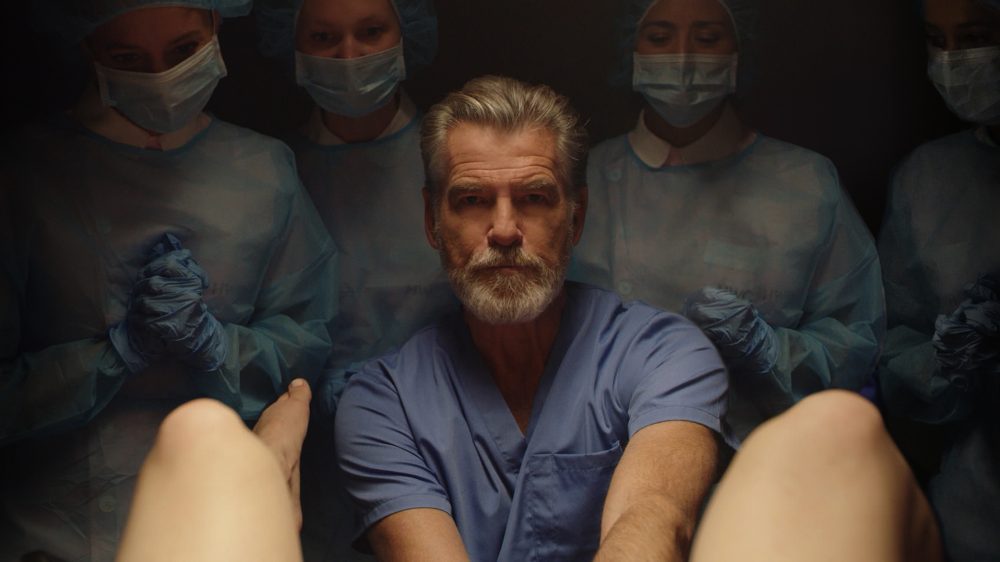
You’ll find real horror in False Positive. There’s the plot, sure—a woman desperate to conceive, in the hands of a nefarious physician with a God complex—and all the body horror and helplessness that go along with it. But that’s not the scary part.

Indeed, co-writer/director John Lee levels a more comedic tone to the by-the-numbers premise. Where he and co-writer/star Ilana Glazer mine unnerving dread is in their observational honesty.

Glazer is Lucy, and she and her husband Adrian (Justin Theroux, slyly wonderful) have been trying to get pregnant for two years. As much as she wants to do this naturally, she finally caves in to Adrian’s suggestion that they visit his med school mentor, Dr. Hindle (Pierce Brosnan – perfection).

Lee’s intention is not to make you wonder whether something sinister is afoot. The Stepford-esque nursing staff and eerily meticulous clinic proclaim it. The sheer number and variety of phallic instruments to be inserted, and the volume of lubricant so very lovingly applied, plays like SNL by way of Cronenberg.

If you’ve ever seen Broad City, Glazer’s groundbreaking Comedy Central sit-com, you may not recognize the performer’s dramatic skills, but you will recognize the writer’s keen eye for everyday absurdities.

Here’s where False Positive’s horror kicks in. It’s the authenticity, the banal realism of Lucy’s daily condescending, dismissive, patronizing, smothering, gaslighting humiliations that really eat at you. The low-key accuracy of it all—from the male colleagues who swear you are glowing as they leave their lunch orders next to your laptop, to your nurse’s reassuring caresses and terms of endearment, to your husband’s reminder whenever you’re feeling down that we’ve been through a lot with this pregnancy.

Tensions escalate as the storyline itself dictates, although the film is far more surefooted in its observational horror than it is in its plot. Lucy’s pre-pregnancy character is ill-defined, which makes her descent less satisfying. The climax is played for comedic value and the final act’s weirdness, though welcome, holds no real meaning.

Worse of all is the under-developed character of a midwife played imposingly by Zainab Jah. Lee clearly hoped to use this character as a statement on the genre itself but the whole affair feels wrong-headed.

Those are some serious misgivings, I grant you, but there really is something subversive, honest, and horrifying worth witnessing in this movie.

Like a Good Neighbor

Werewolves Within

by Hope Madden

I have seen a lot of horror movies. A lot. You have no idea. Do you know what I have never seen before? A horror movie that opens with a quote from Fred Rogers.

Well done, Werewolves Within.

Mr. Rogers is a hero of sorts for Finn (Sam Richardson), new park ranger for a very small, isolated, snowy mountain town. The townsfolk are divided on a deal to run a pipeline through their little hamlet. But they will have to work together despite their differences when it appears that a werewolf has begun to prey on their town.

Because if left and right cannot work together in the face of a common oppressor, the oppressor will win. It doesn’t matter what that is: fascists, greedy capitalists, werewolves. Still, it can be tough to get the two sides to come together, even for their own good, so Finn channels his hero and does what he can to inspire the townspeople to look out for each other. He just wants them to become good neighbors.

It is adorable.

Horror has its share of nice guys, but these are almost invariably tragic victims, either the first to go because they don’t have the inner meanness to overcome villainy, or eventual victims because the movie is so much more emotionally relevant if they sacrifice themselves. The nice guy is almost never a horror film’s hero, and this is where Werewolves Within really does depart from standard fare.

Director Josh Ruben—fresh off Scare Me, a clever horror-comedy he wrote, directed and starred in—delivers a forgiving, even sweet tone. There’s cynicism here, and characters are not drawn with a lot of dimension, but the performances are fun and the comedy is good-natured.

Richardson makes an ideal Rogers-esque central figure, his new hometown populated by a talented comedy ensemble: Michaela Watkins, Michael Chernus, Wayne Duvall, Harvey Guillen (TV’s What We Do In the Shadows), and fan-favorite, Milana Vayntrub. (You know, Lily from the AT&T ads.)

Werewolves Within is loosely based on the video game of the same name, which may be why the plot feels so very slight. Still, writer Mishna Wolff displays a flair for whodunnit fun that elevates the film high above 90% of the video game movies that have been made.

A lot of that success lies in Wolff and Ruben’s investment in the nice guy.

Fred Rogers once said: “When I was a boy and I would see a scary thing in the news, my mother would say to me, ‘Look for the helpers.’”

Finn would have made him proud.

Video Nasty

Censor

by Hope Madden

Catch catch a horror taxi

I fell in love with my video nasty

            –The Damned

Damned, indeed.

Stern, driven Enid (Niamh Algar) takes her responsibilities seriously. Unfortunately for her, they come at a high price. Enid is a film censor in the most punishing time and place for such an endeavor: Thatcher’s England. It’s 1985, an era when controversial films hoping to make their way to screens big and small found themselves more butchered than their characters.

Co-writer/director Prano Bailey-Bond takes inspiration from this notion in her feature debut, Censor—an immersive era-specific horror. It is especially immersive for Enid.

She spends long hours deliberating on exactly where the line is between danger and acceptability: rewinding, examining frame by frame, if necessary, regardless of the nonchalance and casual derision of her co-workers. Enid is convinced it is her duty to protect people from these images.

As she herself drowns in repeated viewings of the most violent and depraved material, you have to wonder whether she might be better off protecting herself.

Bailey-Bond has other questions in mind, like why is it that Enid is so preoccupied with this job, how might it feed her own darkness, and what happens when her worlds blend together?

Censor is a descent into madness film—nothing new in the genre. And moments of Censor can’t help but call to mind fellow Brit Peter Stickland’s 2012 treasure Berberian Sound Studio. But Bailey-Bond and co-writer Anthony Fletcher evoke such a timestamp with this film, not just in the look and style, but with the social preoccupation.

As coincidences pile up – a definitive family decision, a horror movie-style murder spree, a film that hits too close to home — Enid seems to suspect that her real motive has been to censor her own thinking.

When she stops doing that, look out.

Algar’s prim and sympathetic, deliberate and brittle. It’s clear from the opening frame that Enid will break. But between Algar’s skill and Bailey-Bond’s cinematic vision, the journey toward that break is a wild ride.

Unchained Melody

Caveat

by Hope Madden

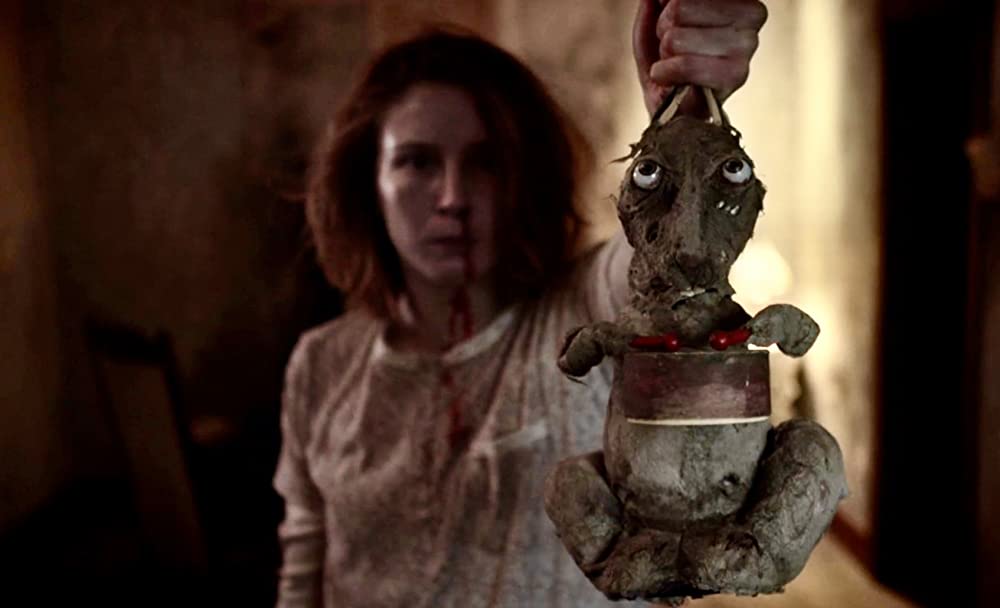
The room is dark, decrepit. A wild-eyed woman with a bloody nose holds a toy out in front of her like a demon slayer holds a crucifix. The toy – what is it, a rabbit? A jackalope? – beats a creepy little drum. Faster. Slower. Hotter. Colder.

This is how writer/director Damian Mc Carthy opens Caveat and I am in.

The woman is Olga (Leila Sykes), and we’ll get back to her in a bit, but first, we’re part of a conversation between the hush-voiced Barrett (Ben Caplan) and the foggy Isaac (Jonathan French). What can we tell from the conversation? They seem to know each other, Isaac’s had some kind of an accident, Barrett needs a favor.

The favor involves Olga, that house, and a long stretch of tightly fastened, heavyweight chain.

Dude, how good is Mc Carthy at this?

An expertly woven tapestry of ambiguity, lies and misunderstanding sink the story into a fog of mystery that never lets up. Isaac’s memory can’t be trusted, but he seems like a good guy. He looks like a good guy. Surely, he is a good guy! He’s just not making good decisions right now.

French shoulders the tale, and you hate to compare anything to Guy Pearce in Memento because who can stand up to that? No one, but still, Mc Carthy and French draw on that same type of damaged innocence and unreliable narration to stretch out the mystery.

Meanwhile, the filmmaker unveils a real knack for nightmarish visuals, images that effortlessly conjure primal fears and subconscious revulsion.

Caveat is not without flaws. Once or twice (when possibly channeling Mario Bava) Mc Carthy dips into camp unintentionally. OK, twice. These moments feel out of place in the unnerving atmosphere he’s created, which makes them stand out all the more. But it’s hardly enough to sink the film.

Mc Carthy does a lot with very little, as there are very few locations and a total of three cast members—all stellar. You won’t miss the budget. Mc Carthy casts a spook house spell, rattling chains and all, and tells a pithy little survival story while he’s at it.  

Goregasm

Skull: The Mask

by Hope Madden

Practical effects, hallucinatory sequences and a throwback exploitation vibe keep Skull: The Mask interesting enough to watch.

The film’s opening is its strongest segment, a grainy video portrayal of a 1944 political bloodbath with the goal of enacting an ancient pre-Columbian ritual. Directors Armando Fonseca and Kapel Furman bring a retro violence to the effort that makes the most of limited resources.

Flash forward 60 years or so and we move from the Amazon to Sao Paulo and a convoluted police procedural led by a one-note performance from Natallia Rodrigues as Det. Beatriz Obdias. She’s bad news! Damaged goods!

She also has no idea how to treat a crime scene, but there’s a lot of questionable policework going around, with no real leads to connect these corpses strewn from one end of town to the other. All of their hearts are missing. Sometimes their guts. Once in a while their faces.

The best thing about Skull: The Mask is Furmam’s extensive background in gore effects. You’ll find plenty of it here, some of it inspired, all of it bloody. The goregasm is in support of a story of a marauder in a stone skull mask, the same cursed mask from the 1944 massacre.

Brought to Sao Paolo by nefarious men with nefarious intentions, it falls into the wrong Goth girl’s hands early on and soon there’s a housecleaner ripping the hearts and guts out of club kids, drug dealers and priests all over town.

Does it make sense? Not really. Does it have to? Probably not. The film is a callback to a style and brand of movie that didn’t need an airtight plot or convincing performances as long as it did very nasty things in novel ways to the human body.

Skull: The Mask is a pretty dumb movie. Hell, even the title is dumb. But it knows where to invest its energy and money, and you cannot say it skimps on the goods.