In this bonus episode recorded live at Nightmares Film Festival from Gateway Film Center, the fest’s panel on what distribution looks like in 2023 for independent horror filmmakers.
This year Hope got to join a panel with Justin Seaman of Nevermore Production Film (and filmmaker behind The Barn & The Barn 2), Cicely Enriquez of The Owens Group, and Scott Donley of Good Deed/Cranked Up Films. Thanks to everyone who participated!
Two years ago, director Kevin Lewis essentially made the live action horror film based on the video game Five Nights at Freddy’s. He did not have a license, but he did have Nicolas Cage. Lewis’s 2021 flick Willy’s Wonderland is an eccentric lock-in with one silent janitor (Cage), and a bunch of Chuck E. Cheese style animatronics out for blood.
It’s not very good. But Cage is very Cage in it – kicking animatronic ass, taking regular breaks to rest up and play some pinball, and uttering not a single word.
Director Emma Tammi (The Wind) does have the rights to the video game IP. But she does not have Cage.
What Five Nights at Freddy’s misses more than anything is the sense of macabre humor that seems a requirement for a film about, essentially, a blood thirsty Country Bears Jamboree.
Josh Hutcherson is a down-on-his-luck big brother. He needs a job, or his wicked aunt (Mary Stuart Masterson) is going to take custody of his little sister, Abby (Piper Rubio). So, he’s desperate. Just desperate enough to take an offer from a sketchy career counselor (Matthew Lillard) for security detail at the long-shuttered kids’ entertainment pizzeria.
Though Masterson’s storyline is predicably moustache-twirling evil, she’s fun. Lillard is reliably, weirdly creepy and his every moment onscreen is a twisted delight.
I like Hutcherson. He was a hoot in Tyler McIntyre’s 2017 gem Tragedy Girls. He has no opportunity to do anything with Mike the Forlorn. Hutcherson grimaces and looks pained for 90 minutes.
Tammi – who’s horror Western The Winddelivered a spare, spooky descent into madness – cannot land on a tone for this one. The script she co-wrote with Seth Cuddeback is a plodding predictable dirge. Game writer Scott Cawthon gets a credit as well, but it’s unclear how much he might have contributed to the screenplay.
The film builds no momentum, most scenes cut short in favor of an emotional flashback, a contrived family moment, or a dream sequence that can’t conjure the eeriness needed to push the film into horror territory.
There’s meanness in the kills, but certainly no blood, and no macabre delight, either.
Willy’s Wonderland was a weak, predictable, dumb film but at least it had Nicolas Cage.
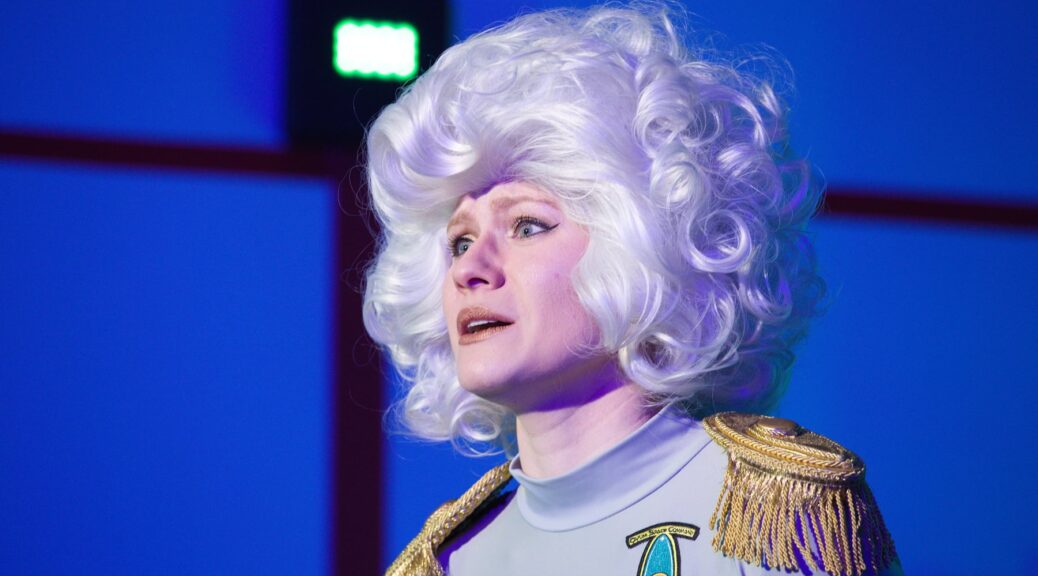
The Wheel of Heaven delivers oddball charm and horror in equal measure.
What’s it about? That’s an excellent question, and not a simple one to answer. We seem to be stuck on late night, all access TV, which is running through a wild set of programs and sponsors. (My favorite sponsor is Rad Abrams, Skateboard Attorney.)
And my favorite show is undoubtedly The Uncle Bobbo Show, which was also the focus of director Joe Badon’s 2021 short, The Blood of the Dinosaurs.
Kids’ TV host Uncle Bobbo (an eerily unblinking Vincent Stalba) wants to teach us where oil comes from. With assistance from his vampire puppet co-host Grampa Universe (voiced by John Davis) and his young helper Purity (Stella Creel), he seeks to enlighten and entertain. And misinform. It’s sort of a Pee-wee’s Playhouse for sociopaths. If that does not seem like a ringing endorsement, you’re not reading it correctly.
So, we’re watching highly local TV programming. Or are we? Maybe each story is a little diorama dreamt up by local artist Margaret Corn (Kali Russell)? Or perhaps we may instead be reading along with Marge the Mechanic (Russell again), who picked up a “choose your adventure” book at a thrift store.
Russell plays at least half a dozen distinct but related characters, each a fully formed and often bizarre individual. Her range and effortless skill with characterization ground the segments in something tangible, however goofy the character.
Whether these characters are part of a book, TV programming or one artist’s imagination is irrelevant. Badon’s upended the concept of a framing story for what is essentially an anthology of short films. Every tale, including the framing stories, morph and mutate and as each folds in on itself, Badon and his crew appear to emphasize the illusion versus reality of this absurdist storytelling.
What else does Badon hit on? Birth. Death. Choice. 3D glasses. Kitch. Homage. Dinosaurs. Storytelling. But mainly creation and how the act of creating is linked to all of these. The Wheel of Heaven throws a lot at you and not all of it hits, but Badon’s instinct for the bizarre, humorous and horrific generate a wonderfully oddball effort.
With her feature debut, director Clare Cooney skates some familiar ice but tweaks the high school slasher enough to produce a charming, compelling and strangely fresh slasher with Departing Seniors.
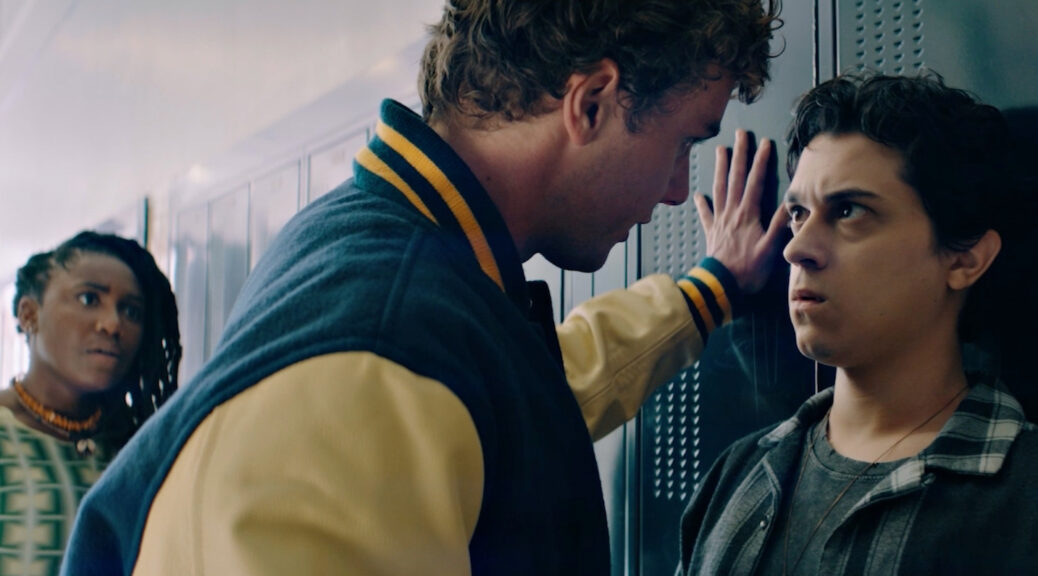
Jose Nateras’s script centers on Javier (Ignacio Diaz-Silverio), a high school senior who loves his best friend Bianca (Ireon Roach) and his gig on the high school paper, and maybe new guy William (Ryan Foreman). Otherwise, high school blows, but it’s almost over and then – even if Ginny (Maisie Merlock) steals his slot as valedictorian – he and Bianca will be out of this Podunk town and on to better things.
Graduation can’t come soon enough, though, because Ginny and her letter-jacket buddies have amped up the bullying. Things are so bad Javier barely even notices when the first of the popular jock dumbasses dies in the pool of apparent suicide.
At its best, Departing Seniors breathes life into the tropes of coming-of-age horror films. Cooney has gathered a truly talented and memorable group of young actors to elevate a clever if somewhat predictable take on the high school slasher. This cast, top to bottom, impresses and Nateras writes characters that they can sink their teeth into.
Diaz-Silverio reimagines the bullied teen with tenderness, resilience and humor. An exceptional, empathetic central figure, it is impossible not to root for Javier.
Roach continues her streak (after Jennifer Reeder’s Knives and Skin and Perpetrator as well as Nia DaCosta’s Candyman) of carving memorable characters regardless of screen time. She brings a relatable, cynical humor that also emphasizes Javier’s kindness.
The traditional plotting eventually limits the film’s creative success and the speechifying undoes a lot of the nuanced storytelling that preceded it, but you never stop caring about the characters. Departing Seniors subverts every one-dimensional high school slasher cliché to deliver a startlingly empathetic and effecting thriller.
Hats! They tell you a lot about a villain. Norma’s lightning bolt hat in Carrie tells us that she lacks fashion sense. Leprechaun’s golden buckled hat tell us that he’s sassy. Art the Clown’s tiny little hat lets us know that he doesn’t take himself too seriously. The Wicked Witch of the West wore the greatest, most iconic villain hat of all time, but The Wizard of Oz is not horror, so she didn’t make this list.
Who did make our list of best use of hats in a horror movie? Let us share with you.
5. The Grabber, The Black Phone (2021)
Ethan Hawke’s look for Scott Derrickson’s adaptation of the Joe Hill short story is epic. The constantly evolving, endlessly sinister mask is the push over the cliff, but it all starts with that hat. A black top hat not unlike the one that brought Frosty to life, this hat means magic.
He is a part time magician, after all! And in 1973, I guess people did not se magicians or clowns as scary. But they should have.
4. Mr. Dark, Something Wicked This Way Comes (1983)
Another dark top hat, Mr. Dark’s headwear of choice also conjures the image of magic. But somehow, even in Green Town, Illinois, Mr. Dark doesn’t look out of place with so formal a look. Sure, every other Joe wears something less fancy, but on Mr. Dark, the hat seems perfectly in place.
That’s all part of his charm.
3. Alex, A Clockwork Orange (1971)
The bowler – headwear of choice for Alex and his Droogies. You have to look sharp when on the prowl for a bit of the old in and out.
The iconic costuming in Stanley Kubrick’s masterpiece adaptation of Anthony Burgress’s novel creates the mood for the piece. Somehow retro and futuristic, elegant and brutal, punk rock and Ludwig Van all come together in this one ensemble: white trousers, white shirt, white cod piece, and suspenders, black boots, one set of black lashes and that spiffy bowler. Welly, welly, welly, welly well.
2. The Babadook, The Babadook (2014)
If it’s in a word, or if it’s in a book you can’t get rid of the Babadook. He wears a hat he’s tall and black but that’s how they describe him in his book. A rumbling sound, than three sharp knocks you better run, or he’ll hold you in his locks. ba-ba-ba-dook-dook-dook… Your closet opens and your honestly hopin’ that he won’t hear a sound but that’s when you know that he’s around. The book close you have an itch under your nose and that’s just how the story goes. So close your eyes and count to ten better hope you don’t wake up again. ‘Cause if it’s in a word, or if it’s in a book you can’t get rid of the Babadook …. you’ll see him if you look
1. Rose the Hat, Doctor Sleep (2018)
Possibly the hottest villain since Salma Hayak wrapped a yellow python around her neck, Rose the Hat (Rebecca Ferguson) will swallow your soul.
Ferguson’s performance is eerily, hauntingly believable in Mike Flanagan’s courageous take on Stephen King’s The Shining sequel. Of his many successes with this film, his villain ranks highest. Rose the Hat is savvy, strong, and more than anything, merciless.
I’m going to guess Joe Lynch is a Stuart Gordon fan.
Who isn’t?!
The Mayhem director returns to the horror genre with a Lovecraftian fable, but this is no garden variety Lovecraft. Lynch’s vibe and manner – not to mention co-writer and cast – lean closer to Gordon homage than outright cosmic horror.
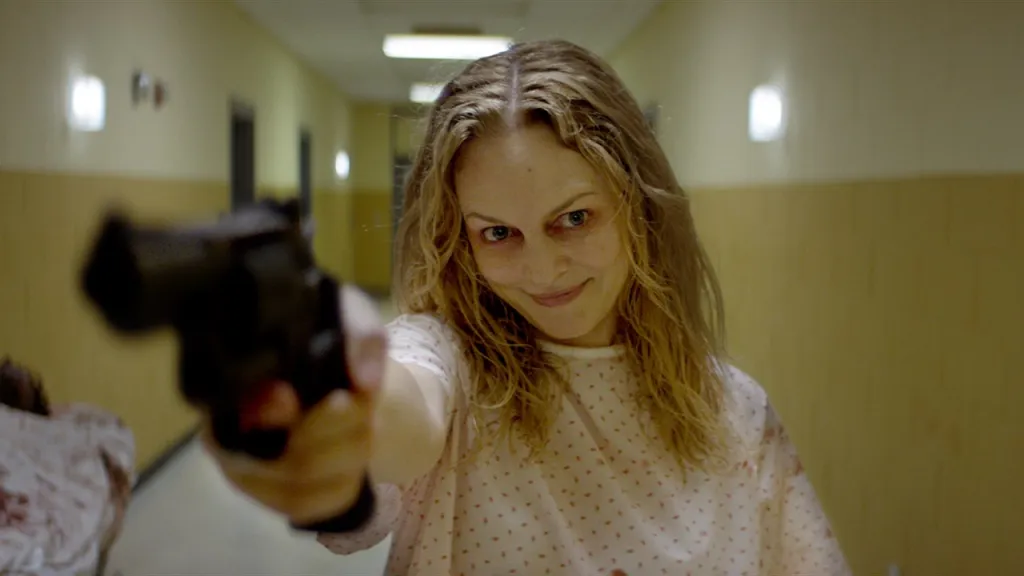
Lynch loosely adapts Lovecraft’s The Thing on the Doorstep, writing with Stewart’s longtime collaborator Dennis Paoli (Re-Animator, From Beyond, Castle Freak, Dagon). Their tale shadows psychiatrist Elizabeth Derby (Heather Graham), who – against her own better instincts – takes on a new patient. Asa (Judah Lewis) believes his father is trying to steal his body.
Cleaving to science and yet inexplicably attracted to the young man, Derby fails to understand her patient’s claims until it is too late – an evil entity has moved from Asa’s father into Asa and is now threatening to take over Dr. Derby’s body.
Graham’s a bit of campy fun in a dual role – far more fun when she gets to dig into the hedonistic villain character. It’s a performance that lets the actor stretch a bit and she seems to relish the darker side of the role. Likewise, Lewis excels in particular when the sinister force inhabits meek and terrified Asa.
Of course, no Gordonesque Lovecraftian flick is complete without the glorious Barbara Crampton (Re-Animator, From Beyond, Castle Freak). Crampton’s Dani, Derby’s uptightcolleague and best friend, becomes an ideal foil for the transformed psychiatrist. Graham and Crampton vamp it up as the demon oscillates between them, which is as much fun as it sounds like it would be.
The film feels very much like a Dennis Paoli film and fans of his Gordon collaborations have reason to celebrate. But Suitable Flesh doesn’t entirely deliver on its promise of mayhem. It never quite leaps off that cliff the way Paoli films usually do and for that reason feels a tad tame.
But a game cast and a bit of 80s inspired lunacy ensure a good time is had by all. Plus, that’s a great title.
Sometimes simplicity in horror is very effective. Take a very routine moment, something so familiar to viewers they realize they wouldn’t even think twice about it, and turn it into something sinister.
It’s late. You stop for gas. A sociopath with a high-powered rifle and good aim is hiding behind a God Is Nowhere billboard.
Franck Khalfoun’s Night of the Hunted is the latest horror to make what it can of a tiny cast, limited set of locations, and modern anxieties. Camille Rowe is Alice. She and John (Jeremy Scippio) are on their way back from a conference – their relationship is complicated – but Alice is in a hurry. And not in a great mood.
It’s 2 am. They stop for gas. The sniper makes excellent use of the well-lit, heavily windowed setting. There’s also a walkie talkie.
Any film that focuses so heavily on an exchange between two people only works when the writing and performances are strong. Rowe delivers when the script lets her. Alice is savvy and angry, recognizes her weaknesses but makes frustrating choices. Those choices are, of course, part of the character’s arc. They may also be due to the fact that all five writers and the director are men.
Night of the Hunted pulls in a lot of buzzy ideas and mixes and matches in a way that’s sometimes clever – the sniper toys with Alice, but why would Alice (or the audience) believe he means anything he says? It’s also sometimes frustrating for a number of reasons, chief among them that the monologue never ties to anything concrete in the story. No insight is gleaned – which is fine as no insight is needed, but the film behaves as if the speechifying has relevance.
There’s tension and some smart moments, although Night of the Hunted is still just another horror movie made by men in which the female lead has no purpose or value until she finds her maternal instinct.
What is it about one charismatic leader that can cause so much devastation? Horror filmmakers have long dug into the narcissism, vanity, and downright evil that lurks within these figures. Here are our five favorite films about a backwods Messiah.
5. The Sacrament (2014)
Ti West dives into Jim Jones territory in probably his most assured film prior to X. A cast of West regulars Joe Swanberg, AJ Bowen join the great Gene Jones for a tense news event.
West mines tensions, upends ideas of safety and power, but never dismisses the vulnerability that draws people toward charismatic figures like Father (Jones). It’s this openness that creates room for the real frights in the film.
4. Jug Face (2013)
Writer/director Chad Crawford Kinkle brings together a fine cast including The Woman’s Sean Bridgers and Lauren Ashley Carter, as well as genre favorite Larry Fessenden and late-life scream queen Sean Young to spin a backwoods yarn about incest, premonitions, kiln work, and a monster in a pit.
As a change of pace, Bridgers plays a wholly sympathetic character as Dawai, village simpleton and jug artist. On occasion, a spell comes over Dawai, and when he wakes, there’s a new jug on the kiln that bears the likeness of someone else in the village. That lucky soul must be fed to the monster in the pit so life can be as blessed and peaceful as before.
Kinkle mines for more than urban prejudice in his horror show about religious isolationists out in them woods. Young is particularly effective as an embittered wife, while Carter, playing a pregnant little sister trying to hide her bump, a jug, and an assortment of other secrets, steals the show.
3. Luz: The Flower of Evil (2019)
As colorful as a dream, Juan Diego Escobar Alzate’s feature film debut Luz: The Flower of Evil looks like magic and brims with the casual brutality of faith.
Set inside a religious community in the mountains of Colombia, the film drops us into ongoing struggles with the group’s religious leader, El Señor (Conrad Osorio). No one knows the devil as he does, he reminds his daughter Laila (Andrea Esquivel).
She lives contentedly, devoutly, along with her two adopted sisters. El Señor and the villagers consider the trio angels—just as they believe the little boy chained up out back is the Messiah who will deliver the community from its recent calamities.
2. The Other Lamb (2019)
The first step toward freedom is telling your own story.
Writer C.S. McMullen and director Malgorzata Szumowska tell this one really well. Between McMullen’s outrage and the macabre lyricism of Szumowska’s camera, The Other Lamb offers a dark, angry and satisfying coming-of-age tale.
Selah (Raffey Cassidy, Killing of a Sacred Deer, Vox Lux) has never known any life except that of Eden, the commune where she lives with the sisters, the wives, and the Sheperd (Michiel Huisman, The Invitation).
Szumowska doesn’t tell as much as she unveils: Selah’s defiant streak, Sheperd’s unspoken rules, what puberty can mean if you’re a good follower. She strings together a dreamlike series of visions that horrify on a primal level, the imagery giving the film the feel of gruesome poetry more than narrative.
The Other Lamb does not simply suggest you question authority. It demands that you do far more than that, and do it for your own good.
1. Martha Marcy May Marlene (2011)
Writer/director Sean Durkin took essentially the Charles Manson story, set it within modern privilege, and swapped the point of view to create an unnervingly realistic look at the reasons people find themselves drawn to cults.
And then, once we relate to Martha (Elizabeth Olsen), he sets the true terror in motion.
This film – through brilliantly written and beautifully directed – benefits from perhaps the best ensemble of 2011: Sarah Paulson, Christopher Abbott, Brady Corbet, Julia Garner, Hugh Dancy. But Olsen’s fearless, vulnerable turn as the woman who just doesn’t fit is only exceeded by the great John Hawes in the most mesmerizing, blistering turn of his magnificent career.