There is something eerily beautiful about Severin Fiala and Veronika Franz’s rural Austrian horror Goodnight Mommy (Ich seh, Ich seh).
During one languid summer, twin brothers Lukas and Elias await their mother’s return from the hospital. They spend their time bouncing on a trampoline, floating in a pond, or exploring the fields and woods around the house. But when their mom comes home, bandaged from the cosmetic surgery she underwent, the brothers fear more has changed than just her face.
Franz and Fiala owe a great debt to an older American film, but to name it would be to give far too much away, and the less you know about Goodnight Mommy, the better.
Inside this elegantly filmed environment, where sun dappled fields lead to leafy forests, the filmmakers mine a kind of primal childhood fear. There’s a subtle lack of compassion that works the nerves beautifully, because it’s hard to feel too badly for the boys or for their mother. You don’t wish harm on any of them, but at the same time, their flaws make all three a bit terrifying.
The filmmakers’ graceful storytelling leads you down one path before utterly upending everything you think you know. They never spoon feed you information, depending instead on your astute observation – a refreshing approach in this genre.
Performances by young brothers Lukas and Elias Schwarz compel interest, while Susanne Wuest’s cagey turn as the boys’ mother propels the mystery. It’s a hypnotic, bucolic adventure as visually arresting as it is utterly creepy.
The film is going to go where you don’t expect it to go, even if you expect you’ve uncovered its secrets.
In honor of George Wolf’s birthday on “the 21st night of September” (thanks Earth, Wind & Fire!), we celebrate Wolf men today. Not the fuzzy abomination of the Twilight wolf boys – let’s skip them. In fact, in prepping for this one we noticed an awful lot of really bad werewolf movies, and even more decent efforts undone by the real curse of lycanthropy – the prosthetics and make up. There’s also one we leave off this list that will piss a lot of people off. It was a close call, but we gave goth poetry the nod over Eighties social commentary.
5. The Company of Wolves (1984)
Neil Jordan’s poetic tale of sexual awakening is saturated with metaphors and symbols – most of them a bit naughty. A young girl dreams a Little Red Riding Hood type fable. She was just a girl, after all, who’d strayed from the path in the forest.
Jordan looks at a lot of the same themes you’ll find in any coming of age horror – the hysteria surrounding the move into womanhood. It’s just that he does it with such a sly delivery.
Theatrical and atmospheric, it’s not a classic horror tale, but it is creepy and it builds genuine dread. It also takes some provocative turns, and it boasts a quick but outstanding cameo by Terence Stamp as the Prince of Darkness.
4. The Wolf Man (1941)
Obviously this classic needs to be remembered in any examination of the genre. Lon Chaney, Jr.’s incredibly sympathetic turn as the big American schlub who keeps accidentally killing people anchors a film that has aged surprisingly well. Just compare it to its heinous 2010 reboot and you, too, will long for the grace of the original.
Sure, the score, the sets, the fog and high drama can feel especially precious. And what self-respecting wolf man goes by the name Larry? But there’s something lovely and tragic about poor, old Larry that helps the film remain compelling after more than sixty years.
3. Ginger Snaps (2000)
Sisters Ginger and Bridget, outcasts in the wasteland of Canadian suburbia, cling to each other, and reject/loathe high school (a feeling that high school in general returns).
On the evening of Ginger’s first period, she’s bitten by a werewolf. Writer Karen Walton cares not for subtlety: the curse, get it? It turns out, lycanthropy makes for a pretty vivid metaphor for puberty. This turn of events proves especially provocative and appropriate for a film that upends many mainstay female cliches. Walton’s wickedly humorous script stays in your face with the metaphors, successfully building an entire film on clever turns of phrase, puns, and analogies, stirring up the kind of hysteria that surrounds puberty, sex, reputations, body hair, and one’s own helplessness to these very elements. It’s as insightful a high school horror film as you’ll find, peppered equally with dark humor and gore – kind of A Canadian Werewolf in High School, if you will.
https://www.youtube.com/watch?v=Zoa1A987A_k
2. Dog Soldiers (2002)
Before Neil Marshall freaked us all out with the excellent genre flick The Descent, he breathed new life into the werewolf tale by abandoning a group of soldiers in the Scottish highlands as bait.
Wry humor, impenetrable accents, and a true sense of being out in the middle of nowhere help separate this from legions of other wolf men tales. Marshall uses an army’s last stand approach beautifully. This is like any genre pic where a battalion is trapped behind enemy lines – just as vivid, bloody and tense. But the enemies this time are giant, hairy, hungry monsters. So the idea (fantastically realized here) of traitors takes on a little extra something-something.
1. An American Werewolf in London (1981)
We’ve mentioned John Landis’s groundbreaking horror comedy in the past. It is the best of the bunch for a number of reasons: a darkly funny script, sharp writing that propels the action, Oscar-winning effects, a cool looking wolf. But is there one scene that encapsulates it all?
A pasty, purse-lipped Brit businessman leaves the train in an otherwise empty, harshly lit subway station. He pumps a small vending machine with change and comes out with mints. A tiny smirk of satisfaction crosses his face as he begins to unwrap the item, but the look turns to a grimace of unpleasant surprise. Echoing through the empty, rounded corridor comes a far off growl.
“Hello? Is there someone there?”
Again the growl.
Stern voice: “I can assure you that this is not the least bit amusing. I shall report this.”
There now, those hooligans have ruined his happy mint moment.
The camera follows him up an escalator, around a turn, into a rounded tunnel-like corridor uninterrupted for a long stretch by doors or windows. It’s a claustrophobic nightmare.
The camera takes the beast’s eye view, rounding a nearby corner, eyeing the Englishman. We see the terror as he backs away.
Welcome to the dog eat dog and child eat child world of elementary school.
Kids are nasty bags of germs. We all know it. It is universal truths like this that make the film Cooties as effective as it is.
What are some others? Chicken nuggets are repulsive. Playground dynamics sometimes take on the plotline of LORD OF THE FLIES. To an adult eye, children en masse can resemble a seething pack of feral beasts.
Directing team Jonathan Milott and Cary Murnion harness those truths and more – each pointed out in a script penned by a Leigh Whannell-led team of writers – to satirize the tensions to be found in an American elementary school.
Whannell – co-creator of both the Saw and Insidious franchises – co-stars as the socially impaired science teacher on staff. He’s joined by a PE teacher (Rainn Wilson), an art teacher (Jack McBrayer), two classroom teachers (Alison Pill, Nasim Pedrad), and the new sub, Clint (Elijah Wood), in a fight for survival once an aggressive virus hits the student population of Fort Chicken.
School-based horror abounds – even Wood’s done it previously, having starred in Robert Rodriguez’s 1998 alien invasion fantasy The Faculty.
Cooties is also not the first horror film to mine tensions from the image of monstrous children turned against us. Come Out and Play (both the 2013 American version and its Spanish predecessor Who Can Kill a Child?) generate tensions based on the presumed difficulty an adult would have in slaughtering children.
Two things set Cooties apart. One: It is often laugh out loud funny. Two: It is willing to indulge the subversive fantasy of (possibly all) school teachers.
They kill a lot of children in this movie.
If Murnion and Milott couldn’t find the comedic tone to offset the seriously messed up violence, the film would be a distasteful, even offensive failure. But, thanks in part to a very game cast, as well as an insightful screenplay, Cooties comes off instead as a cathartic (if bloody) metaphor and an energetic burst of nasty fun. It might be welcome after school viewing in the teacher’s lounge.
Johnny Depp is a remarkable talent whose film choices can be frustrating. Who’s to complain, just because he often buries his unique take on human foibles underneath quirky caricatures in wigs and eyeliner or a handlebar moustache?
I am – but not today. In Scott Cooper’s Black Mass, Depp may undergo a physical transformation, but it’s his skill and authenticity that leave an impression.
In this biopic, Depp plays Southie mob king James “Whitey” Bulger, a “ripened psychopath” who strikes a sweet deal with neighborhood pal turned FBI agent John Connolly (Joel Edgerton).
Front to back, Black Mass spills over with reminders of other films – in particular, The Departed and, thanks in part to the outstanding soundtrack, American Hustle. How could it avoid comparisons? How many new ways are there to tell a story about dodgy criminal/FBI alliances or the Irish mob in Boston?
Wisely, Cooper’s focus is on the complex relationship between Bulger and Connolly. Edgerton handles his character arc, from misguided idealist to blindly loyal accomplice, with subtlety, but this is Depp’s movie.
Depp’s nuanced evolution from friendly neighborhood sociopath to cruel monster leaves chills. He can turn on a dime, as he does in the now required Joe Pesci-esque episode. (Just substitute “funny how?” with “family recipe.”) But the more powerful scenes are the ones that sneak up on you – a situation with a colleague’s step daughter, or Bulger’s moments alone with Connolly’s wife.
The balance of the cast manages to keep pace with Depp’s forbidding performance – Rory Cochrane, Corey Stoll, Dakota Johnson, Juno Temple, and Peter Sarsgaard are all particularly impressive in small roles.
For all the truly fine performances, Cooper’s somber effort can’t seem to define itself. There are flashes – frames resembling a cross between a crime scene photo and an old picture postcard; or individual, eerily crafted moments – but the effort on the whole limits itself to by-the-numbers storytelling.
Depp, on the other hand, sporting vampiric blue contacts that emphasize Bulger’s eviscerating contempt and barely restrained violence, excels. Black Mass may not be quite able to separate itself from the pack, but Depp’s performance will leave a mark.
Who says a sequel can’t be better – or at least as good – as the original? If you look closely, there are loads of excellent horror sequels: New Nightmare, Scream 2, 28 Weeks Later, Ringu 2, The Devil’s Rejects. But which are the best of the best? We have the answer!
5. Exorcist III (1990)
William Peter Blatty wrote and directed this dialogue-dense sequel to the 1973 phenomenon William Friedken had made of his novel. Blatty starts strong enough, garnishing shots with vivid, elegantly creepy images. He enlists George C. Scott to anchor the tale of a cop drawn back into a supernatural case. In other inspired casting, New York Nicks great Patrick Ewing plays the angel of death in one of Kinderman’s freaky dream sequences, joined by romance novel coverboy Fabio as another angel. Also, the always great character actress Nancy Fish plays the bitchy but reluctantly helpful Nurse Allerton.
There are also two of the scariest scenes in cinema. Eventually the story moves into a hospital and stays there, but just before that move, there’s a terrific confessional scare – crazy spooky voice, effective cackle, blood – that elevates the entire project.
And then there’s that insane flash of terror as one nurse crosses the narrow hallway in front of the camera, quickly followed by some gauze-draped figure, arms outstretched. Eep!
4. Dawn of the Dead (1978)
Romero returned to the land of the undead in ’78 with a full-color sequel to Night of the Living Dead. The film follows a news producer, her chopper pilot boyfriend, and two Philly SWAT cops ready to abandon the organized zombie fight and find peace elsewhere. The four board a helicopter, eventually landing on the roof of a mall, which they turn into their private hideaway.
Romero, make-up legend Tom Savini, and Italian horror director Dario Argento teamed up for this sequel. You feel Argento’s presence in the score and the vivid red of the gore. Bloated, dated, and suffering from blue zombie make up, the film does not stand up as well as the original, but it still packs a punch.
Ken Foree and Scott Reiniger as the buddies from SWAT create the most effective moments, whether character-driven tension or zombie-driven action. Romero’s politics are on his sleeve with this one. He uses the “z” word, digs at Eighties consumerism, shows full-color entrails, and reminds us again that the undead may not be our biggest enemy once the zombie-tastrophe falls.
3. The Texas Chainsaw Massacre 2 (1986)
Tobe Hooper revisited his southern cannibal clan 12 years after unleashing The Texas Chain Saw Massacre on an unsuspecting world, and he had the great Dennis Hopper in tow. Hopper plays a retired Texas Marshall. He joins forces with a radio host, played gamely by Caroline Williams. Together they flush the Sawyer family out of hiding. And just in case we’d missed how Leatherface got his name, the act of removing someone’s face to wear as a mask is revisited in a kind of weird wooing ritual.
TCM2 certainly gets weird, and boasts an unhinged performance by Hopper as a lawman willing to make some ugly choices to follow his obsession. Jim Siedow (The Cook) returns, and veteran genre favorite Bill Moseley adds a quirky ugliness to the proceedings. There’s also an awful lot of screaming, even for this kind of a film, but it’s a worthy genre flick. It pales in comparison to the original, but it deserves its own appreciation. Hold it up against any other low-rent horror output of 1986 and it’s a standout.
https://www.youtube.com/watch?v=xUyEaYxTI2U
2. Evil Dead II: Dead by Dawn (1987)
In 1981, Sam Raimi and Bruce Campbell crafted the single bloodiest film ever made. Six years later, Raimi gets a little Ray Harryhausen and Campbell gets a makeover in a sequel that’s mostly a remake. An even broader comedy, with clay-mation monsters aplenty, Evil Dead II works harder for laughs than for scares.
Expect a lot of the same: Necronomicon, possessed friends, demonic woods, dismemberment, and fun. Plus hundreds of gallons of black, green, and red goo. Nice.
The wide eyed, romantic Ash from episode one slowly morphs into the ass kicking, catch phrase spouting, boom-boom stick toting badass we’ll see in all his glory in the third installment. Ash would finally learn how important it is not to listen to tapes left by the owners of the cabin you’re secretly squatting in for the weekend. And we’d eventually learn never to wear Michigan State paraphernalia when camping with Bruce Campbell.
1. The Bride of Frankenstein (1935)
James Whale and Boris Karloff returned to Castle Frankenstein for an altogether superior tale of horror. What makes this one a stronger picture is the dark humor and subversive attitude, mostly animated by Frankenstein’s colleague Dr. Pretorius (Ernest Thesiger).
Thesiger’s mad doctor makes for a suitable counterpart to the earnest and contrite Henry Frankenstein (Colin Clive, again), and a sly vehicle for Whale. This fey and peculiar monster-maker handles the most brilliant dialogue the film has to offer, including the iconic toast, “To gods and monsters.”
The sequel casts off the earnestness of the original, presenting a darker film that’s far funnier, often outrageous for its time, with a fuller story. Karloff again combines tenderness and menace, and Elsa Lanchester becomes the greatest goth goddess of all film history as his Bride.
The Last Airbender. The Happening. After effing Earth. Man, it has been a long time since M. Night Shyamalan made a decent movie. If you keep that in mind – if you manage your expectations – his latest film, The Visit, is pretty enjoyable. It’s a step in the right direction, anyway.
A single mom (a very believable Kathryn Hahn) reluctantly allows her two teenagers visit their estranged grandparents in rural Pennsylvania for a week. You’ve seen the ads – things don’t go well.
Whatever the flaws, no matter the lack of originality, The Visit generates creepy dread punctuated by some genuine laughs, and it boasts several fine performances.
Ed Oxenbould is endearing, fun and funny as little brother/would-be rapper Tyler. Olivia DeJong is slightly less compelling as his sister/budding filmmaker Becca. (Yes, tragically, this is a found footage film – but it’s an M. Night Shyamalan film, so expect some weirdly beautiful vistas and panoramas given Becca’s age.)
She’s decided to make a documentary of the visit as a gift to her mother, and an attempt to rebuild the relationship that went south long before she was born. (This is a theme that echoes, somewhat tediously, throughout the effort.)
Nana and Pop Pop are played, quite eerily, by Deanna Dunagan and Peter McRobbie, respectively.
Per usual, Shyamalan peppers the mystery with more than enough clues, which you look right past. He’s a master at sleight of hand, and his film – modest as it is – showcases his enviable craftsmanship.
The Visit will absolutely not stand up to the filmmaker’s greatest efforts – Signs, Unbreakable, The Sixth Sense. Hell, it may just be the result of a flagging filmmaker turning backward, falling into patterns that garnered early success, but bringing less inspiration with him to the project. Whatever the reason or craft behind it, The Visit is easily the best film Shyamalan’s made in more than a dozen years.
In honor of our next Fright Club Live – where we unspool the unhinged French horror show Sheitan (French for Satan) – we decided to pick through all the performers who’ve played the dark lord onscreen. George Burns to Dave Grohl, we considered them all. Here, though, is our list of the best of the best.
5. Jack Nicholson (The Witches of Eastwick– 1987)
Old Jack really breathed life into the idea of wretched excess in this one, coming across equally as frightening and charming. Appropriate. He seems to be playing off of his own persona, but given the comedic nature of the effort, and the absurdity that this slovenly old cuss could seduce three stunning, intelligent women (Susan Sarandon, Cher, Michelle Pfeiffer) – well, it’s a charm Nicholson seemed to come by naturally, so why not exploit it here?
4. Peter Stormare (Constantine – 2005)
There are two reasons to remember this film – Tilda Swinton and Peter Stormare – and luckily they have one epic scene together. But Stormare manages to even outdo the effortlessly glorious Swinton – androgynous perfection as Gabriel – and that’s something to crow about. He’s been preparing to play the dark lord ever since he pushed Steve Buscemi into that wood chipper in Fargo. Once he got the shot, he was sinister, funny, frightening…and eventually undone by Keanu Reeves, which was almost enough reason to leave him off the list, but not quite.
https://www.youtube.com/watch?v=7rVFse1LLQs
3. Viggo Mortensen (The Prophecy – 1995)
There is no question this film belongs to Christopher Walken – as do all films in which he graces the screen. His natural weirdness and uncanny comic timing make the film more memorable than it deserves to be, but when it comes to sinister, Viggo Mortensen cuts quite a figure as Lucifer. Unseemly, gorgeous and evil, he seethes through his few scenes and leaves the celluloid scorched.
2. Robert DeNiro (Angel Heart – 1987)
De Niro’s well manicured and articulate Louis Cyphre perfectly balances Mickey Rourke’s handsome slob, and both fit beautifully into this sultry version of 1955. It’s really a beautifully made film, courtesy of Alan Parker, who adapted William Hjortsberg’s novel Fallen Angel and directed the film. Deceptively bloody, unusually classy, effortlessly creepy, Angel Heart stays under your skin. Maybe it’s the casual evil, the lurid atmosphere. Maybe it’s De Niro’s understated menace, with those long nails and that hardboiled egg.
1. Tim Curry (Legend – 1985)
Best Satan Ever. That voice, the sultry way he drawls out every syllable, the sweltering inappropriateness of his seduction, the look. Wow. This image clearly influenced both South Park‘s vision, as well as the Dave Grohl part in Tenacious D’s Pick of Destiny. But Curry pulls it off like no one else. Tim Curry is the world’s greatest sweet transvestite, the world’s greatest terrifying clown, and the world’s greatest Satan. Too bad the character is trapped in such a crap film.
In 1998, Bill Bryson published the funny human adventure A Walk in the Woods – the tale of a man grappling with his morality by walking the Appalachian Trail. To stave off boredom he invites (perhaps mistakenly) a friend. Though it lumbers at times, the book is a fun odd couple account of human frailty and the vastness of the natural world.
It’s 2015, and Robert Redford has released a broad, uninspired treatment/vanity project. Redford plays Bryson, the travel writer bristling against age and stagnation. Nick Nolte is Stephen Katz, the overweight, gimpy recovering alcoholic eager to accompany him on his journey.
It’s hard to understand what made Redford want to create this wisp of a comedy road trip after last year’s gripping The Wild, a film that treads very similar ground. But where Reese Witherspoon’s Oscar nominated flick illustrated personal exploration and the redemptive power of nature, Redford’s is content with lazy gags and hollow attempts at profundity.
Redford and Nolte lack chemistry, and while Nolte entertains in several humorous moments, Redford’s utter lack of comic timing is itself kind of awe inspiring.
It’s also absurd casting, given that Bryson – in his 40s when he attempted the trail – was facing a midlife crisis, yet feared he may be too old to make the trip. Nick Nolte is 71 and Robert Redford is 79, for lord’s sake.
At least you can expect a breathtaking view, though, right? Wrong. Director Ken Kwapis misses every opportunity to exploit the sheer gorgeousness of the AT, providing no more than 3 lovely, if brief, images of natural beauty. Nor can he authentically express the passage of time, articulate the grueling nature of the journey, or build tension, and he and his writers (Rick Kerb and Bill Holderman) utterly abandon the enjoyably creepy representation of the South you’ll find in Bryson’s text.
An early draft of the script came from Michael Arndt, whose work on Little Miss Sunshine and Toy Story 3 suggests the kind of playful humor and storytelling skill the project deserved. Unfortunately, the end product came from the keystrokes of Redford’s regular contributor Holderman, which may be why Redford so rarely makes decent movies anymore.
Where are you most vulnerable, if not in the hands of doctors? You don’t know what they’re doing. It’s likely to hurt. There are needles, saws maybe. Suturs. Staples. Blood. Is there more fertile, gory ground for horror? We say no, and today we celebrate the very best there is in medical horror.
5. American Mary (2012)
Twin sisters, Canadians and badasses Jen and Sylvia Soska have written and directed a smart, twisted tale of cosmetic surgery – both elective and involuntary.
Katharine Isabelle (Ginger Snaps) stars as med student Mary Mason, a bright and eerily dedicated future surgeon who’s having some trouble paying the bills. She falls in with an unusual crowd, develops some skills, and becomes a person you want to keep on your good side.
Were it not for all those amputations and mutilations, this wouldn’t be a horror film at all. It’s a bit like a noir turned inside out, where we share the point of view of the raven haired dame who’s nothin’ but trouble. It’s a unique and refreshing approach that pays off.
4. Re-Animator (1986)
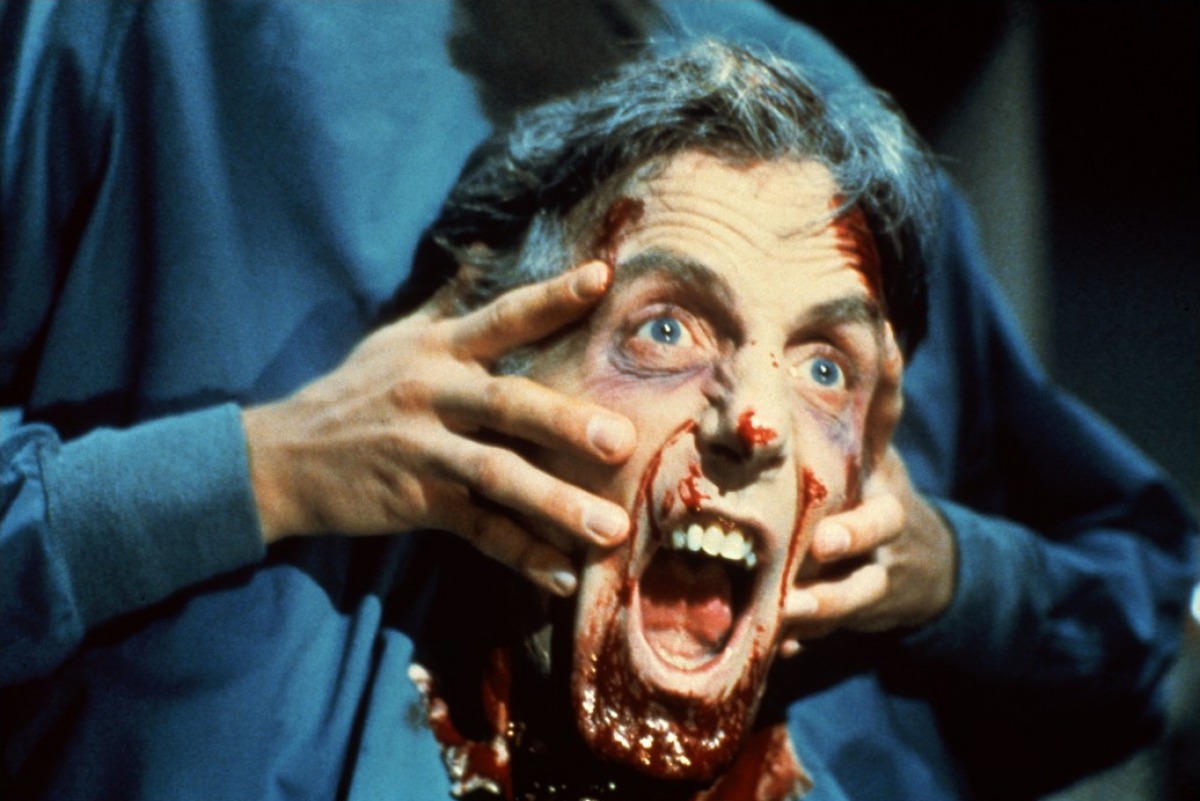
Stuart Gordon’s Re-Animator reinvigorated the Frankenstein storyline in a decade glutted with vampire films. Based, as so many fantasy/horror films are, on the work of H. P. Lovecraft, Re-Animator boasts a good mix of comedy and horror, some highly subversive ideas, and one really outstanding villain.
Jeffrey Combs, with his intense gaze and pout, his ability to mix comic timing with epic self righteousness without turning to caricature, carries the film beginning to end. His Dr. Herbert West has developed a day-glo serum that reanimates dead tissue, but a minor foul up with his experimentations – some might call it murder – sees him taking his studies to the New England medical school Miskatonic University. There he rents a room and basement laboratory from handsome med student Dan Caine (Bruce Abbott).
They’re not just evil scientists. They’re also really bad doctors.
Re-Animator is fresh. It’s funny and shocking, and though most performances are flat at best, those that are strong more than make up for it. First-time director Gordon’s effort is superb. He glories in the macabre fun of his scenes, pushing envelopes and dumping gallons of blood and gore. He balances anxiety with comedy, mines scenes for all they have to give, and takes you places you haven’t been.
3. Dead Ringers (1988)
This film is about separation anxiety, with the effortlessly melancholy Jeremy Irons playing a set of gynecologist twins on a downward spiral. Writer/director David Cronenberg doesn’t consider this a horror film at all. Truth is, because the twin brothers facing emotional and mental collapse are gynecologists, Cronenberg is wrong.
Take, for instance, the scene with the middle aged woman in stirrups, camera on her face, which is distorted with discomfort. Irons’s back is to the screen, her bare foot to his left side. Clicking noises distract you as the doctor works away. We pan right to a tray displaying the now-clearly-unstable doctor’s set of hand-fashioned medical instruments. Yikes.
Irons is brilliant, bringing such flair and, eventually, childlike charm to the performances you feel almost grateful. The film’s pace is slow and its horror subtle, but the uncomfortable moments are peculiarly, artfully Cronenberg.
https://www.youtube.com/watch?v=_xmheE3L19c
2. The Skin I Live In (2011)
In 2011, the great Pedro Almodovar created something like a cross between Eyes Without a Face and Lucky McGee’s The Woman, with all the breathtaking visual imagery and homosexual overtones you can expect from an Almodovar project.
The film begs for the least amount of summarization because every slow reveal is placed so perfectly within the film, and to share it in advance is to rob you of the joy of watching. Antonio Banderas gives a lovely, restrained performance as Dr. Robert Ledgard, and Elena Anaya and Marisa Paredes are spectacular.
Not a frame is wasted, not a single visual is placed unconsciously. Dripping with symbolism, the film takes a pulpy and ridiculous story line and twists it into something marvelous to behold. Don’t dismiss this as a medical horror film. Pay attention – not just to catch the clues as the story unfolds, but more importantly, to catch the bigger picture Almodovar is creating.
1. Frankenstein (1931)
Obviously, any exploration of medicine in horror cinema – no matter how amateurish that exploration – must begin with Frankenstein.
James Whale’s genius was in finding the monster fascinating, rather than the doctor. Nearly every other Frankenstein made before or since has been preoccupied with the doctor, but Whale understood that it was this unique beast, baby and man, evil and innocent, that should compel our interest. Who cares about one more doctor with a god complex?
Luckily for Whale, he had Boris Karloff. Karloff’s gift was in seeing the monster as a neglected child. His monster is sweet and tragic, characterized by the terrible freedom of a loosed child full of fear, unbridled excitement, and shame. Karloff nails this childlike energy and ignorance married to a grown man’s strength in a way that no other actor truly has.
https://www.youtube.com/watch?v=McUce_xwxeA
Join the full conversation on the FRIGHT CLUB podcast.
For the 10-year-old boy inside us all, Turbo Kid opens cinematically and on VOD today. It takes us to the post-apocalyptic future of 1997, many years after the catastrophe that destroyed most of humanity, leaving a scrappy few to scavenge for water and survival.
The film is expanded from a short originally rejected by the ABCs of Death franchise (in favor of T is for Toilet – eesh). The short is worth a Google, but the full length film is a celebration of early Eighties storytelling and juvenile imagination.
It’s a mash-up of the Power Rangers and Hobo with a Shotgun. That is, it’s a perfectly crafted time capsule: a low budget, live action Saturday morning kids show – except for the blood spray, entrails and f-bombs.
The Kid (Munro Chambers) wheels around the wasteland on his sweet bike, picking up bits of retro treasure to trade for water, ever watchful for the henchmen of evil overlord Zeus (Michael Ironside). His one real solace comes from the Turbo Man comics he gets in trade for his scavenged booty.
When his only friend, Apple (Laurence Leboeuf) – an energetic, teal-wearing girl – is in danger, he becomes Turbo Kid. Together he, Apple, and a mysterious Australian arm wrestler take on Zeus to free fellow survivors from his oppressive, bloody leadership.
Writing/directing team Francois Simard, Anouk Whissell, and Yoann-Karl Whissell have crafted a delightfully absurd action comedy. Its 1982-ish panache is joyously spot-on, and the combination of innocence and gore perfectly captures the pre-teen cartoon watcher’s imagination.
And Michael Ironside! The feral Canadian makes a glorious Zeus, flanked by scoundrels and outcasts suited for a Mad Max film. (The early ones, before the budget and talent came in.)
Turbo Kid is not trying to be Mad Max, though. It’s trying to be the imagined Mad Max (or Indiana Jones or Star Wars or Goonines) game you and your stupid friends played in the neighborhood on your bikes, and it succeeds miraculously because Turbo Kid never winks or grimaces at its inspiration. This is a celebration, not a campy mockfest.
Yes, it has trouble keeping its energy for the entire 89 minute running time, but for those of us who took our Saturday morning shows out to the neighborhood streets every weekend, it’s a memory blast.