Emma Thompson and Judy Greer go head-to-head in a kidnaping thriller set in a forsaken Northern Minnesota snowstorm? Dude, I am so in!
With Dead of Winter, Brian Kirk relies on nuanced character work, gorgeously isolating cinematography, and the desperation of human nature to keep you guessing. Thompson, who executive produces, is Barb. Barb with that Minnesota “r”. She’s hearty for a mature gal. And despite the weather forecast, she puts on the ol’ snowsuit, warms up the even older pick up, and heads to faraway Lake Hilda to do some ice fishing. And maybe something else.
But she gets a little turned around and hears chopping in the distance, so she goes to ask directions. Nobody else for miles around, what else is she to do? Barb finds a bearded man in camo (Marc Menchaca, excellent), who—very startled by the sight of her—directs her to the lake. But blood on the snow has Barb a little troubled, and soon enough, she sniffs out a kidnapping. Is she hearty enough to save that poor girl in the wood chopper’s basement?
In some ways, Dead of Winter—written by first time screenwriters Nicholas Jacobson-Larson and Dalton Leeb—feels like little more than a welcome update to a well-worn plot. A handful of flashbacks to Barb’s youth, which flesh out the film’s B-story and deepen Barb’s character, are just this side of Hallmark Channel. But Thompson, from her first determined sigh, is so utterly convincing that you’re hooked.
And that’s all before the glorious Greer makes her entrance. It’s hard to justify saying that the most versatile and employable character actor of a generation is playing against type, since Greer has played every imaginable type of character. But the blind desperation behind her unnamed (she and Barb never really get on chummy terms) character’s cruelty is so precisely wielded by this actor that you would believe this film no matter how farfetched it became.
There’s a simplicity to the storytelling that matches Kirk’s determined avoidance of cynicism. Like Barb, this movie marches on, not necessarily seeing the worst in this world even when it wouldn’t be too hard. Hard with that Minnesota “r”. But he never loses track of his chosen genre. Dead of Winter sidesteps cliché, delivers thrills, and finds new ways to showcase two tremendous talents.
The goat is an apt image to anchor a sports film. The Greatest Of All Time. Every athlete’s dream. If you’ve ever watched horror, goats are also excellent avatars for evil. In the case of Him, co-writer/director Justin Tipping’s feature from Jordan Peele’s Monkey Paw Productions, it’s a bit of both.
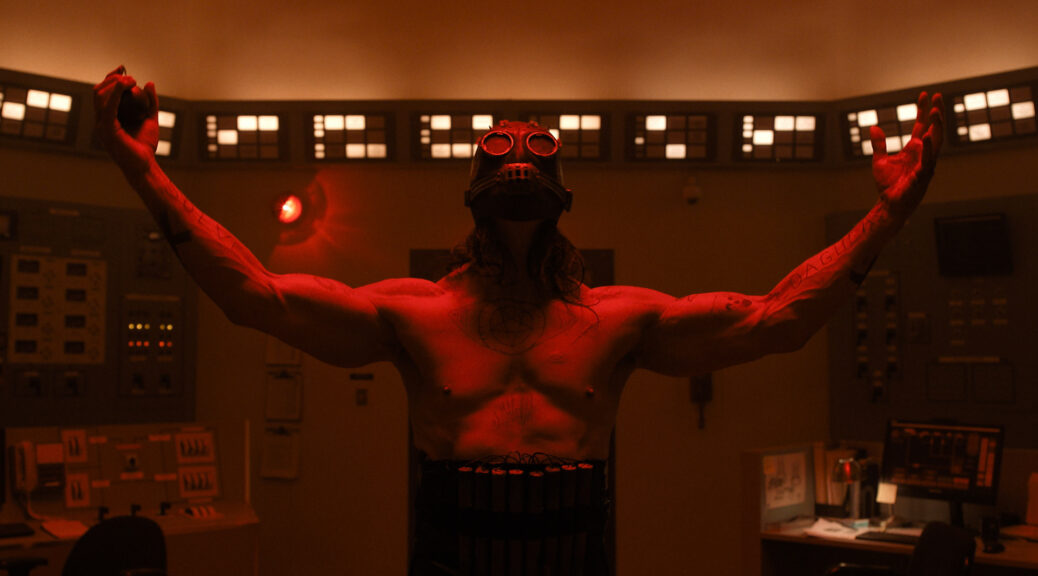
Isaiah White (Marlon Wayans) lives deliciously. Is Cameron Cade (Tyriq Withers) ready for that? Cade is the up-and-comer, the college QB who may be the one man to dethrone legendary Saviors quarterback, White. The 8-time champion came back even after the bone-protruding leg injury Cam’s late father made him watch again and again as a child.
Why would a father make a child watch something like that? To learn what it means to be a man, naturally.
Him is dense with themes and imagery, beginning with the very real frights of traumatic brain injury and its effect on football players. But the larger horror is rooted in performative masculinity, of proving your physical superiority by overpowering an opponent, drawing first blood, drawing last blood, and calling it power when it’s simply entertainment for puny white men with money.
Tipping equates the mechanics of sizing up an athlete with preparation for an auction block in one of the film’s most quietly unnerving sequences. Later references to gladiators obediently entering the pit at the behest of their trainers serve as additional, hardly subtle, illustrations of the power dynamic afoot.
Withers’s overwhelmed acolyte feels more dopey than wide-eyed, but Wayans is slippery, diabolical fun as the primary antagonist. Naomie Grossman steals scenes as White’s biggest fan, and Tim Heidecker’s disingenuous smarm fits perfectly as Cade’s agent.
There’s an intriguing half to this film. It’s the half making points about the way those with a financial stake in the game proselytize brutal sacrifice in search of greatness. The delicious living half, though, feels like a cheat.
The supernatural elements in Him give way to a foggy mythology full of fever dream smash cuts and jump scares. At times—as on a shooting range—details are left delightfully, grotesquely vague. Elsewhere the ambiguity feels like narrative weakness.
Worse still, the supernatural side of the film, to a degree, lets capitalism and white supremacy off the hook, no matter how satisfying the final bloodletting may feel. The set design is evocative and cinematography impresses, but the film can’t quite live up to expectations.
High school can be a tough time. What the youth of today need are role models. Soul eaters. Werewolves. Witches. Girls who know their way around a power drill. There’s so much the teens in these films can teach us!
5. Slumber Party Massacre (1982)
There is a wild juxtaposition at work beneath what could be mistaken as a trope-riddled slasher. Director/co-writer Amy Holden Jones, writing with Rita Mae Brown, deliver over-the-top cliche (teens in a sleepover undressing in full view of a window, one wearing a negligee, etc.), laughably phallic imagery (that power drill!), and the very traditional hack ’em up stuff.
But the behavior of these high school girls at the sleepover, and the one across the street pining to be part of the group, is so wildly masculine it’s hilarious. One hides a Play Girl magazine (the one with Stallone on the cover!) under her pillow, while those undressing together discuss the play of then-Cleveland Browns quarterback Brian Sipe.
The combination of elements subvert expectations even as they wallow in cliche. It’s such a great B-movie that even Tarantino lifted one scene wholesale for his masterpiece, Pulp Fiction.
4. The Craft (1996)
Three Catholic high school outcasts find solace in each other, a coven they create for safety, escape, harmony, and camaraderie. Fairuza Balk is perfection as Nancy, the loose cannon leader of the group. And even though dreamboat asshole Chris (Skeet Ulrich) prefers new girl Sarah (Robin Tunney), Nancy and the coven (Neve Campbell and Rachel True) embrace her.
And that’s what they needed to find real power. With their fourth they learn that power sometimes only amplifies problems. But it’s great while it lasts, and Nancy turns into one of the best badasses in 90s horror.
3. Jennifer’s Body (2009)
If Ginger Snaps owes a lot to Carrie (and it does), then Jennifer’s Body finds itself even more indebted to Ginger Snaps.
The central premise: Boys are stupid, throw rocks at them. Better still, lure them to an isolated area and eat them, leaving their carcasses for the crows. This is the surprisingly catchy idea behind this coal-black horror comedy.
In for another surprise? Megan Fox’s performance is spot-on as the high school hottie turned demon. Director Karyn Kusama’s film showcases the actress’s most famous assets, but also mines for comic timing and talent other directors apparently overlooked.
Amanda Seyfried’s performance as the best friend, replete with homely girl glasses and Jan Brady hairstyle, balances Fox’s smolder, and both performers animate Diablo Cody’s screenplay with authority. They take the Snaps conceit and expand it – adolescence sucks for all girls, not just the outcasts.
2. Knives and Skin (2019)
Falling somewhere between David Lynch and Anna Biller in the under-charted area where the boldly surreal meets the colorfully feminist, writer/director Jennifer Reeder’s Knives and Skin offers a hypnotic look at Midwestern high school life.
Knives and Skin’s pulpy noir package lets Reeder explore what it means to navigate the world as a female. As tempting as it is to pigeonhole the film as Lynchian, Reeder’s metaphors, while fluid and eccentric, are far more pointed than anything you’ll find in Twin Peaks.
And everyone sings impossibly appropriate Eighties alt hits acapella. Even the dead.
1. Ginger Snaps (2000)
Sisters Ginger and Bridget, outcasts in the wasteland of Canadian suburbia, cling to each other, and reject/loathe high school (a feeling that high school in general returns).
On the evening of Ginger’s first period, she’s bitten by a werewolf. Writer Karen Walton cares not for subtlety: the curse, get it? It turns out, lycanthropy makes for a pretty vivid metaphor for puberty. This turn of events proves especially provocative and appropriate for a film that upends many mainstay female cliches.
Walton’s wickedly humorous script stays in your face with the metaphors, successfully building an entire film on clever turns of phrase, puns and analogies, stirring up the kind of hysteria that surrounds puberty, sex, reputations, body hair and one’s own helplessness to these very elements. It’s as insightful a high school horror film as you’ll find, peppered equally with dark humor and gore.
A love letter to Baltimore and a beautiful showcase of talent, The Baltimorons is the yes-and of romcoms.
Jay Duplass directs a script co-written with Michael Strassner, who plays Cliff. Lovable, endearing, excruciatingly earnest, Cliff is headed with girlfriend Brittany (Olivia Luccardi) to spend Christmas Eve with her family. He falls on the back step, knocks out a tooth, and has to comb Baltimore for a dentist available to help.
Schlubby and sweet and desperately afraid of needles, Cliff makes quite an impression on the difficult to impress Dr. Didi (Liz Larsen). A series of mishaps, hijinks and opportunities keeps the two together for the balance of Christmas Eve.
This one-thing-leads-to-another cinematic structure can feel tedious and contrived, but Duplass and Strassner ground the narrative in Cliff’s two defining traits. Newly sober, Cliff is still learning who he is without alcohol. There’s a tentative, brave, sad but funny exploratory nature to the narrative that exactly mirrors this.
He’s also a sketch and improv comic, though he hasn’t done comedy since “the incident”—the catalyst for the film, for his sobriety, and for the personal journey that led Cliff to this moment. Cliff’s approach to life is the “yes, and” improv ethic. Whatever comes Cliff’s way, he’s not only up for it, he will meet it with the next most unexpected yet organic step to take.
Strassner couldn’t be better or more authentic in the lead, and his natural chemistry with Larsen compels interest. It’s a master class in opposites attract, two fully realized characters who are who they are, somehow warming to the thing in each other that most surprises them.
The Baltimorons is about fresh steps and reawakenings and taking what comes with humor and bravery. And it’s funny—sometimes slyly, sometimes hilariously. There’s substance to it, and romance, though the late-film reveal feels forced when compared to the balance of the film. Still, I haven’t seen a romantic comedy this romantic or funny since The Big Sick.
How fitting that Stephen King’s capitalist dystopian nightmare The Long Walk has finally been brought to the screen by director Francis Lawrence. Having helmed four Hunger Games films, including the most recent prequel, The Hunger Games: Ballad of Sonbirds & Snakes, he knows his way around these battles for what crumbs the wealthy deign to throw.
Based on King’s 1979 novel, the film follows a group of young men, each of whom signed up for and were chosen to participate in a last man standing competition: one road, one winner, no finish line. Walk until there’s no one else walking. The catch is that you can’t quit. Hell, you can’t even slow down. You walk until you die, either of exhaustion or by bullet spray (should you break the rules).
Lawrence has gathered a talented cast for these characters, beginning with everybody’s nemesis, the condescending voice of support and doom bellowing from the megaphone. Mark Hamill plays The Major with the perfect combination of swagger and benevolence to be contemptible without veering into caricature.
As Ray, our hero, Cooper Hoffman impresses, even when he’s saddled with King’s unfortunately quaint dialog. The camaraderie among the “four musketeers”— Ray, Pete (David Jonsson), Arthur (Tut Nyuot), and Hank (Ben Wang)—feels contrived from the beginning, Still, Cooper and Jonsson (so impressive in Alien: Romulus) share genuine chemistry, each elevating scenes with a glance, a shrug, a change in tone. Hoffman, in particular, plays nimbly with each of the other marchers, always delivering exactly the tone needed to keep someone’s head on straight and feet moving forward. Unsurprisingly, his moments with the invaluable Judy Greer (as Ray’s mother) are tender and heartbreaking.
This is a story most have deemed unfilmable given the utterly straightforward narrative. Cinematically, there’s not a lot you can do besides walk alongside 50 or so actors as they dwindle in number. There’s little opportunity to show rather than tell. Characters are defined by their dialog, and often, they’re narrowly etched.
But JT Mollner (Strange Darling) finds sly opportunities to broaden what is essentially a war metaphor—soldiers walking side by side, friendly enough but each hoping he’s the one who survives. Mollner and Lawrence subtly draw attention to the dystopian capitalist spectacle of boys walking themselves into an early grave, all so the rest of the country can watch and learn to be good, hard workers.
The Long Walk, as is always the case, will upset King purists because of its handful of plot changes. But when it comes to delivering a cinematic experience with an unfilmable novel, the movie’s a winner.
Did Shakespeare start it all with Uncle Claudius? Maybe, but horror movies have really dug in. Yes, there are some excellent uncles, like drunky Uncle Red from Silver Bullet. That guy was the best! But that’s not what we’re after, and author Eric Miller, writer of the new novel Whatever Happened to Uncle Ed? knows a thing or two about uncles and horror, so he’s joined us to count them down!
5. Uncle Maurice, Possum (2018)
Sean Harris is endlessly sympathetic in this tale of childhood trauma. Philip (Harris) has returned to his burned out, desolate childhood home after some unexplained professional humiliation. His profession? Puppeteer. The puppet itself seems to be a part of the overall problem.
I don’t know why the single creepiest puppet in history—a man-sized marionnette with a human face and spider’s body—could cause any trouble. Kids can be so delicate.
Writer/director Matthew Holness spins a smalltown mystery around the sad story of a grown man who is confused about what’s real and what isn’t. As Uncle Maurice, Alun Armstrong cuts as dilapidated and corrosive a figure as Philip’s home and memories themselves. The melancholy story and Harris’s exceptional turn make Possum a tough one to forget.
In 1988, no one realized the Halloween franchise could be saved. Tarnished by the (now unreasonably popular and beloved) Halloween III, The Return of Michael Myers was expected to be a last gasp. it was not. The film, about the adorable little orphan left behind when Laurie Strode and her husband died in a car wreck, Halloween 4 not only saved the franchise with its remarkable popularity, but gave the slumping slasher genre a boost.
Danielle Harris starred, charming her way into our hearts as surely as the child in peril plot line kept us engaged. The film did so surprisingly well that it spawned a quickly slapped together, wildly inferior sequel a year later, also starring Harris. And then, to beat a dead horse and absolutely horrify anyone with fond memories of little Jamie, 1995’s Halloween 6 turns Myers from and uncle to a great uncle/father. Yeesh.
3. Uncle Kouzuki, The Handmaiden (2016)
Director Park Chan-wook had already investigated the influence of a sinister uncle in the woefully underseen Stoker in 2013. In 2016, that not-so-stable branch of the family tree inspires the auteur to mesmerize again with this seductive story of a plot to defraud a Japanese heiress in the 1930s.
Weird is an excellent word to describe this film. Gorgeous and twisty with criss-crossing loyalties and deceptions, all filmed with such stunning elegance. Set in Korea, the film follows a young domestic (Kim TAe-ri) in a sumptuous Japanese household. She’s to look after the beautiful heiress (KimMin-hee), a woman whose uncle (Cho Jin-woong) is as perverse and creepy as he is wealthy.
Smart and wicked, stylish and full of wonderful twists, The Handmaiden is a masterwork of delicious indulgence.
2. Uncle Charlie, Shadow of a Doubt (1943)
Alfred Hitchcock did the most damage with his mother/son relationships, but the unnerving bond between Charlie Newton (Teresa Wright) and her favorite Uncle Charlie (Joseph Cotton) picks some festering scabs.
After a series of heiress murders, Charlie heads to smalltown America to lay low with his older sister, who adores him. Loves him so much, she named her oldest after him, even though it was a daughter. And oh, newly teenaged Charlie is a firebrand and just as spunky and smart as her namesake!
The film examines narcissism as unnervingly as any ever has, Uncle Charlie an amiable enough guy, and he might really regret having to murder his niece. All within that weirdly stilted performance style Hitchcock preferred, the cracks and anxieties and almost sexual innuendos play against the wholesome Midwest aesthetic in a way that gnaws at you.
1. Uncle Frank, Hellraiser (1987)
Hellraiser, Clive Barker’s feature directing debut, worked not only as a grisly splatterfest, but also as a welcome shift from the rash of teen slasher movies that followed the success of Halloween. Barker was exploring more adult, decidedly kinkier fare, and Hellraiser is steeped in themes of S&M and the relationship between pleasure and pain.
Hedonist Frank Cotton (Sean Chapman) solves an ancient puzzle box, which summons the fearsome Cenobites, who literally tear Frank apart and leave his remains rotting in the floorboards of an old house. Years later, Frank’s brother moves into that house with his teenage daughter Kirsty (Ashley Lawrence), who begins to unravel the freaky shit Uncle Frank and stepmom Julia (an amazing Clare Higgins) get up to.
Smart, weird, transgressive, and most importantly, CENOBITES!
It was so cool to get to host the Columbus premier of the new Stephen King adaptation The Long Walk! We’re grateful to the great crowd at Gateway Film Center for joining us for the screening and for sticking around for a spoiler-free chat about the movie.
Like 2021’s Poser, Noah Dixon and Ori Segev’s thriller of fandom gone feral, writer/director Alex Russell’s Lurker hangs on the cringey relatability of its awestruck lead. Who hasn’t dreamed of being taken into their hero’s inner circle?
Théodore Pellerin is Matthew. Working in a hip LA clothier, Matthew meets rising pop phenom Oliver (Archie Madekwe, Saltburn, Gran Turismo). Quietly, expertly, Matthew manipulates the situation to become the opposite of what he really is: sincere, oblivious to Oliver’s fame, an outsider with taste. Smitten, Oliver invites Matthew to a show.
What follows is a series of steps in Matthew’s budding friendship with the emotionally unfaithful Oliver. Russell never overplays the sleights of hand, the seeds sown, as Matthew the opportunist situates himself within Oliver’s posse.
Russell’s nimble screenplay delivers something sharp, bright, and delightfully morally murky. Though Matthew possesses a dorky, humble charm, we recognize his deception the moment he meets Oliver, so we’re never expected to fully empathize with or root for him.
At the same time, Oliver’s fickle affection makes him hard to pity. The whole entourage swirls with narcissism and insecurity. There’s something a touch Shakespearean about the drama that gives it a timeless quality, while its situation within the “attention as currency” climate lends it immediacy and relevance.
Madekwe is the perfect blend of charm, arrogance, insincerity and vulnerability. His character arc is wild, but the actor never misses a step.
Pellerin delivers a subtly unnerving performance, endearing one moment, volatile the next. The anxiety seething just below Matthew’s smiling surface informs an insecurity that recognizes itself in Oliver. It’s here that Russell’s perceptive screenplay does the most psychological damage, fully separating Lurker from other poisonous fan films.
It’s a quietly effecting study of the way the desire for fame alienates and isolates, whether you’ve achieved some level of fame or you’re happy to siphon it from someone else. Russell’s direction and his cast keep you anxious and keep you guessing.
Hollywood is one big nightmare. That’s essentially the plot of writer/director Rachel Cain’s feature debut, a dreamscape where you’re never certain what Gemma (Chloë Levin) is experiencing and what she’s imagining.
Levine’s cinematic presence, no matter the film, is wholly natural, utterly authentic. There’s nothing uncanny about her. Her humanity and vulnerability inform every moment she’s onscreen. That may be why she’s such a perfect central figure in horror films like The Ranger, The Transfiguration, and The Sacrifice Game. However unnatural the plot or nemesis, Levine is a profoundly human anchor.
In this surreal Hollywood fable—part Neon Demon, part Eternal Sunshine of the Spotless Mind, part Inception, part The Substance—Gemma leaves a small town in Georgia to chase her Hollywood dreams. Lonesome, rejected, lost and always one step away from homelessness and failure, she takes a job at an experimental sleep clinic where people dream their way into believing they can achieve their ideal future.
Gamma works nights, studying scripts and babysitting sleeping clients. By day she auditions, faces rejection, daydreams about her old life, and flirts with the possibly creepy, possibly benevolent Hollywood insider, Brooks (Jonathan Schaech).
But the daydreams are leaking into her waking moments, huge chunks of time keep disappearing, and there’s this contorted figure with a twisted spine she keeps catching in her peripheral vision.
Cain’s script lacks a little something in originality—hers is hardly the first cautionary tale about striking it out on your own in Hollywood. Still, in subverting the idea of big dreams, playing with the notion that perception is reality, and mining the vulnerability and predatory nature of those with and without power in Tinsel Town, she hits a nerve.
She leaves too much unresolved, which is frustrating. But scene by scene, Cain casts a spell both horrifying and hopeful. Though the entire ensemble is strong, Levine is her secret weapon. The film falls apart if you don’t feel protective of Gemma, if you don’t long for her to succeed. Characteristically, Levine has you in her corner, even when lurking doom waits behind her in the shadows.