Screening Room: Upside, Basis of Sex, Replicas and More

A lot of movies, some of them quite surprising, to talk about this week in the screening room: The Upside, Replicas, On the Basis of Sex, A Dog’s Way Home, El Angel and Rust Creek. Plus, we peek at new releases in home entertainment and tease next week’s features.

Listen to the full podcast HERE.

Change My Mind

Replicas

by Hope Madden

Sometimes, dead is better.

That Stephen King quote flashed through my mind as I watched Replicas, Jeffrey Nachmanoff’s SciFi thriller starring Keanu Reeves.

Reeves is William Foster, a scientist working nobly to put human consciousness into robots because this way we can save so many dying soldiers. I’m confident they would totally want to come back as robots.

Foster quickly loses his family in a car accident, his bestie (Thomas Middleditch) conveniently dabbles in cloning, and the mad duo concoct a plan to combine their specialties and bring the Foster family back to life.

Back one step: Will Foster loses his family in a car accident. This requires Reeves to emote.

I would call that Problem #1, but I already covered the plot.

Nachmanoff and writers Chad St. John and Stephen Hamel deserve credit for quietly upending the ages-long moral conundrum at the center of any cloning/Frankenstein/AI film. Good for them for opting out of Judeo Christian finger-wagging.

Also, Alice Eve—when she’s allowed to do something besides look good sleeping—offers a nuanced and often funny performance that makes the most of the moral quagmire the story articulates.

How capable is Reeves at lobbying back answers to her profound and life-altering accusations?

I think you know.

Reeves has proven to have some heretofore unimagined talents via recent supporting turns in The Bad Batch and Neon Demon. His hollow performance in John Wick works strangely well, too. But as a scientist struggling with enormous moral choices and debilitating grief? It is distracting enough that I almost didn’t notice those plot holes I kept falling into.

That King quote didn’t flash through my mind as I thought about the Foster family and their existential paradox. I was thinking about me having to sit through this movie.


https://www.youtube.com/watch?v=ze_ANsckvS0

Hillbilly Elegy

Rust Creek

by Hope Madden

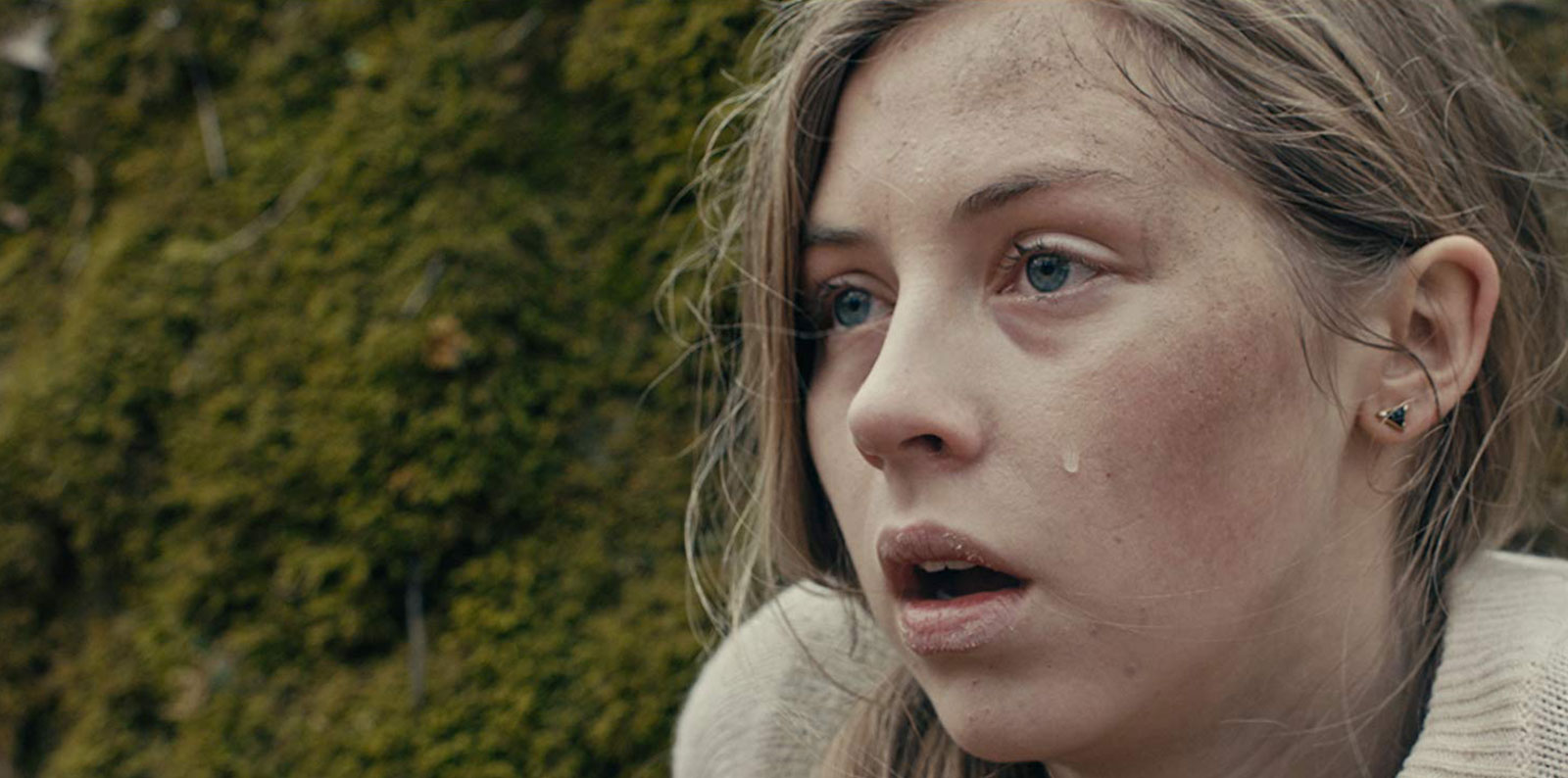
College co-ed (Hermione Corfield) follows her GPS into the backwoods of Kentucky, and hits a dead end before bumping into some less-than-helpful locals: tussle, injury, escape into the woods.

I don’t know how many times you’ve seen that very film, but I have probably seen it twice already this week. (It’s a problem, I know.)

This woman-in-peril pairing with the “city folk lost in the backcountry” formula equals one very tired experience.

The fact that filmmaker Jen McGowan, working from a script by Julie Lipson, offers us a victim/heroine who fights and thinks is not quite enough to save Rust Creek from drowning. But McGowan’s tricky, and she has more surprises packed in her double-wide than you might think.

The film, on its surface, asks us to rethink the victim in a hillbilly thriller. But Rust Creek cuts deeper when it requires that we—and the heroine, for that matter—rethink the hillbilly.

Michelle Lawler’s cinematography sets a potent mood, enveloping the proceedings in an environment that is in turns peaceful and gorgeous or treacherous and brutal, and she does it with natural, almost poetic movement.

This imagery allows the Kentucky woods to become the most vibrant character in the film, although those tree-covered hills are peopled by a few locals worthy of notice—not all, but a few.

Jay Paulson—best known to normal people for his brief stint on Mad Men, best known to my people as the porn-obsessed psychopath in Robert Nathan’s Lucky Bastard—cuts an intriguing, lanky figure as Lowell.

Slyly fascinating from the moment he takes the screen, Paulson shares an uncommon onscreen chemistry with Corfield. The smart, human relationship they build as they bide their time and cook some meth may be reason enough to see Rust Creek.

McGowan doesn’t burst as many clichés as she embraces, unfortunately. Still, the biggest obstacle facing her as she maneuvers her tropes to serve a (hopefully) unexpected purpose is that her protagonist is the least interesting character in the movie. This is not necessarily Corfield’s fault. She does what she can with limited resources. Sawyer is just the fuzziest character, and the one with the least articulated arc.

That means the resolution packs less of a wallop than it should, but certain moments and characters will linger.

Puppy Love

A Dog’s Way Home

by George Wolf

After the sledgehammer schmaltz of A Dog’s Purpose last January, director Charles Martin Smith takes over for the latest adaptation of a W. Bruce Cameron canine tale and chooses wisely by making a straight up kid’s movie.

Martin has the two Dolphin Tale films on his resume, so he knows his way around a family film, and I’m guessing he knew the only chance this one had was to aim it squarely at the youngest in the house.

Just think of it as Bryce Dallas Howard reading a big screen picture book to your kids for 90 minutes, as cute puppy Bella (voiced by Howard) over-explains all the goings on from the moment we meet her as a stray.

She’s adopted by Lucas (Jonah Hauer-King) and his mom Terri (Ashley Judd), and things are great until Bella runs afoul of the overly strict dog laws in Denver (who knew?). She’s taken in by friends in New Mexico until Lucas can sort it out, but homesickness leads to a backyard jailbreak, and Bella sets off on the long journey back to Colorado.

Bella gets into plenty of adventures along the way as her path crosses friendly people, mean people, CGI animal friends, predators and an amusing picnic-basket stealing or two.

Like A Dog’s Purpose, everything is painted with the broadest brush available. It is Martin’s altered viewpoint that makes this one much less painful to endure, even providing subtle teachable moments concerning diversity, veterans, homelessness and even same-sex couples.

Pretty good dog.

And, really, Denver, what gives with those outdated laws?

The Heisenberg Sincerity Principle

The Upside

by Matt Weiner

The man who can’t feel a thing meets the man who hasn’t cared for anybody but himself. You will not believe what happens next.

Actually, if you’ve seen any inspirational movie about overcoming adversity in the last half century, you will totally believe what happens next. There is one big surprise in The Upside, though, and it’s how committed the leads are to making it way less cynical than it has every right to be.

I’m not sure it’s enough to redeem a film that’s been done dozens of times, but at least it makes this entry highly watchable. For this version, Bryan Cranston and Kevin Hart star as the odd couple from different walks of life who learn valuable lessons from each other in unexpected ways.

After being paralyzed from the neck down and losing his wife to cancer in short succession, billionaire investor Phillip Lacasse (Cranston) has given up on life. A chance encounter with street-smart parolee Dell Scott (Hart) brings a burst of fresh air into Lacasse’s narrow world, and Dell is hired on as a live-in aide.

Lacasse sees potential in Dell and appreciates having someone who treats him as a person, not merely someone to be pitied or ignored. It’s an admirable sentiment, and the chemistry between Cranston and Hart is the most winsome part of the movie. And a good deal more enjoyable than the contrived romantic subplot with Nicole Kidman, who gets to put her real accent to good use but not much else.

Cranston and Hart play off each other so well that it makes you wonder why not put that talent to work with a less hidebound story? The Upside is an adaptation by Neil Burger of the 2011 French film The Intouchables, which was wildly popular despite suffering from the same clichés. The script for the remake by Jon Hartmere manages to make the story a little more subtly endearing than colonial when Lacasse, doing his best platonic Henry Higgins, teaches Dell to appreciate fine art and opera. Just a little.

But banish those nagging doubts from your mind. The Upside pleads to be taken as all text, no subtext. This is, after all, a movie that turns themes, lessons and even symbolism into neatly packaged dialogue. You won’t hear anything new, but a lot of it is genuinely funny and well-delivered.

And who am I to judge the French for shopworn sincerity? They’re not the country that gave an Oscar to Crash.

Notorious

On the Basis of Sex

by George Wolf

In his wallet, my friend Jake keeps a picture of an attractive young woman he’s never met, just so he can use it for a bar trick.

It’s a picture clearly taken decades ago, and after a few cold ones, Jake will put the snapshot in someone’s face and challenge them.

“Who is this?!”

Most times they don’t know.

“RUTH BADER GINSBURG!”

That’s just one example of the rock star status RBG has achieved since joining the Supreme Court in 1993. A progressive champion at age 85, her every sniffle draws attention while more serious issues (like the recent surgery that caused her to miss SCOTUS opening arguments for the first time) elicit regular Google searches on her health.

But behind the pop culture status and “Notorious RBG memes” lies a truly heroic life. Already profiled last year in the Oscar-contending documentary RBG, On the Basis of Sex adapts her story for a big screen feature unable to contain its pure fandom.

Biopics on such legendary figures are usually wise to keep the focus tight rather than tackle the entire life story, and OTBOS works best when it digs deep into the first gender discrimination case Ginsburg (Felicity Jones) argued in court: Moritz v. Commissioner of Internal Revenue in 1971.

She presented the case alongside husband Marty (Armie Hammer), giving the film an organic mix of the personal and professional that first-time screenwriter Daniel Stiepelman (who is also RBG’s nephew) uses as his opening to also salute the sweetness of the Ginsburg love story.

It’s an understandable approach by an understandably biased party, but one that leads the film toward a path of hagiography and intermittent schmaltz that director Mimi Leder (Deep Impact, Pay It Forward) is seldom interested in resisting.

Jones carries the film with a terrific lead performance, Hammer delivers his usual fine support, and there’s no question Ginsburg is worthy of a big screen tribute, but this one can’t free itself from the admiring glow RBG basks in today. The sexism she faced is addressed, of course, but in ways that never feel more threatening than annoying flies this Superwoman will easily swat away.

Though its finale scores big, with Jones delivering a stirring closing argument before a cheer-worthy walk up courthouse steps, On the Basis of Sex rests as a film always competent and sincere, but seldom revealing.


Devil in Disguise

El Angel

by Hope Madden

Everyone loves a good bad guy. Why is that?

That’s a question that drives Luis Orgeta’s El Angel, a fantastically stylish period piece and provocative bit of storytelling that mythologizes Argentina’s most notorious serial killer.

Lorenzo Ferro is Carlito, mischievous imp and beautiful youth. In his acting debut, Ferro mesmerizes—appropriately enough. The sleepy charisma of the performance, paired with Ortega’s beguiling direction, seduces you.

Ortega saturates every frame with color, pattern and song, creating a sensual atmosphere that mirrors the storytelling. Meanwhile, Ferro captures a fearlessness that comes from the singular desire to experience each moment as it happens with no regard for what comes after, an alluring quality for both the audience and the other players in Carlito’s world.

While the newcomer is the clear center of gravity in this film, each supporting turn is stronger than the last. Together the actors populate this charmingly unseemly world with dimensional, intriguing misfits.

Chino Darín has the beefiest role as Carlito’s best friend, partner in crime and the object of his longing. That’s a theme—longing—Ortega plays with to unsettling results. There is a sexuality to everything Carlito does, and the relationship between the two friends remains tantalizingly unarticulated.

The release the audience gets instead is in the violence of the crimes.

The way Ortega emphasizes small, curious moments and deemphasizes the brutality without looking away from it is a true feat. The film—and, indeed, the life of Carlos Robledo Puch, the murderer in question—holds a great deal of violence. Truth is, the film may not contain enough.

Ortega’s interest involves the seductive quality of the bad guy. To get at this, though, he whitewashes Puch’s crimes. Besides being a murderer and a bit of an eccentric, Puch was a rapist and kidnapper who once shot at a sleeping infant. The omissions change the film from one that explores and mirrors the seductive quality of the villain to one that manipulates true life to fit a tidier vision.

Still, the sheer off-kilter spectacle that finds its focus in small, weird moments is too great to dismiss. Like the character it creates, El Angel’s allure is too strong to resist.

https://www.youtube.com/watch?v=0ypjYdv8L2M

Slippery Slope

Free Solo

by George Wolf

There are only so many times I can use the word “breathtaking,” so Free Solo has me inventing some new ones.

“Sweatpalming”? “Gutknotting”? “Fascinating” works, too.

It’s all of those, a totally enthralling account of one man’s quest to do the unthinkable, and the uncommon psyche that drives him to do it.

Alex Honnold became hooked on rock climbing at an early age, eventually dropping out of Cal-Berkeley to live in a van and devote himself to the climb. Recognition and sponsor money soon followed, until his increasing devotion to climbing without safety equipment (“free soloing”) caused some sponsors to withdraw support, citing concern for pushing the boundaries of risk.

Last year, Honnold realized a dream eight years in the making, becoming the first human being to free solo up the 3200 feet of granite that is El Capitan in California’s Yosemite National Park, a wall Honnold calls “the most impressive on Earth.”

Directors Jimmy Chin and Elizabeth Chai Vasarhelyi, plus a very visibly nervous crew, were there to document the climb with truly awe-inspiring footage that demands to be seen on the biggest screen you can find. You will marvel at the accomplishment even as you doubt Honnold’s sanity, which makes the second layer of the film that much more meaningful.

As they did with the mountain climbers in their 2015 doc Meru, Chin and Vasarhelyi want to get in their subject’s head, even following Honnold into an MRI brain exam when he wonders if there might be a biological reason for his death-defying urges.

It’s his upbringing, though, one of few displays of affection and a constant need to perform, that’s more revealing. We see Honnold as an extremely bright young man undeterred by societal concerns, yet consistently trying to self-access and become more social.

At 23, he thought it was best to practice the strange act of hugging.

A serious girlfriend, the bubbly, camera-friendly Sanni McCandless, complicates things, and as climbing legend Tommy Caldwell reminds us of the near-total mortality rate for free soloists, Honnold matter-of-factly debates any “obligation to maximize my life span.”

This is merely one contrast in a film of many. Even the filmmakers, committed as they are to the project, question the affect their very presence might have on Honnold’s decision-making. It’s all never less than compelling.

But in contrasting glorious human achievement with acceptable sacrifice, Free Solo becomes nearly unforgettable.

https://www.youtube.com/watch?v=S4F3JK7oHn0

I Don’t Want to Go Out—Week of January 7

Holidays are over, work is already a drag, who wants to just snuggle up and watch a movie? There is one great one available this week. Also one that’s got some promise, even if it derails. Then there’s one that’s frustrating because we really wanted to like it.

Click the film title for the full review.

Mid90s

The Oath

Hell Fest

Horror 101 Full Lineup Is Here!

FULL LIST OF HORROR 101 AT GATEWAY FILM CENTER ANNOUNCED

National panel of experts selects titles for the new program

In 2017, Gateway Film Center launched its most ambitious program ever, Cult 101, which was a celebration of the best cult films of all-time. Selected by a national panel of experts, all 101 films were screened at the center in 2017, and presentations were often paired with conversations, expert analysis, and always with a healthy dose of audience affection. Many of the films were presented as restorations, sometimes in 4K, or on 70mm or 35mm film.

Now, one year later, the center will launch a companion program, Horror 101, paying tribute to the best of those films that scare, unsettle or disturb.

“As soon as Cult 101 ended, I started getting requests for more programs that were similar to it in scale and scope,” said Gateway Film Center President, Chris Hamel. “With the amazing impact these films have had on our culture, and the spirited debates horror films seem to create, Horror 101 was the obvious choice for a new program.”

National and local news outlets, filmmakers, studios, distributors, critics and programmers were selected to help the film center with its final picks. Contributors include representatives from Warner Brothers, Lionsgate, IFC Films, Paramount, MPI Media and Dark Sky Films, Magnolia Pictures, Nightmares Film Festival, Days of the Dead, Fangoria, Maddwolf, and more.

The program begins Valentine’s Day with Candyman (1992) at 7:30 p.m. The complete list of films is below, and their screening times will be revealed each quarter, treating Horror 101 as four seasons of top horror film.

The first screening schedule will be announced on January 15.

Normal Gateway Film Center ticket pricing will apply to all screenings. Most screenings are free to myGFC members. Visit www.gatewayfilmcenter.org for more information.

Here is the list of Horror 101 titles, listed alphabetically:

28 Days Later (2002)
A Nightmare On Elm Street (1984)
Alien (1979)
Altered States (1980)
The Amityville Horror (1979)
An American Werewolf In London (1981)
Antichrist (2009)
Audition (1999)
The Babadook (2016)
Battle Royale (2000)
Beetlejuice (1988)
The Birds (1963)
Black Christmas (1974)
The Blair Witch Project (1999)
The Bride of Frankenstein (1935)
The Cabin In The Woods (2012)
The Cabinet of Dr. Caligari (1920)
Candyman (1992)
Carnival of Souls (1962)
Carrie (1976)
Cat People (1942)
The Changeling (1980)
Child’s Play (1988)
The Creature From The Black Lagoon (1954)
Creepshow (1982)
Dawn of the Dead (1978)
Dead Alive (1992)
The Descent (2005)
Don’t Look Now (1973)
Donnie Darko (2001)
Dracula (1931)
Drag Me To Hell (2009)
Eraserhead (1977)
Evil Dead II (1987)
The Evil Dead (1981)
The Exorcist (1971)
The Fly (1986)
Frankenstein (1931)
Friday the 13th (1980)
Fright Night (1985)
Get Out (2017)
Godzilla, King of the Monsters! (1954)
Halloween (1978)
Halloween III: Season of the Witch (1982)
Hellraiser (1987)
Hereditary (2018)
High Tension (2003)
The Hills Have Eyes (1977)
Horror of Dracula (1958)
The House of the Devil (2009)
House On Haunted Hill (1959)
I Saw The Devil (2010)
Inside (2007)
Invasion of the Body Snatchers (1956)
Jacob’s Ladder (1990)
Jaws (1975)
King Kong (1933)
The Last House On The Left (1972)
Let The Right One In (2008)
The Lost Boys (1987)
Martin (1977)
Martyrs (2008)
Masque of the Red Death (1964)
Misery (1990)
The Mummy (1932)
Near Dark (1987)
Night of the Creeps (1986)
Night of the Hunter (1955)
Night of the Living Dead (1968)
Nosferatu (1922)
The Omen (1976)
The Orphanage (2007)
Pan’s Labyrinth (2006)
Paranormal Activity (2007)
The People Under The Stairs (1991)
Pet Semetary (1989)
Phantasm (1979)
Poltergeist (1982)
Psycho (1960)
Re-Animator (1985)
Return of the Living Dead (1985)
The Ring (2002)
Ringu (1998)
Rosemary’s Baby (1968)
Saw (2004)
Scanners (1981)
Scream (1995)
Se7en (1995)
The Shining (1980)
The Silence of the Lambs (1991)
The Sixth Sense (1999)
Suspiria (1977)
The Texas Chainsaw Massacre (1974)
The Thing (1982)
Trick ‘r Treat (2007)
Videodrome (1983)
The Wicker Man (1973)
The Witch (2015)
The Wolf Man (1941)
Zombie (1979)

Hope Madden and George Wolf … get it?