Not bad little week in home entertainment whether you’re looking for some joyfully earnest Bruce, some joyously earnest Dora, or a gorgeous and strangely seductive Polish romance. You’re not looking for one of those things? Oh, we think you are.
There is something terrifying about being in a strange land, especially if the language is not your own. There are so many great horror flicks that take advantage of that sense of isolation and confusion that we needed a second list of stuff that didn’t make the final cut but that you should check out anyway: And Soon the Darkness (1970), Road Games (2015), Transsiberian (2008), Hostel (2005) and Hostel: Part II (2007), The Human Centipede: First Sequence (2009) and, in particular, the double shot of Spanish horror Who Can Kill a Child? (1976) and its 2012 remake, Come Out and Play.
What’s better? Here you go:
5. Suspiria (1977)
Italian director Dario Argento is in the business of colorfully dispatching nubile young women. In Suspiria, his strongest film, American ballerina Suzy Bannion (Jessica Harper) moves to Germany to join a dance academy, but the other dancers are catty and the school is staffed with freaks. Plus, women keep disappearing and dying.
As Suzy undertakes an investigation of sorts, she discovers that the school is a front for a coven of witches. But Argento’s best film isn’t known for its plot, it’s become famous because of the visually disturbing and weirdly gorgeous imagery. Suspiria is a twisted fairy tale of sorts, saturating every image with detail and deep colors, oversized arches and doorways that dwarf the actors. Even the bizarre dubbing Argento favored in his earlier films works to feed the film’s effectively surreal quality.
4. Ils (Them) (2006)
Brisk, effective and terrifying, Them is among the most impressive horror flicks to rely on the savagery of adolescent boredom as its central conceit.
Writers/directors David Moreau and Xavier Palud offer a lean, unapologetic, tightly conceived thriller that never lets up.
Set in Romania, Them follows Lucas and Clementine, a young couple still moving into the big rattling old house where they’ll stay while they’re working abroad. It will be a shorter trip than they’d originally planned.
What the film offers in 77 minutes is relentless suspense. I’m not sure what else you want.
Creepy noises, hooded figures, sadistic children and the chaos that entails – Them sets up a fresh and mean cat and mouse game that pulls you in immediately and leaves you unsettled.
3. An American Werewolf in London (1981)
Director John Landis blends horror, humor and a little romance with cutting edge (at the time) special effects to tell the tale of a handsome American tourist David (David Naughton) doomed to turn into a Pepper – I mean a werewolf – at the next full moon.
Two American college kids (Naughton and Griffin Dunne), riding in the back of a pickup full of sheep, backpacking across the moors, talk about girls and look for a place to duck out of the rain.
Aah, a pub – The Slaughtered Lamb – that’ll do!
The scene in the pub is awesome, as is the scene that follows, where the boys are stalked across the foggy moors. Creepy foreboding leading to real terror, this first act grabs you and the stage is set for a sly and scary escapade. The wolf looks cool, the sound design is fantastically horrifying, and Landis’s brightly subversive humor has never had a better showcase.
2. The Descent (2005)
A bunch of buddies head to the States for a spelunking adventure.
Writer/director Neil Marshall begins his film with an emotionally jolting shock, quickly followed by some awfully unsettling cave crawling and squeezing and generally hyperventilating, before turning dizzyingly panicky before snapping a bone right in two.
And then we find out there are monsters.
Long before the first drop of blood is drawn by the monsters – which are surprisingly well conceived and tremendously creepy – the audience has already been wrung out emotionally.
The grislier the film gets, the more primal the tone becomes, eventually taking on a tenor as much like a war movie as a horror film. This is not surprising from the director that unleashed Dog Soldiers – a gory, fun werewolf adventure. But Marshall’s second attempt is far scarier. For full-on horror, this is one hell of a monster movie.
1. Midsommar (2019)
In Midsommar, we are as desperate to claw our way out of this soul-crushing grief as Dani (Florence Pugh). Mainly to avoid being alone, Dani insinuates herself into her anthropology student boyfriend Christian’s (Jack Reynor) trip to rural Sweden with his buds.
Little does she know they are all headed straight for a modern riff on The Wicker Man.
Like a Bergman inspired homage to bad breakups, this terror is deeply-rooted in the psyche, always taking less care to scare you than to keep you unsettled and on edge.
It’s a truth universally acknowledged that a cute accent
will make even the silliest sentiment 20 percent more charming. So, it’s
fortunate that the dialogue in Kiah Roache-Turner’s action/comedy/horror is
mostly delivered in appealing Australian accents. Otherwise it’s a bit of a
mess.
A take on cell phone addiction, Nekrotronic asks the question, “What if demons got online and created a knock-off of Pokémon Go to steal our souls?”
Thankfully, Howard, a sanitation engineer/orphan, discovers
he’s the descendant of generations of necromancers (nekromancers?) with
demon-fighting superpowers, now upgraded with what look like coaxial cable
ports in the backs of their heads. Years ago, his necromancer parents split up
when mom, Finnegan, was turned to the dark side. Howard’s dad hid him with
muggles before being murdered by his ex.
Ben O’Toole delivers a decent performance in Howard. He’s
equally able to pull off his silly X-Men-style superhero suit and deliver the
occasional bit of banter that reminds us that the movie is supposed to be part
comedy. His chemistry with his tragically underused sidekick Rangi (Epine Bob
Savea) is probably the best part of the film. Too bad it’s mostly in the first
18 minutes.
After the initial setup, Nekrotronic often seems to forget the comedic slant and leans heavily into the action. The special effects and fight sequences are acceptable. But there are no stakes. What is Finnegan going to do with the power of the souls she devours through the cell phone game? Use the power to get more souls. Why? To what purpose? Unclear. What does Howard stand to lose? Little. He already seems to hate his foster family and his job. He’s not invested in random strangers. His BF Rangi might take a hit, but Howard’s powers can sorta mitigate that.
The movie mashes up Matrix, Tron and Ghostbusters and sets it to a half-hearted attempt at a Tarantino soundtrack. But there’s no focus or originality in the result.
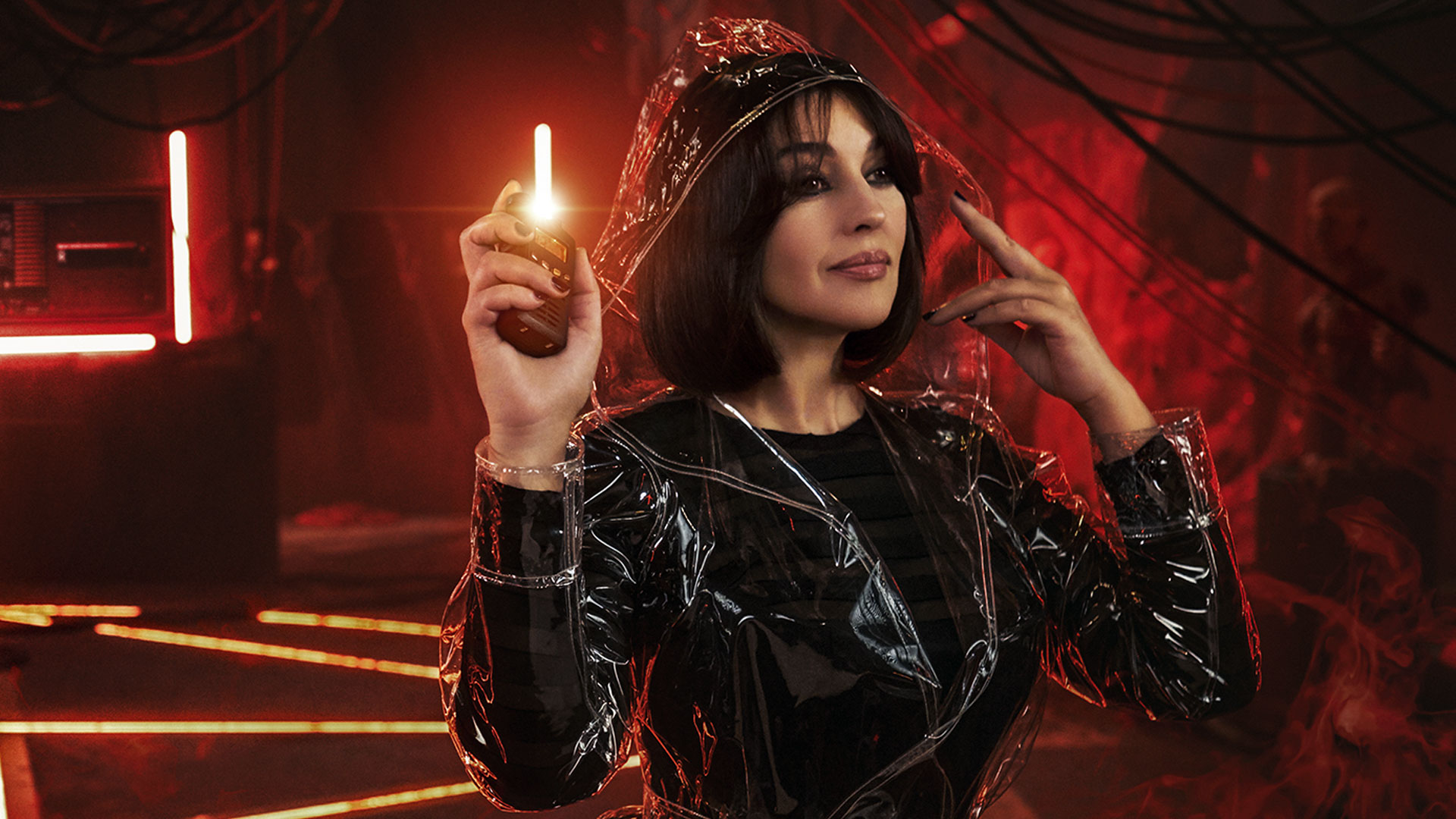
The weakest part of the movie is probably Monica Bellucci’s
Finnegan. Possessing a gorgeous Italian accent, her delivery proves the
exception to the accent-makes-it-better maxim. She struggles to enunciate the
juvenile, expletive-laden dialogue that comes much more naturally from the
other characters. It feels like when your manager researches slang on Urban
Dictionary and pulls the results out in the conference room to seem relevant.
It’s cringy and off-putting.
In the end, Nekrotronic delivers a little bit of everything, but it not enough of the right things.
We’ll know soon enough if there was high demand for a new Charlie’s Angels film. But 16 years after the close of the Drew Barrymore version, Elizabeth Banks apparently thought she could bring the franchise a welcome freshness.
She was right, mostly.
As writer, director and co-star, she’s a Banks of all trades, and just one of the Bosleys assisting a team of Angels. In this Charlie universe, “Bosley” is a rank, not a name, with famous faces such as Patrick Stewart, Djimon Hounsou and even Michael Strahan as some manner of Boz.
But it is Banks’s Bosley that is on the case when Angels Sabina (Kristen Stewart) and Jane (Ella Balinska) must protect Elena (Naomi Scott), a brilliant systems engineer who stands between bad guys and some lethal new technology.
Even with its updated vibe, Banks’s vision seems more in line with the original TV series (12 year-old me was a big fan). Barrymore’s films did bring some charm, but too often treated style as weapon of submission. The feeling this time is more of an easygoing wink-wink, with plenty of callbacks to franchise history and some well-staged battle angel set pieces.
There’s plenty of girl power, too, and while these Angels aren’t first to that party, they fit in quite nicely. They value friendships, they own their sexuality without being sexualized, they’re skilled, strong and always ready to rib each other about awkward flirting or a love of cheese.
Even with the surprises and fake outs it holds, the spy story is a bit too slight to support a full two hours. But, no surprise, it is worth staying for credits that offer plenty of smile-inducing cameos.
Banks deals plenty of hands with Charlie’s Angels, overplaying none but the running time. So while it’s not a laugh riot, it is self-aware and amusing, its action heavy without undue disbelief and it feels like a reboot we needed, whether we realized it or not.
Director James Mangold has a knack for turning the
comfortable biopic formula into something genuinely gripping, even when it’s
not surprising. In the case of Ford v Ferrari, the film manages to be both.
Anchored by contrasting performances from Matt Damon as the
legendary racer and auto engineer Carroll Shelby and Christian Bale as his
prickly driver of choice Ken Miles, Ford v Ferrari condenses the staid
American automaker’s quest to challenge Ferrari’s dominance in sports car
racing as a way of injecting the company with a shot of glamor for younger car
buyers.
The site chosen for that showdown is the 1966 24 Hours of Le
Mans, a grueling endurance race that no American-made car had yet to win.
Shelby previously notched a victory with an Aston Martin in 1959 before
retiring as a driver due to health problems.
Although Shelby and Miles were accomplished designers and engineers,
the story (by Jez Butterworth, John-Henry Butterworth and Jason Keller) uses a
light touch when it comes to detailing the actual car building. There’s almost
as much time spent in the boardroom as there is on the racetrack.
And the film is all the better for it, as the conflict turns out to be less about Ferrari and more between the misfits Shelby and Miles and the rigid executives at Ford. (The exception is Lee Iacocca, archly portrayed by Jon Bernthal as a budding Don Draper of Detroit.)
But Ford v Ferrari is still a racing movie, and
Mangold delivers when the action moves onto the track. In fact he probably
deserves extra credit for heightening the tension during a 24-hour endurance
race. How many tea breaks were there in Days of Thunder?
There are also the requisite glimpses of danger (this is
a biopic), but the script—and especially Bale’s giddy Miles—bring out the
meditative joy as well. It hasn’t been this entertaining to hear Bale yell at
people in his accent since Terminator Salvation.
Miles and Shelby get a bit of the tortured artist treatment,
but just a bit. The film is after something that in its own small way is more subversive:
the friendship, love and respect these men have for each other. (Yes, the focus
is almost entirely on men, boys and their toys, but at least Caitriona Balfe
gets to do more than sketch the faintest outlines of a long-suffering wife. Barely.)
The film builds to the race in France, but Mangold is in top form when he’s remixing and interrogating Americana, from country in Walk the Line to the western in Logan. Ford v Ferrari continues these reflections on our most storied icons, and the world-weary characters who must bear those burdens for the myth to survive.
My genuine thanks to first time writer/director Swati Bhise for bringing to my attention the Indian freedom fighter and queen, Rani Lakshmibai. The woman was an absolute badass.
Lakshmibai (Devika Bhise, Swati’s daughter) reigned over the Indian state of Jhansi during the mid 1850s, a time of British rule. In 1857, she took part in a rebellion aimed at freedom from the colonial oppressors.
When I say took part, I mean she wielded swords on
horseback, united an otherwise divided smattering of armies and generally
kicked all manner of ass.
She was most impressive.
She deserved a better movie.
Bhise’s approach to this wildly untraditional tale is far
too traditional, too restrained, and too afraid to dig into any of the
characters, including the lead. More cripplingly, the film is basically a
chamber piece until the third act.
That could work if what we saw was the backbiting and
usurping that may have gone on behind closed doors—British or Indian—as a woman
took charge. Or if it was strategy and brainstorming that we observed, or if stirring
speeches bore witness to the ruler’s inner conflict and motivational charisma.
Instead we get a blandly sanitized soap opera, the warrior
queen discussing hair care with her female soldiers as frequently as military
tactics. Throughout, Bhise’s direction feels amateurish, every scene stagnating
as it drowns in costumes and unconvincing sets.
Dialog fills in for character development, but we also see a
lot of the queen sitting silently and thinking. The Warrior Queen of Jhansi
depicts lot of pondering, a lot of costumes, very little action.
“I am no stranger to battle,” Rani Lakshmibai tells whoever
might listen, but it’s news to us because we haven’t seen her do anything
besides think, talk and change her clothes. Worse still is the single scene of
battle practice, where she readies her female forces, not one of whom can
convincingly handle a sword.
The British side of things fares little better, although a smug Rupert Everett as Sir Hugh Rose and Nathaniel Parker as blowhard Sir Robert Hamilton do inject some life into the proceedings. Everett is the only actor in the entire cast asked to find multiple layers in his character. It’s just two layers, really, but they are a welcome change.
It is a magnificent feat, no doubt, that the story of a 1850s Indian warrior queen has made its way to the American big screen (there are two Indian films, one classic and a second released this year). I wish it was a better movie.
In 1973, Martin Scorsese gave us Mean Streets, the tale of a fledgeling gangster contemplating the rungs that could lead him to the top of the NYC mafia. The film takes the point of view of the young man looking forward, and it boasts a supernaturally brilliant performance by Robert De Niro, then 30-years-old.
Scorsese’s latest, The Irishman, looks at a gangster’s rise through those same ranks, this time with the eyes of an old man looking back on his life. In another performance that will remind you of his prowess, a 76-year-old De Niro stars.
The 3 ½ hour running time opens patiently enough as Rodrigo
Prieto’s camera winds its way through the halls of a nursing home, establishing
a pattern. We will be meandering likewise through the life and memories of
Frank Sheeran (De Niro), house painter.
“When I was young,” says Sheeran, “I thought house painters
painted houses.”
Sheeran’s telling us his tale in much the way the actual Frank
Sheeran told writer Charles Brandt (author of Scorsese’s source material) what
may or may not have been the truth about his history as a mob hitman (it’s not
paint he’s splashing across walls) and his relationship with Jimmy Hoffa (Al
Pacino).
Teamed with acclaimed screenwriter Steven Zaillian (Schindler’s List, Moneyball, Gangs of New York), Scorsese’s sly delivery suggests that he’s interested in what might have happened to Hoffa, sure, but he’s more intrigued by memory, regret and revisionism in the cold glare of time. The result is sometimes surprisingly funny, with a wistful, lived-in humor that more than suits the film’s greying perspective.
De Niro’s longtime partnership with Scorsese makes it even easier to view Sheeran as an extension of the director himself, taking stock of his legacy in film.
The decades-spanning narrative could have easily made for a riveting Netflix series instead of one three and a half hour feature, but as the first act blends into the second, the film has you. The grip is subtle but it is more than firm, the epic storytelling and nuanced performances combining for an absorbing experience that takes your mind off the clock.
And what a joy to watch three powerhouses in the ring together.
Joe Pesci, playing against type as Russell Bufalino, the quiet mafia boss who mentors Sheeran, is as good as he’s ever been. Pacino fills Hoffa with an electric mix of dangerous bravado, unapologetic corruption and dogged sincerity. And De Niro, like that aging fighter reclaiming his title, gives The Irishman its deep, introspective soul.
And while the trio of legends is commanding the screen, Scorsese uses a small supporting role to remind us he can still speak softly and hit hard.
As Peggy Sheeran, the elder daughter who has watched her father evolve into the man he is, Anna Paquin is piercing, and almost entirely silent. When Peggy finally speaks, she asks her father a direct question that carries the weight of a lifetime behind it, and serves as the perfect conduit to drive the film to its aching conclusion.
Away from the chatter of Scorsese’s views on superhero movies or the proper role of Netflix, The Irishman stands as a testament to cinematic storytelling, and to how much power four old warhorses can still harness.
That’s the mantra young Reese (Brighton Sharbino) repeats as she tries to find her way free of an ultra-realistic virtual reality exercise. Back at home, with her multiple screens in front of her, she has a tough time getting that game out of her head, even when her dad (Dominic Monaghan) calls her down for burgers on the dinner table and vinyl on the turntable .
Radioflash is the latest in a tedious line of films
to point out that we—our youngsters, in particular—are dangerously reliant on
technology, to the point that they barely know how to live day to day in the
real world. I mean, what would Reese do if a nuclear pulse took out the power in
half the country?
Let’s find out.
Being solution oriented, she heads to Grampa’s (Will Patton)
shed. As luck would have it, the first book she grabs falls open to the page
defining a radioflash. And though there’s no reason on earth to believe this is
anything other than a garden variety black out, Reese somehow intuits 1) it is,
indeed, a radioflash, and 2) how to get Grampy’s old CB radio up and running
via a car battery.
Oh, the conveniences just come scattershot like that through
the rest of the film, which is less a journey and more a series of “and then
this happens, and then this happens, and then this happens.”
This is not a film that has a high opinion of humanity. Sure, neither did Cormac McCarthy, but I think he saw civilization surviving more than a single day before his post-apocalyptic nightmare The Road had us eating each other. Not so, writer/director Ben McPherson. Outright cannibalism may be a few days off, but inside of 24 hours he expects to see looting, murder, kidnapping and worse.
Wait, what’s worse than
looting, murder and kidnapping?
Mountain people.
“Only two kinds of mountain people,” says wizened and doomed
good Samaritan Farmer Glenn. “Those chasing a dream, and those that’s being
chased.”
Guess whose hands solution-oriented Reese falls into? Here’s
an actual piece of dialog, to help you decide.
“Ain’t no finer meat than bear.”
Yes, Reese finds herself with the meanest lot of white trash
this side of Wrong Turn.
But Radioflash is not a horror movie. (It’s not a Clash song, either, but damn if I can get that tune out of my head.) It’s a lazy hero’s quest adventure flick where the hero learns little and isn’t given much chance to become a hero.
Admit it. Own up to it. Hold yourself accountable. Then our
country can move on.
Oh right, also, I saw The Report this week.
For his clear-eyed reminder of what post 9/11 America was
like, writer/director Scott Z. Burns takes a page from Adam McKay’s book of
outrage, leaving both tongue and cheek behind.
Daniel Jones (Adam Driver, who is having one hell of a year)
is a Senate staffer working for Dianne Feinstein (Annette Bening, eerily good).
He’s been tasked with investigating the CIA’s post 9/11 “enhanced
interrogation” tactics.
Among the heads of the CIA are Thomas Eastman (Michael C.
Hall) and John Brennan (Ted Levine).
That Burns cast two actors known best for playing serial
killers as CIA leaders is slyly hilarious and indicative of the contempt the
filmmaker has for those responsible for this shameful page in US history.
The Report brims with rage, justifiably so, but Burns
never stoops to melodrama, rarely even preaches. Much of his ire is delivered via
Driver’s sullen stare. Driver is characteristically amazing. Though his
performance is largely internal, it spills over with the ache and anger of a
citizen who loves his country and cannot believe what he sees happening.
The entire cast—and it’s a big one—impresses, from
bewildered CIA staff to opportunists looking to cash in, from battered inmates
to White House Chief of Staff. With limited screen time, each performer
establishes a character, not a cardboard villain or hero, and the contribution
elevates the entire film.
Burns’s script stumbles periodically over exposition, but
given the sheer volume of information he covers, it’s a fault that’s easy to
forgive. Somehow he manages to contain in just under two hours what Daniels himself
couldn’t fit inside 7000 pages.
Importantly, though the film does look to enlighten us on
the corruption, greed and fearmongering that led the US to such sadistic
measures, Burns wisely leans more heavily on a larger theme of admission and
oversight as the only steps toward regaining self-respect and the respect of
the world.