Jane Says

Jane Austen Wrecked My Life

by George Wolf

The Cult of Jane is strong, for good reason. On film, Austen’s groundbreaking work has inspired faithful adaptations, inspired re-imaginings and even romance fantasy. Jane Austen Wrecked My Life (Jane Austen a gâché ma vie) gets filed behind door number three, a fanciful rom-com that finds its joy by throwing a devoted fan into the Austen formula.

Agathe Robinson (Anatomy of a Fall‘s Camille Rutherford) is a “desperately single” bookseller who has dreams of becoming a writer -dreams that she is too scared to pursue. Her love life falls along the same lines, so Agathe seems destined to wander through life in her own fantasy world.

Things change when Agathe’s friend with possible benefits Felix (Pablo Pauly) submits the first chapters of her manuscript to a Jane Austen residency. The organizers there are impressed enough to offer Agathe a spot at their next writer’s retreat, where she’s greeted by Jane’s great-great-great-great nephew Mr. Darcy, er, I mean Oliver (Charlie Anson).

Oliver thinks Jane is overrated. Agathe thinks Oliver is unbearable and arrogant. Felix thinks he and Agathe are ready to take things to the next level.

Guess how that all plays out.

Writer/director Laura Piani knows you can guess, and she makes sure her feature debut leans into that part of the fun. This is meta Jane that manages to be both entirely predictable and consistently pleasing. It’s lush and beautifully shot, intelligent but always accessible, with strong performances and plenty of gently amusing dialog.

And while Piani scores by planting Austen’s centuries-old anxieties into our timeline, she can never quite find a groove of comedy and/or romance that feels memorable. This Jane Austen is hardly a wreck, but it lands as more sweet distraction than solid persuasion.

Mother’s Little Helper

Bring Her Back

by Hope Madden

Damn, son. The Philippou brothers know how to unsettle you.

Filmmakers Danny and Michael Philippou drew attention in 2022 for their wildly popular feature debut, Talk to Me. Before releasing the sequel, due out this August, the pair changes the game up with a different, but at least equally disturbing, look at grief.

Sora Wong and Billy Barratt are stepsiblings Piper and Andy. Andy, on the cusp of 18, is fiercely protective of his visually impaired little sister. When their dad dies unexpectedly, the pair finds themselves navigating the world of foster parenting until Andy can apply for legal custody and they can get their own place.

In the interim, Laura (the always welcome Sally Hawkins) has agreed to take them in. Well, she agreed to take in Piper, and kind of wound up saddled with Andy. Not to worry! The upbeat former counselor, whose own daughter had been blind, will find the room.

Hawkins is a dream. The film asks a great deal of her character, and she delivers on every request and more. There are countless facets to Laura, so many that a weaker actor would have had trouble delivering the depth necessary to connect them authentically. Hawkins doesn’t just manage the depth; she mines it effortlessly.

She’s surrounded by an extremely natural and charismatic young ensemble. Wong, in her first professional acting role, charms as a kid who never gives her disability a second thought. Barratt delivers heartbreaking tenderness under general adolescent dumbassedness and winds up being the character you root hardest for.

Jonah Wren Phillips haunts the film. Though he is utterly terrifying, there’s also something unmistakably sad in the performance that shakes you.  

Danny Philippou, who again co-writes with Bill Hinzman, grounds the film in character and upends tropes so often that on the rare occasion that Bring Her Back falls to cliché, it’s noticeable.

It’s a slow burn, a movie that communicates dread brilliantly with its cinematography and pacing. But when Bring Her Back hits the gas, dude! Nastiness not for the squeamish! Especially if you have a thing about teeth, be warned. But the body horror always serves the narrative, deepening your sympathies even as it has you hiding your eyes.

Australia has a great habit of sending unsettling horror our way. The latest package from Down Under doesn’t disappoint.

Samurai West

Tornado

by George Wolf

Less than ten minutes into Tornado, you’ll be wondering about the cinematographer behind the expansive beauty on the screen. That would be the Oscar-nominated Robbie Ryan (The Favourite, Poor Things), who elevates writer/director John Maclean’s Samurai survival thriller with consistently sumptuous framing of Scotland’s savage beauty.

In the late 1790’s, young Tornado (Kôki) is on the run from a ruthless crime gang led by Sugarman (Tim Roth) and his son Little Sugar (Jack Lowden). Tornado performs enchanting puppet shows with her father Fujin (Takehiro Hira), but when their traveling show crosses paths with Sugarman and his boys, some impulsive choices lead to deadly consequences.

A full decade after Maclean’s impressive debut Slow West (also shot by Ryan), he returns to a similar story structure. A young adult must again navigate harsh countryside and the threat of violence, while keeping their wits about them and their focus on a committed goal.

But this time, the young Tornado has a bit more going for her when events turn ugly. Fujin is a Samurai, and though he has been teaching his daughter the importance of patience and peace, Tornado is more than handy with a sword.

She also prefers to speak English and often scoffs at her father’s attempts to impart wisdom, character traits Maclean uses to place her between cultures. Tornado seems more vulnerable as Sugarman closes in, and the need to accept her destiny becomes increasingly clear.

Anyone who saw Slow West won’t be surprised by the Western themes here, but the influence of martial arts classics starts simmering early in Tornado before Maclean puts Samurai lore at the heart of act three. The transition isn’t completely seamless and does seem a bit overdue by the time it arrives, but terrific performances by both Kôki and Roth create a compelling dynamic on the way to a showdown.

The offbeat humor of Slow West is missed, and though the support cast is strong (especially Joanne Whalley and Jack Morris), no side character makes a mark as unforgettable as Ben Mendelsohn’s Payne from a decade ago.

Instead, it’s Ryan who isn’t afraid to steal the show. Tornado is a simply gorgeous movie, a compelling Samurai Western hybrid that’s painted on a canvas deserving of the big screen.

Running Man

Mission: Impossible – The Final Reckoning

by George Wolf

Remember that eye-popping train stunt in Dead Reckoning? How is this latest Mission: Impossible chapter possibly going to up that ante? Well, it takes two of the film’s nearly three hours to get there, but once Tom Cruise and director/co-writer Christopher McQuarrie break out the dual bi-planes, hang on for some serious thrills.

And The Final Reckoning delivers plenty of them, more than enough to cruise past (pun intended) some clunky moments for a crowd-pleasing, satisfying capper to an epic franchise.

We pick up where they left us two years ago, with Ethan Hunt (Cruise) and his team of Luther (Ving Rhames), Benji (Simon Pegg), and Grace (Hayley Atwell) on the trail of villain Gabriel (Esai Morales) and the secrets of disarming the doomsday AI program known as “The Entity.”

In just 72 hours, The Entity’s efforts to frighten and divide the population will enable it to gain control over every nuclear arsenal in the world, and deploy each one. Hunt’s mission? Find The Entity’s original source code, and pair it with Luther’s poison pill algorithm that will distort the AI’s reality enough to bring it down.

That’s a mighty big ask in three days, one takes the MI team across the globe, under the sea and in the air for more IMAX-worthy stunts and camerawork. And Cruise – one of cinema’s great movie stars – sells every minute of it with his ageless physicality and effortless charisma.

And though the the film’s themes are mighty relevant, McQuarrie can lean too much on exposition dialog and some forced visual reminders. But he also knows the last three decades have earned some capital that the film spends quite well, bringing in plot points and characters from previous installments to play important parts of the plan. Sure, The Final Reckoning gets a bit sentimental toward the final shot, but after all this time that feels right.

It also feels like a fitting start to summer movie season, a fitting end to a solid franchise, and a fine mission accomplished.

Stab Me With a Spoon

Fear Street: Prom Queen

by George Wolf

If you’ve been waiting for Netflix to bring their bloody Fear Street fun to the 1980s, Prom Queen is here to gag you with a spoon (or stab you with a hatchet). But after some satisfying time traveling to the 90s, the 70s, and 1666, part four of the series proves the devil is in the details.

Really, one big detail.

After adapting the original trilogy of R.L. Stine’s Fear Street books, writer/director Leigh Janiak gets only an executive producer credit here, and her absence stands out like a new zit on the night of the big dance.

It’s 1988 in the cursed town of Shadyside, and outcast Lori Granger (India Fowler) tells us she is running for Prom Queen. Seems the town is still whispering about what Lori’s Mom did to her Dad years ago, and Lori wants to prove her worth. Standing in the way? Only Queen Bee Tiffany (Fina Strazza) and her “Wolfpack.”

That, plus the masked, red poncho-wearing marauder who starts picking off the Prom Queen candidates one by one.

Director and co-writer Matt Palmer provides the requisite kills, but can never capture the fun that has made Fear Street such a blast to visit. To start with, the time stamp is off. Where’s the big hair, the slang and the fashions from the late 80s? The production has also switched music supervisors, leaving us with needle drops that are a few years off the mark.

The homages to classic horror, Heathers and Mean Girls seem to be here more as an expected requirement than an understood assignment. Plus, the killer’s identity is not much of a surprise while solid performers such as Katherine Waterston and Lily Taylor are wasted with shallow, throwaway roles.

Is there an After Prom? Maybe that’s where the fun is.

Black & Blue Hawaii

Lilo & Stitch

by Hope Madden

As a general rule, I’m no fan of Disney’s live action remakes. Loved Jon Favreau’s 2016 reimagining of The Jungle Book, but not a single reboot since has lived up to the impressive fun of that one, and most just feel like a soulless cash grab.

Can Lilo & Stitch, an update of Dean DeBlois and Chris Sanders surprise 2002 cultural treasure, meet that high bar?

No, but it comes a lot closer than most.

Sanders wrote and directed 2024’s beautiful emotional gut-punch The Wild Robot, and the pair is responsible for 2010’s equally brilliant How to Train Your Dragon. Director Dean Fleischer Camp’s update, based on an adapted screenplay by Chris Kekanoikalani Bright and Mike Van Waes, remains true to the original’s themes of outsiders longing for connection.

Also, the actual Hawaii is one of the few locations as eye-popping as any animated world. The new Lilo & Stitch is also blessed with a lead who surpasses her animated predecessor in wily spunk and pinchable cheeks. Maia Kealoha’s Lilo, never cloying or false, allows the film the sense of childlike chaos that helps it transcend the artificiality of the story.

The tale itself—about a cute, fuzzy, dangerous, alien scientific experiment crash landed in an undeveloped spot of Hawaii, chased by its creator as well as American intelligence, who’s taken in as a rescue dog by a lonely orphan—remains mainly true to the original.

Live action Stitch is at least as much fun as animated Stitch, although the moments of physical connection—hugs, pets, kisses on the nose–look off. But the joy between Lilo and Stitch is as vibrantly real as ever.

The balance of the cast—Sydney Agudong as Lilo’s frazzled older sister Nani, Zach Galifianakis as bumbling evil genius Jumba, Billy Magnussen as Earth fanboy Pleakley, among others—fully commit to the bit. They make the fun spots funnier and the emotional beats heart-tuggier.

The biggest let down is the updated script, which can’t match the original in terms of the delightfully, delicately human writing. But the contrast between the alien and natural world makes this a natural fit for the leap to live action, and the charming lawlessness of the story is as much fun today as it was in 2002.

Get Your Drink On

Fountain of Youth

by George Wolf

Knock, knock.

Who’s there?

Bab’s uvula.

Bab’s uvula who?

I don’t know, Babs, but I do know this: if you’re going to decipher the map to the fountain of youth, you’ve got to raise the wreck of the Lusitania and grab the long-lost Rembrandt painting that’s still in the ship’s safe.

So they do that, just like it was a random Tuesday, which clues you in to how ridiculous Apple TV’s Fountain of Youth can get. But it is pretty fun ridiculousness, at least for a while.

Years ago, Luke Purdue (John Krasinski) and his sister Charlotte (Natalie Portman) went on many adventures with their archeologist Dad. But now Charlotte is a divorced Mom working as an art curator who – according to her brother – could use a bit of excitement.

And Luke has just the thing. Billionaire Owen Carver (Domhnall Gleeson) has hired Luke to locate the Fountain of Youth. Owen is dying of liver cancer, and since he can afford health care, he’s financing the expedition in hopes of finding a cure and drinking from it.

So they’re off to raise wrecks and piece together clues, with Luke cracking wise, Charlotte struggling to be the voice of reason, and the whole team trying to stay one step ahead of the super sexy Esme (Eiza González) and her group committed to protecting the legendary Fountain.

Yes, James Vanderbilt’s script is lousy with Indiana Jones, National Treasure and Da Vinci Code inspirations – along with the explanatory dialog that seems required of streaming releases. But, director Guy Ritchie’s snappy direction and the chemistry of this veteran cast break down your impulse to write the whole thing off. There’s action, derring-do, mystery solving, and enough archeological super-heroics to make you wonder if this was some discarded idea for an Indy sequel.

And as you’re wondering how they’re going to get out of the adventure corner they’ve painted themselves into, along comes act three to deliver a pretty shameless Raiders of the Lost Ark imitation. I know, that was decades ago, but come on.

Stanley Tucci’s late cameo cements the intention to continue these adventures with future films, which could be promising. Krasinski makes a likable hero, his flirting with González gives off frisky sparks and Portman classes up the script’s attempts to just make her the wet blanket.

Keep the action and the will-they-or-won’t-they sparring between Luke and Esme, beef up Charlotte’s character and for Lord’s sake stop raiding the crypts of other classic adventure films.

Then you might just have something, Babs.

That’s His Name, Don’t Wear it Out

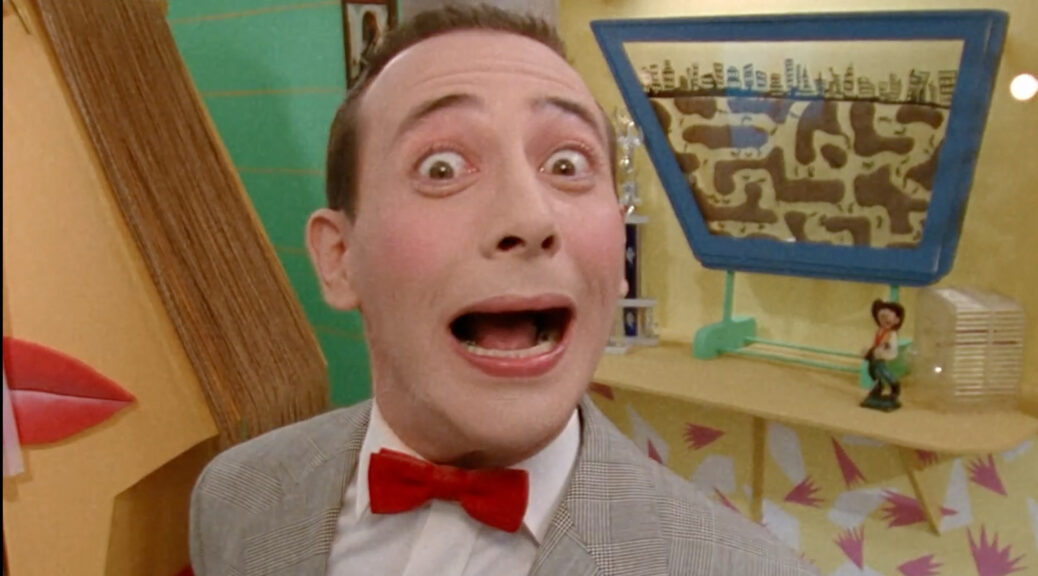
Pee-wee as Himself

by Hope Madden

If there’s one thing Matt Wolf’s 2-part documentary Pee-wee as Himself does, it reminds you what a cultural phenomenon Pee-wee Herman was in the 80s. Movies to TV to MTV to toys to talk shows, he was everywhere and he was beloved by children, college kids, and adults alike.

Who would have guessed that this goofy, bow-tied man-child could steal so many hearts? Or how decidedly and abruptly it could all have ended?

The filmmaker walks an interesting line. The Pee-wee story seems custom-made for a rags-to-riches-to-rags doc, but that’s clearly not what either Wolf or Paul Reubens—the man behind the bowtie—wants.

Unbeknownst to Wolf, during the filming of the documentary, Reubens was in the midst of the 6-year battle with cancer he would lose on July 30, 2023. Knowing now what he did not know then, Wolf lingers over weighty turns of phrase.

Charmingly acerbic but often candid, Reubens is openly reluctant to hand over control of his image after so many years of calculating every detail of his public life. Part of what makes the film so electric is how early and often the two butt heads over which of them ought to be in control of the documentary. This conflict itself paints a portrait of the artist more authentic than any amount of historical data ever could.

Wolf pulls from 40 hours’ worth of interviews with Reubens, who is playful, funny, and occasionally confrontational and annoyed—mainly with Wolf. The filmmaker flanks those conversation snippets with family photos and video from the actor’s massive collection.

The utterly delightful Episode 1 introduces a Paul Reubens unknown even to his most ardent fans (of which I am most certainly one). We’re privy to the foundational yearnings and explorations, choices and happenstances that led the eccentric and creatively gifted young Reubens toward abandoning himself entirely to his adorably oddball alter ego.

These clues to the early budding of the genius are as fascinating as clips from his work on The Gong Show and with The Groundlings are joyous. And for those who’ve loved Pee-wee since childhood, footage from his HBO special, early Letterman appearances, and of course, Pee-wee’s Big Adventure thrill to the point of tears.

Episode 2 could be called Post Adventure. P.W.  Herman was at the top of the world and still climbing. One blockbuster film under his white belt, Pee-wee was about to conquer, of all things, children’s television. Wolf reminds his audience—those who may not know and those who may have forgotten—of the show’s subversive genius.

The inevitable tragic downfall haunts the second film from its opening shot, but neither the filmmaker nor Reubens play the victim card. Whether recounting the collateral damage of his fame (partnerships fractured and friends lost), his career missteps (Big Top Pee-wee), or the immediate and deafening public reaction to his 1991 arrest, both Wolf and Reubens are clear eyed.

You may not be as the second film comes to its close. Wolf lets Reubens have the last word, maybe because he had no choice at all, but again, it’s that conflict itself that best defines the consummate performance artist. Paul Reubens decided who got to know what.

Pee-wee as Himself is revelatory, nostalgic, glorious viewing for Pee-wee fans. That’s me. Maybe that’s not you. Maybe you think I’m a big dummy for loving Pee-wee like I do.

I know you are, but what am I?

Daddy’s Little Girl

The Surrender

by Hope Madden

At one point in writer/director Julia Max’s feature debut The Surrender, Barbara (the always reliable Kate Burton) tells her daughter, Megan (Colby Minifie), that their grief over the death of the family patriarch is not the same. After 40 years together, Barbara says, “I don’t know who I am without him.”

That’s really the heart of the horror film that sees a bereaved mother and daughter transgress the laws of nature to bring their beloved husband/father back from the dead.

Max uses horror tropes to play nimbly with the dishonesty of memory and the ugliness of reality. What The Surrender unveils is that mother and daughter do not know who they are as a family without Robert (Vaughn Armstrong); they don’t recognize the other without the third wheel for balance.

As a character study and a glimpse into family politics, particularly during the tailspin of grief, The Surrender is beautifully, authentically written. Every inexplicable grace Barbara has granted Stephen during their decades is somehow unavailable to her daughter, who, in turn, forgives and forgets conveniently when it comes to her father. But Megan’s less forgiving of her mom.

And so, the two grasp desperately to regain balance and relieve their panic and grief, which is where the horror comes in. Max returns to the exquisitely horrific image that opens the film once Megan and Barbara, aided by “the man” (Neil Sandilands, compellingly understated), go in search of Stephen.

Max’s image of the other realm is as imaginative as it is stark. There’s a bleak beauty to it all that recalls Liam Gavin’s genre masterpiece, A Dark Song. The Surrender never reaches those heights, but Max knows how to ground the supernatural in relatable reality and wonders which is worse.

Fright Club: Punk Rock Horror

There is a chaotic energy, a violence to punk rock that makes it a perfect score to horror. Like horror, punk frightens. It upsets the status quo, that’s its whole purpose. It’s inspired a lot of filmmakers and a lot of movies: Uncle Peckerhead, Class of 1984, Driller Killer and more. But here are our own personal favorite punk rock horror movies.

5 Repo Man (1984)

Is it horror? Maybe, maybe not. Is it punk?

You’re goddamn right!

Here’s who you’ll hear in Repo Man: Iggy Pop, Suicidal Tendencies, Flack Flag, Fear, The Plugz, Circle Jerks – probably more that I’ve forgotten. Three punks wander the streets doing crimes. And the whole movie is basically a love letter to people who repossess cars. It’s anarchy!

Writer/director Alex Cox brought a decidedly anarchic vibe to the project, which served him well in later films Sid & Nancy (masterpiece!) and Straight to HellI. The guy’s got his bona fides.

Plus Harry Dean Stanton. And a lot of people explode, leaving behind only their bloody shoes, so that’s horror, right?

4 Freaky Tales (2024)

Eric “Sleepy” Floyd played thirteen years in the NBA, making the All Star team in 1987 as a member of the Golden State Warriors. Freaky Tales makes him the heroic centerpiece of a wild anthology that loves the late 80s, Oakland, and Nazis dying some horrible deaths.

Let’s party!

Ryan Fleck may be an Oakland native, but his films with partner Anna Boden haven’t primed us for this campy, Grindhouse detour. Freaky Tales feels like a return to a low budget indie mindset, where ambitious and energetic newcomers want to showcase their favorite movies, music, and neighborhoods while they splatter blood and blow shit up.

3 Return of the Living Dead

Do you want to party? Because guess what time it is!

Dan O’Bannon, writer behind Alien and Total Recall, co-wrote and directed the film that introduced into the genre the abiding zombie trait of brain eating, and is the first film in which zombies groan “braaaaiiiinnnnssss.”

Plus, the great Linnea Quigley Leg Warmer Dance Scene, a fun 80s punk rock soundtrack, Clu Gulagar and a lot of campy fun – all of this combined to create one of the more memorable and weirdly important zombie comedies.

2 The Ranger (2018)

The ordered, quiet, vintage world of Smokey the Bear meets the chaos and volume of punk rock in Jenn Wexler’s feature debut, The Ranger.

Chloë Levine and her buddies/band are hiding out from the law. She takes them to the wooded cabin where she spent her childhood, which may not have been as idyllic as she’s letting on.

Jeremy Holm is a stitch as the zealous park ranger here to ensure rules are followed and punks clean up their act. The culture clash is a ton of fun, as is the 80s slasher vibe. This movie’s a blast.

1 Green Room (2015)

Young punk band the Ain’t Rights is in desperate need of a paying gig, even if it is at a rough private club for the “boots and braces” crowd (i.e. white power skinheads). Bass guitarist Pat (Anton Yelchin) eschews social media promotion for the “time and aggression” of live shows, and when he accidentally witnesses a murder in the club’s makeshift green room, Pat and his band find plenty of both.

As he did with Blue Ruin, Saulnier plunges unprepared characters into a world of casual savagery, finding out just what they have to offer in a nasty backwoods standoff.  It’s a path worn by Straw Dogs, Deliverance, and plenty more, but Saulnier again shows a knack for establishing his own thoughtful thumbprint. 

Hope Madden and George Wolf … get it?