As little Anna tells viewers and her elementary school classmates, Madagascar is the 4th largest island on earth, and likely the single poorest country. Ninety three percent of Madagascar lives on less than $2 a day and half the population is children.
Madagascar is also devastatingly beautiful, not unlike Cam
Cowan’s documentary Madagasikara.
Beautifully photographed and expertly edited, Madagasikara
introduces you to a world you just didn’t know existed—one that’s never been
site to war and yet grows more ravaged by poverty daily. It’s a world where
breaking quarry rocks with hand tools offers the most stable occupation, for as
long as your body holds out. The world of this film is one so impoverished it
may as well be medieval—part of a long forgotten period where a family’s best
hope for the survival of their children is the convent.
For all the destitution, Cowan’s film is surprisingly joyous
at times, primarily because of the beautiful little faces surrounding the three
mothers—Deborah, Tina and Lin—that are the documentary’s main focus. It’s hard
to watch so many sweet, cute children and not feel joy.
Their pain is also more punishing.
A decade of botched elections put the island nation at the
center of a tug of war between a millionaire looking to exploit what he can for
his own gain (sounds familiar) and a pro-military dictator even less interested
in the wellbeing of his citizens. It also put Madagascar in the crosshairs of a
global community more focused on sanctioning its leaders than in feeding its
population.
Wisely, Cowan humanizes the tale of strife by dropping us into the day-to-day of three different women. Their struggles, joys and heartaches breathe life into statistics that could otherwise overwhelm, their resilience and their frailty speak powerfully to the human condition.
Just One of Those Things has plenty of things going for it, but catch it right now, and you can add “timing” to the list.
Really, there’s never a bad time to be swept away by one of music’s all time great voices, but these 90 minutes seem even sweeter right about now.
Director Leslie Woodhead assembles a wealth of performance footage, archived interviews and even some home movies to trace Ella’s rise from reform school and homelessness to concert stages across the globe.
Buoyed by the tender narration from actress Sophie Okonedo, Ella’s story becomes one of happenstance, perseverance and one-of-a-kind talent.
Her original aspiration was to be a dancer, but when other dancers at the Apollo Theater’s amateur night in 1934 were too good, 16 year-old Ella decided to sing. From that night until her death in 1996, she mastered jazz, big band, the great American songbook, and of course, be-bop swing.
In fact, the film’s non-performance highlight is a truly fascinating, nearly clinical deconstruction of the otherworldly ability that made Ella perhaps the greatest “scat” vocalist the world has ever known. Watch and learn, hepcats, it’s amazing.
Though the bulk of the film is given a linear, by-the-numbers presentation, the musical history it recounts is essential. An important and timeless biography, Ella‘s got that swing.
Which, as you may have heard, means a thing or two.
Actors getting lost in a role can become the stuff of
legends, or the butt of jokes—as Olivier’s advice allegedly went to Dustin
Hoffman, “Why don’t you just try acting?” In The Truth, director Hirokazu
Kore-eda takes one of film’s most iconic actresses and sets to demolishing the
notion that an artist could ever separate who they are from what they have to
say.
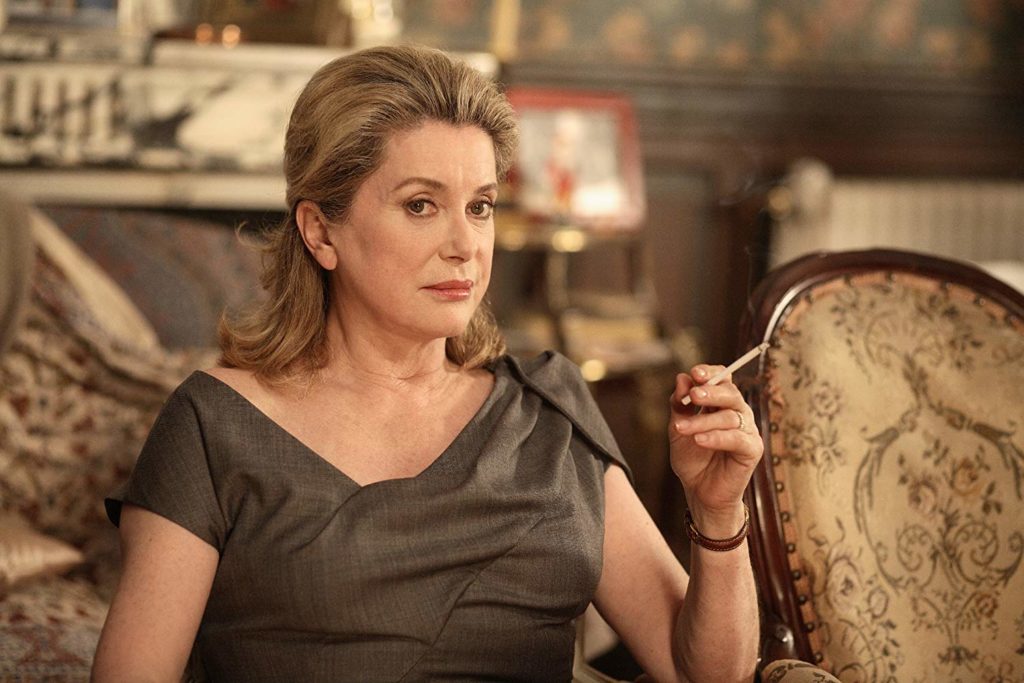
The film is Kore-eda’s first foray outside of Japan, and a worthy follow-up to his masterful 2018 drama Shoplifters. The drama, also written by Kore-eda, has a lighter touch in The Truth, but it’s no less arresting thanks to a brilliant self-referential performance from Catherine Deneuve.
Deneuve plays Fabienne, an idol of French cinema now at a point in her life when she’s ready to look back on her storied career. Fabienne’s daughter Lumir (Juliette Binoche) has brought along her family from America to pay Fabienne a visit. When Lumir gets an early look at Fabienne’s memoir, she lashes out at the wide gulf between Fabienne the myth and Fabienne the mother, the one who pursued her art to the detriment of everything else in her life.
One family’s drama becomes a delightful interrogation of
memory and art. And as if the unreliable memoir weren’t enough to drive the
point home, Fabienne is also currently filming a new movie against an
up-and-coming actress playing her younger version.
The film’s quirky sci-fi twist forces Fabienne to face her
younger self, and the grande dame of French cinema isn’t quite ready to relinquish
her fading star power to what she sees as a poor imitation of her own youthful
rise to celebrity.
Kore-eda blurs the lines even further by referencing Deneuve’s
breakout years, specifically Belle de Jour, with posters and costumes
dotting Fabienne’s house and still exerting a powerful hold on her sense of
self-worth. (Ethan Hawke’s understated turn as Lumir’s bohemian husband Hank
also feels like an alternate universe version of Jesse from the Before trilogy…
but that might also just be Hawke’s natural “these are my ‘just chilling in
France’ vibes.” Either way, the man is living his best life.)
The result is a family drama that manages to humanize the dysfunction without fully absolving anyone. Fabienne might be a legend, but she’s still only human. Living an entire life unmoored, unable to process anything in the moment without layers of artifice to mediate any real emotion, seems like it should be punishment enough.
Some of the best moments during Jon Stewart’s years on The Daily Show happened when his guest was some smug politician who had not done their homework.
Because Jon always did his, and the squirming politico would realize pretty quickly that Jon could throw some heaters. This funnyman was whip smart, too, and pretty handy with the b.s. detector.
It should come as little surprise, then, that Irresistible, Stewart’s second feature as writer/director, employs some purposeful, intelligent comedy as it sets about skewering today’s ridiculous political climate.
Daily Show vet Steve Carell is Democratic strategist Gary Zimmer. Stinging badly from the 2016 election, he’s inspired by a YouTube video of a former Marine hero dressing down the city council in tiny Deerlacken, WI.
Zimmer decides right then that Col. Jack Hastings (Chris Cooper) and his “redder kind of blue” appeal could be the centerpiece of a new nationwide project to expand the Democratic base. And it all begins with getting Hastings elected Mayor of Deerlacken.
This does not go unnoticed on the other side. Once GOP strategist Faith Brewster (Rose Byrne) and her crew come to town, the Mayor’s race in Deerlacken starts carrying some pretty high stakes – including one hilarious sexual side bet between the two opposing operatives.
After an impressively dramatic filmmaking debut with 2014’s Rosewater, Stewart returns to the satirical stomping grounds where he became a respected (and, to some, reviled ) voice that drove many worthwhile conversations.
Though the bite of this screenplay may be a bit softer, his narrative approach betrays a long game that trades the sharper knives for the chance at a wider reach. Because the cure for what’s infecting American politics is not going to spread through niche marketing.
Sure, you could call that a sellout, and for the first two acts of this movie you might be right. The “all politics is local” premise is certainly not new, nor are many of the talking points. But thanks to the two veteran leads, those points are just funnier.
Carell’s default manner is perfect for the quietly condescending Zimmer, an elitist who confuses nobility with blind ambition, and somehow thinks he has a shot with the Col’s much younger daughter (Mackenzie Davis).
The real treat, though, is seeing Byrne finally dig into another role worthy of her comedy pedigree. With the right material, Byrne is a comedic MVP, as she reminds anyone who’s forgotten that fact by making Brewster one hilarious, shameless, priceless piece of work.
Stewart may be known for his progressive leanings, but both the left and the right are in his sights here, along with unchecked political cash and obsessive pundits complicit in fostering the fear and shame game.
Easy targets? Sure. But if you don’t think Stewart’s smart enough to know that, than you never saw him blindside a back-slapping incumbent on late night TV.
Irresistible caters to your expectations just long enough to make you think you knew where it was going all along. The unassuming way the film upends those expectations might seem overly convenient, but it feels right, as if Stewart is practicing what he is taking care not to preach. And that’s just what might make it hard for mainstream America to resist.
I may not be ready for my close up, but I’m finally ready for my movie poster quote. Check it out:
My Spy is the best huge-former-wrestler-stars-with-little-kid movie I have ever seen.
Or, if it helps: “My Spy is the best…movie I have ever seen.” I’m flexible, just remember it’s Wolf, no “e” at the end.
There must be a page somewhere in the wrestler handbook that says the transition from mat to marquee must include some generic whale out of water antics with a precocious wee one. The Hulkster, Rock and Cena all paid their dues with insufferable projects, now it’s your turn Dave Bautista.
What the? This is pretty entertaining.
Bautista is JJ, a former special forces hero trying to make the transition to CIA operative. His ride is not smooth, so he and a wannabe partner (Kristen Schaal) are assigned to boring surveillance duty.
They set up in a Chicago apartment down the hall from Kate (Parisa Fitz-Henley) and her lonely 9 year-old daughter Sophie (Chloe Coleman). The ladies have some bad-niks in the family who the Feds are hoping will make contact, because arms trading, plutonium, stolen flash drive, the usual.
The point is, Sophie sniffs out the neighboring spys in a matter of minutes, gets them on video, and uses the footage to blackmail JJ into being her friend.
Do you think Sophie’s hot mom will warm up to him, too?
Yes, it is predictable, drags in spots and is assembled from parts of plenty of other films. But director Peter Segal (Tommy Boy, Get Smart) and screenwriters Erich and Jon Hoeber (RED, The Meg) find some solid self-aware laughs poking holes in plenty of film tropes, from action scenes and tough guy catch phrases to over-the-top gay neighbors (Devere Rogers and Noah Danby, classic) and the very idea of little kid sidekicks.
Guardians of the Galaxy proved Bautista has charisma and comic timing. My Spy lets him flash a little self-deprecating charm, and a sweet chemistry with his pint-sized partner. Coleman (Big Little Lies) brings plenty of cuteness, but also a vulnerable layer that goes a long way toward keeping the eye-rolling at bay.
And anyone who saw Mr. Nanny, Tooth Fairy or Playing with Fire will appreciate that. I know I did.
It’s hard to do zombies well anymore. Mainly, you have to either
come up with an entirely novel concept or hope that the bloody mayhem works in
your favor.
In Yummy, the concept is only marginally original,
but the bloody mayhem is more than on target. Co-writer/director Lars Damoiseaux
assaults your gag reflex with a viscous mess of a horror flick. Blood and
entrails, of course, but expect a pretty inspired use of pus, liquid body fat,
tendons and other tissues and goos.
It makes for some slick surfaces, I tell you what! Plus some
unexpected little monsters keep things interesting and fun.
Set inside a cut-rate Eastern European cosmetic surgery
clinic, the film follows a mother, daughter and her boyfriend into a very bad
decision. Mom (Annick Christiaens) is after a series of nips and tucks; daughter
Alison (Maaike Neuville) wants breast reduction; boyfriend Michael (Bart
Hollanders) is just a good dude willing to drive everyone even though he’s
afraid of blood.
Here is a ripe premise for horror. Mom is a Cronenberg-esque vehicle for body horror as well as vanity shaming. Alison provides comedic possibilities (no one in the clinic can begin to understand her point of view). Hemophobic Michael offers the clear hero’s arc. (Or he’ll simply die of shock by the gooey second reel.)
And no, it’s not incredibly novel—zombie movies so rarely
are. But it’s smart, witty and fun. Damoiseaux accomplishes much with his
budget. Practical effects are great, performances are delightful, and nothing
beats a little well placed Stooges. (The band, not the knuckleheads.)
Yummy represents Damoiseaux’s feature debut as
director and writer, but he’s garnered attention and awards for years with his
work in shorts. Award winning co-writer Eveline Hagenbeek (Rokjesdag)
channels her affinity for conversational comedy into a script that may follow a
familiar structure but delivers a believable, funny edge that the game ensemble
takes advantage of.
Their collaboration is no masterpiece, but it is a lot of sloppy fun.
Henrietta (Kimberley Datnow) is fumbling through life as an almost stand-up comedian in her mid-20s. She’s not very tactful, she’s definitely a mess, and she can’t address a group of people without holding a prop microphone (or pencil). Also, her dad just died.
Skyping into her father’s funeral with her one-night stand in tow seems like the tip of Henrietta’s daddy issues iceberg.
But we never learn about Henrietta’s father or her relationship with him. He leaves her his LA home, trusts her with a board position at his company, and writes her an ominous letter threatening that if she can’t turn things around, his whole life will have been wasted. Henri proceeds to drink and smoke her way through the rest of the film, bumbling about without making too many revelations or relationships.
Penned by John Cox and Amy Datnow, the story follows three different college friends as they try to figure out what they want. Henrietta is taking another stab at comedy. Alice (Alice Carroll Johnson) waffles in her relationship and tries to find a new career in the gig economy. Nolan (Tanner Rittenhouse) has taken 5 years to finish a deck project and can’t get his girlfriend to take him seriously. While all three characters build relationships with one another, they rarely connect to discuss or help with each other’s struggles. This general lack of connection and fluidity plagues the whole of Daddy Issues.
The story lacks momentum. Moments meant to be absurd or wacky stay dry, shot and edited with the same pace as the lonely and sad portions of the film. The funniest moments are often small asides that feel like improv from secondary characters.
Director Laura Holliday’s experience is mainly in shorts, as you might guess. She focuses well on small moments, like a brewing cup of tea, but loses pace in bigger scenes.
Daddy Issues spends too much time being lost in itself, and we miss most of the resolutions. Other important moments come too late in the story and feel rushed. While it skillfully captures the essence of being at a loss with what comes next, the film suffers from the same nervous halting as its protagonists.
A poetry of dread – that’s what the best in this business can conjure with the right framing, movement, stillness. Whether it’s Dick Pope creating that just-off feel of bucolic 1950s Idaho for The Reflecting Skin or Owen Roizman forever narrowing the screen, our gaze and our options in The Exorcist, the cinematographer is horror’s true master. Mike Giolakis kept us looking around us and behind us to see where the monster might be in It Follows. John Alcott (The Shining), Chung-hoon Chung (The Handmaiden) and Mo-gae Lee (A Tale of Two Sisters) haunted and mesmerized us with color, movement and atmosphere. Has anybody done it better?
Here are our nominees for the best cinematography in horror.
Gorgeous. If you’re looking for something theatrical, a true marriage between cinematography and set design, Masaki Kobayashi’s Oscar nominee Kwaidan delivers the goods.
Yoshi Miyajima lenses four different ghost stories, each almost entirely shot on highly decorated sound stages, and what he captures is the feeling of make believe that gives each story the sense that it is being told, being embellished for your spooky enjoyment.
Each story is given its own look, its own personality. It’s bold and memorable filmmaking, and an absolute sight to behold.
4. Antichrist (2009) – Anthony Dod Mantle
Whether it’s the utter poetry of the opening tragedy, the claustrophobic dread of the middle section, or the lurking menace of the final reels, Antichrist is an absolute treasure trove of emotional manipulation.
At times, Anthony Dod Mantle’s cinematography feels at odds with the actual content on the screen—particularly in Act 1. But mining for beauty in pain is one of many ways director Lars von Trier succeeds in surprising and horrifying with this film.
Mantle finds a terrifying beauty in ugly thing von Trier throws at you, and the end result is a mesmerizing and brutal work.
https://www.youtube.com/watch?v=w4U5rdi9w-U&t=20s
3. Nosferatu (1922) – Fritz Arno Wagner
We needed to pay our respects to some of the earliest and most memorable work in cinema. Why F.W. Murnau’s Nosferatu? Because nearly 100 years later, there are still images that haunt your dreams.
Fritz Arno Wagner (who also lensed Fritz Lang’s glorious M) capitalizes on the unseemly, vermin-like look of Count Orlock (Max Schreck, genius) with creeping silhouettes, lurking shadows, and camera angles that emphasized his hideousness.
Whether it’s the shocking rise from the coffin, the shadow on the staircase, or the image of the sole survivor of the ship recently decimated by “the plague,” Murnau and Wagner’s images are as evocative today as they were in ’22.
2. The Lighthouse (2019) – Jarin Blaschke
The atmosphere is thick and brisk as sea fog, immersing you early with Oscar nominee Jarin Blasche’s chilly black and white cinematography and a Damian Volpe sound design echoing of loss and one persistent, ominous foghorn.
Director/co-writer Robert Eggers follows The Witch, his incandescent 2015 feature debut, with another painstakingly crafted, moody period piece. The Lighthouse strands you, along with two wickies, on the unforgiving island home of one lonely 1890s New England lighthouse.
Salty sea dog Thomas Wake (Willem Dafoe) keeps the light, mind ye. He also handles among the most impressive briny soliloquies delivered on screen in a lifetime. Joining him as second is one Ephraim Winslow (Robert Pattinson)—aimless, prone to self-abuse, disinclined to appreciate a man’s cooking.
1. Pan’s Labyrinth (2006) – Guillermo Navarro
In 2006, Guillermo Del Toro’s masterpiece may have somehow been overlooked as Oscar’s Best Foreign Language Film, but at least the Academy had the common sense to notice Guillermo Navarro’s cinematography.
He manages to create an atmosphere equally imaginative and bitterly realistic, something befitting a child’s logic. Like a fairy tale, the screen blends the magical beauty of good and evil. His vision is as hypnotic as it needs to be, as childlike as we need it to be. It’s beautiful, innocent and utterly heartbreaking.
Most weeks there’s at least one streaming movie option that
will cost you. These are ostensibly the films that were meant to be theatrical
releases, as opposed to your garden variety direct-to-streaming options. The
idea is that you’re paying a premium to get to see it now, rather than waiting
for theaters to open up.
It’ll be interesting to see how long this tactic lasts, but one thing is for sure: You Should Have Left is not worth $20.
Always likeable, always reliable Kevin Bacon reteams with
his Stir of Echoes writer/director David Koepp to bring Daniel Kehlmann’s
novel to the screen.
Bacon plays Theo, a man with a past and a much younger wife
(Amanda Seyfried), Susanna. She’s a sought after actress and he’s feeling a
little neglected, so they decide to spend the three weeks between her shoots
with their 6-year-old Ella (Avery Tiiu Essex) in a remote rental property one of
them found online.
Which one found it, though?
From the early dream sequences to the small town shopkeep
with an accent, an attitude and a secret to—well, hell, every single thing—You
Should Have Left squeezes the life out of standard horror tropes.
Not that this is horror, really. It’s certainly not scary. I
wouldn’t call it a thriller, either, assuming those have to thrill at some
point. Nope, it’s just a boring, predictable waste of talent.
Seyfried, in particular, elevates her stale character,
sharing a believably conflicted lived-in chemistry with Bacon. Uncharacteristically,
it’s Bacon who struggles.
Theo’s internal conflict is weakly depicted, his arc equally
anemic, and for that reason, his epiphany feels unearned. The actor does
develop a lovely onscreen relationship with Essex, although she’s asked to do
little more than look pensive.
Or maybe she was bored. Hard to blame her when Koepp works
so hard to make the film tedious. Uninspired sound design and mediocre FX blend
together with the filmmaker’s hum drum storytelling to betray a tiresome lack
of imagination.
No way Universal believes they deserve your $20 for this.