That is a direct quote from my doctor after I re-injured myself for the 11th or 12th time from running. He may have consulted on Anthony Guidubaldi and Keith Strausbaugh’s screenplay for their new mockumentary, Marathon.
Amateur documentarians follow five runners as they train for
an off-brand marathon organized by Ed Clap (Jimmy Slonina), the owner of a shoe
store, equally off-brand.
In much the way the master of the genre Christopher Guest used dog shows and community theater to explore particular personality types, so do Guidubaldi and Straugsbaugh set a group of oddballs loose inside the idiocy of marathon training.
For Shareef Washington (Tavius Cortez), this is about
sibling rivalry. Unfortunately, he has to do all his training on a treadmill
because whenever he runs outside, he gets arrested by white cops. Jenna (Natalie
Sullivan), on the other hand, wants to break the world record for marathon runners
dressed as fruit.
Crews also tail a woman (Anais Thomassian) trying to
remember life before motherhood and an insecure man (Andrew Hansen) hoping to prove
himself to his ex-wife by qualifying for the Boston Marathon.
So, the runners range from desperate to lunatic, sometimes in insightful and often in amusing ways. Hansen’s quickly deteriorating relationship with Jeff, the cameraman we never see, delivers the film’s funniest moments.
The keenest insights may come by way of Emilou (Kimia Behpoornia),
who drops out the moment she realizes marathons are 26 miles long. Her crew
stays with her through race day, though, just to prove how much better life is
when you’re not training for a marathon.
Though Hansen is clearly the film’s brightest spot, the filmmakers pieced together an entirely solid ensemble. Droll performances suit the script and keep your attention, but the story itself lacks much real punch. Worse, the police oppression subplot feels tone-deaf at best.
Still, Guidubaldi and Strausbaugh understand something my doctor saw perhaps too well, and that’s why their affectionate ribbing rings so true.
Back in 2014, Irish filmmaker Ivan Kavanagh wondered what to do about a dad who may be his son’s only salvation, or may be his one true danger. Canal had a lot going for it—it looked creepy, performances were solid, and it wasn’t afraid to bang up its cast.
It just couldn’t quite make the leap from good to great.
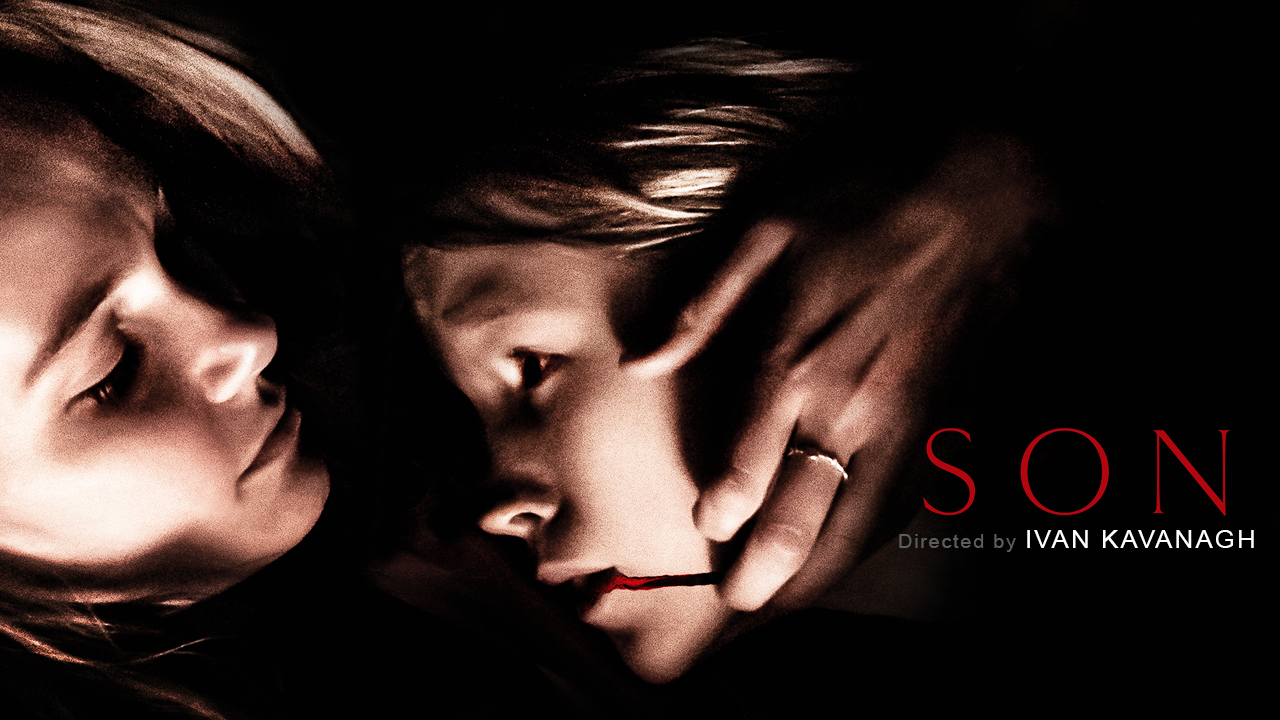
Same goes for the filmmaker’s latest, Son.
We open on a filthy, barefoot, rain-soaked young pregnant woman (Andi Matichak, Halloween) hoping to warm up with a coffee in a roadside diner. Two men walk in, she exits in a hurry.
Cut to eight years later. Same woman, clean and wholesome
now, buckles in precocious little David (Luke David Blumm) to drop him off at
school. They’re adorable. They’re happy, hard-working, loving, and about to
face some ugly stuff once Kavanagh establishes the paradise to be lost.
An awful lot of movies want to know how far a mother is
willing to go to protect the son who may or may not be the real villain. This has
been especially true in the last five years. (See The
Hole, The
Prodigy, Brahms:
The Boy 2, Z,
Brightburn
— it’s a long list.) Does anything set Son apart?
Kavanaugh roots the story in hysteria and conspiracy, sketchy memories of a cult versus police reports of sex trafficking. All of it feels mildly of-the-moment, but the real purpose is to throw skepticism toward the seemingly lucid mother and her claims.
Which is another common horror trope (is she crazy or is she right?), especially in the subgenre where a mother is trying to figure something out that may or may not be supernatural.
So, no, Kavanaugh does not bring much that’s new to the table.
Son does boast solid performances, and the filmmaker once again flexes his strong instincts for unsettling locations and atmospheres. The writing, pacing, and imagery all work together as they should to generate anxiety and dread. Son gets gory now and again, too.
It just doesn’t do anything you don’t expect it to do.
Three characters, and one big house. That’s all that directors/writers Martin Blousson and Macarena Garcia Lenzi need to conjur up a good bit of creepy in Rock, Paper and Scissors (Piedra, papel y tijera).
Jesus (Pablo Sigal) and Maria Jose (Augustina Cervino) are isolated siblings living alone in the family home after the recent death of their father. When their paternal half-sister Magdalena (Valeria Giorcelli) arrives from Spain to discuss the inheritance and plans for the house, Jesus and Maria offer to put her up for the length of her stay.
Magdalena doesn’t want to trouble them for any more than one night, but a nasty fall down the stairs the next morning means little sister isn’t going anywhere.
Suddenly, Magdalena is a captive, and at the mercy of her siblings’ eyebrow-raising eccentricities. Jesus is an aspiring filmmaker filled with questionable inspirations, and Maria is a Wizard Of Oz-obsessed nursemaid who hopes to co-star with a guinea pig named Toto in Jesus’s upcoming film.
Magdalena’s only hope for escape seems to be separating her brother and sister, and probing for ways to work one against the other. Could Maria have pushed Magdalena down the stairs, or is Jesus the real danger in this house? And how did their father really die, anyway?
Blousson and Lenzi move past the Misery-like premise in short order, piling on some surrealistic Lynch-meets-Lanthimos weirdness and bathing it all in a stylistic visual pastiche of earth tone Goth.
The trio of actors reveals their characters’ true motivations at a languid pace that keeps us guessing, right up to the gorgeous closing shot that will leave you looking twice. Maybe three times.
Rock, Paper and Scissors is available on VOD beginning July 6th
Bonus content! Mangled dick experts! Iconic freeze frames! Yes, this extra Fright Club podcast has it all, thanks to the glorious Felissa Rose of Sleepaway Camp, who joined us to talk about horror fans, realizing her iconic status, and worries over whether her face will freeze like that.
Summer of Soul (…Or, When the Revolution Could Not Be Televised)
by George Wolf
According to Amir “Questlove” Thompson, the first time he saw some of the digitized footage from the 1969 Harlem Cultural Festival concerts, he nearly wept.
How could this event have been ignored to the extent that even a musical aficionado such as himself had never heard of it? And why had all these hours of stunning performances gone unseen for decades?
The free concerts ran for six consecutive weekends at Harlem’s Mt. Morris Park in the summer of 1969, attracting over 300,000 fans. That same summer, the Woodstock festival was held about 100 miles away, but even when producer Hal Tulchin tried to market his reels of video as “the Black Woodstock,” there were no takers.
And so the boxes sat in a basement for 50 years.
Once Thompson committed to directing his first film, he immersed himself in the footage nearly 24/7, and Summer of Soul emerges as a triumphant testament to the music that drove a “Black consciousness revolution.”
From the gospel of Mahalia Jackson to the blues of B.B. King, from the 5th Dimension’s smooth pop to Sly Stone’s psychedelic funk, the musical styles blend gloriously in the summer sun and the goosebump moments mount.
A young Mavis Staples and an aging Jackson share one microphone; Stevie Wonder unleashes a furious drum solo; Marilyn McCoo and Billy Davis. Jr. tear up recalling how important it was that the 5th Dimension’s perceived “white” sound be accepted as “black enough;” Nina Simone strikes a commanding presence as she challenges the crowd’s commitment to social change; and on and on and on.
But even more impressive than Thompson’s musical direction is the way he frames the entire festival through the context of time, place, and population.
Embraced by New York’s Republican mayor and sponsored by corporate giant Maxwell House, the festival was seen as a way to keep the Black community calm after the rising tensions of 1968.
But ’69 was – in the words of Rev. Al Sharpton – “the year Negro died and Black was born,” and Thompson layers the archival footage with new interviews that are equal parts poignant and timely.
We see festival attendees telling stories of what lengths they went to for a chance to be in the crowd, and how being there changed their lives. Starkly contrasting footage of white and black crowds being interviewed for reactions to the 1969 moon landing put a fine point on how sadly relevant yesterday’s civil rights struggles remain today.
And while the defiant cries of revolution and equality pulsate through Summer of Soul, they never eclipse the festival’s unbridled joy.
One man who was just a young boy in 1969 and had come to doubt his own memory over the years, cries with joy at seeing proof positive on film.
With a prelude this reminiscent of Edge of Tomorrow and a catalyst that recalls Nolan’s The Dark Knight Rises, The Tomorrow War makes itself clear early. This is not going to be a terribly original movie.
Dan Forester (Chris Pratt) is a high school science teacher
who believes he was destined for more important things. His opportunity arrives
when future earthlings show up to recruit present-day earthlings to fight a
battle against the end of the human race.
Some important questions to answer. What is going to be the
end of us?
Aliens.
Do we get to see them?
Yes! Early and often.
How do they look?
Nasty as hell! Dude, the teeth and these tentacle things—nice!
And finally, why is this movie so long?
While there is no clear answer to that, it appears that
director Chris McKay is a big fan of Roland Emmerich, Michael Bay, maybe Stephen
Sommers. The film emits a throwback vibe, conjuring popcorn munchers of the
late 90s—which is about the era when self-indulgent directors started making 2 ½
hour mindless Sci-Fi.
That’s not all bad, right? The film’s logic may be a bit sketchy, but its professed love of science makes up for a lot of that. Naturally, there are also syrupy family dramatics to drive the narrative, because we all remember Emmerich’s 1996 epic Independence Day.
Also, while many of the internal action sequences feel theme-park stagey, the outdoor set pieces are a blast.
Films like this don’t call for master thespians. Good thing,
because Pratt, who also executive produces, doesn’t bring any real depth of
emotion to the role. Luckily, J.K. Simmons cannot give a weak performance, so
the bruised masculinity and daddy issues have somewhere to take root.
Lose an hour and The Tomorrow War is a pretty fun time-waster, but nothing more. Writer Zach Dean doesn’t say anything new and McKay certainly doesn’t find any fresh ways to say it. But if you miss the bloated, 2+hour action/adventure flicks of the late 1990s, The Tomorrow War is your movie.
Based on the play by Mark St. Germain and adapted for the
screen by writer/director Austin Stark, The God Committee seeks to
provide insight into the fraught decisions behind who lives and who dies when
it comes to organ transplants.
A new heart is recently available for the St. Augustine Hospital, a building in disrepair and under renovation, and the transplant committee convenes to decide who among three matches is the worthiest to receive the heart. The committee has a paltry 90 minutes to make their decision or else the heart will be useless.
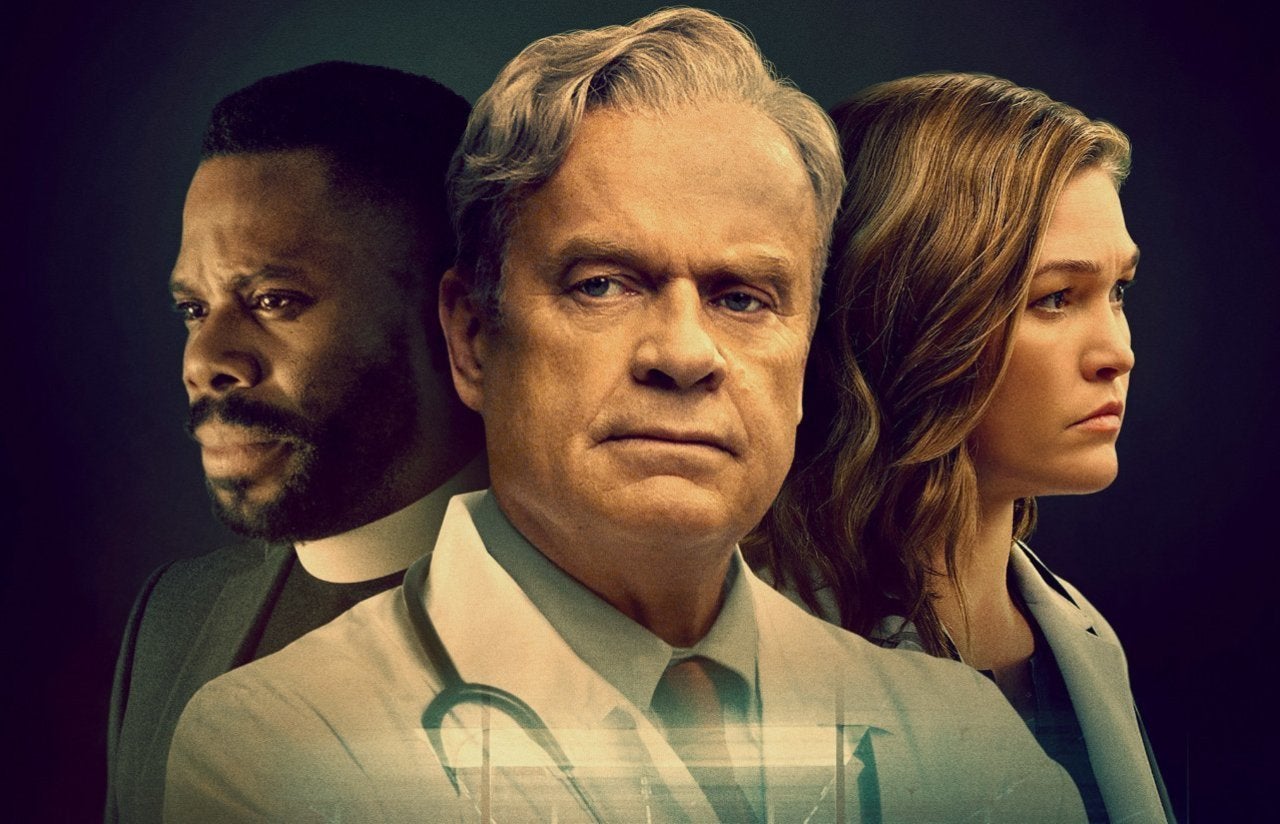
The initial set-up alone is worthy of an entire film, but the movie isn’t satisfied to stay within the confines of a sterile boardroom. The timeline jumps forward seven years to check-in on our committee, primarily Dr. Andre Boxer (Kelsey Grammer), and how the implications of their decision on that fateful day have affected them.
By moving back and forth between the past and present, the tension of those crucial 90 minutes is often interrupted. However, by weaving the present into the past, we get to know the people behind these decisions.
Grammer excels on screen as the pragmatic Boxer, basing his judgments on the medical data rather than emotion. As his foil, Dr. Jordan Taylor (Julia Styles) relies on her heart to guide her decision-making. Unfortunately, Styles can’t quite match the passion of Grammer. The other members of the committee, which include Janeane Garofalo and Colman Domingo, aren’t given as much to work with and don’t resonate on screen in the same way.
The play lends itself well to film, and Stark handily adapts
the source material. There are a few moments that remind us this is an adaption
of a play – mainly, characters who talk to the screen. This might have worked
better had it been transitioned from audience-directed monologue into
character-driven dialogue, as it would have heightened the conflict inside the
boardroom.
The film touches on numerous thematic issues: the ethics of deciding who is worthy of a transplant, the conjunction of corporatism and life-saving medical research, the inequity of medical care across racial and class lines, black market trade in organs, etc. Unfortunately, The God Committee never settles on any of them, careening across multiple threads without any direction.
If the movie had stuck to a theme and a timeline, it might have been more impactful.
In February 1983, Corpus Christi, Texas, gas station employee Wanda Lopez was murdered by a knife-wielding assailant during a robbery. Witnesses saw a man flee the scene, and police eventually caught Carlos DeLuna – shirtless and holding a wad of cash – hiding under a car. After a whirlwind trial, DeLuna, who always claimed his innocence, was convicted of murder and sentenced to death. The execution itself was carried out on December 7, 1989.
During his trial and subsequent incarceration, Deluna maintained that a Carlos Hernandez was the man responsible for Wanda Lopez’s murder. Local police and prosecutors looked into DeLuna’s allegations but claimed to have never found any existence of the Carlos Hernandez described. Nearly a decade later, a private investigator was able to prove that Carlos Hernandez did exist and that he bore a striking resemblance to Carlos DeLuna. What happened next convinced many in the Corpus Christi region that a severe miscarriage of justice had taken place.
With The Phantom, director Patrick Forbes (The Widowmaker) doesn’t waste any time digging into the particulars of Wanda Lopez’s murder, and its seemingly neat resolution. Like any good true crime doc worth its weight in gold, The Phantom is chock full of interviews with the investigators involved, and the family members impacted most. The approach is clinical in nature, with nearly everyone involved getting a chance to speak their piece about what happened.
The second half of the film is where things get really interesting, and the focus of the movie shifts. Miscarriages of justice aren’t new topics in crime docs – and especially crime docs set in Texas (The Thin Blue Line anyone?). More questions are presented than are answered, but answers don’t seem to be Forbes’s objective anyhow. There are more than enough questions surrounding DeLuna’s guilt, but The Phantom’s ultimate goal seems to be to comment on the morality surrounding capital punishment.
As the end credits start to roll, the lasting feeling from The Phantom is that of freshness. So many modern-day crime docs editorialize to the point of denying the audience a chance to think for themselves. Sometimes it’s nice to spend 80 minutes with a fascinating story and walk away with a lingering “What if…?”
The pandemic – as it did with everything else – played havoc with our latest half-year list. Because Oscar understandably extended last year’s window of eligibility, films that would normally have been included on the list below (such as Judas and the Black Messiah) technically come down on the 2020 ledger.
Do we have to play by Oscar rules? No. But mainly to avoid confusion when it’s time for the end-of-the-year list come December, we will.
So in alphabetical order, here are our picks for the best films of March thru June, 2021:
A Quiet Place Part II
AQPII is lean, moves at a quick clip, thrills with impressive outdoor carnage sequences and yet commands the original film’s same level of tension in the nerve- janglingly quiet moments. Writer/director John Krasinski had a tough task trying to follow his 2018 blockbuster, one made even tougher now having to prove the sequel was worth saving for a theaters-only release.
On both counts, we’d say he nailed it.
Final Account
The final film for late documentarian Luke Holland, this oral history of Nazi Germany challenges rationalizations. It doesn’t accuse, doesn’t accost, but it also doesn’t let anyone off the hook. What is the difference between being complicit and being a perpetrator? It’s a question that haunts the film and its subjects. It becomes clear that it’s a question that haunts a nation.
Holler
If you seek an antidote to Hillbilly Elegy, writer/director Nicole Riegel’s feature debut has what you’re looking for. Driven by Jessica Barden’s blisteringly confident lead performance, Holler sugarcoats nothing about American poverty, patronizes no one, and does not need a Mamaw to explain the facts of life.
In the Heights
Director Jon M. Chu takes Lin-Manuel Miranda’s Tony Award-winning In the Heights from stage to screen with the magic intact, for a block party worthy of celebrating – in a theater, with a crowd.
Are we really “back to normal?” Can the American dream still be alive?
For 143 minutes, it sure feels like it.
Nobody
The one and only thing that separates Nobody from dozens and dozens of expertly crafted, wildly interchangeable “underestimated badass” films is the utter brilliance of its casting.
And by that, I mean exclusively the perfection of Bob Odenkirk in this role. His placement at the center of the film not only sells the “average guy” masquerade better than Liam Neeson ever could, but it makes his inner struggle and his displays of violence actually stand out.
Regardless of the fact that you’ve seen this exact movie a dozen times, you just don’t expect it to be this good.
Riders of Justice
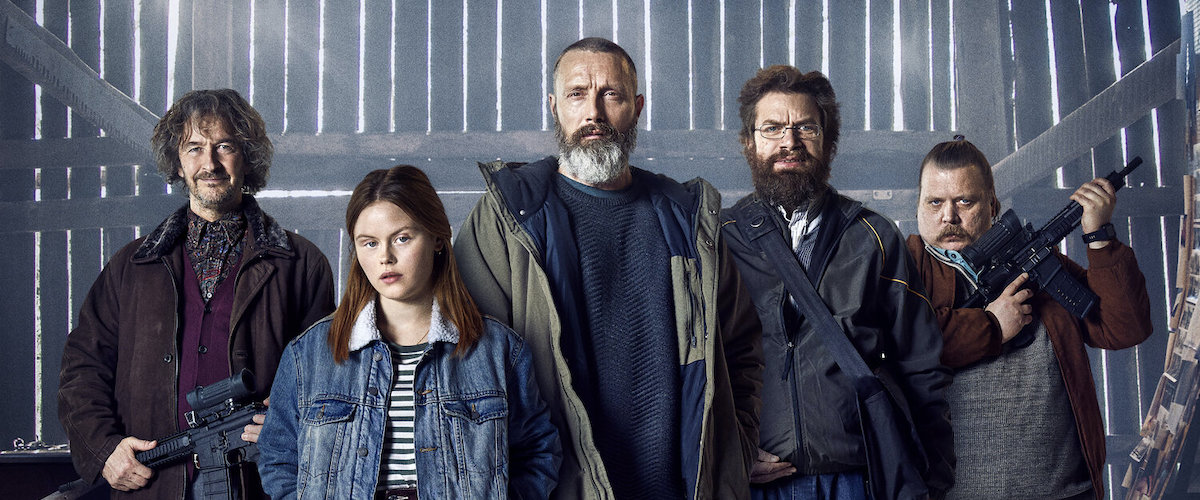
Men will single-handedly gun down an entire biker gang rather than go to therapy. That’s the premise from prolific writer-director Anders Thomas Jensen, where he reunites with Mads Mikkelsen in the dark comic revenge fantasy Riders of Justice.
But Jensen isn’t nearly as interested in the physical mayhem as the emotional wreckage his oddball characters are all coping with. Riders of Justice treats its characters with such forgiving empathy that it’s easy to forget that the group is also almost certainly responsible for the most murders in Denmark since the Vikings.
Rita Moreno: Just a Girl Who Decided To Go For it
Beyond the treasure trove of archival footage, home movies and interview praises, director Mariem Pérez Riera finds the most resonance in the personal journey told by Rita Moreno herself.
Looking back on the obstacles she faced and the successes and failures of her life and career, Moreno displays a hard-won self-worth and an honest self-awareness that she continues to probe.
This is not just an entertaining Hollywood story, it’s an inspiring American story and a hopeful human story. It’s just a damn good story, from someone worthy of celebrating while she’s still here.
Saint Maud
Maud (an astonishing Morfydd Clark) has some undefined blood and shame in her recent past. But she survived it, and she knows God saved her for a reason. She’s still working out what that reason is when she meets Amanda (Jennifer Ehle), a former choreographer now crumbling beneath lymphoma. Maud cannot save Amanda’s body, but because of just the right signs from Amanda, she is determined to save her soul.
As a horror film, Saint Maud is a slow burn. Writer/director Rose Glass and crew repay you for your patience, though, with a smart film that believes in its audience. Her film treads the earth between mental illness and religious fervor, but its sights are on the horror of the broken-hearted and lonesome.
Shiva Baby
Clearly, much of writer/director Emma Seligman’s sharp dialog comes from personal experience, and if it’s one you share this is a film that will feel like part of the family. But you didn’t have to be Greek to get caught up in that Big Fat Wedding, and you don’t have to be Jewish to see the joy in Shiva Baby.
Seligman flashes an insight that disarms you with sex and humor, keeping its hand at a subtle distance. But by the time we’re leaving the buffet, a breakout filmmaker and star (the irresistible Rachel Sennot) have delivered a fresh, funny and intimate take on the indignities of finding yourself.
Slalom
The sports movie genre is littered with tales of the could-have-been athlete who regains what legitimacy he can by shepherding the next phenom. Slalom is more interested in the havoc that can wreak on the younger athlete.
Writer/director Charlène Favier’s take on the situation is even-handed. She never stoops to melodrama, never paints young skier Lyz (Noée Abita’s) as faultless in her relationship with trainer Fred (Jérémie Renier, great). Lyz’s complexities – particularly given Abita’s assured performance – only ensure that the film leaves more of a mark.
There Is No Evil
Presenting four short films together as separately compelling variations on a theme is impressive. Make those four shorts all from the same writer/director, telling distinct stories that raise the emotional stakes in distinct ways, and you have a stunning achievement.
You have Iranian filmmaker Mohammad Rasoulof delivering a political statement of immense weight and moral conviction. You have There Is No Evil.
Each chapter of the film presents a seemingly unique paradox, then quietly mounts the tension before revealing gripping plot turns that unite the strands in memorably devastating fashion.
With four masterful bits of storytelling and the exceptional ensemble cast in There Is No Evil, Rasoulof deftly explores the wages of those decisions, as well as the immoral center of a despotic regime that makes them necessary.
This Is Not a Burial, It’s a Resurrection
Incredibly beautiful and rich with color, light, and shadow, every scene in this film is a haunting painting. The cast, mixed with actors and non-actors alike, brings you to witness the erasure of a real place and real people, and you mourn with them.
Though the people of the film’s central town of Nazareth still live, something about them will be lost forever. They are some of the last of their kind as new roads, and new buildings, and new dams continue to creep into the quiet places of the world. Progress fills up little villages with the walking dead as ways of life are washed away.
Together Together
It takes a full two minutes to get a really good feeling about Together Together. Writer/director Nikole Beckwith delivers witty, engaging dialogue from the jump, defining characters and setting the stakes in a beautifully organic manner.
There’s love and family and funny stuff here, and though none of it is quite the kind we’re used to seeing, all of it is wonderfully real. Together Together is a delivery that somehow feels comfortable and unique, both overdue and right on time.