Generally speaking, when a horror filmmaker inserts a dog into their film, it’s because they know you don’t want anything bad to happen to that sweet pooch. They raise the stakes.
That or they expect the dog to tear a throat out and terrify an audience.
But that’s not really why they put cats into their films. Cats plot and menace. You can’t figure them out. They seem innocent, but then they dart between your feet just as you reach the top of the stairs. Plus you know they’ll eat your carcass, and they probably won’t even wait that long.
Here is our salute to cats in horror movies.
5. Be My Cat: A Film for Anne (2015)
Adrian is a Romanian filmmaker who likes girls and cats. He does not like dogs or boys. His favorite thing? Anne Hathaway as Cat Woman.
He was so inspired by her performance that he knew he had to make a film with her. To convince her, he’s lured three actresses to shoot a film with him. That film is really just to convince Anne, his beloved, that she should star in the real movie.
She’s not going to want to.
This movie works on the sheer, weird charisma of writer/director/star Adrian Tofei. He is pathetic and charming and terrifying as he documents his direction as a kind of “behind the scenes” for Anne, so she can understand how truly perfect she is for his film and he is for her artistic future. The result is unsettling, unique and wildly entertaining.
4. Stephen King’s Cat’s Eye (1985)
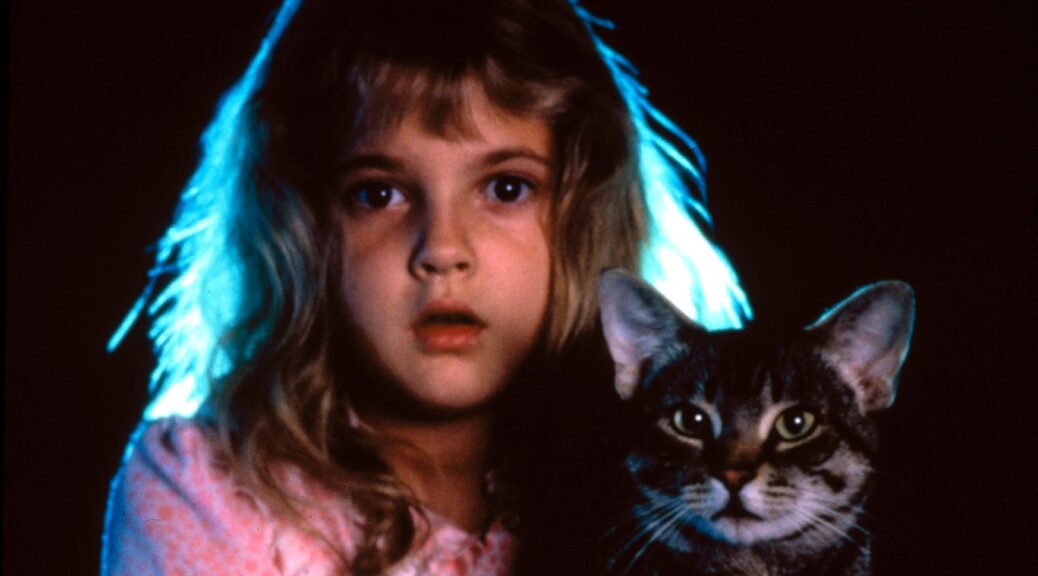
Stephen King wrote the screenplay for this anthology. Two of the shorts come from King’s published work, the third he scripted directly for the screen. A cat named General travels among the three tales.
General gets the most screentime in an episode with Drew Barrymore, who wants the cat to protect her from a little troll living in her bedroom walls. But the best of the tales follows Dick Morrison (James Woods) follows a 100% effective way to quit smoking.
It’s an effective set of tales and one of the better screen adaptations of King’s work.
3. The Black Cat (1934)
Rocky Horror owes a tremendous debt to Edgar G. Ulmer’s bizarre horror show. The film – clearly precode – boasts torture, tales of cannibalism, and more than the hint of necromancy.
Plus Bela Lugosi and Boris Karloff?! What is not to love? It looks great, as does Karloff, whose lisp is put to the most glorious use.
Loosely based on Poe’s The Black Cat – so loose in fact that it bears not a single moment’s resemblance to the short – the film introduces Lugosi’s Dr. Vitus Werdegast. He’s come to seek vengeance on Karloff’s mysterious Hjalmar Poelzig, if only Werdegast can overcome his all-consuming terror of cats!
The cat thing has almost nothing whatever to do with the actual plot of this movie, but who cares? What a weird, weird movie. So good!
2. Cat People (1942)
Jacques Tourneur’s 1942 original explores that oh-so-common horror trope: women’s sexual hysteria. Beautiful Irena is afraid that if she has sex she will become a monster. And we know she’s evil because the tiny kitten her new beau brings her hisses at her.
It’s an often silly film and very dated, but there’s something unnerving in the shifts of power, the perversion the film finds in power. You see it in the way big cats are menaced by small cats.
1. The Voices (2014)
Director Marjane Satrapi’s follow-up to her brilliant animated Persepolis is a sweet, moving, very black comedy about why medicine is not always the best medicine.
Ryan Reynolds is Jerry. As Jerry sees it, his house is a cool pad above a nifty bowling alley, his job is the best, his co-workers really like him, and his positive disposition makes it easy for him to get along. Jerry’s kindly dog Bosco (also Ryan Reynolds) agrees.
But Mr. Whiskers (evil cat, also Reynolds) thinks Jerry is a cold-blooded killer. And though Mr. Whiskers is OK with that, Jerry doesn’t want to believe it. So he should definitely not take his pills.
There’s nothing like an underdog story to help you forget every miserable thing that’s happened and just remember that sometimes, things go right for good kids.
If that’s what you need—and honestly, who doesn’t right now?—filmmaker Eric Cochran would like you to meet Landis Sims.
Born with a condition that left him without hands or feet, Landis Sims decided early that he was a baseball player. And he is.
Cochran’s a veteran behind the camera and it shows. He balances baseball action with home movies, interview material with fly-on-the-wall family footage to deliver something that seems intimate without feeling like an invasion of privacy.
Never showy or sensational, the film settles into an earnest, understated groove that lets the story tell itself. We’re with young Landis as his prosthetist helps him figure out how to hold a bat. We’re there from tee ball through little league to high school baseball.
Nobody has to tell you this kid works hard. Nobody has to take you aside to point out that he’s actually quite a good ball player. Cochran lets his images speak for themselves.
The footage is often remarkable, and the way Cochran uses his camera to create echoes of Landis over the years bridges time. Following him for 8 years gives the documentary the intimacy of Richard Linklater’s 2014 masterpiece Boyhood.
Mercifully missing those maudlin moments that so often mark “inspiring true story” docs, Just Watch Me sidesteps wallowing and trauma because it doesn’t suit the subject. It doesn’t seem part of Sims’s makeup. This is not to say Cochran shies away from the reality of this particular life, just that there’s no manufactured sentimentality.
There’s nothing forced or false about the documentary. It sometimes feels as if Just Watch Me repeats information in an attempt to stretch its running time to feature-length, but it’s not hard to justify a few extra minutes with this extraordinary kid.
Filmmaker Taika Waititi hit a gleefully discordant note with his first venture into the Marvel Cinematic Universe. His Thor: Ragnarok was silly. It held no particular reverence for superheroes, even its own.
Who knew it would be such a welcome change of pace, and so very suited to Chris Hemsworth’s comic talent? Of course, Thor still had Loki (Tom Hiddleston) to play with, plus the great Cate Blanchette as a goth goddess Hela. Hell yes.
Thor: Love and Thunder does not benefit from the previous installment’s villainous one-two punch. But Christian Bale is no slouch.
Bale plays Gorr the God Butcher. The name alone gives you a sense of why Thor is in trouble. The weird thing is, though Bale’s performance intrigues, it’s as if he’s in an entirely different movie.
In Thor’s corner of this fight is the formidable Valkyrie (Tessa Thompson), as well as another familiar face. Natalie Portman returns as Thor’s ex, Dr. Jane Foster, who now commands the Hammer of the Gods herself.
But after fighting his own flesh and blood to save his entire people and culture in the last episode, crushing on his ex while protecting his own skin feels pretty superficial. It’s a slight premise with weak stakes.
Even Waititi seems to think so. Thor and company visit the secret assembly of the gods to ask for help in defeating this new menace. The way Waititi (who co-writes Jennifer Kaytin Robinson) stages the whole bacchanal makes it hard to argue Gorr the God Butcher’s logic.
An interesting act of subversion or wishy-washy storytelling? Hard to say. Waititi’s focus on the film’s aesthetic is clearer, though.
Thor: Love and Thunder evokes a Saturday morning kids’ show, complete with hokey costumes and props. Here Waititi revels in the superficial, the kitschy and commercial. He’s a filmmaker who balances cynicism and goofiness as few can. He hits a couple of clever gags with a jealous Stormbreaker, too.
So, it’s fun. But it’s by no means the inspired fun of Ragnarok. None of the jokes land as well, and the action never approaches the same level of swagger and panache. And it just keeps getting harder to root against Marvel’s villains.
Apples opens with the thump-thump-thump of Aris (Aris Servetalis) slowly and deliberately hitting his head against a wall. We won’t know why for about 90 minutes, as director/co-writer Christos Nikou reveals the layers of his debut feature as carefully as Aris peels his favorite fruit.
Later, on a city bus, a confused Aris becomes the latest victim of a worldwide pandemic that causes sudden amnesia. When his condition does not improve and no relatives can be located, Aris is enrolled as “14843” in a recovery program designed to help “unclaimed” patients build entirely new identities.
Armed with a Polaroid camera and a list of assignments from his doctors, Aris must document the completion of each directive with photos to be displayed on separate pages of an album.
Even if you didn’t know Nikou got his start as second unit director for Yorgos Lanthimos on Dogtooth, you would instantly notice the similarities in detached mood and deliberate pacing. And while it may be unfair to expect anyone to rival Lanthimos’s skill with deadpan irony, Nikou favors a dour, awkward brand of humor (Aris dances the twist!), and a more clear-eyed and gentle resolution to an opaque turn of events.
Nikou’s beautifully realized world resembles the present day, but it is consistently quiet, slow paced and free of digital tech (hence the Polaroid). The film’s comment on disassociation is a compelling surface layer, but Apples has a more haunting goal in mind.
How much of who we are do we owe to our memories? And how far might we be willing to go to put painful memories out of reach? Nikou’s approach to these questions is finely textured, displaying a blend of craftsmanship and vision that bears attention, both now and for whatever he takes a bite of next.
If you don’t really know anything about Manhattan’s Chelsea Hotel, don’t come to Dreaming Walls expecting a thorough biography.
But even if you’ve heard only a bit about the legendary building that has known “all the immortals of the 20th century,” check in to this enigmatic documentary for a dreamlike trip through time and headspace.
Opening in 1884, the Chelsea was designated a New York City landmark in 1966, and placed on the National Register of Historic Places in ’77. Along the way, its guestbook has seen names such as Janis, Marilyn, Dali, Cohen, Warhol, Ginsberg, and two Dylans (Bob, Thomas). Arthur C. Clarke wrote 2001 while staying at the Chelsea. Nancy Spungeon was stabbed to death there.
To put it mildly, the place has a history. But co-directors /co-writers Maya Duverdier and Amélie van Elmbt (along with executive producer Martin Scorsese) root their story in the present, and in the lives of current Chelsea tenants hanging on to ghosts of old New York.
Duverdier and van Elmbt artfully project some of those famous ghosts onto the Chelsea walls themselves. Others come to life through the deft weaving of old and new footage, creating touching moments such as tenant Merle Lister Levine effectively dancing with her younger self via choreography she first performed at the Chelsea decades ago.
Those were the halcyon days of a glorious bohemianism, days remembered by Merle and other current tenants while jackhammers and lawsuits bring the march of time and money to their apartment doors.
The Chelsea has been undergoing renovations for almost a decade. And the plan for a new, lavish and extremely expensive hotel has been prolonged by the legal maneuverings of longtime tenants fighting to stay.
As these residents compare the construction to “the slow motion rape of the building,” and “a grand old tree that’s been chopped down,” a compelling and bittersweet narrative emerges.
These rich personalities push aside the caution tape and stacks of knick knacks, inviting us in to honor the legacy of a place they call home. And, as the best of these stories often do, the intimacy actually allows for a more universal resonance.
Dreaming Walls is a story of art and commerce and bricks and mortar, of glory days usurped by time, and some wonderful, weary souls who find comfort in ghost stories.
A tale as old as time: boy meets girl, girl convinces boy to accompany her on a couple’s retreat, couples retreat turns satanic. If we see this setup anymore, we’ll have to consider the trope its own genre.
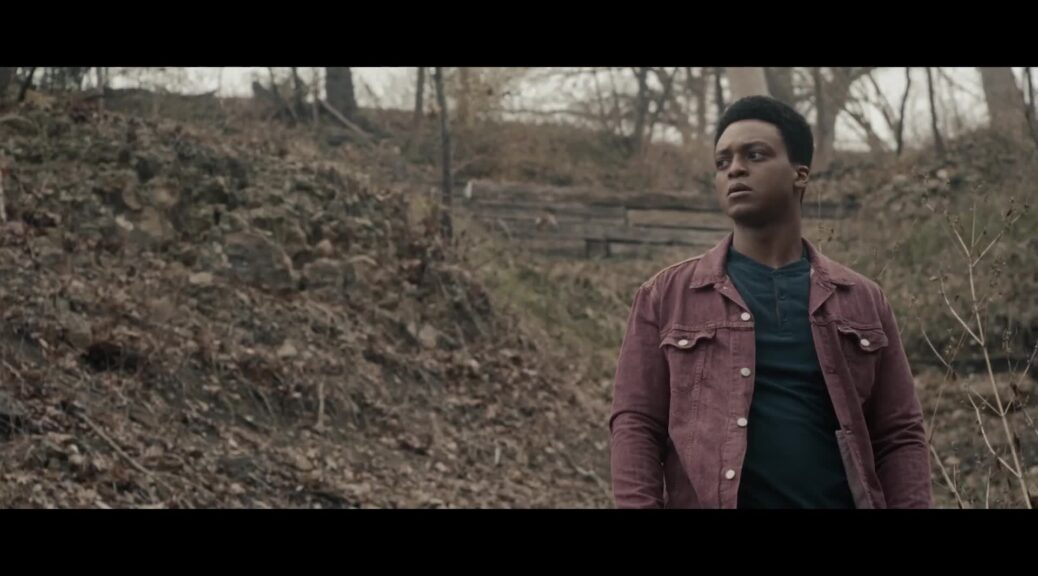
Director Mark Meir’s The Summoned follows average mechanic and hopeful musician Elijiah (J. Quinton Johnson), as he accompanies his pop star girlfriend Joplyn (Emma Fitzpatrick) on a secluded (and exclusive) self-help retreat. Joined by a millionaire author (Salvador Chacon) and prissy movie star (Angela Gulner), the vacation quickly goes from life-changing to life-threatening.
Unfortunately, when drawing up appropriate criticisms or praises for The Summoned, the metaphorical canvas remains blank. That is to say: this film drives at a safe speed and steadily down the dead-center of the road. Never veering into terrible road bumps like uneven performances, loose script, or uninspired narrative. This also means it never hits the high speeds of stellar performances, transformative writing, or intriguing ideas.
The Summoned is competently made in almost every aspect. It looks pleasant, the cast is strong and is obvious in their chemistry, and the direction is solid. But you keep waiting for the twist of the knife, the moment where this film becomes a breathing piece. Unfortunately, that final push never comes, and the result is ultimately adept but magicless.
Perhaps the most enjoyable element of this film was the willingness to lean into camp. The performances offered by Gulner and Frederick Stuart as the flamboyant Dr. Frost gave even the most grisly moments appropriate levity. This levity is the ultimate grace the film needs to distance itself from gloom-obsessed horrors of the past (think Insidious, The Conjuring, etc.). It hits more closely to Jordan Peele’s Get Out, often pulling surprisingly snappy dialogue.
If you’re looking for an easy fright, check this film out. You won’t be disappointed. If you’re looking for a thought-provoking scare, you may wish you hadn’t been summoned.
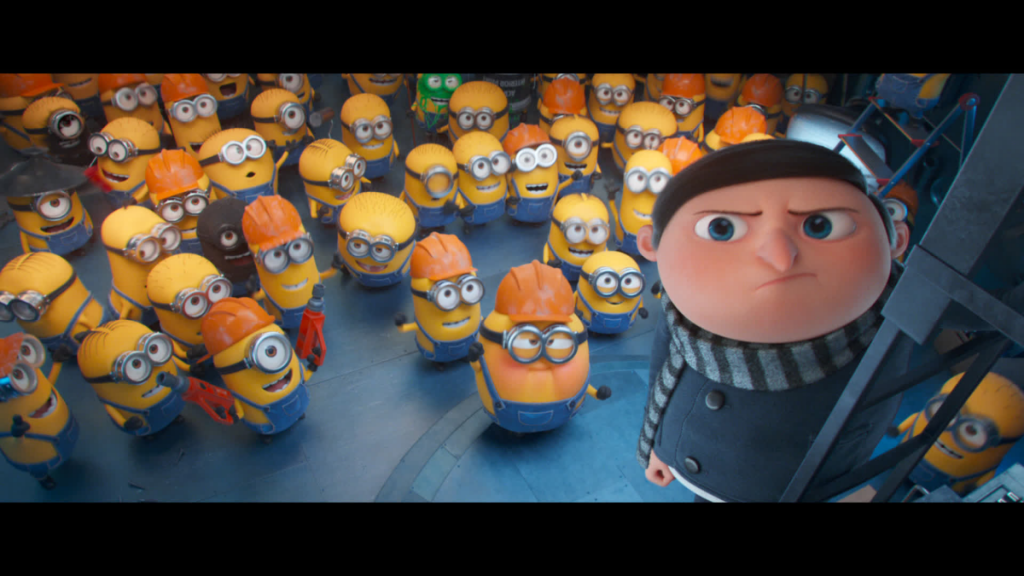
Gru is back, which means more minions. As long as you’re not sick to death of either of those things, Minions: The Rise of Gru is fine, moderately enjoyable family entertainment.
If you are sick to death of any of the above, it’s probably because you are an adult. For you, this second installment of the Minions franchise, fifth overall Despicable Me project, hopes to keep your attention with loads of nods to the Seventies. This probably means they hope the kids are going to theaters with their grandparents.
Why the Seventies? Because we’re watching young Gru (Steve Carell) try to break into the super villain biz. He’s but a wee thing, not yet jaded. Rather than Farrah Fawcett or Starsky and Hutch posters on his walls, though, his bedroom is adorned with The Vicious 6 paraphernalia.
The Vicious 6 are the most notorious supervillains in the world: Wild Knuckles (Alan Arkin), Belle Bottom (Taraji P. Henson), Jean-Clawed (Jean-Claude Van Damme), Stronghold (Danny Trejo), Svengeance (Dolph Lundgren), and Nun-Chuck (Lucy Lawless).
Other newcomers to the series include Michelle Yeoh and RZA, joining returning performers Julie Andrews, Russell Brand and Steve Coogan.
Damn, that’s a lot of talent behind the microphone.
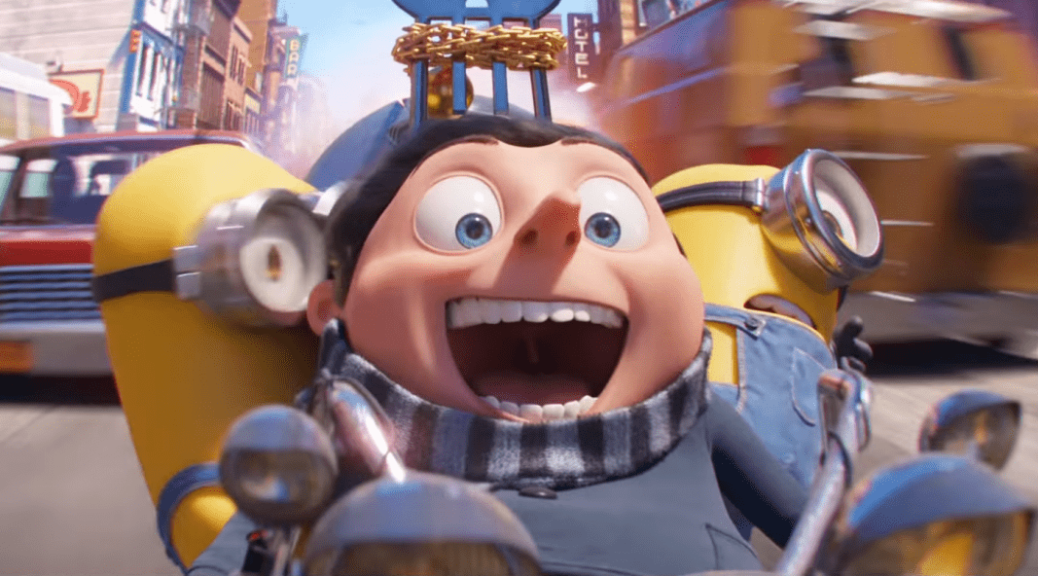
The animation’s great, too. This movie is gorgeous, especially the 3D rendering of San Francisco. There’s an eye-popping Chinese New Year parade and a pretty great cross-country motorcycle ride a la Easy Rider that looks amazing.
Writing is a bit of a weak spot, though.
Part of the problem is that all that voice talent is given very little to do because Pierre Coffin (voice of the Minions en masse) gets most of the screen time.
You see, Gru is kidnapped and several of those little yellow pills set off to rescue him. They’re separated. One pulls a Nicholson to RZA’s Peter Fonda. The other three train in the art of Kung Fu with Master Chow (Yeoh).
Minions don’t make great primary characters. They are interchangeable and have no arcs. They’re wildly, suffocatingly popular, yes, but they can’t really carry a film. They’re a hell of a waste of a good cast, though.
The halfway mark of 2022 is upon us. You know what that means! Well, maybe you don’t — it means a list! It’s at this point in the year that we look back and celebrate the best films we’ve seen so far. A Top 10, of sorts, except it’s really a Top Baker’s Dozen and it’s in alphabetical order.
Cha Cha Real Smooth
On Apple TV
Dakota Johnson is the unquestioned star of indie darling coming-of-age drama Cha Cha Real Smooth, but it’s writer/director/co-star Cooper Raiff who’s shining bright enough to blind you.
Solid support from Leslie Mann and Brad Garrett offers Raiff opportunities to subvert tropes with surprising compassion. There are also more than enough laughs to balance the drama.
Johnson’s greatest strength as a performer is the almost preternatural chemistry she shares with everyone else on screen. That connection with Raiff aches with human tenderness, as does the entire film.
Cha Cha Real Smooth, which won Sundance’s dramatic competition this year, overflows with charm and warmth. More than that, it points to a remarkable cinematic voice that’s just getting started.
Crimes of the Future
On Prime Video
In a dreary world where “surgery is the new sex,” two performance artists (Viggo Mortensen, Léa Seydoux) turn one’s mutant organs into art.
If that doesn’t sound like a David Cronenberg movie, nothing does.
The film references, directly or indirectly, The Brood, Dead Ringers, The Fly, Naked Lunch, Crash, and most frequently and obviously, Videodrome. Like his main character, Cronenberg has long been an “artist of the inner landscape.” And after several decades of excising that tendency from his work, Cronenberg has come full circle to accept what was inside him all along.
Dinner in America
On VOD
It’s not often you watch a film about a fire starting, drug dealing, lying man on the run from police and his romance with a woman with special needs and think, this is delightful.
But it is. Dinner in America is a delight.
Writer/director Adam Rehmeier delivers an unexpected comedy, sometimes dark, sometimes broad, but never aimless. Simon (Kyle Gallner, remarkable) is a punk rocker hiding from the cops. Patty (Emily Skeggs) is a 20-year-old punk rock fan who lives at home and isn’t allowed to run appliances when she’s alone.
Rarely does a film feel as genuinely subversive and darling as Dinner in America, the punk rock rom-com you never knew you needed.
Emergency
On Prime Video
Take two longtime friends on the verge of going their separate ways, and throw in one night of epic partying before they graduate. There will be hijinks, conflict, feelings expressed, and resolution.
We know this formula, right?
Not so fast. Expanding their Emergency short from 2018, director Carey Williams and writer K.D. Dávila run those familiar tropes through a tense, in-the-moment lens that upends convention while still delivering a consistent layer of laughter.
So we get the two friends ready to explore the future, searching for their place in the world. But this wild night of partying holds more sobering lessons than we’re used to seeing.
For these young men, it’s about how quickly their perception of the world can change forever, and the unrelenting weight of navigating how the world sees them.
Everything Everywhere All at Once
In theaters and streaming
Directors Dan Kwan and Daniel Scheinert are back with their brand of sweet-natured lunacy for Everything Everywhere All at Once. The result is an endlessly engaging, funny, tender, surprising, touching maelstrom of activity and emotion.
This is a hard movie not to love.
At the heart of the insanity lurks Michelle Yeoh and a spot-on depiction of a midlife crisis. Yeoh’s Evelyn arcs as no character has arced before.
The real stars are the Daniels, though, who borrow and recast and repurpose without even once delivering something derivative.
Good Luck to You, Leo Grande
On Hulu
If we’re boiling down film narratives to heroes and quests, it won’t take long to define Good Luck to You, Leo Grande.
Nancy (Emma Thompson, glorious as always) is our hero, and sex is her quest. So she hires handsome young Leo Grande (Daryl McCormack) for a tryst.
Nancy’s journey is, of course, an intimate one, and director Sophie Hyde doubles down on the intimacy, rarely leaving the privacy of the hotel room. Regardless, the film is never claustrophobic and always cinematic, framing even the most sexual moments with a refreshing honesty that the characters (and these two impeccable performances) deserve.
And you know what? We deserve it, too. Good Luck to You, Leo Grande is a simply wonderful look at embracing who you are and what you want.
Mad God
On Shudder
Phil Tippett’s demons take center stage in his stop motion head trip 30 years in the making, Mad God. It’s like a Bosch painting and a Tool video accusing each other of being too lighthearted.
Mad God delivers a nightmare vision like little else, overwhelming in its detail and scope. Tippett plumbs cycles of mindless cruelty.
Mad World revels in Tippett’s vulgar, potent fantasy without belaboring a clear plotline. The world itself resembles hell itself. Tippett peoples this landscape with figures and images that also feel reminiscent: a doll’s befouled face, a fiendish surgeon, a cloaked figure.
Memoria
Traveling theatrically
If you are in the mood for something decidedly different, let Apichatpong Weerasethakul’s meditative wonder Memoria beguile you. Or bewilder you. Or both.
The film becomes a mystery of sorts, but one that dredges up more questions than answers. On the filmmaker’s mind seems to be concepts of collective memory and isolation, sensory experience and existence.
Jessica’s (Tilda Swinton) travels through Colombia in search of answers to a confounding sound following her becomes an entrancing odyssey. Akritchalerm Kalayanamitr’s sound design heightens the experience, almost becoming a second character in the way that the sound supports Swinton’s performance.
And what a performance. Quiet and precise as if always listening and careful not to disturb, Swinton once again disappears wholly into a role.
Men
On Prime Video
Jessie Buckley (flawless, as always) plays Harper, a woman in need of some time alone. She rents a gorgeous English manor from proper country gentleman Geoffrey (Rory Kinnear) and plans to recuperate from, well, a lot.
Filmmaker Alex Garland unveils Harper’s backstory little by little, each time slightly altering our perception of the film. The more about Harper we learn, the more village folk we meet: vicar, surly teen, pub owner, police officer, and a naked man in the woods. Each is played by Kinnear—or by actors sporting Kinnear’s CGI face—although Harper never mentions this, or even seems to notice.
Is she seeing what we’re seeing?
Garland’s bold visuals—so precise in Ex Machina, so surreal in Annihilation—create a sumptuous environment just bordering on overripe. The verdant greens and audacious reds cast a spell perfectly suited to the biblical and primal symbolism littering the picture.
Rather than clarifying or summing up, the film’s ending offers more questions than answers. But if you can make peace with ambiguity, Men is a film you will not likely forget.
The Northman
On Peacock
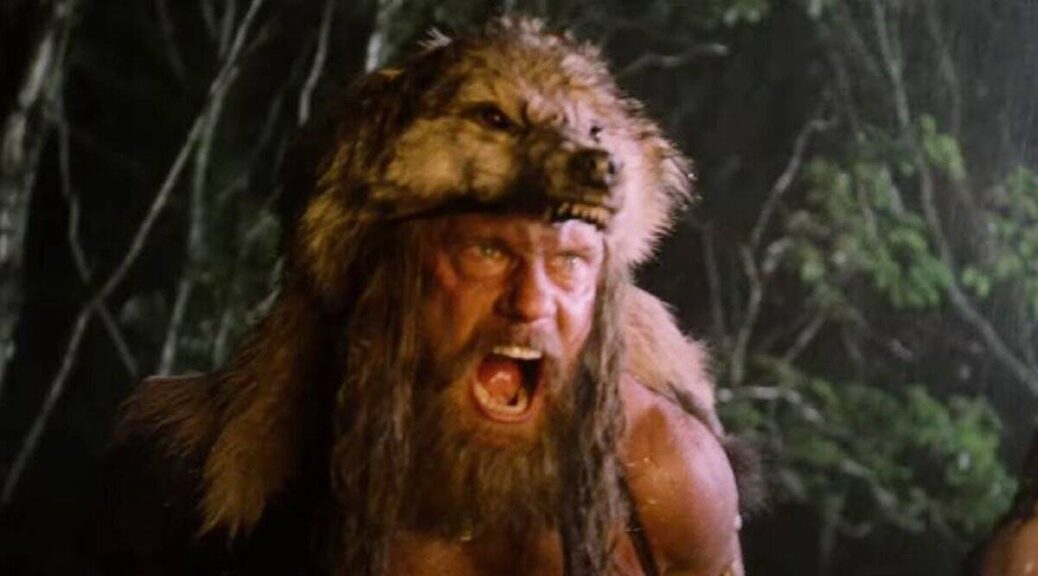
Robert Eggers released his third feature this year, a Viking adventure on an epic scale called The Northman.
What you have is a classic vengeance tale: prince witnesses royal betrayal and the murder of his father. He loses his mother and his crown and vows revenge.
Alexander Skarsgård is cut to play a Viking. His performance is primarily physical: blind rage looking for an outlet. He’s believably vicious, bloodthirsty, single-minded and, when necessary, vulnerable. The entire cast around him is equally convincing.
Classic is exactly how The Northman feels. The story is gritty and grand, the action brutal and the storytelling majestic. As is the case with Eggers, expect a fair amount of the supernatural and surreal to seep in here and there, but not enough to outweigh the meticulously crafted period realism.
Poser
At Gateway Film Center
Directors Noah Dixon and Ori Segev, working from Dixon’s script, drop you into the indie music scene you may never have realized existed in Columbus, Ohio. Lennon (Sylvie Mix) wants to change that with her podcast. She may not have a lot of listeners, but she promises those who do listen a deep dive into the scene, with interviews and performances from the best bands you’ve never heard of.
Mix’s open stare and stealthy movement — a technique she used to great effect in her haunted Christmas flick Double Walker — here feels slyly deceptive. Lennon’s an introvert, a fan, an artist herself. Or is she?
Like a cagey, pink-haired Jena Malone, Kitten commands the screen playing a version of herself. The singer from Columbus-based indie band Damn the Witch Siren, Kitten performs along with bandmate Z Wolf, whose presence adds a fascinating air of whimsy, danger and apathy.
Turning Red
On Disney+
Turning Red – Pixar’s twenty-fifth – keeps the winning streak alive with a frisky, meaningful and culturally rich update of a well worn message.
Director Domee Shi (who also co-writes with Julia Cho) has much to offer in her feature debut. Here, the often generic moral of “be true to yourself” plays out with stakes that will feel authentic to both kids and parents. Pixar has a long history of finding true poignancy amid big laughs, but Turning Red feels like a turning point.
Not only is it the first Pixar film with a female director, women are also in leadership roles throughout most areas of the production. The mission was clearly to begin speaking to a slightly older target, with a tender honesty that adolescents – girls especially – could appreciate.
Respect the past, but embrace the possibilities of the future. That future is going to include parts of your true self that are messy, and that’s okay. In fact, accepting those awkward, messy parts is the first step to being okay.
The Unbearable Weight of Massive Talent
On VOD
It’s not just that it’s the role he was born to play. It’s also that it feels like precisely the right moment for him to be playing it, as if the cosmos themselves are aligning to deliver us some rockin’ good news.
How good? Well, for starters, The Unbearable Weight of Massive Talent gives him about a minute and a half just to name check himself as “Nic f’innnnnnnnnnggggggggow!WoahCage!”
And while we’re loving all manner of Cage, here comes Pedro! More natural and endearing than he’s ever been, Pascal starts by channeling the fan in all of us, and then deftly becomes the film’s surprising heart. Yes, there are nods to Hollywood pretension, but they’re never self-serving, and the film is more than content to lean all the way in to a madcap adventure buddy comedy spoof.
X
On VOD
The Texas Chain Saw Massacre meets Boogie Nights?
Yes, please!
Filmmaker Ti West delivers an utterly unexpected and absolutely inspired horror show like nothing he’s made before. A group of good-natured pornographers descends upon an out-of-the-way ranch to shoot a movie, unbeknownst to the owners. Mia Goth leads a thoroughly entertaining cast, each actor making the most of the humor crackling throughout West’s script.
West explores some common themes, upending every one without ever betraying his clear love of this genre. Blending homages of plenty of Tobe Hooper films with a remarkable aesthetic instinct, West fills the screen with ghastly beauty.