No Leftovers Reqired

The King of Laughter

by Daniel Baldwin

Biopics can be a crapshoot sometimes. Try to cover too much of someone’s life and the film ends up reading more like a Wikipedia entry than it does a worthwhile story. Hyperfocus on one event and you risk missing the forest for the trees. Try to be too realistic and clinical with them and you’re likely to lose your audience. Try to get too wild and you might lose them too! It’s a fine line, one that many a filmmaker has tripped on.

Much like its subject, writer/director Mario Martone’s The King of Laughter is too much. A biographical drama about late 1800s Neapolitan playwright and actor Eduardo Scarpetta, the film is largely about Scarpetta’s legal conflict with playwright Gabriele D’Annunzio , whose play The Daughter of Iorio Scarpetta parodied. Given that the film is 133 minutes long, however, it’s not just about that.

Martone manages to pack so much movie into his movie here that it feels unlikely to drive viewers to seek out more info on Eduardo Scarpetta once it ends. Much like the feeling of being overfed after a big holiday meal, odds are high that viewers exit this film feeling that they’ve more than had enough of Eduardo. This isn’t necessarily a bad thing. It simply means that, for better or worse, Martone left it all on the field here. Baz Luhrmann did something similar with Elvis earlier in the year, although this isn’t nearly as successful. It’s just all a bit too unwieldy and overstuffed for its own good.

That’s fine, however, because the true centerpiece of this work is lead actor Toni Servillo’s showstopping turn as Scarpetta. An already massively-respected, award-winning performer whom arthouse viewers might recognize from Gomorrah and/or Il Divo, Servillo is positively on fire here from start to finish, delivering what is undoubtedly one of the best performances of the year. It’s truly no wonder that this film was in contention for the Golden Lion at the Venice Film Festival only a few months back.

The movie around Servillo’s powerhouse turn is a bit too long, a bit too loud, a bit too garish, and just all around a bit too much. To paraphrase today’s kids, The King of Laughter is extra. Extra extra, even. Odds are that you already know whether or not that will appeal to you. All that aside, if you’re going to see it, Toni Servillo himself is 100% the reason to seek it out.

Home for the Holidays

My Apocalyptic Thanksgiving

by Rachel Willis

With My Apocalyptic Thanksgiving, writer Richard Soriano and director Charles B. Unger have crafted a touching and unique holiday film.

When Doris, the matriarch of a group home serving adults with special needs, unexpectedly dies, it leaves Marcus (Joshua Warren Bush) awash in loneliness and obsessed with a TV show called Apocalyptic Zombies. Come Thanksgiving, Marcus decides he wants to spend time with his long-absent mother.

A colorful cast of characters populates this film. There is Frank (Walker Haynes), who’s trying to fill the void Doris left behind in the group home, and the Park family. It is friction between young Kim Park (Chris Wu) and his parents that leaves a hole Marcus seems to fill.

Luis (Paul Tully) and Paco (David Jenson Perez) are local thugs who see Marcus’s size as a benefit to their operation. Social worker Nicole (Ciera Foster) does her best to help Marcus find his mother, despite Frank’s protestations.

One of the themes of the film is the constant conflict that affects the lives of many adults with special needs. It is clear Marcus cannot consistently take care of himself, but he is independent enough to resent the intrusion of those in charge of his care. He is allowed some freedoms: a job at the local laundromat, the ability to visit with friends. But he is still subjected to a curfew, to the demands to take his medication, even when he expresses his right to refuse.

Bush does a stunning job of encompassing the very real struggles that affect many adults with special needs. Marcus understands that he is frequently at the mercy of someone else’s wishes, but his desperation for family makes him easy to manipulate. Those with good hearts sometimes use this naivety to their advantage. Others with more devious intentions know exactly how to twist the knife in Marcus’s aching heart.

The film’s most disappointing element is the constant return to the fictional zombie show. Though it is an important part of Marcus’s life, the show and its actors never feel truly integrated into the film. This is especially true as we get to know our “real-world” characters. The forced humor of the show draws our attention away from the more interesting elements.

However, this is the only thorn in an otherwise lovely film. The writing is sensitive, and the actor portrayals are poignant. This is a delightful, sometimes devastating, portrait of what it means to be a family.

Thicker than Water

Blood Relatives

by Hope Madden

Noah Segan – a welcome surprise in a Dude-esque role in Rian Johnson’s mystery romp Glass Onion: A Knives Out Mystery – embodies quite a different character for another new release, Blood Relatives.

Segan writes, directs and stars as well, upending the traditional coming-of-age perspective as a vampire learning of a teenage daughter and figuring out how to become a parent. It’s a darkly comedic road trip toward mundanity.

Segan’s screenplay is loose but knowing. It never feels overly scripted but offers enough backstory to ground the tale. And though moments feel familiar – maybe a bit of Near Dark and Stakeland with far more humor and far less dystopia – there is something pleasantly new afoot in this film.

Francis (Segan) is a loner in a muscle car, making his way hither and yon across dusty old by-ways and trying not to draw attention to himself. It’s a lonesome road, but what are you going to do? Jane (Victoria Moroles, Plan B) is a 15-year-old: sarcastic, hostile – you know, normal. Only she’s not normal and now that her mom’s gone, she intends to find out who she is.

That’s the simple success of Segan’s story. It’s about two people figuring out who they are, as we all must. Without feeling preachy or pretentious, Blood Relatives offers some real insight into what parenting ought to be. Even when the only thing you really have in common is the desire to suck the life out of people.

Moroles excels in the role of an angsty teen who recognizes the symbolism of turning into a monster as you hit adolescence. She’s slyly funny but moments of tenderness humanize her Jane. Likewise, Segan finds an arc that suits a man-turned-killer trying to turn back into a man.

Supporting turns, while small, all add a nice spark to the proceedings. Josh Rubin, in particular, is a creepy delight in a Renfield-esque role.

The film’s greatest weakness is its final act, which is enjoyable but unsatisfying. Still, the entertaining Blood Relatives delivers a savvy family comedy.

Over the Hills And Far Way

Strange World

by Hope Madden and George Wolf

So, one of the main characters here looks exactly like John Krasinski, but is voiced by Jake Gyllenhaal?

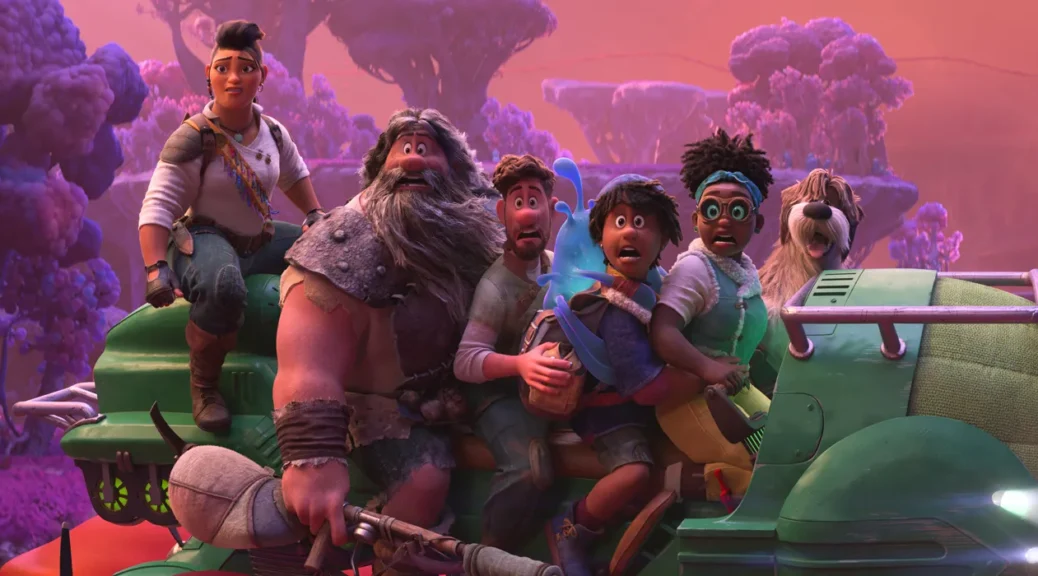
Strange World, indeed, but that’s just an amusing footnote in Disney’s latest animated feature, an enjoyable family adventure with a straightforward message and commitment to inclusion.

Jake is the voice of Searcher Clade, a contented farmer still dealing with the ghost of his famous father, Jaeger (Dennis Quaid). Twenty-five years ago, Jaeger vanished during the family’s quest to discover what lies beyond the mountains of Avalonia. But while Jaeger was lost on the expedition, Searcher brought back a vital new resource for his homeland: the Pando plant.

Pando now provides the energy that drives almost everything in Avalonia, which is all fine until the crops show signs of a serious infection. Putting aside a vow not to follow his father’s adventuring path, Searcher, his wife Meridian (Gabrielle Union), their son Ethan (Jaboukie Young-White) and their three-legged dog join President Mal (Lucy Liu) on a mission to cure the Pando plant and preserve their comfortable way of life.

Writer Qui Nguyen (Raya and the Last Dragon) joins his co-director Don Hall (Raya, Moana, Big Hero 6) to craft an ecological allegory seemingly inspired by the union of a role-playing board game and one of those cute posters you pass while waiting in the lines at Disney World.

The animation itself is stunning, whether snowy peaks, verdant village or trippy, drippy otherworld. Strange World lives up to its title, delivering a visual feast.

But there’s more on Nguyen’s mind than eye candy. His story offers a world where generations do not have to be defined by what they always believed was right, where masculinity has no concrete quality but is a term owned by the individual. More importantly, this Strange World is one where creature comfort is not more important than survival.

Often the film feels like it’s trying too hard to correct the stereotypes nourished by generations of children’s entertainment. But there’s a kindness and a sense of forgiveness throughout the movie that does make you yearn for a world like this one.

Seethers

Sirens

by Rachel Willis

It seems like it would be tough to be an all-female thrash metal band. It looks even tougher if you’re also in Lebanon. Director Rita Baghdadi allows us the opportunity to follow just such a band in her latest documentary, Sirens.

The band is Slave to Sirens, and it boasts a five-woman line-up with an amazing collection of musicians. It’s a shame there are so few opportunities during the documentary to hear them play.

The lack of music is due in part to the pandemic, but another issue is simply the sparsity of opportunities. When one show is booked, the band is called a few days later by the booking agent telling them the show has been canceled. The venue is not allowed to book a metal band.

The wider Lebanese society frowns upon metal music, likening it to Satanism (doesn’t that sound familiar?). The women refuse to give up, but it’s a tough world in which to have a successful metal band.

One of the few chances we have to see Slave to Sirens play is at the Glastonbury Festival in England. It’s a great performance; lead singer Maya has a growl that resonates and lead guitarist, Shery, works magic. It’s a shame that there are only a dozen people in the audience who see them perform.

As the documentary unwinds, two members start to stand apart from the rest: Shery and rhythm guitarist, Lilas. Both feel at odds with the world around them and seek music as a way to express their anger and frustration.

What Baghdadi gives us is more than a simple band documentary. Behind every moment, every note, every song, is a scene of raging turmoil within the borders of Lebanon. This chaos is reflected within the band and the interactions of its members. Scenes of tension between Shery and Lilas reflect the greater tension around them. The two women nearly come to blows during an argument. When a building blows up several scenes later, it feels like a reminder that what we do to each on a small scale is too often reflected back on a larger one.

If you’re not familiar with current events in Lebanon, it doesn’t detract from the overall experience. This is the kind of documentary that reminds us of the power music has to give voice to those who can’t always speak.

Sister, Sister

Shadows

by Brandon Thomas

Growing up is tough, especially once adolescence rears its ugly head. Your body gets weird, emotions are all over the map, and you don’t know shit despite thinking you do. Now imagine growing up amidst a global catastrophe with an overbearing mother and not being able to step foot into the daylight. In Shadows, this scenario ends up being a recipe for disaster.

Alma (Mia Threapleton) and her sister Alex (Lola Petticrew) live in total isolation with their mother (Saskia Reeves). The girls remember nothing of their lives before a catastrophic event drove the family deep into the woods. By day, the family stays indoors hiding from mysterious entities known as “Shadows” – beings that live in the daylight and fully inhabit the land beyond the river. As the sisters’ rebellious curiosity takes hold, they begin to wonder about the world beyond the river, especially as their mother’s grip on reality becomes more and more tenuous. 

Director Carlo Lavagna makes the close bond between Alma and Alex the focal point of Shadows. The mother almost exists on the periphery of their lives – appearing to reprimand them or scare them back into obedience. Even though they are teens, there’s a stunted immaturity to the sisters that’s hard to ignore and makes their situation all the sadder. Threapleton, daughter of actress Kate Winslett, walks a tightrope between inner strength and debilitating reliance on her emotionally distant mother. Many times Threapleton does both within the same scene.

The depiction of Mother is another bright spot. Mother appears sparingly – keeping the audience at arm’s length just as she does with Alma and Alex. Her coldness is rivaled only by her calculated survival instincts and desire to keep the sisters confined and “safe.” The mysterious nature of Mother helps keep us in the same shoes as the constantly confused and fearful sisters. 

For a film that spends so much time in the same location, the cinematography is a standout. Cinematographer James Mather (Frank, Extra Ordinary) has an incredible eye for space and makes the world the family lives in feel spacious, yet closed in and emotionally walled off. The daytime threat of the Shadows themselves is visualized through a harshness in the few daylight scenes that is contrasted perfectly by beautiful nighttime photography.

Where Shadows stumbles is on its way to the finish line. Most viewers will see the “surprise” ending telegraphed a mile away and feel a bit underwhelmed at its perceived cleverness. The climax – while not wholly original – doesn’t retroactively make the rest of the film feel lesser. 
Shadows doesn’t break any new ground on a narrative level, but it does feature three captivating performances by an entirely female cast.

The Nose Plays

Guillermo Del Toro’s Pinocchio

by Hope Madden

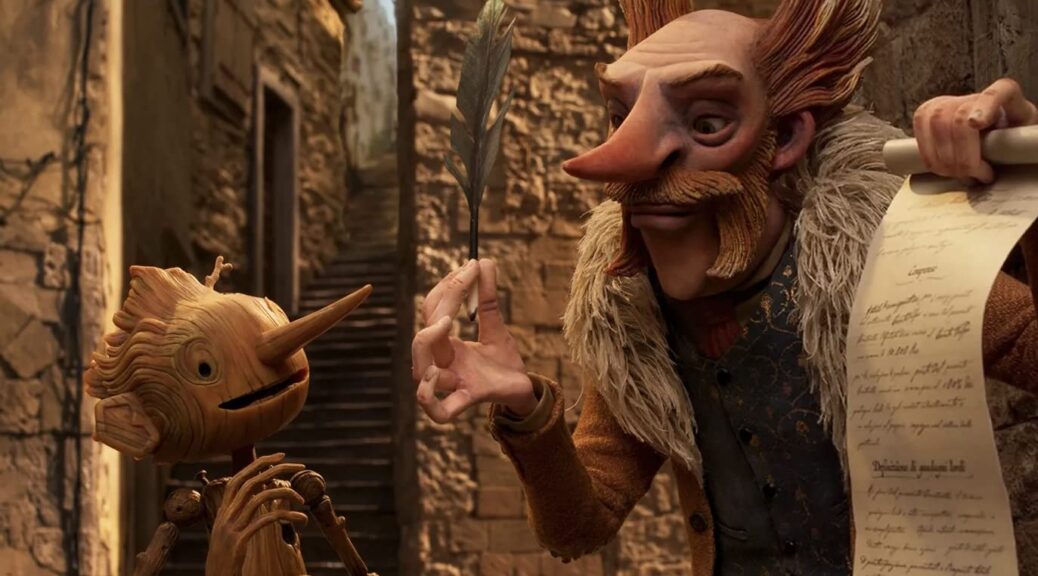
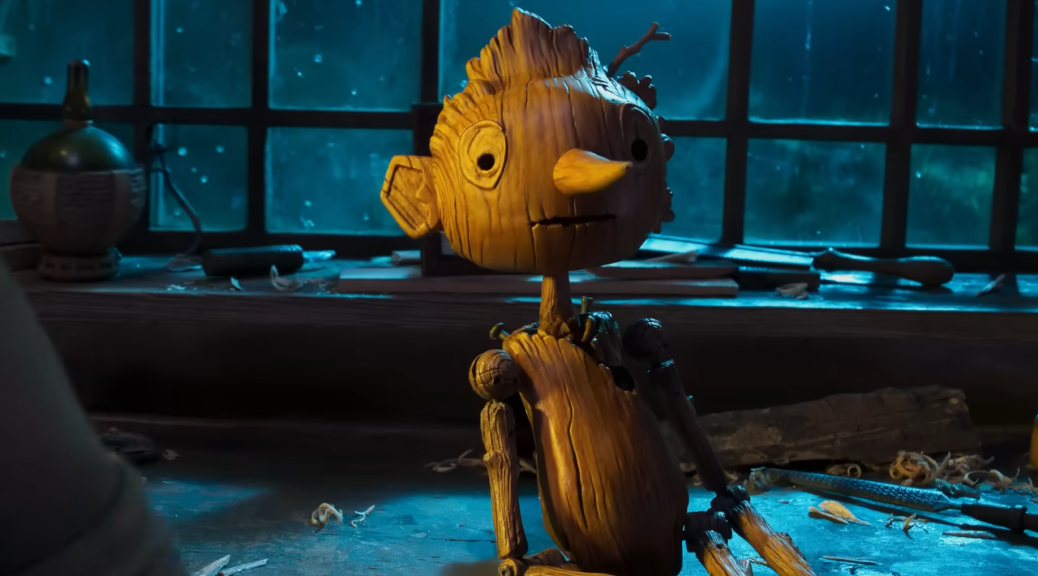
Is it any surprise that Guillermo del Toro’s visionary style, sentimental sensibilities, and macabre leanings suit animation so well? If there was any question, he dispels it with his gorgeous, emotional stop-motion wonder, Guillermo del Toro’s Pinocchio.

Co-directed with sculptor/animator Mark Gustafson, the film begins, as all good children’s tales must, with devastating loss and grief. If you thought the opening minutes of Up! were heartbreaking, gird your loins for this one.

The tragedy begins to abate, albeit clumsily and with much shouting, once Geppetto (David Bradley) hacks away at the tree recently occupied by one Sebastian J. Cricket, homeowner (Ewan McGregor, charming). Cricket’s home becomes Geppetto’s disobedient new puppet. You may think you know where it goes from here, but you do not.

Del Toro’s script, co-written with Patrick McHale and Matthew Robbins, establishes itself immediately as a very different story than Disney’s. The 1940 film – and, to a degree, the live-action remake Disney launched earlier this year – offers a cautionary tale about obedience. So does del Toro’s, although, in true GDT fashion, he’s warning against it.

Set between world wars in rural Italy, the film – as so many of del Toro’s do – examines the presence and pressures of authoritarianism, specifically Catholicism and fascism, on families and on the young.  

A magnificent cast including Cate Blanchett, Tilda Swinton, Tim Blake Nelson, Ron Perlman, Burn Gorman, Finn Wolfhard, John Turturro, Christoph Waltz, and Gregory Mann as Pinocchio brings charisma and dark humor to their roles. This matches the sometimes darkly funny images. Waltz, in particular, is garish, frightening fun as Count Volpe, puppet master.

The animation itself is breathtaking, and perfectly suited to the content, as if we’ve caught an artist in the act of giving his all to bring his creation to life. Everything about the film is so tenderly del Toro, whose work mingles wonder with melancholy, historical insight with childlike playfulness as no other’s does.

A Little Wicked

Disenchanted

by Hope Madden

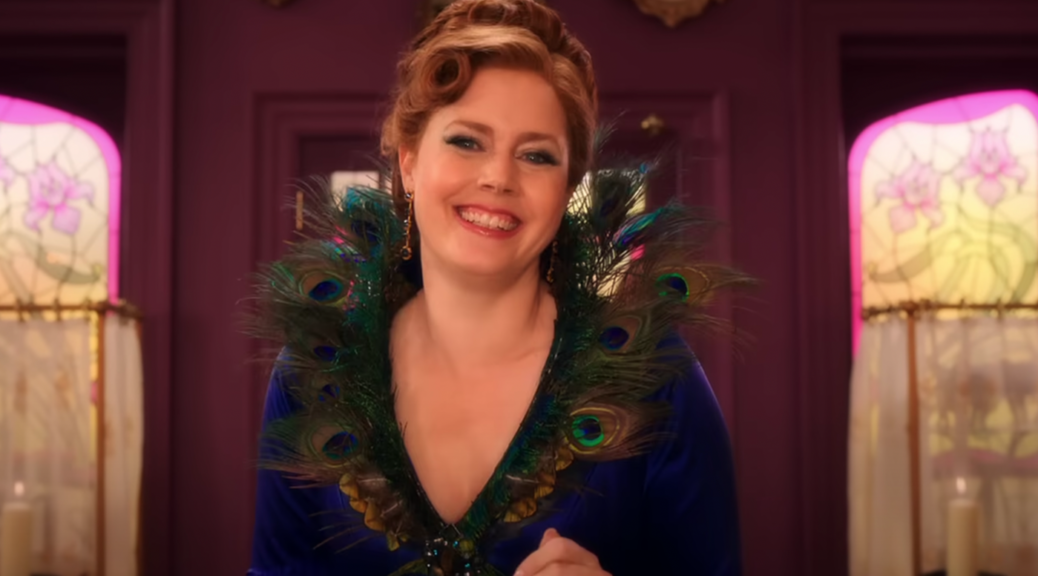
Amy Adams’s small part in Spielberg’s Catch Me If You Can stood out, even in that pool of talent. Her role in Phil Morrison’s 2005 indie Junebug nabbed her the first of many Oscar nominations. But she wasn’t really a star until she donned that enormous, sparkly white dress and went searching for love’s first kiss in Disney’s unabashed 2007 mash note to Disney, Enchanted.

Between 2007 and today, Adams has earned an additional five Academy Award nominations and worked with many of the greatest directors and actors to live. The fact that she chose to reprise her role as wide-eyed innocent Giselle in Disney’s tardy sequel Disenchanted is reason enough to be intrigued.

And Maya Rudolph as the evil queen? I’m listening.

Giselle and her beloved Robert (Patrick Dempsey) leave New York City behind for the fairy tale world of suburbia, the now-teenaged Morgan (Gabriella Baldacchino) and their own toddler in tow. Things don’t go as magically as Giselle had hoped, not because suburbia is so terrible, but because having a teenager is.

Desperate for the happily that’s supposed to come ever after, Giselle wishes for a life like a fairy tale. What she forgot is that she’s a stepmother, and that’s never a good thing in a fairy tale. Soon, she’s battling it out with Rudolph’s Malvina to see who really deserves the title of evil.

There’s also a bit about Morgan finding her inner hero, Robert discovering his purpose, there’s a teen romance, dire consequences back in Andalasia, a lengthy animated preamble, and, of course, singing.

Lyricist Stephen Schwartz and composer Alan Menken return with songs less memorable than the three that earned them Oscar nominations in 2007. In fact, besides a couple of exceptional villainous costumes, very little about Disenchanted stays with you.

It’s overstuffed and feels it. Rather than making an interesting point about midlife crises or – better still, the ill effects of a lifetime of Disney nonsense on a female’s outlook and sense of self-worth – Disenchanted settles for a watered-down “everything’s fine” message.

And that’s what the film is. It’s fine. It doesn’t take advantage of its potential, doesn’t even take advantage of its impressive cast. It’s a pretty slog through missed opportunities and aging odes that reflects Giselle’s angst: wasn’t there supposed to be something better than this?

System Failure

You Resemble Me

by Tori Hanes

How easy it is to cast mindless blame, right? How thoughtless an act to blindly hate those constructed to be our villains. The easiness of hate comes from the idea of the “other” – an unknown enemy, distant and different. The metaphorical peeling of the onion, cathartic and harrowing, is how first-time director/co-writer Dina Amer makes the “other” the protagonist of You Resemble Me.

You Resemble Me expedites this connection to the “other”, forcing bitter tears to stream down unready cheeks. Following alleged suicide bomber (later found to be homicide victim) Hasna Ait Boulachen through her twisted and harrowing past, Amer examines the universal pipeline from neglect to radicalism. 

Amer strengthens this story with overarching themes. Whether it be a victim of abuse’s search for family, neglect manifesting into harm, or yearnings for connection, there is a strong and present backbone throughout Hasna’s tragic tale.

These ideas act as an anchor for Hasna’s orbit, and for the cast of performers. Young Hasna (Lorenza Grimaudo) embodies the fitful spirit being darkened by trauma, while adult Hasna (Mouna Soualem) shows mature yearnings. 

Each performance surrounding the two leads molds itself to represent one of Amer’s themes. While this creates a spotlight around Hasna as a character, it dims the other actors – a tragedy of sorts, as the actors’ potential screams for opportunity.

While the delve into trauma is successful at humanizing, the pipeline effect Amer relies on leaves little room for nuance. This creates a tunnel vision rehashing of an incredibly complex existence, boiling down to its more traumatic cause-and-effect moments.

The discomfort in becoming what you’ve been bred to fear is the soul of You Resemble Me. Audiences who choose to engage will unwittingly participate in slicing the onion, with tears to show for it.

https://www.youtube.com/watch?v=i0A0PWVGqw0

Hope Madden and George Wolf … get it?