Category Archives: New In Theaters

Reviews of what’s out now

OK Google, Start Apocalypse

Project Dorothy

by Christie Robb

When small-time crooks James (Tim DeZarn, the Cabin in the Woods) and Blake (Adam Budron, Special Ops: Lioness) need a place to hunker down and evade the police, they pick the absolute worst location. They’ve stolen a laptop with a Wi-Fi dongle that enables internet access. And they are hiding out in an abandoned research facility where a rogue AI named Dorothy has been lying dormant since killing off its human overlords.

All Dorothy needs to enact its plan for world domination is, you guessed it, access to the internet.

In Project Dorothy, director George Henry Horton (co-writing with with Ryan Scaringe) tries to make the most out of an abandoned factory and a handful of actors. The use of security camera footage and the saccharinely menacing voice of Danielle Harris (genre staple and the voice behind Nickelodeon classic The Wild Thornberrys Debbie Thornberry) as Dorothy is surprisingly effective in conveying the oppressive sense of constant surveillance.  And the use of forklifts as Dorothy’s robotic enforcers is amusing.

But many of the shots seem repetitive and there is not enough in the script to make the viewer care much about the fate of the world or the two men. It’s like the set up for a Doctor Who episode without the lived-in charming characters and would have, perhaps, made a better short film than a feature.

But, hey, forklift henchmen are fun.

Get In, Losers

Mean Girls

by George Wolf

Some of us find the idea of reliving high school during this social media age to be downright horrifying.

Mean Girls takes us there, throwing in enough songs, sass and relatable humor to make the trip entertaining. Still horrifying, but entertaining.

And speaking of social media, word is I need to stress again that there are songs – this is an adaptation of the Mean Girls musical, and not a remake of the 2004 film.

Those songs, from Jeff Richmond and Mark Benjamin, are woven pretty seamlessly into the larger-than-life drama of high school by co-directors Samantha Jaye and Arturo Perez, Jr. Tina Fey adds some new sensibilities to her updated script, but keeps the core tale of “queen bees and wannabes” instantly familiar.

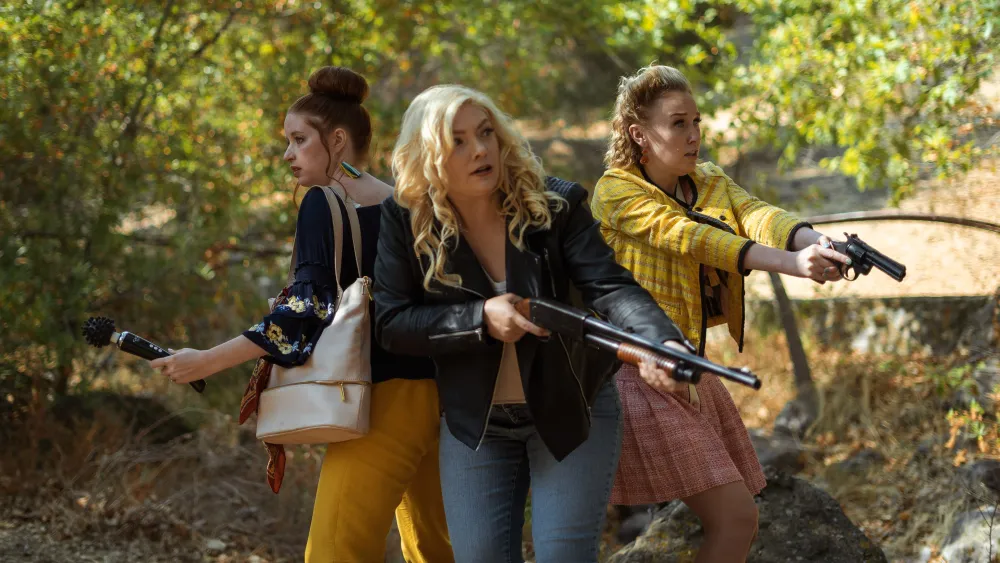
Cady (Angourie Rice from The Nice Guys and Beguiled) goes from home schooling in Kenya to being the new girl at North Shore High in Illinois. Shown some lunchtime pity by Janis (Moana‘s Auli’i Cravalho) and Damian (Jaquel Spivey in an impressive debut), Cady agrees to infiltrate the “plastics” clique of the evil Regina George (Reneé Rapp) and her sycophants Gretchen (Bebe Wood) and Karen (Avantika).

But, of course, Cady falls for Regina’s ex Aaron Samuels (Christopher Briney), and finds herself caught in the lure of burn books, backstabbing and cutthroat social climbing.

It’s all a fertile playground for sudden bursts of song and dance, though the musical set pieces often betray the directors’ extensive TV background and come off feeling a bit constricted. Not every song here is a “banger,” but the vocal talents of the cast – especially Cravalho and Rapp – help tunes like “Meet the Plastics” and “I’d Rather Be Me” make an impression, while the clever wordplay in “Stupid With Love” and “Sexy” stir up infectious fun.

And just wait ’til you hear what song Damian has chosen for the talent show.

This young cast is loaded with talent, Fey and Tim Meadows make reliably solid reprisals, and Busy Phillips brings some mischievous self-awareness to her turn as Regina’s overly chummy mom. If there’s a weak spot here, it’s the under use of the always funny Jon Hamm, who gets a glorified drive-by as the requisite coach teaching sex education.

Does this musical adaptation re-imagine its original film with as much meaning as the new Color Purple? No, it does not. But this Mean Girls brings a new zest that keeps the fetching from feeling like fan service, and enough generational upkeep to forge common ground between longtime graduates and a new class of fans.

Don’t Look Back

Memory

by Hope Madden

“I remember…”

These are the first words uttered in Michel Franco’s deceptively spare drama, Memory. Sylvia (Jessica Chastain) is celebrating 13 years of sobriety at an AA meeting. She’s brought her daughter, and those around her are remembering her impact on them.

For the next 140 minutes, Franco examines what’s true and what’s faulty in the human memory, and what he finds is sometimes harsh and unpleasant, but just often, profoundly tender.

Chastain’s performance is brittle but with complexity and depth. Sylvia’s life, and her hard-edged wall, are built from the years of being denied her truth. She knows who she is and she’s doing what she can with that.

Saul (Peter Sarsgaard, astonishing) does not always know who he is, but when he does the film shimmers with life and humanity. Saul follows Sylvia home from a high school reunion of sorts. The catalyst is provocative in that it makes Sylvie reconsider her own memory, which allows those around her to reignite their assault on its veracity.

A razor-sharp ensemble lends remarkable support to Chastain and Sarsgaard. Jessica Harper, in particular, is picture perfect, her sly and cheery manipulation leading to an emotional climax blistered by authenticity.

Memory is a bit of a departure for Franco, who’s films often keep audiences at arm’s length from the emotional turmoil beneath a character’s enigmatic surface. Not so here. Chastain’s slowly melting wall of ice creates real intimacy, and what she reveals beneath is raw.

She and Sarsgaard are veteran talents reveling in an opportunity to discard artifice and create something untidy. Their work, particularly in scenes together, testifies again to each actor’s remarkable skill.

Franco’s films rarely answer all the questions they ask, and can feel almost shapeless and often hopeless. Memory is a departure here as well. Though it’s far less rigidly structured than many Hollywood films, there’s a comforting structure to it and, more comforting, an undeniable spark of hope.

Violent Fantasies

ClearMind

by Brandon Thomas

With Clear Mind, director Rebecca Eskreis and writer Seanea Kofoed craft a darkly comedic tale of revenge while also poking fun at new age therapy.

After losing her daughter in a freak drowning accident, Nora (Rebecca Creskoff) finds herself adrift in grief. Her marriage over and dropped from her friend group, Nora seeks solace in a new form of virtual reality therapy. In the virtual world, Nora gets to exact revenge against the family and friends who have wronged her. Unfortunately the violence doesn’t stay virtual. 

Despite presenting itself as a horror thriller, Clear Mind is surprising light on frights. As the carnage begins to splash across the screen later in the film, it’s only after Eskreis has subjected the audience to round after round of uncomfortable confrontations between Nora and her former friends. While the kills and gore gags might not wow horror fiends, the tension and seat-squirming anxiety created in the lead up more than makes up for it. 

Despite being high-concept, Clear Mind is not a plot heavy film. The bulk of the movie features characters simply talking to one another around a table. It’s a testament to Kofoed’s writing that while the movie is overly chatty, it’s never boring. Only when the movie stops to propel the plot forward does Clear Mind stumble.

Eskreis and Kofoed’s commentary on therapy and the people found in Nora’s friend group is so well established through character relationships that any push to highlight it through plot seems disingenuous and clunky. The genre hook of the movie feels like the part the filmmakers were the least interested in.

Despite somewhat pulling punches with its genre elements, Clear Mind is still a well written jab at pseudo-science and the people in its orbit.

Honey Don’t

The Beekeeper

by George Wolf

About two-thirds of the way through The Beekeeper, director David Ayer and star Jason Statham hit us with the film’s highlight. It’s an elevator sequence that takes an unexpectedly gory turn, then adds a clever surprise for the finishing touch.

If only the rest of the film could be this interesting.

Statham is playing his usual one man killing machine, this time named Adam Clay. He’s living a quiet and reclusive life as a beekeeper in rural Massachsetts, until a cybercrime firm scams Clay’s only friend (Phylicia Rashad) so badly she kills herself.

Clay takes very explosive, very lethal revenge.

But the phishing firm’s CEO Derek Danforth (Josh Hutcherson in hipster douchebag mode) has friends is high places, including a former CIA director (Jeremy Irons, classing up the joint). Danforth wants Clay taken out, but he soon learns that will not be so easy.

See, Clay is more than a beekeeper, he’s a former beekeeper, an elite group of enforcers who are outside the chain of command and charged only with “protecting the hive when the system is out of balance.”

Bad news for anyone standing between Clay and the scale-tipping Danforth.

Screenwriter Kurt Wimmer (Expend4bles, the Point Break and Total Recall reboots) rolls out a script that feels like a discarded idea from Denzel’s first Equalizer film. Each step closer to “the head of the snake” gets more ridiculous, all presented with a bone dry seriousness from Ayer (Fury, Suicide Squad) and Statham that screams for a little self awareness.

Instead, The Beekeeper keeps pushing toward its own misguided goal of sermonizing about corruption while celebrating vigilante vengeance. Where it lands – elevator ride aside – is strictly in plug-and-play Statham territory, another ironic reminder of why his comedic turn in Spy was such a joyous bullseye.

Shadow Dancing

Reflect

by Rachel Willis

Writer, director, and star Dana Kippel delivers a trippy journey through a form of psychotherapy called shadow work in her film, Reflect.

As Summer, Kippel invites participants to a spiritual retreat as a challenge of sorts in which they can win money upon completing “reflective” obstacle courses.

Accompanying her on this journey to the desert (both spiritual and literal) are three friends (and one frenemy). Each woman brings her own past traumas with her, but none of them take their upcoming journey too seriously. From the clothes they wear to the things they pack, they don’t seem to understand the gravity of what they’re getting into.

Along the way, the characters meet some odd balls – odd balls that are part of a show, The Game of Life, in which the women are unaware participants.

It’s a strange set up for sure. By putting our characters on this journey, Kippel mines the sources of trauma in each woman’s life, some of those traumas more damaging than others.

As each woman undertakes the obstacle courses, they must face their anguish. It’s part of the game, part of the journey, but it makes you wonder what exactly becomes of a person who can’t handle the pain that plagues them.

Reflect excels at delivering a game cast of women (including Grace Patterson and Jadelyn Breier) who play off each other with the authentic dynamic of friends. There is genuine affection, but also a level of cattiness that keeps the quintet from truly letting each other in. Perhaps if they were able to do so, those life traumas would not be so overwhelming.

The film’s only weak element is when Kippel cuts away from the women to the gameshow framing device. Reflect would have worked just as well as a psychedelic journey into shadow work without the added element of voyeurism.

However, Kippel wisely keeps most of our attention on Summer and her friends, revealing their baggage little by little. It’s an interesting look at how our past infects our present and influences our future. Is there a way to move forward when the past pervades our every being? Maybe, maybe not. Kippel offers no easy answers, and the film is better for it.

Survive and Advance

Society of the Snow

by George Wolf

2012’s The Impossible proved director J.A. Bayona could recreate a real life disaster with heart-racing precision, and then mine the intimate aftermath to find a touching depth.

Since then, he’s had his big screen mind on monsters, with results both miraculous (A Monster Calls) and mixed (Jurassic World: Fallen Kingdom). Now, Netflix’s Society of the Snow finds Bayona back in the true adventure business.

And his business in Society of the Snow is heartbreakingly, thrillingly, unbelievably good.

It’s the latest account of the 1972 Andes flight disaster, a legendary ordeal that has been detailed in several books and films over the last five decades plus. Bayona read Pablo Vierci’s “La Sociedad de la Nieve” while researching The Impossible, bought the rights soon after, and now teams with co-writers Bernat Vilaplana and Jaime Marques for a harrowing and fittingly reverent treatment.

Following Vierci’s lead, Bayona makes sure we get to know many of the members of the ill-fated Uruguayan rugby team, who were on their way to a long weekend in Chili when their plane – carrying 40 passengers and 5 crew members – went down among the snowy peaks.

After an introduction that endears the young men to us via enthusiastic friendship and youthful naïveté, Bayona pulls us into the crash experience with a spectacular, terrifying set piece almost guaranteed to whiten your knuckles and quicken your pulse.

It’s a stunner, as it should be, because it anchors the film in a survival mode that will be tested beyond what most people could ever imagine.

The ensemble cast, filled mainly with newcomers, is deeply affecting. The survivors will be pushed to their physical, moral and spiritual breaking points, and these young actors make sure not one exhausting second of it feels false.

Bayona and cinematographer Pedro Lugue present the Andes as a beautiful monster in its own right, capable of majesty and menace in equal measure. The smaller you feel, the better, so experience this one on the biggest screen you can find.

Forget what you know. Even if you’re aware of what these people went through, Society of the Snow will reframe the tale with a deeper level of humanity and courage. And should this legend be new to you, resist the urge to research until after you’ve seen Bayona’s take.

It’s one unforgettable journey.

One Heart

The Color Purple

by George Wolf

No matter how familiar you are with Alice Walker’s original novel, or Spielberg’s 1985 film, director Blitz Bazawule’s adaptation of The Color Purple Broadway musical comes to the big screen as a heartfelt and joyous experience.

Yes, it is the same, often heartbreaking story. Young sisters Celie (Phylicia Pearl Mpasi) and Nettie (Halle Bailey) are separated in early 1900s Georgia, and adult Celie (an Oscar-worthy Fantasia Barrino, reprising her Broadway role) endures decades of heartache and abuse before proudly reclaiming her dignity.

Memorable characters and story beats surround Celie in the first two acts. Celie’s abusive husband Mister (Colman Domingo) pines for the famous singer Shug Avery (Taraji P. Henson), while son Harpo (Corey Hawkins) opens a juke joint and Harpo’s proud and defiant wife Sofia (Danielle Brooks, reprising her role from the 2015 Broadway revival) suffers repercussions from standing up to a white mayor and his condescending wife.

Through all the engaging drama and jubilant musical set pieces, Miss Celie bides her time, slowly inching closer to when both character and star step into the stoplight.

And when that third act hits, it is a glorious exhibition of pride, music and love. With Fantasia’s show-stopping rendition of “I’m Here,” Miss Celie begins to stand on her own as a successful business woman, and the film delivers her some well-earned flowers.

Have those tissues handy, but rest assured they will all be tears of joy. Because as much suffering as Miss Celie and her family endure, that pain is not what drives this vision. Bazawule, Barrino and a top flight ensemble make this The Color Purple an uplifting celebration of heritage and family, and an exhilarating film experience.

Shut Up and Drive

Ferrari

by Hope Madden

My first worry as I watched Michael Mann’s long-awaited return to the screen, Ferrari, was triggered by a line delivered by Enzo Ferrari’s (Adam Driver) mother (Daniela Piperno). In recalling the death of her eldest child, she muses, “The wrong son died.”

There is, of course, no more clichéd way to begin a biopic. Just ask Walk Hard. But Mann, working from a 30-year-old by script the late Troy Kennedy Martina and Brock Yates, veers from formula immediately after that bit of dialog. His approach does not always work, but buoyed by a few remarkable performances, he recreates a compelling piece of history.

Though Driver’s accent is sometimes questionable, he sidesteps cliché in every scene. His Enzo Ferrari is a singular man, driven and emotionally careful but quietly compassionate and endlessly human. The performance is soulful and delightfully humorous, and he makes even the script’s most convenient or obligatory dialog feel authentic.

He’s got nothing on Penélope Cruz, though, who’s a solid contender for an Oscar nomination in the role of Enzo’s wife and business partner, Laura. Moody, funny, but more than anything, worn thin by years of grief and anger, Laura is a character unlike any other in this film or most any other. Cruz dials the drama back just when you’d expect an eruption, erupts at surprising moments, and refuses to make Laura Ferrari a cartoon or a villain.

With these performances at the center of the film and the specter of death in both the rear view and the headlights, Ferrari delivers an emotionally charged adventure. The real possibility of disaster – within the family, within the business, and on the racetrack – is a current running through every scene.

Mann captures the thrill and dread inside that danger with a restless camera and visceral racing action. Thanks to commitment to the human drama, the action never feels glossy or superficial – thrill for thrill’s sake. Mann’s latest embraces the compromise and corrosion that accompany success. It feels less stylish than a Michael Mann film, but more human.

Treading Water

The Boys in the Boat

by George Wolf

We last heard from director George Clooney two years ago, when a fine supporting turn from Ben Affleck was the only thing saving The Tender Bar. That film was so obvious and rote that any interest it inspired in the source novel was only to see what Clooney found so special about it.

He’s back behind the camera for The Boys in the Boat, and unfortunately, none of those boys is Ben Affleck. Because again, we get an inspiring true-life tale presented with none of the humanity, tension or freshness it needs to be inspirational.

It does look good, though.

Clooney leans on screenwriter Mark L. Smith (The Revenant, Clooney’s own The Midnight Sky) to adapt Daniel J Brown’s biography of The University of Washington’s 1936 rowing team. Leading up to that year’s Olympics in Berlin, the group of young rowers hoped to vanquish Hitler’s prized athletes in a contest we’re told is “more poetry than sport.”

Smith’s script tells us a lot of things, but Clooney never manages to make us feel much of anything.

Young Joe Rantz (Callum Turner, fairly lifeless) needs money for shoes, a roof and tuition, so he tries out for the rowing team when he learns team members get a job and a room. He endures coach Al Ulbrickson’s (Joel Edgerton) grueling boot camp to make the squad, and the victories start piling up, right alongside the cliches (hey, that old man tending the boats might have wisdom to share!)

Joe’s romance with the spunky Joyce (Hadley Robinson) comes just as easily, while Joe’s awkward reunion with his alcoholic father lands as a lazy attempt to rekindle memories of Hoosiers without the same investment in character development. Possible avenues for tension – such as a mysterious illness for one team member – are conjured up and then resolved with more regard for convenience than effect.

Remember, George Clooney is an Oscar-nominated director, and that 2005 nod for Good Night, and Good Luck was well-deserved. Since he’s stepped away from co-writing his projects (2012’s The Ides of March earned him a writing nom), though, the results have leaned more and more toward shallow formula.

Here, Clooney does prove adept with some gorgeous shot-making around the water, but even then you wish Martin Ruhe’s cinematography could linger just a beat or two longer each time.

The Boys in the Boat might already be a full two hours, but a few more seconds of beauty could help ease the sting of so much time spent showing us so little that’s truly interesting.