Category Archives: New In Theaters

Reviews of what’s out now

Garden Party

The Zone of Interest

by Hope Madden

Jonathan Glazer takes his time between features. It’s been a full decade since his magnificent sci-fi thriller Under the Skin, which itself came 9 years after another somber piece of science fiction, 2004’s Birth. That makes the four-year span since his feature debut, the darkly ingenious Sexy Beast, seem insignificant.

But there’s nothing insignificant about Glazer or his remarkable spate of compelling, surprising, thought-provoking films, capped off with his latest, The Zone of Interest.

Told primarily in long shots that dwarf the characters within the larger physical context, Glazer unveils casual evil.

It’s taken a few years, but Hedwig Höss (an astonishing Sandra Hüller) has built a little paradise in the home she and husband Rudolph (Christian Friedel) acquired when he was made commandant of Auschwitz.

Between the house and camp is a large wall. On this side of the wall, lovely, meticulously cared for gardens, a pool, a green house, a dog frolicking here and there, and five healthy blond children. Just beyond the wall but visible in nearly every exterior shot in Glazer’s chilling film, the camp’s incinerator buildings.

Though the Höss family thrives, equally oblivious and complacent concerning the boundless inhumanity that surrounds them, Glazer refuses to let the viewer miss its presence. That disconnect is the icy heart of The Zone of Interest.

By setting the story within a minor family drama – Rudolph is being transferred because of the skill with which he manages Auschwitz and Hedwig is loath to leave the home she’s so painstakingly built – Glazer says more about the insurmountable horror of the Holocaust than most. He dramatizes nothing. Seeing how easily, how thoughtlessly and even eagerly human beings can benefit from incomprehensible inhumanity provides new, highly relevant perspective.

Hüller stuns in a performance that’s never showy yet so deeply vile it’s hard to shake. She’s not alone. Glazer’s full ensemble excels.

He adorns his tale with experimental flourishes that may be intended to cause discord, to provide the audience a moment to pause and reflect on the comfort with which human beings can carry out evil. These moments – except a late film glimpse into modern day Auschwitz – rarely achieve the same impact as the narrative.

It’s a minor misstep in a film so assured and authentic.

Forget Me Not

Anselm

by George Wolf

Give a few minutes to Wim Wenders’s Anselm, and you may be inspired to make up some new words to describe the experience.

Like awesommersive. Or historiography.

The film wows you from the outset, as Wenders (Pina, Wings of Desire, Paris Texas) follows German artist Anselm Kiefer around his studio. The use of 3-D (and 6k resolution!) isn’t there to hurl objects from the screen to your eyeholes, but instead to surround you with artistic vision that is often as massive in scale as it is in meaning.

While Wenders does present some layers of biography, it’s clear that the overarching purpose here is to document Kiefer’s work and the mission that continues to drive his “protest against forgetting.” For decades, Kiefer has stood as a provocateur intent on exposing the “open wound of German history,” and Wenders has crafted a mesmerizing ode that delivers an appropriately mixed media aesthetic.

Archival footage permits the older and younger Anselm to become one. We hear his declarations of seeing through the world through a different lens, and then witness the creative process that convinces us it is undoubtedly so.

And even if you don’t know Kiefer from Sutherland, Anselm is a big screen experience that is not to be missed. As much about the art as it is about the artist, Anselm is an unforgettable journey into what makes both so necessary and vital.

History Lesson

The Settlers

by Hope Madden

It’s amazing how often the beauty of unconquered land is met with the ugliness of conquest in film, as deceptively tranquil images of vast, open space underscore the heinous brutality of colonialism.

Co-writer/director Felipe Gálvez Haberle (with a massive assist from cinematographer Simone D’Arcangelo) draws you in with the same aesthetic for his gripping and ruggedly gorgeous indictment of Chile’s history in The Settlers.

An artful and unflinching portrait of atrocities inflicted on South America’s Ona people, The Settlers is a historical indictment not unlike Jennifer Kent’s 2018 study in tension and colonial horror, The Nightingale.

Three men set off across a wealthy landowner’s vast property in 1901: one Scottish soldier (Mark Stanley), one Texan gun-for-hire (Benjamin Westfall), and one native tracker (Camilo Arancibia). Their stated mission is to clear a path for the landowner’s sheep to the ocean. Their actual goal, as tracker Segundo would soon realize, is the sweeping slaughter of all indigenous people on the land.

Act one keeps its distance. There’s little dialog and scenes are mostly shot from afar, Chile’s inhospitable vastness on display. Act two brings the camera and us a little closer to the action, and the cinematic vision morphs from art-Western to something closer to horror.

The third act pivot feels more jarring. The austerity of a chamber piece sets the film on its side, but Gálvez Haberle never loses control. Indeed, it is control itself he is depicting, and the effect is chilling.

These bold shifts in structure and tone do less to undermine the tension than to alter it, set it in another direction. The safer Haberle makes the situation feel, the more institutional the horror becomes. When capitalism, politics and religion work together to redirect and rewrite history, the ugliest things are possible.

Arancibia’s performance is mainly silent, the horror of the unprovoked slaughter registering little by little across his guarded expression. Even more stunning is Mishell Guaña as a indigenous woman who becomes part of the expedition. Guaña wears a lifetime of distrust and injustice so wearily, so angrily on her face.

The true story of one nation’s history of genocide, The Settlers is unsettling universal.  What Gálvez Haberle does so effectively is take it to the next step, where a nation’s brutally criminal past becomes its sanctified, sanitized history.

Wrong Place, Wrong Time

Bad Hombres

by Brandon Thomas

Darkly funny neo-noirs hit my cinematic sweet spot more often than not. The satisfaction of laughing at outrageous bursts of violence or complex plans that go awry is second to none. And throughout these entertaining narratives are classic aesthetic tropes that give filmmakers the opportunity to lean into equally satisfying visuals.

While the plot of Bad Hombres never enters complex territory, the characters and genre beats are more than enough to make up for it. 

Felix (Diego Tinoco) has just arrived in the U.S. from Ecuador. Looking to send money home to his impoverished family, Felix and his cousin go to the local hardware store in the hopes that they can pick up work as day laborers. After his cousin is picked for a job but he isn’t, Felix is approached by a twitchy Australian (Luke Hemsworth, TV’s Westworld, Next Goal Wins) with an offer for an easy day’s work. Also on the job is gruff handyman Alfonso (Hemky Madera, Satanic Hispanics, Spider-Man: Homecoming).

Felix and Alfonso quickly realize the gig is more than basic labor after arriving to the job site to find several bodies and the Australian’s wounded partner (Paul Johansson, TV’s One Tree Hill).

Early on, Bad Hombres feels like it’s going to be your standard direct-to-streaming action thriller. The title alone doesn’t do much to dispel that initial gut reaction, either. However, once Hemsworth’s borderline lunatic character appears on screen, the dynamic shifts ever so slightly in favor of something a bit more interesting – and dare I say, chaotic. Director John Stalberg Jr. wisely paces himself and lets the crazy of Bad Hombres blossom naturally. 

While it’s fair to say that Bad Hombres is a lower budget film, that never really comes across on screen. Stalberg’s direction is methodical and focused with a strong emphasis on visual storytelling. Despite having moments of explosive action, the film mostly consists of scenes of people having conversations. Even in these more “mundane” moments, the film’s energy never drops.

Along with Stalberg’s direction, the other secret ingredient in Bad Hombres is the cast. Madera is especially notable as the unapproachable Alfonso. As the film progresses and the layers of Alfonso’s backstory is revealed, Madera’s performance becomes so much more nuanced and exciting.

Hemsworth is having a blast playing a murderous madman who likes to portray himself as more politically progressive than he probably is. Even the always reliable Thomas Jane (The Punisher, The Mist), Tyrese Gibson (Fast & the Furious series), and Nick Cassavettes (best known for directing The Notebook) pop up in supporting roles. 

Bad Hombres is a lean and mean bit of modern day neo-noir that manages to deliver well past its budget and defy expectations all at the same time.

To Everything There Is a Season

Under the Fig Trees

by Christie Robb

First time feature director Erige Sehiri’s Under the Fig Trees depicts a day in the life of Tunisian agricultural workers harvesting an orchard’s worth of figs on a sunny summer day. The village is almost claustrophobically small. Everyone knows everyone else’s business. Life’s opportunities are limited. Gender roles are rigid.

Sehiri’s film unfolds slowly. It feels like we are eavesdropping. The cast of non-professional actors chat, flirt, and bicker among themselves and try to avoid getting in trouble with the boss Gaith (Gaith Mendassi).

The progressive Fidé (Fidé Fdhili) has a closer relationship with Gaith than most, but is aware that this is a source of gossip for the other workers. She also knows that he is just as capable of assaulting her in a quiet corner as he is capable of letting her ride shotgun to the job site instead of making her stand in the bed of the truck like the others.

Fidé’s younger sister Feten (Feten Fdhili) is delighted to meet up with an ex-boyfriend she’s never completely gotten over. The beautiful Abdou (Abdelhak Mrabti) seems less than thrilled. Another couple struggles to define the terms of their relationship as they simultaneously attempt to hide a stolen bucket of figs.

The young speculate joyfully on their futures and love lives while a separate clutch of older women gaze on from the sidelines. Their swollen bodies and melancholy demeanors hint at the unexpected challenges and burdens that the young folks will someday have to navigate themselves.

Sehiri’s background in documentary film comes through in lingering shots of the countryside that are reminiscent of the honey-hued oil paintings of agricultural workers from the 19th century. And like those paintings, her movie shows both the hardships and the beauty of working on the land in community.

The Woman in the Gorge

The Seeding

by Hope Madden

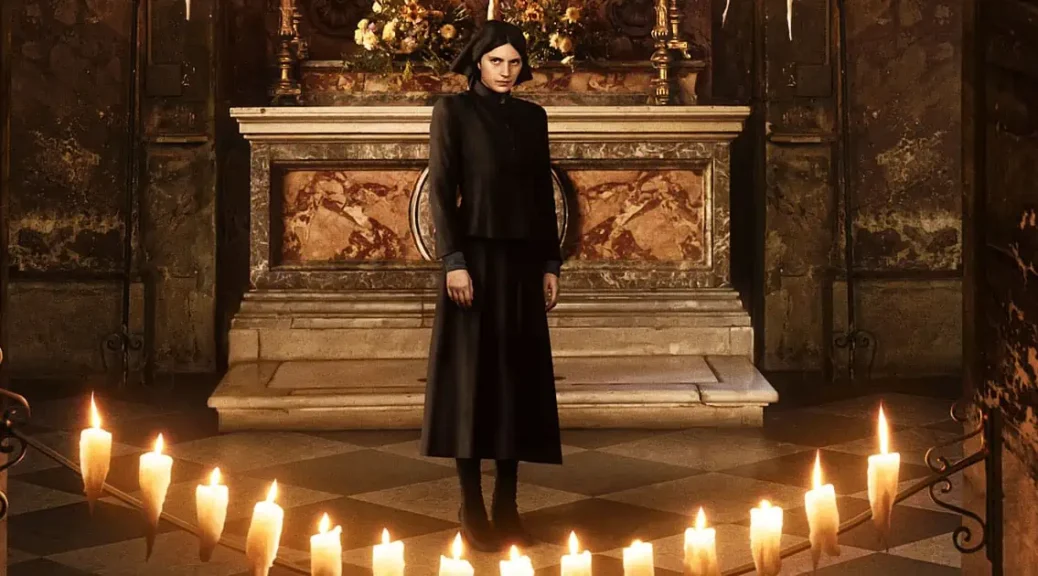
Writer/director Barnaby Clay reimagines Hiroshi Teshigahara’s Oscar nominated 1964 classic The Woman in the Dunes as a Pacific Northwestern horror in The Seeding.

A man (Scott Haze, What Josiah Saw, Antlers) drives out to the desert for the best possible photos of a solar eclipse. He leaves his car, hikes a good way, gets the photos, and heads back to his car, but he’s sidetracked by a boy crying that he’s lost. The boy then gets the man lost. Eventually, alone and thirsty, the man climbs down a rope ladder into a gorge to ask a woman (Kate Lyn Sheil, She Dies Tomorrow) in the lone house for aid.

Next thing you know, the rope ladder is gone.

Like Teshigahara’s film, The Seeding examines the existential crisis of purposelessness and lack of freedom. But Clay’s film is definitely American in that the roots of the entrapment speak more of something monstrous and primal in the wilds of the nation’s last unconquered spaces.

This works to an extent. Haze is solid, if not particularly sympathetic, as frustration turns to terror, then to horror. Sheil’s enigmatic performance suits a character whose motivation and perspective are concealed.

The couple’s story is complicated by the taunts from a gaggle of sadistic boys roaming the rim of the gorge. Here Clay veers from Teshigahara’s path and into something closer to The Hills Have Eyes and declares the film horror. There’s also some vaguely Lovecraftian imagery, as if these feral desert dwellers worship something far older and more cosmic than this man could understand.

It sounds like an interesting meshing of ideas, but if comes off as a bit of a sloppy mess.

Clay, known primarily for directing music videos, nabs a handful of really impressive shots. And both leads benefit from a single opportunity to outright break down, which both do quite impressively.

But the film is too impatient. Clay reexamines an existential nightmare addressed many times (I’m Not Scared, John and the Hole) and turns to a mixed bag of horror tropes to limit its impact.

Fire Down Below

I.S.S.

by Hope Madden

When you watch a Gabriela Cowperthwaite movie, you never fully forget her background in documentary. And while none of her narrative films possess the same vitality of her 2013 doc Blackfish, each film’s lived-in detail gives it authenticity that serves a purpose.

Her latest seals you up inside the International Space Station with three Russian cosmonauts and three American astronauts as the world below devolves into a nuclear battle between the two nations.

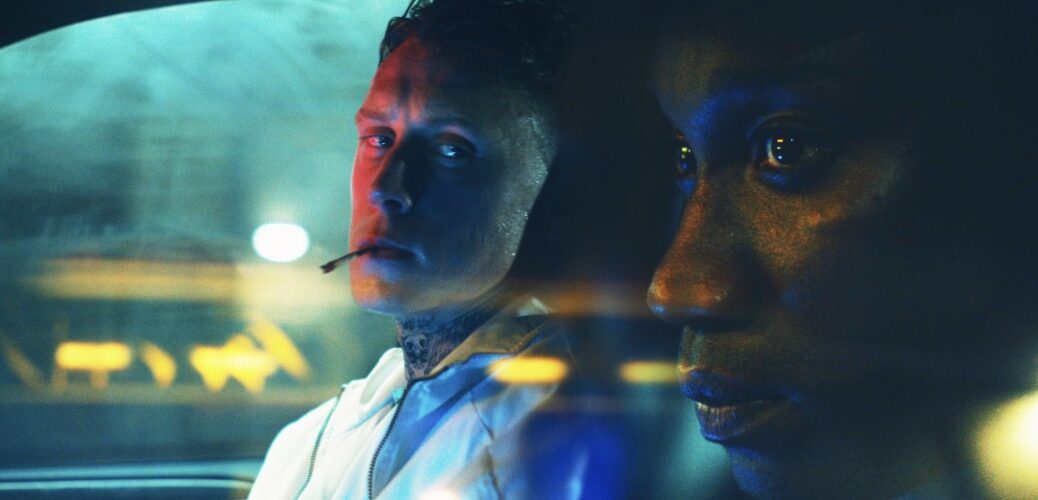
I.S.S. introduces new science officer Dr. Kira Foster (Ariana DeBose) to a close-knit group who’s shared cramped quarters for years. First Officer of the American unit Gordon (Chris Messina) is levelheaded and caring. Weronika (Masha Mashkova) and Gordon move quickly to help Kira feel at home.

Until word comes from below. Each side has been ordered to “take I.S.S. under any circumstances.” In cramped confines and awkward conditions, a handful of people hide and seek and figure out who can and can’t be trusted.

Tight space, small group, big stakes – it seems like an excellent premise, but Cowperthwaite, from a script by Nick Shafir, doesn’t have a lot of spare parts to work with.

She makes up for much of what’s missing with camera work. She and cinematographer Nick Remy Matthews (Hotel Mumbai) employ simple but effective tricks to ramp up tension.

Matthews’s camera floats in and around the zero-gravity quarters while security footage – stable and in b/w – makes you feel as if you’re sneaking a peek at something that you’re not supposed to see. The two styles collaborate to generate dread and a sense of helplessness.

Footage of the brief adventure outside the craft is generally quite impressive – it’s no Cuarón, but it does look good.

Messina and Pilou Asbæk (as conflicted cosmonaut Alexey) deliver the most complete performances, full of regret and humanity.

DeBose is hamstrung between heroism and naivete. Her dialog is often less logical than it is convenient. Jim Gallagher Jr. telegraphs his position in the shifting drama from his first moment onscreen.

Worse still, somehow the whole film feels anticlimactic. The danger never feels real, and the pointlessness of success is never even addressed. It’s a misfire from a reliable filmmaker and a middling effort in the “terror in space” subgenre.

Meeting of Minds

Freud’s Last Session

by Christie Robb

Freud’s Last Session imagines the lengthy conversation that might have taken place had a young C.S. Lewis (author of the Chronicles of Narnia) taken a train down from Oxford to meet up with a dying Sigmund Freud to debate the existence of God.

It could have happened. An anonymous Oxford don did apparently chat with Freud toward the end of his life in 1939, right as England was declaring war on Hitler’s Germany. But history didn’t record the identity of the scholar.

Freud, the man behind the field of psychoanalysis, is a committed atheist and he’s keen to talk to Lewis (already a published author and famous Christian about town) about the origins and inner workings of a faith he’d come to as an adult.

Freud is played by Anthony Hopkins (who once played C.S. Lewis beautifully in 1993’s Shadowlands). He delivers the layered and nuanced performance you’d expect from someone as talented as Hopkins. Still, it manages to feel that he’s giving you Freud’s greatest hits instead of plumbing the depth of this controversial and legendary figure. (He’s shown chomping a cigar talking about regressing to his oral stage of development and absentmindedly fiddling with a pair of scissors after discussing the fear of castration.) But that’s not Hopkins’ fault. Hopkins finds both the fear and the playfulness sprinkled amidst the theory.

Matthew Goode plays Lewis and he is good. He manages to hold his own with Hopkins. Unfortunately, he doesn’t have nearly as much material to work with. He doesn’t expand much about Lewis’s philosophy. Hopkins gets all the best lines.

Freud’s Last Session is adapted from a stage play and you can feel the director/co-writer Matt Brown (The Man Who Knew Infinity) struggling with that legacy.

The film is beautifully set, almost a Pinterest board of all things Dark Academia. It’s shot in chiaroscuro—a high contrast technique that sets off a highlighted subject against a dark background. Perfect lighting for weighty discussions about the legacy of war, why bad things happen to good people, and why one’s daughter feels compelled to tell one about her genderbending S&M fantasies.

To adapt the material to film, Brown makes use of cutaways to what is happening elsewhere while the men chat—whether that is what is happening on the same day but elsewhere or flashbacks.

We see an overburdened Anna Freud (the doctor’s daughter, not his wife, although you’d certainly be forgiven for mistaking her for a spouse given the way the old man treats her) and flashbacks to the two central men’s formative years. However, the cutaways interrupt the flow of the debate. Although sometimes beautiful, they seem like a deflection and distraction from what might have been weightier revelations—like the subject was changed right as we were getting to the good stuff. 

In the end, the film seems like a beautifully composed thought experiment, but it doesn’t exactly make for a satisfying story.

When You’re Alone

All of Us Strangers

by Hope Madden

Loneliness can be self-imposed, but that doesn’t make it any easier to overcome.

Adam (Andrew Scott) is alone. A writer living in a London high rise that’s still under construction, his solitary days bleed into his solitary nights, 80s hits on video and vinyl his main companions.

Adam is trying to write about his parents, so he decides to leave his flat, take a train, and revisit his old neighborhood. And soon his solitary days turn into afternoons spent with his parents (Claire Foy and Jamie Bell) and nights spent with his only neighbor, Harry (Paul Mescal).

What follows is a beautiful, melancholy meditation on reconciling your love for someone who has failed you, recognizing their love for you and their failure.

Scott doesn’t anchor the film as much as he haunts it with a turn that’s achingly tender and forgiving. Meanwhile, Mescal delivers another beautifully wounded performance, raw with emotion and sensuality.

Foy is a delightful change of pace, conflicted and unsure, and Bell stands out as the dad you really want him to be: honest, culpable, sorry, deeply loving.

Writer/director Andrew Haigh (45 Years) expertly weaves the lonesomeness of childhood traumas, as misunderstood and overwhelming as they can be, with personal identity. What of your traumas created who you are? What of who you are created your traumas?

Though never illogical, logic itself is far from the driving principle in Haigh’s storytelling. Emotional honesty, perhaps. Desire, certainly.

All of Us Strangers is a tough film to summarize and even tougher to categorize. It exists in a dream state bound by loss and isolation. Naturally, the only way to puncture that atmosphere is with love.

In many ways, this film should not work. Genre elements litter the script that, told by any other filmmaker, would run either maudlin or cheesy. But Haigh’s hypnotic touch creates a tone equally honest and obscure yet full of wonder. It’s also utterly devastating.

Hiding in Plain Sight

Origin

by George Wolf

Origin is so loaded with theories, facts and history, you may wonder why writer/director Ava DuVernay didn’t just make the film a documentary. After all, 2016’s 13th showed DuVernay can certainly command the genre.

I’m guessing she gives us the answer with a telling line of dialog: “Real people, real things.”

The main character, Isabel Wilkerson, is a real, extraordinary person, and author of the source book, “Caste: The Origins of Our Discontent.” And the film works as well as it does because of how well DuVernay unveils both the results of Wilkerson’s work and the personal journey that made it possible.

Aunjanue Ellis-Taylor’s tremendous turn as Wilkerson doesn’t hurt, either.

We first meet Wilkerson shortly after the news of Trayvon Martin’s murder first breaks. The Pulitzer Prize-winning journalist is looking to take some time off to care for her elderly mother, but her colleagues (Blair Underwood, Vera Farmiga) are hoping she can address the issue in print.

Even Wilkerson’s husband Brett (a wonderful Jon Bernthal) thinks she’s happier working, but Isabel is hesitant.

“I don’t write questions, I write answers,” she explains. And Isabel finds many lingering questions in the Martin murder, the Charlottesville tragedy, and the increasing drumbeat of fascism in America. Her mind is restless, because while racism is a symptom, using it as “a primary language to understand everything isn’t sufficient.”

But as Isabel suffers heartache and loss in her personal life, she researches history in Germany, India, and America’s Deep South to find the connective tissue she sought – caste systems perpetuated through unending violence until they’re accepted as the natural order.

DuVernay utilizes Wilkerson’s classroom presentations, conversations with her cousin Marion (Niecy Nash, terrific) and fact-finding interviews as sufficiently organic vehicles for flashback. The history lessons are rife with discovery and heartbreak, and compelling enough to keep a firm grip on your attention.

There are flashbacks to Isabel’s personal history as well, including a look at her relationship with Brett that is tender, funny and poignant, buoyed by the sweet chemistry between Ellis-Taylor and Bernthal.

And though the third act can get especially lecture heavy, the material works as a narrative whole because DuVernay finds her own layer of tissue that connects us to both the real people and the real things.

The cycle of trauma -be it personal or systemic – can only be broken by confronting it. Origin confronts it with questions and answers, humanity and inhumanity, in ways compelling enough to change the very way we look at the world around us.