Category Archives: New In Theaters

Reviews of what’s out now

A Powerful Quest


by Richard Ades


Focusing on a young girl who masquerades as someone she’s not, Wadjda takes aim at the patriarchal elements of Saudi Arabia, where a conservative interpretation of Islam prevents women from even obtaining driver’s licenses. 

Wadjda (an irresistible Waad Mohammed) is easy to spot in her all-girl school—she’s the one wearing worn sneakers under her ankle-length uniform. Though she would be a typical preteen in most parts of the world, Wadjda’s love of pop music and her tomboyish adventures with boy pal Abdullah (Abdullrahman Al Gohani) mark her as a rebel in the school’s repressive atmosphere.

Then two things happen that change her life: (1) She spots a beautiful bicycle that she decides she must have, even though cycling is considered hazardous to a girl’s virtue. And (2) the school announces a Quran competition whose prize money is almost identical to the bike’s cost. The enterprising girl immediately undertakes a study of Islam’s holy book, fooling the school’s staff into thinking she’s suddenly found religion.

Directed by Haifaa Al Mansour, the film also focuses on Wadjda’s mother (Reem Abdullah), a woman with her own set of problems. She attempts to live by her society’s strict rules, which mean covering up from head to toe and hiring a foreign-born driver when she wants to venture outside the home. But she’s increasingly feeling the sting of patriarchy, particularly because her loving but largely absent husband (Sultan Al Asaaf) is planning to take a second wife who can give him the son he needs to carry on his bloodline.

The mother’s emotional conflicts are shown in subtle ways, as in the primping she engages in before putting on a garment that hides her handiwork from the public. Similarly, Wadjda’s feelings toward her situation—her father’s imminent remarriage and the increasing strictures she’s expected to follow—must be gleaned from her expressive eyes.

Wadjda carries two distinctions: It’s the first full-length film made entirely in Saudi Arabia, and it’s the first feature directed by a Saudi woman. But its most important distinction is the disarming and subtly powerful way in which it depicts the ordeal of growing up female in a patriarchal society.

 

Verdict-5-0-Stars


Richard Ades covers theater and film at Columbustheater.org.
 

Sex, Drugs, No Rock and Roll


by George Wolf


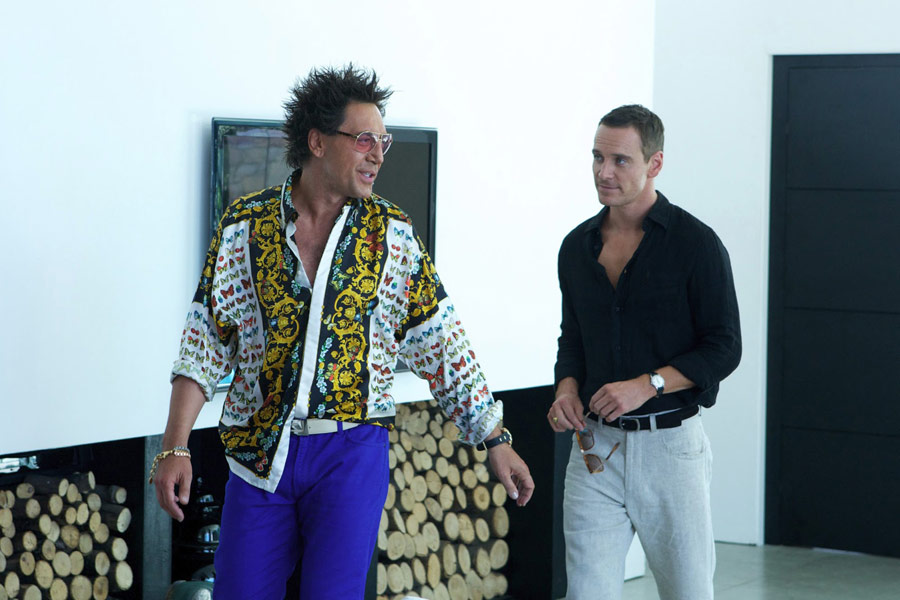
So, you may have heard there’s a new film starring Brad Pitt, Michael Fassbender, Javier Bardem, and Penelope Cruz, that is directed by Ridley Scott.

Serious talent, right?

Well, did I mention it also features the first original screenplay by Cormac McCarthy, one of the greatest writers alive?

No doubt, The Counselor seems like a natural, but while it may not be a complete whiff, it’s an uneven reminder that even the biggest hitters can foul one off at crunch time.

McCarthy, author of No Country for Old Men, The Road, and All the Pretty Horses, revisits familiar themes and favorite locales for the story of a naive attorney who ignores warnings to stay out of the drug trafficking business.

Fassbender is the never-named counselor, newly engaged to Laura (Cruz) and apparently living a bit beyond his means. His professional dealings with Reiner (Bardem) and his mysterious girlfriend Malkina (Cameron Diaz) introduce the counselor to the riches possible in the drug trade, and he is seduced enough to want in.

Of course, this is not a wise move.

The message here is accepting the results of the choices we make, and realizing our shared culpability for the ugly worlds we try to ignore. When these messages hit, they hit hard, but they are too often obscured but too many grandiose speeches and WTF? distractions.

From seemingly nowhere, the focus shifts to the kinky sex favored by Malkina, and Diaz, the weak link in an otherwise stellar cast,  pushes the vamp meter to the edge of comedy.

As eloquent as McCartny can be, his screenplay features overlong wordplay, and too many moments of obvious foreshadowing. When the counselor (and, by extension, the audience) is graphically told about certain methods the drug cartels use for killing, you know these methods are in someone’s immediate future.

Scott sets his scenes well, and is able to sustain fair amounts of tension and dread from the dangers that often remain out of sight, a formula that worked to perfection in No Country for Old Men.

Here, though, the overall effect is undercut by too many characters with unclear connections. The Counselor is a film with too much of just about everything, and ironically, a tale that might have worked better in book form.


Verdict-3-0-Stars


Grandpa’s Off His Meds Again!


by Hope Madden


If you can look past the entire scenes that Bad Grandpa lifts from Borat, Pee-wee’s Big Adventure, and Little Miss Sunshine, you might see two things:   1) A lot of Columbus, Ohio  2) A decent little comedy.

A Jackass production, the film operates Borat-style, as “grandpa” has to drive cross-country to deliver his grandson to a sketchy father. The two stop periodically along the way to convince polite Midwesterners, such as the kindly folks at my neighborhood diner Paul’s 5th Avenue (don’t you dare call it Paul’s Pantry!) that both man and boy are behaving very badly.

There are some really inspired moments, as well as a lot of asinine entertainment. Part of what makes the film work as well as it does is the obvious delight Johnny Knoxville, playing Grandpa Irving, takes in his young co-star Jackson Nicoll. And why not? Nicoll is genuinely delightful.

The kid’s hilarious – a deadpan genius – and Knoxville makes excellent use of his wee accomplice as well as some pretty effective old man make up to prank the unsuspecting grocery clerk, stripper, biker, mover, mourner, wedding guest, and Grandview Heights restaurant patron.

The film’s antics are mild when compared to the rest of the esteemed Jackass canon, and connecting them with a narrative sometimes works but often doesn’t. The same can be said for the string of hanging-testicle sight gags.

Bad Grandpa often feels forced and a bit derivative, but when it hits, it’s hilarious and there’s no denying the joyous chemistry of the two leads. Their giddy charisma is infectious, and it makes for a shamefully enjoyable waste of 90 minutes. (But be sure to waste the full 90 as the outtakes and behind-the-scenes shots are characteristically amusing.)


Verdict-3-0-Stars


What’s in a Name?

Carrie

by Hope Madden

Back in ’76, Brian De Palma brought Stephen King’s first novel, Carrie, to the screen and a terrifying vision of persecution and comeuppance emerged. But that was almost twenty five years before Columbine, and the image of the bullied and confused wreaking bloody revenge at a high school has taken on a different tenor.

That’s no doubt why King’s tale made its way to television in 2002 with a fresh take on the horror. But things in high school have changed again, and the story of Carrie White takes on particular tragedy in a wired time where another innocent high school girl takes her life almost weekly due to bullying. Perhaps that’s what drew filmmaker Kimberly Pierce, whose Boys Don’t Cry also outlines the tragedy that befalls a young woman violently unaccepted for who she is.

In Pierce’s hands, Carrie offers more stripped down drama – none of the scenery chewing of the De Palma original. There’s no humor to be found in the reboot, but realistic performances and updated context give the film enough bite to keep you watching.

Chloe Grace Moretz takes on lead duties as the youngster whose first monthly flow triggers all manner of havoc, from the most unconscionable bullying to telekentic powers. Oh, and her mom tries to kill her. So, not the blessing those Health Ed books try to tell us it is.

Moretz has a big prom dress to fill, and though she has always been a reliable talent, her turn here is unconvincing. Sissy Spacek truly was that innocent, a girl so repressed by her religious mother that she had no conscious knowledge of appropriate social behavior. Moretz is a cute, shy girl the mean kids dislike. It’s not the same.

The always exquisite Julianne Moore actually has an even larger task cut out for her. The role of Margaret White is a juicy one. Even the TV version drew the great Patricia Clarkson to the project. And Moore is characteristically strong, clearly defining the role in a terrifying yet almost sympathetic way. But she’s no Piper Laurie.

Laurie brought such vitality and insanity to the role that the prom became almost secondary, and her chemistry with Spacek was eerily perfect.

The updated context casts a truly saddening shadow over the film, making a major thematic adjustment without even trying. Stephen King wrote a story about hysteria over the dawning of womanhood. But today, the story carries an even darker message. Carrie is a cautionary tale about sending your kids to high school.


Verdict-3-0-Stars

Sound Familiar?

A.C.O.D. (Adult Children of Divorce)

by Hope Madden

A.C.O.D. takes a comical look at an actual phenomenon. Today’s adults are the first generation of people most likely to have grown up in a broken home, or as the film sees it, “The least parented generation ever.” So, what’s that like?

It’s fascinating and true, and it’s as if screenwriters Ben Charlin and Stu Zicherman (who also directs) are so geeked to be the first folks to think of this that they weave that discoverer’s excitement into the script itself. It gives the film a cynical yet giddy, self-reflexive joy that’s contagious.

The film is a sort of anthropological study told from the inside out. Carter (Adam Scott) is our subject. He’s a successful, perhaps uptight restaurateur and survivor of one of the most acrimonious and hellish parental divorces of all time. But in his adulthood he’s managed to manage his parents – played gloriously by Richard Jenkins and Catherine O’Hara.

But now his little brother is engaged, and Carter must try to get both parents into the same room without killing each other.

Things unravel in a string of heartfelt and humorous surprises; all the while, the researcher who made her career studying children of divorce (Carter, in particular) now wants to resurface with a look at this brand new generation of adults.

The always weird Jane Lynch portrays the researcher in a sort of guardian angel/maybe really the devil sort of role. She appears periodically, manipulates, guides, mocks – but is she really leading Carter to something positive in his life? Or is she just looking to profit from his misfortune? Or is she simply an incompetent wacko? Whichever, she’s a laugh riot.

The whole cast is great and Scott anchors the picture tenderly. Wisely untidy with a provocative ending, the film bucks convention, takes aim at societal preoccupation, generates plenty of sympathetic laughs and never feels smug. It’s not a genius work, but it is a fairly original and genuinely insightful comedy worth checking out.


Verdict-3-0-Stars

“Only the Mountain Knows”


by George Wolf


“Every cell in your body is screaming ‘oxygen…”

That’s how one climber describes her attempt to survive K2 in The Summit, a documentary that outlines, in gripping fashion, the deadliest day in the history of the world’s second tallest peak.

Everest may reach higher, but experienced mountaineers brand K2, along the border of China and Pakistan, as the most dangerous climb there is, evidenced by a mortality rate greater than that of playing Russian roulette.

In the first two days of August 2008, eleven climbers lost their lives in a series of events that is still not fully understood. Director Nick Ryan weaves together interviews, outstanding reenactments and some thrilling archival footage to put you about as close to the danger as you’ll ever want to be.

Working with skilled doc writer Mark Monroe (The Cove/Chasing Ice), Ryan is not only able to convey the enormity of the challenge, but also the universal themes and human frailties that follow each climber.

While the drama plays out, there are inevitable clashes of risk and responsibility, of sacrifice and reward. When the survivors struggle for explanations, there are conflicting accounts and pointed accusations. As one climber explains, “only the mountain knows.”

The film does struggle with a few occasions of possible confusion, as there are frequent switches in time and location as the climb becomes more perilous.

Those moments aside, The Summit is an engrossing, often pulse-pounding experience that demands a big screen viewing.


Verdict-3-5-Stars


Privacy Versus Transparency: Discuss

The Fifth Estate

by Hope Madden

The Fifth Estate tries to be a lot of things: a character study, an international thriller, a magnifying glass on the eternally combustible definition of journalism. Had its focus been less fragmented, a powerful film might have emerged.

Back in 2006, an Australian Internet activist launched a website with the goal of sharing classified documents globally by making it impossible to trace sources. He believed he was protecting the whistleblowers. As Oscar Wilde and Julian Assange say: Give a man a mask and he will tell you the truth.

Assange (Benedict Cumberbatch) was that charismatic “hacktivist”, and he soon collected a handful of loyal underlings, as well as 1.2 million classified documents.

Within months, Assange and crew were in hot water with the US government, among others, as their unfiltered version of journalism begged the question: Are there things that should not be shared with the public?

It’s a fascinating debate centered around an intriguing figure, but director Bill Condon can’t manage what David Fincher made look so easy: tell a socially relevant tale about how technology is revolutionizing our lives, anchor the story with a fascinating yet oh-so-nerdy character, and keep away from the death trap image of a guy at a keyboard. Because The Fifth Estate and The Social Network are essentially the same story.

Sure, no one died because of Facebook, but otherwise, it’s the look-alike tale of a social misfit, his zeal and brains and toxic insecurities, and the friends he hurt in the name of success. But Condon’s story contains a built-in excitement the Zuckerberg story couldn’t hope to reach.

Perhaps Condon put too much faith in screenwriter Josh Singer, a scribe primarily known for work in TV. Singer adapts two nonfiction titles on the topic, which may account for the splintered vision. His script too often tells rather than shows, relies on the most obvious kind of shorthand to explain Assange’s personal baggage, and offers ham-fisted proclamations to drive points home.

Condon doesn’t help matters with unfortunate and thematically misplaced dream sequences.

To his credit, Condon certainly cast the picture well. Cumberbatch owns the film. He is characteristically wonderful, bringing life to the ego, charisma and insecurity that mark a zealot. The yin to his yang, Daniel Bruhl offers his second excellent performance of the season (after his award-worthy turn in Rush) as the level-headed line around Assange’s chaos.

The underused but magnificent Laura Linney and Stanley Tucci also help keep the film entertaining. In fact, the strong performances are reason enough to spend some time with the film, but given the source material, the pull should be more compelling.


Verdict-3-0-Stars


http://www.youtube.com/watch?v=ZT1wb8_tcYU

Tonight There’s Gonna be a Jailbreak!


by George Wolf


As nonsensical, potentially offensive and completely ridiculous as it is, Escape Plan does enough things right to render it more entertaining that you might expect.

Think of it as residing in the Face/Off neighborhood, where a film embraces its outlandishness so convincingly you eventually surrender under the weight of the escapist fun to be had.

Of course, that film had two of the all-time greatest hambones, John Travolta and Nicolas Cage, operating at maximus overacti. Escape Plan has Stallone and Schwarzenegger, two aging action stars trying to prove they still have box office juice.

To its credit, the film doesn’t even address the age factor, even though it is very easy to imagine stars such as Dwayne Johnson and Mark Wahlberg in the lead roles.

Sly is introduced as Ray Breslin, the leading expert in structural security. He routinely puts his skills to the test by assuming the identities of inmates in various prisons and then going full MacGuyver to expose security weaknesses by busting out with little more than toilet paper and a used carton of chocolate milk.

Breslin’s firm gets an outlandishly lucrative offer to test the limits of a…cough, cough…”off the grid,” black-ops type prison in an undisclosed location. Despite concerns from his co-workers, Breslin goes in, realizing almost immediately he’s been set up, and must enlist the help of a mysterious new friend on the inside (Arnold) to break out for reals.

Director Mikael Hafstrom (The Rite/Derailed) wisely chooses to keep matters focused on action and away from any cheesy attempts at tongue in cheek humor. Less successful are his depictions of Muslim inmates and scenes of enhanced interrogation.

Giving the film a “Blackwater” setting may have been an attempt by screenwriters Miles Chapman and Jason Keller to address a timely topic. Instead, they toss the dark realities of torture around so flippantly the film comes dangerously close to making light of the entire issue. Muslim stereotypes don’t help either.

Still, there’s action aplenty amid some clever twists, an effective supporting cast (Amy Ryan, Sam Neill, Vincent D’Onofrio and a surprisingly emotive Jim Caviezel), and Arnold, at least, seems to be having a blast getting back in the saddle.

Maybe they’re not too old for this shit.


Verdict-2-5-Stars


Machete Bores


by George Wolf


So disappointing.

The legend of Machete began in 2007, with director Robert Rodriguez‘s standout faux trailer in Grindhouse. That trailer screamed for an actual feature, and Rodriguez obliged in 2010 with Machete, a wonderful homage to 70s exploitation films.

The original had many things going for it, but Machete‘s secret weapon was what it didn’t have:  comic parody.

Sadly, that is all Machete Kills is interested in offering.

Danny Trejo is back as the titular badass, but this time his exploits deteriorate into an Austin Powers-type mission to thwart the plans of a Dr. Evil-type madman (Mel Gibson). Nothing feels like a hat-tip to the genre, especially the female characters, scripted this time with less fun and more degradation. It is all so incredibly dumb and misguided that an hour and forty minute running time feels like twice that.

Just weeks ago, Kick-Ass 2 failed in a similar fashion, as new filmmakers took over the franchise and completely abandoned everything that made the source film so worthy.

The demise of Machete Kills is a little harder to understand, as Rodriguez is back to direct, and, as in Machete, the screen is filled with wild casting choices (Carlos Estevez aka Charlie Sheen, Cuba Gooding, Jr, Sofia Vergara, Lady Gaga). The screenplay, duties, though, this time fall to newcomer Kyle Ward, which raises some questions.

How old is he? Did he even see the original Machete? Why did Rodriguez accept this travesty?

Machete in space?

Noooooooooooooo!


Verdict-1-5-Stars


http://www.youtube.com/watch?v=BO1WwOQowlg

A Skipper Brave and Sure


by George Wolf


If the story of Captain Phillips wasn’t true, someone in Hollywood would have dreamed it up for a new Paul Greengrass adventure film starring Tom Hanks. That movie would have been pretty good.

The reality-based version, though, is pretty great.

In 2009, Phillips was at the helm of the Mearsk Alabama when it was attacked and boarded by Somali pirates. Failing to take control of the ship, the pirates took Phillips hostage, holding him in a lifeboat for days until a Navy SEAL team did what Navy SEALs do.

As this is not a documentary, some of the details may be exaggerated, a fact which takes nothing away from the film’s effectiveness. Greengrass (The Bourne Supremacy and Ultimatum, United 93) utilizes the shaky camera movements and extreme closeups he’s known for to create solid tension early on, and then to slowly increase the pressure as events unfold.

In much the same vein as the fact- based films Argo and Zero Dark Thirty, Captain Phillips chronicles a crisis from recent history, and tells the story well enough to make you bite your nails over an outcome you already know.

Ironically, that story gets off to a bit of a rocky start. In setting up a contrast between the respective worlds of Phillips and the lead pirate Muse (Barkhad Abdi, in a stunning acting debut), Greengrass and screenwriter Billy Ray (The Hunger Games, State of Play) seem a bit hurried.

Not only is Phillips’s pre-trip routine very reminiscent of Hanks’s pre-flight scenes in Castaway, but, more importantly, in attempting to explain the attack, the opening minutes skirt with reducing the entire ordeal to little more than black savages against white heroes.

If you’ll pardon the pun, the ship is righted once the attack begins. From the moment Phillips spies the pirate boat through his binoculars, the tension is palpable. Greengrass creates an effective hide-and-seek between the pirates and the crew of the Alabama, culminating with the capture of Phillips himself.

The claustrophobic depiction of the days inside the lifeboat, mixed with scenes of a rescue being planned and implemented are nothing short of gripping, as Hanks delivers what is possibly the best work of his career.

His status as Hollywood heavyweight and all around swell guy has at times made it easy to forget that Hanks is damn good. This performance slaps the memory back into you. Hanks gives Phillips the humanity needed to ground a tale such as this, and drives the entire film into your psyche with one of the finest depictions of post-trauma shock ever seen on film.

By the time you are breathing a sigh of relief, you can’t imagine the story of Captain Phillips in better hands.


Verdict-4-0-Stars


http://www.youtube.com/watch?v=Sp6jpeDeQmE