Category Archives: New In Theaters

Reviews of what’s out now

Meet Me at the Crossroads

Two Trains Runnin’

by George Wolf

Why would two different sets of white college boys head into the deep South in the summer of 1964 and go searching for long lost bluesmen?

“We were either brave, stupid, or uninformed.”

Two Trains Runnin’, director Samuel D. Pollard’s engrossing documentary on the convergence of separate journeys, shows them to be all three.

In June of ’64, the boys were privileged enough to be unaware of the Mississippi Summer Project, which aimed to bring voter registration to as many African-American Mississippians as possible. Like historical embodiments of Steve Buscemi’s music nerd in Ghost World, they were all obsessed with Delta blues, and most specifically, with two legends of the genre who had all but disappeared.

A group from California set out in search of Skip James (though no known photographs of James even existed), while “three Jews in a VW Bug with New York plates” went south to follow clues that might lead them to Eddie “Son” House (someone maybe saw him leave a theater). Maps are laid out like dueling ascents on Everest, and Pollard utilizes first-person interviews, stylized graphics, animated re-creations and, of course, stirring blues music to unite the paths of the “two trains” headed to Mississippi.

The boys were drawn to these performers through powerful expressions of both the “source and cure” of a torment light years away from their postwar suburbia. Outside the comforts of home, they found the raging racial torment of beatings, bombings, and murder, with a view that they themselves were just more outsiders coming to “give the vote to the blacks.” It is on this point that Pollard makes his subtle pivot, and the film strengthens the current of shared humanity running through it.

Featuring graceful narration from Common and contemporary Delta blues performances by Valerie June, Gary Clark, Jr., Lucinda Williams and others, Pollard has crafted a rousing bookend to Bill Guttentag and Dan Sturman’s 2009 documentary Soundtrack for a Revolution. The music is the message and the message is the music, and Two Trains Runnin’ becomes both a sober reminder that the fight continues, and an uplifting ode to fight on.

Verdict-4-0-Stars


https://www.youtube.com/watch?v=pvjHLxliFAg


Jiggidy Jog

Home Again

by Hope Madden

Let’s say you love Nancy Meyers’s movies – you know, those fantasies like It’s Complicated or Something’s Gotta Give where late-middle-aged women land all the attention, sex, career opportunities and marital comeuppance they’ve always really deserved, only to realize that they had it all in them the whole time. Let’s say you love those, but you’d like them to skew maybe 15 – 20 years younger.

Boy howdy, is Home Again the movie for you.

Written and directed by Meyers’s daughter Hallie Meyers-Shyer, it spins a familiar, albeit younger, yarn.

Newly single, freshly 40, gorgeous, living in an unbelievable house and raising two precocious and adorable kids – man, does Alice Kinney (Reese Witherspoon) have it rough.

One contrivance leads to another and suddenly three Hollywood dreamers in the form of gorgeous twentysomething dudes hoping to realize their moviemaking ambitions are living in her guest house.

Why not? I mean, except for the high potential for murder and/or child molestation, but this isn’t that kind of movie. This is the kind that would never happen.

What will happen when Alice’s  estranged husband (Michael Sheen) comes home unexpectedly?

Gasp – do you think he’ll finally see how special she is? Will she hear all those things she’s wanted to hear from him for years? Will it work, or will she slowly realize that she deserves better?

Hell, she deserves it all!

I will tell you who deserves better—besides the audience—Reese Witherspoon.

How great was she earlier this year in HBO’s Big Little Lies? Well, she’s not great here. She coasts along with awkward and/or appreciative faces. She does have some fun chemistry with the underused (but always welcome) Candice Bergen.

None, surprisingly, with the usually reliable Sheen and less than none with the trio of hotties (Nat Wolff, Pico Alexander and Jon Rudnitsky) taking up residence.

It doesn’t help that those actors are bland (Wolff) to middling (Alexander) to weak (Rudnitsky).

No problem appears to be especially troubling, no solution feels earned, no relationship looks authentic. Even Nancy Meyers’s most self-indulgent work had a hard earned charm about it.

What Home Again needed was a different Meyers. That or a scary clown.


Innocence Lost

Crown Heights

by George Wolf

An innocent man is convicted of murder and sent to prison. For decades, his appeals are ignored while family members refuse to give up hope. Tragically, Crown Heights tells a story we have seen before, and while the film’s commitment is never lacking, a true depth of feeling is never quite realized.

Writer/director Matt Ruskin adapts the true story of Colin Warner, who spent twenty years in a maximum security prison for a crime he didn’t commit. The victim of mistaken identity, a backlog of cases, overzealous prosecutors and the systemic inequality of criminal justice, Warner became little more than a voiceless statistic, where “no matter what I say, nobody gonna listen.”

Ruskin is able to convey the enormity of all that is stacked against Warner, aided greatly by two stellar performances. As Warner, Lakeith Stanfield (Straight Outta Compton, Get Out) uncovers the desperate confusion of innocence, while Nnamdi Asomugha (also one of the film’s producers) is the picture of quiet strength as the friend who sees Warner’s plight as universal and refuses to give up on him.

Warner’s story is another tragic example of a nearly unthinkable wrong, and Crown Heights does plenty right with it. But too often, the film misses the chance to make any intimate details resonate or to cut its own path, settling instead for a well-assembled summary of gut-wrenching events.


Fun & Games

It

by Hope Madden

Clowns are fun, aren’t they?

Back in ’86, Stephen King released the novel It, about a bunch of New England kids plagued by a flesh-hungry monster who showed itself as whatever scared them the most. Like, say, a clown.

The basic premise of It is this: little kids are afraid of everything, and that’s just good thinking.

Four years later, It made its way to TV as a miniseries, the first episode of which is one of the most terrifying things ever to grace the small screen, much thanks to the unforgettable presence of Tim Curry as Pennywise the clown.

It’s been 27 years, and as the story itself dictates, the time has come for It to return.

The Derry, Maine “losers club” finds itself in 1988 in this adaptation, an era that not only brings the possibility of Part 2 much closer to present day, but it gives the pre-teen adventures a nostalgic and familiar quality.

Though The Goonies this is not. Nor is it made for TV.

This version shares a lot of tonal qualities with one of the best King adaptations, Stand By Me. Both are bittersweet tales of the early bonds that help you survive your own childhood.

Bill Skarsgård has the unenviable task of following a letter-perfect Curry in the role of Pennywise. Those are some big clown shoes to fill, but Skarsgård is up to the challenge. His Pennywise is more theatrical, more of an exploitation of all that’s inherently macabre and grotesque about clowns.

Is he better than the original? Let’s not get nutty here, but he is great.

He and the kids really make this work. The young cast is led by the always strong Jaeden Lieberher (Midnight Special), and he’s surrounded by very strong support. Sophia Lillis charms as the shiniest gem in the losers’ club, and Finn Wolfhard (that is a name!) is a scream as the foul mouthed class clown Richie.

The almost inexcusably cute Jackson Robert Scott is little, doomed Georgie, he of the yellow slicker.

In keeping with that Eighties theme, both characters cast as minorities—the Jewish Stanely Uris (Wyatt Oleff) and African American “Homeschool” Mike Hanlon (Chosen Jacobs)—are noticeably underwritten.

So, they weren’t perfect, but the team adapting for this go-round got a lot right.

The best Stephen King adaptations are those with writers who know how to prune and refocus. Luckily, newcomer Chase Palmer, longtime horror writer Gary Dauberman and, maybe most importantly, Cary Fukunaga (who wrote Beasts of No Nation) are on it.

The trio streamlines King’s more unwieldy plot turns and bloat, creating a much-appreciated focus.

Director Andy Muschietti shows great instinct for taking advantage of foreground, background and sound. Yes, It relies heavily on jump scares, but Muschietti’s approach to plumbing your fear has more depth than that and he manages your rising terror expertly.

Playing God

The Oath

by Hope Madden

A fight for alpha ensues with a rugged Icelandic backdrop in director Baltasar Kormákur’s latest, The Oath.

Kormákur, a filmmaker known for action-heavy thrillers, also stars as Finnur, a surgeon with some family troubles.

Though his young wife and small daughter seem picture-perfect, Finnur’s 18-year-old daughter from a previous marriage, Anna (Hera Hilmar), is spiraling out of control. An entitled party girl, her drug flirtation blossoms into a full-blown habit, much thanks to her love interest and dealer, Óttar (Gísli Örn Garðarsson).

Finnur’s increasingly reckless behavior, all aimed at removing Óttar from Anna’s life, points as much to a need for control as it does misdirected protectiveness. The film’s title refers to the surgeon’s oath never to play god – which, of course, surgeons do daily. It’s an occupational habit, though, that Finnur is bringing into his time outside the office.

As director, Kormákur works to make both men equally detestable and tender. Óttar is vulgar and brutish, but regardless of the havoc he wreaks or the horror he threatens as Finnur tries harder and harder to separate the lovers, his affection for Anna feels authentic.

Likewise, Finnur’s behavior oscillates between imprudent protectiveness and troubling malevolence. Kormákur’s performance is the picture of restraint, his conflict primarily dealt with internally. It robs the film of some excitement but delivers tension and urgency.

Though both male leads impress, it’s really Hilmar who leaves a mark. Vulnerable, naïve and headstrong, her Anna’s a perfectly frustrating culmination of post-adolescent volatility.

The Oath lacks the slick production values and audience-friendly narrative found primarily in Kormákur’s English-language product (2 Guns, Everest, Contraband), favoring grittier fare and more subdued energy. These are choices that benefit the story, although Kormákur struggles to maintain a tone that suits the tale.

Finnur’s behavior at a highly critical point feels nefarious in a way that doesn’t fit Kormákur’s characterization, and his actions are so atrocious that the resolution feels unsatisfyingly easy. The Oath dips into horror territory, not necessarily a bad thing, but the film can’t make its shifting approach feel anything but jarring – as if an entirely different film landed around Act 3, then vanished for the final reel or so.

Melodic and Ferocious

Beside Bowie: The Mick Ronson Story

by George Wolf

The last several years have seen a bevy of documentaries aiming to shine a light on musicians never given their due. From the backup singers in 20 Feet From Stardom, to the session musicians in The Wrecking Crew and Standing in the Shadows of Motown, and even the managers in Supermench and Lambert & Stamp, we see great artistry from talents who never became household names.

Classic rock enthusiasts may already know the name Mick Ronson as one of the original Spiders from Mars, but Beside Bowie pushes him out from the shadow of Ziggy Stardust. Director Jon Brewer makes an effective case for “Ronno” as the catalyst for Bowie’s harder-edged sound and a gifted, under appreciated producer/arranger for various other artists, most notably Mott the Hoople, Lou Reed and John Mellencamp.

Brewer, a music business and documentary veteran, weaves interviews, voiceovers and some nifty historical footage to paint Ronson as a somewhat casual genius who had little inkling of how much his “melodic and ferocious” playing would impress the young David Bowie in need of  a new guitarist.

Though the “Ziggy and the Spiders” phase would last a mere 18 months, its influence is still felt today, a result of Bowie’s legendary pivot from the “acoustic glam” of Hunky Dory to the hard-driving sound of Ziggy. The inspiration for that shift, according to Brewer and the succession of musicians he interviews, was Ronson.

Perhaps understandably, much of the film’s early going leans more Bowie than Ronson, but the most effective moments come later, when Brewer slows down long enough to clearly illustrate Ronson’s insightful contributions to iconic music.

Lou Reed listening to isolated instrumental tracks from his Transformer album (produced by Ronson and Bowie), Ian Hunter remembering how Ronson helped save Mott the Hoople, or Mellencamp crediting Ronson for the arrangement that made Jack and Diane a smash all add needed layers that resonate beyond the usual rock cliches.

The lack of any recent perspectives from Ronson, who died from liver cancer in 1993, is sadly evident, but Beside Bowie still succeeds in its mission: elevating the status of a talent that has long deserved elevating.


Sounds of America

Rumble: The Indians Who Rocked the World

by Rachel Willis

The history of indigenous people in America is one of erasure. Their contributions are overlooked, rewritten, or simply forgotten. In Rumble: The Indians Who Rocked the World, Catherine Bainbridge (and co-director Alfonso Maiorana) seeks to shed light on the American Indian musicians who helped form the sound of American music.

The documentary explores many aspects of indigenous influence in American music. It profiles individual artists, including Link Wray, Buffy Sainte-Marie, and Charlie Patton, among others, but also examines how traditional Indian music, specifically the music of the Mississippi delta, shaped rock and roll, blues, and the big band sound of the 1930’s.

With each artist profiled, there is a shift in narrative style. In some ways, this works as many of the musicians represent different genres of music. The shifts help to better highlight the hand indigenous peoples have had in multiple areas of American music. However, it also gives the film an episodic feel. One wonders if the material would have been better served as a multi-part television documentary.

Interviews with music historians and ethnologists help explain the evolution of traditional indigenous music into different aspects of rock and roll and blues. Vocal styles heard in recordings from 1907 can be heard again in the early blues of Charlie Patton. Many Americans consider these sounds to be the traditional sounds of African music, but the reality is more complex. The true history is one that blends cultures, with a heavy emphasis on American indigenous music. When one hears the comparison, it’s hard not to hear the traditional music of the American Indian in the blues.

Musicians like Iggy Pop, George Clinton, and Steve Van Zandt are also interviewed. They provide a context in which the early American Indian musicians influenced scores of famous bands and musicians. At times, it feels they’re revealing a secret that many in the music world know to the rest of us. They’ve known all along where the indigenous musicians fit into the history of music and they’re finally opening the eyes of the rest of us.

While the music history is interesting, the most important aspect of the film is what it gives to indigenous communities. It emphasizes their role in American history. It gives Indian kids heroes to emulate. It shows the rest of us that the culture of the American Indian exists within the fabric of what makes us all Americans. It’s the kind of documentary that deserves a wide audience.

Third Course

The Trip to Spain

by George Wolf

“I’m asking you if you’ll come with me.”

Steve Coogan may be inviting his travel buddy Rob Brydon to join another tasty road trip, but he may as well be asking us if we’re game to ride shotgun.

Once again it’s a witty, breezy, sometimes utterly hilarious getaway.

If you’re hip to The Trip, The Trip to Italy or even the original The Trip TV series, you know what’s coming. For the uninitiated, it’s Steve and Rob playing slightly fictionalized versions of themselves as they tour a particular region to sample the finest restaurants and write reviews for the U.K. Observer.

This time out The New York Times is in on the action, too, as our boys are off on The Trip to Spain. They’ll eat well, deliver sarcastic barbs (Rob: “We welcome Philomena back to the conversation, it’s been a good 5 or 6 minutes.”), and of course try to one up each other with dueling celebrity impersonations from Bowie to Brando and Mick Jagger doing Shakespeare.

But in Spain, Roger Moore becomes the new Michael Caine. After trading rapid-fire imitations, Steve detours into a lecture on the Spanish history of the Moors while Rob continues on as Roger.

It’s LMAO funny and the film’s most uproarious bit.

Director Michael Winterbottom is back for this third go ’round as well, and while you’re right to expect more of the same, all involved sense a need to deepen the characterizations.

Understandable, but ultimately a bit of a double edged sword.

There’s bittersweet humanity mined from how Steve and Rob have settled into separate lives, but as the running time begins to feel bloated, the sense that this premise is treading water makes the slightest of appearances.

Not enough to derail the journey, mind you. These boys are still good fun, and so is The Trip to Spain.


Goon Baby Goon

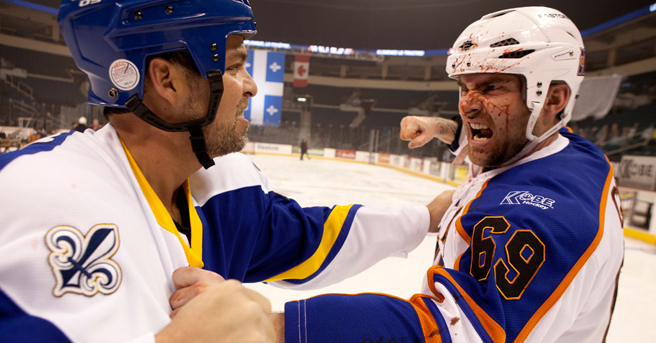
Goon: Last of the Enforcers

by George Wolf

Seven years ago, we got three successive blasts of fresh air released in roughly 18 months: Kick-Ass, Machete and Goon. Sequels for the first two quickly followed, each doomed by an approach that seemed oblivious to all that made their origin stories so appealing.

It’s taken quite a bit longer, but Goon: Last of the Enforcers is here to complete the unfortunate trifecta.

Lovable hockey goon/overall simpleton Doug Glatt (Seann William Scott) is touched to be named captain of his Halifax Highlanders squad, but when he’s beaten to a bloody mess by new goon on the block Anders Cain (Wyatt Russell), Doug faces some tough decisions.

His girl Eva (Alison Pill) is pregnant and really doesn’t want him fighting anymore, so Doug takes a sad gig handling “insurance documents.” But with his team in disarray and a familiar itch to scratch, Doug starts training with old foe Ross Rhea (Liev Schrieber) for a possible return to the ice.

Familiar sports movie cliches follow, but that’s not what makes this new Goon so disappointing. The problems come from forgetting to give us any authentic reasons to care about Doug, or any attempts at humor that rise above sophomoric.

Jay Baruchel returns as co-star/co-writer, and takes the big chair for his debut as a feature director. His vision falls well short of the bawdy bulls-eye the first film delivered, sorely missing the script input from original co-writer Evan Goldberg (Pineapple Express, This Is the End, Sausage Party, Superbad). Goldberg’s smart brand of humor is just what this film needs more of, as it relies instead on silly gags aiming for the lowest hanging fruit.

Also gone is the goon so easy to love. Doug is much too broadly drawn this time, reduced from a big-hearted brute we rooted for to a village idiot merely there to laugh at, not laugh with.

Goon was an underdog winner. Last of the Enforcers earns the penalty box.


Tale of Two Spitters

Patti Cake$

by George Wolf

Glamorous dreams in a hardscrabble town. Local rappers “spitting” in free-style battles, gunning for the neighborhood respect they that can’t get at home or work. A rousing hip-hop anthem showcasing star making talent.

Sure, Patti Cake$ often smells what 8 Mile was cooking, but writer/director Geremy Jasper’s feature debut is loaded with enough exuberant sincerity and earnest button-pushing to succeed on more levels than it probably should.

And since somebody mentioned star making, just try to turn your eyes away from Danielle Macdonald’s lead performance as Patti Dombrowski, a twenty-something bartender in New Jersey who stares across the river and dreams of NYC stardom.

While the kids still call her “Dumbo,” Patti calls herself “Killa P,” rapping her original rhymes with constant support from her pharmacist friend Jheri (Siddharth Dhananjay) and no support from her drunky mom Barb (Inside Amy Schumer’s Bridget Everett).

But when scary new musician friend “Antichrist” (Mamoudou Athie, The Get Down‘s Grandmaster Flash) turns out to be pretty handy with the beat boxes and recording equipment, a homemade CD just might punch Patti’s ticket out of Jersey poverty.

Macdonald, a television vet plenty worthy of this move to features, keeps the entire film grounded in authenticity, which is good, because this entire film needs some grounding in authenticity.

While contrived events and manipulative strings may be pulled around her, Patti’s daily struggles never feel false. The ways she deals with drunks at her bar, a potential new boss at a job interview, or the failing health or her grandmother (Cathy Moriarty, nice to see despite being too young for the role) are filled with a mix of exhausted resignation and cautious optimism well known to countless Americans just trying to get ahead.

Jasper throws in enough stylish dream sequences and weirdly awkward close ups to expose both his inexperience and potential. What Patti Cake$ lacks in originality is made up in creative spirit, because like Patti, Jasper is a talent dreaming big.

With Macdonald as a perfect muse, he’s making sure his own homemade CD has too much fairy tale pixie dust to ignore, with a final track too proudly shameless to resist.