Category Archives: New In Theaters

Reviews of what’s out now

Dramatic Art

Reefa

by Brandon Thomas

Based on a true story, Jessica Kavana Dornbusch’s Reefa explores a short period in the life of street artist Israel “Reefa” Hernandez.

As the film opens, the Hernandez family is about to get what many immigrant families can only dream of: their Green Cards. Originally from Colombia, the Hernandezes are in the United States – Miami to be specific –  as asylum seekers. Young Israel Hernandez has a potent love of art, and has become quite a well-known graffiti artist around the city. As Israel begins to think more about his future away from Miami and his family, the complexities of life as a young immigrant make themselves more and more evident. 

Reefa is the kind of film that proudly wears its heart on its sleeve. This has both positive and negative sides to it. The movie is charming and gets a lot of mileage out of the fantastic chemistry between the actors playing the Hernandez family. The same can be said of the cabal of young people playing Israel’s friends. These are the kinds of scenes that don’t necessarily move the narrative forward, but they do allow the characters to come alive in a way that many melodramatic plot threads do not.

While the majority of Reefa is tonally light, there’s an overarching sense of dread that cannot be ignored: whether it’s the constant state of worry felt by Israel’s parents over their status as refugees or the threat of an overzealous police officer who lets his disdain for immigrants be known. You know tragedy is coming – you just don’t know how. 

The film occasionally dips its toe into After School Special territory. The real story of Israel Hernandez is compelling enough, and the more embellished aspects added to the film have a phony feel to them. The shoe-horned romance between Israel and a New York model, Frankie (Clara McGregor), lacks any spark. The eventual conflict that arises in their relationship only highlights many of the weaker story issues in the script. 

The performances are generally quite good with Tyler Dean Flores impressing as the titular character. Veteran character actor Jose Zuniga (Con Air, Alive) delivers in a small, but impactful, role as Israel’s demanding father. The rest of the cast doesn’t leave the same impression, but they do well with the material provided. 

While not the most successful film it could be, Reefa still ends up serving as a touching tribute to a young man taken too soon.

Love Letter to a Genre

Sensation

by Phil Garrett

Martin Grof’s Sensation is a low-tech science fiction mystery/thriller that pulls together familiar plotlines and devices including a protagonist with a mysterious family history, people with superhuman abilities, research facilities, unknown threats, and the dynamic of the real world vs. the dream world. The film feels more than inspired by films such as Christopher Nolan’s Inception and Tenet, along with the superhuman sub-sub-genre.

The plot centers around Andrew (Eugene Simons, Game of Thrones), a young man with no knowledge of his family history, including his father’s identity. Andrew is drawn into a patchwork mystery after a strange and confrontational meeting with Dr. Marinus (Alastair G. Cumming), who delivers Andrew’s DNA test results. He is then followed by mysterious men in matching gray hats who disappear from the film as quickly as they appear. Marinus confronts him and explains that Andrew’s life is in danger and only by joining a secret research program to explore his superhuman sensory powers will he be safe.

Safe from whom? Good question. The veil of vagueness seems to be part of Grof’s attempt to build tension, but it plays as a trope in the boldest of terms, whether through familiar scenarios or bald dialogue that could be delivered by characters in any similar movie. 

Andrew heads off to a secret research facility in the remote English countryside at an appropriately gothic manor estate. There he meets the “enigmatic” Nadia (Emily Wyatt, the Rise of the Footsoldier franchise) who runs the program. We’re introduced to the research group, all of whom have different super-senses like Andrew, all drawn together for special training to learn, focus and sharpen their abilities, and all in danger from unknown forces.

Sound familiar? The double-secret secret of their powers? They can “receive information” via their senses, which is highly valued by, you guessed it, that vaguely defined threat.

The film weaves its way through scenes and sequences that, again, seem more than inspired by other films, delivered with that mix of vagueness and baldness we’ve become familiar with. The dramatic action plays out fairly flatly with huge exposition dumps dropped in at just the right time. The story heads down a spiral of interwoven plots and subplots that are not fully baked, culminating in a protracted final act that tries hard to be inventive but feels like a different movie altogether.

Story aside, the cinematography visual style – ranging from foreboding interiors of the manor house to the sharp, vibrant streets of London – is well put together and effective for the low-tech nature of the film, often elevating the storytelling. The score is impressive but sometimes used as a crutch for dramatic tension. Eugene Simons and the ensemble should be given credit for their work in trying to bring some emotional truth to the film.

Hard-core genre fans may be interested in this exploration of familiar territory, but overall, Sensation plays like a love letter to a genre, and ends up a fractured, amalgamated narrative that works hard to be entertaining and intriguing but doesn’t quite get there.

Into the Woods

In the Earth

by Hope Madden

If there’s one Ben Wheatley film people don’t seem to like, it’s 2013’s A Field in England. That film feels a lot like an experiment made with limited resources about strained friendship and hallucinogenic substances.

Wheatley’s latest, In the Earth, is a lockdown film—a kind of experiment made with limited resources about strained friendships and hallucinogenic substances. Wait, wait—it works better this time!

Made during and ostensibly about the pandemic, Wheatley’s film finds more terror in avoiding the virus than other lockdown films have found dealing directly with it. We open, Romero-like, with hazmat suits and government facilities, but that makes way pretty quickly to a dreamlike—one might even say enchanted—trek into the woods.

Scientist Martin (Joel Fry, Yesterday) joins park ranger Alma (Ellora Torchia, Midsommar) in an infection-free zone of forest to make a 2-day trip on foot into the depths of the woods. They are here to check in on a scientist (Hayley Squires, In Fabric) who’s been incommunicado. But we all know that you should never go into the woods no matter the reason.

Honestly.

In its best moments, the film feels a bit like the director shaking off the style-over-substance films he’s made lately. (I’m looking at you, Rebecca.) Instead, he leans toward the genre-bending, lower-budget thrillers like those that got him noticed in the first place: Down Terrace, Sightseers, and especially Kill List.

And, yes, A Field in England.

In the Earth blends ecological terror, pagan ritual horror and Lovecraftian SciFi into a dreamlike episode. Performances are wonderful, and when Wheatley gets gritty, watch out. (Oh, Martin and his poor foot!)

Fry’s energy in the film is so thoroughly honest. Martin is not really outdoorsy, he’s a little butt hurt about something, and he’s probably not that used to human company. And thus, his character is entirely articulated before he even speaks.

Torchia’s grounded, handy performance makes a perfect counterbalance, which prepares us for the two wildcards (played brilliantly by Reece Shearsmith and Squires).

It’s expert casting within top-notch visual storytelling. It’s also a bit exasperating, especially its closing moments. The drug-fueled mayhem and madness work to an extent, but also feel a bit like a narrative cheat.

For longtime Wheatley fans, In the Earth feels like a return to form – or at least a step in that direction. It delivers a couple of good wallops, too.

It’s no Kill List, though.

This Is My Town

Our Towns

by George Wolf

If all politics is local, then Our Towns is the most political film you’ll see this year.

Because authors James and Deborah Fallows had one rule as they traveled the country looking for towns with interesting stories. Never, ever talk about the national political climate.

The Fallowses, both longtime writers, reporters and academics, have lived and traveled all over the world. Their 2018 bestseller Our Towns: A 100,000 Mile Journey Into the Heart of America was based on their extensive reporting for The Atlantic on the civic and economic renewal of America’s towns.

Oscar-nominated directors Steven Ascher and Jeanne Jordan (Troublesome Creek: A Midwestern) put the gentle, reassuring authors front and center for an easygoing documentary from HBO that touts possibilities over partisanship.

From the influx of refugees in Sioux Falls, South Dakota to the twenty percent unemployment of Columbus, Mississippi; from the end of logging in Bend, Oregon to the climate change fears in Eastport, Maine, we see how these towns have adapted and thrived.

And, by the way, what we see is gorgeous, thanks to the drone footage from Bryan Harvey and the cinematography from him and Ascher.

The solutions – diversity, investment, innovation, local engagement – may not be revelations, but the surprise comes in seeing how some communities have actually been able to move these ideas from buzzwords to policy.

The film skirts specifics, as well as the deep ideological divisions that stand in the way of such progress, but even that seems true to the stated goal of locality. It never wavers, even in the face of celebrity. Because even though you clearly see actor Jeff Daniels playing guitar and singing with a band in Charleston, West Virginia, his national fame is completely ignored, as it should be.

It is not lost on The Fallowses that their book research coincided with a national recession and their film project debuts during a global pandemic. But even with such large-scale challenges, they say the building blocks for recovery are the same, and they start in our own neighborhoods.

For 97 minutes, Our Towns shows you that underneath all of our ugliness, there are success stories we can look to for examples of hope and possibility.

And now feels like a pretty good time to see them.

Tin Soldiers

Moffie

by Samantha Harden

“Moffie” is a derogatory term used in South Africa meaning an “effeminate homosexual man.” Moffie is also the name of the South African-British biographical war film.

The film was written and directed by Oliver Hermanus. With help from his co-writer Jack Sidey, the two created a love story that encapsulates struggles, racism and homophobia. You feel stressed right from the beginning.

The year is 1981, South Africa’s white minority government is entangled in conflicts at its borders with communist-led Angola. All white men between the ages of 17 and 60 must complete two years of mandatory military service.

Nicholas Van der Swart (Kai Luke Brummer) was drafted into South Africa’s military, but he knows he is different from the other men serving. Another recruit develops an intimate relationship with Van der Swart and they realize that they are both in danger. 

This is just an incredible performance by Brummer. You could feel his emotions, the worry and the sadness and most of all, fear. Throughout the movie you rarely saw even the slightest smile. 

The first scene begins with suspenseful music that feels as though it belongs in a horror movie. Of course for young Nick, it is a horror movie.

But once Nick meets Dylan Stassen (Ryan de Villiers) and begins to fit in (at least a little), the music changes to classical opera. Later the music makes another change, and then another, and another. Braam du Toit’s score continues to change throughout the film to match Nick’s moods, an excellent detail.

Moffie not only has an aesthetically pleasing score but it is an aesthetic pleasure of the highest order, on nearly every level. 

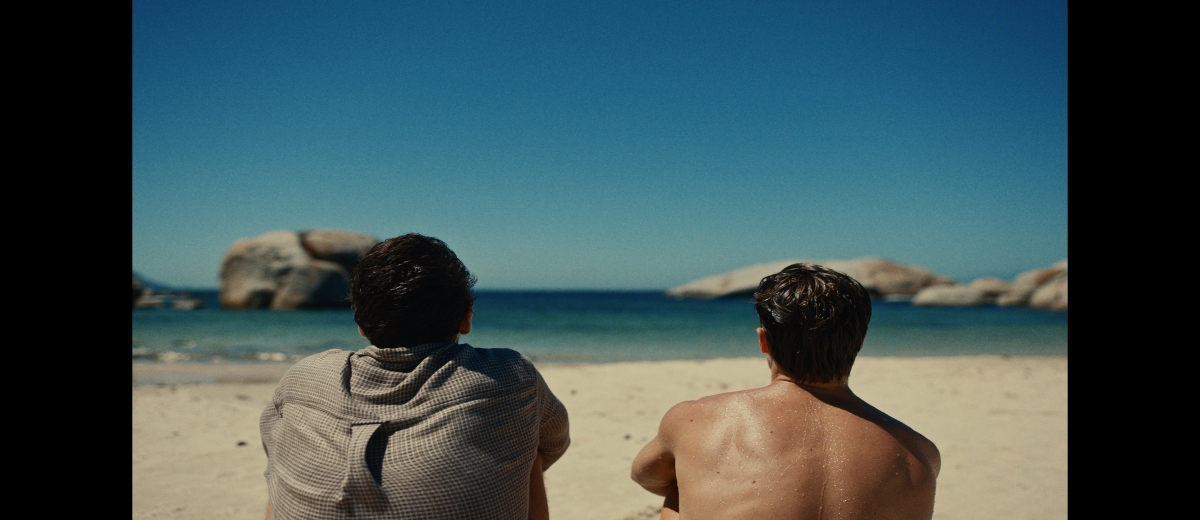
The movie is so bright and beautiful even if the story is heartbreaking. In a flashback we see young Nick at the public pool with his parents. The camera follows him underwater and for a moment, Nick is happy and carefree. 

We see Nick again underwater, but this time he isn’t a carefree young child anymore. Now Nick is a soldier in the South African military and he just lost a friend. The world has been cruel to Nicholas Van der Swart, Moffie captured that cruelty. 

Everything Adults Do

Voyagers

by Hope Madden

If you have ever wondered what Lord of the Flies might look like in space, Neil Burger thinks like you.

The generally mediocre director (The Upside, Limitless, Divergent, etc.) follows a manned vessel in search of the next planet we can ruin. Or not. Maybe our better natures will win out.

Voyagers is the journey toward that new home. The crew doesn’t really know Earth—they were the result of specifically engineered donors, raised indoors so they wouldn’t miss open spaces, and will spend their whole adult lives on the ship. Their children will, too. But their grandchildren will be the first generation to see the new planet.

Naturally, this is only going to work if nothing kills them and they don’t kill each other before future generations can exist.

Scientist and father figure Richard (Colin Farrell) will shepherd them through as much of the journey as he can, but the future of the human race is in the hands of these young people.

Essentially a YA space fantasy, Voyagers is not without its charms. Tye Sheridan and Fionn Whitehead lead a cast of convincingly naïve geniuses. The conflict is obvious (especially for those who read Golding), but Burger zigs and zags enough to keep your interest. The director’s knack for encapsulated action and his sharp cast’s baser instincts create some B-movie thrills.

The nature versus nurture argument gets a quick nod, but Burger (who also wrote) isn’t especially preoccupied with the why. The immediacy of the fact that it just is requires more attention.

Science fiction tends to be heavily allegorical and heavily borrowed—Voyagers is certainly both of these. Although the execution feels a bit like a neutered version of Claire Denis’s brilliant 2018 cosmic horror High Life, the story itself looks to the distant future to illustrate our present (and very, very recent past).

Test of Wills

Slalom

by Hope Madden

As her camera races down the mountains of Val-d’Isère, writer/director Charlène Favier depicts both thrill and isolation in equal measure.

It’s a tone that fits more than just the competitive Alpine skiing that sits at the center of her latest film Slalom. The breathless and somewhat terrifying imagery is a perfect characterization of wunderkind skier Lyz Lopez’s (Noée Abita) particular coming of age.

At 15, Lyz is in training but on her own. Her mother has taken work quite a distance away, so Lyz will be looking after herself on weekends, training at a facility and studying schoolwork on weekdays.

She’s also quite heartbreakingly looking for somebody who won’t let her down.

Abita’s performance is equally aching and frustrating, which makes her a painfully realistic adolescent. Faviere wisely limits Lyz’s actual dialog, allowing the performance to become more observational. Lyz watches and processes, her awkwardness, stillness, and anger telling us more than words ever could.

There’s a lived-in feel to this film, likely born of the filmmaker’s experience growing up in Val-d’Isère. The training, the experiences of team and competition, the beautiful but frigid landscape create an organic backdrop to the larger drama, a complex and soberingly authentic exploration of abuse.

The sports movie genre is littered with tales of the could-have-been athlete who regains what legitimacy he can by shepherding the next phenom. Jérémie Renier offers nary a false note as charismatic, tough-as-nails trainer Fred, whose moral weaknesses far outweigh any coaching talent.

Faviere’s take on the situation is even-handed. She never stoops to melodrama, never paints Lyz as a faultless innocent. The character’s complexities, particularly given Abita’s assured performance, only ensure that the film leaves more of a mark.

Oscar Nominated Shorts: Live Action

by George Wolf

When I was a kid watching the Oscars, I remember always being perplexed by short film categories. How do people manage to see these shorts?

Good news, kids, it’s gotten much easier. In the last several years, all the nominated shorts have been packaged by category for theatrical showings. This year, of course, virtual screenings are available as well, making it more convenient than ever to find great films in smaller packages.

And if there was any doubt that movies are mirrors, check the pervasive theme that runs through this year’s live-action nominees. All are examples of the struggle to retain human dignity, to be seen simply as worthy. And in four of these five films, that struggle directly involves abuses by law enforcement officials.

Feeling Through 18 Mins. Writer/director: Doug Roland

A troubled teen (Steven Prescod) needs a place to stay for the night, but his search is interrupted by a deaf and blind man (Robert Tarango) who needs help crossing the street.

The fact that Tarango is the first deaf and blind actor to be cast in a film is reason enough to seek this out, but Roland has crafted a truly touching ode to the healing power of caring.

Prescod and Tarango are wonderful together, and our short time with both of them is nothing but rewarding.

Two Distant Strangers 32 mins. Writer: Travon Free Directors: Travon Free and Martin Desmond Roe

Really? Another Groundhog Day premise? Yes, but get ready, this gripping slice of activism will rock you.

Carter (Joey Bada$$) and Perri (Zaria) are still flirting the morning after their first hookup. Shortly after Carter heads home to check on his dog, an aggressive cop (Andrew Howard) incites a confrontation, and soon Carter is dead on the sidewalk…until he again wakes up in Perri’s bed.

The scenario plays over and over, with Carter trying to come up with some way to change his fate.

Free, a former Daily Show writer making his film debut, lulls you with a comfortable device before lowering the boom. It’s uncomfortable, as it should be, but you’ll want to thank Free for the experience…as soon as you catch your breath.

The Letter Room 33 mins. Writer/director: Elvira Lind

The first thing that catches your eye here is a familiar face. Yes, that is Oscar Isaac, starring as Richard, a corrections officer granted a transfer to the facility’s letter room.

Letters from Rosita (Alia Shawkat) to Death Row inmate Cris (Brain Petsos) captivate Richard’s interest, until he’s tempted to cross some questionable lines.

Lind (Isaac’s wife) mines her powerhouse cast for a beautifully subtle layer of humanity. Everyone here is flawed, in different ways and by varying degrees. But Lind lets us see just how far a little empathy can go – even in the darkest places.

The Present 24 mins. Writers: Farah Nabulsi Directors: Farah Nabulsi and Hind Shoufani

On the morning of his wedding anniversary, Palestinian Yusef (Saleh Bakri) and his young daughter (Mariam Kanj) head out to buy a gift for his wife (Mariam Basha).

But the road to celebration is littered with soldiers and segregation, cages and checkpoints. As Yusef endures humiliation in front of his daughter, rising tensions increase the chance of a deadly altercation.

It feels somewhat surprising to see the Israeli-Palestinian conflict funneled through a Palestine viewpoint. And though Nabulsi’s hand is never overly heavy, a universal power struggle emerges: authority flexes muscle against those trying to remain calm and grasp for options.

The Present offers hope that the children can one day find common ground.

White Eye 20 mins. Writer/director: Tomer Shushan

White Eye‘s search for humanity begins with a bicycle.

An Israeli man named Omer (Daniel Gad) spots his stolen bike locked up on the street. Immigrant Yunes (Dawit Tekelaeb) says he bought the bike fair and square, but Omer doesn’t want to hear it.

Once Omer alerts the police, the situation (you guessed it) escalates, and soon Yunes’s co-workers are in hiding and Omer is staring headfirst into consequences he may not have intended.

Gad carves out a 20-minute arc of awakening for Omer that feels achingly real. It’s a standout performance, and the driving force that makes White Eye linger with lasting resonance.

Oscar Nominated Shorts: Animation

by George Wolf

When I was a kid watching the Oscars, I remember always being perplexed by short film categories. How do people manage to see these shorts?

Good news, kids, it’s gotten much easier. In the last several years, all the nominated shorts have been packaged by category for theatrical showings. This year, of course, virtual screenings are available as well, making it more convenient than ever to find great films in smaller packages.

In these 5 nominated (and three bonus) treats, you’ll find charm, humor, fascination, and devastation – all a tribute to the different ways animation can touch our souls.

Burrow 6 mins. Writer/director: Madeline Sharafian

An excited bunny has big plans for a new home underground (maybe a disco?). But the more the bunny burrows, the more times she accidentally invades a neighbor’s place!

What to do?

Originally intended as the short subject intro to theatrical showings of Soul, Burrow is a completely charming reminder of the need for friends you can count on. And the beautiful 2D, hand-drawn animation gives it a picture book feel that’s refreshingly retro.

https://www.youtube.com/watch?v=apx1aUP3MqA

Genius Loci 16 mins. Writer/director: Adrien Merigeau

From France, Genius Loci is a surrealistic trip through “urban chaos, ” as a young loner named Reine (voiced by Nadia Moussa) takes off on a dreamlike tour through the heartbeat of her city.

Unfolding like a watercolored stream of consciousness, Loci is wonderfully stylistic, bursting with contrasts and ambiguities about Reine’s headspace that keep it constantly intriguing.

If Anything Happens, I Love You 12 mins. Writers/directors: Michael Govier, Will McCormack

Oh my, this one is heartbreaking, tender and devastatingly lovely.

A middle-aged couple is living in a fog of despair, completely unable to comfort each other or find any joy in life. A charcoal-type animation style reveals shadows depicting a former life of happiness, then leading eventually to the tragic event that broke them.

Keep the tissues handy for a soft-spoken gut punch that reframes the stakes we know only too well.

Opera 9 mins. Director: Erick Oh

9 minutes? I could watch this for 9 hours.

Billed as a “massive 8K size animation installation project which portrays our society and history,” Opera is a single frame in constant, intoxicating motion.

The eye level creeps in, then out, up and down and around a pyramid filled with scores of small figures co-existing in a constantly evolving community. Even as you fixate on one fascinating section, you’re drawn to others that are equally rewarding.

Oh has created a true animated marvel, and one that should be hard to beat in this category.

Yes-People 8 mins. Director: Gisli Darri Halldorsson

Welcome to a tenement building in Iceland, where we follow some 3D Wallace and Grommet-looking Icelanders going about their daily trials and snowy tribulations.

Most of the dialog is a well-placed exclamation of “Yow!” which adds to the goofiness and overall fun factor. With glimpses into work, school and mundane chores around the house, Yes-People becomes a light and breezy take on the small moments that make our lives.

The 2021 animated shorts program will also feature three “highly commended” animated short films

Oscar Nominated Shorts: Documentary

by George Wolf

When I was a kid watching the Oscars, I remember always being perplexed by short film categories. How do people manage to see these shorts?

Good news, kids, it’s gotten much easier. In the last several years, all the nominated shorts have been packaged by category for theatrical showings. This year, of course, virtual screenings are available as well, making it more convenient than ever to find great films in smaller packages.

As usual, these nominated documentary shorts are often heart-wrenching, but able to speak necessary truths to power and our collective human experience.

A Concerto Is a Conversation 13 mins. Directors: Kris Bowers and Ben Proudfoot

Pianist and film composer Kris Bowers explains to his 91 year-old grandfather Horace (and to us) that a concerto is a conversation between a soloist and an ensemble.

But the conversation between the Bowers men is a moving work of art itself, as Horace recalls his life’s journey from a poor kid in the Jim Crow south to a successful business owner in Los Angeles.

And as Kris prepares for the premiere of his first concerto, the film becomes a beautiful expression of heritage, love, talent and courage.

Colette 25 mins. Writer/director: Anthony Giacchino

75 years after her stint as a member of the French Resistance, 90 year-old Colette Catherine is preparing to make her first journey to the concentration camp in Germany where her brother Jean-Pierre died.

She’s accompanied by the young Lucie, a history student and docent at France’s WWII museum, who regards Colette as a “national hero.”

As sobering and horrific as the subject matter suggests, Collette – the film and the hero – finds a redemptive power through defiantly shining a spotlight on an evil that still searches for dark places to take root.

Do Not Split 36 mins. Director: Andreas Hammer

Taking us to the front lines of Hong Kong’s pro-democracy protests of 2019, Do Not Split becomes a tense, indelible account of resistance against civil rights abuses that will look pretty familiar to U.S. audiences.

Hammer is blessed with a host of intimate footage, often featuring first person commentary from protesters while they are actively pushing back against tear gas and police escalation.

It’s gripping stuff. Without becoming overbearing, the film never lets you forget you are watching important and heroic history unfold.

https://www.youtube.com/watch?v=zuO71RwQp_k

Hunger Ward 40 mins. Director: Skye Fitzgerald

Part 3 of Fitzgerald’s Refugee Trilogy (along with 50 Feet From Syria and the Oscar-nominated Lifeboat), Hunger Ward‘s focus is the children – specifically those affected by the ongoing civil war in Yemen.

The images of wounded and starving children carry an understandably tragic weight, while real time footage inside a Yemeni memorial service being actively shelled is unforgettable.

And still, those committed to helping the children exhibit an unwavering and miraculous resolve.

The U.N. has labeled Yemen as home to the world’s “greatest humanitarian crisis,” and Fitzgerald’s unflinching call for action and empathy will leave your heart in your throat.

A Love Song For Latasha 19 mins. Director: Sophia Nahli Allison

A touching tribute to one victim of senseless gun violence, A Love Song…turns the focus away from the aftermath and toward the positive effect Latasha Harlins had on those around her.

In 1992, 15-year-old Latasha was killed by a store clerk in South Central Los Angeles. Framed by Allison (and Executive Producer Ava DuVernay) as a VHS tape memoir with sequences of animation, the film lets the narration from Latasha’s best friend Ty and cousin Shinise craft a warmly intimate profile.

A Love Song For Latasha wants us to know that these victims of racial injustice aren’t just statistics to be glossed over. In a short time, Latasha Harlins made a big impact. So it seems only fitting that a short film makes you glad to meet her.