All posts by maddwolf

Shut Up and Shoot

Silent Night

by George Wolf

December is a busy month, so Brian (Joel Kinnaman) has some helpful reminders written on his wall calendar.

“Pick up Mom from the airport?”

“Buy a ham?”

No, no, Brian is thinking bigger this year, especially for his Christmas Eve party plans.

“Kill them all!”

And, if things go really well, “start a gang war?” Yes, he really writes that down.

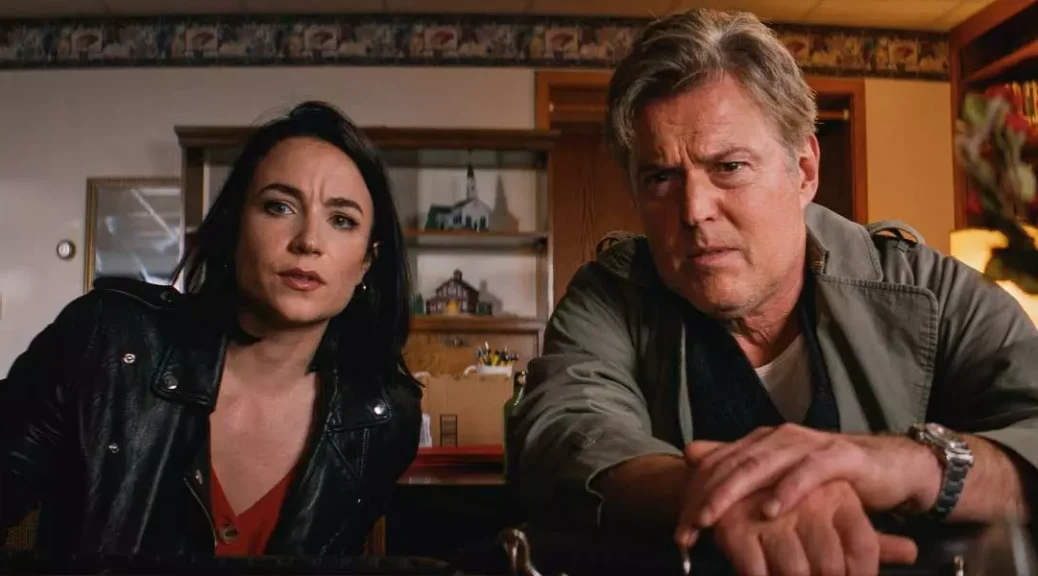
A year ago, Brian’s son was killed by a stray bullet from a gangland shootout in suburban Texas. Brian himself was shot in the throat during the mayhem, and he’s spent all his silent days and nights since then ignoring his wife (Catalina Sandino Moreno, doing what she can with a thankless role) and planning some very bad tidings of revenge.

Silent Night is director John Woo’s first American film in 20 years, but his considerable skill with an action sequence is never enough to elevate the film beyond a misguided fantasy of bloodlust and wall-building.

And even then, the blood-spilling combat doesn’t begin until nearly halfway in, as we wade through 50 tedious minutes of dialog-free montages with Brian target shooting, reinforcing his ride and making anguished faces.

Despite the title, the Christmas setting feels tacked-on for marketing purposes, becoming the only theme in Robert Archer Lynn’s script that’s soft-pedaled. The “silent” gimmick becomes contrived pretty quickly, there are numerous gaps in logic and you wonder why everyone involved here was so comfortable with an angry, self-righteous white man executing countless Mexicans.

Sure, Brian tips off an African-American cop (Scott Mescudi) about his mission to do what the law won’t, but the film is never hazy about what heroes and villains look like.

Those hand-written calendar notes teased the possibility for some humorous lunacy that is completely ignored, as the only thing over-the-top here is the utter seriousness of tone. Could Nic Cage and a face-off machine have saved this holiday turkey? Tough call. Even Woo’s battle sequences seem uninspired and repetitive, and the most memorable piece of the action in Silent Night becomes how much louder its speaking.


Cabin Fever

Honeymoon at Cold Hollow

by Hope Madden

Nat Rovit has obviously seen a few American films of the 1970s. His award-winning horror short Honeymoon at Cold Hollow could not nail the aesthetic more precisely if it had been filmed in ’74 and held in a vault until this year.

Honeymooners David (Russ Russo) and Mary (Jessie Paddock) traverse the wintry Vermont mountainside en route to their romantic cabin getaway. Like so many genre film heroes taking their chances in an isolated cabin, they are warned. It seems there was recently some trouble with a married couple, the husband going mad and all…

Mary nods empathetically. David seems…uncomfortable. But on they drive, the perfect, wilting and crackling era-appropriate score accompanying them through the snow toward their little slice of heaven. Si Begg’s musical composition even follows the lovers through their pitch-perfect Seventies romance montage.

Rovit’s film turns from syrupy to sinister with an unexpectedly funny image. The filmmaker mines Seventies cinema for its frustrating logical lapses as well as its loose and gorgeous aesthetic. Kudos to cinematographer John de Menil – this is one of the most gorgeous short films you’ll see, whether external shots of endless winter or the eerie, almost glowing tunnel of snow.

Russo and especially Paddock mirror the performance style that suits the overall time period tone Rovit so expertly develops, and by the time their brief story reaches its conclusion, you’re reminded again just how strangely beautiful blood can be when it slaps against snow.

No Crumbs Left

Do Not Disturb

by Daniel Baldwin

It’s a tale as old as time. Sweethearts get married to fix their very rocky relationship and – surprise, surprise – it makes things worse! Chloe and Jack are longtime lovers turned newlyweds taking a honeymoon trip to Miami, hoping that it might bring them closer together. When a chance encounter with a strange drug mule leaves them with a stash of designer drugs, they hope that tripping together might help them achieve that.

Spoiler alert: Things get even worse!

Sometimes couples want to tear each other apart. And other times, they want to – as the kids today say – “eat each other up, no crumbs left.” But in the case of Chloe and Jack, it’s both! You see, while the cocaine-by-way-of-peyote high that they’re on might initially make them more open to physical and emotional intimacy, their moments of sobriety between trips drive them further apart. The solution? Do more drugs. Problem there is that in addition to a trippy high, the substance has this bad habit of making one crave human flesh.

Cannibalism CAN be an interesting metaphorical delivery system for a romance. After all, when we’re in love, we want to be a part of one another as much as possible. What is more a part of you than what is inside you? Throw in cannibalism as an additional flavoring and you’ve taken the allegory to its most extreme conclusion. This is illustrated nowhere better than in Luca Guadagnino’s masterful road trip cannibal romcom, Bones and All.

While John Ainslie’s Do Not Disturb does not reach those same heights, there’s a lot to like here. Kimberly Laferriere and Rogan Christopher turn in good work as Chloe and Jack, although they’re more at home during the drug trips and horror elements than they are during the grounded dramatic beats. This is largely the fault of the writing not quite being up to snuff in those sequences, but the highs of the more genre-oriented fare go a long way toward balancing that out.

Do Not Disturb is slow to start, but once it gets going, it earns that build up and is at its best when it’s freaking out, man. If you’re a fan of the aforementioned Bones and All or even the psychedelic ferocity of Joe Begos’ Bliss, you’re bound to find something to like here. Just be sure not to snack on your loved ones while you watch it!

The Seaweed is Greener on the Other Side

Deep Sea

by Matt Weiner

Stormy seas are among the less pressing problems for a troubled young girl trying to find her way in the world, according to Deep Sea, the new animated film from writer-director Tian Xiaopeng (Monkey King: Hero Is Back).

Quiet and withdrawn Shenxiu (Tingwen Wang) dreams of finding the mother that abandoned her as a child. Her father and stepmother take the family on a cruise over Shenxiu’s birthday, but it’s not much of a mental distraction when a late-night storm throws her overboard.

She manages to find her way to a fantasy version of the world, where the cruise ship has been replaced by a floating restaurant called the Deep Sea. Its proprietor and captain is Nanhe (Xin Su), a mischievous and somewhat unscrupulous man who is more interested in getting rich quick than serving as a good steward of both ship and restaurant.

While Nanhe tries to find the right recipe to keep his patrons happy, Shenxiu’s gloomy moods are tied mysteriously to the presence of a Red Phantom, a surging mass of tendrils that threatens to engulf Shenxiu and anything in her way.

While Deep Sea at times lacks the polish and subtle charm of a Studio Ghibli tale, the film succeeds at its own version of the unique blend of terror, wonder and melancholy that comes with growing up. It’s hard not to root for Shenxiu, and that’s helped along by the expressive animation of the intrepid sea creature crew of Nanhe’s floating restaurant.

The film also trusts adolescents to handle content that can at times border on true horror, with more drowning panic than you’re likely to see in the average Disney film. The identity of the metaphorical phantom that pursues Shenxiu throughout the film might be quickly apparent to older viewers, but the emotional climax is no less moving.

And for all the ocean setpieces—which are stunning—it’s often the small touches that cut the deepest. Like Shenxiu’s lone birthday message from her cell phone provider, rather than friends or family. Or the image of a small girl lost in a storm, crying out to her mother.

The sea might be a cruel mistress, but in Xiaopeng’s coming of age tale it’s nothing compared to the pain of embracing life and growing up in the face of hardship.

A Man Aparte

Napoleon

by George Wolf

“Destiny has brought me here! Destiny has brought me this pork chop!”

And a silly food fight ensues between Napoleon and Josephine, just minutes before director Ridley Scott unveils a simply breathtaking recreation of 1805’s Battle of Austerlitz.

Scott’s Napoleon is a film that succeeds with moments both big and small, but suffers from a lack of connective tissue that might have formed it into one unforgettable whole.

Joaquin Phoenix makes the legendary emperor and military commander as endlessly fascinating as you’d expect, while Vanessa Kirby’s equally mesmerizing turn as Josephine creates a dynamic that authenticates Napoleon’s lifelong devotion.

But even if we didn’t already know Scott’s 4-hour director’s cut is coming, this 2 and 1/2 hour version ends up feeling like a stunningly crafted, IMAX-worthy appetizer. It’s every bit a grand spectacle with epic vision of history, but never quite the incisive character study that may be waiting in the streaming wings.

The Man Who Craves More

Saltburn

by Hope Madden

Somewhere on the other side of Alexander Payne’s The Holdovers lurks Emerald Fennell’s bacchanal, Saltburn.

Oliver (Barry Keoghan), a loner attending Oxford on scholarship, is befriended by the most beautiful, richest of the rich, Felix (Jacob Elordi, so good earlier this year in Priscilla). They become such good friends at school that Felix invites Ollie home to Saltburn, his family’s honest to God castle, for summer break.

A tale of casual cruelty versus calculated cruelty, Saltburn flirts with any number of have-nots in a have land stories: Rebecca, The Little Stranger, and most evidently, The Talented Mr. Ripley. That doesn’t mean the Oscar winner who penned Promising Young Woman lacks an original thought on the matter.

Fennell’s film is a seduction, sensuality dripping from every frame, every image – the interiors, the grounds, the bodies. On display is unimaginable wealth, and the fantasy of decadence and isolation that accompanies it. Felix’s family is drawn to Ollie like vampires to human flesh and blood. That they will tire of him is inevitable, and that he will do terrible things to remain in their graces is also inevitable. But that’s not truly the story.

And even if you have a clear sense of the direction the story will take, the tension will break you.

Not everything works in Fennell’s film, but man, Keoghan does. No one plays the vulnerable, potentially dangerous outsider quite as he does. Elordi is tender and lovely in an appropriately superficial way, and Gran Turismo’s Archie Madekwe nails the insecure wealthy-by-technicality cousin with ease.

The image of vacuous wealth becomes cartoonish, however wonderful Richard E. Grant and Rosamund Pike are as Felix’s wildly oblivious, inhumanly privileged parents.

It’s tough to watch a film that asks you to empathize with, much less pity, the grotesquely wealthy. Luckily, Fennell doesn’t. Her effort is far more cynical, finding obscene wealth and the desire for obscene wealth equally unappealing, if not equally villainous.

The filmmaker loses her way before she gets to the magnificent final dance scene. We relive clues and take a hard turn that feels too genre for what had been a glorious mess. In the end, Saltburn often feels like a story you’ve seen before, told with more style and meanness. But style and meanness count for something, and this cast understands that.

Feelin’ Groovy

The Job of Songs

by Christie Robb

Paul Simon’s “59th Street Bridge Song (Feelin’ Groovy)” is a one minute and 43 second impression of being content and in the moment. It feels like a possible anthem for the Slow philosophy—an approach to life that values taking one’s time, doing things at the right pace, valuing the quality over the quantity in life.

Writer/director Lila Schmitz’s one hour and 13 minute documentary has a similar approach.

The Job of Songs is about the community of session musicians that populate the small village of Doolin in County Clare in the west of Ireland—the area around the Cliffs of Moher. An isolated village until the 1970s, folks gathered in homes to play traditional (“trad”) Irish music and to dance.

Opening the Cliffs to international tourism brought in increased revenue and enabled musicians to pursue their art professionally, but it also changed the cultural scene. Folks dashed in on day trips to take a snapshot of the Cliffs, but failed to linger and really take in the place and the people.

Tourism meant that performances moved from private to public spaces—out of the kitchen and parlor and into pubs and restaurants.  But performing trad music is still a community activity. At a session, anyone is welcome to pick up their instrument or raise their voice and join in, even if they only know a couple of bars to a piece.

Through candid interviews and emotional performances, Schmitz’s film explores the changing culture of Doolin and the various purposes songs have in the lives of the Irish of the West country. It’s a source of entertainment, yes. But songs also carry the often melancholy history of the Irish people and culture, allow the saying of otherwise unspeakable things, and give people permission to feel things that are not easily understood intellectually.

The film explores the different aspects, both dark and light, that this musical culture has in people’s lives. While the session scene brings people together, it also has ties to drink, depression, and suicide. And though singing the old trad songs maintains a connection to Ireland’s past with its history of brutal colonization, famine, and emigration, Schmitz also leaves space to explore the change that technology, tourism, and a recent history of immigration has brought to the scene. She shows how a culture so rooted in a place can slowly change over time.

The music of  Luka Bloom, Eoin O’Neill, Kate Theasby, Christy Barry, and Ted McCormac (among others) could be draw enough, but slowing down to appreciate the way the cozy light of the pub provides an antidote to winter’s gloom goes a long way toward making a person feel pretty groovy.  As does the drama inherent in the view of the green of the land ending abruptly in the pounding of the ocean. It’s a movie worth savoring.

Pitchforks Out

Hayseed

by Rachel Willis

An insurance investigator is pulled into a who-done-it murder mystery in writer/director Travis Burgess’s film, Hayseed.

Bored from the moment he enters the small town of Emmaus, Michigan, investigator Leo Hobbins (Bill Sage) becomes intrigued when Darlene (Ismenia Mendes) tells him the esteemed reverend’s death wasn’t an accident, nor was it suicide (Hobbins’s reason for investigating). It was murder.

From the get-go, we’re introduced to a colorful cast of characters, each with their own stories and ideas about what happened. It’s a small-town, so gossip runs rampant – some of it true, most of it false. Several characters feel like people you know. Others are awfully quirky, but it works for this comedic mystery.

Hobbins might draw comparison to some of the other big-screen detectives we’ve seen over the last several years, but Sage creates his own character – one who is charismatic in his own droll way. Though Darlene is a member of the community, her status is that of an outcast. Several question her relationship to the reverend and her influence on him. Together, our dynamic duo leads us deeper into the mystery surrounding the reverend’s untimely end.

There are several moments when you might feel like you know where the mystery is headed, but it doesn’t harm the film. Many pieces fall into place as we prod further alongside Hobbins. There aren’t any obvious red herrings, nor are any threads untied. This is a tidy package, one wrapped by a writer who knows how to draw you in and lets you attempt the solve the mystery.

While the conclusions might not be entirely obvious, there is enough on the table to leave you satisfied by what comes of the sleuthing.

With a larger cast, some characters are less well-developed than others, but no one feels underdeveloped. These are all people who have a place, and it’s easy to differentiate one from another – no small feat when working with so many characters. While our two leads are the focus of the show, there are others who stand-out, particularly Joyce Metts (Kathryn Morris) with her bitchy gossip and snide comments.

Overall, this is a film that works well. While it might be overlooked in comparison to other, recent murder mysteries, it’s not fair to draw too many comparisons. This is a movie that deserves its own consideration, and you’ll have fun if you let yourself be draw into the mystery.

Lucky Star

Wish

by Hope Madden

Adorably subversive, that’s how I would label Disney’s new animated feature, Wish. Chris Buck’s latest, co-directed with Fawn Veerasunthorn, strings together in-jokes and homages to Disney’s past to camouflage its fight the power message. Unfortunately, the balance doesn’t emphasize storytelling and the result is middling.

Asha (Oscar winner Ariana DeBose) is interviewing to become apprentice to King Magnifico (Chris Pine). Magnifico is much beloved, and not just because he’s so very handsome. It’s also because he takes such good care of his people’s wishes, which they donate to him when they turn 18 and then forget all about. Once in a great while, he grants one. But mainly that’s to mollify the masses.

I smell a message, and it is one I can get behind. Hold your elected official accountable, people. Do it! You owe them nothing.

Your animated movie owes you some things, though, and Wish struggles a bit to provide those things. Obviously DeBose has a voice, and her songs are solid. Pine’s a charmer and spot-on as the aggrieved leader. Better still, Alan Tudyk voices the Disney-required sassy animal sidekick, Valentino. He’s unnecessary and adds nothing to the actual narrative, but he’s a bit of fun and Tudyk’s an impressive vocal talent.

Asha also has seven buddies. One’s smart and wears glasses. Another sneezes a lot. One’s bashful. Another one is always drowsy. Get it? Just one (or seven) needless winks, as if to say, “We love Disney! We just hate entitled men in power who refuse to share that power with the very people who’ve built their fortune.”

Bit of a mixed message.

Of course, none of that matters if the film itself is a fun, gorgeous, memorable time for the kids. Wish has its moments. It often looks quite lovely. Each performance delivers something bright and fun. While the songs are not especially memorable, they’re enjoyable enough while you’re watching.

In truth, Wish shares a lot in theme with last week’s The Hunger Games: The Ballad of Songbirds and Snakes. And though that film is no masterpiece, it digs into the idea that you cannot fight the power from within. This is where Wish misses the point. It’s trying to do something radical without upsetting anybody, and that’s just not possible.