Screening Room: Nomadland, I Care A Lot, Flora & Ulysses and More
by George Wolf
Serj Tankian is a passionate guy.
As frontman for System of a Down (and as a solo artist), he’s passionate about music. As an American of Armenian descent, he’s passionate about America’s foreign policy – specifically the U.S. stance on recognizing the Armenian genocide of 1915.
In Truth to Power, director Garin Hovannisian not only gets us closer to a charismatic and multi-talented performer, but he also tackles the sometimes thorny relationship between art and activism.
For Tankian, shutting up and singing is a ridiculous notion. And though he freely admits he seldom knows what he’s going to say before an onstage rant, Tankian’s social consciousness only increases when the lights come up.
Hovannisian gives us a satisfactory trip through Tankian’s life story and the forming of SOAD with three other Armenian-Americans, then brings us along as the band plays its first Armenian show in 2015. Tankian especially is regarded as a national hero, and the intimate moments where we see how deeply this treatment touches him are among the film’s strongest.
But the broader focus is on Tankian’s push for Turkey to admit to the Armenian genocide, as well as his inspirational role in the Armenian revolution of 2018. And though the film makes an often powerful case for art’s ability to affect change, it ignores a very obvious conflict.
In the last few years, SOAD drummer John Dolmayan has been an outspoken supporter of Donald Trump and various hard right political postures. Though we hear Tankian worry about the rise of such views, Hovannisian never broaches the subject of how the band members co-exist.
Even if the bulk of the film was completed before Dolmayan spoke out, the somewhat slight running time suggests an epilogue would only add relevant context to the entire conversation.
Without it, there’s a pretty major question just sitting there unanswered, and Truth to Power – despite its commendable passion – feels incomplete.

by George Wolf
Is “Holy Bagumba!” gonna happen?
Too early to tell, but Flora & Ulysses wants it to happen.
Ten year-old Flora (Matilda Lawler) likes to blurt the phrase out in excited surprise, and there have been plenty of surprises since Ulysses got super powers.
Ulysses (a CGI squirrel with noises courtesy of John Kassir) has skills, no doubt, and in between trashing donut shops and learning how to type, he just might teach a self-described young cynic that there is some magic in this world after all.
Director Lena Khan brings the latest animal adventure tale from novelist Kate DiCamillo (The Tale of Despereaux, Because of Winn-Dixie) to the screen with broad brushes, easily digestible messages and family-friendly hijinks.
Khan does try to keep the parents interested through winking nods to E.T, Alien, and The Shining, along with a curious amount of music montages. The playlist ain’t bad (Bill Withers, Tom Jones) but it’s big enough to make you wonder how much was added just to get the film to feature length.
Young Lawler is a treat, with spunky charm to spare and a seemingly natural sense of comic timing (especially with a CGI co-star). But the adapted script from Brad Copeland (Spies in Disguise, Ferdinand) is all surface-level spoon feeding, where the family strife is sanitized, the danger little more than silly and the squirrel is a furry, slo-mo ninja.
In other words, perfectly fetch for the younger set transitioning from picture books to family films.

by Hope Madden
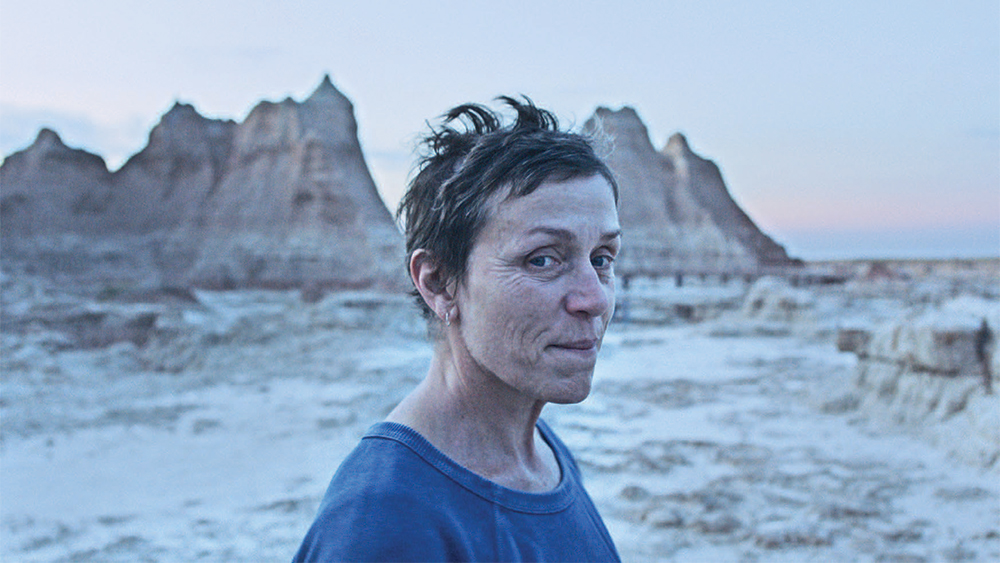
Nobody sees American poverty as honestly or as poetically as filmmaker Chloé Zhao.
Those who saw Zhao’s sublime 2018 cowboy story The Rider will recognize her romantic fascination with the American West. That’s not the only thumbprint the filmmaker leaves on her third feature, Nomadland.
She weaves a spontaneous, near-verite style into lonesome, wide vistas of a rugged America we think of as lost to time. In doing so, Zhao creates a lucid dream where struggle as reality is somehow beautiful but never sentimental.
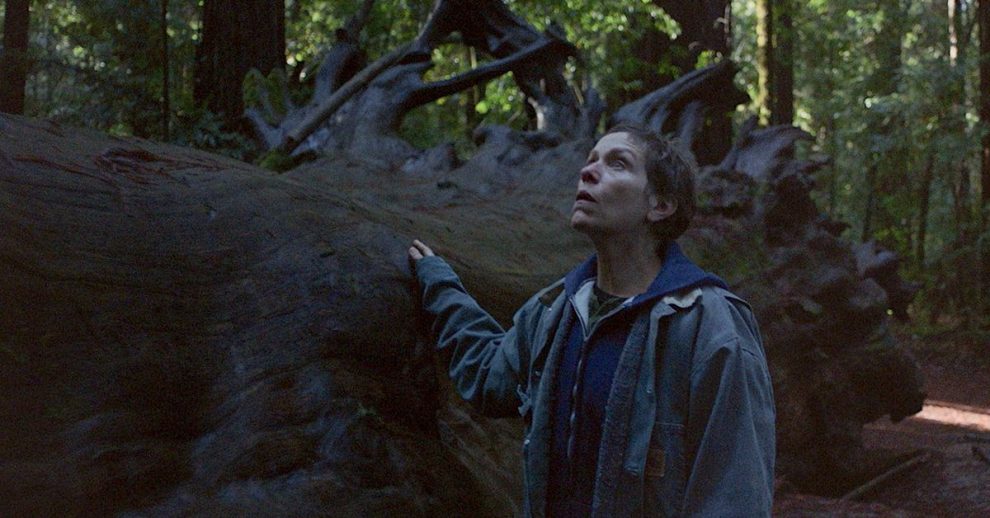
The incandescent Frances McDormand stars as Fern, an itinerant widow since her hometown of Empire, Nevada ceased to exist once the gypsum mine closed. We join Fern on her journey sometime after that collapse. She’s just beginning to customize “Vanguard,” the van that serves as her new home.
In that same loose style that’s marked Zhao’s previous films, Nomadland follows Fern through her days, boxing product for Amazon in the winter, working vacation rest stops and tourist destinations in season, and traveling the country in the meantime following work, looking for a safe place to park, and getting to know this country.
Zhao—who writes, edits, and produces as well as directs—based the screenplay on Jessica Bruder’s nonfiction book. Empire was a real place. Fern is a fictional character, but those who mentor her in her new life—including the endlessly endearing Linda May and brilliantly saucy Swankie—are, indeed, real nomads.
McDormand is perhaps the only perennial Oscar contender who could fit so seamlessly in this tapestry. Without an ounce of vanity or artifice, her performance allows this film to be one of resilience and promise. Given that Normadland is, in fact, the story of a penniless Sixtysomething widow who lives in a van, that is in itself a minor miracle.
But that’s the film—a minor miracle. Perhaps only in a year when the billion-dollar franchises were mainly held at bay could we make enough space to appreciate this vital and beautiful reimagining of the rugged American tale of individualism and freedom, which is almost always also a story of poverty.

by Hope Madden
People really hate social media influencers.
I mean, somebody must love them or who is it they influence? But horror definitely does not love them. Influencers have become the go-to objects of horror in recent years, seen as the vacuous product of a narcissistic culture that doesn’t value—or even make—human connections.
Meet Mia (Daisye Tutor). The rising makeup influencer has way more followers than her two besties and her boyfriend, so they’re unhappy when she pulls out of their livestream event this Saturday to dog sit for her sister.
But being selfless is totally on brand for Mia, and another makeup influencer just died trying to protect her own dog from a canine killer. Is it guilt? Is it opportunism?
Neither. It’s a setup for the premise of Shook. Mia is home alone with Chico (the dog, who’s awfully cute). But she’s never unplugged and soon someone is playing life or death games with her.
Writer/director Jennifer Harrington’s film really begins with a plot as old as the genre. It could be the babysitter and the escaped lunatic, the point is to have a vulnerable (and acceptably stupid) young woman alone, trying to protect those in her charge from an unseen and menacing force.
So, it doesn’t start out fresh, but movies have made a go of this plot. Harrington layers in newer cliches derived from our collective, plugged-in anxieties. The result is When a Stranger Calls meets Scream meets Unfriended.
It feels exactly that derivative, a fact that doesn’t entirely sink the film. It definitely never lives up to its opening, though.
Harrington makes her most incisive comment about the performance art that is influence culture as she pans back from a glamorous, opening red carpet photo shoot to show the bleaker reality of the staged event. It’s a smart, cinematic revelation that works on two levels.
Thematically, it underscores the film’s point about the artifice of Mia’s life. As a horror movie, we’re suddenly aware that someone is watching – someone who sees all of it.
Watching Shook, you’ll find solid filmmaking followed by two acts of uninspired, sometimes idiotic, sometimes enjoyable horror.
by Brandon Thomas
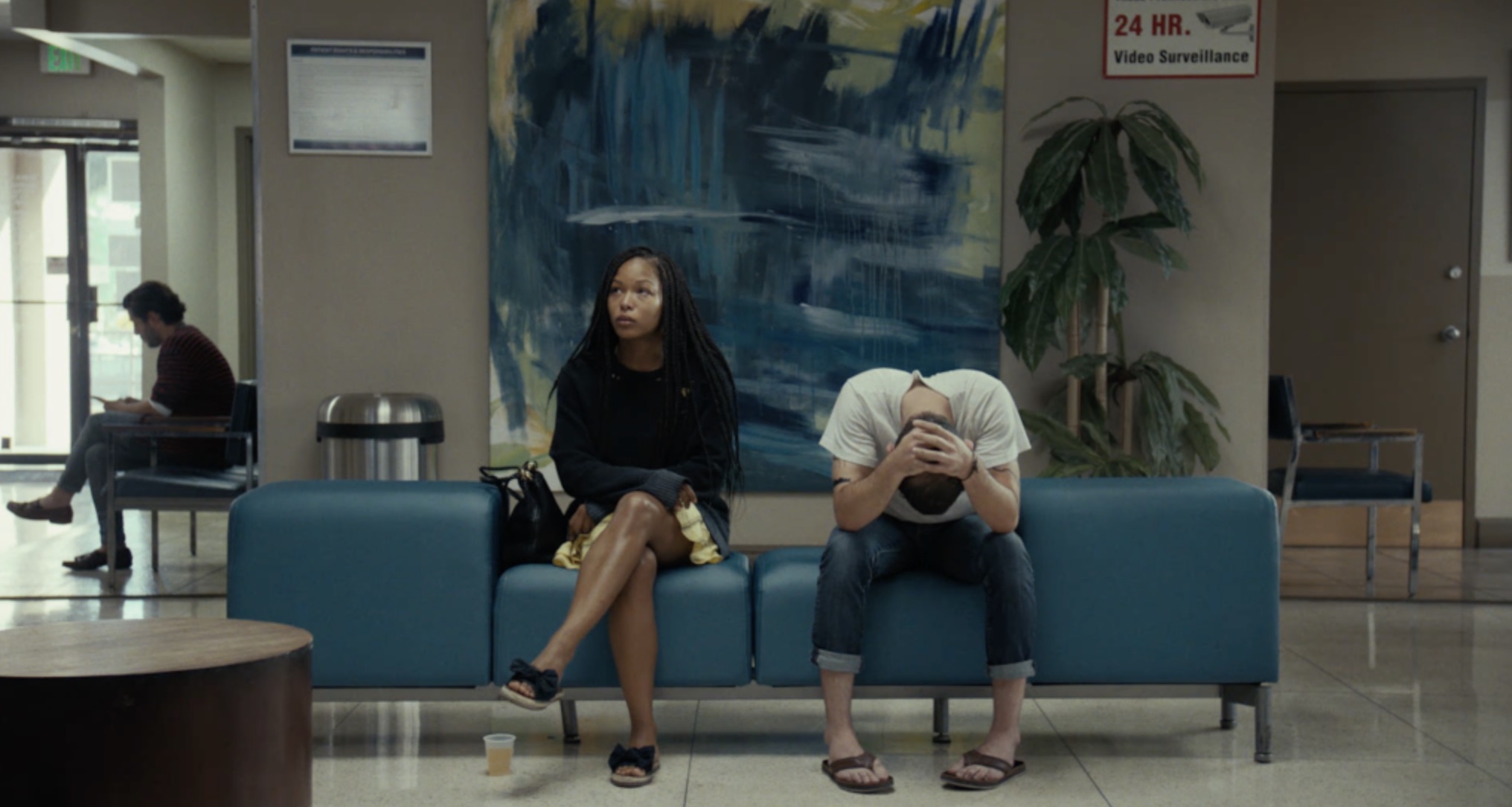
The debut feature from writer/director Shatara Michelle Ford, Test Pattern, is a compelling look at date rape, its confusing aftermath, and the ways in which the medical field and law enforcement can fail victims with their chaotic bureaucracy.
After an opening that delivers one of the sweetest, most awkward “meet-cutes” in recent memory, Test Pattern digs into the burgeoning relationship between Renesha (Brittany S. Hall of TV’s Ballers) and Evan (Will Brill of The Eyes of My Mother). Their life together is put to the test after Renesha is drugged and sexually assaulted after an evening out with her girlfriend.
Test Pattern offers a matter-of-fact approach that makes it hard to look away. The audience is with Renesha every step of the way as she traverses the confusing hours after her assault. It’s an honest, but tough, journey we take with her as she runs the gamut of emotions and, at times, humiliating experiences.
Nothing in Test Pattern would work if the strength of the cast wasn’t there. Hall is jaw-droppingly good as Renesha. She easily conveys strength, vulnerability, and poise in her early scenes. At one point on their first official date, Evan comments, “I feel like you always know what you’re talking about.” There’s no greater summation of the Renesha we meet early on.
Brill is equally good as the doting, supportive Evan. Evan’s almost “too nice” persona is in contrast to the man we see later in the film. His focused, almost fanatical need to get Renesha in front of a doctor and the police starts to feel like a salve for his wounded pride, not her well-being.
Together, these two actors have the type of natural chemistry that isn’t often seen. They deliver lines from Ford’s already expertly written script with ease and purpose. You can almost feel the history of this relationship pour off the screen. The genuine love and respect shared between Renesha and Evan make it hurt all the more as things start unraveling.
Ford’s slow-burn approach to the story, and especially the aftermath of the assault, offers an incredibly riveting, and honest approach to this serious subject matter. The tension that begins to build as Renesha and Evan drive from hospital to hospital sometimes feels akin to some of the more emotionally disturbing horror films from recent years. The result is a direct focus on the painful process this couple is forced to endure.
Test Pattern presents no easy answers. Renesha and Evan’s story isn’t wrapped up in a nice bow for us to feel good about. We don’t get the happy ending; we get the honest one.

by Rachel Willis
Watching Alice Fades Away is akin to stepping into a Flannery O’Connor short story (without the overt religiosity). The film crackles with ominous energy as a larger-than-life villain haunts the rural, isolated landscape. As a horror/thriller blend, this one hits the mark.
In his first feature, writer/director Ryan Bliss crafts a film that seamlessly blends genres: horror, drama, mystery. Set in the early 1950’s, the film is reminiscent not only of O’Connor, but films such as The Night of the Hunter. The tradition of the Southern gothic lends itself well to Bliss’s vision.
Seeking refuge on her uncle Bishop’s farm, Alice (Ashley Shelton) is on the run. She is accepted by a group of people suffering from their own terrible pasts, all taken under the wing of her generous uncle. We’re not quite sure of Alice’s story, but we’re given disturbing glimpses as past and present merge on screen.
As Alice’s past catches up with her, we’re held hostage to the increasing dread the situation conjures. The cinematography works wonders at turning the idyllic setting of Bishop’s farm into one of dreadful isolation. Its setup as the ideal hideaway melts beautifully into a desolate trap.
All of the actors in the movie are well cast, but the one to watch is Timothy Sekk as Holden. His performance, along with Bliss’s writing, adds depth to a character that could have easily been a lifeless stereotype. Sekk’s energy adds to the mounting horror of what has followed Alice.
With so many great scenes, the film’s blunders are even more obvious. It performs best when it has minimal dialogue, some lines are melodramatic while others are poorly delivered. Many themes are broached, but only a few are explored. A character disappears, leaving us scratching our heads. And what’s with the rabbits?
However, the few moments that don’t land can’t wholly detract from the film’s overall effect. Bliss knows how to invoke dread, and the moments that take us out of the film are easily ignored considering what works. You’ll care less about some of the details and more about what’s ahead.
Same goes for the filmmaker, as Alice Fades Away is a debut that will make you curious to see what Bliss does next.

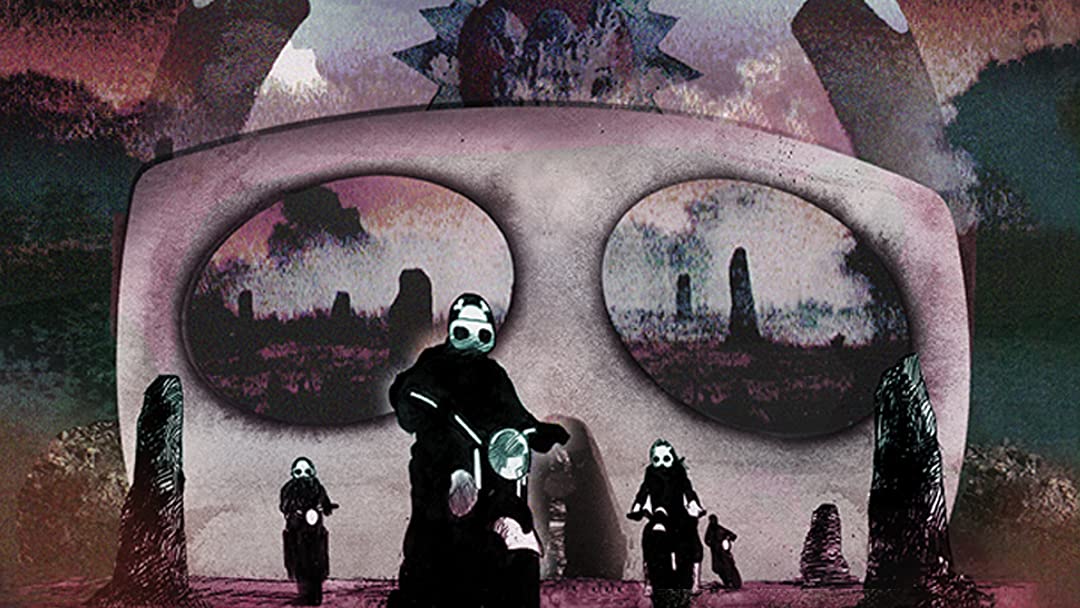
Is it ever too cold to ride? My God, yes – it is way too cold to ride. So instead, we invited our friend Jamie Ray from the Fave Five from Fans podcast to join us as we talk through our favorite chopper-themed horror flicks. Some of these are pretty bad – but so fun! – so prepare for a bumpy ride!
Oh, there were so many terrible films that could have taken this final slot. Would it be Blood Freak? Chopper Chicks in Zombietown? Werewolves on Wheels?
So many choices!
Deathmaster gets the nod because it combines all the required elements – Satanism, hippies, and motorcycles – but it cranks it up a notch. This subgenre owes its very existence to Charles Manson, who braided those three elements together in the minds of Americans. But Deathmaster takes that one step further by creating a specifically Manson-like character—the charismatic guru Khorda – and making him a vampire.
Why is he a vampire? Maybe because they cast Robert Quarry (Count Yorga), who already had the teeth. Who knows, it comes off as utter nonsense, but it makes for a little fun variety.
Black leather, black leather, smash smash smash
Black leather, black leather, crash crash crash
Black leather, black leather, kill kill kill
I got that feelin’ – black leather rock
That, in a nutshell, is how dumb this movie is. And yet, like the ludicrous theme song, it’s just weird enough to stay in your head.
Oliver Reed is at his youngest, sultriest, Oliver Reediest as the street tough who chases his sister and her older American boyfriend right into some kind of underground lair where radioactive children are kept.
Suddenly you’re in what appears to be an entirely different movie. It’s like somebody sewed A Clockwork Orange and Village of the Damned together, buried them under rock, and them lobotomized the final version.
Which is kind of appealing, isn’t it?
More adorably sketchy Brit motorbikers in this one. Some mods wreak havoc on their bikes (because apparently drivers in England have no idea how much more vulnerable a bike is than a truck). But they crave more!
More danger! More excitement!
So they decide that if they kill themselves they can will themselves back to life and become hip zombie bikers.
The film’s appeal has a strange longevity. It’s never scary for even a moment, and it’s often outright ludicrous – if not adorable – but it does have a style and a couple of performances you can admire.
Yes, Janet. Life’s pretty cheap to that type.
Whether it’s the Transylvanians traveling dto Time Warp with the doctor and his domestics, or the arrival (and quick removal) of Eddie, motorcycles play a significant role in this treasure of a film.
It was 1975, after all, and no self-respecting edgy, dangerous film could possibly convince the world of its anti-establishment bonafides if no one rode a motorcycle. It turns out, it’s the ones who aren’t riders you need to watch out for.
At some point somebody decided they were tired of seeing the motorcycle riders always turning out to be Satanic hippies. Nope, not this time.
The film re-teams Peter Fonda and Warren Oates – so great together in 1971’s The Hired Hand. They’re buddies taking a top-of-the-line RV out for a spin across Texas, along with their lovely wives. They stop to camp in the middle of nowhere, the guys take their bikes out for a stretch, and next thing you know, they’re being followed by Satanists and who knows which of these backwoods locals can be trusted?
The film generates real tension in much the same way Spielberg had done four years earlier with Duel. That tension, supported by solid, gritty performances, give this one surprising punch.
by George Wolf
Remember that opening of Napoleon Dynamite, where Napoleon was tossing a green plastic Army man on a string out of the school bus window? If you didn’t think that was funny, it was an early sign you were gonna have a bad time.
Barb and Star Go to Vista Del Mar opens with its own litmus test, as a kid on a bicycle is delivering papers while singing “Guilty” along with the Streisand and Gibb in his headphones.
If that makes you laugh, stick around, you’ll laugh more.
Things have been better for the always perky, cullotte-loving Barb and Star (co-writers Annie Mumolo and Kristen Wiig). They’ve lost their husbands, their spot in weekly “talking club,” and their jobs at the hottest furniture store in Soft Rock, Nebraska (not a real place, but it should be).
With mid-lifers in tube tops, a 24 hour CVS and a parade of guys in Tommy Bahama, Vista Del Mar, Florida promises a vacation paradise perfect for “finding their shimmer.” Plus, it’s the home of the annual Seafood Jam (“where the crowd’s on the older side!”).
After a Disney-on-Viagra greeting at the hotel, it isn’t long before the BFFs’ rock solid bond is threatened by the handsome Edgar (Jamie Dornan) and the chance to rent a banana boat.
Will the girls’ friendship survive all the fibs and sneaking around? And how long can Edgar hide his part in the nefarious plan by an evil genius (also Kristen Wiig) to kill everyone on the island with poisonous mosquitoes?
I’m sorry, what was that second thing?
Just know director Josh Greenbaum keeps a loose grip on a film that’s ridiculous at every turn but still full of good-natured, garish fun and about as many laugh out loud moments as dry patches. Even though Barb and Star are new to us, they feel like characters the two stars have been privately honing for years, and it’s the chemistry of Mumolo and Wiig (who also co-wrote Bridesmaids) that allows a bit about the name “Trish” to continue beyond all limits of good sense until you give in to the hilarity.
You’ll also recognize plenty of faces in the supporting cast, highlighted by Mark Jonathan Davis doing his Richard Cheese lounge singer persona and Damon Wayans, Jr. as a spy with a bad habit of spilling his personal info (“dammit!”).
Expect some goofy outtakes over the credits, and waves of silliness that just won’t rest until your frown is turned upside down! It may not be dynamite, but Barb and Star brings enough laughs to make spending time with them a pleasure.
Just don’t call it guilty.