Tag Archives: thrillers

Family Recipe

Kin

by Hope Madden

I’m no cook. If it’s not on Chipotle’s menu, I’m not eating it. And yet, I feel like I understand certain things that don’t go together, say Captain Crunch cereal and goat cheese, meatball subs and tuna, ice cream and hair.

That’s kind of the experience to be had when watching Kin.

Advertised as an adolescent SciFi adventure where a ‘tween finds an intergalactic gun and all his problems are solved (nothing tone deaf about that storyline), the film is much more than that. And also much less.

Eli Solinski (Myles Truitt) is an adolescent outsider, missing his mom and trudging through his dad’s chores and disappointment. His older brother Jimmy (Jack Reynor, or as I like to call him, Handsome Seth Rogan) comes home from a 6-year prison stretch, and things go quickly to hell in a handbasket thanks to his old associate, Taylor (James Franco).

Filmmaking brothers Jonathan and Josh Baker start off with traditional angsty teen drama. They quickly warp it into a gritty, mid-budget crime thriller, with a little charm thanks to Franco’s characteristic weirdness: badly cut mullet, unexplained puffy coat, women’s shoes.

But then it turns into a road picture with antics and a sort of tragic take on the cycle of poverty, crime and bad decisions. By this time, we realize that Truitt doesn’t have much hope of establishing a character, as he may, indeed, have no idea what film he’s in.

Reynor fairs slightly better. He’s likable and vulnerable. To pull the role off, he’d also have to be believably corrupted, which is where Reynor falters.

Zoe Kravitz is Milly, the stripper they befriend. Let’s not even get into it.

The strength and honest conflict in the film is really the relationship between the two brothers and the inevitable, depressing conclusion their lives together will lead to.

But, wait. Don’t settle into that just yet, because there’s an over-the-top, high-octane climax headed inexplicably and irreversibly toward you. And remember the whole SciFi nonsense they threw at us in the trailer? Well, it finally finds its resolution in the last five minutes of the film—a plot twist that is so mismatched with the tone of the film leading up to it, it truly feels like a whole other movie just came knocking on the door because it was lost.

Dude, all we wanted was beans and rice.

Clear History?

Searching

by George Wolf

Much like early 80s music video directors adjusting to the possibilities afforded by the power of MTV, it’s taken current filmmakers some time to craft nuanced statements on the rise of social media.

But then, we’ve yet to see evidence that ZZ Top’s “Legs” swung an election, so clearly, we’re all still adjusting.

Searching is the latest reminder that for social media-themed movies, at least, things are looking up.

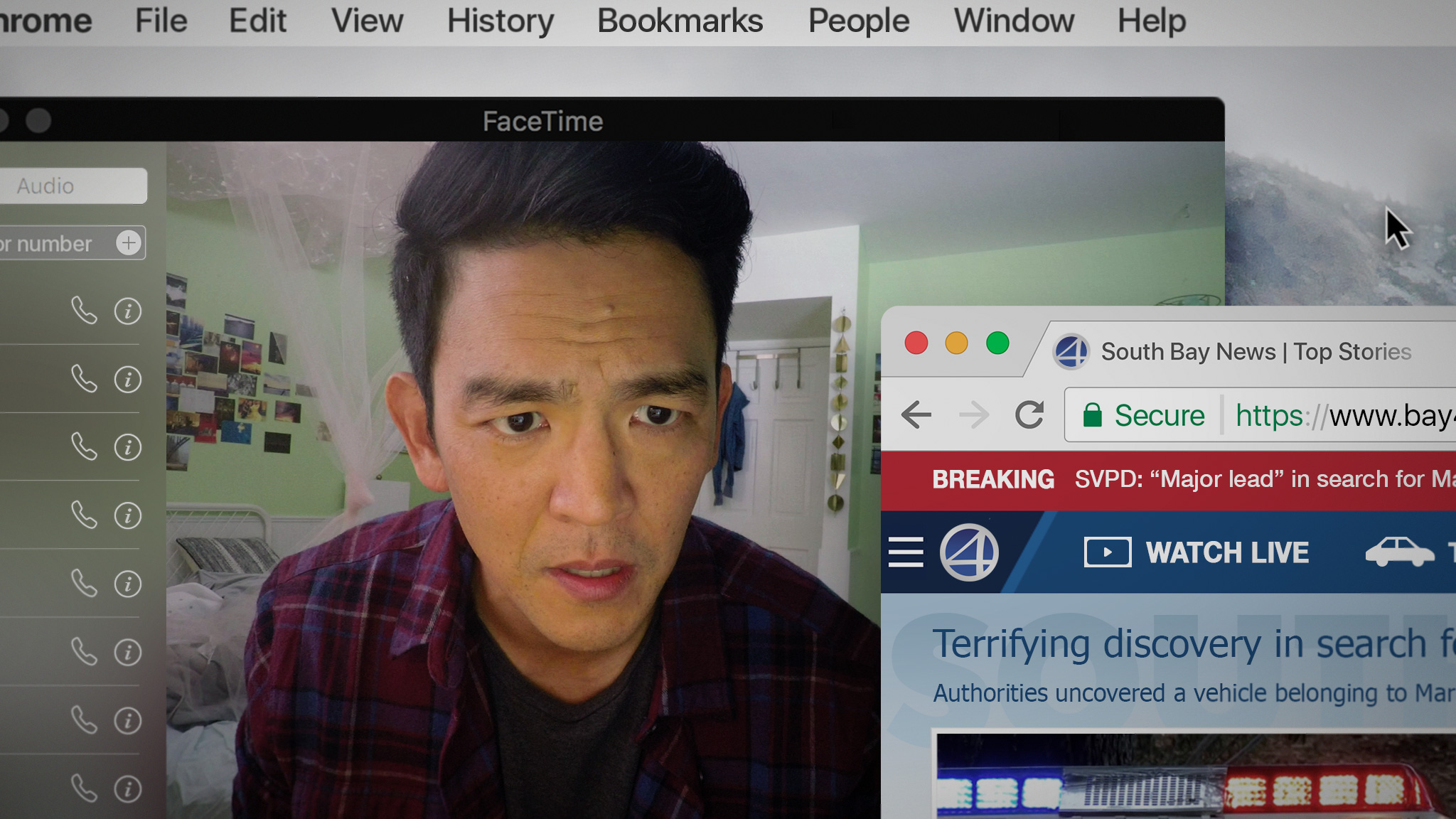
In his debut feature, director/co-writer Aneesh Chaganty crafts a smart, fast-moving internet mystery that plays out on the screens of various platforms. Dropping sly clues among its plot twist head fakes, the film becomes a surprisingly satisfying B-movie potboiler, a terrifically tense race against time that reminds us how tech-entrenched we are without resorting to any heavy-handed judgments.

Busy father David Kim (a perfect John Cho) is annoyed when his 15-year-old daughter Margot (Michelle La) won’t answer his texts or face time requests. Annoyance turns to desperation when it becomes clear Margot is a missing person.

Detective Vick (Debra Messing, effectively understated and against type) is on the case, and as David follows her advice to scour Margot’s online history for clues, we learn along with Dad that Margot had secrets.

Right from a nifty opening montage that serves to bond us with the Kim family while it wistfully reminds us how our own connections to technology have grown, Chaganty establishes a commitment to narrative momentum that rarely lets up. Very little time feels wasted because, natch, there’s no time to waste.

The integrity of the “real-time computer screen” device is richly detailed, organically sound and beautifully constructed, drawing a strange contrast in authenticity with the TV news segments covering Margot’s disappearance.

Did Changanty not bother sweating those details, or is it his nod to “old media” being out of step? I’m guessing the latter.

At least one plot twist seems a bit of a reach, and the final reveal stops just south of Scooby Doo inspired explanation, but Searching has brains and heart enough to rise above.

Though Chaganty assembles the film with the latest in frame wizardry, he surrounds it with familiar thriller elements that bring a subtle throwback feel to the astute look at how we live now.

Ultimately, Searching is a mystery with as much to say about parenting as posting, and a remarkably in-the-moment statement.

Captive

Beast

by Hope Madden

An outsider love story, a chilly whodunit, a psychological thriller—Beast is all and none of these.

This remarkably assured first feature from writer/director Mark Pearce keeps its focus on Moll (Jessie Buckley), the highly-scrutinized woman living with her parents in a small island community.

We open serenely enough on an angelic church choir rehearsing, a peace that’s harshly broken by the choir leader’s remark: I need more from you, Moll.

Geraldine James is haughty Hilary Huntington, the choirmaster; Moll is her grown daughter.

Soon a rugged stranger draws Moll out of her unhappy life, makes her feel awake and seen. She is destined to love this boy regardless of the string of missing girls in her village, regardless of his shady past, and in spite of the warnings of the smothering community.

Pearce’s skills keep you entranced, no matter the tropes he so easily picks up, throws off or reinvents. Sunlight, shadow, earth, sea—all these serve the visual storyteller’s purpose, while angles and frames keep you off kilter as you puzzle through the tale at hand.

You’re as invested, cautious and curious as Moll, but it’s actually Buckley’s performance—her depiction of Moll’s internal conflict—that is the most compelling and mysterious. As Moll changes demeanor, exploring her own identity becomes more important than determining her lover’s.

Johnny Flynn impresses as well as the local no-account presumed guilty, sharing a misfit chemistry with Moll that is both primal and tender. Tenderness is not what she’s used to from her severe mother, an epic James.

Together with the washed out colors of the characters’ bleak world, the film offers a harsh backdrop for Moll’s dizzying grasp on her own reality. The conflict, duality and self-discovery in Beast cannot help but draw you in, asking you about your own inner beast.

Without hitting a single false note, no matter the choir leader’s opinion, Buckley ushers us through a moral quagmire with a fire and authenticity that is gorgeous to behold.

KITT, Meet Stem

Upgrade

by Hope Madden

It’s a setup you’ll recognize. A man, doing man’s work, brightens when his wife arrives. Oh, they are really in love. Let’s just do this one thing before the romance, OK honey?

Minutes from now, she will be dead, he will be damaged, and eventually his suicidal melancholy will fuel revenge.

From Death Wish to John Wick to Death Wish (again), it’s a premise that never goes out of style and never, ever surprises.

Credit writer/director Leigh Whannell and star Logan Marshall-Green (The Invitation) for keeping you entertained for 90 minutes.

Marshall-Green plays Grey. While all the rest of the world relies on technology to drive them around, buy their eggs and dim their lights, Grey’s in the garage listening to blues on vinyl and rebuilding a Trans-Am.

After the aforementioned tragedy, Grey reluctantly turns to a Cyber Victor Frankenstein type (Harrison Gilbertson, a little over-the-top), who implants a chip to help repair the physical damage.

What happens from there is like Knight Rider meets David Cronenberg.

Right?!

Whannell freshens up the technophobe dystopian narrative with a few fresh ideas, a silly streak and serious violence.

This is the guy who wrote Saw, after all. Those who are surprised by the inspired bloodshed probably haven’t seen his canon.

Marshall-Green shines when he’s not morose and lovelorn, but rather tentatively administering “justice.” His physical performance and the action sequences are enough to keep you interested; the strangely comical tone rewards you for your time.

Aside from Betty Gabriel (always a joy to see her), the performances around Marshall-Green are serviceable: the devoted mom, the icy mercenaries, the boundlessly loving wife. Luckily, this is Marshall-Green’s show. Though he struggles (as does Whannell) with the emotional bits, he’s more than at home with the goofy and the violent.

Long live the flesh!

Crazy Train

The Commuter

by Hope Madden

In 2014, Jaume Collet-Serra directed Non-Stop, a Liam Neeson thriller that saw the down-on-his-luck Irishman with a particular set of skills trapped on a speeding vehicle with a killer, a mystery, and an outside force looking to pin some wrongdoing on him.

In 2018, Jaume Collet-Serra directed The Commuter. Same movie. Train this time.

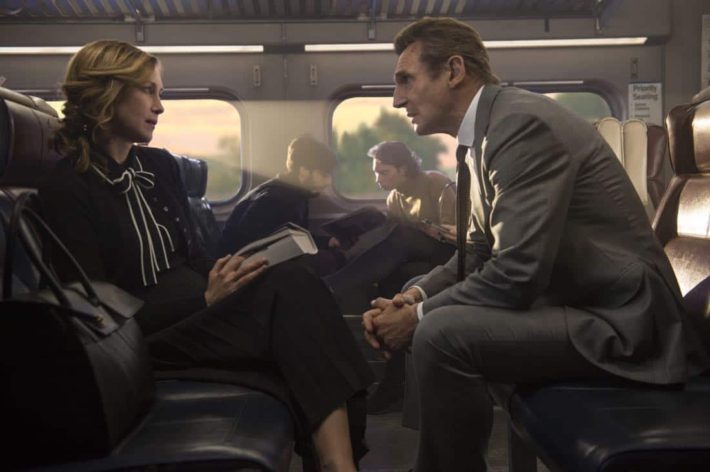
This go-round, happily married devoted father Michael MacCauley (Neeson) gets chatted up by the lovely and mysterious Joanna (Vera Farmiga) as he heads home on his nightly commute. She poses a question: would you do one little thing—something you are uniquely qualified to do—if it landed you 100k and you had no idea of the consequences?

Well, it’s not a game and next thing you know he’s dragging his lanky frame up and down the train cars trying to find a mysterious person with a mysterious bag before his family is nabbed or someone else gets killed.

How many times do we have to see this movie? We get it, Neeson is not a man to be messed with. He’s savvy, noble and he can take a punch.

Farmiga’s always a welcome sight, plus Sam Neill and Patrick Wilson contribute as they can. But mainly it’s just you, Neeson and a host of stereotypes trying to test your mystery-solving skills but not your patience.

At its best, The Commuter is a B-movie popcorn-munching ode to the forgotten middle class good guy. At its worst, a boldly predictable waste of talent littered with plot holes and weak CGI.

It’s a Liam Neeson movie. What do you want?

Bring a Shovel

The Snowman

by Hope Madden

The Snowman, a Norway-set serial killer thriller, runs like a 3-hour flick that someone gutted for time without regard to sensibility, leaving a disemboweled and incoherent pile in the snow for audiences to puzzle over.

Not what I had expected.

I love director Tomas Alfredson. Well, I love his 2008 gem Let the Right One In and so, by extension, I love him. His writing team, adapting Jo Nesbø’s novel, includes the scribes behind such bits of brilliance as Drive (Hossein Amini) and Frank (Peter Straughan), and Michael Fassbender is the lead. Rock solid, that’s what that is.

And yet, The Snowman went horribly, embarrassingly, head-scratchingly wrong.

Fassbender plays Detective Harry Hole. (I swear to God, that’s his name.) He’s a blackout drunk in need of a case to straighten him out. He finds it in one misogynistic mess of a serial killer plot.

All he and his new partner Katrine (Rebecca Ferguson) know is that the killer leaves snowmen at the crime scene and has complicated issues with women. What follows is convoluted, needlessly complicated with erratic and unexplained behavior, ludicrous red herrings and a completely unexplained plot point about prescription pills.

The Snowman is not the first in Nesbø’s Harry Hole series, so a lot of “catch us up on this guy” exposition gets wedged in. From there, the writing team took a buzzsaw to Nesbø’s prose, leaving none of the connective tissue necessary to pull the many, varied and needlessly lurid details together into a sensible mystery plot.

It all leads ploddingly, frustratingly to an unearned climax heavy with needless flashbacks and convenient turns.

Everybody smokes, so it almost works as a cigarette ad, but as an actual story? No.

Fassbender, an inarguable talent, offers little to a clichéd character whose tics are predetermined—a shame because this is an actor who can dig deep when it comes to character tics. Ferguson and Charlotte Gainsbourg, as Hole’s ex, fare even worse. And an entire slew of heavy hitters gets wasted completely, including J.K. Simmons, Toby Jones and a weirdly dubbed Val Kilmer.

Alfredson films snowcapped carnage with a grotesque beauty few directors can touch, but that’s hardly reason enough to sit through this muddled mess.

Playing God

The Oath

by Hope Madden

A fight for alpha ensues with a rugged Icelandic backdrop in director Baltasar Kormákur’s latest, The Oath.

Kormákur, a filmmaker known for action-heavy thrillers, also stars as Finnur, a surgeon with some family troubles.

Though his young wife and small daughter seem picture-perfect, Finnur’s 18-year-old daughter from a previous marriage, Anna (Hera Hilmar), is spiraling out of control. An entitled party girl, her drug flirtation blossoms into a full-blown habit, much thanks to her love interest and dealer, Óttar (Gísli Örn Garðarsson).

Finnur’s increasingly reckless behavior, all aimed at removing Óttar from Anna’s life, points as much to a need for control as it does misdirected protectiveness. The film’s title refers to the surgeon’s oath never to play god – which, of course, surgeons do daily. It’s an occupational habit, though, that Finnur is bringing into his time outside the office.

As director, Kormákur works to make both men equally detestable and tender. Óttar is vulgar and brutish, but regardless of the havoc he wreaks or the horror he threatens as Finnur tries harder and harder to separate the lovers, his affection for Anna feels authentic.

Likewise, Finnur’s behavior oscillates between imprudent protectiveness and troubling malevolence. Kormákur’s performance is the picture of restraint, his conflict primarily dealt with internally. It robs the film of some excitement but delivers tension and urgency.

Though both male leads impress, it’s really Hilmar who leaves a mark. Vulnerable, naïve and headstrong, her Anna’s a perfectly frustrating culmination of post-adolescent volatility.

The Oath lacks the slick production values and audience-friendly narrative found primarily in Kormákur’s English-language product (2 Guns, Everest, Contraband), favoring grittier fare and more subdued energy. These are choices that benefit the story, although Kormákur struggles to maintain a tone that suits the tale.

Finnur’s behavior at a highly critical point feels nefarious in a way that doesn’t fit Kormákur’s characterization, and his actions are so atrocious that the resolution feels unsatisfyingly easy. The Oath dips into horror territory, not necessarily a bad thing, but the film can’t make its shifting approach feel anything but jarring – as if an entirely different film landed around Act 3, then vanished for the final reel or so.

Timing is Everything

Bushwick

by Hope Madden

Who was not delighted and surprised by David Bautista’s runaway comedic performance in 2014’s Guardians of the Galaxy?

And truth be told, his turn in the sequel was funnier still. Dave Bautista is comic gold!

Drama, on the other hand, is still just a tad outside his grasp.

Bautista stars with Brittany Snow (Pitch Perfect) in Bushwick, a real-time(ish) survival adventure.

Lucy (Snow) brings a new beau home to her Brooklyn neighborhood Bushwick to meet the fam. Weirdly, there is not a soul in their subway station – aside from that screaming man who’s on fire. That’s extreme, even for New York.

Bombs, snipers and general mayhem greet the two as they try to leave the underground and head to Lucy’s grandma’s place. What is happening?

Directors Cary Murnion and Jonathan Milott want to take a minute before laying it all out for you. It’s not a bad narrative decision – having the audience share in Lucy’s confusion. The directors make a handful of worthy choices, the most provocative and obvious of which is the sleight of hand used to make the film look and feel like one long take.

Beyond the visual trickery employed to minimize the noticeability of cuts, most scenes are delivered as if caught in one take. Actors stumble over lines, for instance, in much the same way humans might when conversing.

There’s even a chance it could have even worked to generate urgency and underscore the raw, wild ride of the adventure if the writing weren’t so bad and the actors had talent.

Snow could not be more irritating or less believable and Bautista, God help us, is asked to deliver an earnest, emotionally devastated monolog.

He’s awful, but he’s not alone. Everyone is. In fact, the most common comment in my notes from the film: This is so bad.

The one reason the film may stick out this weekend is its utterly amazing timing.

Bushwick has been invaded by a well-armed, organized militia of entitled racists.

Shut the F up.

The film won’t satisfy your blood lust, your peaceful dreams or your hope for a decent movie. But damn, its timing is eerie.

Verdict-2-0-Stars

Tenacious M

Kidnap

by Hope Madden

Let me admit this from the start – I may have liked Kidnap better than I should have. Why? Well, I saw it immediately after The Dark Tower, and it is Citizen Kane compared to that festering pile.

In this film, Haley Berry plays Liam Neeson. It’s her second time in the role, actually.

Back in ’08, Neeson – with help from the pen of Luc Besson – revolutionized film with the (wildly over-appreciated) genre flick Taken. Mid-budget “I have a particular set of skills” thrillers have littered the cinematic landscape since, wreaking righteous vengeance and prolonging the careers of middle aged actors everywhere.

In 2013, Berry made The Call, which was not a bad B-movie thriller and her first turn as Liam Neeson. Kidnap sees the Oscar winner playing a loving mother whose 6-year-old (a very sweet Sage Correa) is nabbed from a busy park. Mom sees the napper shoving her son into a car, she jumps in her minivan and the pursuit begins.

The film amounts to a 90-minute car chase with one unreasonably attractive mom behind the wheel. Several of the action sequences are interesting and flashy (for a film with this level of budget – do not go into this hoping for Fast and the Furious: Minivans).

Writer Knate Lee can’t really justify the lack of cell phone or police presence, but he does what he can. Meanwhile, director Luis Prieto ably assembles car chases and panicked driver close ups, then competently shifts tone for a final act that toes the line between thriller and horror.

There’s nothing exceptional about Kidnap. Not one thing. You’ll forget it existed as quickly as you forgot The Call was ever made. But for a getting-the-phone-bill-paid flick, it’s not too bad.

Verdict-2-5-Stars

https://www.youtube.com/watch?v=R-Ht8VRPRvU


Abandon All Hope

Inferno

by Matt Weiner

Good versus evil. Heaven versus hell. The first 15 minutes of Inferno versus the last 105 minutes…

Director Ron Howard’s latest Dan Brown adaptation reprises Tom Hanks as the clearly tenured Professor Robert Langdon, once again caught up in a global conspiracy that will require his knowledge of symbols, art and religious icons to solve a series of puzzles.

And this time, it’s not just Catholicism that hangs in the balance—Langdon soon learns he’s tracking a deadly virus that, if released, would wipe out much of the world’s population.

Langdon spends the first 15 minutes of the film recovering from a bullet wound and massive head trauma, with no memory of the last few days. He hears voices and suffers violent hallucinations plagued with visions of medieval horror. The quick cuts are unsettling, as if Jason Bourne dropped acid while watching The Omen.

The Dantean grotesques invading Langdon’s head and complete lack of plot coherence also hinted at the chance that maybe, just maybe, Howard would pull off the greatest conspiracy of all and turn a lavish studio tentpole into an unhinged Italian horror send-up.

And then Langdon’s memory starts to come back. That’s when the rest of the film segues from Dario Argento to standard thriller. (You can reliably track the dullness of the movie with the sharpness of Langdon’s puzzle skills.)

It’s not that the thriller portion of Inferno is bad, although it is equal parts frenetic and nonsensical. Based on the source material, though, the relentless pacing is probably for the best, or else you’ll start to wonder when the World Health Organization started building up lethal military commandos without the United Nations getting concerned. Or why nobody is too bothered by the existence of a secret multinational security company that almost destroyed the world. (Or why the movie wastes the electric Irrfan Khan as the group’s leader.) Go in with the right expectations, though, and Inferno won’t disappoint.

Where Inferno really misses the mark isn’t so much its tiredness as a thriller but its complete lack of relevance. Paranoid classics like Three Days of the Condor and All the President’s Men oozed 1970s zeitgeist like blood on bitumen.

But in 2016, at the climax of the United States election—of this election, in these times—Inferno opts to menace us with an asocial Silicon Valley businessman (played by Ben Foster) whose views on humans are just a hair to the right of some actual Silicon Valley CEOs and venture capitalists.

Forgive the plot. Forgive Robert Langdon’s haircuts. Forgive Foster, whose face earns infinite goodwill by reminding you that he also spent 2016 onscreen in Hell or High Water.

But in a movie that, including the end credits, makes rational sense for maybe 20 minutes, the biggest unsolved mystery is how little feels at stake—and how unimaginative the film thinks about what the end of the world as we know it might look like.

Verdict-2-0-Stars