
Tag Archives: Screen Wolf
Screening Room: Dungeons & Dragons, Tetris, Malum, Spinning Gold and More

Anyone for Tetris?
Tetris
by George Wolf
So, you had mad Tetris skills back in the day, did you? Wel then, maybe you know that the name came from merging “tetra” (Greek for “four”) with “tennis.”
But did you know that the road to your gaming glory was paved with blackmail, Cold War intrigue, corporate backstabbing, KGB harassment and perhaps even one exuberant singalong to Europe’s 1986 anthem “The Final Countdown?”
The Apple Original Tetris gives us all that and more, riding an animated lead performance from Taron Egerton and a nostalgic, 16-bit aesthetic for an entertaining ride through history that’s only too happy to borrow from both Pixels and Argo.
And no matter how familiar you are with gaming culture, this is one crazy-ass story.
In the late 1980s, Henk Rogers (Egerton) was a video game sales rep whose shoot-from-the-hip manner and boots-with-suits style earned him a cowboy reputation. His first look at Tetris left him mesmerized at its “poetry, art and math,” and obsessed with obtaining the marketing rights for he called “the perfect game.”
But Tetris was a spare-time invention from Russian worker bee Alexey Pajitnov (Nikita Efremov), and getting those rights would put Rogers in the criss-crossing crosshairs of a competing sales rep (Toby Jones), a billionaire tycoon (Roger Allam, under some questionable makeup) and his heir (Anthony Boyle), game developers from Nintendo and various members of the KGB.
Fun! it is, especially the moments when a Russian business exec (Oleg Stefan, fantastic) moves from room to room in his office building, pitting the players against each other with deadpan delight.
Once again, Egerton is terrific. We first meet Henk as a fast-talking sales dog always ready with a pitch. But as Henk’s passion for a possible Tetris goldmine gives way to manic desperation, it feels real, as does his concern for safety of Alexey and his family.
Director Jon S. Baird (Stan & Ollie) indulges the throwback Thursday vibe, with plenty of game player graphics, pixellated frames and 80s jams. But look beyond the breezy attitude, and you’ll also find that writer Noah Pink includes some resonant nods to how even the seemingly harmless technology can quickly be weaponized.
Yes, the finale becomes a bit tidy, idealistic, and familiar (does Ben Affleck get a credit?), but the fictionalized history of Tetris is worth revisiting, meaning that after a slew of terrible video game adaptations, the genre can bask in a rare double score. Dungeons and Dragons can please crowds at the multiplex, while briefcases and boots gets the job done at home.

They Got Game
Dungeons and Dragons: Honor Among Thieves
by Hope Madden and George Wolf
There is a new Dungeons and Dragons movie, Dungeons and Dragons: Honor Among Thieves. Unfortunately, there is not a topic on this planet about which Madd and/or Wolf know less than Dungeons and Dragons. It honestly took us decades to undersand that “zero charisma!” reference in E.T.
Well, good news, then, that MaddWolf pack writer Cat McAlpine is a D&D expert!
Bad news! Cat McAlpine was unavailable for the screening because she was – we swear to God this is true – playing Dungeons and Dragons. So, you’ll have to settle for us. And here’s the crazy thing: we liked it.
We did not expect to. You should have seen the fit we threw when we realized Cat couldn’t review it and we would have to. Hissy levels.
Obviously, we can’t speak to how closely the film sticks to whatever it is Dungeons and Dragons is/does/conjures. But as a comedic adventure film with a quest narrative and a game-like aesthetic, it succeeds.
Co-directors John Francis Daly and Jonathan Goldstein (Game Night), both writing with Michael Gilio (Kwik Stop), find an easy humor that feeds off the charm and charisma of their cast. They inject a Guardians of the Galaxy tone into a narrative that mirrors role-playing level changes, and let a talented ensemble keep you entertained.
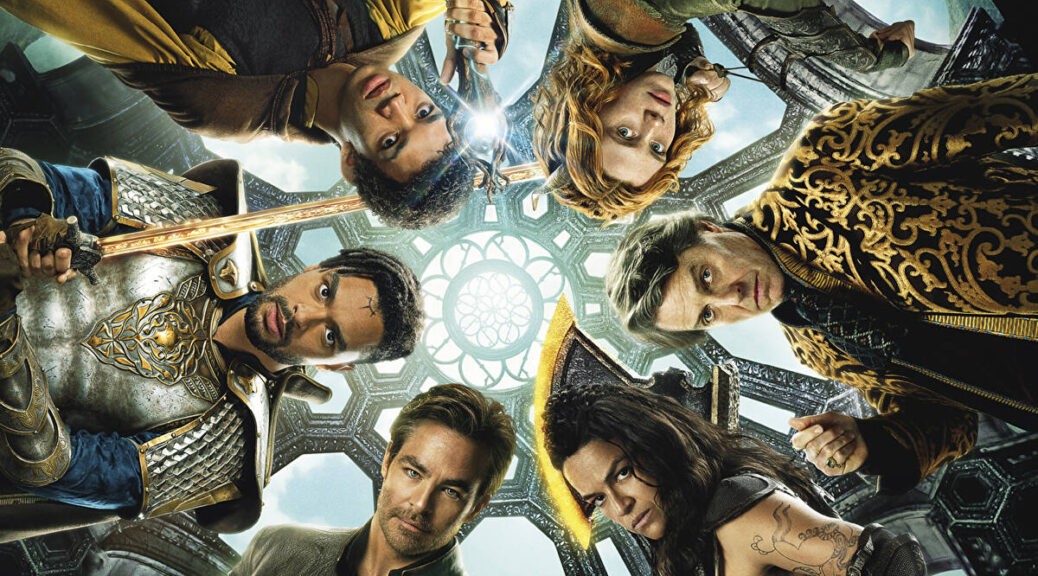
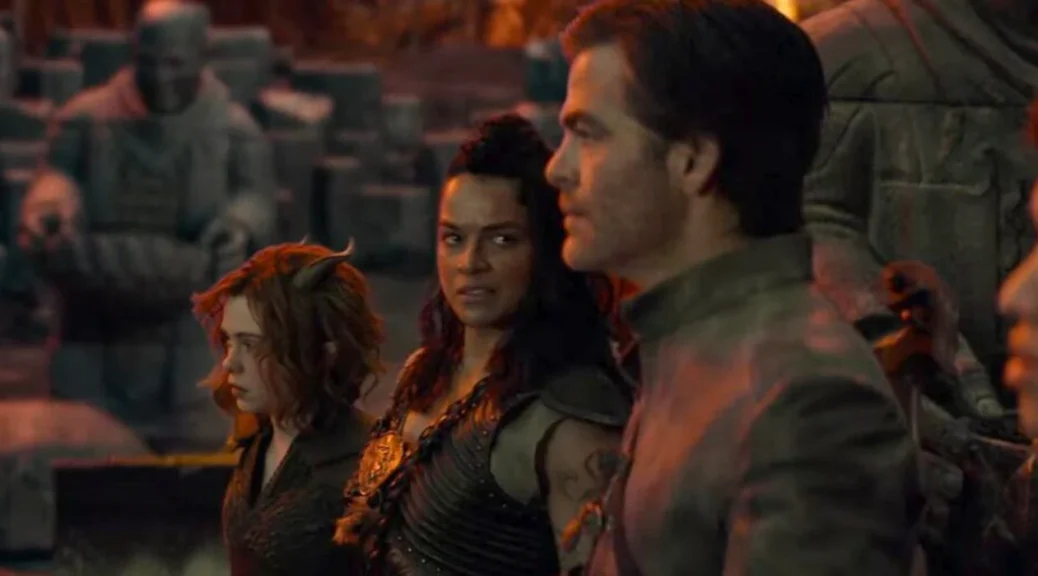
Chris Pine is the lute-playing, wise-cracking Edgin, who teams with the badass Holga (Michelle Rodriguez) to bust out of prison and go on the run from that cad Forge (Who else but that cad Hugh Grant). They pick up young sorcerer Simon (Justice Smith) and the shape-shifting druid Doric (Sophia Lillis) along the way, and the foursome embarks on an adventure to retrieve a powerful relic that could help reunite Edgin and his daughter Kira (Chloe Coleman).
Does any of this follow a D&D storyline? We don’t know. But even before Bridgerton‘s Regé-Jean Page shows up to lampoon his own image as the dashing Xenk, the contagious, wink-wink swashbuckling had won us over.
The fantastical creatures are plentiful (an “owl bear,” presumably cocaine free!) and gameboard-worthy, while Daly and Goldstein keep upping the ante with fast-paced plot turns that recall those “extra life” badge things that gamers rely on to keep the action pumping.
And the adventure does run a tad long, sometimes feeling simultaneously overstuffed and superficial. But the tone it embraces feels just right, and Honor Among Thieves fulfills its quest to deliver likable characters, infectious humor, and escapist fun.

Fright Club: Iconic Creature Make Up
We are beyond thrilled to get to talk with horror makeup FX master and good friend David Henson Greathouse for an episode on the best creature makeup in horror.
5. The Howling (1981) (Rob Bottin)
Rob Bottin won an Oscar for his FX makeup in Total Recal and was nominated for the glorious mostermaking in Ridley Scott’s Legend. Still, he may be best known for the touchstone in horror movie makeup, The Thing.
But the Bottin work we want to celebrate is in Joe Dante’s 1981 lycanthrope horror The Howling. Not because we love it more than his groundbreaking work those others, but because he shapes so many characters, and his makeup defines those characters. From partial transformations to complete metamorphosis, the makeup FX in The Howling create an unseemly atmosphere and tell us all we need to know about the characters on the screen.
4. Hellraiser (1987) (Bob Keen)
Bob Keen’s creatures have terrified in Candyman, Lifeforce, Nightbreed, Dog Soldiers and more. But his crowning glory wore pins.
Keen is the builder who brought Clive Barker’s maleficent cenobites to life and he had such sights to show us. Josh Russell took what Keen created and finessed it brilliantly for David Bruckner’s 2022 reboot, but Keen’s original – Pinhead, especially – cut a figure as memorable and identifiable as any monster since Frankenstein’s.
3. Pan’s Labyrinth (2006) (David Martí)
David Martí won the Oscar for his magnificent work on longtime collaborator Guillermo del Toro’s 2006 masterpiece Pan’s Labyrinth. He’d brought del Toro’s wondrously macabre imagination to life many times – The Devil’s Backbone, Hellboy II: The Golden Army, Crimson Peak – but never as beautifully, terrifyingly or heartbreakingly as here.
The Pale Man is a perfect example of actor and artist melding, Doug Jones taking the inspired horror of Martí’s makeup and animating the character as no one else could. The result is absolute perfection.
2. The Fly (1986) (Chris Walas)
When Chris Walas and David Cronenberg collaborated on 1981’s Scanners, a star was born. Probably two. That head explosion catapulted both artists into the genre stratosphere. With Naked Lunch, Walas was able to indulge his imagination in wildly various ways with all manner of creature.
But his Oscar came for his 1986 stroke of genius that was The Fly. Once again, artist and actor merged as Walas’s designs led Jeff Goldblum through the transformation, and his character’s arc. No matter how grotesque or repulsive, Walas and Goldblum managed to maintain a human heart, which is what was broken by the time the credits rolled.
1. Frankenstein (1931) (Jack Pierce)
What else? There may be on planet earth no image more instantly recognizable, and in the genre there is certainly no profile more iconic, than that of the monster created by Jack Pierce and brought to life by Boris Karloff.
The design didn’t resemble the description from Shelley’s text, nor did Whale’s direction or Karloff’s performance resemble the doomed monster of the novel. But what image do you associate with the Frankenstein monster? What square head, big boots, bolted neck has become the shorthand across popular culture from film to cereal boxes? And whose wild imagination conjured that image? Jack Pierce’s.

Screening Room: John Wick 4, A Good Person, One Fine Morning, Return to Seoul & More

Seoul Searching
Return to Seoul
by George Wolf
“Your birth name is Yeon-Hee. It means ‘docile’ and ‘joyous.'”
None of those things apply to Frédérique (Park Ji-min), whose name was changed after a French couple adopted baby Yeon-Hee and moved her from Seoul to Paris.
25 years later, she’s back.
In Return to Seoul (Retour à Séoul), the trip “home” becomes a catalyst for one woman’s search for identity, as director and co-writer Davy Chou crafts a relentlessly engrossing study of character and culture.
Now 25, “Freddie”‘s planned vacation in Japan is diverted by a typhoon, and she lands in Seoul “by surprise” – or so she tells her adoptive mother in France. But it isn’t long before Freddie is visiting the agency that handled her adoption, and reaching out to her birth parents to gauge interest in a meeting.
And from the minute we meet Freddie, she is purposefully upending the societal expectations of her heritage. When Freddie laughingly explains it away to her friend Tena (Guka Han) as “I’m French,” Tena quietly responds that Freddie is “also Korean.”
Freddie’s birth father and mother have very different reactions to her outreach. Chou moves the timeline incrementally forward, and Freddie’s two-week holiday becomes a new life in Seoul, one that’s fueled by restlessness and unrequited longing.
In her screen debut, Park is simply a revelation. Her experience as a visual artist clearly assists Park in realizing how to challenge the camera in a transfixing manner that implores us not to give up on her character. Freddie is carrying a soul-deep wound and pushes people away with a sometimes casual cruelty, but Park always grounds her with humanity and restraint.
As the narrative years go by, Chou adds flamboyance without seeming overly showy, and manages to toe a tricky line between singular characterization and a more universal comment on Korean adoptees.
Freddie begins to embody the typhoon that pushed her toward this journey of self, and Return to Seoul becomes an always defiant, sometimes bristling march to emotional release. And when that release comes, it is a rich and moving reward for a filmmaker, a performer, and all who choose to follow.


Press To Play
Kubrick by Kubrick
by George Wolf
Stanley Kubrick gave so few interviews in his lifetime that an early striking moment in Gregory Monro’s Kubrick by Kubrick comes the first time you hear his voice.
It doesn’t really seem to fit, until you remember Kubrick wasn’t French or British, he was a native New Yorker. And he had a clear penchant for precise, matter-of-fact observations.
Film critic Michel Ciment was lucky enough to get some of those thoughts on tape over the course of several years, and Monro surrounds highlights of those cassette recordings with still photos, movie clips, and interviews with various cast and crew from Kubrick’s 13 movies.
Monro anchors the film with a recreation of the hotel suite from 2001. This one is adorned with mementos from Kubrick’s catalogue, which Monro spotlights as Ciment and Kubrick move their conversations from film to film.
Obviously, film fans will get critical insight into Kubrick’s mindset and interpretations of the stories he told (horror fans may especially take note of his far-from-the-rabbit-hole thoughts on The Shining).
But however much time Ciment spent with Kubrick, it seems Monro only found enough usable material for a heavily padded, barely one-hour running time, which leaves plenty unsaid. It’s certainly great to see all the classic clips from Kubrick’s films, but after actors such as Jack Nicholson, Malcolm McDowell, Sterling Hayden (Dr. Strangleove) and Marisa Berenson (Barry Lyndon) comment on Kubrick’s legendary perfectionism, you wait for reactions from the man himself that never come.
Maybe beggars like us can’t be choosers, and there are fascinating answers from Kubrick here, chief among them some suddenly prescient thoughts on HAL’s A.I. awareness. Kubrick by Kubrick is the rare chance to get inside the mind of a guarded legend, and even when it leaves you wanting more, that somehow feels like an ending he had planned all along.
Screening Room: Shazam! Fury of the Gods, Inside, Boston Strangler, Magician’s Elephant & More
The Write Side of History
Boston Strangler
by George Wolf
Writer/director Matt Ruskin wants us to remember that decades before the events of All the President’s Men, Spotlight or She Said, journalists – specifically women journalists – were heroically committed to finding the truth.
Wading through historical record with a detailed screenplay that’s surprisingly unaided by any source material, Ruskin crafts Boston Strangler as a salute to two dogged reporters and the mystery that still surrounds their biggest story.
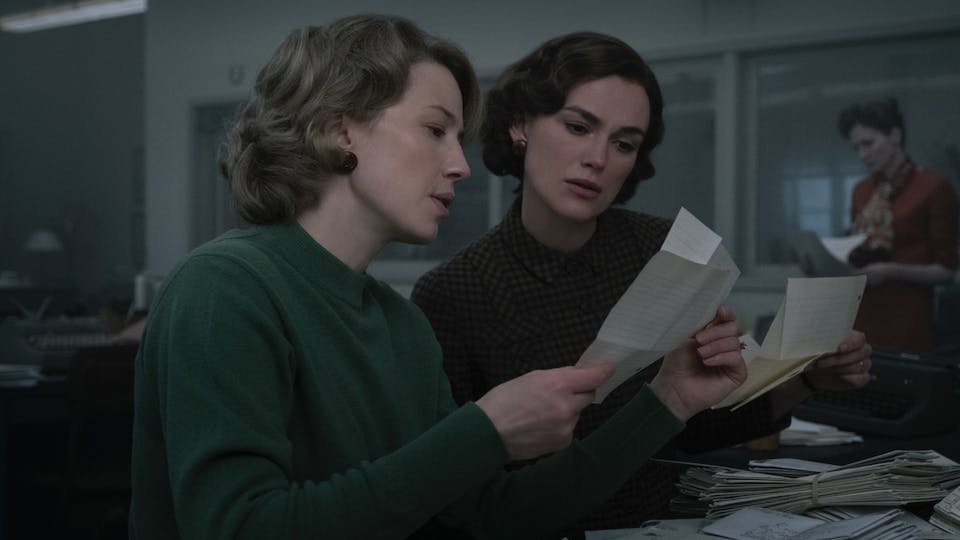
In the 1960s, Loretta McLaughlin (Keira Knightley) was a lifestyle reporter for Boston’s Record American. She pressured editor Jack Maclaine (Chris Cooper, reliable as always) for a better beat, but got approval to work the Strangler story only on her own time. As Loretta’s promising leads met increasing roadblocks, street-wise veteran Jean Cole (Carrie Coon) had her back and the two “girl” reporters started lighting up the front pages.
Knightley and Coon make for a team just as formidable as their characters, highlighting the contrasts of the two women’s lives while making it clear how much they came to depend on each other. The always welcome Alessandro Nivola adds solid support as Detective Conley, a sympathetic cop who proves useful to the case.
And you might remember that case eventually led to the confession of Albert DeSalvo (David Dastmalchian). But Ruskin is arguing that bit of history is far from settled, and he methodically makes his case via the work of McLaughlin and Cole.
Ruskin’s storytelling is patient and assured, nicely mirroring the ladies’ work ethic and building a subtle bridge from past to present through the sexism and police corruption that made the truth even more evasive.
The film is more compelling than thrilling, striking a tone that fits the material. It’s not the splashy headline that’s important, it’s what kind of substance is delivered underneath. Boston Strangler delivers a relevant history lesson, and another salute to the ones that keep asking questions.
