Tag Archives: Screen Wolf

Fright Club: Best Drunks in Horror Movies

Whether they’re merrymakers (Grabbers), comic relief (Mrs. MacHenry, Black Christmas), tempted heroes (Dan Torrance, Doctor Sleep), or outright villains (Jane, What Ever Happened to Baby Jane), the drunk is a staple of horror. They can generate a laugh to help offset tension, or develop dread along with their temptation. They can add tragedy, comedy, lunacy and even terror. Here are our favorite horror movie alcoholics.

5. John Grant (Gary Bond), Wake in Fright (1971)

An unrelenting work of tension and sweat, Ted Kotcheff’s Outback thriller follows an aggrieved school teacher who stops over for a single night in the Yabba on his way from his consripted teaching post to Sydney for Christmas.

One bad decision later, and he (John Grant) and we are trapped, possibly forever, in drunken, mad, dangerous, almost sadistic debauchery. Donald Pleasence co stars as part of a merry band of utter lunatics whose sold purpose seems to be to trap this man in their depravity with them.

4. Sam (Larry Fessenden), Habit (1995)

Writer/director/star Larry Fessenden explores alcoholism via vampire symbolism in this NY indie. Fessenden plays Sam, a longtime drunk bohemian type in the city. He’s recently lost his father, his longtime girlfriend finally cut bait, and he runs into a woman who is undoubtedly out of his league at a party.

And then he wakes up naked and bleeding in a park.

The whole film works beautifully as an analogy for alcoholism without crumbling under the weight of metaphor. Fessenden crafts a wise, sad vampiric tale here and also shines as its lead.

3. John Marshall (Jim Cummings), The Wolf of Snow Hollow (2020)

Writer/director/star Jim Cummings is officer John Marshall of the Snow Hollow sheriff’s department. John’s father (Robert Forster, in his final role) is the longtime sheriff of the small ski resort town, but Dad’s reached the age and condition where John feels he’s really the one in charge.

John’s also a recovering alcoholic with a hot temper, a bitter ex-wife and a teen daughter who doesn’t like him much. But when a young ski bunny gets slaughtered near the hot tub under a full moon, suddenly John’s got a much bigger, much bloodier problem.

Cumming’s script, like his writing for Thunder Road, is full of life, and has hin again juggling random outbursts of absurd non-sequiturs and hilarious anger with real human issues of struggle and loss. John’s afraid of losing his father, women are being preyed upon, and a drink would sure hit the spot.

2. Wake (Willem Dafoe) & Winslow (Robert Pattinson), The Lighthouse (2019)

Robert Eggars has gone to sea. The Lighthouse strands you, along with two wickies, on the unforgiving island home of one lonely 1890s New England lighthouse.

Salty sea dog Thomas Wake (Willem Dafoe) keeps the light, mind ye. He also handles among the most impressive briny soliloquies delivered on screen in a lifetime. Joining him as second is one Ephraim Winslow (Robert Pattinson)—aimless, prone to self-abuse, disinclined to appreciate a man’s cooking. Both enjoy a bit of drink.

This is thrilling cinema. Let it in, and it will consume you to the point of nearly missing the deft gothic storytelling at work. The film is other-worldly, surreal, meticulous and consistently creepy.

And we’ll tell you what The Lighthouse is not. It is not a film ye will soon forget.

1. Jack Torrence (Jack Nicholson), The Shining (1980)

It’s isolated, it’s haunted, you’re trapped, but somehow nothing feels derivative and you’re never able to predict what happens next. It’s Stanley Kubrick’s masterpiece rendition of Stephen King’s The Shining.

Jack Nicholson outdoes himself. His early, veiled contempt blossoms into pure homicidal mania, and there’s something so wonderful about watching Nicholson slowly lose his mind. Between writer’s block, isolation, ghosts, alcohol withdrawal, midlife crisis, and “a momentary loss of muscular coordination,” the playfully sadistic creature lurking inside this husband and father emerges.
Screening Room: Maestro, Boy and the Heron, Eileen, Wonka, Sacrifice Game

Band of Brothers

Immediate Family

by George Wolf

In the last couple decades, documentaries such as Standing in the Shadows of Motown and the Oscar-winning 20 Feet from Stardom have given just due to the unknown musicians and singers who have long backed up our idols.

Director Denny Tedesco may have been first with the idea, though his debut doc The Wrecking Crew! endured years of delays until its 2008 release. Tedesco is back with Immediate Family, and while he’s still looking behind the musical scenes, his second feature boasts some important distinctions.

To start, it’s much more contemporary. This one features a trove of interviews that are not only recent, but feature musicians that are still highly relevant, such as Stevie Nicks, Don Henley, Jackson Browne, James Taylor, Keith Richards, Lyle Lovett and more.

And secondly, for serious music fans (and even casual fans of a certain age), the names Leland Sklar, Russ Kunkel, Waddy Wachtel and Danny “Kooch” Kortchmar may already be plenty familiar. As the film points out, that’s largely thanks to producers Peter Asher and Lou Adler, who in the 1970s decided to start featuring the names and faces of these longtime sidemen in the liner notes of the many albums they played on.

But even if you recognize these players, it’s still a kick to hear the superstars go into detail about how valuable they are, and to watch their specific grooves morph into fully produced classics.

It all follows a formula very similar to the one that made The Wrecking Crew! so irresistible, but with greatly improved production values that increase the immediacy along with the timeline.

Immediate Family ends up feeling like the next logical step in Tedesco’s musical journey. We get more great tunes, witness more important stages in the evolution of popular music, and spend some quality time with four more unique talents that are well worth getting to know better.

She Seems Nice

Eileen

by George Wolf

You need an “easy on the eyes” vamp for your nourish thriller? Anne Hathaway’s on your short list, for sure.

Soft-spoken, sheltered waif with eyes that long for a new life? Get me Thomasin McKenzie!

The casting in Eileen may be no surprise, but there are big surprises in store. And the way the two leads slowly draw their characters toward a deadly intersection keeps William Oldroyd’s second feature engaging throughout.

McKenzie is the put-upon Eileen, who quietly spends her days fantasizing about sex and violence and stashing away all the money she makes doing secretarial work at a boys correction facility in early 1960s Massachusetts. Eileen is also the daughter of the town’s former police chief (Shea Whigham), currently a paranoid, drunk widower with a penchant for verbal abuse and gun waving.

Eileen’s world is rocked when the facility’s staff psychologist retires, and Rebecca (Anne Hathaway) shows up to replace her. Tall, Ivy League-schooled with a sarcastic wit and a smoldering sensuality, Rebecca stands out plenty in the little New England ‘burg.

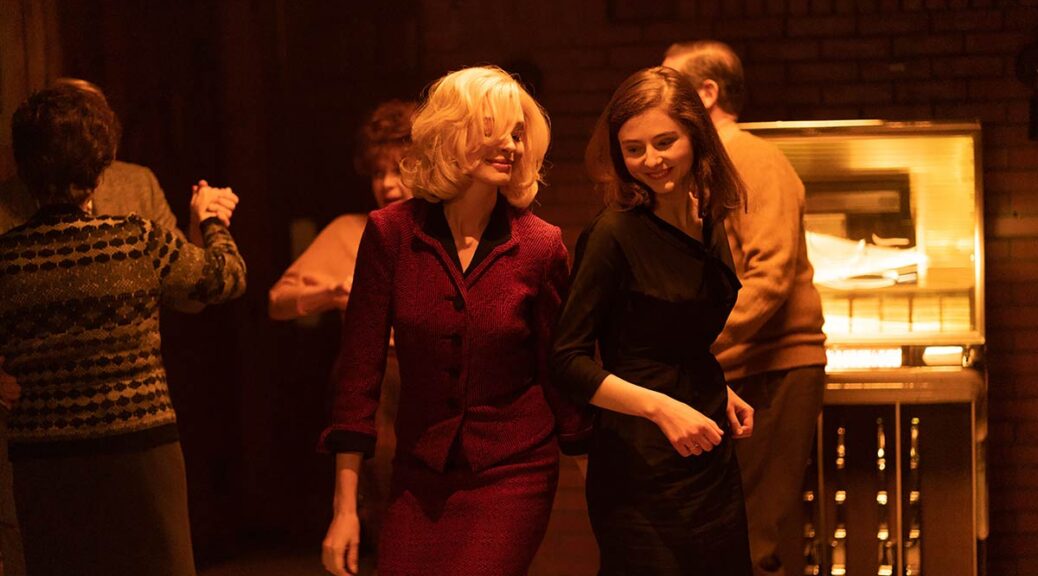
They meet for a couple drinks at the local bar and hit the dance floor while Rebecca belittles the leering regulars. Eileen is transfixed.

So she jumps at the invitation to visit over the holiday break, where Rebecca (and screenwriter Luke Goebel, Causeway) have a big bomb to drop.

Adapted from Ottessa Mosfegh’s award-winning 2015 novel, the film is a slow boil that leans on mood and atmospherics to lull you, even as you feel the creep of dread.

Both Hathaway and McKenzie are perfection, consistently smoothing the bumps when Oldroyd (Lady Macbeth) seems a bit hesitant to fully embrace the story’s pulpy underbelly. He and Goebel also tweak the novel’s ending, leaving the resolution more open-ended and abstract.

Fans of the book may feel slighted, but Eileen lands on the big screen as its own slippery shape shifter, a simmering throwback with just enough thrills to satisfy.

https://www.youtube.com/watch?v=vj4q8-9Fchg

Your Roots Are Showing

Godzilla Minus One

by George Wolf

“Get back to your roots.”

It’s an old adage, maybe even a cliche. But Godzilla Minus One reminds us it can also be a damn good idea.

Writer/director Takashi Yamazaki returns to themes he explored ten years ago in The Fighter Pilot, tips some unmistakable hats to both Jaws and Dunkirk, and emerges with a completely satisfying Kaiju adventure.

And though Yamazaki makes sure Godzilla wreaks his havoc early and often, Minus One is a film driven by characters with all-too-human complexities.

As Japan is struggling to recover from WWII, pilot Koichi Shikishima (Ryunosuke Kamiki) is suffering from survivor’s guilt, and the taunts of townspeople who feel he is a coward for not “dying with honor.” He’s also suppressing memories of Godzilla, the whispered-about monster he witnessed wipe out an island military base near the end of the war.

Years pass, with Koichi scraping by in the small place he shares with Noriko (Minami Hamabe) and the orphan child she has taken in. In need of money, Koichi accepts a dangerous job clearing old mines from coastal waters. And once out on the boat, Koichi and his shipmates realize they’re going to need a bigger one.

Yamazaki – who’s also credited as the VFX supervisor – gives Godzilla a wonderfully classic look, with imposing and well-defined features like those spiky scales that turn blue when he’s about to spit that fire! Hell yeah!

But back to the roots.

By taking the setting back to post-war Japan, Yamazaki’s script not only revisits the original cautions of the atomic age, but adds some new layers of depth. The clever plan to defeat Godzilla may let Japan rewrite some history, but Yamazaki doesn’t let his homeland’s approach to war off that easy.

The morals are clearly marked, but this is a crowd pleasing and often thrilling adventure, with some well-chosen moments of humor woven into a pace that rarely bogs down, despite a bit of schmaltz and one or two unsurprising surprises that dot the landscape. Yamazaki deftly balances the destruction with the reflection, and Minus One raises up a welcome addition to Godzilla lore.

Shut Up and Shoot

Silent Night

by George Wolf

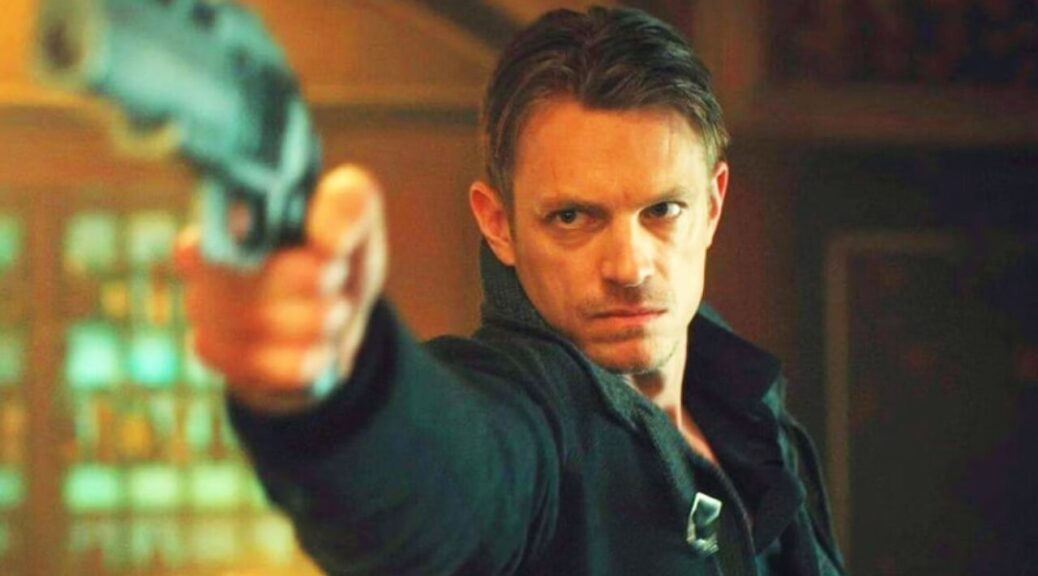
December is a busy month, so Brian (Joel Kinnaman) has some helpful reminders written on his wall calendar.

“Pick up Mom from the airport?”

“Buy a ham?”

No, no, Brian is thinking bigger this year, especially for his Christmas Eve party plans.

“Kill them all!”

And, if things go really well, “start a gang war?” Yes, he really writes that down.

A year ago, Brian’s son was killed by a stray bullet from a gangland shootout in suburban Texas. Brian himself was shot in the throat during the mayhem, and he’s spent all his silent days and nights since then ignoring his wife (Catalina Sandino Moreno, doing what she can with a thankless role) and planning some very bad tidings of revenge.

Silent Night is director John Woo’s first American film in 20 years, but his considerable skill with an action sequence is never enough to elevate the film beyond a misguided fantasy of bloodlust and wall-building.

And even then, the blood-spilling combat doesn’t begin until nearly halfway in, as we wade through 50 tedious minutes of dialog-free montages with Brian target shooting, reinforcing his ride and making anguished faces.

Despite the title, the Christmas setting feels tacked-on for marketing purposes, becoming the only theme in Robert Archer Lynn’s script that’s soft-pedaled. The “silent” gimmick becomes contrived pretty quickly, there are numerous gaps in logic and you wonder why everyone involved here was so comfortable with an angry, self-righteous white man executing countless Mexicans.

Sure, Brian tips off an African-American cop (Scott Mescudi) about his mission to do what the law won’t, but the film is never hazy about what heroes and villains look like.

Those hand-written calendar notes teased the possibility for some humorous lunacy that is completely ignored, as the only thing over-the-top here is the utter seriousness of tone. Could Nic Cage and a face-off machine have saved this holiday turkey? Tough call. Even Woo’s battle sequences seem uninspired and repetitive, and the most memorable piece of the action in Silent Night becomes how much louder its speaking.

A Man Aparte

Napoleon

by George Wolf

“Destiny has brought me here! Destiny has brought me this pork chop!”

And a silly food fight ensues between Napoleon and Josephine, just minutes before director Ridley Scott unveils a simply breathtaking recreation of 1805’s Battle of Austerlitz.

Scott’s Napoleon is a film that succeeds with moments both big and small, but suffers from a lack of connective tissue that might have formed it into one unforgettable whole.

Joaquin Phoenix makes the legendary emperor and military commander as endlessly fascinating as you’d expect, while Vanessa Kirby’s equally mesmerizing turn as Josephine creates a dynamic that authenticates Napoleon’s lifelong devotion.

But even if we didn’t already know Scott’s 4-hour director’s cut is coming, this 2 and 1/2 hour version ends up feeling like a stunningly crafted, IMAX-worthy appetizer. It’s every bit a grand spectacle with epic vision of history, but never quite the incisive character study that may be waiting in the streaming wings.

Screening Room: Hunger Games, Trolls Band Together, Thanksgiving, MayDecember, The Stones and Brian Jones