Tag Archives: Oscar contenders

Swimming in Romance

The Shape of Water

by Hope Madden

In its own way, The Creature from the Black Lagoon is a tragic romance. But what if it weren’t? Tragic, I mean. What if beauty loved the beast?

It seems like a trend this year.

An unforgettable Sally Hawkins—an actor who has never hit a false note in her long and underappreciated career—gets her chance to lead a big, big show. She plays Elisa, a mute woman on the janitorial team for a research institute in Cold War era Baltimore.

Enter one night a malevolent man (Michael Shannon), and a mysterious container. Color Elisa intrigued.

Writer/director Guillermo del Toro is an overt romantic. So many of his films—Cronos, The Devil’s Backbone, Crimson Peak—swim in romance, but he’s never made as dreamily romantic or hypnotically sensual a film as The Shape of Water. And he hasn’t made a film this glorious since his 2006 masterpiece, Pan’s Labyrinth.

Del Toro favorite Doug Jones—Pan’s Pale Man and Hellboy’s Abe Sapien—gets back into a big, impressive suit, this time to play Amphibian Man. His presence is once again the perfect combination of the enigmatic and the familiar.

The supporting cast—Shannon, Octavia Spencer, Richard Jenkins and Michael Stuhlbarg—are among the strongest character actors Hollywood has to offer and del Toro ensures that they have material worthy of their talent. Each character is afforded not only his or her own personality but peculiarity, which is what makes us all both human and unique—important themes in keeping with the story. With Hawkins and Jones, they populate a darkly whimsical, stylish and retro world.

Characteristic of del Toro’s work, Shape of Water looks amazing. Its color scheme of appropriate greens and blues also creates the impossible truth of sameness within otherness, or the familiar with the alien.

The aesthetic is echoed in Alexandre Desplat’s otherworldly score and mirrored by Dan Laustsen’s dancing camera.

The end result is a beautiful ode to outsiders, love and doing what you must.

The Screening Room: Holidays, Lawyers and Billboards

Welcome to The Screening Room. This week we take a look at new theatrical releases Coco, Three Billboards Outside Billing, Missouri, Roman J. Israel, Esq., Novitiate and I Remember You. Plus, we’ll help you pick through new home entertainment.

Listen HERE.

Post By Post

Fences

by Hope Madden

Denzel Washington is an Oscar contender in about one of every three films he makes – Fences is clearly one of those special performances.

As a director, he’s chosen to focus on the African American experience – August Wilson’s Pulitzer and Tony-winning stage play being the strongest effort yet.

Troy Maxson – a 1950s garbage man with a lot to say – is a character that feels custom-made for Washington. Larger than life, full of conflict and bullshit, bravado and stubbornness, Troy is a big presence. He fills up the screen, he fills up a room, but it is Viola Davis as his wife Rose who offers an emotional and gravitational center to the story.

It doesn’t take much effort to pitch Viola Davis a ball she can hit out of the park. Denzel does just that.

As Rose – the force that keeps the family functioning smoothly – Davis quietly astonishes. She delivers every scene – from silly reminiscences to life-altering decisions – with the easy grace of a profound talent.

Together she and Washington boast such chemistry, their glances, smiles and gestures articulating a well-worn, bone-deep love. Their time together on screen – which is a great chunk of the film – is an opportunity to watch two masters riff of each other for the benefit of character and audience alike. The result is in turns heart-warming and devastating.

The two leads benefit from the remarkable support of the ensemble – longtime character actor Stephen Henderson and Russell Hornsby, in particular.

True to the source material, Washington’s direction feels very stage-bound and theatrical. But in most respects, Washington’s delivery – faithful as it is to the idea of the stage from which it leapt – retains what is needed about the sense of confinement allowed by the few sets and locations.

This is a respectful and powerful tribute to the late Wilson, the playwright whose on-stage Fences saw its 2010 revival starring both Washington and Davis. There is no doubting this play’s bonafides, and Washington honors its intimacy and universal themes.

Verdict-4-0-Stars

Great Dane

The Danish Girl

by Hope Madden

Tom Hooper is a proven director. He followed an Oscar for The King’s Speech with an impeccable reimagining – perfectly theatrical and cinematic – of Les Miserables. He now turns his attention to the true life tale of what is likely the world’s first transgender surgery.

The Danish Girl is the gorgeously appointed, elegantly acted portrait of artist Einar Wegener (Eddie Redmayne – proving himself a chameleon of the same caliber as Tom Hardy or Tilda Swinton). His wife Gerda (a remarkable Alicia Vikander), an artist of less fame, needs a favor: her model has cancelled.

What begins as a favor – some silk stockings and fancy shoes – turns into a game for Gerda, but something else entirely for Einar.

The film works best as a study of marriage in turmoil, as Gerda’s riot of conflicting emotions is beautifully articulated by Vikander. Hers is an authentically tumultuous, tender and human performance.

Redmayne – Oscar winner for last year’s The Theory of Everything – is a fierce and nimble talent, no question. His graceful turn here is filled with vulnerability and longing. But The Danish Girl – and Redmayne’s performance, in particular – may be too restrained, too dignified for its own good.

Vikander’s character is fascinating from the beginning, and her fiery yet tender performance drives the film. But that’s kind of the problem. It’s Lili, the woman Einar is determined to become, that we should care for more, learn more about. The Danish Girl should be her story, but it really isn’t.

The fault is hardly Redmayne’s. He evolves slowly from a passionate if delicate husband to an even more delicate yet burgeoning woman, but he never invites us into Lili’s head. She’s an enigma.

The film never truly belongs to Gerda’s story, either, and the lack of true focus leaves the lovely film feeling superficial.

The story itself is astonishing, bordering on unbelievable. Lili Elbe was pioneering and tragic, fragile but fearless in a time when her journey was utterly unimaginable. The Danish Girl has a lot to offer, but it needed quite a bit more of Lili’s spirit if it was to leave a lasting impression.

Verdict-3-5-Stars

Not Too Sweet

Cake

by Hope Madden

Jennifer Aniston has spent the last couple years shedding her golden-girl-next-door image with bawdy comedy roles in the Horrible Bosses franchise and We Are the Millers, as well as a handful of indie flicks. Through the journey she’s successfully mined new area in comedy, but her latest, Cake, shows she has unplumbed depths of talent in drama as well.

Aniston plays Claire. Suffering with chronic pain as well as deep emotional scars, Claire is a self-described raging bitch. Acid tongued and brutally frank, she’s not a favorite with her support group. Or with her physical therapist. Or with much of anybody, really, until she develops an unlikely (and highly contrived) relationship with the widower of another support group member (Sam Worthington).

The film, directed by Daniel Barnz (Beastly), wants to meander through Claire’s unconventional journey, allowing events and details to evolve sloppily, as they do in life. But it doesn’t succeed. Instead, it creates a highly unlikely series of coincidences and relies on Aniston’s formidable performance to make the linkages feel both natural and surprising.

He’s treading similar ground as John Cameron Mitchell’s poignant 2010 effort Rabbit Hole, but Cake suffers a great deal by comparison. Barnz and screenwriter Patrick Tobin are trying too hard. Their scenes feel forced, the relationships inauthentic.

Aniston, on the other hand, is as real as she can be. Her performance is unapologetic, as it should be. Grief isn’t flexible. It doesn’t change shape or appearance just to make the people around it more comfortable. Aniston understands this character, what she’s going through and why she’s behaving as she is, and she doesn’t judge her. More importantly, she doesn’t give a shit if you do.

Her supporting cast is stocked with talent, but only the great Adriana Barraza gets the opportunity to build a real character with a real relationship to Claire. And while even Aniston relies heavily on the words on the page, Barraza can convey everything she needs with a wearied look or a reluctant gesture.

We know Aniston’s cute, but the truth is, she has been proving herself a genuine talent for years. Unfortunately, she made far too many far too safe choices as the adorable romantic lead, and they did not pay off.

Now she’s taking real chances, and though Cake is not an exceptional film, Aniston’s performance is a revelation.

Verdict-3-0-Stars

Go See Selma

Selma

by Hope Madden

Every year Oscar season sees a healthy number of well made biopics for the Academy’s consideration, and those efforts are very often rewarded: 12 Years a Slave, Lincoln, The Iron Lady. But in the 14 years I’ve been covering film in Columbus, none has been as painfully relevant as Selma.

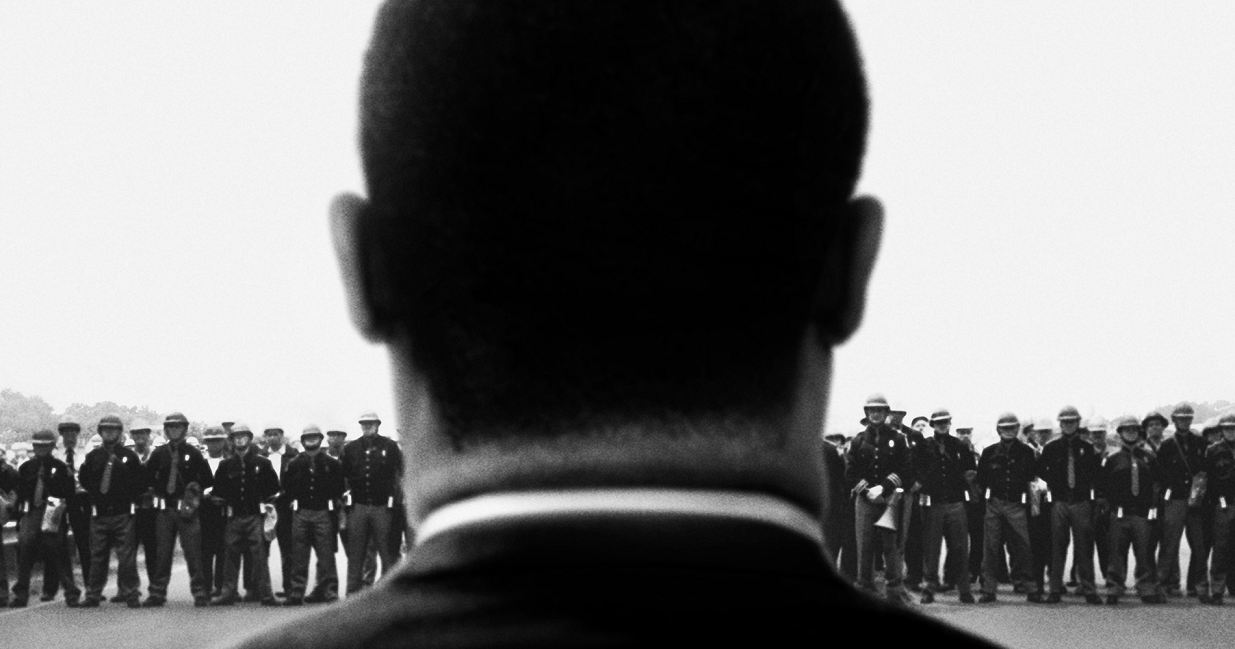
Ava DuVernay’s account of the civil rights marches in Selma, Alabama doesn’t flinch. You can expect the kind of respectful approach and lovely, muted frames common in historical biopics, but don’t let that lull you. This is not the run of the mill, laudable and forgettable historical art piece, and you’ll know that as you watch little girls descend a staircase within the first few minutes. Selma is a straightforward, well crafted punch to the gut.

Working from a screenplay by first time scripter Paul Webb, DuVernay unveils the strategies, political factions, internal frictions and personal sacrifices at play in the days leading to the final march from Selma to Montgomery, Alabama. Yes, she simplifies some complicated issues and relationships, but she is a powerful storyteller at the top of her craft and her choices are always for the good of the film.

The reliable David Oyelowo exceeds expectations as Dr. King. His passionate reserves at the pulpit and the microphone are goosebump perfection, but it’s in the quiet moments that he most impresses, having a bone-deep feel for the man’s weariness as well as his humor, his failings and his faith. It’s a beautiful performance and the heart of a powerful film.

At all times, DuVernay’s film certainly maintains an appropriate reverence for the material. Her cast is more than up to the challenge, beginning with the powerhouse turn from Oyelowo and extending through an impressive, sizeable ensemble. But it’s the filmmaker’s strength in storytelling that elevates this film above others, because DuVernay is never heavy handed, never preachy, and yet every scene is weighted with its historical significance as well as the disheartening immediacy of these events.

The closer black Americans came to the same simple freedoms others took for granted, the more dangerous their lives became, the more anger they faced in the streets, the more outrage was heard from the system that didn’t want – not just yet – to recognize their rights. That shameful time in American history was 1965 – a full fifty years ago. How awful that those wounds feel so fresh.

Verdict-5-0-Stars

Best Film of 2014 For Your Queue

The best film of 2014, Boyhood, releases today for home entertainment. See it! Do it! Director Richard Linklater’s meandering auteurism has led him to this culminating effort, a low key slice of life – but a really, really big slice. Filmed over 12 years, Linklater’s work captures something absolutely unique yet entirely recognizable as it journeys through one boy’s entire young life. A master of the small moment and a genius of collaboration, Linklater draws the best from his game cast and reimagines cinema as he does it.

This great American director’s career is littered with underseen gems, but the one you really need to find is Bernie. Jack Black – who was letter perfect in Linklater’s wonderful School of Rock – excels in this true-crime comedy/drama. Black plays the titular Bernie, the nicest, most beloved guy in town, who happens to also be a murderer. Linklater’s laid back approach and liberal use of non-actors gives the film an off kilter likeability that perfectly supports Black’s genius turn.

https://www.youtube.com/watch?v=YJuhWKcY_6U

Lost and Found

Unbroken

by Hope Madden

With Unbroken, Angelina Jolie’s second effort behind the camera, she proves she knows how to put together a team. Beginning with screenwriters Joel and Ethan Cohen (each with 4 Oscars, two apiece for writing) and extending to cinematographer Roger Deakins (11-time Oscar nominee) and the man behind the music, Alexandre Desplat (with his mere 6 Oscar noms), she’s given Louis Zamperini’s story the storytellers it deserves.

Their film shares the honestly amazing tale of an Olympic runner who finds himself adrift at sea and then held in a Japanese POW camp during WWII. If the film suffers from anything, it’s an overabundance of respect for the source material.

So much of Zamperini’s life just defies belief – if ever there was a true story destined for the big screen, it was his, and Jack O’Connell delivers the grit and spirit needed to pull off the tale. O’Connell may be new to many viewers, but this Brit has been quietly developing an impressive arsenal of work (Eden Lake, Starred Up, ’71). If this performance and film leave questions about Zamperini as a person, O’Connell certainly convinces when it comes to the man’s seemingly bottomless reserve of strength.

While you absolutely get the feeling that this is the guy you’d want with you if you were ever lost at sea, the film refuses to expound on what drives that buoyancy. Nor does it offer a glimpse at the conflicting emotional turmoil he would carry with him after the war.

The cast is large and O’Connell has the kind of easy charisma that makes most scenes feel intimate. The ensemble offers some memorable turns – from Domhnall Gleeson and Takamasa Ishihara, in particular – but too many actors fall back on broad stroke flying ace clichés and too few hold your interest.

Still, there’s no escaping the jaw-dropping facts of this adventure – facts which alone compel rapt attention for the duration of the film. Deakins’s images are on a scale befitting the epic, and Jolie has a knack for taking advantage of every inch of a screen.

Whatever Unbroken’s faults, the adventure will overwhelm you, as it should, and the facts and triumphs will stay with you long after the credits roll.


Verdict-3-5-Stars


Trading Olympic for Oscar Gold

Foxcatcher

by Hope Madden

Sibling rivalry, loneliness, competition and madness fuel director Bennett Miller’s award-worthy true crime tale Foxcatcher.

The film follows the events that unfolded as Olympic gold medal winning wrestler Mark Schultz, and later his older brother, gold medal winner Dave (Mark Ruffalo), get involved with sinister millionaire John du Pont, who’s looking to bankroll 1988 US Olympic competitors.

Tatum performs as we have simply never seen him before, a fact that may be outshone by the other two quite amazing performances. Tatum has proven himself a facile comic talent, but his dramatic skills to this point have been lackluster at best.Yet here he brings a brooding, insecure competitor to life in every facet of his performance.

The always excellent Ruffalo is likewise stellar as the more congenial, more talented of the brothers, and the two together create a realistic sibling bond, one as desperate for the other’s approval and help as he is to finally best him; the other a tender, protective mentor.

Joining them, Steve Carell is revelatory as John du Pont. Never transparent, offering no easy answers, equal parts monstrous and pathetic, Carell creates an enigmatic and unseemly presence that haunts the screen. His graceless chemistry with all cast mates creates an uneasy tension in every frame, though his scene with a marvelous Vanessa Redgrave is particularly intriguing.

One thing you can expect from a Bennett Miller film is his meticulous attention to the setting. Miller creates such rich yet understated contexts that the drama unfolding within that environment cannot help but feel authentic. Whether it’s small town 1959 Kansas rocked by murders in Capote or Billy Bean’s world of low rent MLB wheeling and dealing in Moneyball, Bennett shows such respect for the settings of these true tales that the stories immediately take root.

Foxcatcher benefits from his measured touch – from the spare score and the film’s unusual pacing to the embedded, inescapable symbolism he mines of the relationships and the sport of wrestling. It all contributes to a building sense of unease that befits the tale.

Miller may go unnoticed as the maestro behind the weird onscreen magic, but his faith in unproven talent alone is reason to hail him one remarkable director.

Verdict-4-0-Stars