Tag Archives: movies

Bloody Bunny Trail

Easter Bloody Easter

by George Wolf

“What is that? A llama?” says the guy at the bar, pointing to the mounted head of a rabbit with huge antlers that he actually thought was real.

“No, that’s a jackalope,” says the bartender, trying to keep a straight face. “They’re attracted to the smell of whiskey!”

“Oh…..”

That’s not a scene from Easter Bloody Easter, it’s a cherished memory from my days tending bar, and this horror comedy about a bloodthirsty jackalope is finally giving me the chance to weave it in!

It’s all just as silly as it sounds, with director/co-star Diane Foster and writer/co-star Allison Lobel setting that vibe right from a prologue that pokes fun at the well-worn horror trope of “teenage sex = death.” The two actors are much too old and their southern accents are way overdone, which is goofy and endearing. It’s only when the film forgets these roots that things get messy.

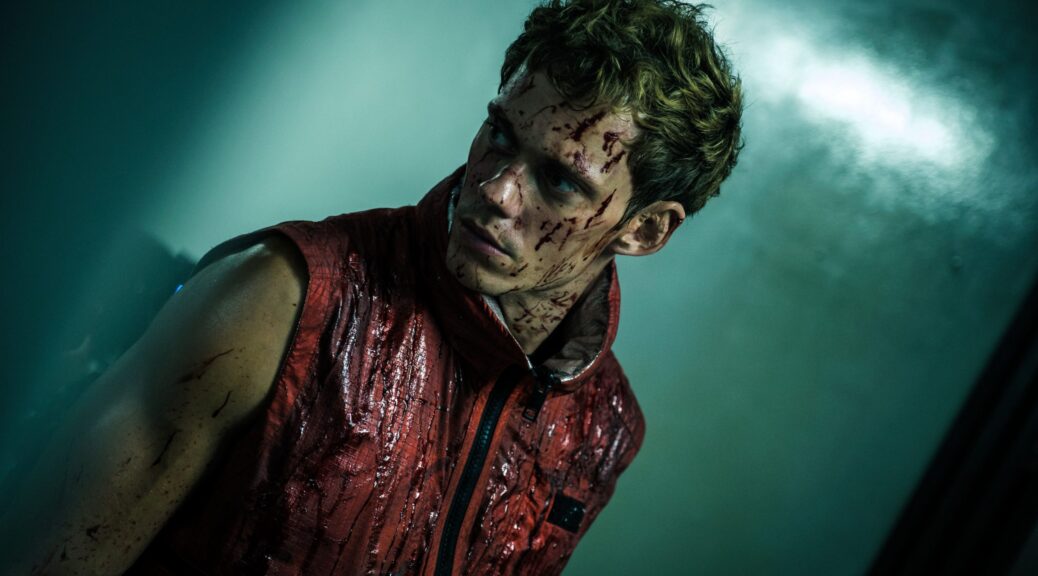
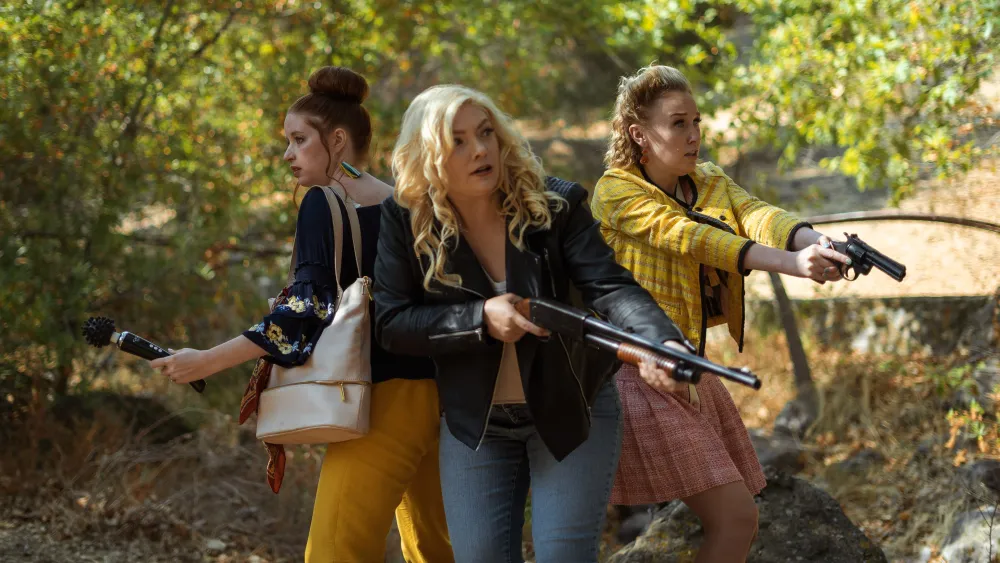
The setting is springtime in small town Texas, when everyone’s excited for the annual combination fish fry/bunny hop/egg hunt they call Easterpalooza! Check that, Jeannie (Foster) is not excited, because her husband Lance is missing! Jeannie’s best friend Carol (Kelly Grant) grabs her shotgun to join the search, and it isn’t long before the warnings from tinfoil hat-wearing Sam (Zach Kanner) begin to play out.

The urban legendary Jackalope and his army of devilish bunnies are on the loose and out for blood! So why won’t the mayor from Jaws—I mean the Sheriff—postpone Easterpalooza?

The film sends up low budget creature features, small town busybodies (with Lobel starring as the leader of the catty church ladies), conspiracy theorists and more with considerable zest. The ensemble cast, led by Grant’s strong comic timing, is all in on the gags, and the moments when fuzzy bunnies turn into maneaters are frequently hilarious.

But the absurd zaniness hits a roadblock whenever the film suddenly starts taking itself seriously. An introspective musical number hits with an especially curious thud, and the running time starts swelling enough to chip away at your patience.

When Easter Bloody Easter stays on its bloody bunny trail, though, it puts together a basket of over-the-top fun. Just be prepared to wade through some patches of grass to find all the treats.

After the Break: Dr. Joyce Brothers and a Demon!

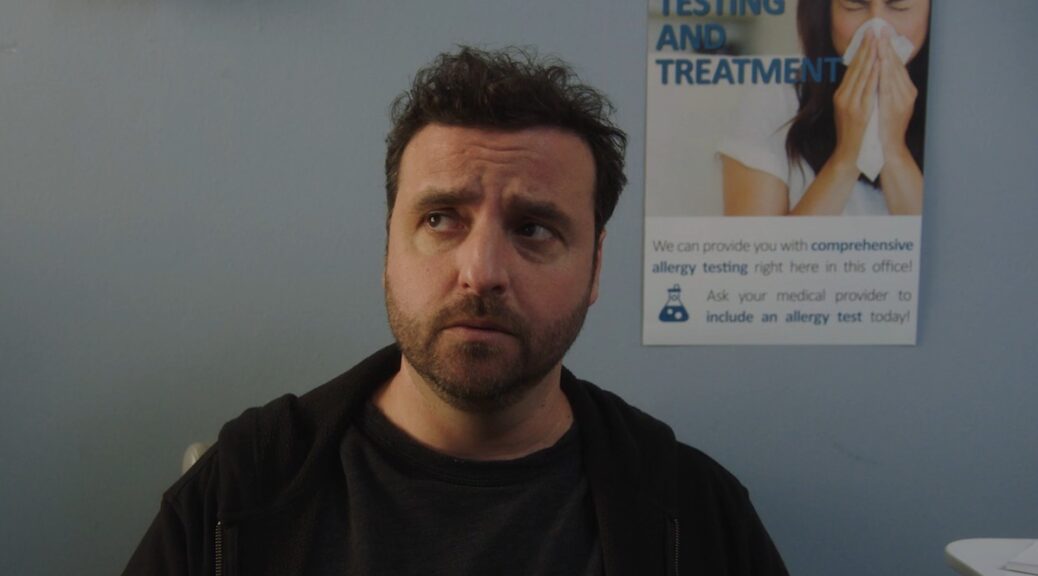
Late Night with the Devil

by George Wolf

Who remembers The Amazing Randi?

He was that magician, author and “professional skeptic” who would come on the Johnny Carson show to debunk anyone claiming to have supernatural, paranormal or occult powers.

Memories of Randi aren’t required to feel the pull of Late Night with the Devil, but if you grew up around 1970s TV, you’re likely to have an even deeper appreciation for this high-concept homage from filmmakers Cameron and Colin Cairnes.

The Australian brothers who gave us the terrific low budget horror 100 Bloody Acres have essentially crafted their found footage genre entry, all centered around broadcast and BTS footage from the last episode of Night Owls with Jack Delroy, a nighttime talk show trying to compete with Carson.

The film’s prologue—featuring foreboding narration from Michael Ironside—tells us that by the late 70s, Delroy (a terrific David Dastmalchian) had been worried about the future of the show, which led to a fateful gamble.

Cue the footage!

Delroy’s “Randi” is Carmichael Haig (Ian Bliss, perfectly smug), who condescendingly debunks the show’s first guest, clairvoyant Christou (Fayssal Bazzi). Haig is then ready to do the same to Dr. June Ross-Mitchell’s (Laura Gordon) claim that her young patient Lilly (Ingrid Torelli) is possessed by a demon.

But Lilly’s got a surprise for sweeps week.

Cameron and Colin share the writing/directing duties, and they set an effective time stamp early on through solid production design and patient editing. The mood is one of appropriately cheesy humor amid some uneasy dread.

After all, we know what these wide-lapeled jokesters don’t: something nasty is about to go down.

The Cairnes boys take their time getting there, letting Dastmalchian reel us into Delroy’s easy charm and increasingly questionable backstory. Dastmalchian—a longtime supporting MVP blessed with a memorable face—is finally getting his chance to carry a film, and he does not disappoint.

Kudos also go out the effects department, rolling out a (mostly) practical finale that serves as a perfect capper to the film’s finely tuned aesthetic. Computer wizardry has no place in this world, and the Cairneses keep it refreshingly real.

Ultimately, what Late Night with the Devil has in mind is more like an R-rated Twilight Zone, with a twisty moral backed up by blood. Expect devilish fireworks and frisky throwback fun, even if you’re not scared out of your bellbottoms.

Tin Roof, Rusted

Snack Shack

by George Wolf

Four years ago, Adam Rehmeier’s Dinner In America arrived as a delightfully subversive 90s punk rock rom-com. Snack Shack finds the writer/director still navigating the 90s with hilarious R-rated delight, even as the punk rock ‘tude has been usurped by capitalistic dreams.

It’s 1991 in small town Nebraska, and teen best friends A.J. (Conor Sherry) and Moose (The Fablemans‘ Gabriel LaBelle) are coming hot into summer with some big plans. They score at the dog track, market their own homemade beer and are working more than enough angles to please the Gordon Gekko poster hanging on the wall.

But then an unexpected new hustle presents itself. The boys’ older friend Shane (Nick Robinson) – who’s a bit of a local hero thanks to his service in Kuwait – is home to manage the local pool, and he gives the foul-mouthed young Gekkos a tip on how to win the city council’s summer contract for the poolside snack bar.

Before long, business is booming, and that 75-cent upcharge for using ketchup to write “fuck” on a hotdog (a “fuckdog!”)is paying off big time. Will success go to their heads? Will A.J. earn enough cash for his Alaskan trek with Shane, AND earn the respect of his parents (David Costabile and Gillian Vigman, both priceless)?

And what about Brooke, the hot new lifeguard (Mika Abdalla)? Could she actually come between these hometown homies?

You’ll know where some of this is going, but Rehmeier’s script delivers foul, horny hilarity, and outstanding turns by both Sherry and LaBelle stand out in a letter perfect ensemble. The time stamp is again spot on, with Rehmeier’s freewheeling style crafting an infectious mashup of The Way Way Back, Superbad and Project X.

And most importantly, Rehmeier captures that zest for life on the cusp of adulthood without a whiff of pandering or condescension. The boys will do some growing up during this one crazy summer, and the film will grow up with them. Slowly, parents don’t seem quite as lame, the hijinx aren’t as silly and some important lessons about love, sex, death and friendship hang in the air just long enough to hit just hard enough.

Fuckdogs are still funny, though, homie, just like a surprise punch to the nuts.

Ordinary People

One Life

by George Wolf

Back in 2015, Sir Nicholas Winton passed away at the age of…106.

Healthy diet? Lots of cardio? Maybe, but One Life lets us know Winton could have subsisted on little more than whiskey, smokes, and the unlimited good karma from his days as a young man on a humanitarian mission that put faith in “ordinary people.”

In the years before World War II, “Nicky” (Johnny Flynn) was a London stockbroker. But as Hitler and the Nazis marched across Europe, Nicky committed himself to saving as many Jewish children as he could, spearheading a committee to place the children with foster families in the U.K.

Years later, the older Nicky (Anthony Hopkins) and his wife Grete (Lenas Olin) begin cleaning out their house, which brings him face to face with an old briefcase. Inside the satchel are the records from Nicky’s refugee network, and he begins to wonder if the story might be of interest to the local press.

It is.

Veteran television director James Hawes and the writing team of Lucinda Coxon and Nick Drake adapt the book by Winton’s daughter Barbara as a standard take on an extraordinary story. Have plenty of tissues handy, which is a testament to the sheer power and timely urgency of Nicky’s life-saving work.

The flashback scenes are satisfactory, but lack the cinematic style and structure to find a unique voice amid the holocaust dramas we’ve seen in just the last several years.

It is the later narrative thread – with, unsurprisingly, a truly touching turn by Hopkins – that allows One Life to leave its mark. Overdue accolades only seem to increase Nicky’s despair over the lives he couldn’t save, and Hopkins is able to craft the haunted man with a nuance that underscores all the good that can come from turning care into action.

The film’s final act puts the effect of Sir Nicholas’s work in very specific, very human and very public terms. And even if you remember hearing about the goosebump-inducing way the “British Schindler” finally got his flowers, One Life makes sure those goosebumps will come again.

Wolves at the Door

Four Daughters

by George Wolf

The Oscar-nominated documentary Four Daughters tells the story of Olfa Hamrouni and her four girls. The two youngest, Eya and Tassir, still live at home and speak for themselves. The eldest, Rahma and Ghoframe, are played by actors (Nour Karoui, Ichrak Matar) as the real sisters “were devoured by the wolf.”

Yes, it is a metaphor, one that Tunisian writer/director Kaouther Ben Hania explores with a deeply sympathetic mix of doc and drama.

Most of the time, Olfa will tell her own story while veteran actress Hind Sabri stands by, ready to step in and play the role when the emotion is too much for Olfa to bear.

Mother and daughters laugh, cry and bicker as we hear of their life in the patriarchal society of Tunisia. Olfa moves between gregarious and reserved, as capable of flashing a strong defiant streak as she is of handing down oppressive customs because “that’s just the way it is.”

And as Ben Hania slowly moves toward the source of the family’s heartbreak, the film’s many moving parts don’t always engage in perfect sync. The subtle aspects of Ben Hania’s reenactments – such as having actor Majd Mastoura play all the male parts, or the surreal interplay between real sister and stand in – pay dividends. But moments when actor and subject go off script to debate the familial choices can begin to blur unfortunate lines.

The staggering 2012 doc The Act of Killing used similar tactics, but the arc of barbaric murderers recreating their genocidal crimes mined insight from intimacy. Here, the staged production of pain spurs questions about when intimacy becomes exploitation.

Ben Hania wisely travels a more conventional road in the film’s third act. The reason for the elder sisters leaving home becomes clear, and Four Daughters leaves its unique mark.. A compelling, touching story of memory and generational trauma, it’s a heartbreaking roadmap to radicalization marked with a family’s despair.

Fearless Oscar Picks 2024

by Hope Madden and George Wolf

This year’s group of nominees is stacked. Category after category, you find multiple films, filmmakers and performers all worthy of some hardware. But who will win?

Best picture

  • “American Fiction”
  • “Anatomy of a Fall”
  • “Barbie”
  • “The Holdovers”
  • “Killers of the Flower Moon”
  • “Maestro”
  • “Oppenheimer”
  • “Past Lives”
  • “Poor Things”
  • “The Zone of Interest”

Should win: “Poor Things” Will win: “Oppenheimer”

Best actor

  • Bradley Cooper, “Maestro”
  • Colman Domingo, “Rustin”
  • Paul Giamatti, “The Holdovers”
  • Cillian Murphy, “Oppenheimer”
  • Jeffrey Wright, “American Fiction”

Should win: Cillian Murphy Will win: Murphy (Hope) Paul Giamatti (George)

Best actress

  • Annette Bening, “Nyad”
  • Lily Gladstone, “Killers of the Flower Moon”
  • Sandra Hüller, “Anatomy of a Fall”
  • Carey Mulligan, “Maestro”
  • Emma Stone, “Poor Things”

Should win: Stone or Gladstone Will win: Gladstone

Best supporting actor

  • Sterling K. Brown, “American Fiction”
  • Robert De Niro, “Killers of the Flower Moon”
  • Robert Downey Jr., “Oppenheimer”
  • Ryan Gosling, “Barbie”
  • Mark Ruffalo, “Poor Things”

Should win: Ruffalo Will win: Downey Jr.

Best supporting actress

  • Emily Blunt, “Oppenheimer”
  • Danielle Brooks, “The Color Purple”
  • America Ferrera, “Barbie”
  • Jodie Foster, “Nyad”
  • Da’Vine Joy Randolph, “The Holdovers”

Should win/Will win: Randolph

Best director

  • Jonathan Glazer, “The Zone of Interest”
  • Yorgos Lanthimos, “Poor Things”
  • Christopher Nolan, “Oppenheimer”
  • Martin Scorsese, “Killers of the Flower Moon”
  • Justine Triet, “Anatomy of a Fall”

Should win: Nolan or Lanthimos Will win: Nolan

International feature film

  • “Io Capitano,” Italy
  • “Perfect Days,” Japan
  • “Society of the Snow,” Spain
  • “The Teachers’ Lounge,” Germany
  • “The Zone of Interest,” United Kingdom

Should win/Will win: “The Zone of Interest”

Animated feature film

  • “The Boy and the Heron”
  • “Elemental”
  • “Nimona”
  • “Robot Dreams”
  • “Spider-Man: Across the Spider-Verse”

Should win: “The Boy and the Heron” (Hope) “Spider-Man” (George) Will win: The Boy and the Heron” (Hope) “Spider-Man” (George)

Adapted screenplay

  • “American Fiction”
  • “Barbie”
  • “Oppenheimer”
  • “Poor Things”
  • “The Zone of Interest”

Should win: “Poor Things” Will win: “American Fiction” (Hope) “Oppenheimer” (George)

Original screenplay

  • “Anatomy of a Fall”
  • “The Holdovers”
  • “Maestro”
  • “May December”
  • “Past Lives”

Should win: “Anatomy of a Fall” Will win: “The Holdovers” (Hope) “Anatomy of a Fall’ (George)

Cinematography

  • “El Conde”
  • “Killers of the Flower Moon”
  • “Maestro”
  • “Oppenheimer”
  • “Poor Things”

Should win/Will win: “Poor Things”

Animated short film

  • “Letter to a Pig”
  • “Ninety-Five Senses”
  • “Our Uniform”
  • “Pachyderme”
  • “War Is Over! Inspired by the Music of John & Yoko”

Should win: “Ninety-Five Senses” Will win: “War Is Over”

Live action short film

  • “The After”
  • “Invincible”
  • “Knight of Fortune”
  • “Red, White and Blue”
  • “The Wonderful Story of Henry Sugar”

Should win/Will win: “Henry Sugar

Documentary short film

  • “The ABCs of Book Banning”
  • “The Barber of Little Rock”
  • “Island in Between”
  • “The Last Repair Shop”
  • “Nǎi Nai & Wài Pó”

Should win/Will win: “The Last Repair Shop”

The 96th Academy Awards, hosted by Jimmy Kimmel, will air on ABC on Sunday, March 10, live from the Dolby Theatre at Ovation Hollywood.

Trip of a Lifetime

Io Capitano

by George Wolf

The destination may be Italy, but the Oscar-nominated Io Capitano unfolds like a classic Greek fable. Director and co-writer Matteo Garrone crafts a stirring and often gut-wrenching modern Homeric tale, with a young African refugee enduring multiple hardships while refusing to surrender his character or humanity.

16 year-old Seydou (Seydou Sarr) and his cousin Moussa (Moustapha Fall) have been planning for months to leave their home in Senegal for the hope of a better life in Europe. The locals warn against the dangerous trip, and Seydou’s mother (Ndeye Khady Sy) forbids it, but the boys take the stash of money they’ve been saving and head out in secret.

The journey will not be kind. From Niger to Libya to the unforgiving Sahara (presented with breathtaking scope) and beyond, the boys will face shakedowns, bribes, arrest and torture, while subtle twists of fate conspire with glimpses of human kindness to keep them moving forward.

Sarr is absolutely terrific in a highly emotional and physical role, allowing Garrone (Dogman. Gomorrah) to strategically build empathy for the young man and his mission. With brutality all around him, Seydou must ultimately defend his humanity with stirring defiance, cementing his standing as a true and just wanderer.

But though Seydou’s odyssey may have a classic structure, the subtext here is never in doubt. Io Capitano succeeds on both fronts, bringing stark intimacy to the global refugee crisis, along with realization that stories can often speak so much more clearly than statistics.

Coen My Way?

Drive-Away Dolls

by Hope Madden and George Wolf

Is the flattery still sincerest if you’re imitating yourself?

Because about 15 minutes into Drive-Away Dolls, the first installment of a lesbian B-movie trilogy from director/co-writer Ethan Coen and co-writer Tricia Cooke (Coen’s longtime producer/editor/wife), you can’t ignore how much this film reminds you of Coen Brothers movies.

And yes, better Coen Brothers movies.

Like The Big Lebowski, Burn After Reading, Barton Fink and A Serious Man, all of which get subtle and not-so-subtle nods in a twisting story of two young women and a mysterious, valuable briefcase.

Jamie (Margaret Qualley) and Marian (Geraldine Viswanathan) are queer best friends in 1999 Philadelphia. Marian is sexually conservative, and the free-spirited Jamie hopes to get her friend some action while they accept a drive-away job down to Tallahassee and hit every lesbian bar they can find.

What the girls don’t know is that the car they’ve been given has two very important items in the trunk, and it isn’t long before “The Chief” (Colman Domingo) and his two hapless henchman (Joey Slotnick, C.J. Wilson) are on their tail heading South.

The cast is indeed impressive (with appearances from Pedro Pascal, Bill Camp, Beanie Feldstein and Matt Damon), but while the film serves up a handful of LOL moments, the vast majority of the nuttiness lands with more desperation than inspiration.

It all feels so forced, except for Viswanathan, whose earnest delivery points out the artifice in Qualley’s. The Foghorn Leghorn-y of pre-millennium lesbians, Jamie’s every line draws attention to its own zaniness. It calls to mind The Ladykillers—and that’s never the Coen movie you want to make people remember.

Much of the ensemble works magic, though. Camp is particularly, dryly memorable. But this script, and the unsteady direction, suffers from high expectations. Drive-Away Dolls is fine. It’s fun enough. It’s nutty. But if Coen and Cooke weren’t awkwardly chasing their own family history, it would have been more satisfying.

Community Organizer

Ordinary Angels

by George Wolf

It’s understandable if Ordinary Angels seems familiar. Hilary Swank playing a tireless do-gooder in a based-on-true-events drama with a vaguely inspirational title is probably going to feel that way.

And while the film does rely on plenty of broad-brushing, it ultimately mines enough nuance to find some genuine feels, as well.

Swank plays Sharon Stevens, a hard-partying beauty salon owner in Kentucky who’s hoping one day to mend the relationship with her estranged son, Derek (Dempsey Byrk). While waiting at the grocery store checkout, a local newspaper story gives Sharon’s life new meaning.

Five year-old Michelle Schmitt (Emily Mitchell) has a rare disease and needs a liver transplant to survive. Her father Ed (Jack Reacher‘s Alan Ritchson), still hurting from his wife’s fatal battle with Wegener’s disease, is facing a mountain of medical debt while struggling to raise Michelle and her older sister Ashley (Skywalker Hughes) as a single parent.

After so much heartache, Ed admits to his mother Barbara (Nancy Travis) that he’s losing his faith. Could this hardscrabble hairdresser at their door be a Godsend? The few thousand dollars she raises from a salon fundraiser is a darn good start.

Two-time Oscar winner Swank is perfect for the role, even if the script from Kelly Fremon Craig (Are You There God? It’s Me, Margaret) and Meg Tilly (the veteran actress with her first feature writing credit) doesn’t provide many edges, at least early on. Sharon is all “hush my mouth” spunk, smiling through her accent as she imposes her will on multiple situations and begins to feel interchangeable with similar characters from The Blind Side to Swank’s own Conviction.

Ritchson is fine and shares sweet chemistry with the two adorable young girls, though Ed also lacks the depth to move the character beyond any number of faith-based dramas following a basic heart string-tugging playbook.

Ordinary Angels does find a unique voice in the third act, when Ed’s patience wears thin, and Sharon is finally forced to confront the life she’s really trying to save. Plus, director Jon Gunn (The Case for Christ, The Week) moves away from the formulaic to develop some respectable tension when the call for Michelle’s life-saving transplant comes during a monster snowstorm.

That really happened, and the true story here does provide an inspiring example of the good that humans are capable of. No doubt we need that right now, and Ordinary Angels manages just enough extraordinary moments to please more than the choir.

Holy Sanctimony

God & Country

by George Wolf

When Rob Schenck was a young pastor, he was told never to prepare a sermon without consulting the Theological Dictionary of the New Testament, edited by Gerhard Kittel.

Years later, Schenck learned that Kittel was also the man who gave Hitler a Christian blessing for his Final Solution.

“That was an eye opener,” Schenck admits. The point—that there is no limit to what radical Christianity can be used to justify—is what drives God & Country. And much of the film’s success comes from how it combats that fanaticism with a measured, confident deconstruction.

Director Dan Partland doesn’t insert himself into the conversation, but has no problem crafting a spirited one. Yes, he has a clear agenda, but includes enough footage from news reports, political speeches and televangelist messaging that the film’s worldview becomes the “other side” getting a chance to be heard.

Partland relies on historians, authors, and theologians to trace the rise of Christian Nationalism, it’s deviation from actual Christian teachings, the quest for power over values that earns a rebranding as “White Religious Nationalism,” and how the true believers have been convinced that America has a God-ordained role in human history.

And if democracy gets in the way? See January 6th, 2021.

The attack on the Capitol is what bookends the film, and in between, Partland actually elicits sympathy for the attackers, who have been fed a calculated diet of lies, fear and outrage. The resulting echo chamber creates an alternative reality bubble, one that was always designed to burst.

If you noticed the proudly theocratic ruling from the Alabama Supreme Court last week, you know that the threat to democracy is only becoming more dangerous. Partland makes it clear that the biggest hope is awareness, so that those led astray by the fervor (like Schenck) can experience a new awakening.

Christian Nationalism has nothing to do with Christianity. And God & Country finds a useful tone between sermonizing and condescension that can help us see that light.