As you take shelter from yet another downpour and check in on the interwebs, have you seen that thing Pope Francis said about humanity ruining the planet? Or Jeb Bush’s command for him to shut his pointy-hat wearing trap? Or the latest on California drying up like a raisin?
Well, there’s a documentary out on that theme, The Yes Men Are Revolting.
The Yes Men, activists Andy Bichlbaum and Mike Bonanno (not their real names) have been together since the 90s egging each other on to ever escalating heights of ridiculousness in an attempt to prank corporations and climate change deniers.
In order to draw public attention to issues, they stage phony press events and impersonate lobbyists, employees of corporations, and/or governmental agencies and announce dramatic shifts in policy, like Canada agreeing to pay 1% of its GDP to help poor countries adapt to climate change. (Imagine the guys from Jackass, but with a political agenda.)
Often, the stunts get picked up as legitimate stories by mainstream media, before the folks they’ve been impersonating scramble to set the record straight and do damage control.
This, the Yes Men’s third film, covers their attempts to draw the public’s attention to climate change while simultaneously dealing with transformation in the duo’s own lives. They’ve been doing this gig for a while. Now, Bonanno’s married with two kids and one on the way. Bichlbaum finally finds a man he wants to settle down with. Both men have other jobs that put demands on them. They’re asking questions: How much time can they devote to their stunts and each other anymore? Is activism even worth it? What difference are they actually making? Isn’t the world in worse shape now than when they started?
Despite these questions and the gloom generated by any discussion of climate change, The Yes Men Are Revolting will not result in you wanting to slit your wrists.
Bichlbaum and Bonanno’s enjoyment of each other and their vocation, the silliness of their fake names and awful disguises, the quality of the ideas at the heart of their pranks, and a final act that involves getting defense contractors to awkwardly dance, make this film fun and even potentially inspirational.
New parents can easily panic at the counterintuitive, conflicting, hyperbolic, self-righteous nonsense that purports to be parenting advice. At no time in your life do you feel more of a need to be strong and reliable, and at no time do you see yourself as more of an underprepared moron. It can be terrifying.
Hungry Hearts mines that terror in provocative and insightful ways as it invites us into the crumbling relationship between Mina (Alba Rohrwacher) and Jude (Adam Driver).
Jude and Mina’s tale is told in terms of proximity rather than intimacy. From their remarkable meeting throughout their courtship and marriage, their story is articulated by its confinement, the fragile power struggle almost always shown in corporeal terms: Inside this small space, whose body is controlling whose?
From this perspective, the casting is impeccable, with Driver’s unintimidating lankiness at odds with, and often physically overwhelming, the petite Rohrwacher.
Driver is a master at walking the line between vulnerability and believable insincerity, a skill he puts to impressive use here. Jude seems so harmless, sees himself as harmless, and he certainly doesn’t intend to do anything other than love and respect his family. That’s why he’s so confounded when it all goes south.
It’s a provocative story where Jude’s seemingly small acts of power lead to the need for more concrete acts, although it is Mina’s helplessness in the face of all those small but profound betrayals that created her paranoia in the first place.
Director Severio Costanzo traps you in this insulated world. What looks and feels like an indie drama gives way to the distorted camerawork and intentional score of horror. The tonal shift doesn’t always work, and the third act feels too tidy and conventional for the film itself, but you never lose interest.
What Costanzo has created, and what his small but game cast has almost perfectly animated, is a nuanced, delicate nightmare of helplessness, control and madness with the fate of a 7-month-old in the balance.
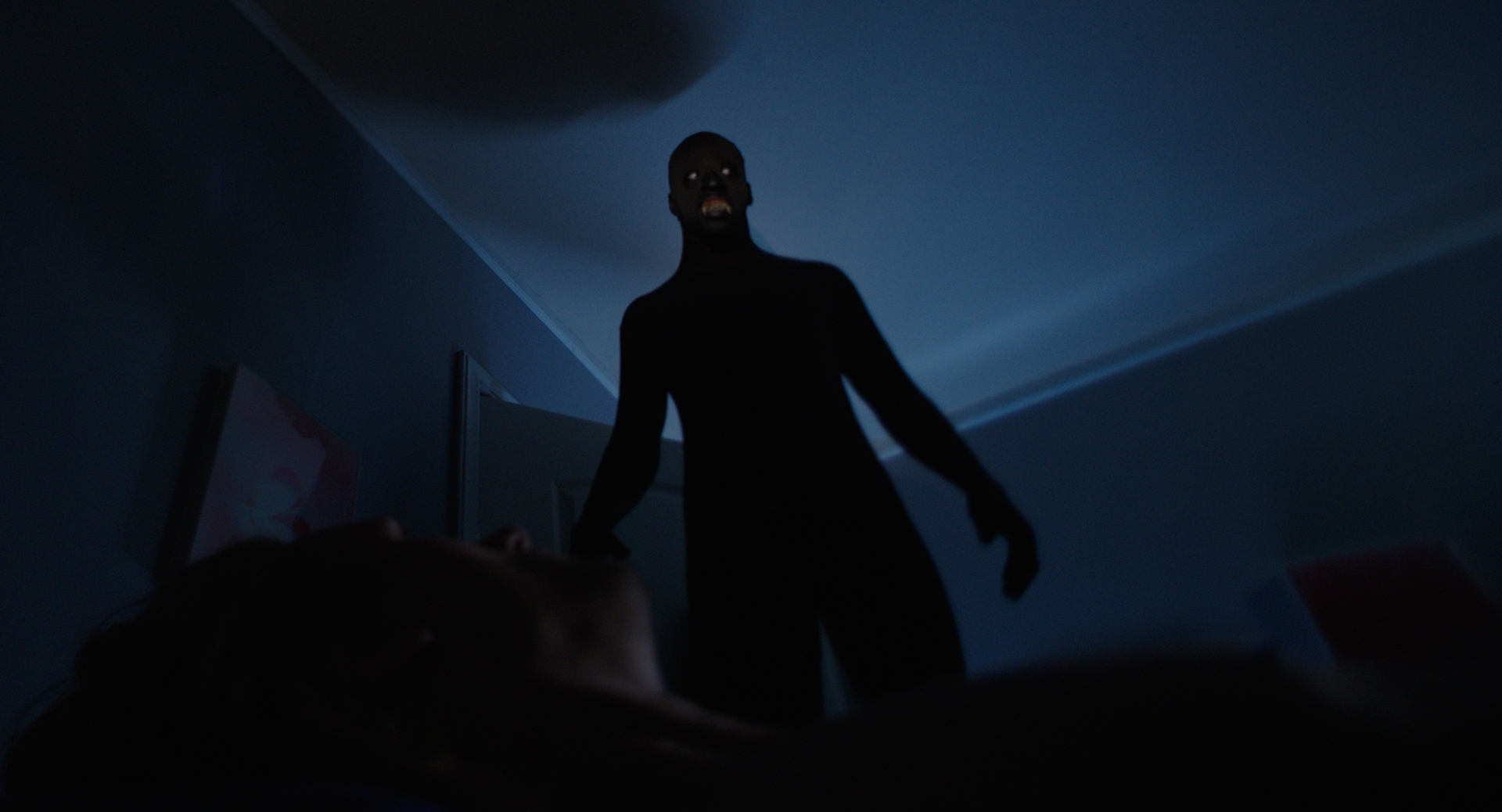
An effective scary movie is one that haunts your dreams long after the credits roll. It’s that kind of impact most horror buffs are seeking, but even the most ardent genre fan will hope out loud that Rodney Ascher’s new documentary The Nightmare doesn’t follow them to sleep.
His film explores sleep paralysis. It’s a sleep disorder – or a label hung on the world’s most unfortunate night terrors – that’s haunted humanity for eons. Most sufferers never realize that others share their misery.
Sleep paralysis is the phenomenon that inspired Wes Craven to write A Nightmare on Elm Street. It’s a clear creative root for Insidious, Borgman and scores of other horror movies. But it isn’t fiction. It’s a sometimes nightly horror show real people have to live with. And dig this – it sounds like it might be contagious.
Ascher’s a fascinating, idiosyncratic filmmaker. His documentaries approach some dark, often morbid topics with a sense of wonder. His films never seem to be pushing an agenda, he doesn’t seem to have made up his mind on his subject matter. Rather, he is open which, in turn, invites the audience to be open.
It’s not all earnest sleuthing, though, because Ascher is a real showman. What’s intriguing is the way he draws your attention to his craftsmanship – like framing a shot so you see the speaker not head on, but in a large mirror’s reflection, then leaving the reflection of the cameraman’s arm in the same shot. Touches like this never feel amateurish, but they don’t really feel like a cinematic wink, either. Instead they seem intentional, as if he may just be playing.
Coyness suited his Shining documentary Room 237 pretty brilliantly. Here it feels almost like a way to release the tension, remind you that you are, indeed, watching a movie… a heartbreaking, terrifying movie.
I spend a great deal of time watching horror movies, and I cannot remember an instance in my life that I considered turning off a film for fear that I would dream about it later. Until now.
It’s 1992 in what had recently been the Soviet Union. The Abkhazians of western Georgia have declared independence and Civil War has broken out. The battle is almost at Ivo’s door, but even as natives kill for the land under his feet, the Estonian immigrant tends the Tangerines. He and a neighbor – also Estonian by birth – hope to harvest the crop before it is lost to the war.
It’s a lovely central image: two elderly men with no dog in the fight working against the clock tending to the region’s natural bounty. Unfortunately, the fight comes knocking. Gunplay between three Georgians and two Chechen mercenaries leaves two wounded men – one from either side of the battle – in Ivo’s care.
Writer/director Zaza Urushadze’s elegant film garnered nominations for best foreign language film from the Academy, Golden Globes and others, and rightly so. His succinct screenplay relies on understatement and the power in silence and in action to convey its pacifist message. The timeless ideas embedded in this intimate setting become potent. While the theme is never in doubt, Urushadze’s unadorned film never feels preachy.
A great deal of that success lies in Lambit Ulfsak’s powerful performance as Ivo. He has an amazing presence, inhabiting this character with weary wisdom. Resolute and morally level-headed, Ivo is impossible not to respect. He’s the film’s conscience and through him we quietly witness a powerful humanity – one that the film would like to see infect us all.
There are three other principals – Giorgi Nakashidze as the Chechen, and Misha Meskhi as the Georgian, and Elmo Nuganen as neighbor Margus. Each brings something muscular but tender to their role. Their work benefits from the dry humor and melancholy tone of Urushadze’s screenplay. The quiet evolution beneath their boisterous clashing feels more inevitable than predictable, which allows Urushadze’s point more poignancy.
We don’t get to see a lot of Estonian filmmaking over here, and that appears to be a shame. Ulfsak was recently named the country’s male performer of the century. It’s not hard to see why.
In 2013, Jeremy Scahill opened our eyes to the darker side of drone wars with his documentary Dirty Wars. Writer/director Andrew Niccol uses a more understated and intimate road to the same destination with his latest effort, Good Kill.
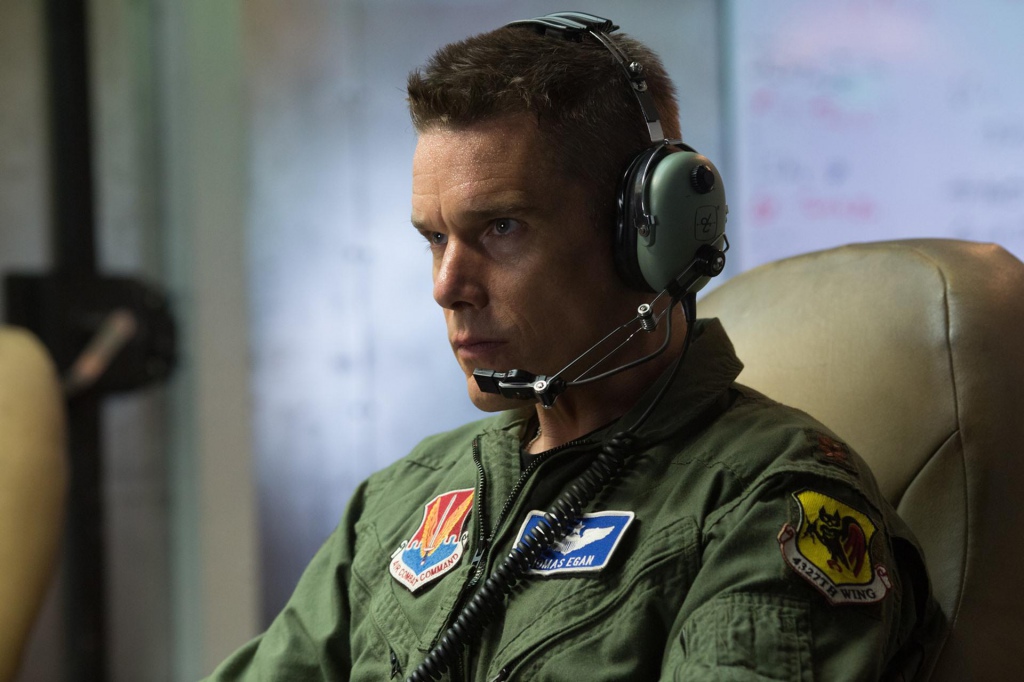
The film follows Tom Egan (Ethan Hawke), a man who flew 6 tours of duty in Iraq and Afghanistan and is now on his third tour in a Vegas cubical piloting drones. From 7000 miles away he watches, then eliminates Taliban threats. Then he goes home to barbeque.
As a writer, Niccol has a long history of mining similar ideas – the alienating power of surveillance as well as the business of war (The Truman Show, Lord of War). He’s on his game here, depositing points and counterpoints in the mouths of the right characters and watching each character evolve as their duties begin to look more like war crimes.
Niccol made some fine decisions as the director as well, keeping the tone understated and the tensions on low boil. He also slyly parallels the aerial images of the Middle East – dry, brown and dusty with neat rows of damaged houses – with aerials of Vegas. Once you get past the glitz and bombast of the strip, the landscape is eerily similar. Not only does this humanize the targets, but it exposes our own vulnerability.
Hawke, hot off a career-best performance in Boyhood, does a stellar job animating a mostly internal character. His struggle feels honest, and on the rare occasion that Tom articulates an issue, his thoughts are enlightening. “We got no skin in the game. I feel like a coward every day.”
Bruce Greenwood, reliable as always, carries a great deal of the weight in the film without ever taking the spotlight. Meanwhile, the great character actor Peter Coyote lends a smarmy, soulless voice as “Langley,” the CIA contact given control over Egan’s unit.
This is a meticulously written script, one that weighs issues without truly taking sides, and Niccol develops a hushed tension that builds to something powerful.
It’s a finely crafted and engrossing film that looks at the effects of a risk-free war from the eyes of one of the warriors being saved from combat. Without beating you about the head with its message, it’s about a lot more than that, too.
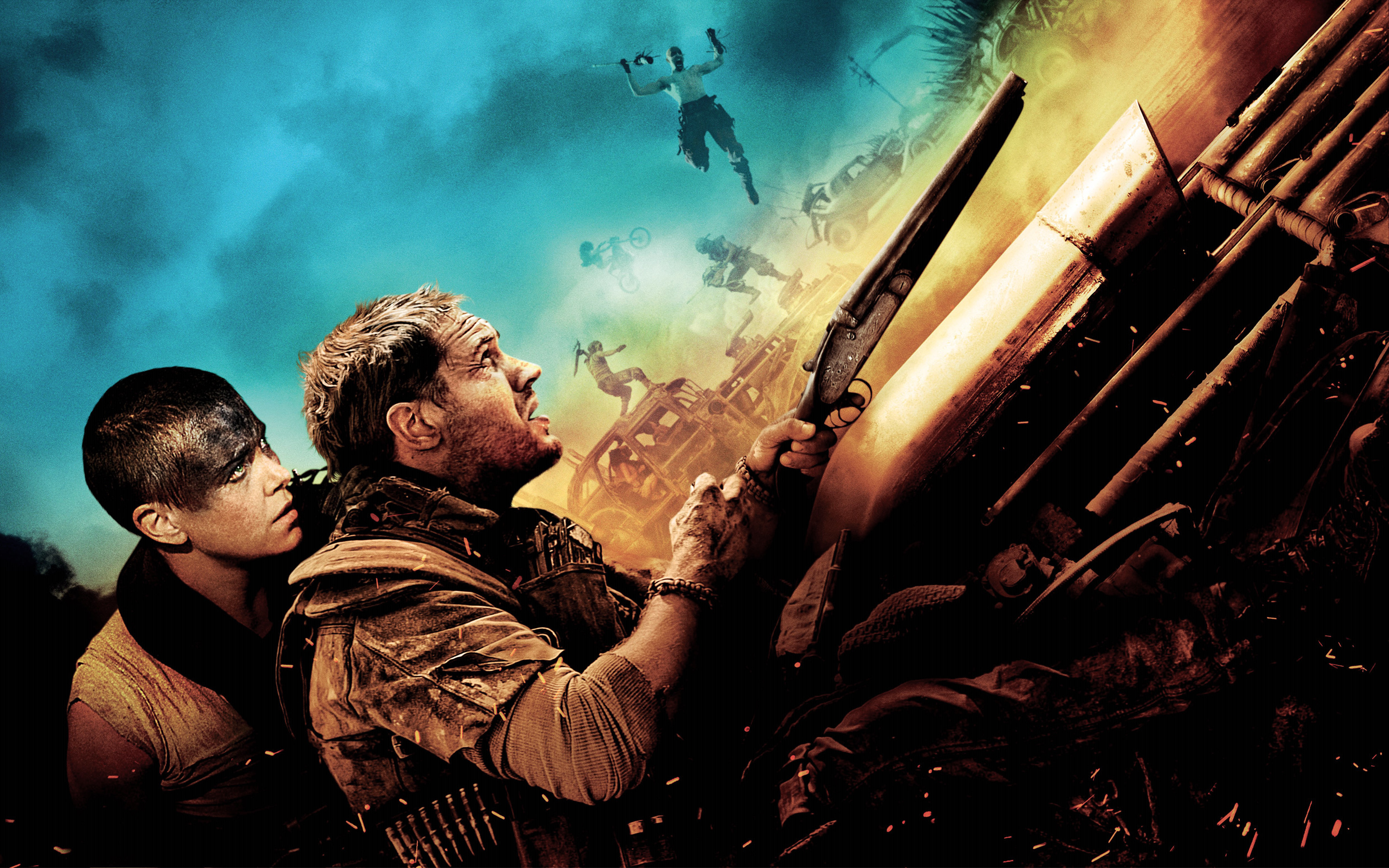
To say that George Miller has stepped up his game since he left us at Thunderdome would be far too mild a statement to open with. Mad Max: Fury Road is not just superior to everything in this franchise, as well as everything else Miller has ever directed. It’s among the most exhausting, thrilling, visceral action films ever made.
Powerful, villainous white guys have ruined the planet by way of their greed for oil and their warmongering, and now they are sustaining their power by taking control of women’s reproductive systems. So, you know, pretty far-fetched.
But Max doesn’t belong to any of these festering wounds called societies. He’s feral. Again. No telling how long it’s been since Max saved the kids from Aunty Entity, but he’s lost himself again, wandering the desert hunted by man and haunted by those he couldn’t save.
Again Miller puts Max in a position to redeem himself by helping the vulnerable and pure survive this apocalyptic future. Mercifully, there are no children and no mullets this go-round.
Unsurprisingly, the great Tom Hardy delivers a perfect, guttural performance as the road warrior. As his reluctant partner in survival, Charlize Theron is the perfect mix of compassion and badassedness. Hardy’s a fascinating, mysterious presence, but Theron owns this film.
Like the first two films in this series, Fury Road wastes little time on dialogue or plotting. Rather, it is basically one long, magnificent car chase. Miller adorns every scene with the most astonishing, peculiar imagery and the vehicular action is like nothing you’ve ever seen.
Dudes on poles!
Miller’s magnificent action sequences keep the film from ever hitting the dragging monotony of his first two efforts in the series. While the characters remain as paper thin as they have been in every episode, the vast superiority of this cast from top to bottom guarantees that the marauding band’s excess and abandon are handled with genuine skill.
Fury Road amounts to a film about survival, redemption and the power of the universal blood donor. Clever, spare scripting makes room for indulgent set pieces that astonish and amaze. There’s real craftsmanship involved here – in the practical effects, the pacing, the disturbing imagery, and the performances that hold it all together – that marks not just a creative force at the top of his game, but a high water mark for summer blockbusters.
In 2012, Elizabeth Banks produced a film that was “an inspiration to girls all over the country too ugly to be cheerleaders.” And now it’s time to return to Barton University to get our accompaniment-free groove on in Pitch Perfect 2.
That’s right, pitches.
The Barton Bellas, having survived power struggles, forbidden romance and intimacy issues, have been the reigning collegiate a cappella champs for 3 years. However, an a cappella-tastrophe during a command performance at the Lincoln Center stripped the group of their title, and their only way to get it back is to become the first Americans to win the World Competition.
To do it, they’ll have to beat the Germans. Just like Rocky, but with singing … and comedy that’s intentional.
Banks returns in her role as one half of a bedecked competition commentator duo, opposite the endlessly hilarious John Michael Higgins. While their hysterical banter punctuates the proceedings, Banks also directs this time around. She shows as strong a sense of comic timing behind the camera as she has always shown in front of it, but really impresses when staging the musical numbers.
The game cast returns for seconds, with a dry, self-deprecating Anna Kendrick leading up the singing sisterhood. Rebel Wilson and Adam DeVine are back, ensuring plenty of uncomfortable lunacy, while a stable of fun cameos including David Cross, Jason Jones and Keegan-Michael Key keeps scenes fresh and funny.
I’m no Green Bay Packers fan, but it’s a lot of fun watching Clay Matthews and most of their offensive line sing Bootilicious.
Plenty of bits feel stale, too. As with any sequel, the novelty is gone and certain jokes have more than run their course by now. The storyline is a bit too predictable and tidy, the new characters are not compelling, and now and again Banks returns to a gag once too often.
Still, Kendrick is a solid foundation. She’s a talented comic performer who sings remarkably well, so a good place to build your movie. Kay Cannon’s script balances silliness, raunch and heart quite well, and those folks looking for lots of exceptionally choreographed numbers won’t be disappointed.
Horror films have long told the story of religious zealots, usually of the Black Mass variety – The Mephisto Waltz (1971), Sheitan (2006), Starry Eyes (2014), Rosemary’s Baby (1968). We decided not to look to the cloaked, horned Satanists and instead, examine religious zealots of a different flavor. Here are our favorites.
5. Red State (2011)
Kevin Smith’s first foray into horror is perhaps his very strongest and least seen film. Red State is an underrated gem. Deceptively straightforward, Smith’s tale of a small, violently devout cult taken to using the internet to trap “homos and fornicators” for ritualistic murder cuts deeper than you might expect. Not simply satisfied with liberal finger wagging, Smith’s film leaves no character burdened by innocence.
The usually stellar Melissa Leo chews more scenery than need be as a devoted apostle, but pastor Abin Cooper spellbinds as delivered to us by Tarantino favorite Michael Parks. Never a false note, never a clichéd moment, Parks’s performance fuels the entire picture.
There’s enough creepiness involved to call this a horror film, but truth be told, by about the midway point it turns to corrupt government action flick, with slightly lesser results. Still, the dialogue is surprisingly smart, and the cast brims with rock solid character actors, including John Goodman, Stephen Root, and Kevin Pollak.
Smith said at the time: “I think we have something. It’s creepy and very finger-on-the-pulse and very much about America.”
We agree.
4. The Wicker Man (1973)
In the early Seventies, Robin Hardy created a film that fed on the period’s hippie versus straight hysteria.
Uptight Brit constable Sgt. Howie (Edward Woodward) flies to the private island Summerisle investigating charges of a missing child. His sleuthing leads him into a pagan world incompatible with his sternly Christian point of view.
The deftly crafted moral ambiguity of the picture keeps the audience off kilter. Surely we aren’t to root for these heathens, with their nudey business right out in the open? But how can we side with the self-righteous prig Howie?
Hardy and his cast have wicked fun with Anthony Shaffer’s sly screenplay, no one more so than the ever glorious Christopher Lee. Oh, that saucy baritone!
The film is hardly a horror movie at all – more of a subversive comedy of sorts – until the final reel or so. Starting with the creepy animal masks (that would become pretty popular in the genre a few decades later), then the parade, and then the finale, things take quite a creepy turn leading to what is still a very powerful climax.
https://www.youtube.com/watch?v=21gb49H-Uo4
3. Kill List (2011)
Never has the line “thank you” had a weirder effect than in the genre bending adventure Kill List.
Hitman Jay (a volcanic Neil Maskell) is wary to take another job after the botched Kiev assignment, but his bank account is empty and his wife Shel (an also eruptive MyAnna Buring) has become vocally impatient about carrying the financial load. But this new gig proves to be seriously weird.
Without ever losing that gritty, indie sensibility, Ben Wheatley’s fascinating film begins a slide in Act 2 from crime drama toward macabre thriller. You spend the balance of the film’s brisk 95 minutes actively puzzling out clues, ambiguities and oddities. (The often impenetrable accents don’t exactly help with this sleuthing). The “What the hell is happening?” response to a film is rarely this satisfying.
For those looking for blood and guts and bullets, Kill List will only partially satisfy and may bewilder by the end. But audiences seeking a finely crafted, unusual horror film may find themselves saying thank you.
https://www.youtube.com/watch?v=bQDPp5hxFZQ
2. Martyrs (2008)
This import plays like three separate films: orphanage ghost story, suburban revenge fantasy, and medical experimentation horror flick. The whole is a brutal tale that is hard to watch, hard to turn away from, and worth the effort.
Mining the heartbreaking loneliness of abandoned, damaged children, the film follows the profound relationship between torture survivor Lucie (Mylene Jampanoi) and the only friend she will ever have, an undeterrably loving Anna (Morjana Alaoui).
Constantly subverting expectations, including those immediately felt for Anna’s love, writer/director Pascal Laugier makes a series of sharp turns, but he throws unforgettable images at you periodically, and your affection for the leads keeps you breathlessly engaged.
The proceedings are tough to stomach, but well-conceived and skillfully executed. It holds some gruesome imagery, and though the climax may not be pleasing, it certainly doesn’t disappoint.
https://www.youtube.com/watch?v=-7Qx2dT-lUw
1. Frailty (2001)
Director Bill Paxton stars as a widowed, country dad awakened one night by an angel – or a bright light shining off the angel on top of a trophy on his ramshackle bedroom bookcase. Whichever – he understands now that he and his sons have been called by God to kill demons.
Flash forward and we’re led through the saga of the serial killer God’s Hand by a troubled young man (Matthew McConaughey), who, with eerie quiet and reflection, recounts his childhood with Paxton’s character as a father.
Dread mounts as Paxton drags out the ambiguity of whether this man is insane, and his therefore good hearted but wrong-headed behavior profoundly damaging his boys, or is he really chosen, and his sons likewise marked by God? The film upends everything – repeatedly – until it’s as if it’s challenged your expectations, biases, and your own childhood to boot.
Paxton crafts a morbidly compelling tale free from irony, sarcasm, or judgment and full of darkly sympathetic characters. It’s a surprisingly strong feature directorial debut from a guy who once played a giant talking turd.
https://www.youtube.com/watch?v=89u-uKDNrfU
Listen to the whole conversation on our FRIGHT CLUB podcast.
Remember Election – Alexander Payne’s 1999 movie about high school student body electoral process? Reese Witherspoon was funny. She was also truly funny in Legally Blonde, a film that had no business working at all and yet did, miraculously, because of Witherspoon.
While Sofia Vergara isn’t quite as proven on the big screen, four Emmy nominations suggest she has some comic talent as well. So, if we can’t blame them, why in the world is Hot Pursuit so, so awful?
Better yet, why in the hell did they sign up to do it?
Witherspoon plays Cooper, an uptight cop assigned to transport duty. She needs to get a recently widowed drug lord’s wife to Dallas to testify against her late husband’s boss.
Things go terribly wrong, obviously, and soon Hot Pursuit clarifies itself as a fish out of water buddy cop cliché of a road trip movie.
They have nothing in common, you see. Cooper’s uptight, small, intense, while Vergara’s Daniella is a steaming pile of racial stereotypes. Daniella has big boobs, but Cooper dresses like a boy. How can they ever make it to Dallas?
Anne Fletcher, who also helmed the abysmal road trip cliché The Guilt Trip, outdoes herself with this one. Not one joke lands, not one gag goes over, not a frame of the film feels anything other than stale and beneath the talent involved.
David Feeney and John Quaintance took a break from anemic TV sitcoms to pen this. Dan Fogelman wrote The Guilt Trip, which means that Fletcher intentionally chose two separate, awful road trip movies to bring to the screen. Why? Does she hate us?
Witherspoon and Vergara work hard to keep this thing afloat, and Witherspoon fares a little better because at least her character is not outright offensive. There’s almost chemistry between the two – something that might have translated into a fun onscreen bond if either one of them had a single funny line to deliver. Banter is really too much to hope for.
Is every clown really a sad clown? In his debut as a documentarian, actor Kevin Pollak seeks to find the answer to that question by asking it (or variations of it) to 50 or so of the brightest comic minds of the day.
Who? Tom Hanks, Amy Schumer, Martin Short, Jimmy Fallon, Janeane Garofalo, Judd Apatow and dozens of other stand-up comics and comedic writers and performers. What Pollak wants in return is a glimpse into the shared psyche of the funnyman.
Who were their influences? When did they realize they were funny? What’s it like to bomb onstage? To kill? They’re interesting enough questions and sometimes the answers are fun to watch, but the sheer volume of responses almost requires that the film remain superficial.
His doc would have benefitted had Pollak narrowed down the interviewees, perhaps focusing solely on stand-up comics. We also hear from film directors, sit-com actors and one radio morning show. The breadth only draws attention to the lack of depth.
And yet, there are ways in which the cast feels very narrow. The group is – whether inadvertently or not – pretty white and male. Pollak may simply have raided his own personal phone book, calling in favors from friends for the film, but the result is breathtakingly one sided. He talks with 5 or 6 women, one of whom (Whoopi Goldberg) is not white. He also talks to one male (Kumail Nanjani) who isn’t white.
So, 40+ white guys tell us about the context of being funny. Presumably this is not because of some deeply held belief of Pollak’s, but that doesn’t excuse it. Forget that whatever thesis he may be trying to put forward is irredeemably skewed by this, the fact that anyone could direct a documentary about stand-up comedy without including the point of view of one African American male – no Chris Rock, Eddie Murphy, Kevin Hart, Dave Chappelle, Tracy Morgan – is astonishing.
Plus, honestly, the film itself is almost never actually funny. He talks to fifty funny people about being funny yet catches almost no comedy on film. What?
In the end the film is dedicated to the memory of Robin Williams, and I’m sure Pollak’s heart was in the right place. It’s just that nothing else was.