Tag Archives: movie reviews

Glen Baby Glen Ross

The Boss Baby

by Hope Madden

Imaginative only child Tim (Miles Christopher Bakshi) loves his life. He loves to play with his mom (Lisa Kudrow) and dad (Jimmy Kimmel), loves to have adventures, and loves to go to sleep after his three favorite stories, five hugs and one special song.

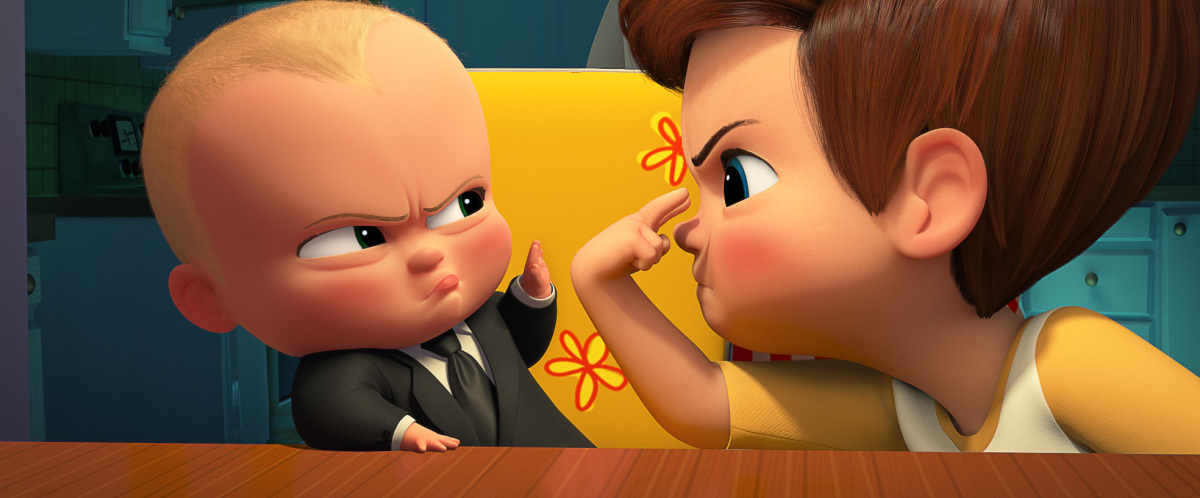
All that changes when his little brother (Alec Baldwin) arrives. Why can’t his parents see that this stranger in their home is all manner of wrong?

Tim’s right – there is something up with the wee one. Baldwin’s Baby has been sent to Tim’s house to infiltrate a pet company. Why? Because puppies are so darn cute, people might want to stop having babies and just get puppies.

Things get considerably more convoluted from there.

Marla Frazee’s children’s book The Boss Baby is a clever metaphor brought to life. There’s a new boss in the house, and he is a total baby. Cute.

It was Michael McCullers’s unfortunate task to turn Frazee’s couple dozen lines into a screenplay that would take up approximately 90 minutes. That leaves an awful, awful lot of space to fill with McCullers’s imagination, and that brain takes us in some weird directions.

The film’s foundation combines ideas from the recent animated mediocrity The Secret Life of Pets and Storks. Plus there’s a surprisingly good dose of The Office tossed in there, and, of course, some Glengarry Glen Ross.

But still, there is more time to kill.

How shall we fill it?

How about with Elvis impersonators? Lots of poop jokes? An evil Mrs. Doubtfire? Pacifier acid trip? Maybe a pot shot or two at designer puppies?

Why not?

As it turns out, The Baby Boss is a very strange and strangely subversive little cartoon.

Many of the jokes are aimed high above the average 3-foot-tall and under crowd, but honestly there’s not a great deal for the tykes to cling to. The story is far too complicated, and the dazzling array of bizarre ornamentation only further confounds viewers.

Maybe you have to settle for the little things. Does Tim learn that there is enough love to share with his baby brother? Does Alec Baldwin say, “cookies are for closers”?

Yes and yes.

Verdict-2-5-Stars

Brutally Vital

Land of Mine

by Rachel Willis

Land of Mine is almost impossible to watch. Not because it’s bad. On the contrary, it’s an amazingly crafted film that boasts an incredible screenplay and cast. It’s hard to watch because writer/director Martin Zandvliet’s film is so intense it leaves the viewer on constant edge.

Roland Møller is Sargent Carl Rasmussen, a Danish soldier tasked with overseeing fourteen German POWs at the end of World War II as they clear a beach in Denmark of land mines. This violation of international law is a stain on Denmark’s history that Zandvliet brings to light. The thought of grown men forced to crawl across beaches searching cautiously for land mines is repellant enough. It’s made worse by the fact that many of the POWs were teenage boys.

Zandvliet’s scripts balances the emotions of the situation well, and Møller’s performance brilliantly captures the feelings of the Danish people. There is little sympathy for the German POWs. If anything, this is seen as a just punishment for the crimes committed by Germany during the war. However, the audience sees the soldiers for what they are: children who simply want to go home.

As the film proceeds, tensions mount. The history of the situation is brutal and bleak, so as the audience gets to know the characters, it’s impossible not to sympathize and worry for their safety with each moment that passes. The mental torture inflicted on the prisoners is felt by the audience as we’re forced to watch their slow advance across the beach. Moments of quiet could be rent apart at any moment. It’s nearly unbearable.

However, Zandvliet knows when to give the audience a break, and the scenes on the beach are countered by more lighthearted moments: a soccer game, the boys talking about their futures, and interactions between Rasmussen and the boys that show his shifting emotions.

Land of Mine is difficult viewing, but as Zandvliet brings empathy and compassion to a dark moment in history, it becomes equally vital.

Verdict-5-0-Stars

https://www.youtube.com/watch?v=kCgLSY-3bYw

Life: It’s What’s for Dinner

Life

by Matt Weiner

Life comes at you fast. Real fast, when it’s a hyper-intelligent Martian lifeform hell-bent on survival. In Life, a seemingly unstoppable alien terrorizes the isolated crew of a spaceship. Is the plot eerily familiar? You bet. Does the film do enough to merit its obvious Alien comparison? Surprisingly, yes.

Director Daniel Espinosa makes the most of the zero-gravity settings on the International Space Station—first with inspired long takes introducing the cramped passages, and later with the haunting, creative blood spurts that will soon saturate them.

Inhabiting the ISS is a multinational crew who has recovered alien life from Mars. All the diverse archetypes are on board, including a wisecracking specialist (Ryan Reynolds), a world-weary veteran (Jake Gyllenhaal) and a suspiciously reserved biologist (Miranda North). Plus a few more alien appetizers, but this paragraph is already more backstory than most of the crew members receive.

Excitement quickly turns to horror once scientist Hugh Derry (Ariyon Bakare) finds a way to bring the cell to life. The astronauts are no match for “Calvin,” as those blissfully ignorant down on Earth have christened the creature. The more astronauts Calvin feeds on, the bigger it gets until it balloons to a nightmarish love child between an octopus and the Xenomorph.

Life is written by Rhett Reese and Paul Wernick, the team responsible for Zombieland and Deadpool. And the film allows a few—very few—quiet moments to shade in some character depth. But these quasi-philosophical pauses just get in the way of the movie’s strengths.

And the biggest strength Life has going for it is that the film is a whole lot of fun as a dumb thriller. Well, that and a way-too-qualified cast who can add some pathos to the almost methodically expectant death scenes. (Did I mention how nifty those blood spurts are?)

Much like the ISS crew, the film comes dangerously close to running out of gas by the end. The familiar setup wears itself thin, and Calvin has too much CGI aloofness to win our affection like the Alien did.

Overall though, Espinosa mostly succeeds at keeping the action moving. Life trades in the languid dread of its forebear for a breakneck (among other appendages) pace that requires little thought and demands no frame-by-frame viewings. But while this monster might be a bit immature, it packs a vicious punch.

Verdict-3-0-Stars


Ride or Die

CHIPS

by Hope Madden

How many of you remember that, in 70s cop shows, cars blew up all the time?

Without that knowledge, one of two running jokes in CHIPS will make no sense. The other one – well, you’ll understand it, it’s just not funny.

Neither is much of anything else in writer/director/star/seemingly good guy Dax Shepard’s big screen tribute to the cop show of a bygone era.

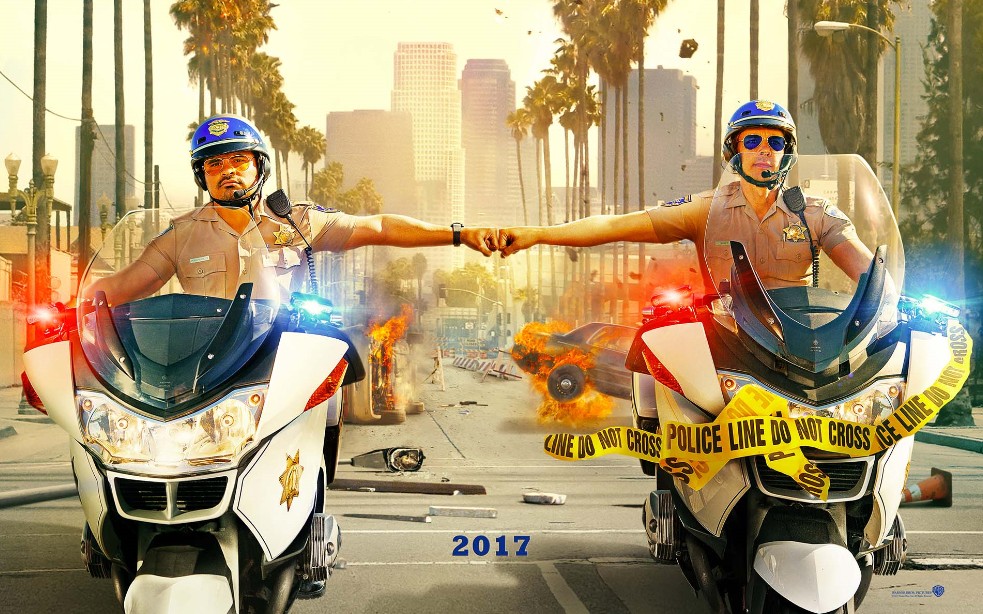
Shepard plays Jon to Michael Peña’s Ponch, and the two have to overcome their intimacy issues and crack some case about dirty cops.

Peña’s a talented actor (and a hard worker – the 41-year-old has 83 acting credits). He’s also versatile, easily handling drama or comedy. What he’s not is a lead.

Neither is Shepard. Both actors are likeable enough, amusing enough, but not compelling enough to keep your interest for 100 minutes.

Shepard’s script doesn’t do them many favors, either. The convoluted story offers opportunities for cool motorcycle tricks, and who needs a reasonable plot for a 70s TV spoof? But the laughs aren’t there, the nostalgia doesn’t work, and the film lacks the self-referential humor and off-handed fondness for the source material that made films like 21 Jump Street so much fun.

Kristin Bell is underused but fun as Jon’s unlikeable ex-wife and Vincent D’Onofrio remains a welcome presence in any film. But the rest of the supporting cast gets little opportunity to make a mark.

It’s hard to hate CHIPS. Like its leads, the film is blandly appealing but seriously in need of something bolder to hold your attention.

Verdict-2-0-Stars

Shout at the Devil

The Devil’s Candy

by Hope Madden

Hard rock music makes for both an evocative soundtrack and theme for horror. It possesses a throbbing, angry darkness perfectly suited to imagery, behavior and pace. The hilariously wrong Kiwi flick Deathgasm and last year’s brilliant Green Room knew this.

Writer/director Sean Byrne recognizes this ripe musical landscape. He returns to the genre after too long an absence with his own head banging horror show – The Devil’s Candy.

In 2009 the Tasmanian filmmaker released one of my all-time favorite films, The Loved Ones. And while Candy can’t match the unhinged lunacy of Byrne’s previous classic, his skill with a story, a camera and a cast are still evident.

Ethan Embry plays Jesse Hellman, struggling metalhead painter who, with his wife and pre-teen daughter, just bought a bargain of a house out in the Texas sticks. Why so cheap? Amityville shit.

So, the demented son (Pruitt Taylor Vince) of the deceased former owners lurks about. Meanwhile Jesse’s art becomes more disturbing and consuming. But Byrne shifts expectations, setting the film up as a haunted house/possession terror that turns into more of a serial killer thriller.

Still, so much about this film smacks of redundancy. Too many movies follow a young family into the damned home of their dreams, generating tension with either the fear that one family member will turn on another, or that the parents cannot keep their child safe. Or both.

No, Byrne’s follow up film does not boast the same unbridled originality as Loved Ones. But he almost makes up for that flaw with well-crafted characters, excellent on-screen chemistry among his performers, and a genuine love of metal.

The crossroads between Satan and music – in imagery and lyric – have long influenced and been influenced by horror films. Black Sabbath and White Zombie took their names from scary movies, and the list of flicks that set Satan and rock music against the innocent is too long – and mostly too awful – to mention. (OK, a few: Trick or Treat, Phantom of the Paradise, The Gate, Suck, Liquid Sky, Queen of the Damned – remember that piece of garbage?)

Byrne does a better job of exploding the clichés associated with this line of thinking than perhaps any filmmaker who’s taken up Dio’s sign of the horns. No longer the hysterical outsider condemning that devil music, the film simply uses metal as its backdrop and vehicle, no judgment involved.

Byrne’s also blessed with a lead in Embry, whose caring and vulnerability shine through his tough- looking exterior. Vince is another reliable (if typecast) actor, easily generating sympathy and terror in equal measure.

Clocking in at under 90 minutes, Devil’s Candy is a tight little rocker. The lyrics are familiar, but the riffs still kick ass.

Verdict-3-0-Stars

Choose Nostalgia

T2 Trainspotting

by Christie Robb

Choose life. Choose a movie. Choose a sequel, a prequel, a reboot, a franchise. Choose a revival. Choose familiarity. Choose nostalgia.

Watching the sequel to Trainspotting was like watching the new Gilmore Girls—only with more violence and heroin.

Is it social media that makes us feel we need to keep endlessly up to date on everyone? Is living in a chaotic world leading to an increased desire for tidy endings? Is it just the same kind of curiosity that makes folks RSVP to class reunions? Who needs reasons when you’ve got Trainspotting?

T2 takes place 20 years after Mark Renton steals £16,000 of communal drug sale profits from his friends and splits, vowing to live the life of a grown up. He experiences a minor coronary episode on a treadmill, which serves as the catalyst for a midlife crisis. And this crisis doesn’t take him on the path to buy a convertible, or to a hair plug consultation, or make him vow to consume a daily probiotic. Because the plot demands it, Mark is drawn back home to Edinburgh-to a bunch of people who feel that, to some degree or another, he ruined their lives.

In the original movie, Simon “Sickboy” Williamson states his theory of life, “Well, at one point you’ve got it. Then you lose it.” T2 isn’t bad. But it’s not great either. It’s lost some of the magic that the first movie had. But then it’s probably supposed to have.

It’s a movie about middle age, about looking back at who you were in your twenties and assessing what you’ve done or haven’t. Set against the backdrop of a gentrifying Edinburgh, we are presented with a familiar plot. Scenes from the first movie are rehashed. Renton delivers a new “Choose Life” monologue to a bored 20-year-old, which largely pans internet culture, shrilly condemning the choices of a stereotypical member of the younger generation in the same way he condemned the spirit-crushing lifestyle of clichéd older folks 20 years before.

Sometimes key scenes from the old movie are even played as flashbacks or projected on top of an existing new scene. The music too, is recycled. As if the characters stopped listening to anything new at 25.

Sure, it’s delightful to see all the cast members together again (Ewan McGregor, Robert Carlyle, Ewen Bremner and Johnny Lee Miller) under the helm of original Trainspotting director Danny Boyle (who went on to win the Oscar for Slumdog Millionaire). But the enjoyment is not unlike seeing a fading star in concert, or asking for a tour of your childhood home, or meeting up with an old flame for a drink.

It’s nice for a bit, but maybe not quite as good as in the old days.

Verdict-2-5-Stars


Searching for Xenu

My Scientology Movie

by Hope Madden

Another documentary on Scientology? Is that religion really so endlessly fascinating?

Um, yes.

There is just something about this cross-breed of spirituality, celebrity, science and greed that makes Scientology immediately intriguing.

And the backstory: a religion that reads like science fiction, developed (revealed?) by a science fiction writer, believed by many as the true and only possible answer to our deepest questions.

Plus celebrities, secrets and very, very suspicious behavior – it’s just hard to look away, and if a filmmaker can find a novel way of exposing the subject, then why not indulge?

Documentarian Louis Theroux brings his wry curiosity to the project, and the result is an uneven but surprisingly compassionate glimpse.

Theroux has a 20-year career with BBC defined by enmeshing himself with fringe populations from neo-Nazis to the Westboro Baptist Church and others. It is his uncanny charm and low-key curiosity that help him endear himself to his subjects and his audience.

The obstacle to any documentary on Scientology is access. You can’t get in. And there is a limit to the number of speculative outsider-looking-in docs that can be considered worthwhile.

What makes Theroux’s avenue into the story interesting is that he uses his lack of access to gain access, because one of Scientology’s curious customs is to combat any perceived threat of investigation. Paranoia is baked into their business model.

They send people out to follow, film and generally harass folks like Louis.

A good portion of Theroux and director Rob Alter’s doc captures the sound stage recreation of incidents – primarily those alleged abuses that have dogged Scientology leader David Miscavige. Theroux also interviews former church members, including one-time high-ranker Marty Rathburn.

So far, so ordinary.

But Theroux’s aim is to flush out the active Scientologists and document their behavior.

A lot can be gleaned from that behavior, and from Theroux’s more balanced investigation into the former church members who participate in his documentary.

We’re still left with so many aggravating holes that you have to rely more on being entertained than informed. Theroux’s affable persistence and comedic intelligence combine with his empathetic insights to offer enough difference that his look is worth the time.

Verdict-3-0-Stars

Killing Time at Work

The Belko Experiment

by Hope Madden

Back in 2005, Aussie director Greg McLean made a name for himself with the brutal but brilliant Wolf Creek. A year later, writer James Gunn would make his feature debut behind the camera with the underseen and wonderful creature feature Slither. (You may know him better for a little something called Guardians of the Galaxy.)

Regardless of whether you do or do not know these two, the fact that they worked together on the new horror The Belko Experiment meant one thing to me: hoo-effing-ray!

There’s the ripe premise: office workers hear over a loud speaker that they have a few minutes to kill two people or the unseen speaker (a royal we) will kill 4. Things escalate. People go a little nuts. It’s Darwinism at its most microcosmic.

Plus McLean and Gunn have assembled a fine cast full of excellent character actors: Tony Goldwyn, John C. McKinley, James Gallagher, Michael Rooker and Gregg Henry, among others.

So what went so blandly, forgettably wrong?

The biggest surprise in The Belko Experiment is the utter absence of surprises. Each actor plays exactly who you’d expect him or her to play. Their Stanford Prison Experiment meets Lord of the Flies exercise turns people into exactly what you’d expect them to turn into.

There’s not even a single inventive death scene to distract you from the fact that you had really high expectations because you totally love these filmmakers and now you’re just wasting yet another lovely evening a darkened movie theater.

Sigh.

Verdict-2-5-Stars

https://www.youtube.com/watch?v=qZNfwayNLL0

Can’t Stand Up for Falling Down

Staying Vertical

by Hope Madden

Alain Guiraudie’s meditation on manhood Staying Vertical hits upon similar themes as his 2013 murder mystery Stranger by the Lake. In other ways, one film is the other’s opposite.

Stranger by the Lake – a serial killer film set on the banks of a French lake used for gay cruising – examined its topic from the inside out. We were surrounded by the suspects, the victims and the scene of the crime. We knew what the leads knew when they knew it, so we participated in each curious choice.

And though Guiraudie once again considers sexuality – sexual expression, repression and identity – he keeps the audience at arm’s length from the exploration.

We wander the French countryside with Léo (Damien Bonnard). Our wide-eyed protagonist is a screenwriter in search of a story. He meanders from one situation to the next, his open curiosity his guide as well as his frequent undoing.

Staying Vertical’s story is as loose and open as Stranger’s was tightly wound. The film is borderline plot free. Leo hikes into the path of shepherd Marie (India Hair), plays with her kids, dodges looks from her father (Raphaël Thiéry – a find!), wanders away and, periodically, back.

His rambling leads him to town, where he tries to connect with a homeless man under a bridge. Then we’re on to a ramshackle house and into the lives of a young man and his ambiguously-defined father figure, into a bizarre plant therapy situation, back to Marie and out again.

Between the loose structure and Bonnard’s guileless performance, Guiraudie creates a fascinatingly male world of disconnection, longing and hope. Léo is – as are we, by extension – an interloper, regardless of his attempts to situate himself.

The filmmaker knows how to arrest your attention despite the meandering nature of the plot. The frank and often jarring sexual imagery (seriously, there’s a scene set to a Pink Floyd riff that will floor you) manages to question preconceived notions in truly fresh ways.

He also shoots scenes through with wry humor, and he captures landscapes (in look and sound) as few if any current filmmaker can.

Guiraudie’s metaphors are frequent and interesting, but never stronger than in the closing scene. Though the crossing storylines don’t always work, the characters that populate this harsh but lovely environment pique your interest as Léo’s journey captures your imagination.

Verdict-4-0-Stars

Young Turks

The Ottoman Lieutenant

by Hope Madden

With an almost offensively naïve – or more likely, revisionist – sense of history surrounding an entirely anachronistic amount of gumption, The Ottoman Lieutenant is the third historical romance to hit theaters in as many weeks.

And the weakest.

The lovely A United Kingdom struggled to find an authentic voice for the true story of Seretse and Ruth Khama’s love. Bitter Harvest, on the other hand, lacked the focus to use its love story to articulate the horrors of war.

Both films made a valiant effort to shine a light on a historical period. The Ottoman Lieutenant separates itself from the pack primarily with its open attempt to rewrite history, to make it more noble, palatable and romantic.

Lillie Rowe (Hera Hilmar) is a young woman of privilege. She’s also an American with a thick Icelandic accent, but no matter. Lillie spurns her stuffy 1914 Philadelphian upbringing in in favor of mission work in Anatolia, thanks to a cardboard-stiff speech given by mission doctor Jude Gresham (Josh Hartnett).

Once there, as Dr. Gresham falls in love with Lillie, she’s busy falling for Lieutenant Ismael Veli (Michiel Huisman) who, luckily, speaks English – as do all Turks in the film, even when they’re talking amongst themselves. How convenient!

Armenians – a population all but wiped from existence one year later – figure minutely in this soft focus clash between Muslims and Christians. But why tell their story just because your film is set in their backyard on the eve of their genocide? The important thing to understand is that, in war, everyone is wrong and only love is right.

That’s the gallingly simple outlook of the nurse with the tousled hair whose cloying voiceover tells us everything and nothing, simultaneously.

Though Joseph Ruben’s direction can never transcend Jeff Stockwell’s historically vacuous screenplay, the film often looks quite lovely. As does Hilmar, which is great as she is never called upon to act. She poses really well, though, and never laughs no matter how precious the dialog. Plus, Lillie has so many great hats!

It’s almost a shame Ben Kingsley shows up when he does because, even saddled as he is with this one-dimensional stereotype of a character, Ben Kingsley can act. His talent only exposes the balance of the cast for the posers (and poseurs) they are.

The Ottoman Lieutenant offers a lot of easily won wisdom and quick solutions – and hats. None of these strike me as items abounding during a time of war, but stark reality is not the goal of the film.

What the point is, I couldn’t tell you.

Verdict-2-0-Stars