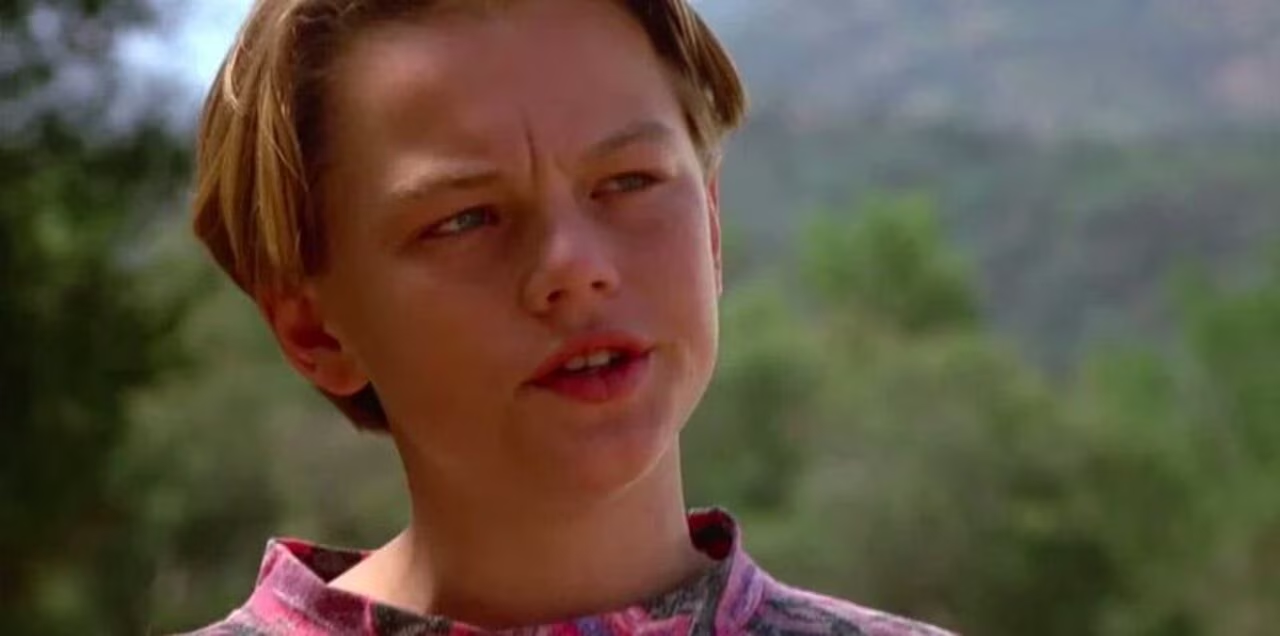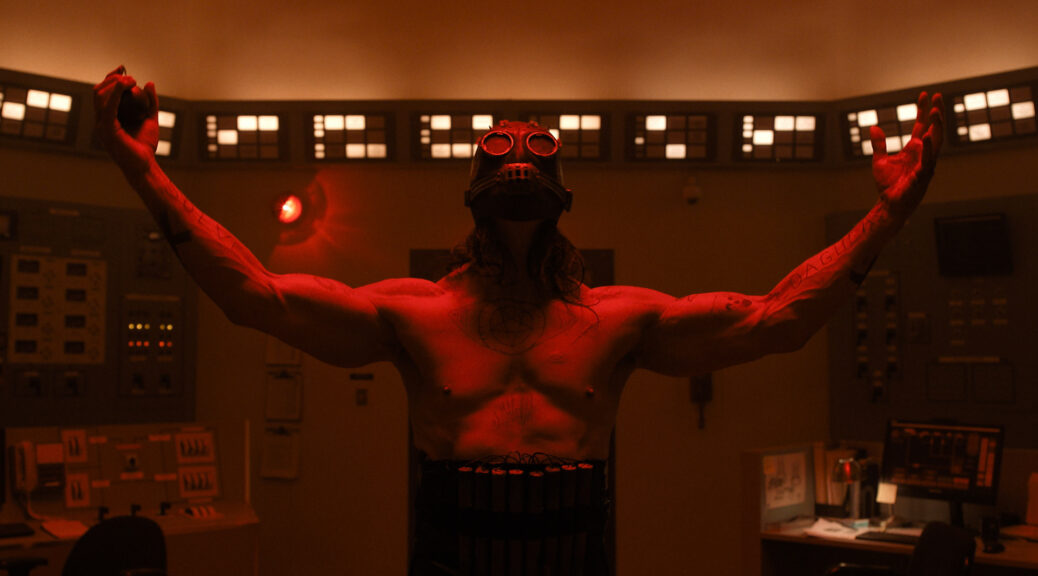
Imagine Guillermo del Toro meets Wes Anderson. Equal parts fanciful and gruesome, the film tells the tale of a precocious youth named Aurora (Sophie Sloan), who hires the neighbor in 5B (Mads Mikkelsen) to kill the monster that lives under her bed.
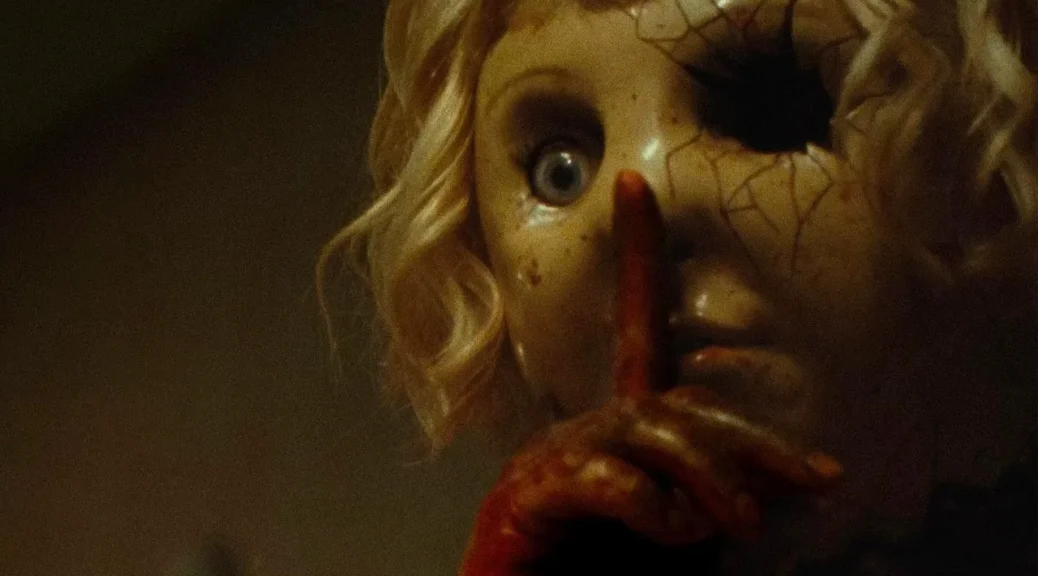
What a wonderful premise, and writer/director Bryan Fuller wastes not a frame of his feature film debut. The saturated colors and intricate patterns and textures of the set design, the ballet of horror that is his shadow imagery, the boldly whimsical costuming—all of it conjuring an amplified fairy tale. It’s tough to believe this remarkably confident feature is his first foray behind the camera.
Fuller’s casting is just as playful. Sloan delivers Roald Dahl’s Matilda by way of Wednesday Addams, braids and all. Mikkelsen’s adorably gruff, and watching his character mentally work through the mystery surrounding Aurora’s missing parents (eaten, he’s told) is fascinating. He and Sloan share a wonderful chemistry, never cloying for a second, and often darkly hilarious. Their banter is often priceless, Sloan landing lines with impeccably droll comic timing.
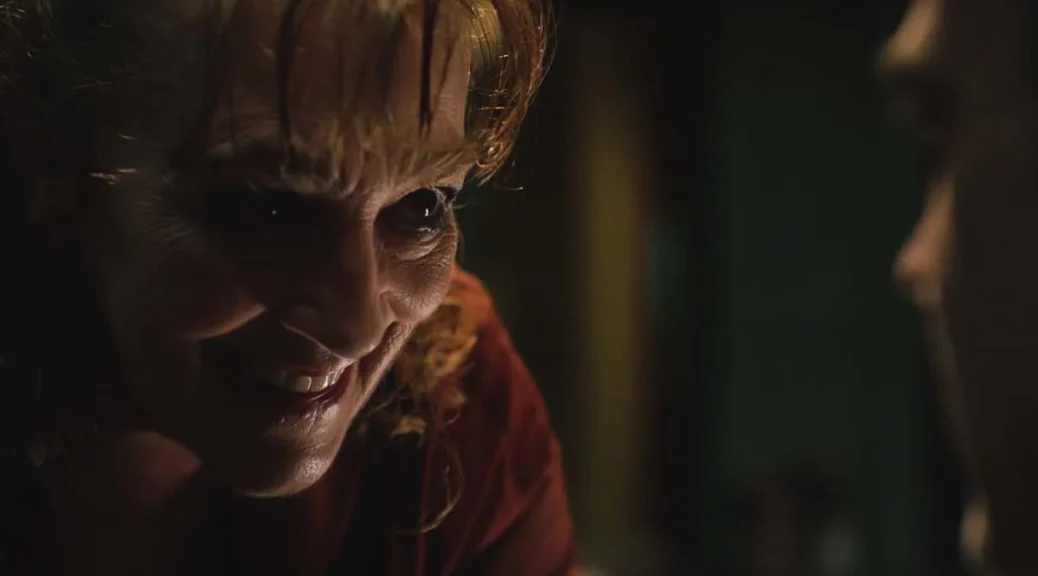
Speaking of hilarious, the great Sigourney Weaver is having a blast playing gleefully against type and shoplifting every second of screentime. All smiles, genuine joy, and murder, her character enjoys the pleasures life affords and accepts, with a smile, the reality of each situation. Again, usually murder.
Likewise, David Dastmalchian and Sheila Atim, with big support from an inspired costume designer, deliver entertaining weirdness.
Fuller’s premise could have taken many directions. It’s the sense of wonder Dust Bunny articulates that mesmerizes. But the writing doesn’t serve only to carry the visual splendor. It’s a clever script, edged with pathos and vulnerability, hinting at metaphor without ever submitting to it.
Oscar winner and perennial contender Kate Winslet makes her directorial debut with the Christmastime family drama, Goodbye June. What drew the esteemed thespian behind the camera? A script by her son, Joe Anders.
The film tells the tale of June (Helen Mirren), whose cancer has returned just two weeks before Christmas. Her doting, anxiety riddled son, Connor (Johnny Flynn), and her husband (Timothy Spall) get her to the hospital and wait for the rest of the family to come in and, well, take over.
These are the sisters: Julia (Winslet), Molly (Andrea Riseborough), and Helen (Toni Collette).
Pause to marvel at this cast.
It would be hard to go wrong with any one of those humans, and indeed, Winslet’s ensemble—Riseborough and Spall, in particular—craft lived-in characters, each one’s behavior naturally amplified because of the situation. June is dying.
Winslet captures the chaos, simultaneously merry and discordant, in a big family brimming with little kids all cramped in a hospital room or running wild through its halls. The child actors are quite good, not to mention awfully cute.
Anders’s script doesn’t overexplain, mercifully. The details aren’t terribly necessary if you’ve ever been in or near a family. Molly kind of hates Julia. This hurts Julia, who is also mortified by Molly’s controlling, even bullying behavior with hospital staff. Everyone thinks Helen’s a flake. Likewise, everyone is fed up with Dad and filled with a mixture of tenderness and disappointment in Connor.
Credit Anders, as well, for avoiding the cliché of the sainted, dying mother in the hospital bed. A charmingly mischievous Mirren is unapologetic but loving, still getting in digs here and there that have no doubt worn down her children over the decades. Helen shouldn’t wear yellow. Julia needs to look after everyone, but not in that overbearing way she sometimes has.
The fine-tuned performances are nearly undone by the superficial plot, unfortunately. Goodbye June is saddled with obviousness bordering on the maudlin that Winslet and her inarguably talented cast can’t quite transcend. Winslet’s crafted a holiday tearjerker with a fine but conspicuous message.
Not every bad, low-budget, unreasonably beloved Eighties horror movie needs to be rebooted. Do I rewatch Charles Sellier’s 1984 holiday slash fest Silent Night, Deadly Night every holiday season? Maybe.
I don’t rewatch its 1987 sequel every single year. I’m not a masochist. Nor have I watched SNDN 3, 4, or 5 (starring Mickey Rooney!) more than once apiece. Anyway, I’m obviously if begrudgingly the audience for Mike P. Nelson’s new update on the old Santa suit, Silent Night, Deadly Night.
And maybe it benefits from low expectations, but I liked it.
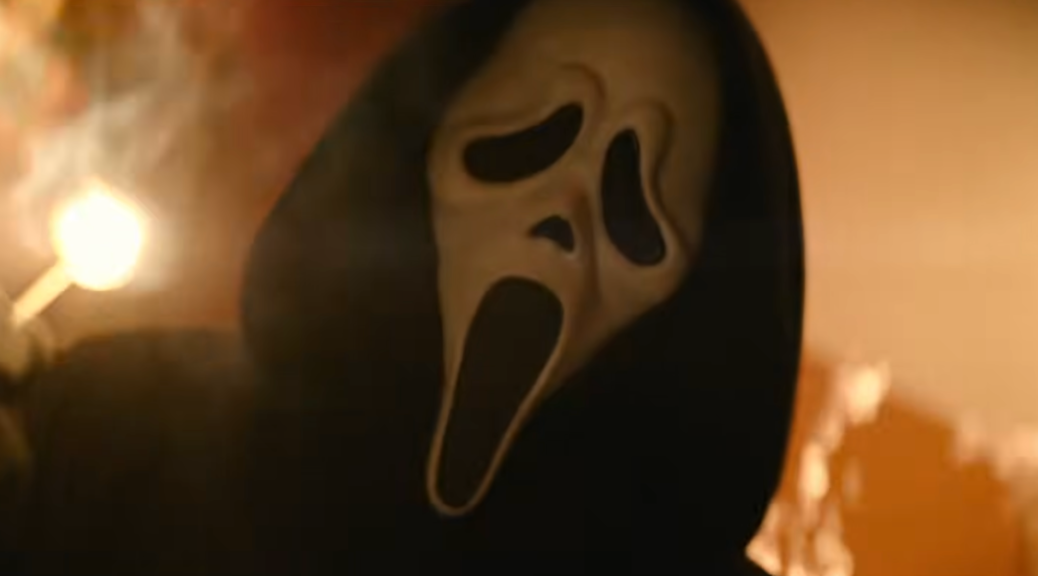
Nelson, who writes and directs, revisits the important beats of the ’84 original but he’s smart about it. Billy (Halloween Ends and The Monkey’s Rohan Campbell) listens to the voice in his head. That voice belongs to the Santa who murdered Billy’s parents when he was 8.
That’s an added layer to the triggered homicidal lunatic that populates every previous installment. It’s a welcome change that the filmmaker, Campbell, and Mark Acheson—as the voice of Shotgun Santa—maneuver for creepy fun.
Nelson does have a good time with the franchise, tossing Easter eggs around like a holiday crossover. But these moments feel more like communal celebration than pandering, a wink from one fan to another.
The casting is on point, even eerie, as Nelson’s tale feels like a Yuletide merging of SNDN and Halloween Ends, once gift store owner Pamela (Ruby Modine) gets involved—again, an inside joke that works better than it has a right to.
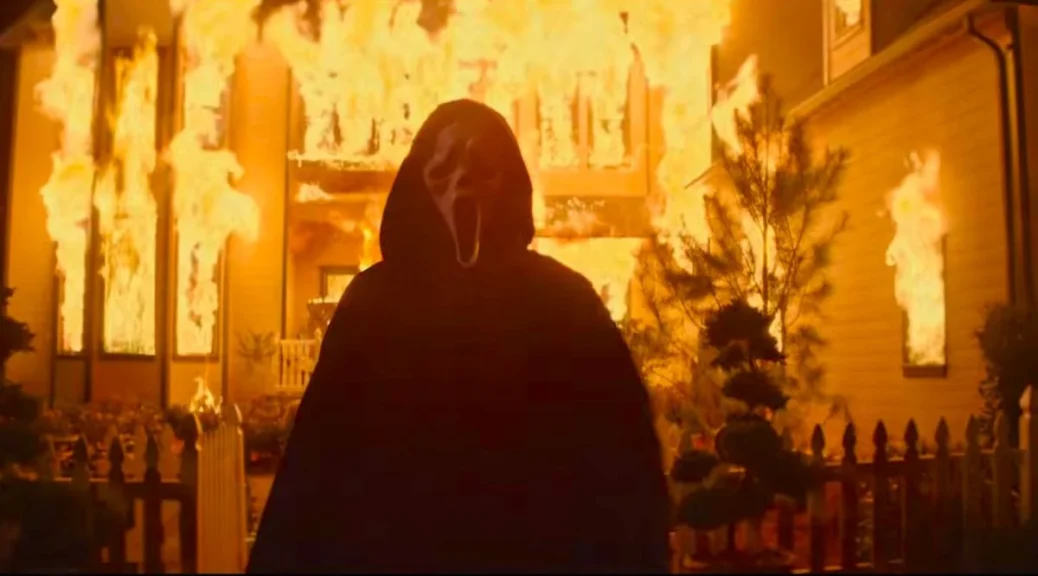
The carnage is often quite fun—one party scene, in particular. But even with the humor, Nelson never stoops to camp or spoof. He’s a little hemmed in by the limitations of the franchise itself, breaking no remarkably new ground. But Silent Night, Deadly Night is often clever fun. There are creepy moments, funny moments, bloody moments, but his film hangs together as a solid holiday horror.
Our Christmas gift to you, an extra Fright Club episode! We talk with filmmaker Kurtis David Harder, whose newest feature, Influencers, hits Shudder this weekend. He chats with us about the new film, his Nightmares Film Festival award winning Influencer, making movies, inspirations, and Christmas films. Check it out!
Hope & George review this week’s new releases: Five Nights at Freddy’s 2, Hamnet, Merrily We Roll Along, Oh What Fun, Man Finds Tape, Pig Hill, Reflections in a Dead Diamond, The Wailing, The Lonely Legend and My Mother the Madam!
In 2023, Five Nights at Freddy’s—a predictable PG-13 horror built on a video game—delivered a bit of gimmicky fun for fans of the game and little to nothing for the rest of us. So, hooray! There’s a sequel.
Director Emma Tammi returns, with video game creator Scott Cawthon handling the sole screenplay credit this go-round. His script sees Mike (Josh Hutcherson) still avoiding therapy for himself or his disturbingly naïve 11-year-old sister Abby (Piper Rubio). And Vanessa (Elizabeth Lail) is so bad off she’s taking psychological advice from Mike.
Naturally, all of them are suffering the trauma of the bloodthirsty animatronics that came to life on night security Mike’s watch last time around, possessed by Vanessa’s evil dad’s. But Mike’s painting a house and Abby’s into robotics, so I’m sure they’re fine!
Wait, they’re not. And through a fairly convoluted storyline that sees one of Seinfeld’s neighbors get The Story of Ricky treatment, the trio not only brings the Country Bear Murder Spree back to life, they set them free to roam the town.
Scenes are slapped together with a gleeful disregard to continuity, and again, the macabre sense of humor that might have kept the film afloat is entirely missing.
Freddy Carter is a fun addition as the villainous Michael. (Who, honestly, names one character Mike and another one Michael?) And there is a Skeet Ulrich sighting. Plus, a new animatronic—kind of a goth Miyazaki styles marionette—is cool. And though I’d predicted McKenna Grace to be a kind of cold open kill, instead she gets a bit of a creepy, if small, character arc.
I realize the film is aimed at a young audience, but Tammi and team could at least pretend to respect them as viewers.
Hutcherson can act, and I’m confident someday he’ll get another film that lets him do that. Until then, Five Nights at Freddy’s 2 ends with a clear path to a third installment. Hooray.
Co-writers/directors Paul Grandersman and Peter S. Hall experiment with concept of found footage in an often unique and puzzling feature, Man Finds Tape.
While there are times that the film feels less than original—an influencer suggests he’s stumbled onto something supernatural only to be believed a fraud—the mystery itself is something I haven’t seen before.
Lynn (Kelsey Pribilski) and her brother Lucas (William Magnuson) are not close. She left their small Texas town shortly after their parents died, while Lucas knocked around the old house, falling slowly into depression, until he came across a MiniDV with his name on it. He shares the find online, creating a big conspiracy that screws up Lynn’s documentary career.
So, when he calls her up asking her to watch another video, she’s understandably, even angrily reluctant. But she’s worried about him, so she watches. And while the footage itself is genuinely intriguing, Lynn’s more unnerved by the affect the footage has when her brother watches it. Turns out, every person living in Larkin, Texas has the same reaction. Only Lynn is unaffected.
So, Lynn sets out to document what’s happening, which is how all the various formats of found footage are stitched together. This gives the film a Shelby Oaks or Strange Harvest vibe that leeches some originality from the concept.
But for a good while, it is an interesting concept. Both Pribilski and Magnuson convince as bickering siblings, and most of the ensemble—primarily playing townies happy to be interviewed for Lynn’s documentary—are a lot of fun. Meanwhile, Brian Villalobos approaches his role as “The Stranger” with a fascinating air of smug disgust.
Man Finds Tape delivers an often-engrossing metaphor about parasitic predation dressed as religion, and its particularly harmful effect on small, Southern towns. But Hall and Gandersman write themselves into a corner and the final solution to the mystery is unsatisfying. It’s too bad, because for a good while, they really had something.
It’s been five years since Chloé Zhao took home two Oscars, one for directing and one for adapting the screenplay for Nomadland. She returns to form in both respects with Hamnet, the cinematic adaptation of Maggie O’Farrell’s novel that imagines the way grief may have shaped Shakespeare’s greatest tragedy.
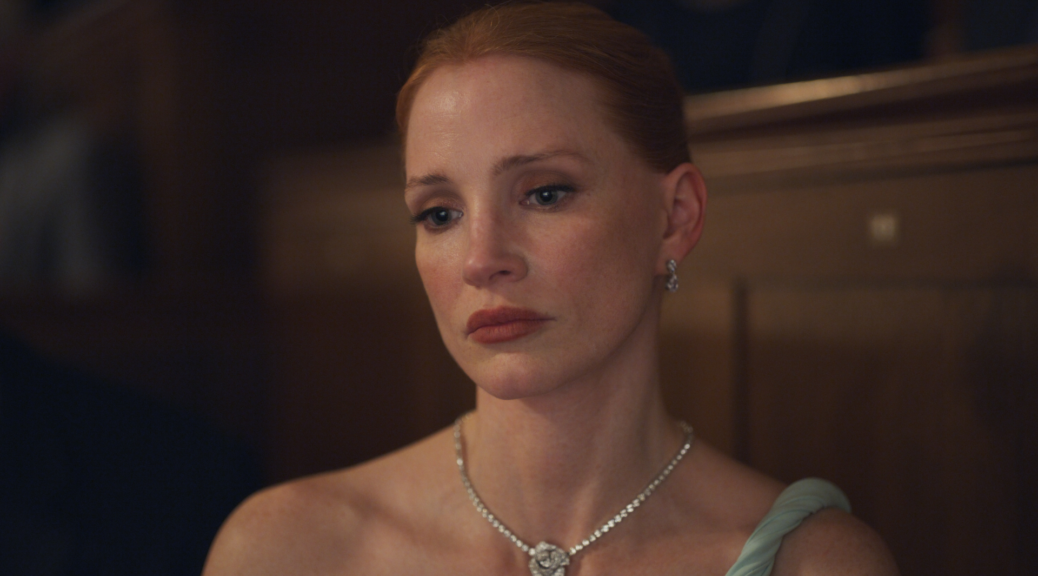
Zhao’s film opens stunningly on Jessie Buckley, nestled womblike among the roots of a massive tree, her face and hands dirty, her hair tangled with leaves. Buckley is Agnes, believed by those in town to be the daughter of a forest witch. Agnes comes from what is.
Will (Paul Mescal) imagines what can be. The hyper real poetry of Zhao’s camera perfectly articulates their yin/yang balance.
It’s with Will that we first see Agnes’s nurturing side applied to humanity rather than the wild. It’s a trait that will become the backbone of their story. Her love is powerful, messy, and unforgiving, and Buckley’s more than up to the task. Her performance, as is so often the case, feels dangerous and uncensored. And gazing adoringly at her, inspired and nurtured, is Will. If there is a better face in cinema than Mescal’s for earnest yet doomed longing, I don’t know whose it could be.
The young cast more than keeps pace. Jacobi Jupe is particularly amazing and utterly heartbreaking as Will and Agnes’s boy, Hamnet. (His older brother Noah Jupe also impresses later in the film as the actor portraying the great Dane in the first ever stage production.)
By the time the most famous lines in theatre are uttered, it takes restraint and rawness. The slightest hint of artifice and the previous ninety minutes are ruined, the film a gimmick. But Zhao never skirts artifice, not even when she makes a Marvel movie, and Mescal delivers lines we know by heart as if they were freshly pulled from an open wound.
Zhao has crafted, aided by magnificent performances and hauntingly stunning cinematography from Lukasz Zal (The Zone of Interest, Cold War), a film that is shattering in its articulation that it is the depth of love that deepens and amplifies the pain of grief.
People make movies about grief all the time. We can expect one every Oscar season. But what Chloé Zhao does with Hamnet is ask us to experience that grief, not just witness it, and in experiencing it we understand the power and vital importance of art.
We’ve gone exploring to find all our Christmas decorations! It led us to the basement (which we discuss with Jamie Ray over on his amazing Fave Five from Fans podcast), and into the attic! That’s where we stay for a countdown of the best attics in horror movies!
5. 30 Days of Night (2007)
A pod of survivors hides in an attic, careful not to make any noise or draw any attention to themselves. One old man has dementia, which generates a lot of tension in the group, since he’s hard to contain and keep quiet.
There’s no knowing whether the town has any other survivors, and some of these guys are getting itchy. Then they hear a small voice outside.
Walking and sobbing down the main drag is a little girl, crying for help. It’s as pathetic a scene as any in such a film, and it may be the first moment in the picture where you identify with the trapped, who must do the unthinkable. Because, what would you do?
As the would-be heroes in the attic begin to understand this ploy, the camera on the street pulls back to show Danny Huston and crew perched atop the nearby buildings. The sobbing tot amounts to the worm on their reel.
Creepy business!
4. Hereditary (2018)
With just a handful of mannerisms, one melodic clucking noise, and a few seemingly throwaway lines, Ari Aster and his magnificent cast quickly establish what will become nuanced, layered human characters, all of them scarred and battered by family.
Art and life imitate each other to macabre degrees while family members strain to behave in the manner that feels human, seems connected, or might be normal. What is said and what stays hidden, what’s festering in the attic and in the unspoken tensions within the family, it’s all part of a horrific atmosphere meticulously crafted to unnerve you.
Aster takes advantage of a remarkably committed cast to explore family dysfunction of the most insidious type. Whether his supernatural twisting and turning amount to metaphor or fact hardly matters with performances this unnerving and visual storytelling this hypnotic.
3. The Birds (1963)
As The Birds opens, wealthy socialite Melanie Daniels (Tippi Hedren) has followed hottie bachelor lawyer Mitch (Rod Taylor) to little Bodega Bay, his hometown, to play a flirtatious practical joke of cat and mouse. But you know what will eat both cats and mice? Birds.
Hitchcock introduces a number of provocative characters, including Hedren’s not-that-likeable heroine. Suzanne Pleshette’s lovelorn schoolteacher’s a favorite. But whatever the character, the dread is building, so they need to work together to outwit these goddamn birds.
The film is basically an intelligent zombie film, although it predates our traditional zombie by a good many years, so maybe, like every other dark film genre, the zombie film owes its history to Hitchcock. The reason the birds behave so badly is never explained, they grow in number, and they wait en masse for you to come outside. No one’s off limits – a fact Hitch announces at the children’s party. Nice!
Though the FX were astonishing for 1963, the whole episode feels a bit campy today. But if you’re in the mood for a nostalgic, clean cut and yet somehow subversive foray into fairly bloodless horror, or if, like one of us, you’re just afraid of birds, this one’s a classic.
2. The Changeling (1980)
George C. Scott is a grieving father isolating himself in an old mansion. But something in that mansion in Peter Medak’s atmospheric ghost story is drawn to him.
The Changeling is a beautiful, haunting mystery full of melancholy and grief. Scott’s big, gruff performance breaks with vulnerability just often enough to jerk a tear or two in a film that’s spooky, lovely, and satisfying.
1. Black Christmas (1974)
Director Bob Clark made two Christmas-themed films in his erratic career. His 1940s era A Christmas Story has become a holiday tradition for many families and most cable channels, but we celebrate a darker yule tide tale: Black Christmas.
Sure, it’s another case of mysterious phone calls leading to grisly murders; sure it’s another one-by-one pick off of sorority girls; sure, there’s a damaged child backstory; naturally John Saxon co-stars. Wait, what was different? Oh yeah, it did it first.
Released in 1974, the film predates most slashers by at least a half dozen years. It created the architecture. More importantly, the phone calls are actually quite unsettling, there is something fantastically horrifying staring out the window in the attic, and the end of the film is a powerful, memorable nightmare.
This week in the screening room, Hope & George review Wake Up DeadMan: A Knives Out Mystery, Zootopia 2, Eternity, The Thing With Feathers, Left-Handed Girl, Jingle Bell Heist and Tinsel Town.