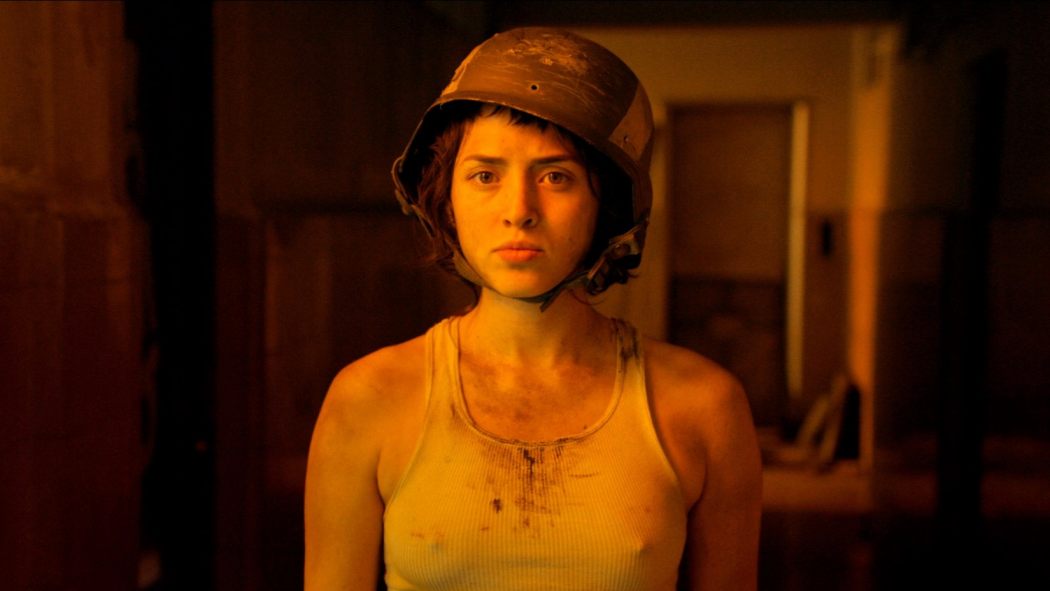
This is actually the first question my friend was asked in an interview for an internship with a meat packing plant, but it’s also a good piece of self-reflection before you sit down to We Are the Flesh.
First time feature writer/director Emiliano Rocha Minter announces his presence with authority – and a lot of body fluids – in this carnal horror show.
A hellish vision if ever there was one, the film opens on a filthy man with a lot of packing tape. He’s taking different types of nastiness, taping it inside a plastic drum to ferment, and eventually turning it into a drink or a drug. Hard to tell – loud drum banging follows, as well as hallucinations and really, really deep sleep.
During that sleep we meet two siblings, a teenaged brother and sister who’ve stumbled into the abandoned building where the hermit lives.
What happens next? What doesn’t?! Incest, cannibalism, a lot of shared body fluids of every manner, rape, maybe some necrophilia – depending on your perspective – a lot of stuff, none of it pleasant.
Minter has created a fever dream as close to hell as anything we’ve seen since last year’s Turkish nightmare Baskin.
Had Minter not found an anchor for the overwhelmingly lurid imagery, his movie would have felt like little more than self-indulgent horror porn (like literally horror and porn).
Noé Hernández conjures a goblin-like image, his unblinking eyes and demonic grin permanent fixtures as he mentors his teenage charges in his repellant ways. The boy he’s dubbed Skeletor (Diego Gamaleil) resists, though his consistently surprising sister (María Evoli) is less inhibited.
There’s little chance you’ll watch this film in its entirety without diverting your eyes – whether your concern is the problematic sexuality or just the onslaught of viscous secretions, the screen is a slurry of shit you don’t really want to see.
What opens as a post-apocalyptic hellscape eventually morphs into a social comment on Mexico City’s disposable population, which is both the film’s strength and its weakness.
Unfortunately, though Minter’s movie boasts deeply unnerving ideas and compelling performances, in light of other Mexican filmmakers making social commentaries – Jorge Michel Grau’s brilliant 2010 We Are What We Are, in particular – We Are the Flesh comes up slightly lacking.
From Truffaut’s Day for Night to Burton’s Ed Wood and countless others, films frequently take the setting of filmmaking as their playground. For horror, the meta-possibilities seem endless. What if a serial killer hired a documentary crew to capture him as he lived the tropes of the slasher? I give you Behind the Mask: The Rise of Leslie Vernon. Or what if a horror veteran reinvigorated a dying genre by creating a horror film where life imitated art – a serial killer struck a small town using all the slasher cliches in his arsenal – just as a horror film was being released about that town? Oh Wes Craven, you genius.
The options are numerous, but today we focus on those films that use filmmaking as a backdrop to explore both horror and filmmaking, all the while entertaining and horrifying us all.
5. Berberian Sound Studio (2012)
Mild mannered – even for a Brit – sound engineer Gilderoy (Toby Jones – perfect) flies to Italy to do the sound for a documentary about horses. But The Equestrian Vortex is, in fact, a gaillo horror film about torturing women – not that director Santini (Antonio Mancino) will admit that.
Gilderoy is bullied and misused, returning to his quiet room at night to miss his mum and work on some sound effects. As the harassment in the studio spills beyond his own bullying to something more sinister with one of the female voiceover talent, and the sounds and images he’s forced to work with become more and more brutal, Gilderoy begins to see the world differently.
This is a surreal look into the splintered imagination of a delicate man pushed into something ugly. It’s also a very slow but effective, absorbing meditation on horror.
4. The Editor (2014)
Adam Brooks plays Rey Cisco, the editor of gaillo films who finds himself at the center of a murder mystery resembling the very films he helps to create. Adam Brooks is also the editor of the film The Editor, a gaillo film about an editor caught inside a gaillo-film-like mystery.
Oh so meta!
If you do not know Italian horror well, this may feel like a slapstick piece of nonsense. But if you do know this very nichy genre, man, do Brooks and his co-writer/director Matthew Kennedy know what they are doing.
The reason the send up is so funny is not just because it’s very loving, but because an unreasonably popular line of films behaves exactly like this one. It’s just that this one knows it’s funny.
3. The Last Horror Movie (2003)
A clever concept handled very craftily, The Last Horror Movie is found footage in that we, the audience, have found it recorded over the VHS tape we are apparently watching. What serial killer Max (a top notch Kevin Howarth) has done, you see, is made a documentary of his ghastly habits and shared them with an audience that’s shown, by virtue of the movie it intended to rent just now, its predeliction for someting grisly.
There’s a lot of “yes, I’m a bad person, but aren’t you, too” posturing going on, and while it is an idea to chew on, it nearly outlives its welcome by the time Max applies his theory to concrete action. It’s an idea explored masterfully by Michael Haneke in 1997 (and again, ten years later) with Funny Games, and by comparison, The Last Horror Movie feels a bit superficial. (Not a huge criticism – few could withstand a comparison to Michael Haneke.)
But director Julian Richards deserves immense credit for subverting expectations throughout the film. Just when we assume we’re seeing a predator anticipating the pounce – just when we’re perhaps feeling eager to see someone victimized – the film makes a hard right turn. In doing this, Richards not only manages to keep the entire film feeling fresh and unpredictable, but he enlightens us to the ugliness of our own horror movie fascinations.
https://www.youtube.com/watch?v=McCUO5tQ5gk
2. Shadow of the Vampire (2000)
E. Elias Merhige revisits F. W. Murnau’s masterpiece Nosferatu with smashing results in Shadow of the Vampire. Wickedly funny and just a little catty, ‘Shadow’ entertains with every frame.
This is the fictional tale of the filming of Nosferatu. Egomaniacal artists and vain actors come together to create Murnau’s groundbreaking achievement in nightmarish authenticity. As they make the movie, they discover the obvious: the actor playing Count Orlok, Max Schreck is, in fact, a vampire.
The film is ingenious in the way it’s developed: murder among a pack of paranoid, insecure backstabbers; the mad artistic genius Murnau directing all the while. And it would have been only clever were it not for Willem Dafoe’s perversely brilliant performance as Schreck. There is a goofiness about his Schreck that gives the otherwise deeply horrible character an oddly endearing quality.
Eddie Izzard doesn’t get the credit he deserves, reenacting the wildly upbeat performance of Gustav von Wagenheim so well. The always welcome weirdness of Udo Kier balances the egomaniacal zeal John Malkovich brings to the Murnau character, and together they tease both the idea of method acting and the dangerous choice of completely trusting a director.
https://www.youtube.com/watch?v=uAn5uLNMmjk&t=10s
1. Man Bites Dog (1992)
In another bit of meta-filmmaking, Man Bites Dog is a pseudo-documentary made on a shoestring budget by struggling, young filmmakers. It is about a documentary being made on a shoestring budget by struggling, young filmmakers. The subject of the fictional documentary is the charismatic Ben – serial killer, narcissist, poet, racist, architecture enthusiast, misogynist, bird lover.
There’s more than what appears on the surface of this cynical, black comedy. The film crew starts out as dispassionate observers of Ben’s crimes. They’re just documenting, just telling the truth. No doubt this is a morally questionable practice to begin with. But they are not villains – they are serving their higher purpose: film.
At first.
Benoit Poelvoorde’s (who also co-directs) performance as Ben is just as quirky, ridiculous and self-centered as it can be. He’s perfect. His character needs to move the group toward fear, camaraderie, and sometimes even pity – but slyly, he also moves the audience.
The film examines social responsibility as much as it does journalistic objectivity, and what Man Bites Dog has to say about both is biting.
So much great horror in 2016! We may not have had that much to be happy about last year – besides the Cavs national championship (hooray!!) – but at least we can celebrate one outstanding 365 days of horror.
Joined by Killumbus Horror’s fearless leader Bridget, we argue about what is and is not horror – and whether Neon Demon thrills or disappoints – plus a few words on scissoring.
10. Demon
Like the mournful soul that clings to poor bridegroom Piotr (Itay Tiran), Demon sticks to you. Director/co-writer Marcin Wrona’s final feature (he ended his life at a recent festival where the film was playing) offers a spooky, atmospheric rumination on cultural loss.
Wrona sets the Hebrew folktale of the dybbuk – a ghost that possesses the living – inside a Catholic wedding, accomplishing two things in the process. On the surface, he tells an affecting ghost story. More deeply, though, he laments cultural amnesia and reminds us that our collective past continues to haunt us.
With just a hint of Kubrick – never a bad place to go for ghost story inspiration – Wrona combines the familiar with the surprising. His film echoes with a deeply felt pain -a sense of anguish, often depicted as scenes of celebration clash with unexplained images of abject grief.
9. The Love Witch
Wes Anderson with a Black Mass fetish and a feminist point of view, Anna Biller wrote/directed/produced/edited/set-designed/costume-designed/music-supervised the seductive sorcery headtrip The Love Witch.
Elaine (Samantha Robinson – demented perfection) needs a change of scenery. Driving her red convertible up the seacoast highway toward a new life in northern California, her troubles – and her mysteriously dead ex-husband – are behind her. Surely, with her smart eyeshades and magic potions, she’ll find true love.
Expect a loose confection of a plot, as Elaine molds herself into the ideal sex toy, winning and then tiring of her trophies. This allows Biller to simultaneously reaffirm and reverse gender roles with appropriately wicked humor.
8. 10 Cloverfield Lane
Less a sequel than a tangentially related piece, 10 Cloverfield Lane amplifies tensions with genuine filmmaking craftsmanship, unveiling more than one kind of monster.
Michelle (Mary Elizabeth Winstead) wakes from a car crash handcuffed to a pipe in a bunker. Howard (John Goodman, top-notch as usual), may simply be saving her from herself and the apocalypse outside. Good natured Emmett (John Gallagher Jr.) certainly thinks so.
Goodman is phenomenal, but Winstead and Gallagher prove, once again, to be among the strongest young actors working in independent film today.
Talented newcomer Dan Trachtenberg toys with tensions as well as claustrophobia in a film that finds often terrifying relevance in the most mundane moments, each leading through a mystery to a hell of a climax.
7. The Wailing
“Why are you troubled,” Jesus asked, “and why do doubts arise in your hearts? Look at my hands and my feet. It is I myself. Touch me and see — for a spirit does not have flesh and bones, as you see I have.”
Though the true meaning of this quote won’t take hold until the final act, it presents many questions. Is this film supernatural? Demonic? Or, given the corporeal nature of the quote, is it rooted in the human flesh?
Yes.
That’s what makes the quote so perfect. Na meshes everything together in this bucolic horror where superstition and religion blend. The film echoes with misery, as the title suggests. The filmmaker throws every grisly thing at you – zombies, pustules, demonic possession, police procedural, multiple homicides – and yet keeps it all slippery with overt comedy.
6. The Greasy Strangler
Like the by-product of a high cholesterol diet, The Greasy Strangler will lodge itself into your brain and do a lot of damage.
A touching father/son story about romance, car washes and disco, this movie is like little else ever set to film. Both men fall for one particular “rootie tootie disco cutie,” and if that wasn’t enough, there’s a marauder on the loose – an inhuman beast covered head to toe in cooking grease.
The brilliantly awkward comedy leaves you scratching your head. Every absurd character begs for more screen time, and yet, each gag (and you will gag) goes on for an almost unendurable length of time.
The result is ingenious. Or repellant. Or maybe hilarious – it just depends on your tolerance for WTF horror and sick, sick shit. Whatever else it may be, though, The Greasy Strangler is – I promise you – hard to forget.
https://www.youtube.com/watch?v=VPl1vcb4hao
5. Don’t Breathe
For his sophomore effort Don’t Breathe, director Fede Alvarez dials down the blood and gore in favor of almost unbearable tension generated through masterful deployment of set design, sound design, cinematography and one sparse but effective premise.
Young thugs systematically robbing the few remaining upscale Detroit homeowners follow their alpha to a surefire hit: a blind man (Stephen Lang) sitting on $300k.
This is a scrappy film that gives you very little in the way of character development, backstory or scope. Instead, Alvarez focuses so intently on what’s in front of you that you cannot escape – a tension particularly well suited to this claustrophobic nightmare.
4. Under the Shadow
Our tale is set in Tehran circa 1988, at the height of the Iran/Iraq war and just a few years into the “Cultural Revolution” that enforced fundamentalist ideologies.
Shideh (a fearless Narges Rashidi) has been banned from returning to medical school because of her pre-war political leanings. Her husband, a practicing physician, is serving his yearly medical duty with the troops. This leaves Shideh and their young daughter Dorsa (Avin Manshadi) alone in their apartment as missiles rain on Tehran.
When a dud missile plants itself in the roof of the building (shades of del Toro’s Devil’s Backbone), Dora starts talking to a secret friend. Maybe the friend would be a better mommy.
The fact that this menacing presence – a djinn, or wind spirit – takes the shape of a flapping, floating burka is no random choice. Shideh’s failure in this moment will determine her daughter’s entire future.
3. Green Room
The tragic loss of 27-year-old talent Anton Yelchin makes this one bittersweet. Young punk band the Ain’t Rights is in desperate need of a paying gig, even if it is at a rough private club for the “boots and braces” crowd (i.e. white power skinheads). Bass guitarist Pat (Yelchin) eschews social media promotion for the “time and aggression” of live shows, and when he accidentally witnesses a murder in the club’s makeshift green room, Pat and his band find plenty of both.
Along with concertgoer Amber (a terrific Imogen Poots), they’re held at gunpoint while the club manager (Macon Blair from Blue Ruin) fetches the mysterious Darcy (Patrick Stewart, gloriously grim) to sort things out. Though Darcy is full of calm reassurances, it quickly becomes clear the captives will have to fight for their lives.
As he did with Blue Ruin, writer/director Jeremy Saulnier plunges unprepared characters into a world of casual savagery, finding out just what they have to offer in a nasty backwoods standoff.
It’s lean, mean, loud and grisly, and a ton of bloody fun.
2. The Eyes of My Mother
First time feature writer/director Nicolas Pesce, with a hell of an assist from cinematographer Zach Kuperstein, casts an eerie spell of lonesome bucolic horror.
There is much power in dropping an audience into a lived-in world – the less we know, the better. Pesce understands this in the same way Tobe Hooper did with The Texas Chainsaw Massacre, and though The Eyes of My Mother lacks the cynicism, satire and power tools of Hooper’s farmhouse classic, it treads some similar ground.
Where Eyes differs most dramatically from other films is in its restraint. The action is mostly off-screen, leaving us with the sounds of horror and the quiet clean-up of its aftermath to tell us more than we really want to know.
1. The Witch
In set design, dialog, tension-building and performances this film creates an unseemly familial intimacy that you feel guilty for stumbling into. There is an authenticity here – and an opportunity to feel real empathy for this Puritan family – that may never have been reached in a “burn the witch” horror film before.
On the surface The Witch is an “into the woods” horror film that manages to be one part The Crucible, one part The Shining. Below that, though, is a peek into radicalization as relevant today as it would have been in the 1600s.
Beautiful, authentic and boasting spooky lines and images that are equally beautiful and haunting, it is a film – painstakingly crafted by writer/director Robert Eggers – that marks a true new visionary for the genre.
All the single ladies, all the single ladies – unfortunately, life does not always turn out as well for us as it does for Beyonce. Today we celebrate and fear the horror that can befall the single parent. Your kids may be monsters. Monsters may be after your kids. You may be the monster. Maybe it’s all three at once. Whatever the case, horror filmmakers have found a way to hit some very effective buttons when exploring the horror potential in a single parent home.
5. The Ring (2002)
Let’s be honest, Rachel (Naomi Watts) is not much of a mother. Were it not for her sloppy parenting, her precocious son Aidan (adorable and creepy David Dorfman) might not even be in this mess. But she left her VHS tape laying around, paid no attention to what he was up to, and now Samara is coming for him.
Gore Verbinski one-upped Hideo Nakata’s 1998 Japanese original Ringu with this deeply creepy, well-executed nightmare, much of it centering on questionable parenting. Both Watts and Dorfman are excellent, each creating a character that is somehow rigid and distant, but you long for tenderness between them. Dorfman’s wise-beyond-his-years performance feels both chilly and vulnerable, and the relationship here creates an off-kilter foundation for the horrific mystery unfolding.
Everything about this film is done well – the images on the video tape, the looks on the faces of the victims, that horse bit on the boat, Brian Cox in the bathtub, Samara climbing out of the well! Verbinski strings together one nightmare image after another, but the tension of whether or not Rachel has the wherewithal to save the son she hasn’t paid enough attention to in the first place is what holds these together.
https://www.youtube.com/watch?v=_PkgRhzq_BQ
4. Goodnight Mommy (2014)
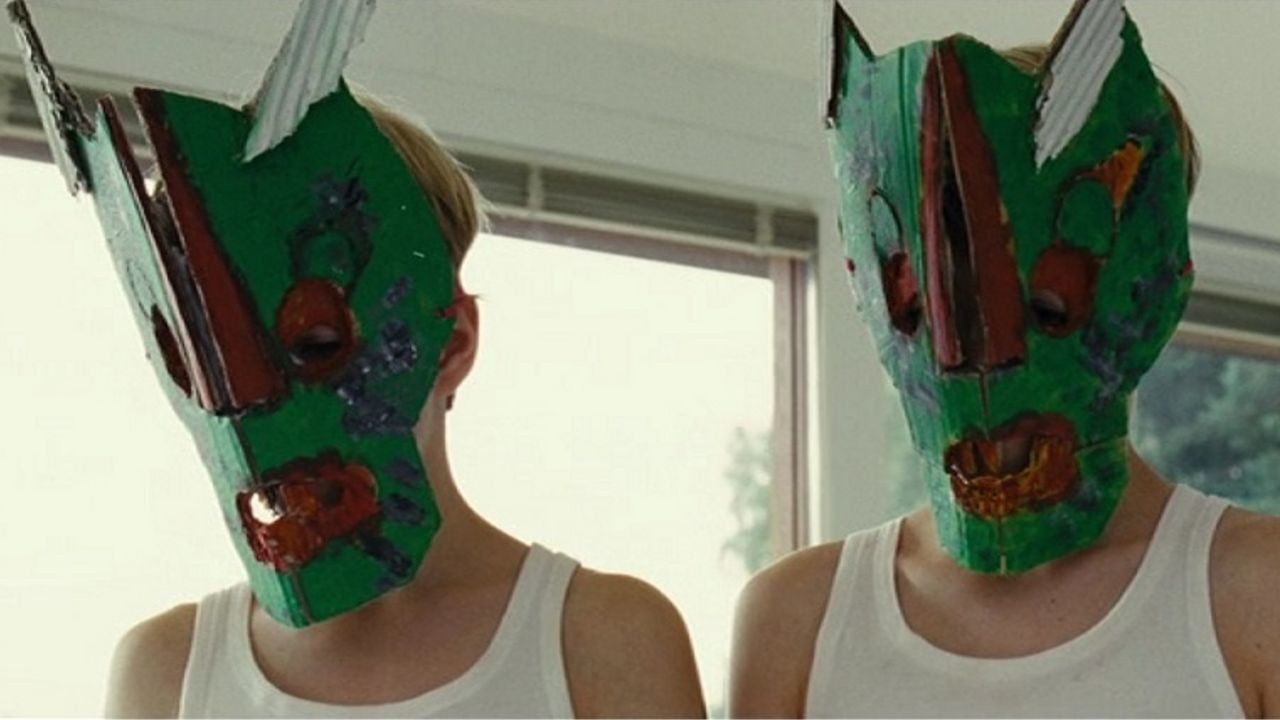
There is something eerily beautiful about Severin Fiala and Veronika Franz’s rural Austrian horror Goodnight Mommy (Ich seh, Ich seh).
During one languid summer, twin brothers Lukas and Elias await their mother’s return from the hospital. But when their mom comes home, bandaged from the cosmetic surgery she underwent, the brothers fear more has changed than just her face.
Inside this elegantly filmed environment, where sun dappled fields lead to leafy forests, the filmmakers mine a kind of primal childhood fear. There’s a subtle lack of compassion that works the nerves beautifully, because it’s hard to feel too badly for the boys or for their mother. You don’t wish harm on any of them, but at the same time, their flaws make all three a bit terrifying.
Performances by young brothers Lukas and Elias Schwarz compel interest, while Susanne Wuest’s cagey turn as the boys’ mother propels the mystery. It’s a hypnotic, bucolic adventure as visually arresting as it is utterly creepy.
3. Under the Shadow (2016)
The tale is set in Tehran circa 1988, at the height of the Iran/Iraq war and just a few years into the “Cultural Revolution” that enforced fundamentalist ideologies.
Shideh (a fearless Narges Rashidi) has been banned from returning to medical school because of her pre-war political leanings. Her husband, a practicing physician, is serving his yearly medical duty with the troops. This leaves Shideh and their young daughter Dorsa (Avin Manshadi) alone in their apartment as missiles rain on Tehran.
When a dud missile plants itself in the roof of the building (shades of del Toro’s Devil’s Backbone), Dora starts talking to a secret friend. Maybe the friend would be a better mommy.
Frazzled, impatient, judged and constrained from all sides, Shideh’s nerve is hit with this threat. And as external and internal anxieties build, she’s no longer sure what she’s seeing, what she’s thinking, or what the hell to do about it.
The fact that this menacing presence – a djinn, or wind spirit – takes the shape of a flapping, floating burka is no random choice. Shideh’s failure in this moment will determine her daughter’s entire future.
https://www.youtube.com/watch?v=4fhejr94P14
2. Psycho (1960)
Was Norman Bates psychotic from the start? Or was he smothered into madness by his mother?
Hard to say – Mrs. Bates can’t speak for herself, can she? Although Norman’s mother is not a character in Hitchcock’s classic, her presence is everywhere. But to be fair, we don’t get to see her as she was, we only get to see her as Norman sees her.
Whatever the case, Norman has an unhealthy attachment to his late mother, a single parent whose relationship with her son may have driven him to some very bad deeds. Part of Hitchcock’s skill in this film is to play with our expectations of the characters.
The heroine has done some questionable things. The villain is the most sympathetic character onscreen. The most relevant character in the story isn’t even in the film. Was Mrs. Bates really a bad mom, or does she just seem like that to us because we see her through Norman’s eyes, and he’s a psycho?
1. Babadook (2014)
You’re exhausted – just bone-deep tired – and for the umpteenth night in a row your son refuses to sleep. You let him choose a book to read, and he hands you a pop-up you don’t recognize: The Babadook. Pretty soon, your son isn’t the only one afraid of what’s in the shadows.
Filmmaker Jennifer Kent’s film is expertly written and beautifully acted, boasting unnerving performances from not only a stellar lead in Essie Davis, but also the alarmingly spot-on young Noah Wiseman. Davis’s lovely, loving Amelia is so recognizably wearied by her only child’s erratic, sometimes violent behavior that you cannot help but pity her, and sometimes fear for her, and other times fear her.
Likewise, Wiseman delivers as a tender, confused, dear little boy you sometimes just want to throttle. Their naturalistic performances genuinely showcase the baggage that can exist between a parent and a child.
Much of what catapults The Babadook beyond similar “presence in my house” flicks is the allegorical nature of the story. There’s an almost subversive relevance to the familial tensions because of their naked honesty, and the fight with the shadowy monster as well as the film’s unusual resolution heighten tensions.
The film’s subtext sits so close to the surface that it threatens to burst through. Though that does at times weaken the fantasy, it gives the film a terrifying urgency. In the subtext there is a primal horror, a taboo rarely visited in film and certainly never examined with such sympathy. Indeed, the compassion in the film may be the element that makes it so very unsettling.
The unerring authenticity of The Witch makes it the most unnerving horror film in years.
Ideas of gender inequality, sexual awakening, slavish devotion to dogma, and isolationism roil beneath the surface of the film, yet the tale itself is deceptively simple. One family, fresh off the boat from England in 1630 and expelled from their puritanical village, sets up house and farm in a clearing near a wood.
There William (Ralph Ineson) and Katherine (Kate Dickie) will raise their five children: the infant Samuel, young twins Mercy (Ellie Grainger) and Jonas (Lucas Dawson), nearly adolescent Caleb (Harvey Scrimshaw), and the eldest, Tomasin (Anya Taylor-Joy), nearly a woman now.
Each performance is remarkable. The twins are enormously creepy and both parents are flawed in the most necessary and compelling ways. Young Scrimshaw offers layers and tenderness galore, leading to an astonishing scene it’s hard to imagine a child managing.
Still, it’s Taylor-Joy who not only anchors the film but gives it its vulnerable, burgeoning, ripening soul. She is flawless.
As a series of grim catastrophes befalls the family, members turn on members with ever-heightening hysteria. The Witch creates an atmosphere of the most intimate and unpleasant tension, a sense of anxiety that builds relentlessly and traps you along with this helpless, miserable family.
Every opportunity writer/director Robert Eggers has to make an obvious choice he discards, though not a single move feels inauthentic. Rather, every detail – whether lurid or mundane – feels peculiarly at home here. Even the most supernatural elements in the film feel appallingly true because of the reality of this world, much of which is owed to journals and documents of the time, from which Eggers pulled complete sections of dialog.
Though The Witch is Eggers’s first feature as filmmaker, his long career in art direction, production and costume design are evident in this flawlessly imagined and recreated period piece.
Equally important is the work of Eggers’s collaborators Mark Kovan, whose haunting score keeps you unnerved throughout, and cinematographer Jarin Blaschke. From frigid exteriors to candle-lit interiors, the debilitating isolation and oppressive intimacy created by Blaschke’s camera feed an atmosphere ripe for tragedy and for horror.
As frenzy and paranoia feed on ignorance and helplessness, tensions balloon to bursting. You are trapped as they are trapped in this inescapable mess, where man’s overanxious attempt to purge himself absolutely of his capacity for sin only opens him up to the true evil lurking, as it always is, in the woods.
Listen weekly to MaddWolf’s horror podcast FRIGHT CLUB. Do it!
Speaking of sex and monsters – wait, were we? – have you seen Possession? WTF is going on there?
Andrzej Zulawski – writer/director/Czech – created this wild ride with doppelgangers, private investigators, ominous government (or are they?) agencies, and curious sexual appetites. It’s more precisely fantasy than horror, but it strikes me as David Cronenberg meets David Lynch, which is a pairing I can get behind.
Sam Neill plays Mark. Mark has just left his job – a mysterious position with some kind of lab. He’s being offered a lot of money to stay, but he needs to go home. We don’t know why.
Back at home, he greets his genuinely adorable son Bob (Michael Hogben). I love that his name is Bob. Bob – it’s so normal, and yet feels so unusual for a small child. Mark’s wife Anna (Isabelle Adjani) is also at home with Bob. There’s nothing normal about Anna.
Mark and Anna’s relationship boasts an intentional artificiality- a queasying sexuality- that makes it hard to root for either of them as their marriage deteriorates. Anna, it seems, is in love with someone else. Is it the sexually open – really, really open – Heinrich? Is it a bloody, mollusk-like monster? Is Mark boning Anna’s mean friend with a cast on her leg? Does Bob’s kindergarten teacher bear an unreasonable resemblance to Anna? Is anyone caring properly for Bob?
These questions and more go basically unanswered in a deviant, summary-defying, fantastical bit of filmmaking that mocks the idiocy, even insanity of obsession and boasts a handful of weirdly excellent performances. And sex with a bloody mollusk-like monster.
Listen weekly to MaddWolf’s horror podcast FRIGHT CLUB. Do it!
It’s a rare thing for a sequel to better its predecessor. It helps when the bar is not particularly high in the first place.
Such is the case for Ouija: Origin of Evil. A prequel to the 2014 by-the-numbers spook flick Ouija, the new iteration takes us back to a stylish 1965 where a struggling widow (Elizabeth Reaser) tries to eek out a living as a fortune teller.
Though her goal is noble – she just wants to bring peace to the grieving – her gig is a scam. Worse still, she enlists the help of her 9 and 16-year-old daughters. But when she brings a Ouija board home to liven up the act, her youngest turns out to be the real medium.
This is not a great film. It is, however, not half bad.
Director Mike Flanagan (Absentia, Hush), who co-wrote with Jeff Howard, has proven that he can mine even familiar territory for chills. His casting certainly doesn’t hurt.
Rather than relying on fresh faced teens to carry a supernatural slasher, he turns to seasoned actors – Reaser and Henry Thomas (that’s right – Elliot!) – to ground the fantastical elements with understated but believable performances.
The important roles, though, are the kids. Annalise Basso – so strong in Flanagan’s middling Oculus – again nails a performance as a normal kid living through extraordinary circumstances.
Lulu Wilson plays the wee spiritualist Doris, and though she occasionally slips into something too cloying, for the most part she handles her part with a nice balance of innocence and eeriness.
Flanagan wisely picks up enough from the previous film for this origins story to make it a proper standalone effort. He does get a bit heavy handed with the tiresome FX (is anyone still undone by a crab walking pre-adolescent at this point?), but for 2/3 of the film his approach is more measured. He lets the appealing performances and family dynamic do most of the heavy lifting.
Elements that weaker filmmakers would have hit hard Flanagan allows to linger, to become intriguing rather than damning.
As has been the case throughout his career, he can’t quite close the deal. Though never terrifying and rarely fresh, Origin of Evil still brings enough era-specific nods and spook house moments to be a fun seasonal escape – but never more than that.
Aah, the precarious position of the alpha male. Oh should I say Aaaaaaaah!? Because that is the delightfully appropriate title of Steve Oram’s feature directorial debut.
An absurd horror comedy, the film offers no dialog at all, just grunts, as humans – devolved into ape mentality – go about their poop-throwing, territory marking, television smashing daily existence.
It’s the kind of overly clever premise you expect to wear thin, but honestly, it doesn’t. Much credit goes to a game cast (including Oram) that sells every minute of the ridiculousness, and to Oram again as director. He keeps the pace quick, his images a flurry of insanity you need to see more than once to fully appreciate.
Oram has more in store than a wickedly bloody send up, though. His film wisely deconstructs our own human preoccupations and foibles in a way that’s strangely touching, even sad at times.
The lack of dialog suits the experiment in the same way Steven Soderbergh’s meta-dialog suited his weirdly personal 1996 effort Schizopolis, or the way Miroslav Slaboshpitsky’s use of unsubtitled sign language fits his brilliant film The Tribe. While Aaaaaaaah! is far lighter and more madcap than either of these, it still asks you to use another means of understanding character actions, which allows you to see humanity on a more jarringly primal level.
It wouldn’t even be a horror movie were it not for all those severed penises.
Oram and his appealing cast keep you interested as seemingly divergent stories blend and reshape, and domestic hierarchies shift. Lucy Honigman is particularly compelling, but every actor has surprising success in articulating a dimensional character with nary a word to help.
A familiar face in British comedy, Oram stood out in Ben Wheatley’s 2012 horror comedy Sightseers. He’s playing against type here as the threatening male presence, but he’s equally hilarious. The talent has to rely primarily on sight gags, obviously, and Oram has a flair for presentation. His quick 79 minute running time helps, but there’s never a dull moment in this jungle.
Listen weekly to MaddWolf’s horror podcast FRIGHT CLUB. Do it!
Unlike any film of its time – horror or otherwise – Henry: Portrait of a Serial Killer depicts an unforgivingly realistic portrayal of evil. A deeply disturbing Michael Rooker plays serial killer Henry (based on real-life murderer Henry Lee Lucas). We follow him through his humdrum days of stalking and then dispatching his prey, until he finds his own unwholesome kind of family in the form of prison buddy Otis (Tom Towles) and Otis’s sister Becky (Tracy Arnold).
Director John McNaughton’s picture offers a uniquely unemotional telling – no swelling strings to warn us danger is afoot and no hero to speak of to balance the ugliness. He confuses viewers because the characters you identify with are evil. Even when you think you might be seeing this to understand the origins of the ugliness, he pulls the rug out from under you again by creating an untrustworthy narrative voice. His film is so nonjudgmental, so flatly unemotional, that it’s honestly hard to watch.
What’s diabolically fascinating, though, is the workaday, white trash camaraderie of the psychopath relationship in this film, and the grey areas where one crazy killer feels the other has crossed some line of decency.
Rooker’s performance unsettles to the bone, flashing glimpses of an almost sympathetic beast now and again, but there’s never a question that he will do the worst things every time, more out of boredom than anything.
Re-released in time for its 30th anniversary with a 4K scan and restoration from its original 16mm camera negatives, Henry now boasts an even grittier, more unseemly quality. The world McNaughton invites you into feels even more alien and yet lived-in – a world you never imagined existed, but one that feels so authentic you’ll truly believe it does.
Prepare to be pissed off. Why? Well, because we’re going to explore the best zombie comedies today and there are hundreds of options. We guarantee that we will leave something off this list that you want to see on it. There’s really no question about it. Probably at #5. So just know that we know that there are at least a dozen great zombie comedies that we do not address here, given that we’ve limited our list to five.
And here they are!
5. The Return of the Living Dead (1985)
Why Return of the Living Dead? Because it was one of the very first zombie comedies, mainly. But its pedigree is impressive. The original story – one of bumbling warehouse employees who unwittingly unleash the very biochemical that caused the Night of the Living Dead in the first place – was conceived by Russell Streiner, producer of the Romero zombie classic.
Also, Dan O’Bannon, writer behind Alien and Total Recall, co-wrote and directs.
The film also introduced into the genre the abiding zombie trait of brain eating, and is the first film in which zombies grown braaaaiiiinnnnssss.
Plus, the great Linnea Quigley Leg Warmer Dance Scene, a fun 80s punk rock soundtrack, Clu Gulagar and a lot of campy fun – all of this combined to create one of the more memorable and weirdly important zombie comedies.
4. Dead Snow (2009)
Nazi zombies, everybody! Hell yes!
Like its portly nerd character Erlend, Dead Snow loves horror movies. A self-referential “cabin in the woods” flick, Dead Snow follows a handsome, mixed-gender group of college students as they head to a remote cabin for Spring Break. A creepy old dude warns them off with a tale of local evil. They mock and ignore him at their peril.
But co-writer/director/Scandinavian Tommy Wirkola doesn’t just obey these time-honored horror film rules. Like Scream and The Cabin in the Woods, Dead Snow draws your attention to them. It embraces our prior knowledge of the path we’re taking to mine for comedy, but doesn’t give up on the scares. Wirkola’s artful imagination generates plenty of startles and gore by the gallon.
Spectacular location shooting, exquisite cinematography, effective sound editing and a killer soundtrack combine to elevate the film above its clever script and solid acting. Take, for example, the gorgeous image of Norwegian peace – a tent, lit from within, sits like a jewel nestled in the quiet of a snowy mountainside. The image glistens with pristine outdoorsy beauty – until it … doesn’t.
The unapologetically faithful image of the traditional American horror film, Dead Snow is funny and scary, utterly gross and thoroughly enjoyable.
3. Juan of the Dead (2011)
By 2011, finding a zombie film with something new to say was pretty difficult, but writer/director/Cuban Alejandro Brugues managed to do just that with his bloody political satire Juan of the Dead.
Breathtakingly and unapologetically Cuban, the film shadows slacker Juan and his layabout pals as they reconfigure their longtime survival instincts to make the most of Cuba’s zombie infestation.
I’m sorry – dissidents. Thankfully the Cuban media is on top of this situation, letting the faithful patriots know that the violent, flesh-hungry villains outside are all dissidents. Your old, fat auntie? Dissident. Paperboy, missing a foot and dragging himself toward that priest? Dissident.
One of a thousand hilarious touches is that the word zombie is used only once, by a non-Cuban – even Juan and his friends thoughtlessly refer to the mayhem-happy characters as dissidents. It’s a whole new approach to the zombiepocalypse – not to mention social satire – and it’s entirely entertaining.
It’s such a clever, eye-opening film with some added oomph via soundtrack and closing credits animation. Juan of the Dead promises one killer dia de los muertos!
2. Shaun of the Dead (2004)
This is a hard movie not to like. Writer/director Edgar Wright teams with writer/star Simon Pegg to lovingly mock the slacker generation, 80s pop, and George Romero with this riotous flesh-eating romance. But what is easy to overlook is the genuine craftsmanship that went into making this picture.
Every frame of every scene is so perfectly timed – pauses in conversation synchronized with seemingly random snippets of other conversations, or juke box songs, or bits from the tele. (The movie will turn you British. By the end you’ll be saying holiday instead of vacation, spelling colour with a u and saying, “How’s that for a slice of fried gold?” even though you don’t really know what that means.)
Shaun offers such a witty observation of both a generation and a genre, so well told and acted, that it is an absolute joy, even if you’re not a fan of zombie movies. As social satire, it is as sharp as they come. It also manages to hit the bull’s eye as a splatter horror film, an ode to Romero, a buddy picture, and an authentic romantic comedy. And it’s more than just a remarkable achievement; it’s a fresh, vivid explosion of entertainment. It’s just a great movie.
1. Zombieland (2009)
Zombieland is quite possibly the perfect movie. Just when Shaun of the Dead convinced me that those Limey Brits had created the best-ever zombie romantic comedy, it turns out they’d only created the most British zom-rom-com. The Yank counterpart is even better, and with this amount of artillery, it’s certainly a more American vision.
Let’s start with the writing. Rhett Reese and Paul Wernick take the tried-and-true zombiepocalypse premise and sprint with it in totally new and awesome directions.
And the cameo. I cannot imagine a better one. I mean that. I’m not sure a walk on by Jesus himself could have brought me more joy.
That’s not true. Plus, in zombie movie?! How awesome would that have been?!
Jesse Eisenberg anchors the film with an inspired narration and an endearing dork characterization. But Woody Harrelson owns this film. His gun-toting, Twinkie-loving, Willie Nelson-singing, Dale Earnhart-number-wearing redneck ranks among the greatest horror heroes ever.
I give you, a trip to a loud and well-lit amusement park is not a recommendation Max Brooks would make during the zombiepocalypse. Still, you’ve got to admit it’s a gloriously filmed piece of action horror cinema.