Tag Archives: Hope Madden

Fright Club: Best Horror of the Nineties

The Nineties boasted more good horror than you might remember. It was a time of big budget, Oscar nominated studio films like Misery and early genre work from filmmakers who would go on to become the best in the business, like Fincher’s Seven, M. Night Shyamalan’s The Sixth Sense, Tarantino and Rodriguez’s From Dusk Til Dawn, and Adrian Lyne’s Jacob’s Ladder. Foreign films made a splash – Michael Haneke’s Funny Games, Peter Jackson’s Dead Alive, and a wave of Japanese films that would have a powerful influence in the next decade of American horror. Here we pick the best of the decade.

5. Cape Fear (1991)

In 1991, Martin Scorsese toyed with the horror genre with a remake of the ’62 Gregory Peck/Robert Mitchum power struggle between a steamy psychopath and an uptight lawyer. Scorsese mines the very ripe concept for more outright horror, recasting Robert DeNiro – still on top of his game and garnering an Oscar nomination – as Max Cady, a deeply disturbed criminal who should not be underestimated. Nick Nolte takes on the Peck role, but it’s Juliette Lewis (also Oscar nominated) as Nolte and Jessica Lange’s teenage daughter who amps up the unseemly tension.

Scorsese and his cast know how to wring anxiety from an audience and their film brims with a sultry tension that keeps everything on edge. It’s masterful storytelling with a throwback feel, the kind of film that finds you yelling at the screen, not because characters are doing anything stupid, but because you know better than they do just how terrifying Max Cady is. Still, the evil that he can do manages to stagger every single time.

4. Scream (1996)

In its time, Scream resurrected a basically dying genre, using clever meta-analysis and black humor. What you have is a traditional high school slasher – someone dons a likeness of Edvard Munch’s most famous painting and plants a butcher knife in a local teen, leading to red herrings, mystery, bloodletting and whatnot. But director Wes Craven’s on the inside looking out and he wants you to know it.

What makes Scream stand apart is the way it critiques horror clichés as it employs them, subverting expectation just when we most rely on it. We spent the next five years or more watching talented TV teens and sitcom stars make the big screen leap to slashers, mostly with weak results, but Scream stands the test of time. It could be the wryly clever writing or the solid performances, but I think it’s the joyous fondness for a genre and its fans that keeps this one fresh.

3. The Blair Witch Project (1999)

Blair Witch may not date especially well, but it scared the hell out of a lot of people back in the day. This is the kind of forest adventure that I assume happens all the time: you go in, but no matter how you try to get out – follow a stream, use a map, follow the stars – you just keep crossing the same goddamn log.

One of several truly genius ideas behind Blair Witch is that filmmakers Daniel Myrick and Eduardo Sanchez made the audience believe that the film they were watching was nothing more than the unearthed footage left behind by three disappeared young people. Between that and the wise use of online marketing (then in its infancy) buoyed this minimalistic, naturalistic home movie about three bickering buddies who venture into the Maryland woods to document the urban legend of The Blair Witch. Twig dolls, late night noises, jumpy cameras, unknown actors and not much else blended into an honestly frightening flick that played upon nightmares I have almost every night.

2. Audition, 1999

Audition tells the story of a widower convinced by his TV producer friend to hold mock television auditions as a way of finding a suitable new mate. He is repaid for his deception.

Nearly unwatchable and yet too compelling to turn away from, Audition is a remarkable piece of genre filmmaking from horror master Takashi Miike. The slow moving picture builds anticipation, then dread, then full-on horror. Midway through, Miike punctuates the film with one of the most effective startles in modern horror, and then picks up the pace, building grisly momentum toward a perversely uncomfortable climax. By the time Audition hits its ghastly conclusion, Miike and his exquisitely terrifying antagonist (Eihi Shina) have wrung the audience dry. She will not be the ideal stepmother.

Keep an eye on that burlap sack.

1. The Silence of the Lambs

It’s to director Jonathan Demme’s credit that Silence made that leap from lurid exploitation to art. His masterful composition of muted colors and tense but understated score, his visual focus on the characters rather than their actions, and his subtle but powerful use of camera elevate this story above its exploitative trappings. Of course, the performances didn’t hurt.

Hannibal Lecter ranks as one of cinema’s greatest and scariest villains, and that accomplishment owes everything to Anthony Hopkins’s performance. It’s his eerie calm, his measured speaking, his superior grin that give Lecter power. Everything about his performance reminds the viewer that this man is smarter than you and he’ll use that for dangerous ends. But it’s Ted Levine who goes underappreciated. Levine’s Buffalo Bill makes such a great counterpoint to Hopkins’s Lecter. He’s all animal – big, lumbering, capable of explosive violence – where Lecter’s all intellect. Buffalo Bill’s a curiously sexual being, where Lecter is all but asexual.

Demme makes sure it’s Lecter that gets under our skin, though, in the way he creates a parallel between Lecter and Clarice Starling (Jodie Foster). It’s Clarice we’re all meant to identify with, and yet Demme suggests that she and Lecter share some similarities, which means that maybe we share some, too.

Usually, a director shoots a villain from below, making him look larger and more menacing. The victim is usually shot from above, which makes them seem smaller, less powerful, more vulnerable, and cuter. When Clarice and Lecter are talking in the prison, they’re shot at the same angle, eliminating that power struggle. They’re shot as equals.

More than that, during their conversations, Demme captures each character’s reflection in the partition glass as the other speaks, once again making the visual impression that these two are equals, have similarities, are in some ways alike. No one is like Buffalo Bill. He’s incomprehensible. Unacceptable. But Demme generates something akin to sympathy in his depiction of Hannibal in relation to Clarice, and given how terrifying he is, that’s equally unsettling.

Listen to the whole conversation – join our FRIGHT CLUB PODCAST.

It Has Sprung

Spring

by Hope Madden

In 2012, Justin Benson and Aaron Moorehead made their filmmaking debut with the smashing Resolution – an intriguing rewrite of familiar “cabin in the woods” genre tropes. Surprising the audience even inside a well-worn genre by weaving into the story equal amounts of humdrum realism and bizarreness, the directorial duo offered a fresh and provocative flick. They took those same skills and showed off some new ones with their next effort, Spring.

Like Resolution, Spring looks and feels familiar but the filmmakers’ approach is anything but straightforward.

Evan (a spot-on Lou Taylor Pucci) has hit a rough patch. After nursing his ailing mother for two years, Evan finds himself in a bar fight just hours after her funeral. With grief dogging him and the cops looking to bring him in, he grabs his passport and heads to the first international location available: Italy.

It’s a wise set up, and an earnest Pucci delivers the tender, open performance the film requires. He’s matched by the mysterious Nadia Hilker as Louise, the beautiful stranger who captivates Evan.

The less said about the plot the better. Like Resolution, this film walks between two different genres, blending the two masterfully with a result that is not exactly horror. At its core, Spring is a love story that animates the fear of commitment in a way few others do.

On display here is a prowess behind the camera that Resolution did not predict. The look of the Mediterranean seaside is imposingly beautiful – appropriately enough. The film’s entire aesthetic animates the idea of the natural world’s overwhelming beauty and danger. It’s a vision that’s equally suited to a sweeping romance or a monster movie, and since you’ll have a hard time determining which of those labels best fits Spring, it’s a good look.

There are some missteps – a vulgar American tourist side plot rings very false after the authenticity of the balance of characters. Louise’s backstory sometimes feels slightly forced, and the film takes on an unusual comic flavor toward the end that doesn’t quite fit. But there is something so lovely about the way the filmmakers approach the dangerous but compelling glory of love and nature that sets this apart from other genre efforts and keeps you thinking.

Scared Single

It Follows

by Hope Madden

David Robert Mitchell invites you to the best American horror film in more than a decade.

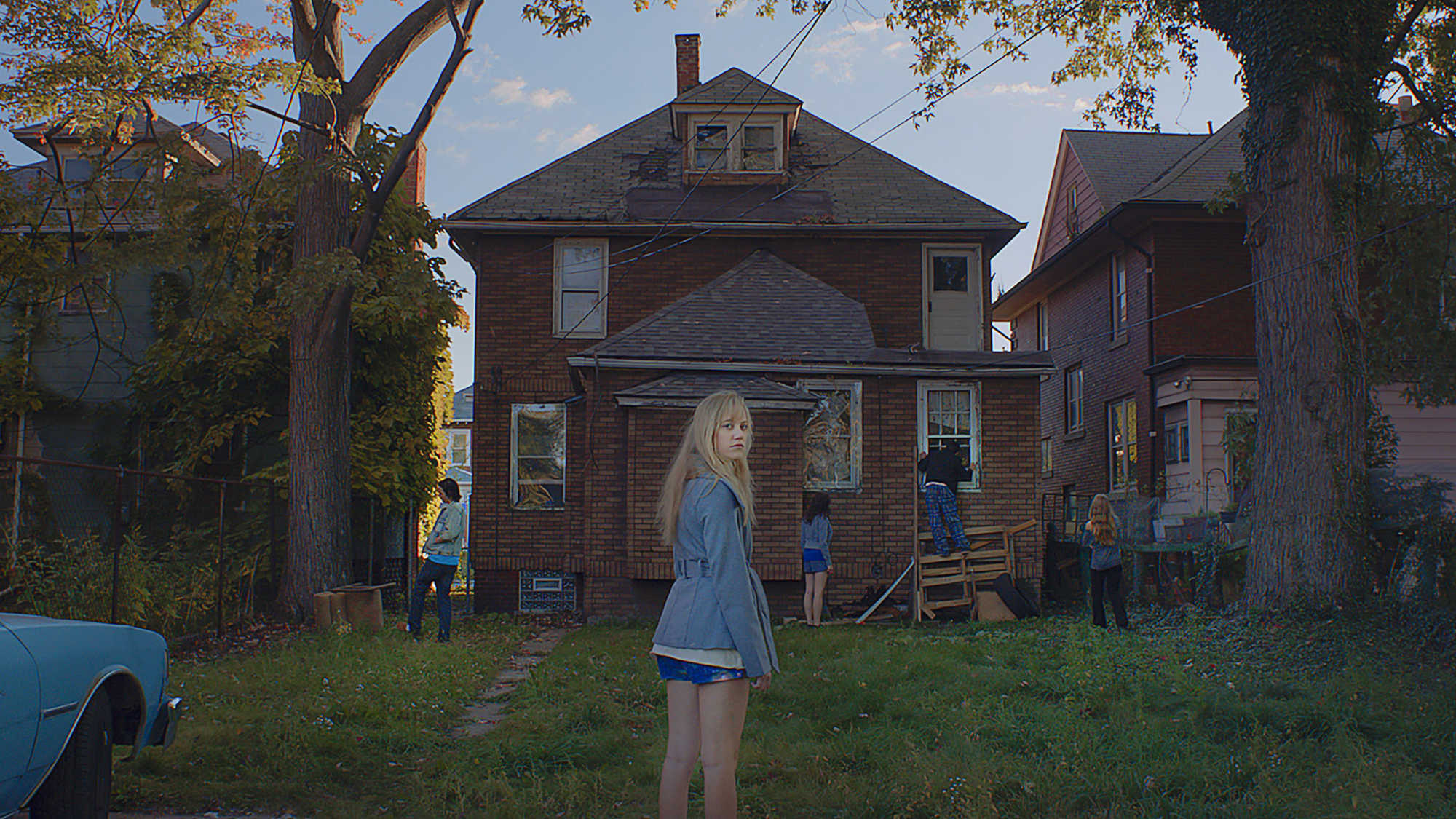
It Follows is a coming of age tale that mines a primal terror. Moments after a sexual encounter with a new boyfriend, Jay discovers that she is cursed. He has passed on some kind of entity – a demonic menace that will follow her until it either kills her or she passes it on to someone else the same way she got it.

Yes, it’s the STD or horror movies, but don’t let that dissuade you. Mitchell understands the anxiety of adolescence and he has not simply crafted yet another cautionary tale about premarital sex.

Mitchell has captured that fleeting yet dragging moment between childhood and adulthood and given the lurking dread of that time of life a powerful image. There is something that lies just beyond the innocence of youth. You feel it in every frame and begin to look out for it, walking toward you at a consistent pace, long before the characters have begun to check the periphery themselves.

And though the entire effort boasts the naturalism of an indie drama, this is a horror film and Mitchell’s influences are on display. From the autumnal suburban loveliness of the opening sequence to the constantly slinking camera, the film bears an unabashed resemblance to John Carpenter’s Halloween.

Mitchell borrows from a number of coming of age horror shows, but his film is confident enough to pull it off without feeling derivative in any way. The writer/director takes familiar tropes and uses them with skill to lull you with familiarity, and then terrify you with it.

Maika Monroe – hot off an excellent turn in The Guest – anchors a cast of believable teens, absent mindedly bored with their adolescence. The performances across the board are fresh and realistic. The gang of buddies movies languidly toward adulthood in a time outside time – their lives speckled with TV antennas and wall phones but also e-readers. This inconcrete time period allows the film a nostalgic quality that any audience can tap into.

The shape shifting entity itself appears in a variety of forms, each a more lurid image direct from some nightmare.

Mitchell’s provocatively murky subtext is rich with symbolism but never overwhelmed by it. His capacity to draw an audience into this environment, this horror, is impeccable and the result is a lingering sense of unease that will have you checking the perimeter for a while to come.

Verdict-4-0-Stars

Kinder, Gentler Alien Invasion

Home

by Hope Madden

Home – DreamWorks’ latest animated adventure – is the genuinely sweet tale of an alien invasion of earth. Little bubble-driving cowards called Boovs, fleeing their arch enemies the Gorgs, take over Earth, moving the entire human population to Australia. Boovs are a proud collection of conformists, which is why lonesome and blunder-prone Oh (Jim Parsons) is an outcast and, eventually, a fugitive.

He and New York’s last Earthling Tip (Rhianna) reluctantly team up to evade the Boov military and find Tip’s mom (Jennifer Lopez). (This is particularly funny because, in the Adam Rex book on which the film is based, the character Oh is goes instead by the name J.Lo.)

It’s a fish out of water buddy comedy brimming with lessons on bravery and letting your freak flag fly (or not being afraid to be you), which means it resembles about 45% of our current animated output. Still, director Tim Johnson’s the animator behind the nonconformity classic Antz as well as the genius Simpsons Treehouse of Horror episode Homer Cubed. Does that mean we can at least hope for some inspired comedy?

Inspired is a strong word.

Like his inescapable TV persona, Parsons is adorably geeky, and Rhianna delivers the required goods as the spunky tween protagonist. Steve Martin also hams it up enjoyably as the Boov’s inept leader Captain Smek.

There are more than a few laughs, and though most of the sight gags are aimed at parents, the entire film is tender and wholesome enough for the very young. And though the 3D is often superfluous, the animation is really gorgeous. Still, there’s nothing new to see here.

If you’re in the market for a film that offers your wee ones positive examples aplenty – girl power, anti-colonialism, nonconformist messages among many, many others – this movie hits every mark, although it does so in a way that won’t leave a big impression. Even if you’re looking for an inoffensive time waster, Home fits that bill. Think of it as a colorful, sweet, blandly likeable 94 minutes worth of teachable moments.

Verdict-2-5-Stars

Paging Mr. Neeson

The Gunman

by Hope Madden

Taken director Pierre Morel helms a film where a middle aged man with a particular set of skills finds himself marked for death and must shoot/stab/explode/punch his way out of it to redeem himself and save the one he loves. At first blush, The Gunman just looks like a Liam Neeson movie with a better cast, right? Not quite.

Sean Penn (2-time Oscar winner and 5-time nominee) goes beefcake as Terrier, the retired and oft shirtless gun-for-hire who gets pulled back in. Terrier was once a triggerman for a Democratic Republic of Congo assassination, but he’s carried that guilt and the remorse over a bad breakup for 8 years. Now, with a plot against his life (the contrivance that gets him into and out of hot water is beyond ludicrous), he sets out to make amends.

Penn cannot find his footing as an action hero. Yes, he now has the build for it, but his performance is laborious. Whether he’s smooshy and romantic or single mindedly ripping through foes, nothing has the honesty of his dramatic work or the exciting edge of an action flick.

Flanking Penn are Oscar winner and 3-time nominee Javier Bardem (arguably the best actor of his generation) and the endlessly underrated character actor Ray Winstone. Both men are worth watching, each chewing scenery just enough to keep their screen time vibrant and intriguing. Neither actor has ever turned in a lackluster performance, and this film needs that level of generosity and skill.

Unfortunately for us, the great Idris Alba is woefully underused and Terrier’s love interest Annie (Jasmine Trinca) is both predictably bland and, at twenty-plus years Penn’s junior, embarrassingly young for the effort.

Morel cannot find a usable path through the convoluted story and the only tensions that feel real at all are those in fleeting scenes between Penn and Bardem. There’s a murkiness to the script that requires more skill than Morel has ever shown, and the final product suffers from misplaced drama, uneven tensions, badly tacked on symbolism and misspent artistic capital.

At least with Neeson’s current catalog you know what you’re in for. The Gunman doesn’t know what it is. Too plodding to be an action movie, too obvious to be a thriller, too needlessly bloody to be a drama, The Gunman is a man without a country.

Verdict-2-5-Stars

Come Fly with Me

Above and Beyond

by Hope Madden

Roberta Grossman’s documentary Above and Beyond is full of surprises, but perhaps the most shocking thing of all is that it took almost 70 years for a filmmaker to decide to tell this story.

In 1948, a number of American pilots fresh from their WWII duties were courted for a new war effort. They were asked to fight in Israel’s war for independence, becoming the burgeoning nations first ever air force.

Grossman’s tale brims with excitement, derring-do, intrigue and impossible odds – not to mention all the hoo-rah you can squeeze into 90 minutes. Her film benefits from a truly unbelievable story that Grossman wisely mines for more than just sky high heroics.

The American pilots were all Jews who’d fought in WWII only to return home to the same anti-Semitism they’d faced as kids. While they saw the effort to aid the struggling new nation as their chance to subvert yet another Holocaust, for most of these men the fight became one of a personal and cultural relevance they could not have imagined.

Archival footage, reenactments and interviews with surviving pilots and their families are rarely balanced so well or to such entertaining effect. Where so many historical documentaries sink under reverential solemnity or textbook-like staleness, Grossman’s whips past with a combination of surprised laughter and amazed silence.

It’s impossible not to be charmed by these sweet old men and their war stories, but my favorite part was listening to comic genius Paul Reubens (Pee-wee Herman) recount the stories of his father’s participation in the effort. Nutty!

While there are dry spots and flat moments, Above and Beyond boasts a giddy excitement about the whole effort, which is held aloft by the fascinating historical material and anchored with the moving spiritual realizations the battle brought to the pilots.

The film’s most painful flaw is Grossman’s myopic view of the struggle. Above and Beyond aches for some perspective concerning the Palestinian refugees and the lasting struggle facing the region since Israel’s established statehood. It’s an unfortunate oversight because without it the otherwise fascinating, informative and entertaining film feels incomplete.

Verdict-3-5-Stars

An Irishman in New York

Run All Night

by Hope Madden

Who wants to spend St. Pat’s with a badass Irishman? Run All Night is just your latest chance to see Liam Neeson show off his particular set of skills.

An aging thug and unrepentant lush, Neeson’s Jimmy Conlon relies heavily on the good will of his best friend from the neighborhood, Shawn (Ed Harris). Shawn runs a business that used to be shady – maybe still is – but Shawn’s legitimate. Shawn’s son is strictly shady, and when Jimmy’s estranged son sees something he shouldn’t, the dads have to sort things out. With bullets.

After Non-Stop and Unknown, this marks the third time director Jaume Collet-Serra has filmed Neeson as the damaged, aging loner with regrets and a bunch of people to shoot – but at this point, who hasn’t? While this film certainly doesn’t feel fresh, it’s a more accomplished movie than their last two collaborations, offering emotional pull and fine performances.

Neeson’s haunted tough guy Jimmy is one of his more memorable action movie roles, even if the father/son angle telegraphs the redemption theme from up the block. Full of regret and just barely daring to hope, Jimmy’s last attempt at fatherhood is a complicated, bloody affair.

Ed Harris is characteristically excellent as well, and the two veterans invest in their characters and the history they share. Because the relationship feels honest, the payoff maintains some emotional punch.

The supporting cast is solid from top to bottom. From Vincent D’Onofrio’s good cop down to an uncredited Nick Nolte, they’re not flashy, but they are committed enough to their characters to keep the drama tight.

Collet-Serra’s film begins as a Seventies’ style gritty NYC street drama, but as the night wears on, little glints of modern action flick start to tear through that fabric. It’s too bad, even if it is inevitable. Contrivances pile up, and wildly obviously plot twists appear only to resolve in exactly the way you expect them to.

Much of Run All Night – too much, really – is familiar and predictable. It’s a credit to Collet-Serra’s pacing that the film can keep your attention, and a nod to the talent of his cast that you can feel caught up in their dysfunctional family drama regardless of the threadbare script.

Verdict-3-0-Stars

RoboCop Meets Short Circuit

Chappie

by Hope Madden

In what amounts to RoboCop meets Short Circuit, Neill Blomkamp’s latest, Chappie, celebrates the outsider.

Chappie is the first sentient robot, his consciousness a program crafted by the engineer behind Johannesburg’s “scout” police force. The scout robots – a simple form of artificial intelligence assisting the Jo’burg po po – have all but eliminated urban crime.

Two problems. 1) A handful of the city’s remaining thugs want one to help them pull a heist, and 2) a weirdly coiffured rival engineer (Hugh Jackman) believes AI is an abomination and thinks his own robot – controlled by a human brain – is superior.

Imagine how pissed he gets when he finds that his rival Deon (Dev Patel – everywhere this weekend) has taken the body for one of his scouts and given it life.

Blomkamp’s third film proves that he is kind of entrenched in a single story: the corrupt wealthy versus the damaged poor with an innocent outsider hero to bring it all together. But in Blomkamp’s hands, the story always feels wildly, deeply his own. The fact that he tells it through richly imagined characters doesn’t hurt.

Chappie tells this tale with more heart and enthusiasm than the director’s last effort, the middling Elysium, but it lacks the originality (obviously) and much of the tension of his impressive debut effort, District 9.

His film suffers from an abundance of sentimentality and attention-seeking. Jackman’s over-the-top aggression and bizarre costuming are almost overshadowed by the often fascinating (though sometimes cloying) oddity that is the duo of Nija and Yo-Landi Visser (South African rappers cast as Chappi’s thug-life parents).

Blomkamp favorite Sharlto Copley performs admirably as the maturing robot-child Chappie, though you can’t help but feel abused by the manipulative child-mind/adult-world theme.

Blomkamp, who also wrote the screenplay with District 9 collaborator (and wife) Terri Tatchell, finds fertile ground in the images of Johannesburg’s criminal population, and when he can keep the sentimentality in check he does a nice job of balancing drama, comedy and action.

His real aim – as is usually the case with decent SciFi – is social commentary. The consequences he leaves unexplored in his film are so big and complex they are often the entire storyline of other films, but Blomkamp has his muse to follow. Chappie is true to his creator’s intention, and though it’s certainly a flawed and limited image, the experiment is not a complete failure.

Verdict-3-0-Stars


Hatin’ on Hollywood

Maps to the Stars

by Hope Madden

Who but David Cronenberg could take the bubbling Hollywood cesspool that is Maps to the Stars and create from it a chilly but fascinating snapshot of industry dysfunction?

The truth is that Bruce Wagner’s screenplay requires Cronenberg’s anthropological approach and perverse sense of humor. Without it, he’s written a vulgar soap opera. With it, he’s written a revoltingly compelling, oddly austere essay on the self-indulgent, self-congratulatory, fraudulent, repugnant, insecure insanity that is Hollywood.

The story itself couldn’t be more lurid, which is why Cronenberg’s peculiarly distant style is so effective. Some elements of his direction have changed little since he was bursting heads in Scanners.

What has changed over the decades is his ability to draw talent to his projects, and few of his casts have been as stocked as this one. The great (and finally Academy-acknowledged) Julianne Moore steals every scene as the prototypical damaged, aging starlet. Needy, vulnerable, charming and venomous – Moore hits every note on time and in tune.

The versatile Mia Wasikowska – who played Moore’s daughter in The Kids are All Right – here plays her newly hired personal assistant, or “chore whore” as she so delightfully puts it. Wasikowska’s Agatha is the vehicle for chaos in the film, although given the temperament and predilections of the characters involved, chaos is probably never far away.

Agatha wants to make amends for something she did to her family (Olivia Williams, Evan Bird and a gleefully toxic John Cusack) – something related, we assume, to the scarring on her face and neck. Meanwhile, she falls for a sweet but opportunistic limo driver (Cronenberg favorite Robert Pattinson).

Though the actions, reactions and eventualities are never entirely clear, there’s nothing convoluted about this film. Behaviors and reactions feel insane but never ridiculous, as if every self-serving act – no matter how vile – feels natural in this hotbed.

Maps to the Stars is unforgiving, yet somehow weirdly watchable. Cronenberg’s films can be a challenge – not that they’re necessarily tough to understand, just sometimes tough to stomach. Maps to the Stars is certainly not his most violent, although the violence here is tough and surprising. What makes his latest so startling is that, though these characters are as horrid as those found in his best horror and SciFi, they belong right here in our own world.

No wonder he makes independent films.


Verdict-4-0-Stars


Lazy Lazarus

The Lazarus Effect

by Hope Madden

Four years ago filmmaker David Gelb directed the lovely, layered, joyous documentary Jiro Dreams of Sushi. This weekend we see his newest effort, The Lazarus Effect. What the hell happened?

Gelb abandons novelty and nuance for a by-the-numbers Frankenstein horror. Medical researchers work on a cure for death. Big Pharm is looking to steal their ideas for nefarious gain. Think Splice.

The scientists test their process on animal subjects, but make the leap to human trials a tad prematurely when one of the team-Zoe (Olivia Wilde) – is electrocuted. Things do not go well. Think Pet Sematary.

The serum super-powers Zoe’s brain. Think Lucy.

But Zoe may have been brought back from hell, and may have brought some of hell back with her. Think Event Horizon. Or Flatliners.

It appears screenwriters Luke Dawson and Jeremy Slater have seen enough movies to be able to cobble together plenty of stale ideas to fill 83 minutes, although you will swear the film runs two full hours.

Part of the problem is the blandness of the set. For most of the running time we’re trapped in the hospital’s sub-basement with the doomed scientists. This should create anxiety, develop claustrophobic dread, but the dull set and uninspired direction do little but breed tedium.

Gelb can generate tension now and again, but he doesn’t know how to deliver the payoff. The film is so paint-by-numbers – from the greedy chemical company to the dream sequence, from the dog to the unrequited love to the twist ending – there’s nary a surprise to be found.

Wilde and cast (Mark Duplass, Evan Peters, Sarah Bolger and Donald Glover) can’t bring depth to their characters, though Wilde does give it a shot. There’s more to Zoe than what’s on the page, but not nearly enough to keep the film interesting.

There are plenty of awful horror movies, and The Lazarus Effect is not one of them. It’s succinct, tidy, offers a jolt or two, and it’s held together workmanlike-fashion with enough logic and borrowed ideas to remain lucid for as long as it needs to. But horror also has some great films to offer, and this is certainly not one of those. It’s a disposable February flick and a genuine disappointment from Gelb.

Verdict-2-0-Stars