
Tag Archives: George Wolf

Corn Stalkings
Dark Harvest
by George Wolf
Director David Slade came out of the gate strong with his first two features, Hard Candy and 30 Days of Night. Then came the downturn of The Twilight Saga: Eclipse in 2010, and Slade has been mainly a TV director ever since.
Dark Harvest finds Slade back on the big screen, and back among teens and monsters, for a gorgeous and often brutal creature feature with a winning throwback vibe.
Adapting the 2006 Bram Stoker Award-winning novel with author Norman Partridge and screenwriter Michael Gilio, Slade blends the period pastiche of The Vast of Night with narrative nods to The Lottery, The Hunger Games, and a few choice slices of Pumpkinhead.
It’s the early 1960s in the small midwestern town of Bradbury, and smoldering teen Richie Shepard (Casey Likes) is not having a happy Halloween season. It’s 5 days until Bradbury’s annual October run, and since Richie’s older brother Jim (Britain Dalton) won last year, Richie has to sit this one out.
And that means no chance at the $25,000, the new Corvette, or the one- way ticket out of his one-monster town.
The monster is Sawtooth Jack (Dustin Ceithamer) who returns the same time every year, rising from the corn stalks. Three days before each run, the young men in town are sequestered and starved, until they’re finally let loose to fanatically hunt down Sawtooth Jack before he can reach the town church.
But Richie is eager to prove himself and claim his destiny, teaming with restless theater clerk Kelly Haines (Emyri Crutchfield) on a quest to break the rules, win the run and earn a new life together.
There are secrets hiding in this local tradition, to be sure, but even though we’re not sure exactly why the prisoners of Bradbury are prisoners, the metaphors here are effectively drawn without heavy hands. Slade leans on cinematographer Larry Smith (Only God Forgives) and the production design team to give the film a wonderful vintage look, with terrific use of backlighting that sets an imposing mood – especially deep in the corn stalks.
And once ol’ Sawtooth comes calling, the effects department earns that R rating, with some vicious bloodletting that proves Jack can be a very naughty boy.
The tale wraps some familiar Young Adult themes around equally familiar creature feature lore. And though Slade flirts with over indulgence on both sides, he’s ultimately able to walk a line that allows Dark Harvest to reap some tasty Halloween treats.

Screening Room: The Exorcist: Believer, Totally Killer, Reptile, Fair Play and More
Killing Time
Totally Killer
by George Wolf
The quickest description is Back to the Future meets a mash of Scream and Happy Death Day. But Totally Killer offers a funhouse full of other genre wink-winks in a violent, raunchy, rollicking good time that often works in spite of itself.
Director Nahnatchka Khan and a writing team relatively new to features riff on everything from the Disney Channel to Sixteen Candles to Ace Ventura and beyond as a terrific Kiernan Shipka leads us on a life-saving mission back to the late 80s.
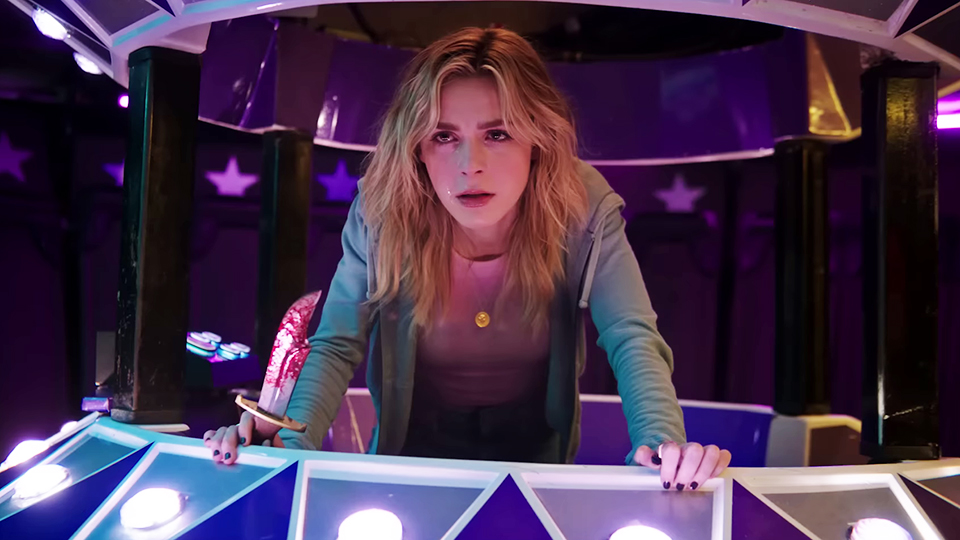
Shipka is Jamie Hughes (natch), a high school junior who is completely dismissive of her mom Pam’s (Julie Bowen) plea for caution on Halloween night.
See, back in late October 1987, three of Pam’s friends were murdered, each stabbed 16 times by a still-unknown masked assailant dubbed the “Sweet 16 Killer.” A true crime podcast host (Jonathan Potts) clues us in on the details, and the reasons why Pam is still skittish this time of year.
But Mom is one of the many townsfolk Jamie scoffs at, until her best friend Amelia’s (Kelcey Mawema) photo booth time machine turns out to actually work! So Jamie steps out of it and into ’87, where she’ll try to infiltrate her teen Mom’s (Olivia Holt) clique “The Mollys” (in tribute to Ringwald) and prevent those infamous murders from ever taking place.
And then, of course, she’s got to get back to…that place that is forward in time.
“I hate time travel movies. They never make any sense!’
So says the 80s sheriff (Randall Park) when Jamie tries to explain her predicament via Michael J. Fox, kicking off a self-aware string of consistently clever gags. And the veteran Shipka (Mad Men, The Blackcoat’s Daughter, Chilling Adventures of Sabrina) proves charmingly adept at navigating the two generations with determined sass.
Jamie’s got a mission and she won’t be distracted by these oversexed heathens and their lack of boundaries!
“Hey, inappropriate touching!”
“This mean girl schtick is really outdated.”
And don’t even get her started on the lack of wifi or having to watch her future parents get handsy!
Shipka is irresistible, and she goes a long way toward keeping this mix of blood, sex, nostalgia, a Mandela effect discussion and F-bombs on the rails whenever it flirts with flying off. And there’s plenty of flirting.
But even when things get stabby, Khan brings a bright and shiny touch. There are helpful reminders about who these oblivious teens are young versions of, and some earnest explanations about what Marty McFly got wrong about time travel.
Totally Killer wants to play by its own rules of inspiration, tell you about it in advance and then yell “high five!” when it all works out.
Don’t leave ’em hanging. It’s a bloody fun time.

Soul Power
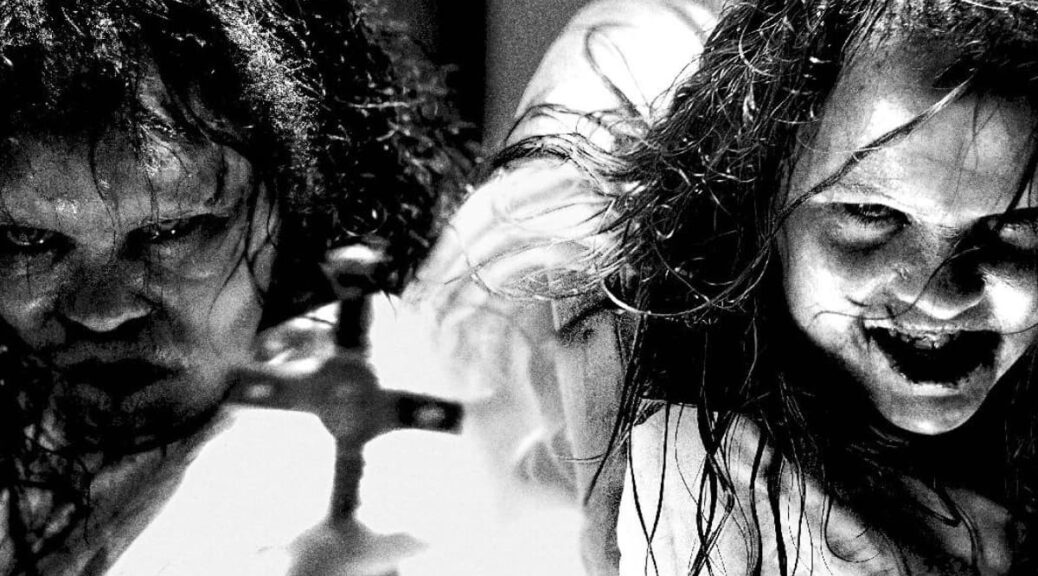
The Exorcist: Believer
by Hope Madden and George Wolf
There have been more Exorcist movies than you might realize and almost all of them are good. One is great. One is a masterpiece.
Is it really fair to hold any of them up against the mastery of William Friedkin’s 1973 original? Well, The Exorcist: Believer flies the titular flag, and brings back Ellen Burstyn to reprise her role as Chris MacNeil, so the film isn’t exactly staying away from it. And with two more Exorcist films on the way, director and co-writer David Gordon Green is nothing if not ambitious.
Green has been here before, recently bringing Michael Myers roaring back to life with his Halloween trilogy. That project came out of the gate with strength and promise, which only made the final two installments that much more disappointing.
This opening statement brings cause for both optimism and worry.
Green’s multiple nods to Friedkin’s original start from Believer‘s opening frame, as Victor Fleming (Leslie Odom, Jr.) and his pregnant wife are traveling in Haiti. Tragedy strikes, and we move ahead thirteen years, with Victor raising Angela (Lidya Jewett from Hidden Figures and TV’s Good Girls) as a single father in Georgia.
Angela and her friend Katherine (Olivia O’Neill, in her debut) go missing after a walk in the woods, showing up three days later as very different people. Katherine’s parents (Jennifer Nettles and Norbert Leo Butz) are true Bible thumpers, and their contrast with Victor’s skepticism becomes an important thread that Green will pull to the end.
The girls’ shocking and blasphemous behavior leads Victor’s neighbor (Ann Dowd) to suggest contacting MacNeil, now a best-selling author who has devoted the last 50 years to understanding what happened to her daughter, Regan.
Odom, Jr. delivers a complex but never showy performance that anchors all the fantastical that orbits him. And it’s great to see the Oscar-winning Burstyn back in this role, but her rushed introduction here reminds you of what an effectively slow burn the original employed. Maybe today that’s a harder sell. But as good as all these performances are, you are just not as deeply invested once the fight for two souls begins.
Green does show a good feel for the callbacks, never going overboard and holding your attention with a consistently creepy mood. The girls’ makeup, demonic voices and atrocities combine for a series of solidly unnerving sequences. Nothing may come close to the shocks from the original, but really, what could? You’re not going to put another child actor through what Linda Blair endured.
Still, 1990’s Exorcist III managed two original moments that bring chills to this day, and nothing about Believer feels destined for iconic status.
The storytelling scores by mercifully limiting the Catholicism, as Green embraces the idea that every culture has a ritual for expelling evil. It’s nice to point out that the Catholics don’t hold a monopoly on exorcisms and that maybe horror fans have grown weary of priests and nuns at this point. Green removes the power from an individual faith and empowers the idea of community, where “the common thread is people.”
But while Believer brings in some welcome new ideas, it lacks the confidence to let a path reveal itself without guideposts of undue exposition. Too much of what happens in the third act is telegraphed early or explained late, even saddling the always-great Dowd with a needless, bow-tying monologue.
What made the original great? Friedkin and writer William Peter Blatty tied us all up in one man’s shame, his inability to do the right thing, and his crisis of faith just to see him sacrifice himself for an innocent. Friedkin terrified us with the most unholy image one could imagine at that time, closed us in a tiny space with this foul idea, and then released us only when one good man died for us.
The demon is again playing on shame and exploiting grief, ultimately revealing a long held secret that becomes key to the fate of both girls. And while the issue this film raises is worthy and mildly provocative, the question of where the franchise goes next is equally intriguing.
Believer spends two full hours telling the story, and it needs those 121 minutes. But Green doesn’t spend them where he should. He tells us too much, shows us too little, and doesn’t invest our time with characters so we feel for the families. There are scary moments, for sure, but this episode does not feel like a kick start to a beloved franchise or a new vision of evil. It feels like an entertaining sixth movie in a decent series.

Fright Club: Horror at the Dinner Table
The dinner scene is a staple in all of film. It’s a way to get to know the family, tweak tensions, display power struggles, uncover secrets, get sentimental, get gross.
And horror filmmakers have mined the anxiety of the dinner table brilliantly for decades. Hereditary‘s “I am your mother!” to The Invitation‘s big reveal, Invisible Man‘s public, damning murder to Beetlejuice‘s singing possession to every amazing scene in The Menu. There are dozens of worthy scenes and films to discuss, but since we must limit ourselves, here are our five favorite dinner scenes in horror.
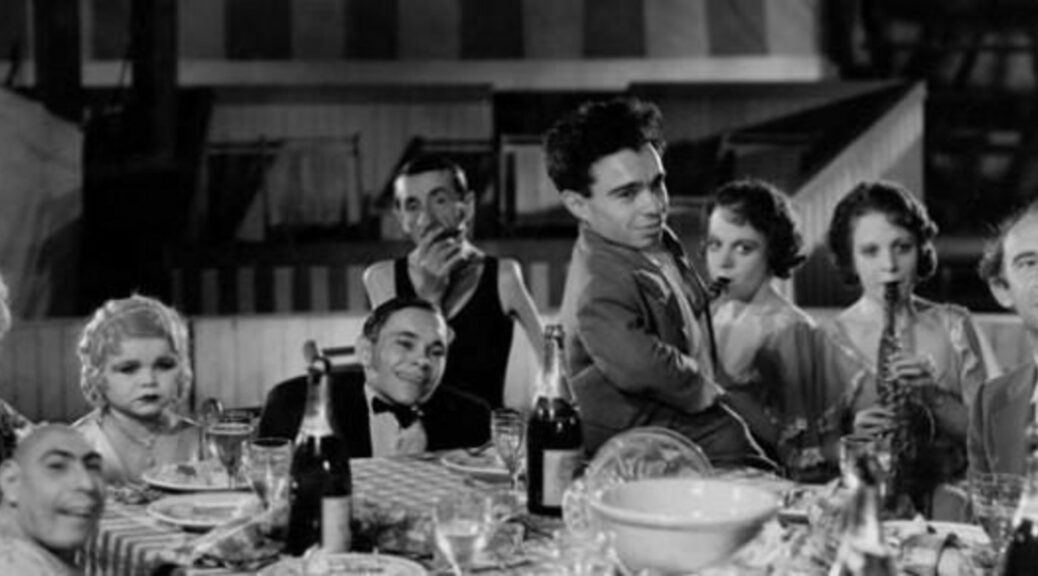
5. Freaks (1932)
It’s the turning point in Tod Browning’s controversial film. It’s the moment when all the circus freaks embrace Cleopatra, accept her as family.
Gooble gobble gooble gobble, one of us! One of us! The proud call of the outcast, a phrase adopted and beloved but horror fans and weirdos the world over. Could Browning have known when he filmed this boisterous celebration that he’d instantly created a classic?
4. Dead Alive (Braindead) (1992)
Nasty!
Peter Jackson knows gross out splatter gore. If he didn’t prove that with his first films, he owns it with Dead Alive. Power tools and priests, zombie babies and Sumatran Rat Monkeys, and one delicious custard.
That custard bit wins. The dinner scene in this film – a movie spilling over with viscera – is among the most disgusting things ever set to film.
Bravo, Peter Jackson!
3. Rocky Horror Picture Show (1975)
Master! Dinner is prepared!
Poor Dr. Frank-N-Furter (Tim Curry, perfection). These party crashers have ruined his big event AND Rocky’s birthday party! And now that repugnant old scientist is here looking for Eddie – a rather tender subject.
An exceptional cast, a clever dance of allegiances, a showy reveal and my favorite “Happy Birthday” meme all roll into one delicious dish!
2. Eraserhead (1977)
Henry (Jack Nance) is so uncomfortable in this scene, and it’s the first scene where the audience really associates with him. He’s a hard character to get behind until he goes to his girlfriend Mary’s parents’ house for dinner.
Her dad tells this weird story and asks him to do the honors of cutting the meat. He’s nervous, wants to vanish, is afraid to say no but has no idea what to do.
Which is probably everybody’s fear in such a situation. Although, this being a David Lynch film, none of us will ever have exactly this experience. Man, Mom seems to be really invested.
1. The Texas Chain Saw Massacre (1974)
It is around the dinner table that a guest gets to see the true family dynamics. Sally’s getting a good look. Like a really close up, veiny eyed look.
This is the scene that grounds Tobe Hooper’s 1974 masterpiece. Suddenly it’s a family with a lived-in vibe and a backstory. And another person’s face. And a metal basin and a nearly mummified old man.
Edwin Neal’s already had his chance to nab the spotlight in the van, and of course Gunnar Hansen’s the star of the show. It’s in this scene that Jim Siedow gets to dig in and create an unforgettable character. And Sally (Marilyn Burns – god bless her) – goes through a lot and comes out the other side.

Screening Room: The Creator, Saw X, Deliver Us & More

Horny Little Devil
Deliver Us
by George Wolf
On the heels of that evil nun’s return to theaters, Deliver Us arrives with a sexy nun, a horny priest, one ancient prophecy and two incredible claims.
In a Russian convent, sister Yulia (Maria Vera Ratti) is pregnant – with twins. Not only is Yulia claiming immaculate conception instead of virgin birth (remember kids, the immaculate conception was of Mary, not Jesus), but she says one of her unborn children is the Messiah, and the other is the Anti-Christ.
The Church promptly reaches out to the handsome Father Daniel Fox (Lee Roy Kunz) for an investigation (Father Joseph McDreamy was apparently busy). Though the American priest has a history of success with these “demonic” cases, he also has a high level of skepticism and a belief that most can be explained through natural science.
Father Fox is also expecting a child with a prominent Russian bussinesswoman, and is planning on leaving the Church to start a family. Still, he accepts this last assignment, and soon uncovers a secret society’s plan to kill sister Yulia before her twins can fulfill that centuries-old prophecy.
The ancient order/prophecies fulfilled stuff is fertile ground for horror films. And though Kunz – who also co-writes and co-directs – is shaky on religion (the film also has a Catholic bishop trying to talk Father Fox out of leaving the Priesthood by arguing that celibacy is merely a “tradition”), a brutal opening sequence and the resulting mystery combine to set an intriguing hook.
Cinematographer Isaac Bauman gives the film a dark, gorgeously foreboding aesthetic, using stark confines and snowy landscapes to great effect. Candlelit rooms and steam heat in winter air are framed with a fine construction that adds to the feeling of isolation once Father Fox, sister Yulia and the twins set out on the run.
Sacrifices are demanded, and blood is spilled, but as the mystery unfolds, the unfortunate layer of silliness that plagues many films in this demonic subgenre begins to creep in. Even worse, two incredulous Shining references appear to nearly comedic effect, derailing the mood in an instant.
The writing and directing teams also seem overly concerned with the lack of eroticism in the exorcism game. And though Deliver Us can be a horny little devil, some fine production elements are ultimately let down by a script too distracted to satisfy.

Screening Room: Dumb Money, Expend4bles, It Lives Inside, No One Will Save You & More
Stranger In My House
No One Will Save You
by George Wolf
No One Will Save You gives Brynn Adams – and us – just 12 minutes before uninvited friends come calling.
And in those 12 minutes, writer/director Brian Duffield utilizes some fine visual storytelling to set the stage.
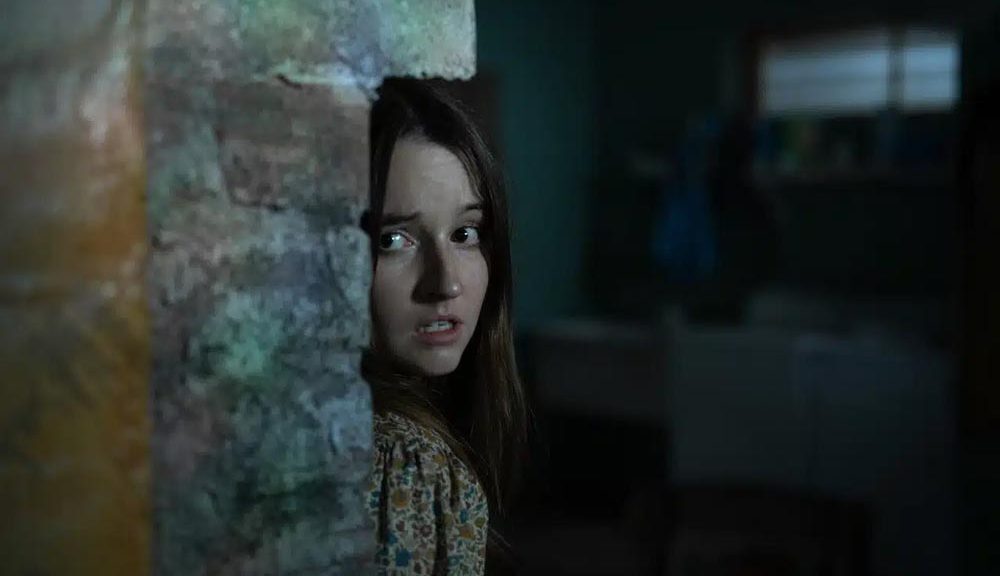
Brynn (Kaitlyn Dever) lives by herself in a lovely country home. Brynn’s a simple homebody who likes simple charms like rotary phones and making beautiful crafts to sell. But in her small town of Mill River, Brynn is a pariah. Something very painful occurred there years ago, and the townsfolk are not shy about reminding Brynn that she was – and still is – to blame.
Brynn soon finds out that what’s worse than no one stopping by is a sudden alien invasion. Hide and seek soon turns to fight or flight, with Brynn struggling to stay alive and find anyone to help her. But as the title implies, Brynn has only herself to rely on.
Duffield (screenwriter for Underwater and The Babysitter, among others) rolls out story beats that recall Signs, It Follows, and The Babadook, while upping the A Quiet Place ante for a film that is 99.9% dialog-free.
In place of conversation, we get some very effective SFX work from James Miller’s sound department, and the always-welcome Dever delivering a physically demanding, sympathetic performance that wordlessly evokes desperation, sorrow and courage.
But as Brynn’s nightmare plays out, a stale air begins to creep in. The creature design is fairly generic, and more effective before we start to see them up close. Duffield’s extended metaphor has been done before and with more subtlety, though it’s rescued somewhat by a final twist from that Twilight-y Zone place.
Most of all, Hulu’s No One Will Save You is another example of a film that seems structured exclusively for a streaming algorithm. The action comes early, it’s repeated often enough that you can go feed the dog and not feel like you’ve missed anything, and the themes are obvious and easily digested.
Once again, it’s a formula that is tasty in spots, but far from filling.
