Just Do It

All In: The Fight for Democracy

by Hope Madden

Documentaries can be frustrating, especially political documentaries. They warn you about coming disasters you hadn’t predicted, show you the brutality and ugliness in parts of the world you hadn’t seen, reinforce that ulcerous dread in your gut about humanity on the whole. You can basically only hope they also show you a way out.

Mercifully, All In: The Fight for Democracy does that. But first it upbraids your apathy about voting by detailing the harrowing history of Americans who had to take a beating, even die, just to exercise that right. Then it details the meticulously detailed strategy in place and being executed right now to keep you from exercising your right, now that you understand its value.

Filmmakers Lisa Cortes and Liz Garbus wisely anchor their facts to Georgia’s gubernatorial race of 2018. The core storyline, narrated by the Democratic candidate in that race, Stacey Abrams, is of that election’s rampant and open-to-pubic-view suppression of Georgia votes. Abrams’s opponent, Brian Kemp, had been an architect of voter suppression as Georgia’s Secretary of State: closing polling places, purging voting rolls and instituting legislation that made voting more difficult.

It was incredibly successful for him. Expect to see more of it.

If that sounds cynical, it is. It’s also a major point of the film. But Cortes and Garbus (and Abrams) have a more idealistic goal, which is to point out something important to every American citizen regardless of party: Democracies only work when citizens decide what politicians do, not vice versa. When citizens vote, we can make the decisions. We can determine who is in office and what they need to fight for and against. And if they don’t do it? We can vote them out.

But we can only do that if we can actually vote, which is why politicians who don’t want to do their jobs enacting the will of the people work tirelessly to make it harder and harder for Americans to cast their ballots.

The history is well told between effective speakers and illustrative animations, but it’s the insidious nature of voter suppression and its modern execution that is equal parts enlightening, terrifying and frustrating.

So make a plan. Verify your polling location. Double check that you are still on the rolls. (Ohio is especially guilty of stifling the vote.) Vote early.

Just vote.

And watch this movie.

Hope Floats

Buoyancy

by Hope Madden

Hey, it’s been a pretty easy going year. Feel like a movie?

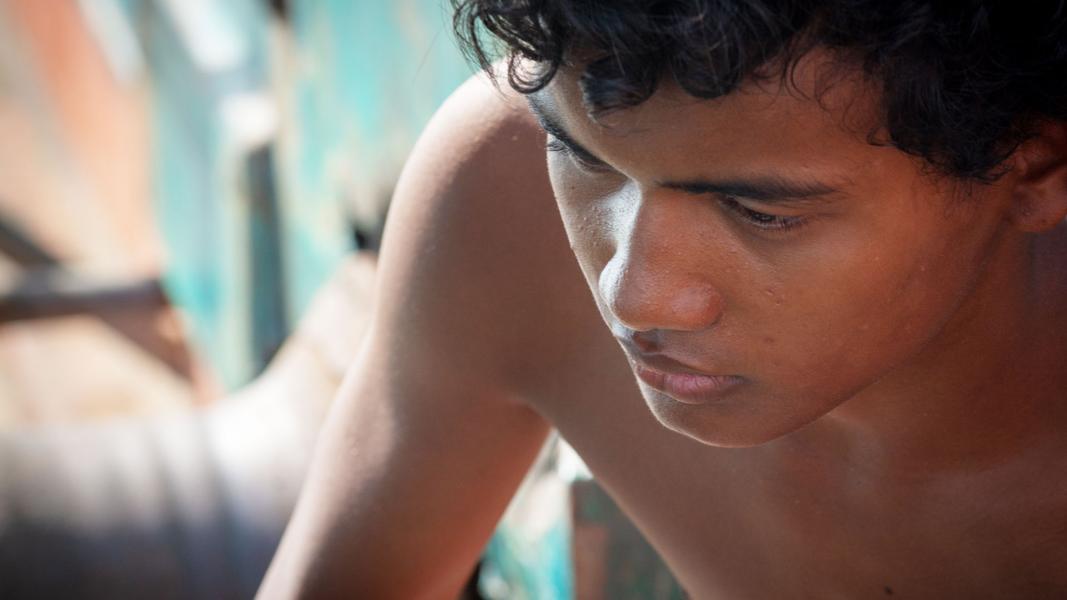
Well, first time feature filmmaker Rodd Rathjen has one for you and you’re not going to like it, but you should watch it anyway. Buoyancy shadows a 14-year-old Cambodian boy sold into slave labor on a Thai fishing trawler.

I know, but stay with me.

In his feature debut behind the camera, Rathjen wisely relies on naturalistic performances from mainly non-professional actors to recreate the circumstances rather than dramatize them.

Sarm Heng is Chakra, a put upon adolescent bristling at the limitations of his life. There’s the universal element of adolescent rebellion, here tied to far more than angst. Chakra does manual labor rather than going to school, and as kids in uniform whiz by him on bicycles, and cars on the nearby highway come and go, his stagnancy and the back breaking monotony awaiting him in adulthood press down on him.

He follows an opportunity to sneak away from home and get a ride out of the country, where he’ll make real money working in a factory. It’s OK if he doesn’t have the $500 fare to leave the country, he can work that off in his first month.

That’s not how it actually works, and we spend the rest of the film watching as Chaka’s realization comes to him in bits and pieces that he will probably never leave this rickety fishing boat.

Rathjen’s film ends with sobering facts concerning the modern slave trade in Southeast Asia, with as many as 200,000 boys and men currently missing and believed to be held in bondage on fishing boats. The filmmaker’s verité style helps us understand how this happens. There’s no boisterous villain detailing the scheme, no, “Ha! You belong to me now!” No one tells you you’re never being paid, never going home. You simply adjust to your circumstances or you die.

There’s little dialog once Chakra leaves the boys in the village behind, but Heng doesn’t need it. The evolution of this character hangs on his face. It’s a remarkable performance, especially from a kid who’s never acted before.

Heng gets an assist from two actors with some experience. An utterly heartbreaking Mony Ros is the middle aged man who falls prey to the scheme in the hopes of providing for his family. The camaraderie between these two characters is powerful, and it’s a theme Rathjen mirrors in Chakra’s relationship with the ship’s captain, played with menacing relish by Thenawut Ketsaro.

What they create together is harrowing, but it’s also a brilliant piece of filmmaking that needs to be seen.

Show Me Your Junk

The Broken Hearts Gallery

by George Wolf

I have no problem at all with scary movies, I love them. But I gotta be honest, I can’t think of many things more frightening than the prospect of dating in today’s social climate.

So kudos to writer/director Natalie Krinsky for squeezing so much feel-goodiness out of the dating tribulations of twenty-something New Yorkers in The Broken Hearts Gallery.

Lucy (Geraldine Viswanathan), a gallery assistant, is smarting from a painful breakup. Her roommate besties Amanda (Molly Gordon from Booksmart, Good Boys, Life of the Party) and Nadine (Hamilton‘s Phillipa Soo) are helping her cope.

First lesson in letting go: get rid of all that junk you’ve saved as souvenirs from past relationships!

But a chance meeting with Nick (Dacre Montgomery from Stranger Things), a budding hotel owner, spawns an idea. If Lucy will help get the hotel ready for opening day, Nick will give her space to open a gallery showcasing trinkets donated by lovers left behind.

Krinsky, a TV vet helming her first feature, leans on plenty of familiar rom-com tropes, but gives them all just the right amount of unabashed enthusiasm to feel more comfortable than cheesy.

The dance montages are numerous, the dialog less like real conversations and more like people waiting for their next turn to quip, and the ladies’ Big Apple cynicism as biting as a sugar-coated fantasy.

But Viswanathan (Blockers, Bad Education) is bursting with bubbly charm, Montgomery brings a welcome, dialed-down authenticity, and Krinsky is able to mine some contemporary laughs from recycled ideas (the actual Museum of Broken Relationships, When Harry Met Sally-styled interviews with the trinket owners).

The Broken Hearts Gallery is often as awkward and messy as it is breezy and spirited. You know where it’s going and it goes there, pushed buttons blazing.

And for 108 minutes, dating in this world seems like it isn’t that scary at all, and could maybe even be fun. Maybe.

Clear as Mud

Red, White & Wasted

by George Wolf

The most effective documentaries often serve as windows to a new world. The world framed by Red, White & Wasted may be covered in Florida mud, but its view – in both foreground and background – is remarkably clear.

Up front, we’re immersed in the culture of “mudders,” who live for monster trucks and mud holes, beer and babes. The undercurrent, though, carries the type of bare bones political insight authors and filmmakers have been trying to articulate for years.

Directors Sam Jones and Andrei Bowden Schwartz introduce us to Matthew Burns, a mudding disciple who years back gained some local Orlando fame as “Video Pat,” ringleader of the “Swamp Ghost” mud hole. The monster truckers would come to barrel through the mud, and Pat would eventually fill “1,000 +” videotapes with all the filthy glory.

But Orlando, as you may have heard, is famous for some other attractions, and eventually the mudders’ favorite piece of land is sold, forcing them all to give up the Ghost.

The introduction of Video Pat’s family and friends expands the fascination the film finds in uncovering this backwoods life. While Jones and Schwartz – in their feature debut – never condescend to the mudders opening up to them, they’re also smart enough to follow where the simple country folks are only too happy too lead.

These proud “rednecks” are openly racist but don’t think it’s really a problem, keep tuned to conservative media, have “a lot of respect for Vladimir Putin” and protest that the Confederate flag really represents “home grown cookin’.”

And they are bigly fans of Donald Trump.

For anyone still wondering why so many of these rural Americans continue to vote against their own interests, this film and these people make it clear as mud. Their way of life is disappearing, and blaming the immigrants, city slickers, job-stealing foreign countries and libtards makes them feel better.

And whichever way you react to that, Pat’s reflections on his years of mudding, his failures as a father, and his status as a brand new grandfather arrive with a conflicted poignancy.

As he smiles and gently cradles his new grandson, Pat wonders about all the boy might soon be taught.

He’s not the only one wondering.

Asking for a Friend

Rent-A-Pal

by Hope Madden

What did we do before Tinder?

Back in 1990 there weren’t even online dating sites, let alone handy apps for lonely singles, and David (Brian Landis Folkins) is lonely. He cares for his mother by day and spends evenings in his basement, viewing new VHS tapes from a dating service—a service he’s belonged to for six months without a single match.

When he goes back in to record a new video of his own, David stumbles across a different kind of tape: Rent-A-Pal.

This video doesn’t tempt David with first person accounts of women who won’t be interested in him. No, Andy (Wil Wheaton) is a real friend, even if he is just a recording.

It’s like Blue’s Clues, except it’s aimed at desperately lonely men, which is maybe the creepiest premise I can remember.

From the top loading VCR to the woody wagon, writer/director Jon Stevenson has David clearly defined. Even for 1990, he is behind the times. He’s a loser. But Stevenson doesn’t dismiss David, and he definitely doesn’t mock him. Which is not to say Rent-A-Pal is entirely sympathetic.

Stevenson and Folkins work together to make David a believable, heartbreaking, damaged human being. Were he a caricature of that loser who lives in his mom’s basement, Rent-A-Pal would not pack nearly the wallop it does. Folkins’s layered, vulnerable performance and his character’s evolution are powerful, awful, and awfully relevant.

It’s a pre-internet story of a lonely white guy, easily convinced of his entitlement to everything he wants by another, similar white guy. Thanks to this other voice, so very similar to his own and so very supportive, David’s self-pity turns bitter.

Rent-A-Pal is a cautionary, pre-incel tale of the insidious dangers of blame and entitlement. Driven by a smart script, excellent supporting work (both Amy Rutledge and Kathleen Brady are wonderful), and an unerring lead turn, Rent-A-Pal delivers an alarming kind of origin story.

Much Ado About Nature

Entwined

by Hope Madden

Aah, the woods. It is almost overwhelming in its defiance of civilization, its sheer magnitude of just plain nature. Shakespeare set his magic there, but a lot of horror filmmakers lean closer to Lars Von Trier’s proclamation: Nature is Satan’s church.

Making his feature debut as both director and co-writer, Minos Nikolakakis conjures a spooky fairy tale that makes much ado about nature.

Panos (Prometheus Aleifer), a city doctor looking for a simpler, more isolated existence, moves to a remote Greek village to become the town’s only (and apparently first) doctor. Winding through wooded, mountainous roads on his way to his new home he nearly runs down a lovely young woman, who promptly disappears back into the woods.

Once in the village, Panos discovers tight-lipped locals, superstition and boredom—all of which leads him on a quest to figure out who that girl in the woods might be.

It’s to Nikolakakis’s credit as a visual storyteller that so many familiar elements still work to cast a spell. The film explains very little. It sprinkles clues about, but relies on your familiarity with the way folk tales work to lead you into an unusual take on the genre. There’s nothing overstated or campy about Nikolakakis’s fairy tale trappings.

Aleifer’s understated charisma—his penetrating stare, his abiding sadness—creates a strong center for the story. A melancholy mixture of logic and longing, his bearing articulates the dizzying, frustrating mixture of emotions and circumstances that trap Panos.

Anastasia Rafaella Konidi’s earthy version of the succubus intrigues consistently. She vacillates between demanding and imploring, but never feels genuinely sinister. And we’re never entirely sure whether the doctor sees his plight in the woods as a dream or a nightmare, and that shifting reality generates dizzying dread.

The film’s weakest element is the presence of co-writer John De Holland in the role of Panos’s protective half-brother, George. The performance is shaky enough that the first act suffers badly—the first impression is of a movie not worth your time.

Luckily De Holland has considerably less screen time through the remainder of the film. Still, when George does appear intermittently he punctures the spell Nikolakakis and the remainder of the cast has conjured and it takes a while to recreate the mood.

The way the story resolves itself is a puzzle, and not an especially satisfying one. With Entwined, Nikolakakis boasts some impressive storytelling instincts, but there’s still room for growth.

All Sword, No Play

Mulan

by Hope Madden

The first tale of Mulan—a story that’s has been told and retold for centuries—dates to an epic poem written more than 1500 years ago in China. Back in 1998, Disney made its first attempt to capitalize on the girl power message of the daughter who hides her identity to take her father’s place in battle.

As part of the company’s live action re-imaginings of those old animated films, Mulan comes back today.

Yifei Liu plays the young warrior in a version that takes its material seriously. Don’t expect a wisecracking little dragon this go-round. With the PG-13 rating and the multiple and violent battle sequences, this one wasn’t made with the youngest fans in mind.

Director Niki Caro is not Asian, which makes her an unusual and potentially inappropriate choice to helm a story so entrenched in Chinese folklore. She hasn’t made as impressive a film as Mulan since her 2002 coming of age tale, Whale Rider, and it is no doubt on that film’s account that the New Zealander got the call from Disney.

She certainly does justice to the message of empowerment, as expected. What you might not expect given her previous films is her virtuosity in filming beautiful, elegant and eye-popping action.

The fight choreography is wonderous, as are the gorgeous vistas. Caro’s Mulan is a spectacle and it’s too bad it won’t be shared across big screens.

There’s a simplicity to the storyline that allows Caro and her cast to create wonder with the visuals, and Liu’s earnest portrayal suits that aim. The screenplay remains true to the folktale’s message in spots where ’98 animated version betrayed its more conventional view of female power.

There are no songs and dances here, but there is magic nonetheless.

Artful Escape

A Step Without Feet

by Hope Madden

“People want to know about the road, if it was hard getting here. That’s not the question.”

A Step Without Feet, the first documentary from Jeremy Glaholt and Lydia Schamschula, spends 90 minutes in snowy Berlin with a handful of refugees from the Syrian war. The filmmakers’ first question: What do you think of the word “refugee”?

They don’t see the word the same way you do.

It’s actually a fascinating way to get into a story that looks sideways at a topic so often portrayed in documentaries. The bloody, lengthy, horrific war in Syria has launched more documentaries than I can count, many of them brilliant, most of them brutal.

Glaholt and Schamschula pull us out of all that brutality, mercifully, and drop us into the newly created lives of those who’ve escaped it: a dancer and a dentist, a musician and a cook, a writer and a student. Their resilience, nostalgia, trauma and optimism are on screen in a film that recognizes salvation—however profound—as just another transition in life.

Though life in Germany has been seemingly peaceful for the group and each has many happy moments to discuss, the anxieties of the past and the longing for what is lost give their peaceful existence a bittersweet flavor.

Many bridge the past and the present, their old home and new, with art. One writes, one dances, one sings, each of them tapping into something that gives creative outlet to their fear and yearning.

The film’s biggest drawback is its lack of context. We’re 15 minutes or more into the film before anyone utters the word Syria. The reasons each one left is never clearly articulated. While those familiar with the conflict would certainly have a sense, the reasons that these individuals needed to flee while their parents or siblings were OK to stay is never addressed.

With the clear and mostly fulfilled goal of casting these human beings in the present tense, the filmmakers likely made the conscious decision not to dig too deeply in this painful terrain. Still, the magnitude of the subjects’ sorrow, longing and trauma is tied to that specific conflict. To do their present justice we need more of their past.

The film—almost exclusively talking head footage of interviews with the seven refugees—remains strangely captivating throughout. Because of the music, the dance, the poetry and the candor, a deeply human and powerfully universal story emerges.

Anguish for Anguish

Measure for Measure

by Cat McAlpine

In this modern adaptation of Shakespeare’s play by the same name, Measure for Measure follows a large cast of characters all tied to the same horrific event. A man high on meth goes on a racially charged shooting spree in a housing commission tower. Angelo sold him the drugs. Farouk might have sold him the gun. Claudio and Jaiwara were simply lucky enough to survive. What really connects the tenants of the dreary flats is not a single act violence, but the fact that their lives are rife with it.

Director Paul Ireland uses trauma as connective tissue, highlighting the theme with repeated showings of August Friedrich Schenck’s “Anguish.” The painting shows a ewe crying out over the body of her dead lamb, encircled by waiting crows. It is trauma, and vulnerability, like this that pushes characters together and rips them apart, with carrion birds waiting to swoop in.

The script, penned by Ireland and Damian Hill (to whom the film is dedicated), is strongest when it strays from Shakespeare. The addition of an immigrant family to the story adds dimension to the types of trauma we face and how it shapes the next generation. The love story of Ireland and Hill’s Measure for Measure is much more straightforward than Shakespeare’s. If anything, the film would’ve improved from even further deviation.

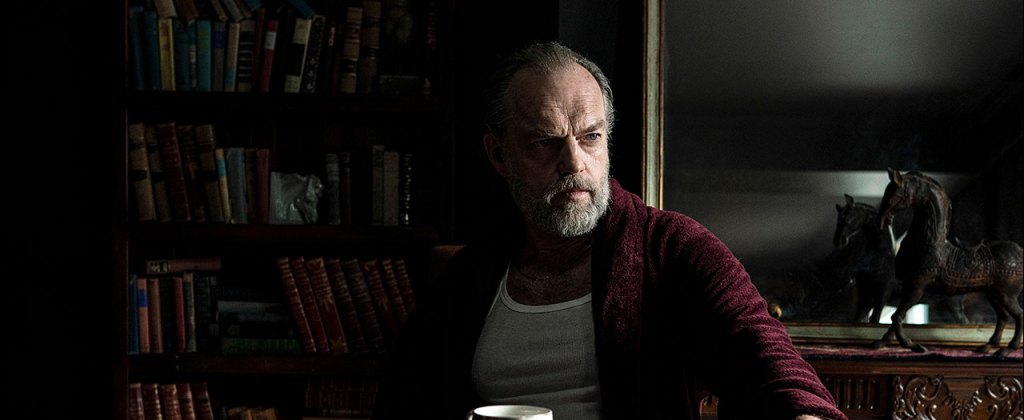
What truly carries the production are its strong performances. Hugo Weaving is great as Duke, endlessly watchable. His manic foil Angelo (Mark Leonard Winter) is also fantastic, even when the script doesn’t support him. Farouk (Fayssal Bazzi) starts as a stereotypical baddie, but Bazzi finds complicated depth in him later on. Harrison Gilbertson and Megan Smart build great chemistry together as Claudio and Jaiwara, despite a bit of a montaged love story at the start.

Measure for Measure is a worthy effort to take the endlessly classic nature of Shakespeare and frame it in a modern retelling with new resonance. Its focus on loss, vengeance, and love are undeniably relatable, while still telling a fresh story in an old frame.

Hope Madden and George Wolf … get it?