The Rubber Meets the Road

Plan B

by George Wolf

Even before theaters shut down, there was no shortage of solid R-rated comedies getting woefully ignored. One of those was the wonderful Booksmart – which put a female friendship at the center of a Superbad-type coming-of-age romp.

Hulu’s Plan B takes the Booksmart model, mixes in some trusty road movie hijinx and even more sexual honesty than Blockers to concoct a teen sex comedy with plenty of smarts and sustained laughs.

South Dakota teens Lupe (Victoria Moroles) and Sunny (Kuhoo Verma) are best friends on slightly different social levels. The confident, outgoing Lupe is, ahem, “dating,” while the reserved Sunny has zero prospects and just pines for her crush to come over for a “Disney Plus and thrust.”

But then Sunny’s Mom goes out of town, so party! After Lupe’s cheery advice to “make good choices!” an impatient Sunny wants to get it over with already, leading to a very awkward bathroom hookup and an unfortunate condom accident.

Trading puke buckets and talking it over the next morning, the girls decide the best thing to do is get Sunny the morning after pill. This turns out to be a lot harder than they expect.

Moroles and Verma are both terrific, each finding distinct ways to give their characters authentic levels of the angst, curiosity, self-doubt and cautious confidence that are perpetually bouncing off teenage walls.

Once the search for Plan B involves a road trip to Rapid City, the script from Joshua Levy and Prathiksha Srinivasan delivers welcome surprises alongside inspired silliness and moments of outright hilarity (like the bit about Footloose and a doll museum).

There are some dry stretches along the way, but director Natalie Morales shows good instincts for when to pivot, and for making sure this teen sex comedy ends up speaking to some mighty serious issues.

So expect Rachel Dratch teaching abstinence by way of driver’s ed, but also young women exploring their sexuality amid an onslaught of mixed messages, double standards and threats to their freedom of choice.

Don’t let the dick jokes fool ya, there’s heart and brains here, too, and a sweet friendship illustrating the importance of unconditional love from your family, as well as the ones that feel like family.

And also dick jokes.

Goregasm

Skull: The Mask

by Hope Madden

Practical effects, hallucinatory sequences and a throwback exploitation vibe keep Skull: The Mask interesting enough to watch.

The film’s opening is its strongest segment, a grainy video portrayal of a 1944 political bloodbath with the goal of enacting an ancient pre-Columbian ritual. Directors Armando Fonseca and Kapel Furman bring a retro violence to the effort that makes the most of limited resources.

Flash forward 60 years or so and we move from the Amazon to Sao Paulo and a convoluted police procedural led by a one-note performance from Natallia Rodrigues as Det. Beatriz Obdias. She’s bad news! Damaged goods!

She also has no idea how to treat a crime scene, but there’s a lot of questionable policework going around, with no real leads to connect these corpses strewn from one end of town to the other. All of their hearts are missing. Sometimes their guts. Once in a while their faces.

The best thing about Skull: The Mask is Furmam’s extensive background in gore effects. You’ll find plenty of it here, some of it inspired, all of it bloody. The goregasm is in support of a story of a marauder in a stone skull mask, the same cursed mask from the 1944 massacre.

Brought to Sao Paolo by nefarious men with nefarious intentions, it falls into the wrong Goth girl’s hands early on and soon there’s a housecleaner ripping the hearts and guts out of club kids, drug dealers and priests all over town.

Does it make sense? Not really. Does it have to? Probably not. The film is a callback to a style and brand of movie that didn’t need an airtight plot or convincing performances as long as it did very nasty things in novel ways to the human body.

Skull: The Mask is a pretty dumb movie. Hell, even the title is dumb. But it knows where to invest its energy and money, and you cannot say it skimps on the goods.

No Evil Thing Will

Cruella

by Hope Madden and George Wolf

Disney possesses more of the greatest villains than any other studio or property in existence, more than Marvel, more than DC, more than even Universal and its set of classic monsters. By more we don’t mean quantity necessarily, but quality: Maleficent, Cinderella’s evil stepmother, Snow White’s evil queen, Scar, Ursula, Jafar, Madam Medusa (seriously, if you haven’t seen the original 1977 The Rescuers, you need to do so at once), and of course, Cruella De Vil.

That’s a stash of villains to covet or to celebrate, so why does Disney hate them so?

Cruella is the mouse’s latest attempt to give a villain the Wicked treatment with an origin story that offers insight into the root cause of their villainy. As these things go, Cruella does have a few really bright spots.

Emma Stone has honestly never been bad in anything. She brings a charmingly conflicted Jekyll/Hyde to a character who is working against her own instincts to be a good person. Joel Fry and Paul Walker Hauser are endlessly endearing as her cohorts Jasper and Horace, respectively. But can we talk about Emma Thompson for a second?

The definition of glorious, Thompson delivers a delightfully droll Baroness Von Hellman – the fashion icon nemesis who brings out the wicked in Cruella. Scenes between the Emmas elevate the entire project, allowing Thompson to radiate devastating narcissism and Stone to mine her character’s emotional and intellectual landscape.

And who doesn’t like to see Mark Strong? He’s one of maybe a dozen performers in tiny, mainly pointless roles decorating the dozens and dozens of scenes that should have been purged from a film that runs two hours and fifteen minutes but feels twice that.

My God does this movie need trimming. You will have aged noticeably by the time it’s over. It meanders for the better part of an hour before actually hitting the catalyst for the story, then stages heist upon gala upon big reveal upon public comeuppance upon more big reveals before actually getting to the point.

Some of these are interesting and fun, but most of them serve no real purpose. Director Craig Gillespie, working from a script by committee (there are 5 credited screenwriters), belabors everything. This not only leaves his film almost structureless, but it also guarantees that nothing sticks with you, not even individual scenes that absolutely should be memorable. No scene or plot point is allowed any real emphasis or import.

It’s curious that Gillespie – who proved a master of tone with I, Tonya – can never find a consistent one here. It doesn’t help that a nearly endless parade of pop/rock hits are jammed into the soundtrack with questionable regard for cause or effect.

And still, there are fun-filled stretches that seem desperate to claw out from under all the dead weight. Cut a full 45 minutes from this film and you may have something. Instead, we get a pointless mess that can’t decide how it even feels about Cruella de Vil.

Walk Softly

A Quiet Place Part II

by George Wolf and Hope Madden

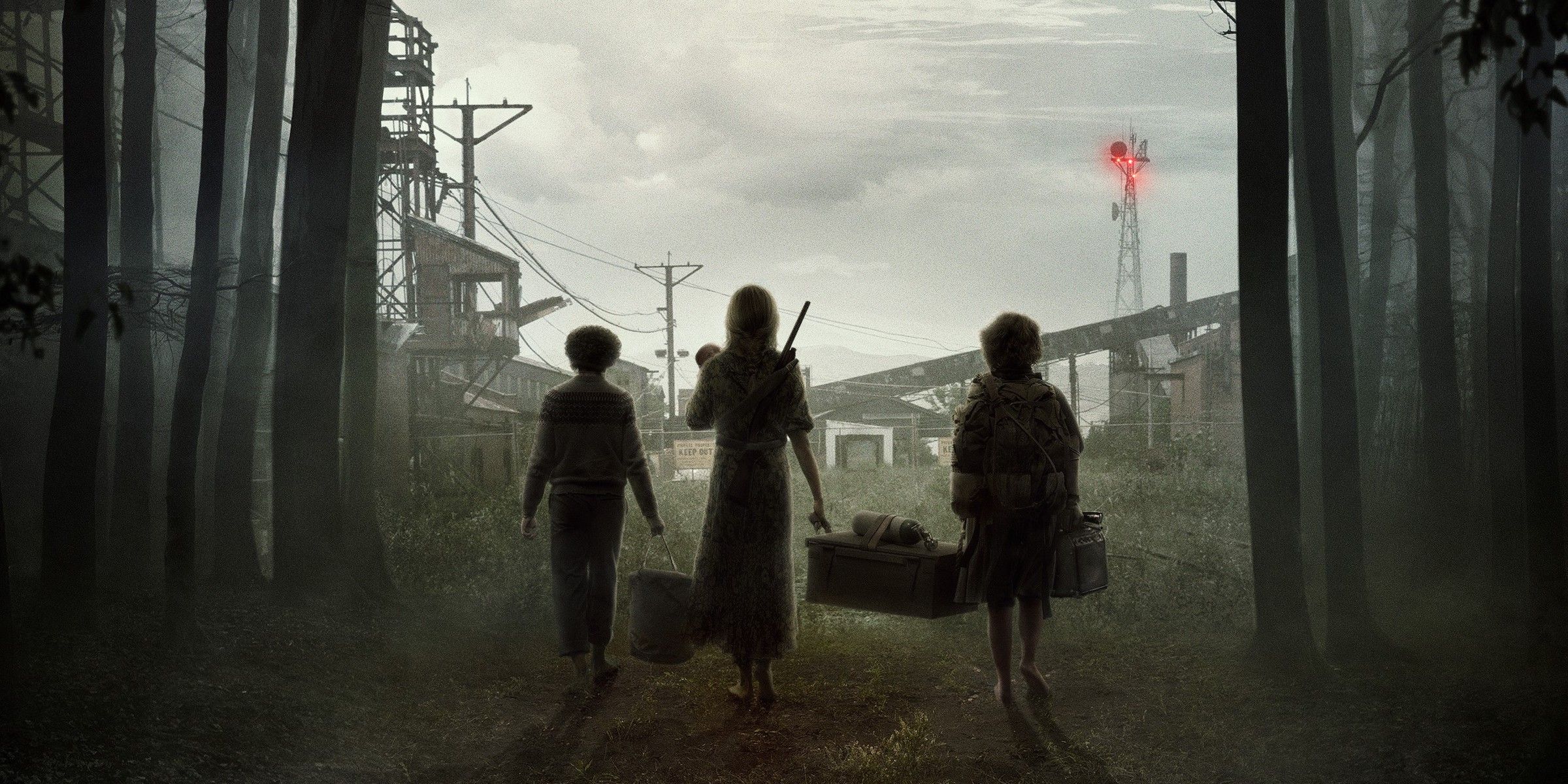
For a few well-placed and important seconds, there it is: the much-discussed nail from A Quiet Place. And like most everything else in writer/director John Krasinki’s thrilling sequel, the nail’s return carries weight, speaking visually and deepening our investment in these characters’ terrifying journey.

But before we see that the Abbotts have learned to avoid that nail, we go back to how it all began on “Day 1.” And Krasinski knows it doesn’t make sense now to tease us with monsters we’ve already seen up close, so beginning right from that pulse-pounding prologue, he keeps ’em coming.

So while there’s no shortage of exhilarating, squirm-inducing and downright scary moments, Krasinski instills it all with an impressive level of humanity.

As Evelyn (Emily Blunt), Regan (Millicent Simmonds), and Marcus (Noah Jupe) continue traveling on foot with baby Abbott in tow, they enter the fortified compound of old friend Emmett (Cillian Murphy), who is not nearly as welcoming as they hoped.

But when Regan heads out alone to find the permanent safe haven she’s sure exists, Evelyn convinces Emmett to follow, and bring her daughter back to the family.

From that point, the film splits into two parallel narratives that Krasinki layers with some nifty intercutting and clever, crowd-pleasing plotting. As the threats keep coming for Regan and Emmett in the wild, and for Evelyn, Marcus and baby back at the compound, the tensions build simultaneously via storytelling that’s primarily visual and wonderfully economical.

The editing gives the enterprise a welcome retro feel and Krasinski’s flair for visual storytelling has only strengthened since the last film.

Jupe is tenderly terrific, and it’s no surprise that Blunt and Murphy—two exquisite actors who never let you down—carry their own, but the one who carries the most weight in Part II is Simmonds. Regan is the film’s believable and capable hero this time, in a narrative choice that underscores the entire film’s optimism for our future and Krasinski’s reminder that there are always “people worth saving.”

AQPII is lean, moves at a quick clip, thrills with impressive outdoor carnage sequences and yet commands that same level of tension in its nerve- janglingly quiet moments. Krasinski had a tough task trying to follow his 2018 blockbuster, one made even tougher now having to prove the sequel was worth saving for a theaters-only release.

On both counts, we’d say he nailed it.

Fright Club: Dolls in Horror

Hard to believe we’ve been doing this so long and have never gotten into creepy doll horror! Well, with help from our friend Phantom Dark Dave, we do just that. Here is our salute to creepy-ass dolls!

Our focus is on the best movies with creepy dolls (rather than the creepiest dolls themselves), and we have a bunch to cover! Dave brings his list, we have ours, and of course, there are also-rans and left-overs. Take a listen!

5. Dead Silence (2007)

Somewhere between their career-defining Saw and their even leggier Insidious and Conjuring franchises, director James Wan and writer Leigh Whannell dropped a plastic-headed thud with this ventriloquism horror.

It’s kind of a shame because although the story meanders in and out of consciousness, the actual dolls are creepy as hell.

Mary Shaw (Judith Roberts) had all 100 of her “children” buried with her. So why does Buddy keep showing up? And why does Donnie Wahlberg insist on this weird Columbo impression?

No matter. We somehow end up crossing a moat into a gloomy old haunted house filled to bursting with ventriloquist dummies of every shape and description. Dead Silence pays tribute to their own Jigsaw doll as well as that creepy clown in Poltergeist while predicting Goosebumps and Toy Story 4 scares.

Are all those movies better than this one? Yes, but it gets points anyway.

https://www.youtube.com/watch?v=D4lnaNy0nmI

4. Pin (1988)

Who wants something weird? Because, man, does Pin deliver on weird.

Leon and Ursula have always felt close to their dad’s anatomically correct anatomical dummy. Sure, he uses it for doctor’s office stuff (and his nurse uses it as she sees fit!), but to the kids, he’s kind of a member of the family.

He means an awful lot to lonely recluse Leon (David Hewlett), who’s no hit with the ladies. It doesn’t help matters that Ursula (Cynthia Preston) is his favorite lady. I wonder what kind of advice Pin might have? He’s got a real knack with Dad’s nurse…

The point is, people die, people have sex with medical dolls, and Terry O’Quinn (The Stepfather) is again really not showing any natural paternal instincts.

3. Annabelle Comes Home (2019)

Writer Gary Dauberman, who’s penned every installment (as well as It, which seriously amplifies his credibility), takes on directing duties for the first time with the third film in the standalone franchise.

From that opening gag by the cemetery, the movie brings the high-spirited, popcorn-munching goods. It is fun, with generous writing that does not ask us to root against any of the kids, and performances that are far superior to the content. Plus a couple of real laughs, mostly thanks to a randomly hilarious pizza delivery guy.

2. Magic (1978)

Anthony Hopkins has made more horror movies than you realize, and no matter how much you may assume that a ventriloquist horror will be dumb, Magic is actually pretty creepy.

It helps that Hopkins is so effortlessly creepy. It also helps that the film was penned by William Goldman (Marathon Man, The Stepford Wives, All the President’s Men) and directed by Richard Attenborough (Gandhi).

It’s still goofy as all hell. Burgess Meredith sees to that. But Hopkins is fully on board, Ann-Margret was still a dream, and there is just something not right about Fats.

1. Child’s Play (1988)

Let’s be honest, it could probably have been any of the films in the original series, but Chucky had to be on this list. Hell, he had to be #1.

We went with Tom Holland’s original because that’s what it was—original. Brad Dourif and writer Don Mancini evolved the character over the next half dozen installments, but the original benefits from newness as well as Holland’s focus on the peril of little Andy (Alex Vincent). With a maniacal doll on one side and an unrelenting cop (Chris Sarandon) on the other, this kid’s in big trouble.

Still, it all begins and ends with that freckle-faced devil.

Brother’s Keeper

Blast Beat

by George Wolf

The most effective way a film can lead us to look at a complex issue from a new angle – or look at it at all – is to narrow the focus. Introduce the issue through characters worth caring about, and suddenly individuals make the stakes more tangible than memes and hot takes.

In his feature debut, Blast Beat director/co-writer Esteban Arango shows fine instincts for just this type of socially aware storytelling.

It is the summer of ’99, and brothers Carly and Mateo (real life siblings Mateo and Moises Arias, respectively) are spending their last few days with high school friends in their native Columbia. They’re moving to the U.S. with their mother (Diane Guerreo), where they will finally join their father Ernesto (Wilmer Valderrama) and build a new life in Atlanta.

A metalhead who’s also a science prodigy, the older Carly sees the move as getting him one step closer to the Georgia Aerospace Institute, and then to his dream job at NASA.

Ne’er do well Teo, though, feels differently. He’s a talented artist, but only seems happy when he’s acting out to show his unhappiness.

Both Arias brothers are terrific, and it is the strength of their performances that keep the film from collapsing when Arango pulls convenient and predictable pages from the Young Adult playbook. Each brother begins making friends, with Teo remaining the fuckup while Carly poses as a student at the Aerospace Institute so he can audit a class taught by a former astronaut (Daniel Dae Kim).

But when Ernesto is suddenly faced with deportation, and when broken promises and unscrupulous lawyers threaten all the family has planned, the film’s investment in character pays dividends. We’re pulling for this family, and these boys in particular.

The immigration question in America is a messy one. But beneath the heated rhetoric and political posturing are real families with complicated stories. Even in the moments when it chooses well-worn paths, Blast Beat brings that message home.

Fun Bus

Drunk Bus

by Brandon Thomas

When you’re sober, drunk people are annoying. Drunk college students are infinitely worse. But drunk college students on public transportation? The absolute worst. Entertaining, but still the worst. 

Thankfully Drunk Bus leans harder into the entertaining part of the drunkenness, and leaves the annoying portions on the cutting room floor.  

Michael (Charlie Tahan, Ozark) isn’t a college student anymore, but he’s still intimately involved in campus life. See, Michael drives a bus on campus during the late shift. Affectionately known as the “Drunk Bus,” the route typically consists of inebriated students and the more colorful townies. After Michael is assaulted during one of his shifts, his boss hires a tatted-up, punk rock Samoan security guard named Pineapple (Pineapple Tangaroa) to keep the peace. The two men couldn’t be any more different, but they quickly strike up a friendship that leads Michael on a path of rediscovering who he is.

I’m of the mind that a good comedy is typically light on plot. Sure, there should be an overall story being told, but no one is asking for anything as comically complex as Tenet. That being said, Drunk Bus hits the sweet spot for me by being more of a character study that also borders on being a hangout film. There’s situational and physical comedy to be sure, but the majority of the laughs come through the interactions of these characters.

Speaking of characters, there are more than a few memorable ones. Directors John Carlucci and Brandon LaGanke pepper interesting personalities with equally interesting faces throughout the film. The standout being the imposing Samoan, Pineapple. Tangaroa is relatively new to acting, yet he brings a naturalistic charm to the role. He and Tahan find fast chemistry that has to work with as much screen time they share. 

Characters with names like “Fuck You Bob” and “Devo Ted” also charmed me to my core. An elderly character that says nothing but, “Fuck you!” and a middle-aged drug dealer who’s really into Devo might sound one-note – and they are to a point – but they also help define this ridiculously eclectic world the filmmakers have conjured. 

Drunk Bus dips its toe into cliche now and again, but, really, what comedy doesn’t? The strength of the film is its dedication to character and letting those relationships feel real and lived in.

School Daze

Seance

by Hope Madden

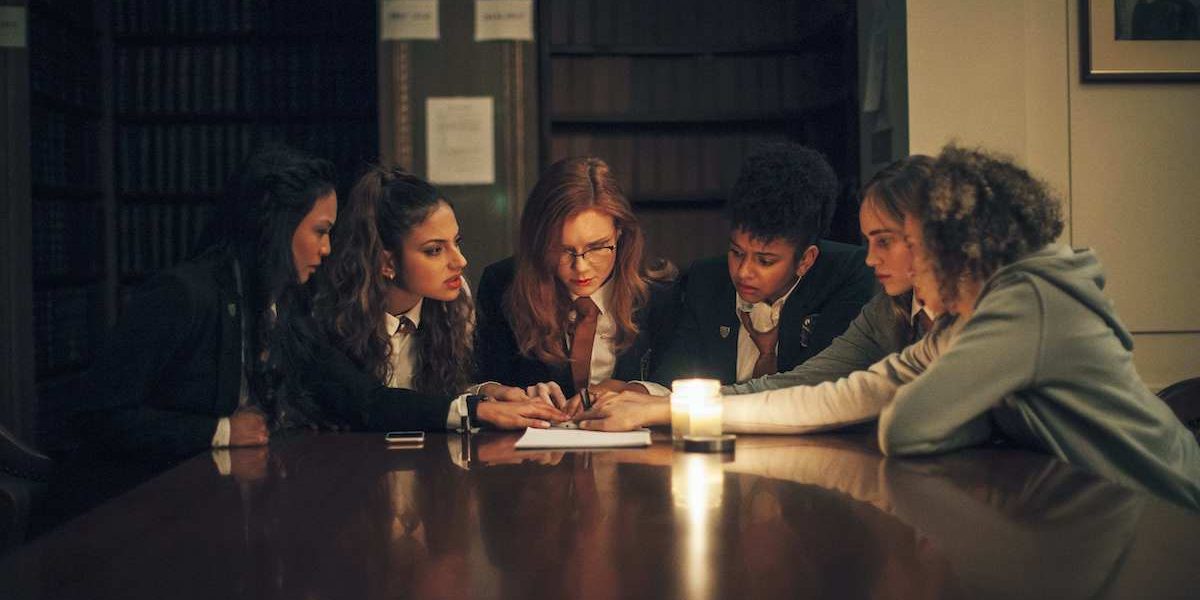
Off in the dusty old Edelvine boarding school, the girls are restless. They need something to pass the time, something to entertain them. They need a Séance.

Essentially, the mean girls gather in a dorm lav and Candyman the school’s ghost—saying her name 3 times at 3:13 am, the moment she died, in the very bathroom where it all happened.

Oooo, spooky!

Well, it’s all just a harmless prank until one of the girls winds up dead. Was it the ghost?

Fast forward a bit and Camille (Suki Waterhouse) arrives to fill the vacant room. More girls go missing or turn up dead in a film that cannot find a way to say anything new. Simon Barrett has written some good stuff: Blair Witch (2016), The Guest (2014), You’re Next (2011), Dead Birds (2004). He had not directed any features prior to Séance, but it’s hard to blame this film’s doldrums on its direction. The story just isn’t there.

Everything feels borrowed, not from any film in particular, but from the collective unconscious of dorm room horror that involves whispering ghosts, nubile schoolgirls, glinting blades and mystery. Barrett’s writing has tended to utilize tropes from the 80s and 90s to lull audiences into a sense of familiarity that allows him to deliver unexpected thrills.

His latest pulls most clearly from 90s staples like the Urban Legend franchise. But when he zigs instead of zags, the lull has turned stupor and Séance’s surprises just aren’t enough to snap us out of it.

Performances are fine, production values solid. There’s nothing embarrassing here, just nothing to get excited about. Some of the film’s sleights of hand are clever enough, but the storytelling is so anemic that it’s hard to applaud them. Barrett generates no dread and no sense of connection to any of the characters.

Unlike Guest’s Maika Monroe or You’re Next’s Sharni Vinson, who command the screen and drive the film, Waterhouse delivers a mainly listless performance. She’s neither scared nor curious, and though her bursts of ferocity feel cagey, it’s not enough to inject the film with any fire.

Hope Madden and George Wolf … get it?