Category Archives: Slider

For the homepage slider

Too Safe at Home

by George Wolf


Just this week, Major League Baseball announced the formation of a task force charged with finding ways to reverse the decline of African Americans in the sport.

Even if it wasn’t timed to coincide with the release of 42, that announcement would bring Jackie Robinson to mind.

The story of Robinson breaking baseball’s color barrier is heroic, inspiring, and uniquely American. So why did news of a movie version bring immediate fears of how that story could falter?

Well, precisely because of some of the aspects 42 incorporates into its brand of storytelling.

To be fair, writer/director Brian Helgeland’s film is solid in areas that will most likely move audiences to cheers and applause. Crowd-pleasing aside, though, Helgeland’s biography too often becomes hagiography, casting Robinson as a near-biblical figure in a way that ultimately does a disservice to his achievements.

Helgeland, though more experienced as a writer than director, displays a nice feel for the pacing of Robinson’s story and for the historical details of the era. Rather than crafting the film as a slow build to Robinson’s first game with the Brooklyn Dodgers in 1947, Helgeland takes the tale from Robinson’s days in the Negro Leagues through his first season in “white baseball” with a speed that is brisk but never hurried. Though clocking in at slightly over two hours, 42 never feels bloated.

For baseball geeks like me, the rosters are familiar, the stadiums look great and the on-field play is competent. On those fronts, which are indeed important in a film such as this, thumbs up all around.

But as good as much of it looks, there is little intimacy.  Chadwick Boseman is terrific as Jackie (looks like him, too) but isn’t given the room to explore anything beyond a one-dimensional saint.  Harrison Ford gives a solid, albeit sometimes scenery-chewing performance as Dodgers executive Branch Rickey, leading a supporting lineup that is stacked with talent. The Tenth Man Award must go to John C. McGinley. His dead-on turn as legendary announcer Red Barber provides a joyous reminder of baseball on the radio.

Reminders are fine, but if that’s all Helgeland was after, he needed to aim higher. We know Robinson is an American hero, but he was human.  We see some of the ugliness he faced (most likely a very small, watered-down sample), but we don’t feel his human struggle to the degree that we should.

This lack of depth is surprising, as Helgeland has penned complex, intelligent scripts before, such as Mystic River and L.A. Confidential. With 42, he is tentative, too afraid to stray from the Hollywood formula for fear of swinging and missing.

Ironic, and disappointing.

      Verdict-3-0-Stars


Help Me, I’ve Been Hyp-no-tized!

By George Wolf


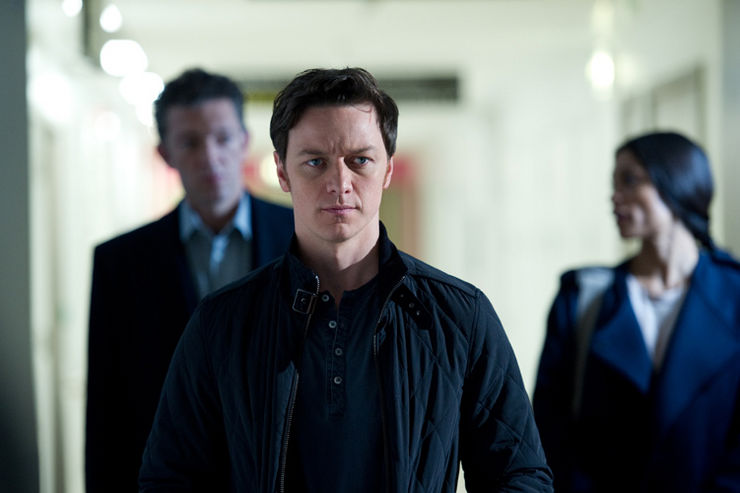
The head-trippy space so eloquently invaded by Christopher Nolan in films such as Memento and Inception seems to have caught the fancy of Oscar-winning director Danny Boyle (Slumdog Millionaire).  In Trance, Boyle gleefully plays with perception and reality as he unveils a mostly effective noir tale of the hunt for a stolen art masterpiece.

James McAvoy stars as Simon, an employee of an exclusive London auction house who opens the film by explaining his game plan for safeguarding art masterpieces during any heist attempts.  While Simon is narrating, we see a heist being organized, leading up to the moment when ringleader Franck (Vincent Cassel) and his thugs steal a prized work.

Simon owes Franck an old debt, but attempts to pay it off with the location of a lost painting are stalled by Simon’s claim of amnesia.  And so, the group understandably turns to…hypnosis.

Stay with me, because this is when things get freaky. Once Simon begins visiting hypnotherapist Elizabeth (Rosario Dawson), all lines begin to blur.

What is real, and what is a hypnotic suggestion? Who is plotting with whom, and is all that nudity and sex merely subconscious desire?

Boyle, in films such as Slumdog, 127 Hours, Trainspotting, 28 Days Later, and Shallow Grave, has shown that his choices regarding pacing and visual style are often masterful.  With Trance, Boyle seems energized by his new genre playground – so much so that the questionable leaps taken by the script are swept aside with little regard.

The core story was first hatched by current “Dr. Who” writer Joe Ahearne in a TV movie from 2001. Frequent Boyle collaborator John Hodge has expanded the screenplay to keep your head swimming with possibilities, as heroes turn into villains, past becomes present, and then back again.

The solid cast is anchored by Dawson, who reaches beyond anything we’ve seen from her so far with a layered, emotional performance in a role that makes frequent demands. She answers them all, and becomes the film’s center of gravity when too many elements threaten to spin out of control.

Trance is engaging and entertaining, but I’m guessing Boyle was after a bit more. Instead of leaving with a feeling of wonder as you spend days trying to get your head around it, you’re more likely to view Trance as clever, forgettable fun.

Verdict-3-5-Stars


Beyond the Pines Live Handsome Fathers and Sons

By Hope Madden

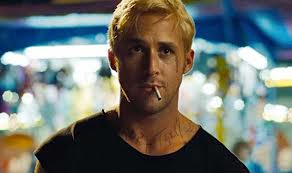
Sure, The Place Beyond the Pines is a bank robber movie starring three weirdly attractive A-listers (Ryan Gosling, Eva Mendes, Bradley Cooper). But this layered, complex film about men and the sins they pass on hopes to be a lot more than that.

What co-writer/director Derek Cianfrance (Blue Valentine) has crafted is a generational drama about fathers, sons and consequences.

The Place Beyond the Pines tells its story in three parts. Each part introduces us to a new, young male lead as he makes a life-altering decision. Their individual tales are aided immeasurably by great supporting turns from Mendes and Ben Mendelsohn (making a name for himself playing the guy our hero would be better off not knowing), but Cianfrance’s interest is in the young men – their choices, how they were affected by their fathers, and how they will affect their sons.

Act 1 follows Gosling’s stunt motorcyclist Luke as he tries to claim the family he didn’t know he had. We move to Cooper’s rookie cop in the second act, who walks the compromised line between justice and ambition. Act 3 brings us full circle.

Cianfrance’s lens casts a bittersweet small town spell, and his actors – an exceptional Gosling in particular – develop fully formed, flawed, compelling characters. The filmmaker’s smart script and patient camera give the talent the time and content they need to mine the depths of each character. Unfortunately, this borderline Greek tragedy just loses steam.

Whether Parts 2 and 3 feel like middling efforts because Gosling’s smolder is missing or because Cianfrance’s interest lies elsewhere is hard to tell. Taken on their own, the second and third acts amount to a solid family drama; compared with the livewire of Act 1, though, they let you down just a bit.

It feels like Cianfrance just bit off more than he could chew, but it’s hard to knock him for ambition. Pines veers as wildly as Handsome Luke’s motorcycle, and it doesn’t always find its way back. Cianfrance tries too hard, covers too much, but he does it with such passion and such cinematic skill that he can be forgiven.

Verdict-3-5-Stars


Kubrick Obsessed Invite You to Come Play with Them

by Hope Madden

As evidenced by the phenomenal attention to detail shown in The Simpsons Treehouse of Horror V, Stanley Kubrick’s magnificent film The Shining inspires close examination. Director Rodney Ascher assembled some of the most inspired – obsessed, even – for his documentary on the Kubrick ghost story, Room 237.

If you’re going to make a movie about Kubrick, it better look good, and this one does. Ascher never puts the commentators on screen, preferring instead to replay fascinating scenes from The Shining, or pad with genius cut-ins from other films – some Kubrick, some not. His endlessly fascinating clip choices keep his doc engaging, while appealing to the movie nerd in us all.

Off screen, we hear the thoughts of ABC News’s Bill Blakemore, Albion College historian Geoffrey Cocks, playwright/artist/author Juli Kearns, recording artist John Fell Ryan, and “authority on the hermetic and alchemical traditions” Jay Weidner. Each has his or her own theory to spin. For instance, 2+3+7=moon. And while these theories are all a bit wild, most carry just enough evidence to keep you intrigued.

It would be too simplistic to take Room 237 as a deconstruction of The Shining, and those hoping to uncover Kubrick’s deeper meaning may be disappointed.

But what the film does, it does well. It explores one of cinema’s most exquisite films, using it to encourage the spectator’s active participation in viewing. In doing so, it positions film as an art equal to literature or painting in terms of thematic dissection.

It also opens our eyes to the abject nuttiness of Kubrickian “scholars” – and a documentary always gets extra points if it introduces an audience to an entirely new concept, like that of the Kubrickian scholar.

More than anything, though, Room 237 is a documentation of obsession, and a fascinating one at that. It bares more insight into the act of obsessing than it does on Kubrick’s work itself, but it helps that these people spend all their time analyzing such a great movie. If they were this excited about tessellations or ringworm, well, the movie would have lacked that certain panache.

To be fair, Kubrick invites obsession. It’s hard to watch any of his films, The Shining in particular, without feeling submerged in images and symbolism just out of your reach. It’s the kind of richly textured experience ideal for a ghost story.

Or a film that confesses the creation of another film in which the moon landing was faked.

Unless it’s a film about the slaughter of the American Indians. And Jews.

Or a minotaur.

Verdict-3-5-Stars


For Your Queue: Who doesn’t love Bill Murray?

Another less than stellar week in DVD releases. The strongest contender this week is Hyde Park on Hudson.

A Bill Murray presidency would be gleefully weird, wouldn’t it? Maybe that’s why he landed the role of Franklin Roosevelt in the charming if scattered tale of King and Queen of England’s visit to FDR’s weekend home. When director Roger Mitchell’s film is hitting on all cylinders, it offers glimpses of bold yet delicate nuttiness. The film splits its focus, unfortunately. While the time spent on a love story with cousin Daisy (Laura Linney) grows tiresome, every moment spent with the president and his royal visitors is a gas.

http://www.youtube.com/watch?v=UQaScjiWDyY

One of the reasons Murray has become such a beloved figure is his willingness to break convention. Yes, it has led to some disappointments (Garfield, Passion Play), but it has given him a well-rounded film resume filled with overlooked performances worth seeking out. One of these is his fine supporting turn in 2009’s Get Low.  In 1930s Tennessee, a small-town hermit (Robert Duvall) decides to have his funeral before he dies, and thus recruits the local funeral director (Murray) to help him “get low.” Duvall is superb in the lead, and Murray crafts a unique character in his limited screen time.
http://www.youtube.com/watch?v=Gy265yfzlNg


Weekend Countdown: Top 5 “cabin in the woods” flicks

In honor of Evil Dead, we’re counting down our favorite “cabin in the woods” horror films that are not associated with that particular franchise.

5. Tucker & Dale Versus Evil (2010): This hilarious Shaun of the Dead-style send up of hillbilly horror entertains with every frame.

http://www.youtube.com/watch?v=RFFh25DmPNU

4. Resolution (2012): Self-aware, atmospheric and creepy, Resolution doesn’t rely on traditional slasher implements to get under your skin.

3. The Blair Witch Project (1999): There is, too, a cabin. At the very end, remember? After we lose Josh and Josh loses his tongue. Oh, you remember – Mike’s standing in the corner like a naughty child, and Heather…. poor, poor Heather…

http://www.youtube.com/watch?v=D51QgOHrCj0

2.  Antichrist (2009): “Nature is Satan’s church.” “Chaos reigns!” “Keep her away from the hand tools.” (No one said that last one, but man, somebody should have.)

http://www.youtube.com/watch?v=eBdDcQONmkM

1. The Cabin in the Woods (2011): Kind of a cross between Tucker & Dale and Resolution, this funny, wickedly clever, joyous deconstruction of horror tropes leaves you just giddy.

Like Visiting an Old, Very Very Bloody Friend

By George Wolf

Back in ’the early 80s, a low budget horror flick called The Evil Dead got an unexpected boost from legendary author Stephen King. His  public endorsement thrust the obscure title into the spotlight, and on its way to cult status among horror fans. Evil Dead 2 followed in ’87, and then Army of Darkness in ’92. While the series grew increasingly campy, the original story of a deserted cabin, stupid kids and a certain book of the dead remains iconic.

It gets new life with Evil Dead, and fans that have been chomping at the bit will not be let down. The camp is long gone, replaced by solid writing and surprisingly steady direction. Oh, and blood, lots and lots of blood.

Director/co-writer Fede Alvarez, in his feature debut, isn’t concerned with Stooge-worthy splatter . His reboot lovingly reworks Sam Raimi’s tale, eliminating nearly all the humor but absolutely none of the bloodletting. Did I mention it’s bloody?

The film puts more backstory and character development in the mix, but the core remains. We find two couples and one sister holed up in an old cabin, but this time David (Shiloh Fernandez, a bit weak), his girlfriend and his buddies are there to help his sister Mia (Jane Levy, from TVs Suburgatory, in a fantastically gritty performance) quit her drug habit.

Though it’s impossible to pick out the contributions of each of the screenwriters updating Raimi’s script, certain elements – like this back story – scream of Diablo Cody (Juno, Young Adult, Jennifer’s Body), as an ingenious concept gives the film potential subtext by way of an unreliable narrator. Is this reality, or is Mia just insane and detoxing?

Solid writing and Alvarez’s gleefully indulgent direction allow the film – not only a remake, but a remake of a film that tread the overworn path of “cabin in the woods horror” – to remain shockingly fresh.  This is thanks in part to a handful of inspired tweaks, a couple fine performances, and a fearless but never contemptuous eye for carnage.

From the super-creepy opening sequence, Alverez’s update announces its fondness for the source material and his joyous aspiration to stretch that tale to its fullest, nastiest potential. He also shows a real skill for putting nail guns, machetes, hammers, electric meat slicers, hypodermics, even your standard bathroom mirror to fascinating new uses. Bloody, bloody uses.

It’s a quick, intense ride, but don’t be in a rush to leave the theater. For fans of the series, there’s a little gift at the end of the credits.

Bloody good fun!

This image has an empty alt attribute; its file name is Verdict-4-0-Stars.png

For Your Queue: Soy Sauce and Bug Powder

Slim pickin’s in the new release category this week, but if you feel like getting really high, we have a couple of options for you.

John Dies at the End tells the mind-bent tale of a couple slacker vigilantes hunting the supernatural. Dave (Chase Williamson) tells viewers how the twosome came to “handle unusual problems,” and the story he spills comes together in shades of Cronenberg, Burroughs, and Phillip K. Dick, spun with the sensibilities of Sam Raimi circa Evil Dead. That, friends, is good company. And though director Don Coscarelli (best known for Phantasm, but personally beloved for Bubba Ho-Tep) can’t keep the trippy logic afloat for the whole running time, its “whatevs” style of clever remains surprisingly enjoyable.

As long as we’re breaking the time-space continuum, let’s hit 1991 and the David Cronenberg film so frequently referenced in John Dies: Naked Lunch. Bill Lee’s a kind of an investigator, a writer, and, of course, an exterminator. Warped, beautiful and repellant, Cronenberg’s take on the William S. Burroughs classic is a SciFi adventure into Interzone where sex, writer’s block, addiction, guilt, transformation, and bug powder mesh gloriously.

http://www.youtube.com/watch?v=LxYxiVfNk6M

http://www.youtube.com/watch?v=dtflS5wCbjw

Needs More G.I. Joementum


by George Wolf


At the risk of sounding too much like Grandpa Simpson…In my day G.I. Joe had Kung Fu grip and that was all and we liked it!

Before G.I. Joe:  Retaliation started to roll, Hope asked me if I knew any of the characters besides good old Joe. Since the long ago days when I played with the action figures, it seems there was a cartoon and one previous movie. Though I was vaguely  aware of 2009’s The Rise of Cobra, I have to admit I didn’t know Cobra Commander from Cobra Kai. Sweep the leg!

The point is, this G.I. Joe sequel is ridiculously bad, only redeemed by one sweet mountainside action sequence and the curious moments where it seems to know how bad it is and lets some self-aware humor sneak in.

If lines such as “Soon the world will bow down to Zues,” and “Storm Shadow, tell us Zartan’s plans or die!” sound more suited for Saturday-morning fare, A) you’re correct and B) you’ll be disappointed to learn this dreck was written by Rhett Reese and Paul Wernick. These guys wrote the sublime Zombieland, and knowing that hurts my heart.

Director Jon M. Chu brings a resume loaded with the Step Up movies and a Justin Beiber concert film, which makes perfect sense. Retaliation sports the volume, pace, and emotional depth of a frenetic music video.

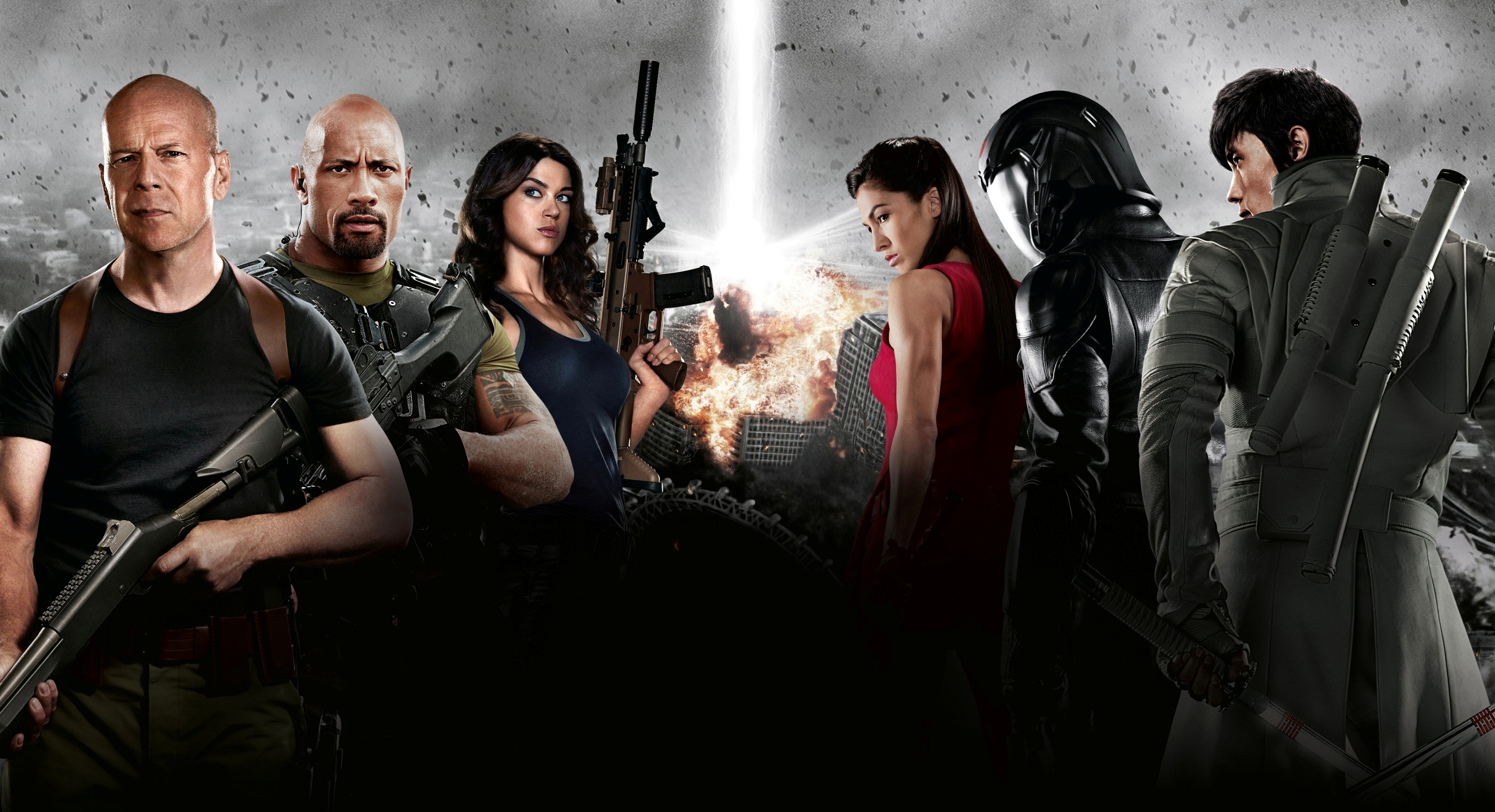
Oh, there’s Dwayne Johnson and Bruce Willis, finally deciding to team up since they’re in every other movie anyway. Johnson flexes well and makes sure the Under Armour logo gets screentime, while Willis lands some good one liners, especially when he insists on calling the female Joe “Brenda” even though her name is Jaye. And ladies, you get Channing Tatum (with a fake facial scar – rugged!) for a full 9 or 10 minutes!

Most of Retaliation truly seems aimed at kids, with just enough silly narrative and sophomoric exposition to keep things moving from one scene of extreme bloodless violence to the next. Then, just to throw the adults a funny bone, a joke about taxes or North Korea comes flying in from left field.

The biggest joke, though, was on me, as I actually stayed through the credits thinking there might be an extra scene.

2 stars (out of 5)

http://www.youtube.com/watch?v=bSX2oxLdcWA

For Your Queue: Mumblecore Madness

If you’re a fan of the “mumblecore” then A) we’ll just call you “Mumble Cory” and B) a film you might have missed in its limited run is now on DVD, and we’ll pair it with one of the best of the mumblecore genre.

The Comedy is a character study about a character you will instantly hate. Swanson (terrifically played by Tim & Eric’s Tim Heidecker) is a trust-fund brat who spends his days drinking, boating, and embracing every chance to be offensive. Make it past the halfway point, and the ironically-titled film becomes strangely hypnotic.

Director/co-writer Rick Alverson is after a sort of subversive honesty, perhaps even grasping for answers to the types of questions raised whenever another white male goes on a shooting spree.

Hanging out with a guy like Swanson for 90 minutes isn’t easy, but you might be glad you made the effort.

If you’re looking for something slightly more accessible, Cyrus (2010) might the film for you. Still clearly a mumblecore flick (written and directed by the auteurs of the style, Mark and Jay Duplass), the film still follows a relatively well-established story arc and stars actors who actually act. John C. Reilly wants to date Marisa Tomei (who doesn’t?), but her relationship with her adult son (Jonah Hill, in a triumphant performance) is beyond complicated. One profoundly uncomfortable comedy follows.